How To Answer "Sell Me This Pen" in a 2026 Sales Interview
The pen is not the point. Here is the exact 5-step framework hiring managers score you on, three full scripts, and the answers that quietly get you rejected.
TL;DR
- "Sell me this pen" is not a product test. It is a discovery test. The interviewer is scoring whether you ask questions before you talk features.
- The winning structure is five moves: qualify, dig for pain, tie value to pain, close, handle the objection. Roughly 70% of your talk time should be questions.
- Never open with "This pen has a smooth ballpoint tip and premium grip." That is the single most common rejection trigger.
- Three scripts below — the classic discovery answer, the reframe answer, and the scarcity answer — with notes on which interviewer type each one lands with.
- The same muscle you use here is the one you use on real pipeline: qualify before you pitch. Bad-fit prospects and unverified contact data waste the same hour.
Why do interviewers still ask "sell me this pen"?#
Because it is cheap to run and brutally revealing. In under three minutes, a hiring manager learns whether you default to feature-dumping or to diagnosis. Those are two different salespeople, and only one of them hits quota in a competitive market.
The question got famous through The Wolf of Wall Street, but it predates the film by decades and shows up in interviews at everything from SDR roles at seed-stage startups to enterprise AE seats. The object changes — a pen, a coffee mug, a stapler, the interviewer's phone — the scoring rubric does not.
What they are actually measuring:
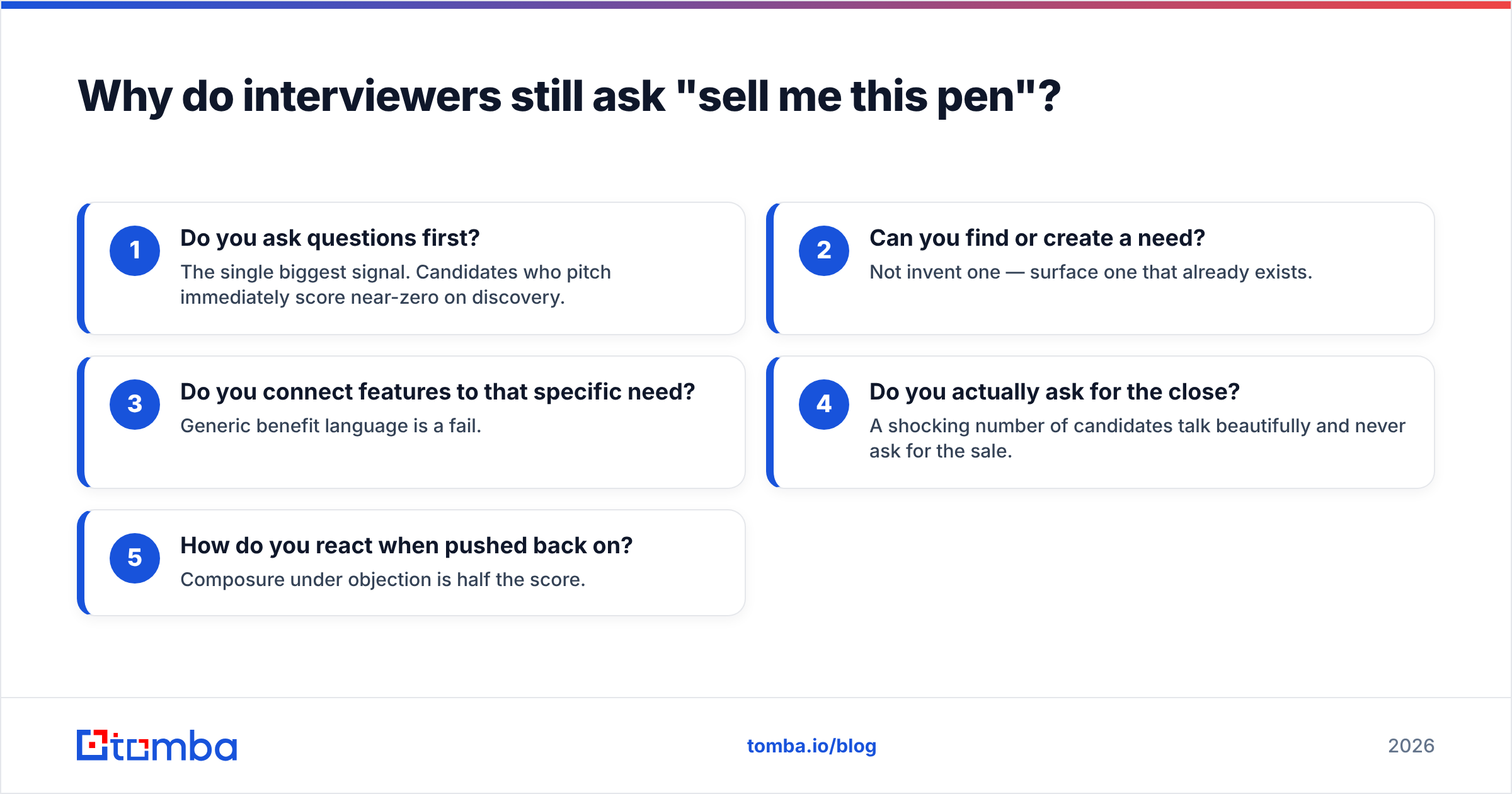
- Do you ask questions first? The single biggest signal. Candidates who pitch immediately score near-zero on discovery.
- Can you find or create a need? Not invent one — surface one that already exists.
- Do you connect features to that specific need? Generic benefit language is a fail.
- Do you actually ask for the close? A shocking number of candidates talk beautifully and never ask for the sale.
- How do you react when pushed back on? Composure under objection is half the score.
If you want the underlying theory, HubSpot's sales blog has extensive material on consultative selling, and the pattern here is straight out of that playbook: diagnose, then prescribe.
What is the 5-step framework for answering it?#
Here is the structure that scores well with almost every interviewer. Memorize the shape, not the words — recited answers sound recited.
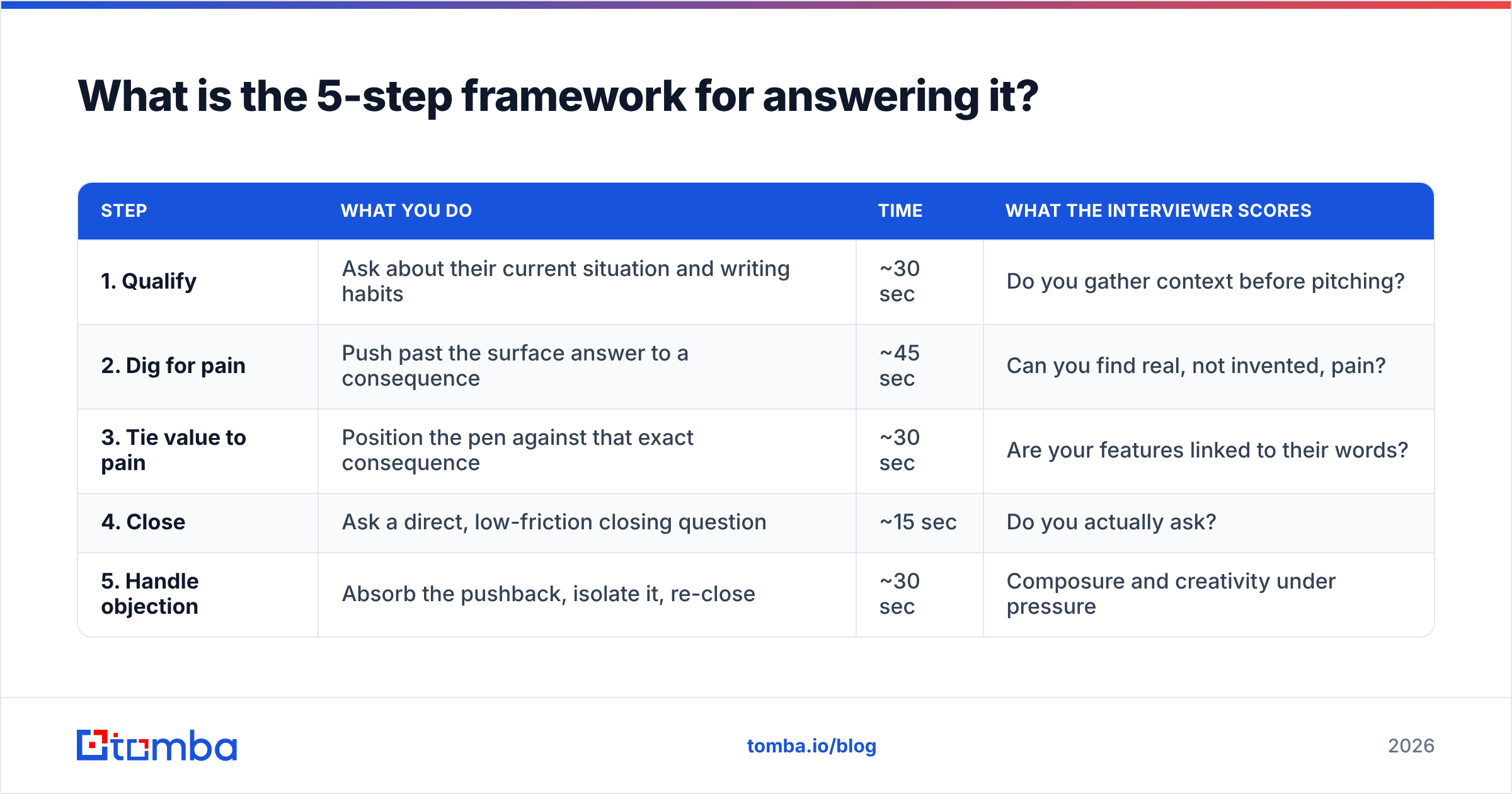
| Step | What you do | Time | What the interviewer scores |
|---|---|---|---|
| 1. Qualify | Ask about their current situation and writing habits | ~30 sec | Do you gather context before pitching? |
| 2. Dig for pain | Push past the surface answer to a consequence | ~45 sec | Can you find real, not invented, pain? |
| 3. Tie value to pain | Position the pen against that exact consequence | ~30 sec | Are your features linked to their words? |
| 4. Close | Ask a direct, low-friction closing question | ~15 sec | Do you actually ask? |
| 5. Handle objection | Absorb the pushback, isolate it, re-close | ~30 sec | Composure and creativity under pressure |
Notice the ratio. Steps 1 and 2 take more than half the clock. That is deliberate. The pitch is the shortest part of a good answer.
The five questions that carry most of the weight:
- "When was the last time you needed to write something down?" — establishes whether a need exists at all.
- "What were you writing, and what happened next?" — moves from activity to stakes.
- "What did you use? How did that go?" — surfaces the incumbent solution and its friction.
- "How often does that happen in a week?" — quantifies frequency, which quantifies pain.
- "If you had a pen you never had to think about, what would that be worth to you?" — pre-frames the close.
That last one is the hinge. It gets the interviewer to price the value themselves, which makes your close feel like their idea.
What does a strong answer actually sound like?#
Here is a full script, annotated. Read it out loud once — the rhythm matters more than the vocabulary.
You: Before I pitch you anything, can I ask — when was the last time you wrote something by hand?
Them: This morning, I signed a contract.
You: Got it. Does that happen often — signing physical documents?
Them: A few times a week, yeah.
You: And when you go to sign, do you always have a pen on you, or are you borrowing one from whoever's nearby?
Them: Honestly, I usually borrow one.
You: So a few times a week you're pausing a signing moment — probably with a client or a candidate sitting across from you — to go find a pen. What does that moment feel like?
Them: A little unprofessional, I guess.
You: That's the part I'd fix. This isn't about ink. It's about never having that pause again in front of someone you're trying to close. It's a reliable pen that lives in your jacket pocket, writes first time every time, and costs less than one lunch. If it removes that pause even twice a week, it pays for itself in the first month. Want me to put one in your pocket right now?
Them: I already have three pens in my drawer.
You: Perfect — then you already agree a pen is worth owning. The problem isn't ownership, it's location. The three in your drawer weren't with you this morning. This one goes in the jacket you actually wear. Should we start with one, or do you want a spare for the car?
That answer takes about ninety seconds and it hits all five scoring criteria. Note that the candidate never says "premium," "high-quality," or "smooth-writing." Not once.
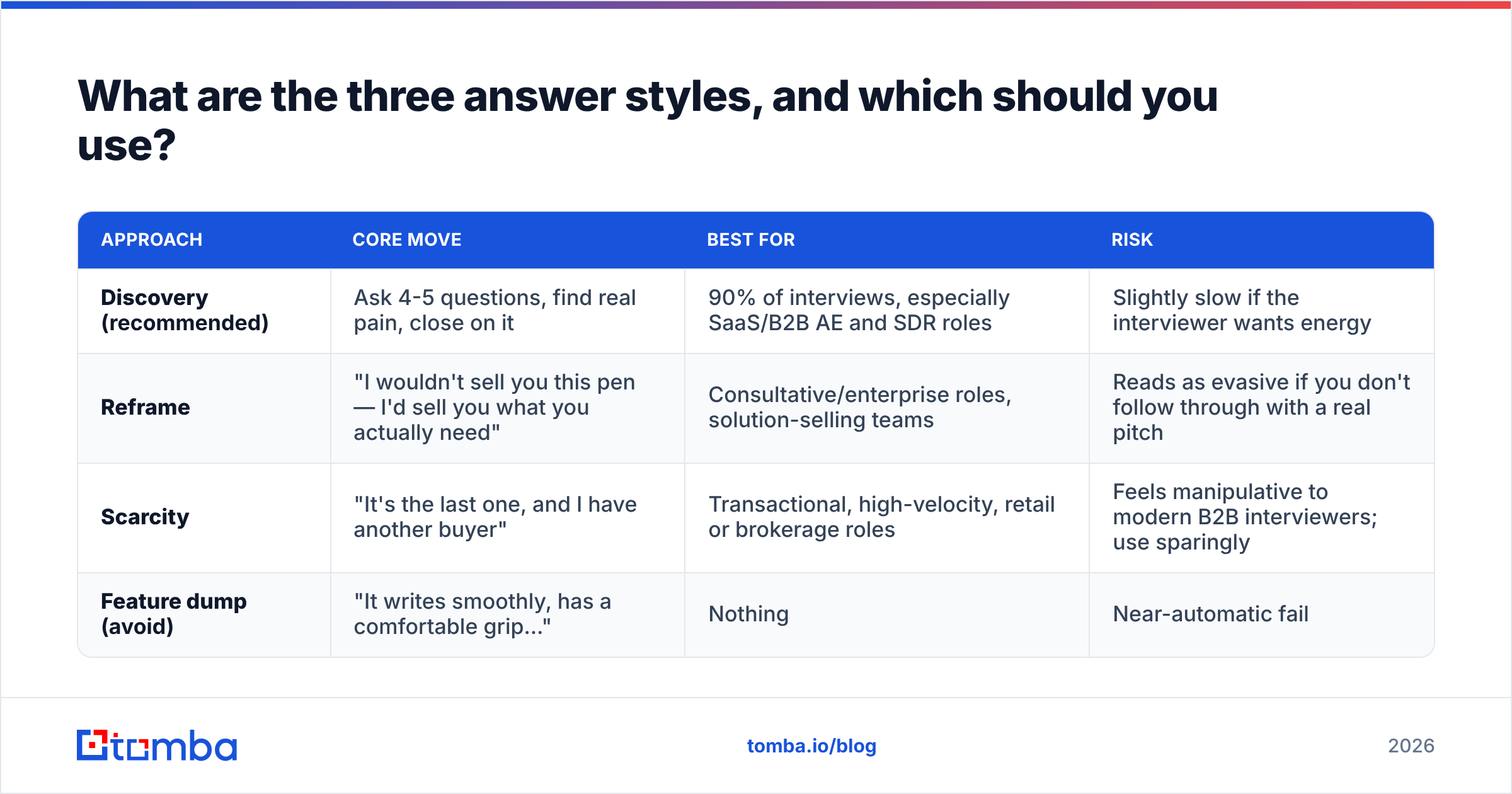
What are the three answer styles, and which should you use?#
There is no single correct answer — there are three defensible approaches, and picking the right one for your interviewer is itself a test.
| Approach | Core move | Best for | Risk |
|---|---|---|---|
| Discovery (recommended) | Ask 4-5 questions, find real pain, close on it | 90% of interviews, especially SaaS/B2B AE and SDR roles | Slightly slow if the interviewer wants energy |
| Reframe | "I wouldn't sell you this pen — I'd sell you what you actually need" | Consultative/enterprise roles, solution-selling teams | Reads as evasive if you don't follow through with a real pitch |
| Scarcity | "It's the last one, and I have another buyer" | Transactional, high-velocity, retail or brokerage roles | Feels manipulative to modern B2B interviewers; use sparingly |
| Feature dump (avoid) | "It writes smoothly, has a comfortable grip…" | Nothing | Near-automatic fail |
The reframe answer, in short: "I'm not going to sell you the pen until I know you need a pen. If it turns out you sign contracts three times a week and borrow one every time, I'll sell you the pen. If it turns out you sign everything in DocuSign, I'd be wasting your money and my credibility. So — which is it?" That answer wins strong marks at companies that pride themselves on consultative selling, and it dies at a transactional brokerage that wants to see hunger.
The scarcity answer is the Wolf of Wall Street answer — create urgency, force the moment. It still works in some rooms. It works badly in most B2B rooms in 2026, where buyers are trained to spot manufactured urgency instantly. Use it only if the interviewer's own company sells that way.
What answers get candidates rejected?#
The failure modes are consistent and easy to avoid once you can name them.
- Leading with features. "This pen has a tungsten carbide ballpoint and an ergonomic rubberized grip." You have told the interviewer you sell to people, not with them.
- Inventing pain the interviewer never expressed. "You probably struggle with pens running out mid-meeting." They didn't say that. You just put words in a prospect's mouth, which is exactly what you'd do on a real call.
- Never asking for the close. Beautiful discovery, warm rapport, and then… you stop. Roughly a third of candidates do this.
- Getting defensive at the objection. The pushback is part of the test. "I already have a pen" is a gift, not a wall.
- Making it a joke. "I'd throw it out the window and sell you a new one." It gets a laugh, then it gets a no.
- Talking for two minutes straight. If your answer contains no question marks, you have failed the exercise regardless of how polished the prose was.

How does this map to real sales work?#
The pen exercise is a compressed model of a real deal cycle, which is exactly why interviewers trust it. Every step has a field equivalent:
- Qualify → account research and ICP fit before the first touch
- Dig for pain → discovery call, MEDDIC/SPICED-style questioning
- Tie value to pain → tailored demo, not the standard deck
- Close → clear next-step ask with a date attached
- Handle objection → objection handling and multithreading
The most common real-world version of the feature-dump failure is the untargeted outbound sequence: 800 contacts, one generic pitch, no qualification, and a reply rate that rounds to zero. Same mistake, larger blast radius. Improving your response rate starts with the same discipline the pen question tests — know who you're talking to before you talk.
It also matters that the list itself is real. Discovery is worthless if half your contacts bounce. Running a list through an email verifier before a campaign is the outbound version of qualifying before you pitch: cheap upfront, expensive to skip. And when you need to build the list in the first place, domain search pulls the actual decision-makers at a target company rather than a generic info@ inbox.
For a broader view of how buyers evaluate sales tooling and process maturity, G2's sales software category is a useful, vendor-neutral read.
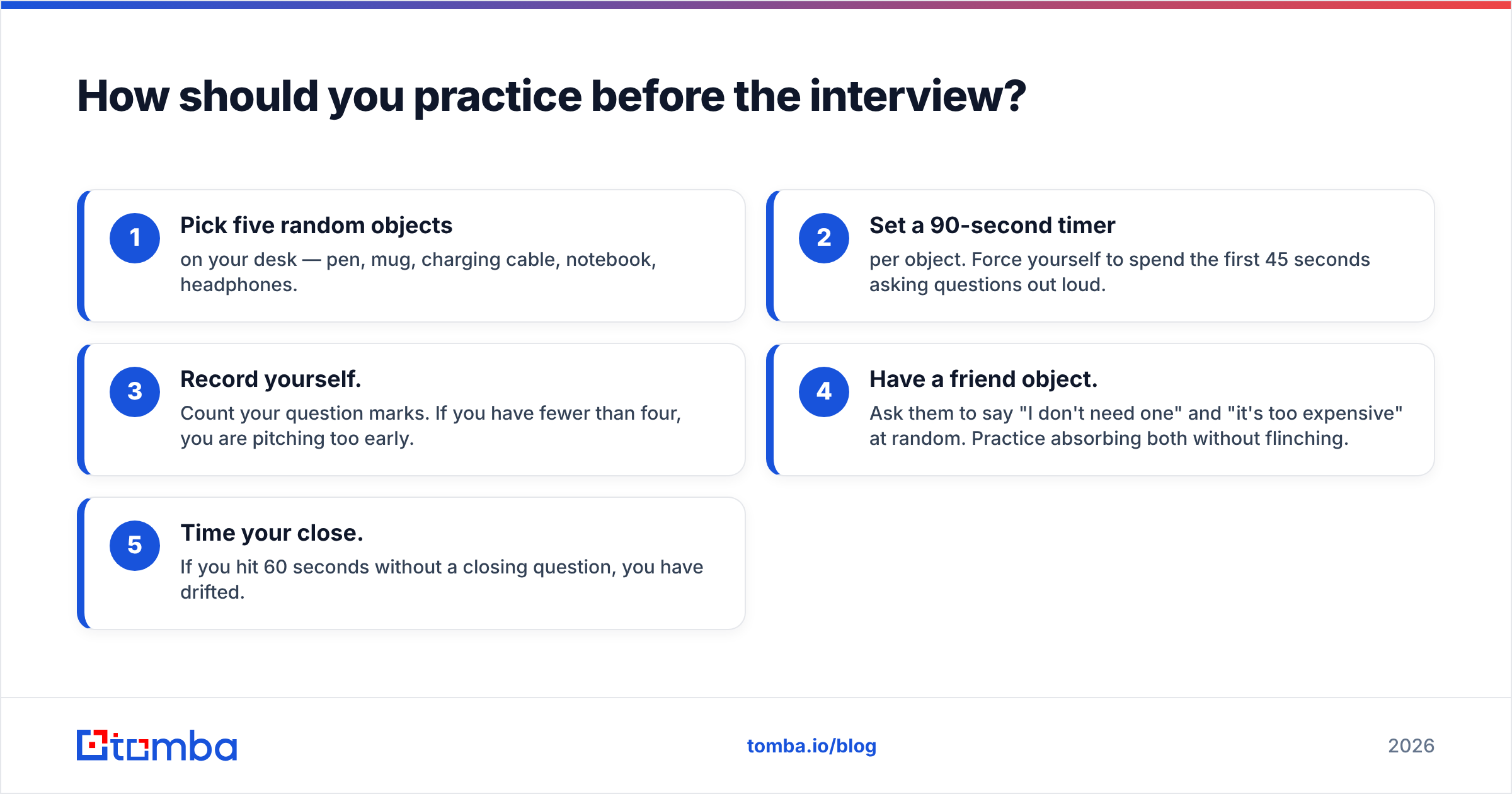
How should you practice before the interview?#
Do not memorize a script. Interviewers have heard the polished ones and they can tell. Practice the sequence instead.
A 20-minute drill:
- Pick five random objects on your desk — pen, mug, charging cable, notebook, headphones.
- Set a 90-second timer per object. Force yourself to spend the first 45 seconds asking questions out loud.
- Record yourself. Count your question marks. If you have fewer than four, you are pitching too early.
- Have a friend object. Ask them to say "I don't need one" and "it's too expensive" at random. Practice absorbing both without flinching.
- Time your close. If you hit 60 seconds without a closing question, you have drifted.
Two extra prep notes. First, research the interviewer's company sales motion before you walk in. A PLG SaaS company and a commercial insurance brokerage want visibly different answers to the same question. Second, prepare one follow-up question for them: "Out of curiosity, how does your team run discovery here?" It turns the exercise into a conversation and signals you think about process, not just performance.
If you want to see how a modern outbound stack actually assembles a target list — the practical version of "qualify before you pitch" — the breakdown of where Tomba gets data is a reasonable starting point on source quality and freshness.
What if the interviewer changes the object?#
They will, sometimes. "Sell me this stapler." "Sell me this bottle of water." "Sell me this chair." The framework does not change at all, and that is the point of learning the shape instead of the script.
Two adjustments help:
- For a genuinely useless object ("sell me this paperclip"), lean harder on the reframe. "Before I do — what would you actually pay money to solve today?" Turning a trick question into real discovery is a strong move.
- For an object the interviewer clearly owns and likes ("sell me my own phone"), pivot to upgrade or replacement framing. "You already bought into the category. What's the one thing about it that still annoys you?"
The interviewer is testing adaptability at that point, not product knowledge. Stay in the sequence, keep asking questions, and close.
The bottom line#
The candidates who win this question do one thing differently: they treat the pen as a symptom, not a subject. They spend more time asking than talking, they price the value in the interviewer's own words, and they ask for the sale out loud.
That instinct — qualify before you pitch — is the same one that separates outbound campaigns that book meetings from ones that get marked as spam. If you're heading into a sales interview, drill the framework above. If you're already in seat and building the pipeline you'll be judged on, start with contacts worth pitching: Tomba Email Finder locates verified professional emails by name, domain, or company, with a free tier at 25 searches a month and paid plans starting at $49/mo. Qualify the list first. Then earn the close.
Related guides#
Ready to find emails that actually work?
Join 150,000+ professionals who stopped guessing and started sending. Free credits on signup — no credit card required.
Get the Tomba newsletter
Practical outbound tactics and product updates — once every two weeks.
About the author