How to Apply AIDA Model Steps in B2B Cold Email (2026 Guide)
AIDA is 120 years old and still outperforms most cold email frameworks — but only if you map each stage to a real buying signal. Here is the step-by-step build, with templates and a framework comparison.
Here is how to apply AIDA model steps to a cold email: four sentences, one per stage. One Attention line, one relevance proof, one outcome with a number, one small ask. This guide walks through each step, the mistakes that kill reply rates, and when another framework beats AIDA.
TL;DR
- AIDA is a four-stage sequence — Attention, Interest, Desire, Action — and in cold email each stage maps to a specific line, not a paragraph.
- The stage most teams botch is Desire. They describe the product instead of describing the buyer's after-state, and reply rates collapse.
- AIDA beats PAS and BAB when your prospect does not yet feel the pain; PAS wins when they already do.
- Apply it in four steps: one specific Attention line, one relevance proof, one outcome with a number, one low-friction ask.
- None of it matters if the email bounces. Verified contact data comes before copy frameworks.
What is the AIDA model, exactly?#
AIDA is a persuasion sequence that moves a reader through four mental states in order: Attention, Interest, Desire, Action. Ad executive Elias St. Elmo Lewis sketched it out around 1898 for print advertising. It survived 120 years of media change because it describes how attention decays, not how any one channel works. You can read the full history on Wikipedia if you want the academic version.
Here is the everyday analogy. AIDA is a conversation at a conference. You say the prospect's name and something true about their company (Attention). They turn toward you instead of scanning the room (Interest). You describe a result they want badly enough to rearrange their calendar for (Desire). You ask for fifteen minutes on Thursday (Action). Skip a stage and the conversation dies — you cannot ask for Thursday before they have turned toward you.
Technically, each stage is a filter with its own drop-off rate. In a cold email, roughly 60-80% of your audience is eliminated at Attention (subject line and first line, read in the inbox preview). Of the survivors, maybe half continue past Interest. Desire and Action fight over what remains. Compounding filters are why a "good" cold campaign converts 3-8% to replies, not 30%.
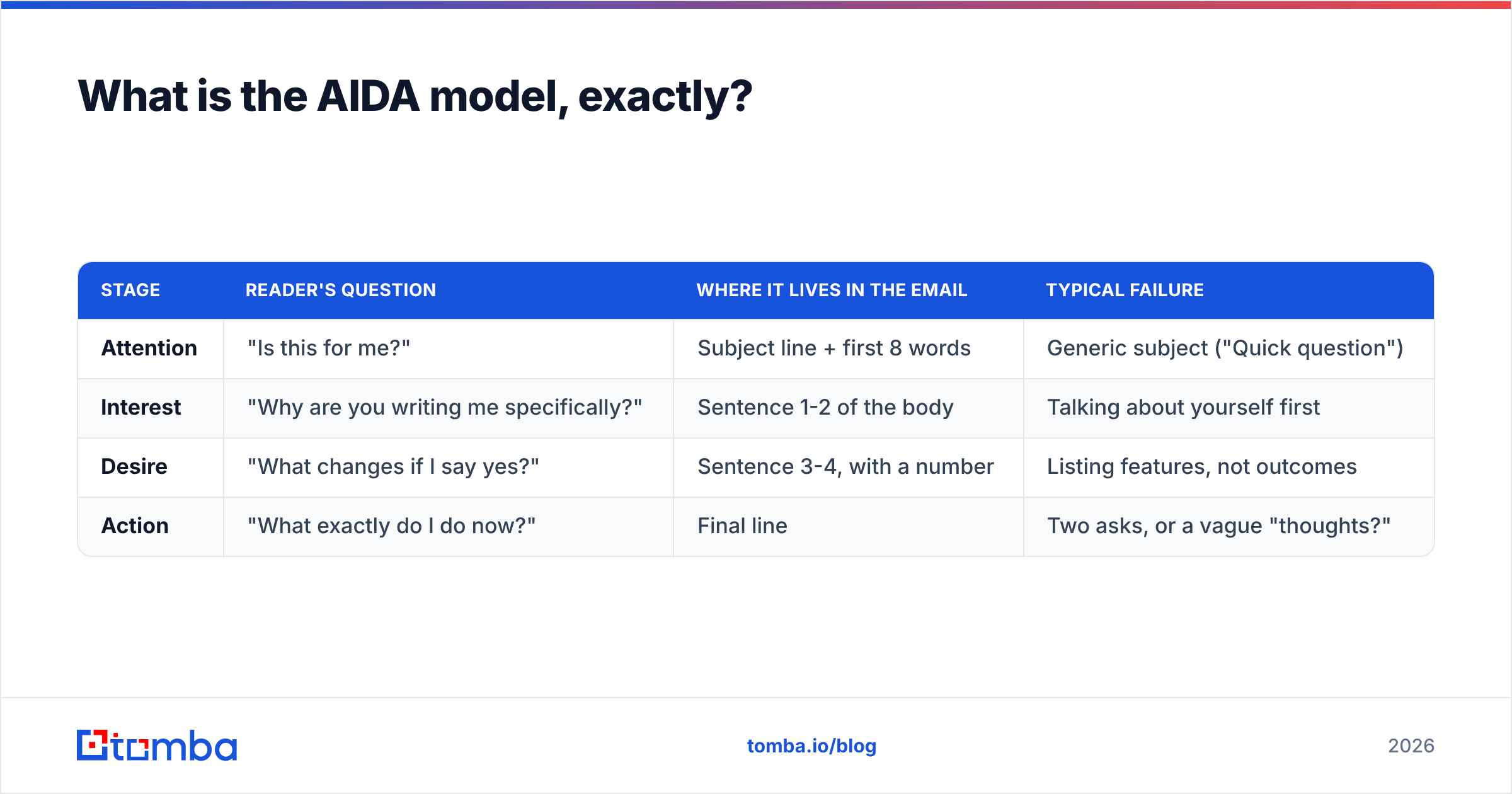
| Stage | Reader's question | Where it lives in the email | Typical failure |
|---|---|---|---|
| Attention | "Is this for me?" | Subject line + first 8 words | Generic subject ("Quick question") |
| Interest | "Why are you writing me specifically?" | Sentence 1-2 of the body | Talking about yourself first |
| Desire | "What changes if I say yes?" | Sentence 3-4, with a number | Listing features, not outcomes |
| Action | "What exactly do I do now?" | Final line | Two asks, or a vague "thoughts?" |
Why does AIDA still work in 2026 when inboxes are hostile?#
Because the problem AIDA solves got worse, not better. Attention is scarce, and readers commit one small step at a time. The average B2B buyer now gets more automated outreach than ever. AI-generated copy has made the median cold email blander. In a noisy inbox, a framework that makes you earn each next second is worth more, not less.
What has changed is the budget per stage. In 1898, an ad had a full page. In 2026, you have a subject line, a preview snippet, and about 90 words before a mobile reader scrolls away. So AIDA in modern outbound is not four paragraphs. It is four sentences.
The second change is that Attention now depends on infrastructure, not just wording. If your domain has a bad sender reputation, your brilliant Attention line lands in spam and the other three stages never run. Treat deliverability as stage zero.
How to apply AIDA model steps in a cold email?#
Four steps. Write them in order, then cut 30% of the words.
Attention — earn the open with specificity, not cleverness. Your subject line should name something only a person who studied their company would know. "Your Series B hiring plan" beats "Quick question" every time. Keep it under 45 characters so it survives mobile truncation, use sentence case, and never use a bracketed tag like [URGENT]. If you need volume ideas, run a batch through a subject line generator and then rewrite the winners by hand — generated lines are starting points, not finished copy.
Interest — prove relevance in one sentence. This is where you answer "why me, why now." Cite a trigger: a funding round, a job posting, a new integration on their site, a conference talk. The structure is observation → implication. "You posted three SDR roles in Austin last month — that usually means the outbound motion is about to double in volume." No product mention yet. You are proving you did homework, which buys you the next four seconds.
Desire — describe the after-state with a number. The most common mistake in B2B cold email is describing what your product is instead of what the prospect's Tuesday looks like after they buy. Wrong: "Our platform offers email verification with 99% accuracy." Right: "One customer cut bounce rate from 11% to under 2% in six weeks, which pulled their domain off two blocklists." Use a real customer, a real number, and a comparable company size. Vague superlatives read as noise.
Action — one ask, low friction, explicitly small. Ask for exactly one thing and make the cost of yes obvious. "Worth a 12-minute call Thursday or Friday?" outperforms "Let me know if you'd like to learn more" because it names a duration and offers a binary choice. Never stack two asks. Never end with "thoughts?" — it transfers the cognitive work to the reader.
A worked example, 78 words:
Subject: three SDR roles in Austin
Sana — you posted three SDR openings in Austin last month, which usually means outbound volume roughly doubles by Q2.
When that happened at Vero, their bounce rate went from 9% to 1.8% after they moved list-building off scraped exports. Two blocklist removals followed.
Worth 12 minutes Thursday to compare how your list is built today?
Notice the ratio: one line per stage, no logo drop, no "hope this finds you well," no calendar link buried in a signature.
Is AIDA better than PAS, BAB, or the 4Ps?#
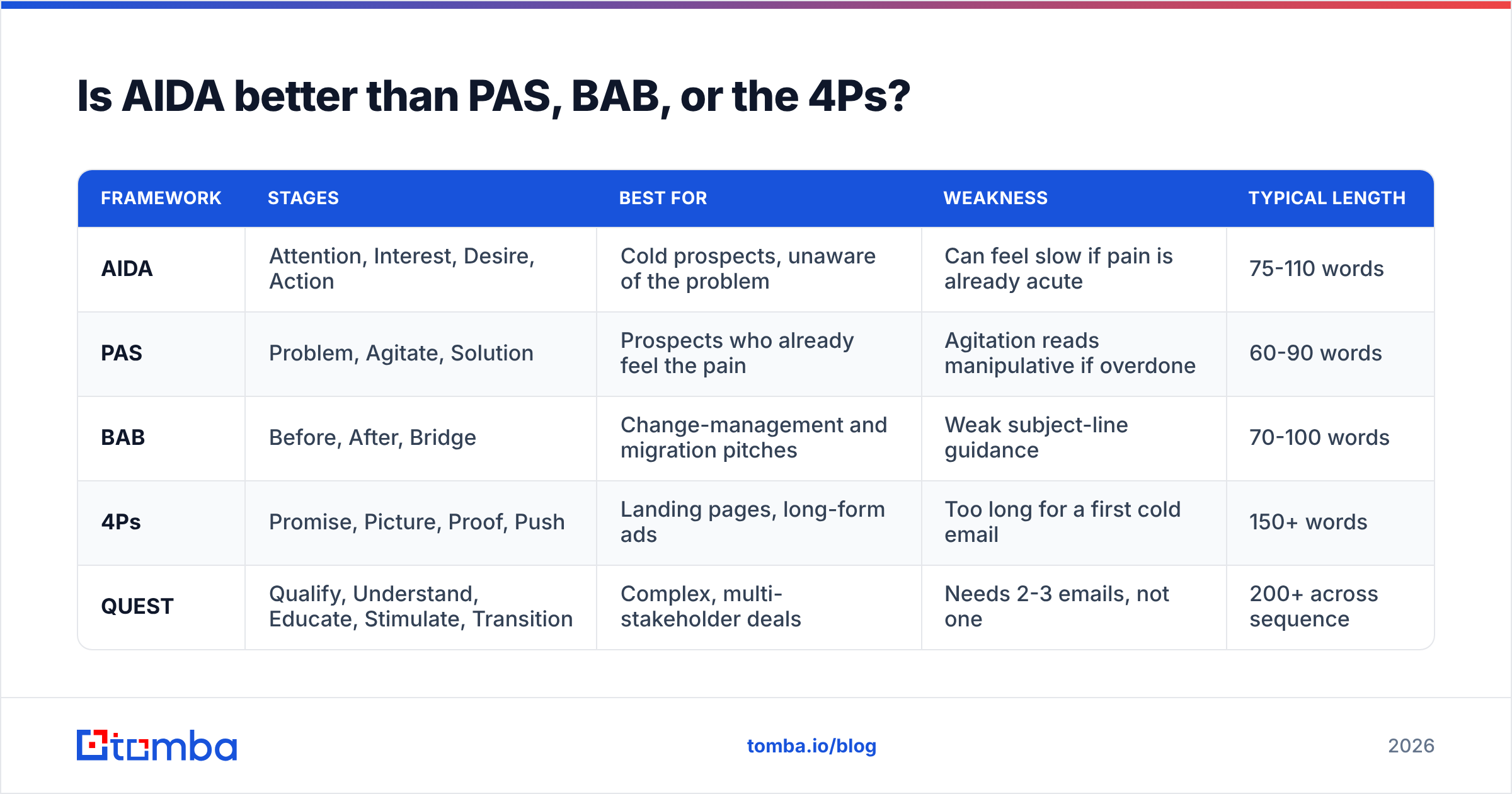
Not universally. Pick the framework based on how aware your prospect already is of the problem — the classic Eugene Schwartz awareness spectrum. AIDA is the right default for cold audiences who have not named their pain yet. PAS is stronger when they have.
| Framework | Stages | Best for | Weakness | Typical length |
|---|---|---|---|---|
| AIDA | Attention, Interest, Desire, Action | Cold prospects, unaware of the problem | Can feel slow if pain is already acute | 75-110 words |
| PAS | Problem, Agitate, Solution | Prospects who already feel the pain | Agitation reads manipulative if overdone | 60-90 words |
| BAB | Before, After, Bridge | Change-management and migration pitches | Weak subject-line guidance | 70-100 words |
| 4Ps | Promise, Picture, Proof, Push | Landing pages, long-form ads | Too long for a first cold email | 150+ words |
| QUEST | Qualify, Understand, Educate, Stimulate, Transition | Complex, multi-stakeholder deals | Needs 2-3 emails, not one | 200+ across sequence |
The practical rule: if you cannot state the prospect's pain in their own words, use AIDA — it lets you introduce the pain gently through Interest. If you can quote their pain from a G2 review, a support forum, or a job description, use PAS and hit it directly. G2's software review corpus is an underrated source of literal customer complaint language for exactly this.
For a sequence, mix them. Email one AIDA, email two PAS with a different angle, email three a one-line BAB with a case study link. Repeating the same framework four times makes the sequence feel like one long email the prospect already ignored.
What are the most common AIDA mistakes in cold email?#
Each mistake below is a broken stage. Learning how to apply AIDA model steps well is mostly learning to spot these four.
Stacking all four stages into the subject line. Some reps try to compress the whole pitch into the subject to "save the reader time." The subject line has one job: earn the open. Nothing else.
Writing Desire from the seller's chair. Feature lists are Desire failures. Run this test on every Desire sentence: does it describe something that changes in the prospect's week? If the sentence still makes sense with your competitor's name swapped in, it is not Desire — it is a category description.
Making Action expensive. A 30-minute demo, a form, and a "reply with your availability" in the same email is three asks. Pick the cheapest one that still moves the deal.
Assuming AIDA fixes a data problem. This is the big one. If 20% of your list bounces, your Attention stage is being judged by a spam filter before a human ever sees it. Every bounce degrades the domain that carries your next 500 emails. Clean the list with an email verifier before you obsess over word choice — a 2% bounce rate and mediocre copy will outperform 15% bounces and brilliant copy.
Ignoring the follow-up's own AIDA. Follow-ups need their own Attention line. "Bumping this to the top of your inbox" is not one. Give each follow-up a fresh angle: a new trigger, a different customer story, a shorter ask.
How do you build the list AIDA runs on?#
AIDA is the last mile. The first mile is knowing who to write to and having a deliverable address for them. A perfect Interest line addressed to a contact who left the company eight months ago converts at zero.
Start with the list itself:
- Define the trigger before the list. Decide what observable event makes someone worth writing to — hiring, funding, tech-stack change, a new office. The trigger becomes your Interest sentence, so choosing it first keeps the copy honest.
- Find contacts by company, not by scraping exports. A domain search pulls the people at a target account along with their role, so you can target the buyer rather than whoever happened to appear in a list you bought.
- Verify before send, not after bounce. Run the whole list through verification and drop the risky ones. Catch-all domains need their own handling — a catch-all verifier tells you whether a catch-all address is genuinely reachable rather than just accepted by a permissive server.
Then make the copy specific enough to earn a reply:
- Enrich for the Interest line. Job title, headcount, funding stage, and tech stack are what make Interest specific. Data enrichment fills those fields so the writer is not guessing.
- Warm the domain before volume. Ramp sends gradually and watch your complaint rate. HubSpot's research on email marketing benchmarks is a reasonable sanity check for normal open and reply rates by industry, before you conclude your copy is broken.
- Segment so the Desire line stays true. One Desire sentence cannot be accurate for a 20-person startup and a 5,000-person enterprise. Split the list and rewrite the number for each segment.
If you are choosing tooling for this stage, the honest comparison is between broad all-in-one platforms and focused finders. Broad platforms like Apollo bundle sequencing and a database; specialists like BookYourData sell curated, pay-as-you-go B2B lists with strong coverage in specific verticals; Tomba sits on the finding-and-verifying side with an API-first approach. Pick based on whether your bottleneck is data quality or workflow consolidation — they are different problems and buying the wrong one is expensive.
How do you measure whether AIDA is working?#
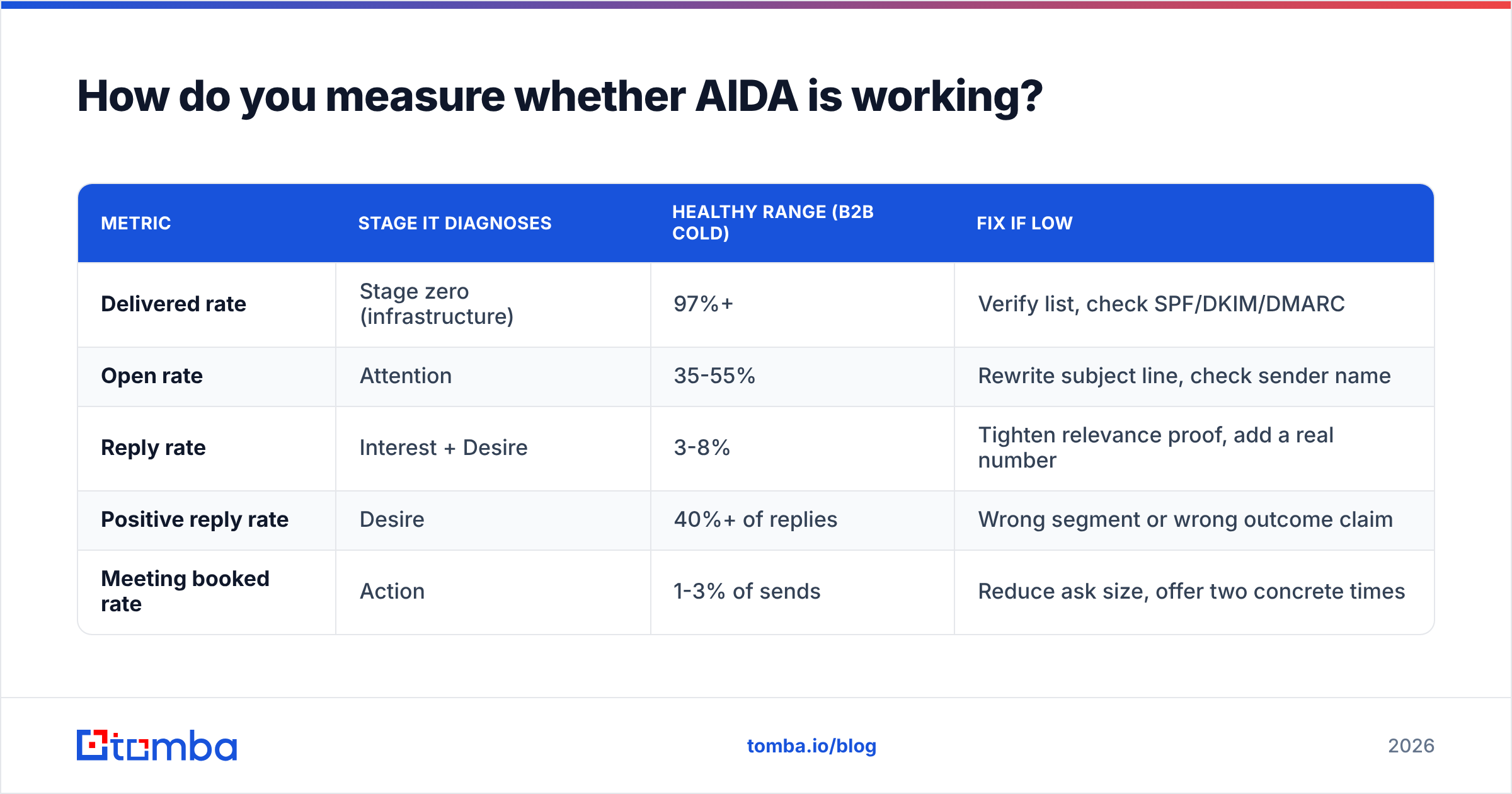
Instrument per stage. A single reply-rate number tells you the email failed but not where.
| Metric | Stage it diagnoses | Healthy range (B2B cold) | Fix if low |
|---|---|---|---|
| Delivered rate | Stage zero (infrastructure) | 97%+ | Verify list, check SPF/DKIM/DMARC |
| Open rate | Attention | 35-55% | Rewrite subject line, check sender name |
| Reply rate | Interest + Desire | 3-8% | Tighten relevance proof, add a real number |
| Positive reply rate | Desire | 40%+ of replies | Wrong segment or wrong outcome claim |
| Meeting booked rate | Action | 1-3% of sends | Reduce ask size, offer two concrete times |
Read them in order. High opens with near-zero replies means Attention works and Interest does not — your subject line promised relevance the body did not deliver. Good replies but no meetings means your Action is too expensive. Low delivered rate means stop testing copy entirely and go fix the list.
Change one stage per test. If you rewrite the subject line and the CTA in the same week, you learn nothing. Give each variant enough volume that a 1-point difference is not noise — for most teams that means at least 300 sends per variant.
Track response rate as your primary copy metric and delivered rate as your primary infrastructure metric, and never let a copy debate proceed while the infrastructure number is red.
Where should you start this week?#
Rewrite one campaign, not all of them. Take your lowest-performing sequence, isolate the four AIDA sentences, and check each against the failure column in the first table. Most teams find the same thing: the Attention line is generic and the Desire line is a feature list. Fixing just those two typically moves reply rate more than any amount of subject-line A/B testing on top of a broken body.
Then check the list underneath it. Frameworks amplify data quality; they do not substitute for it. That is the whole answer to how to apply AIDA model steps in 2026: good data first, four sentences second.
When you are ready to rebuild the list your AIDA copy runs on, start with the Tomba Email Finder — search by company domain or by name, get verified professional addresses with confidence scores, and push them straight into your sequencing tool via the Tomba API. The free tier gives you 25 searches a month to test the workflow. Paid plans start at $49/month on Starter, and full Tomba pricing covers Growth at $99/month and Pro at $249/month if you are running volume. Write the four sentences well, send them to addresses that actually exist, and AIDA does what it has done since 1898.
Related guides#
Ready to find emails that actually work?
Join 150,000+ professionals who stopped guessing and started sending. Free credits on signup — no credit card required.
Get the Tomba newsletter
Practical outbound tactics and product updates — once every two weeks.
About the author