How To Ask For A Follow Up: 7 Scripts and a Timing Plan
Most deals die in the gap between "sounds interesting" and silence. Here is how to ask for a follow up with real timing windows, seven copy-paste scripts, and a cadence that stops at the right number.
TL;DR
- Silence is almost never rejection. It is usually priority order, and a follow-up is how you re-enter the queue.
- The highest-yield window is 48–72 hours after the first touch, then widening gaps: day 3, day 7, day 14, day 30.
- Every follow-up needs one ask, one reason to reply, and no guilt. "Just checking in" is the single most ignored sentence in B2B.
- Four to five touches captures most of the replies you will ever get. Past six, you are damaging the brand more than the pipeline.
- Bad data looks exactly like silence. Verify the address before you assume the person is ignoring you.
What does "asking for a follow up" actually mean?#
There are two versions of this question, and they need different playbooks.
The first is the chase: you sent something — a cold email, a proposal, a post-demo recap — and got nothing back. You want a reply.
The second is the booking: you are at the end of a good conversation and you want to lock the next step. That is not a chase at all. It is a close, and it happens live, in the room or on the call.
Most people conflate the two and end up chasing something they never actually booked. If you finish a discovery call with "I'll follow up next week," you have created work for yourself and an obligation for nobody. If you finish it with "Can we hold Thursday at 10 for the technical review? I'll send the invite now," you have a calendar entry instead of a chase.
So the first rule of how to ask for a follow up is: ask before you need to. The best follow-up email is the one that confirms an agreement that already exists.
Everything below assumes you did not get that lucky.
When should you send a follow up?#
Timing beats wording. A mediocre message at the right moment outperforms a beautifully written one sent three weeks late, because relevance decays fast and your name decays faster.
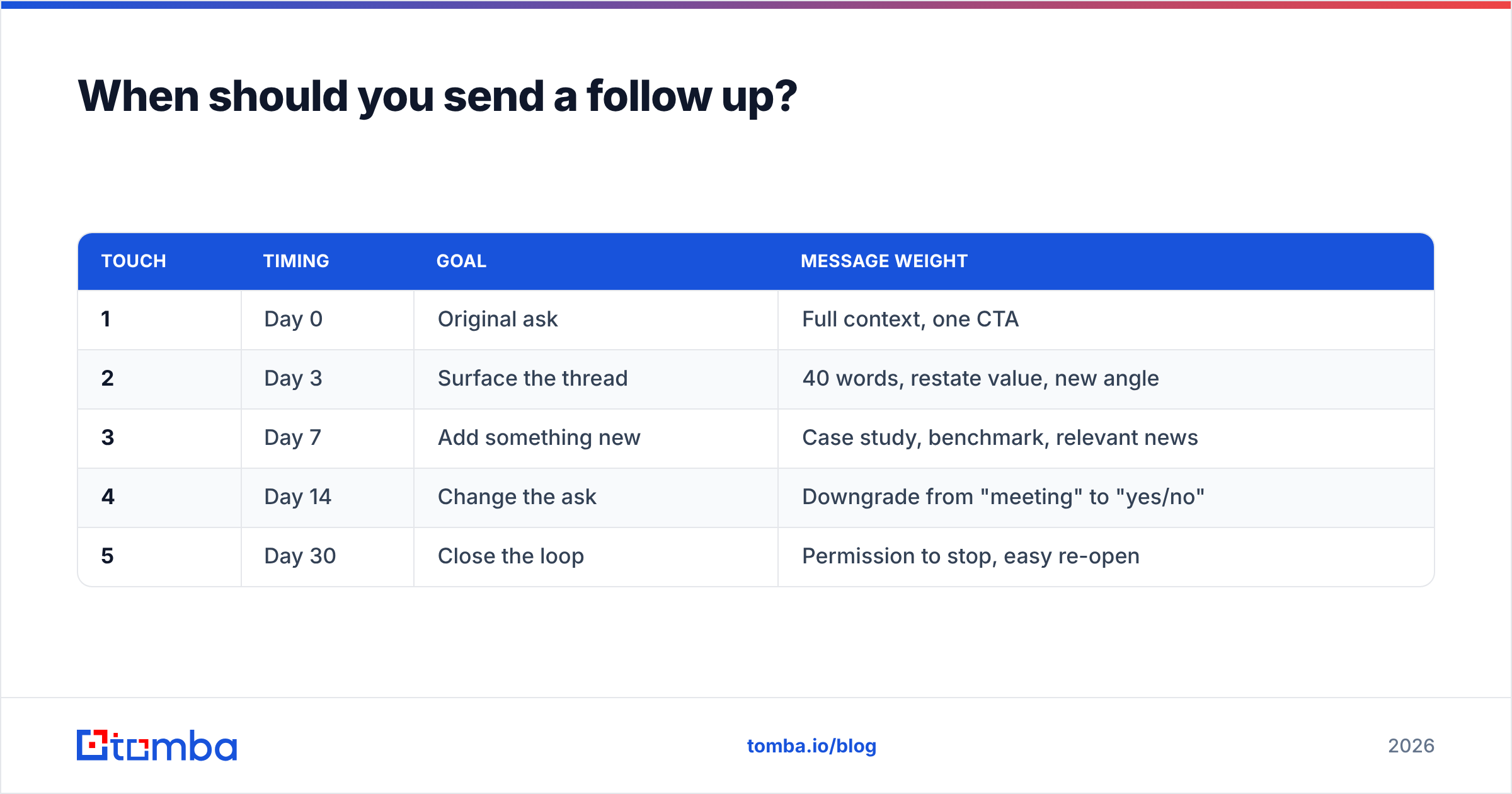
Use widening intervals. The person who is going to reply usually replies early; the person who needs a nudge needs breathing room, not a drumbeat.
| Touch | Timing | Goal | Message weight |
|---|---|---|---|
| 1 | Day 0 | Original ask | Full context, one CTA |
| 2 | Day 3 | Surface the thread | 40 words, restate value, new angle |
| 3 | Day 7 | Add something new | Case study, benchmark, relevant news |
| 4 | Day 14 | Change the ask | Downgrade from "meeting" to "yes/no" |
| 5 | Day 30 | Close the loop | Permission to stop, easy re-open |
A few adjustments worth making:
- Post-proposal, compress everything. Day 2, day 5, day 10. Proposals have a decision window and it closes.
- Post-interview or post-referral, stretch it. Day 5, day 12, then stop. These are relationship touches, not pipeline touches.
- Enterprise buying committees move on quarter boundaries. A day-30 touch that lands in the first week of a new quarter frequently outperforms the day-7 touch.
- Send between 7–10am in the recipient's timezone, not yours. If you do not know the timezone, you have a data problem, not a timing problem.

How do you ask for a follow up without sounding pushy?#
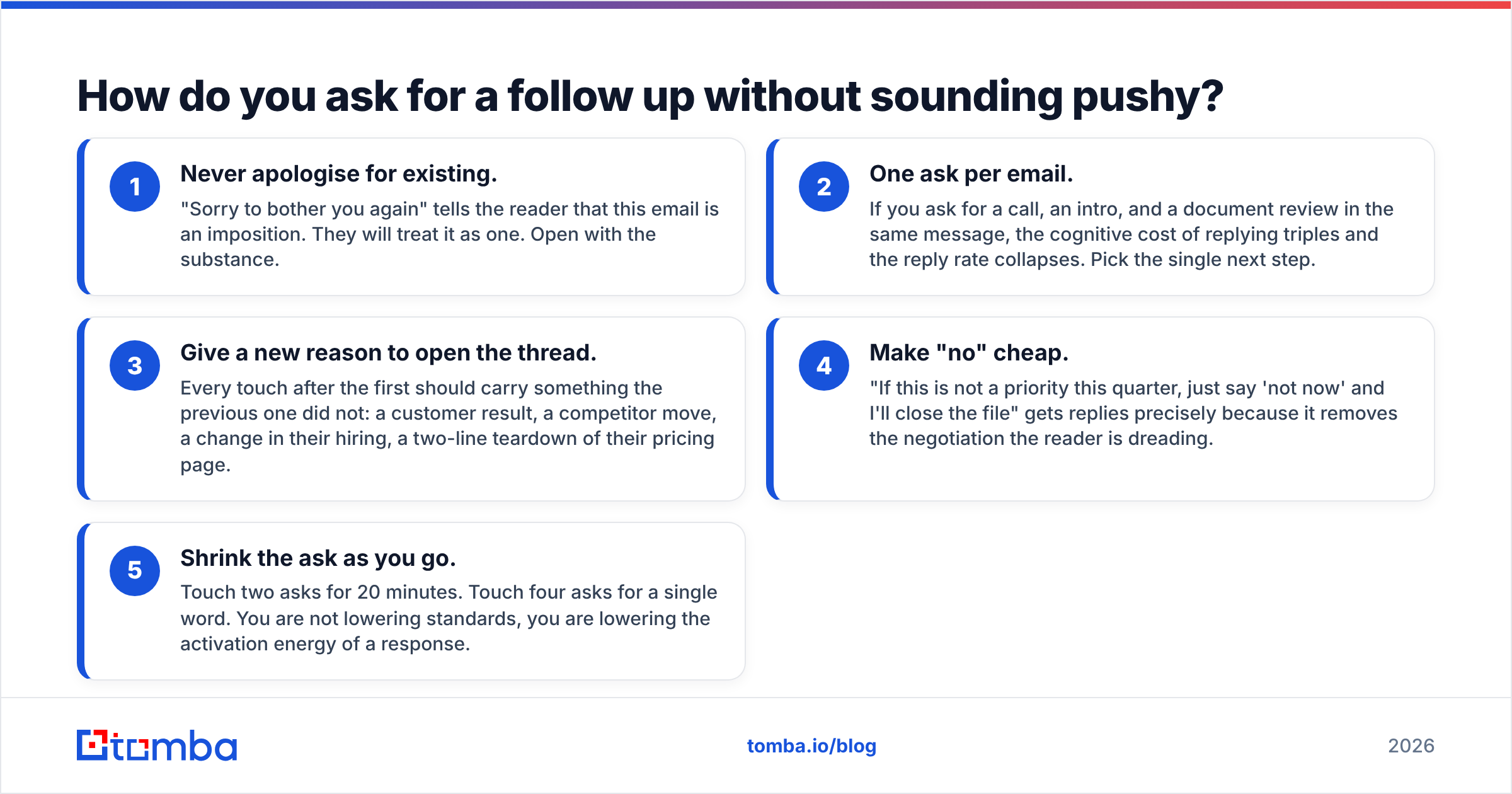
Pushiness is not about frequency. It is about who the message is for. A follow-up that is obviously about your quota reads as pressure; one that is obviously about their problem reads as service. Five principles do most of the work:
- Never apologise for existing. "Sorry to bother you again" tells the reader that this email is an imposition. They will treat it as one. Open with the substance.
- One ask per email. If you ask for a call, an intro, and a document review in the same message, the cognitive cost of replying triples and the reply rate collapses. Pick the single next step.
- Give a new reason to open the thread. Every touch after the first should carry something the previous one did not: a customer result, a competitor move, a change in their hiring, a two-line teardown of their pricing page.
- Make "no" cheap. "If this is not a priority this quarter, just say 'not now' and I'll close the file" gets replies precisely because it removes the negotiation the reader is dreading.
- Shrink the ask as you go. Touch two asks for 20 minutes. Touch four asks for a single word. You are not lowering standards, you are lowering the activation energy of a response.
The subject line does a disproportionate amount of this work. Reply-in-thread on touches two and three so the history is visible, then break into a fresh subject on touch four to escape a dead thread. If you are not sure whether a line reads as urgent or desperate, run it through a subject line tester before you send it to 300 people.
What should a follow-up email actually say?#
Here are seven scripts covering the situations that come up most. Keep them under 60 words in the body. Length signals anxiety.
1. The 48-hour bump (cold, no reply)
Subject: re: [their initiative]
Hi [Name] — floating this back up. We help [similar company] cut [metric] by [number] without [common tradeoff]. Worth 15 minutes next week, or is this someone else's call at [Company]?
The last clause is the point: it offers an out that is also a routing question. People who are not the buyer will happily tell you who is.
2. The new-information nudge (touch three)
Saw [Company] just [hiring signal / product launch / funding event]. When teams hit that stage, [specific problem] usually shows up within a quarter. Here's how [Customer] handled it: [one-line result]. Want the two-page version?
3. The post-demo recap chase
Hi [Name] — you mentioned [objection] was the open question after Tuesday. I put the answer in three bullets below so you can forward it to [stakeholder] without editing anything. What do you need from me to get this in front of [stakeholder] this month?
4. The proposal follow up
Checking on the proposal from the 4th — not to rush the decision, but I want to make sure the [pricing tier / scope] section matched what you had in mind. Should I revise it, or is the holdup somewhere else?
Naming a possible objection out loud gets more replies than "any thoughts?" because you have given the reader a script for their own answer.
5. The one-word close (touch four)
Hi [Name] — I'll assume the timing is wrong unless I hear otherwise. Reply with "Q3" and I'll come back then, or "no" and I'll stop. Either is a good outcome for me.
6. The breakup (touch five)
Last one from me. Closing the file on this — if [problem] moves up your list, my line is open and the [resource] is yours regardless. Good luck with [specific thing they are building].
Breakup emails are famous for producing replies, but the reason matters: they end the ambiguity, not because guilt works. Do not fake finality if you plan to email again next month.
7. The post-interview / post-networking follow up
Thanks again for the time on Thursday — the point you made about [specific detail] stuck with me. I know decisions take a while; would it be helpful if I checked back around [date], or would you rather reach out when there's news?
Asking permission to follow up is the most underused move in this entire category. It converts a chase into a scheduled appointment.
If you want a starting library rather than building from scratch, the cold email templates collection covers first touches and follow-ups you can strip down to fit your voice.
Which channel should the follow up go through?#
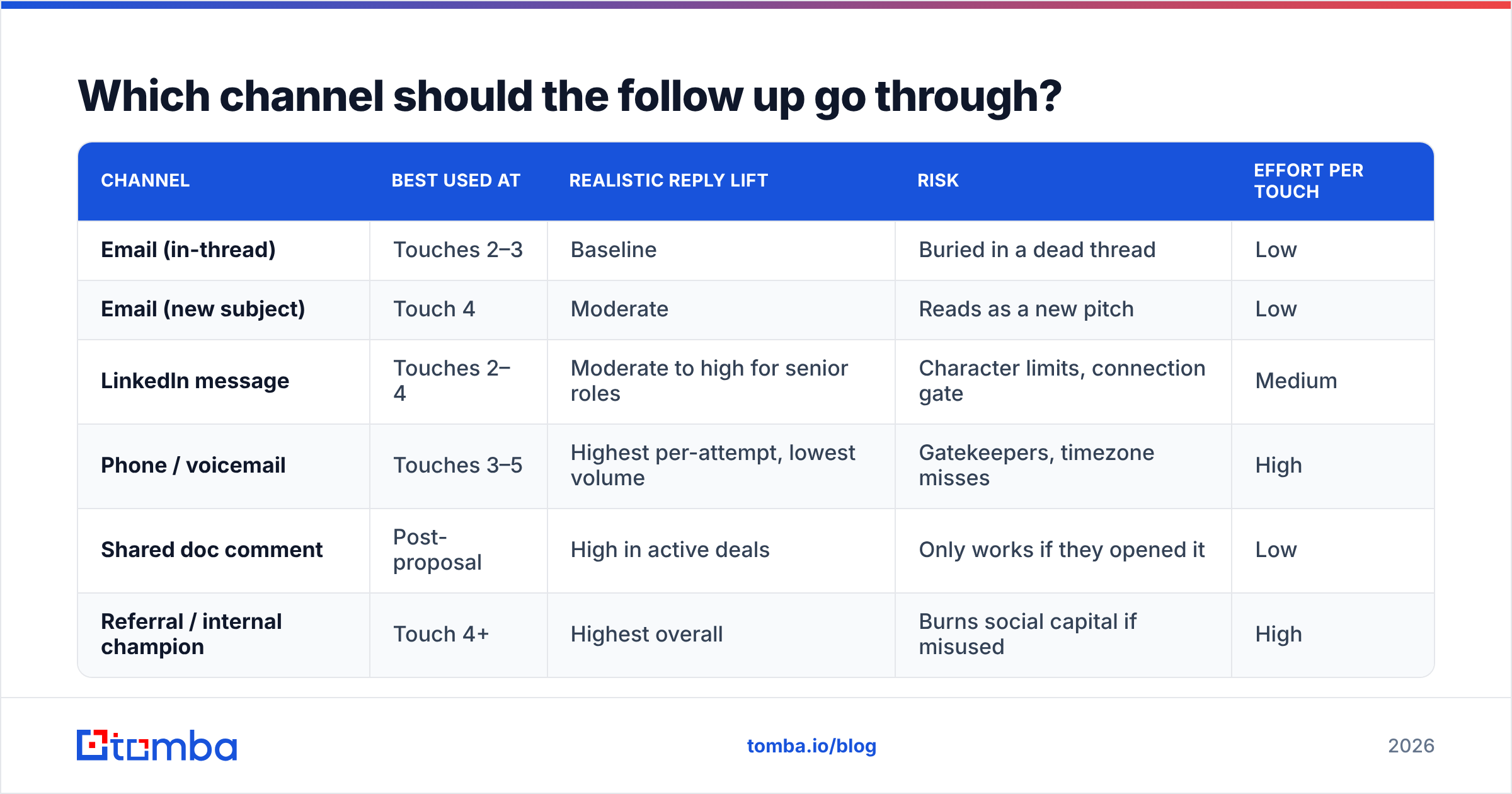
Email is the default, not the answer. Multi-channel sequences consistently outperform email-only ones, but only when each channel does something the others cannot.
| Channel | Best used at | Realistic reply lift | Risk | Effort per touch |
|---|---|---|---|---|
| Email (in-thread) | Touches 2–3 | Baseline | Buried in a dead thread | Low |
| Email (new subject) | Touch 4 | Moderate | Reads as a new pitch | Low |
| LinkedIn message | Touches 2–4 | Moderate to high for senior roles | Character limits, connection gate | Medium |
| Phone / voicemail | Touches 3–5 | Highest per-attempt, lowest volume | Gatekeepers, timezone misses | High |
| Shared doc comment | Post-proposal | High in active deals | Only works if they opened it | Low |
| Referral / internal champion | Touch 4+ | Highest overall | Burns social capital if misused | High |
The pattern that works: email carries the substance, LinkedIn carries the reminder, the phone carries the urgency. Sending the same paragraph across all three is not multi-channel — it is one message with three chances to annoy someone. For senior titles, a short LinkedIn outreach note referencing the email ("sent you a note Tuesday about [topic] — worth a look?") reliably resurrects threads that email alone could not.
How many follow ups are too many?#
Four to five touches per sequence, then stop and re-enter the contact in a nurture track 60–90 days later.
The math behind that number is unglamorous. Reply rates per touch drop steeply: touch one carries the bulk, touches two and three add meaningfully, touch four adds a smaller but real slice, and touch five mostly harvests the "wrong timing" crowd. Past six, the incremental replies are dominated by negative sentiment, spam complaints, and unsubscribes — all of which cost you future deliverability across your whole domain, not just this thread.
Two things change the ceiling:
- Active deals earn more touches. Someone who took a demo and went quiet is not a cold prospect. Seven or eight touches over six weeks is normal there.
- Cold sequences earn fewer. If a person has never replied, never opened, and never engaged, touch five is generous. HubSpot's sales research and playbooks and vendor comparison data on G2 both point the same direction: persistence pays until it visibly does not, and the tipping point is earlier than most reps assume.
Track this at the sequence level, not the rep level. If touch five is producing under 0.5% replies and any measurable complaint rate, cut it. Your response rate is a portfolio metric, and one bloated cadence can drag the whole domain down.
What actually kills follow-up replies?#
In descending order of damage:
- The address was never valid. This is the silent killer. A hard bounce at least tells you something; a soft-fail or a catch-all domain absorbs your message and returns nothing. You then send four more touches into a void and record it as "no interest." Verify before the sequence starts — a quick pass through an email verifier separates real silence from technical silence.
- You are emailing the wrong person. Job changes run at roughly 20–25% annually in software sales roles. Your day-30 touch may be going to someone who left in week two.
- No new information. Three identical bumps train the reader to ignore your sender name permanently.
- A soft ask. "Let me know your thoughts" has no verb the reader can act on. "Does Thursday 10am work?" does.
- Wall-of-text guilt. Every apology, every "I know you're busy," every recap of your previous two emails adds length and subtracts authority.
- Deliverability drift. If your follow-ups are landing in Promotions or spam, no amount of copywriting fixes it. Check your authentication and sending reputation before you rewrite the script for the fifth time; Gartner's sales technology research is a decent primer on where teams misallocate this kind of effort.
How do you ask for a follow up in a way that scales?#
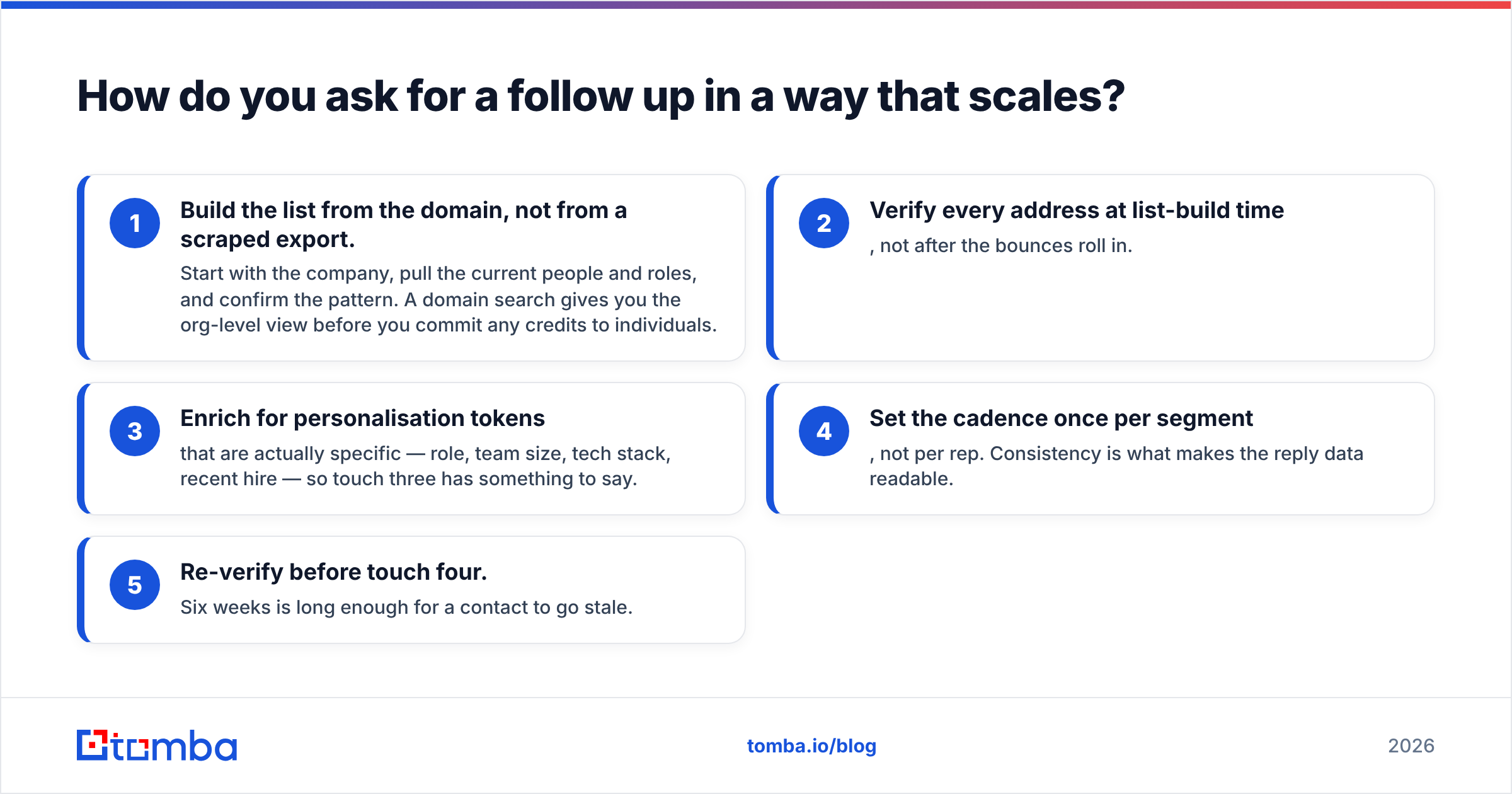
Manual follow-ups work fine at 20 accounts. They break at 200. The scaling constraint is almost never writing — it is knowing who to contact, whether the address is live, and what changed since the last touch.
A workable operating model:
- Build the list from the domain, not from a scraped export. Start with the company, pull the current people and roles, and confirm the pattern. A domain search gives you the org-level view before you commit any credits to individuals.
- Verify every address at list-build time, not after the bounces roll in.
- Enrich for personalisation tokens that are actually specific — role, team size, tech stack, recent hire — so touch three has something to say.
- Set the cadence once per segment, not per rep. Consistency is what makes the reply data readable.
- Re-verify before touch four. Six weeks is long enough for a contact to go stale.
Done this way, "how to ask for a follow up" stops being a copywriting question and becomes a data hygiene question — which is where most of the recoverable revenue actually sits.
Get the follow-up sequence on a foundation that replies#
The best follow-up script in the world cannot outrun a dead inbox. Before you rewrite touch two for the fourth time, make sure the address is real, current, and attached to the person who owns the decision.
Start with the Tomba Email Finder to build a verified contact list by name or domain, then run your cadence knowing that silence means "not now" instead of "wrong address." The free tier covers 25 searches a month, and paid plans start at $49/mo — see Tomba pricing for the full breakdown. Fix the data, then send the four emails that matter.
Related guides#
Ready to find emails that actually work?
Join 150,000+ professionals who stopped guessing and started sending. Free credits on signup — no credit card required.
Get the Tomba newsletter
Practical outbound tactics and product updates — once every two weeks.
About the author