How to Ask for a Meeting: Email Scripts That Get Yes
Most meeting requests die because they ask for too much, too early, from the wrong inbox. Here are the exact asks, timing rules, and scripts that convert cold contacts into booked calls in 2026.
TL;DR
- The meeting request is not the hard part. The 40 words before it are — if the reader does not believe you understand their problem, no calendar link saves you.
- Ask for a decision, not for time. "Worth a look?" outperforms "do you have 15 minutes Tuesday?" because it costs the reader nothing to answer.
- Specificity beats politeness. One named day and time converts better than "let me know what works," which pushes the scheduling labor onto a stranger.
- Send it to a verified, individually-owned inbox. A perfect ask sent to
info@is a perfect ask nobody reads. - Follow up three to four times over 12–15 days. Roughly half of positive replies to cold sequences arrive after the first message.
What does "asking for a meeting" actually mean in 2026?#
It means asking someone to spend their scarcest asset on a stranger. That framing changes everything about how you write the request.
A prospect's calendar in 2026 is not empty. Between internal syncs, async video reviews, and the general post-hybrid meeting bloat that Harvard Business Review has documented repeatedly, the average knowledge worker treats a 30-minute request as a genuine cost. So the question your email must answer is not "are you free Thursday?" It is "is this worth 30 minutes of my life?"
Most reps get this backwards. They spend four sentences on their company, one sentence on the prospect, and then hit them with a Calendly link. The reader does the math instantly — high cost, unproven value — and archives.
The asks that work invert the ratio. They earn the right to ask by demonstrating, in one or two lines, that you did homework a generic blast could not have produced.
Why do most meeting requests get ignored?#
Five failure modes cover almost all of it. Diagnose yours before you rewrite anything.
- You asked a stranger for a commitment. A 30-minute meeting with an unknown vendor is a leap. A one-line reply is a step. Design your ask to be a step.
- You made the reader do work. "What does your calendar look like next week?" outsources scheduling to someone who owes you nothing. Propose a slot instead.
- Your relevance is generic. "I saw you're in fintech" is not research. "I saw you shipped SOC 2 in March and are hiring two more AEs" is.
- You reached the wrong inbox. Role addresses, catch-all domains, and stale contacts silently swallow good copy. If your bounce rate is over 3%, your copy is not the problem — your data is.
- You quit after one send. A single-touch cold email is a coin flip weighted against you. Sequences of four to six touches routinely produce two to three times the reply volume of a single send.
Note that only one of those five is a writing problem. The rest are process and data problems, which is why "better subject lines" rarely fixes a broken meeting-booking motion on its own.
Which meeting ask should you use?#
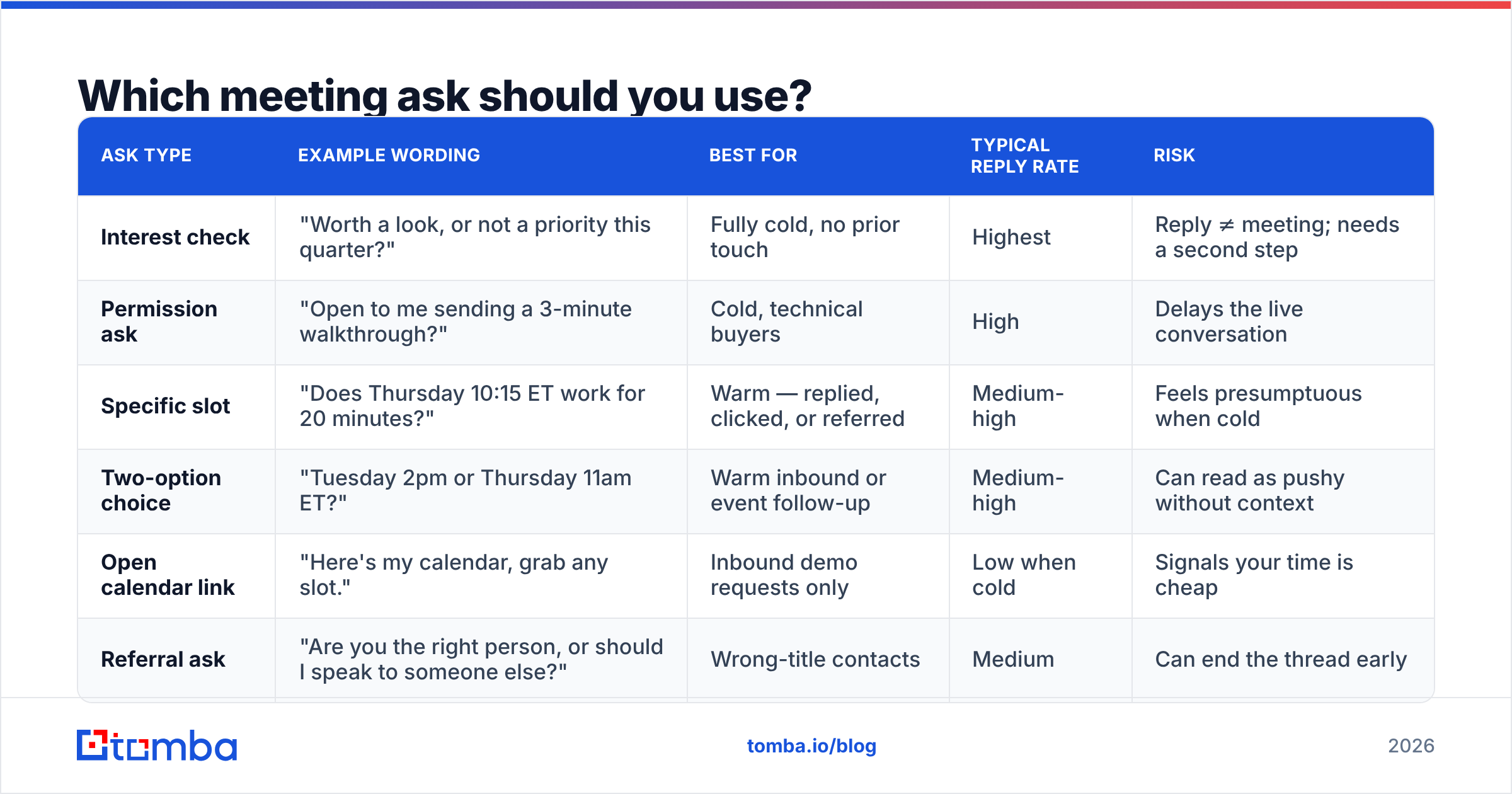
There is no universally best ask — there is a best ask for a given relationship temperature. Match the size of the request to how much trust you have actually earned.
| Ask type | Example wording | Best for | Typical reply rate | Risk |
|---|---|---|---|---|
| Interest check | "Worth a look, or not a priority this quarter?" | Fully cold, no prior touch | Highest | Reply ≠ meeting; needs a second step |
| Permission ask | "Open to me sending a 3-minute walkthrough?" | Cold, technical buyers | High | Delays the live conversation |
| Specific slot | "Does Thursday 10:15 ET work for 20 minutes?" | Warm — replied, clicked, or referred | Medium-high | Feels presumptuous when cold |
| Two-option choice | "Tuesday 2pm or Thursday 11am ET?" | Warm inbound or event follow-up | Medium-high | Can read as pushy without context |
| Open calendar link | "Here's my calendar, grab any slot." | Inbound demo requests only | Low when cold | Signals your time is cheap |
| Referral ask | "Are you the right person, or should I speak to someone else?" | Wrong-title contacts | Medium | Can end the thread early |
The pattern: cold contacts get low-commitment asks, warm contacts get calendar-specific asks. Sending a calendar link to a stranger inverts the hierarchy and reads as entitlement.
How do you write the ask itself?#
Keep the request to one sentence, placed on its own line, at the end. Here is the anatomy that consistently converts.
- Trigger line (1 sentence). Something that happened at their company. A funding round, a job posting, a product launch, a compliance milestone.
- Consequence line (1 sentence). What that trigger typically creates as a problem — stated as an observation, not a pitch.
- Proof fragment (optional, 1 clause). A named peer or a number. "Two other Series B fintechs cut list-build time by about 60%."
- The ask (1 sentence). Small, binary, answerable in four words.
- The out (optional, 1 clause). "If it's not a priority, say so and I'll close the loop."
That fifth element does more than it looks. Giving people explicit permission to decline raises reply rates because it removes the social cost of saying no — and a fast no is worth more to your pipeline than a slow ghost.
Here is the shape in practice:
Subject: your two new AE reqs
Hi Dana — saw the two AE openings on the careers page this week.
Usually when a team doubles headcount, the list-building step becomes the bottleneck before the calling does. New reps burn their first three weeks on data hygiene instead of conversations.
We fixed exactly that for two other Series B fintechs — ramp time down about a month.
Worth a look, or is hiring the only fire right now?
— Sam
Ninety-one words. One ask. No calendar link. The reader can dispatch it with a single word in either direction, which is precisely why they will.
What about the follow-up sequence?#
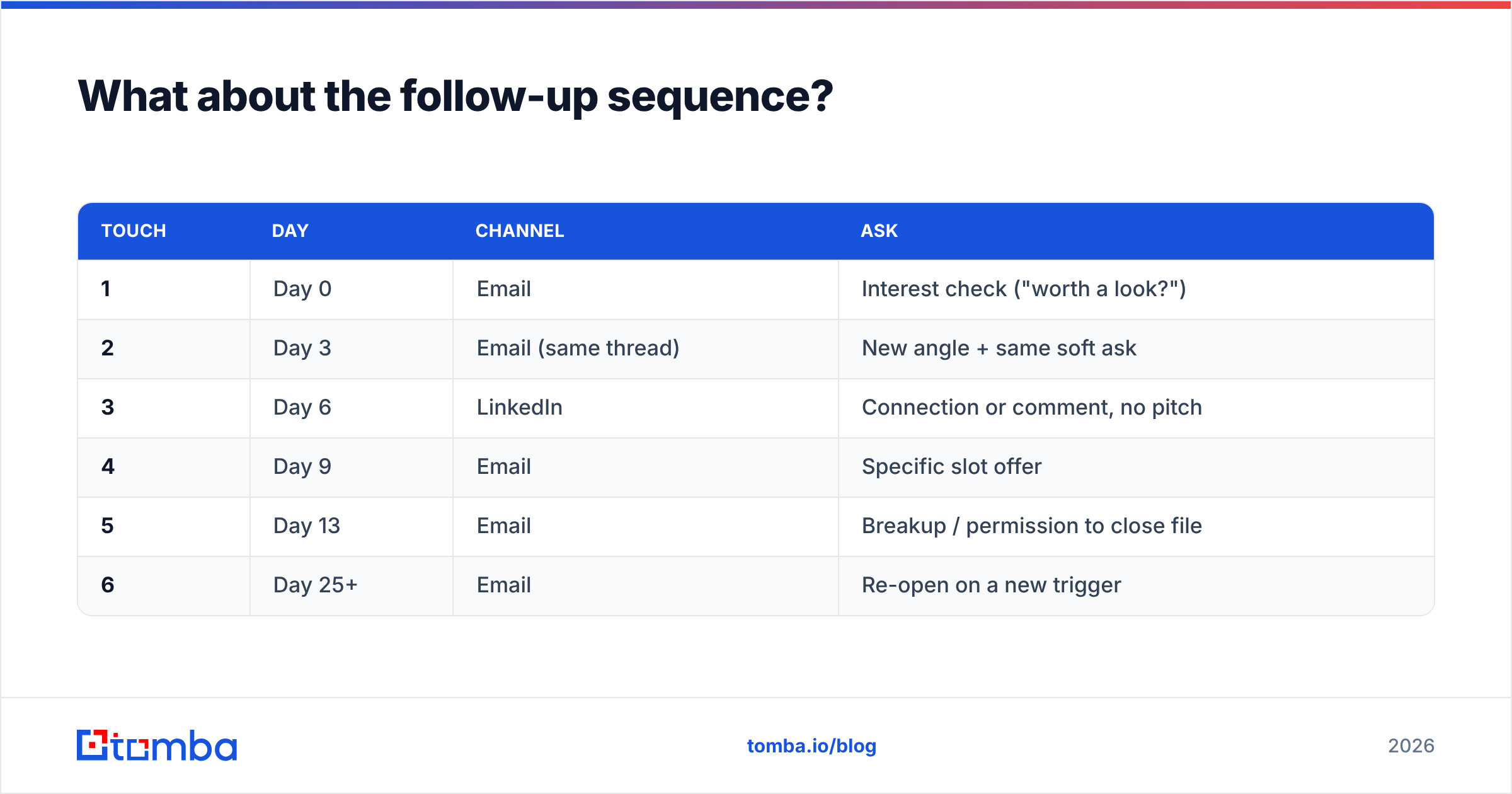
The follow-up is where meetings actually get booked. Treat the first email as an opener, not a closer.
A working cadence for 2026:
| Touch | Day | Channel | Ask |
|---|---|---|---|
| 1 | Day 0 | Interest check ("worth a look?") | |
| 2 | Day 3 | Email (same thread) | New angle + same soft ask |
| 3 | Day 6 | Connection or comment, no pitch | |
| 4 | Day 9 | Specific slot offer | |
| 5 | Day 13 | Breakup / permission to close file | |
| 6 | Day 25+ | Re-open on a new trigger |
Two rules govern this cadence. First, never repeat the same argument — each touch introduces a new angle, a new proof point, or a new format. Second, escalate the ask only as engagement rises. If they opened three times and clicked once, you have earned the specific-slot ask on touch four. If there is dead silence, keep it soft.
The breakup email is the most underrated touch on this list. "I'll assume this isn't a priority and close the file — happy to be wrong" reliably produces a burst of replies, because loss aversion is a stronger motivator than curiosity. Just do not fake it. If they say nothing, actually close the file.
Does the channel change the ask?#
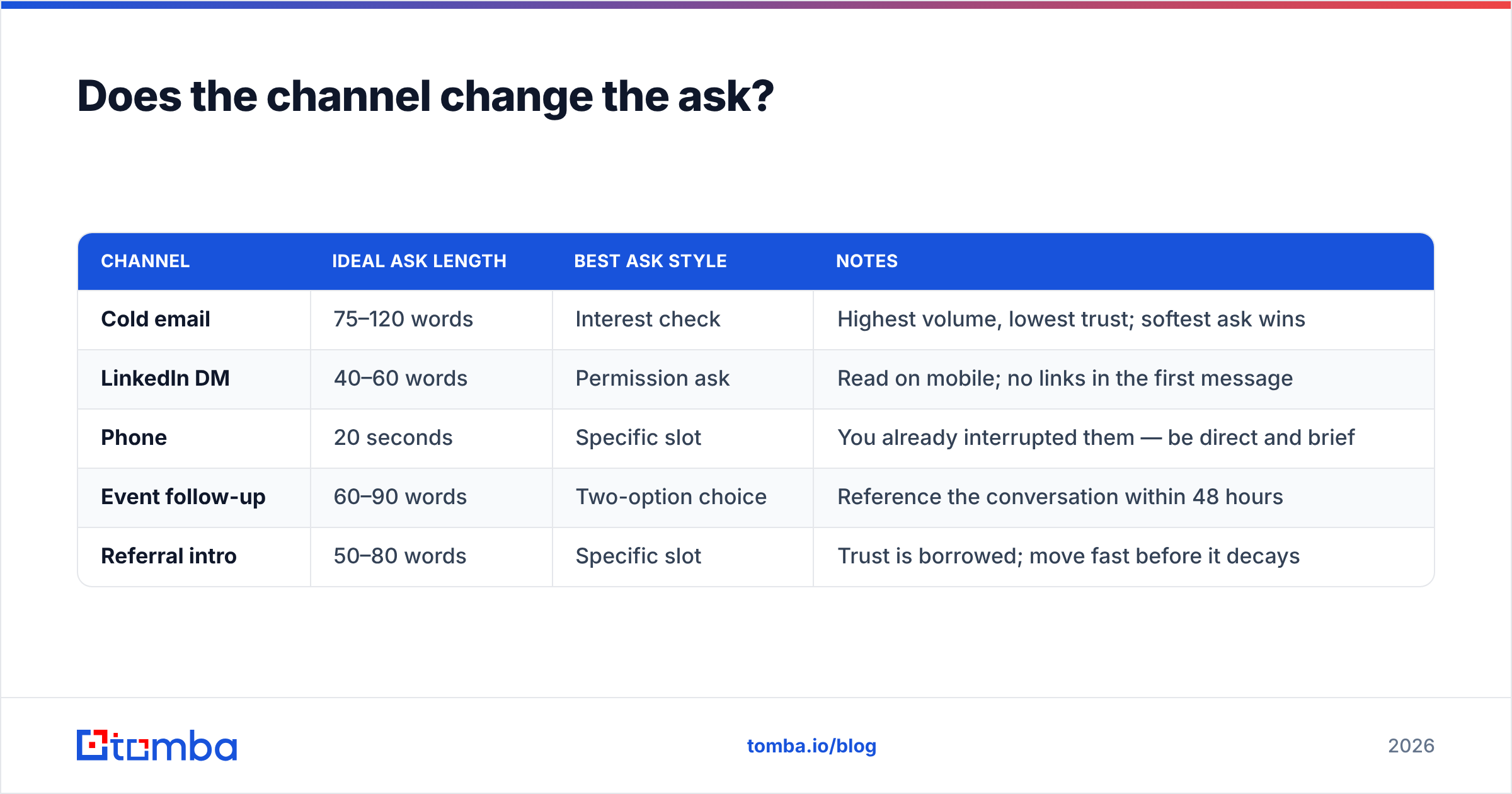
Yes — substantially. The same words land differently depending on where they arrive.
| Channel | Ideal ask length | Best ask style | Notes |
|---|---|---|---|
| Cold email | 75–120 words | Interest check | Highest volume, lowest trust; softest ask wins |
| LinkedIn DM | 40–60 words | Permission ask | Read on mobile; no links in the first message |
| Phone | 20 seconds | Specific slot | You already interrupted them — be direct and brief |
| Event follow-up | 60–90 words | Two-option choice | Reference the conversation within 48 hours |
| Referral intro | 50–80 words | Specific slot | Trust is borrowed; move fast before it decays |
The phone deserves a note. On a cold call you have already spent the interruption budget, so hedging wastes it. "I'll be direct — this is a cold call. Can I take 30 seconds to tell you why, and you decide if it's worth 20 minutes?" That is the ask, delivered upfront. Pair it with verified B2B phone numbers so you are not burning dials on dead lines.
For LinkedIn, keep the first message link-free. Platform algorithms deprioritize outbound links in DMs, and a naked calendar URL from a stranger reads as spam regardless. Build the LinkedIn outreach rhythm first, then move to email once they accept.
How does data quality affect your meeting rate?#
More than your copy does. This is the part most "how to ask for a meeting" advice skips entirely.
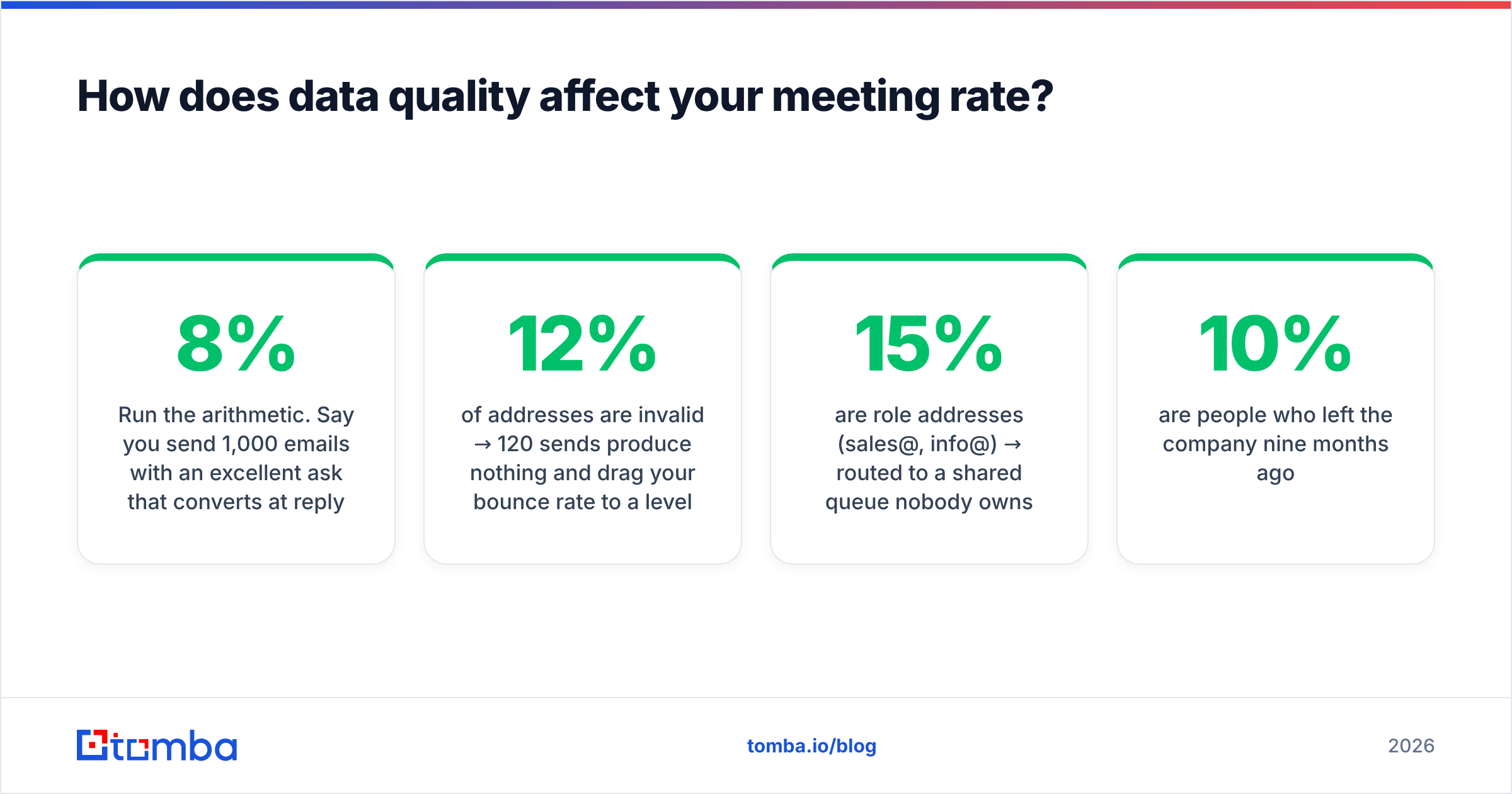
Run the arithmetic. Say you send 1,000 emails with an excellent ask that converts at 8% reply and 3% meeting-booked on clean data. Now degrade the list:
- 12% of addresses are invalid → 120 sends produce nothing and drag your bounce rate to a level that triggers filtering at Google and Microsoft.
- 15% are role addresses (
sales@,info@) → routed to a shared queue nobody owns. - 10% are people who left the company nine months ago.
You just lost roughly a third of your volume before anyone read a word, and the bounce spike quietly reduced inbox placement for the remaining two-thirds. Your ask did not get worse. Your denominator did.
Fix the input side first:
- Verify before every send. An email verifier run costs a fraction of a cent per record and protects your sender reputation from the bounce spikes that trigger filtering.
- Prefer individual mailboxes over role addresses. A named human can say yes. A shared queue cannot.
- Re-verify anything older than 90 days. B2B contact data decays at roughly 2–3% per month through job changes alone.
- Confirm catch-all domains separately. Catch-all servers accept everything, so a standard check returns "valid" for addresses that do not exist. A dedicated catch-all verifier distinguishes real mailboxes from accepted-then-discarded ones.
- Enrich before you write. Title, headcount, tech stack, and funding stage are what make the trigger line specific rather than generic. Pull those with data enrichment rather than guessing.
Vendor choice matters here too, and the honest answer is that several tools do this well. BookYourData is strong if you want pre-built, verified lists you can buy by segment and start sending against the same day. Tomba's email finder fits a different shape of work: you already know the accounts and the people, and you need verified addresses for those specific names at $49/mo on the Starter plan rather than a broad database subscription. Pick based on whether your bottleneck is "who to target" or "how to reach the people I already chose."
What should you never say in a meeting request?#
A short list of phrases that measurably reduce reply rates because every reader has seen them a thousand times.
- "Quick call" — nobody believes it will be quick. Name the actual duration.
- "Pick your brain" — signals you want to extract value, not deliver it.
- "Just following up" — adds no new information and admits the previous email failed.
- "Circling back" — same problem, worse.
- "Let me know if you're interested" — the burden is on the reader with no defined next step.
- "I'd love to show you a demo" — your love for the demo is not the reader's motivation.
Replace each with something concrete. "Quick call" becomes "18 minutes." "Just following up" becomes "One more angle on this —". "Let me know if you're interested" becomes "Worth a look, or not this quarter?"
The G2 buyer behavior research consistently shows B2B buyers complete most of their evaluation before contacting a vendor. Your meeting request is competing against self-service research, not against other reps. That raises the bar: the meeting has to offer something the buyer cannot get from your website in five minutes. Say what that is.
How do you handle the "send me some info" deflection?#
Treat it as a soft yes, not a rejection. The prospect is interested enough to reply but not convinced enough to commit calendar time.
The wrong response is to send a 12-page PDF. The right response is a small, specific asset plus a re-ask:
Sure — sending the two-page version rather than the deck, since you asked for info and not homework.
One question so I send the right half: is the bottleneck list volume or list accuracy right now?
That question does double duty. It qualifies the opportunity and it restarts a two-way conversation, which is what actually leads to a booked meeting. A one-way document attachment ends threads; a question continues them.
If they answer the question, you have earned the specific-slot ask. If they do not, you learned something too.
Ready to send asks that reach a real inbox?#
The best-written meeting request in your sequence is worth exactly zero if it lands on an address that bounces, a role inbox nobody monitors, or a person who left in March. Fix the input before you tune the copy again.
Start with the Tomba Email Finder — search by domain, name, or company, get verified individual addresses with confidence scores, and push them straight into your sequencer. The free tier gives you 25 searches a month to test the difference on a live campaign; Starter is $49/mo when you are ready to scale, and full Tomba pricing runs up through Growth and Pro for larger teams. Write the ask well, send it to a real human, follow up four times. That is the whole method.
Related guides#
Ready to find emails that actually work?
Join 150,000+ professionals who stopped guessing and started sending. Free credits on signup — no credit card required.
Get the Tomba newsletter
Practical outbound tactics and product updates — once every two weeks.
About the author