How to Ask for a Meeting in a Cold Email (2026 Guide)
Most cold emails die at the ask. Here are the exact meeting-request formats that book calls in 2026, the CTA styles worth testing, and the mistakes that quietly kill your reply rate.
TL;DR
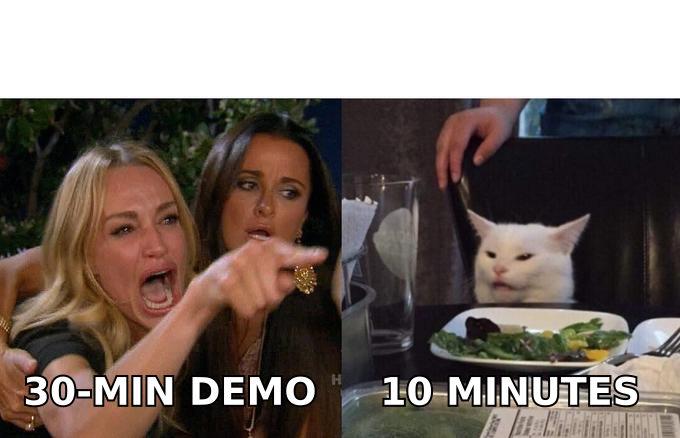
- The meeting ask fails more often than the subject line does. Most reps write a decent opener and then bury it under a 30-minute demo request that nobody agreed to.
- Interest-based CTAs ("worth a look?") consistently out-reply calendar-based CTAs ("Tuesday at 2pm?") on first touch, because they ask for a decision the prospect can actually make.
- Specificity beats politeness. "15 minutes Thursday to walk through how three other RevOps teams cut enrichment spend" pulls better than "Do you have time to chat?"
- Never paste a Calendly link into a first cold email. Save it for the reply after they say yes.
- None of it matters if the address bounces. Verify before you send — a 4% bounce rate makes your best CTA invisible.
Why does the meeting ask fail more often than the pitch?#
Because the ask is where you stop talking about the prospect and start asking them for something. Everything before it is free to read. The CTA is the first line that costs them time.
Think of it like asking a stranger at a conference for coffee. If you open with "Can I get 30 minutes on your calendar next Tuesday at 2pm?", you've asked them to commit budget, calendar space, and social risk before they know whether you're worth it. If you open with "Is this something your team is even dealing with?", you've asked for an opinion. Opinions are cheap. Opinions start conversations.
Most cold emails I see in audits do the opposite. The body is careful, researched, and personal. The last line is a copy-pasted "Are you free for a quick 30-minute call this week to discuss?" — a sentence that undoes 90 seconds of goodwill.
The other silent failure is upstream: the email never arrives. Bounces, spam traps, and stale contacts wreck the numbers before the CTA gets a vote. Run your list through an email verifier before you optimise a single word.
What are the six meeting-request CTA formats that actually work?#
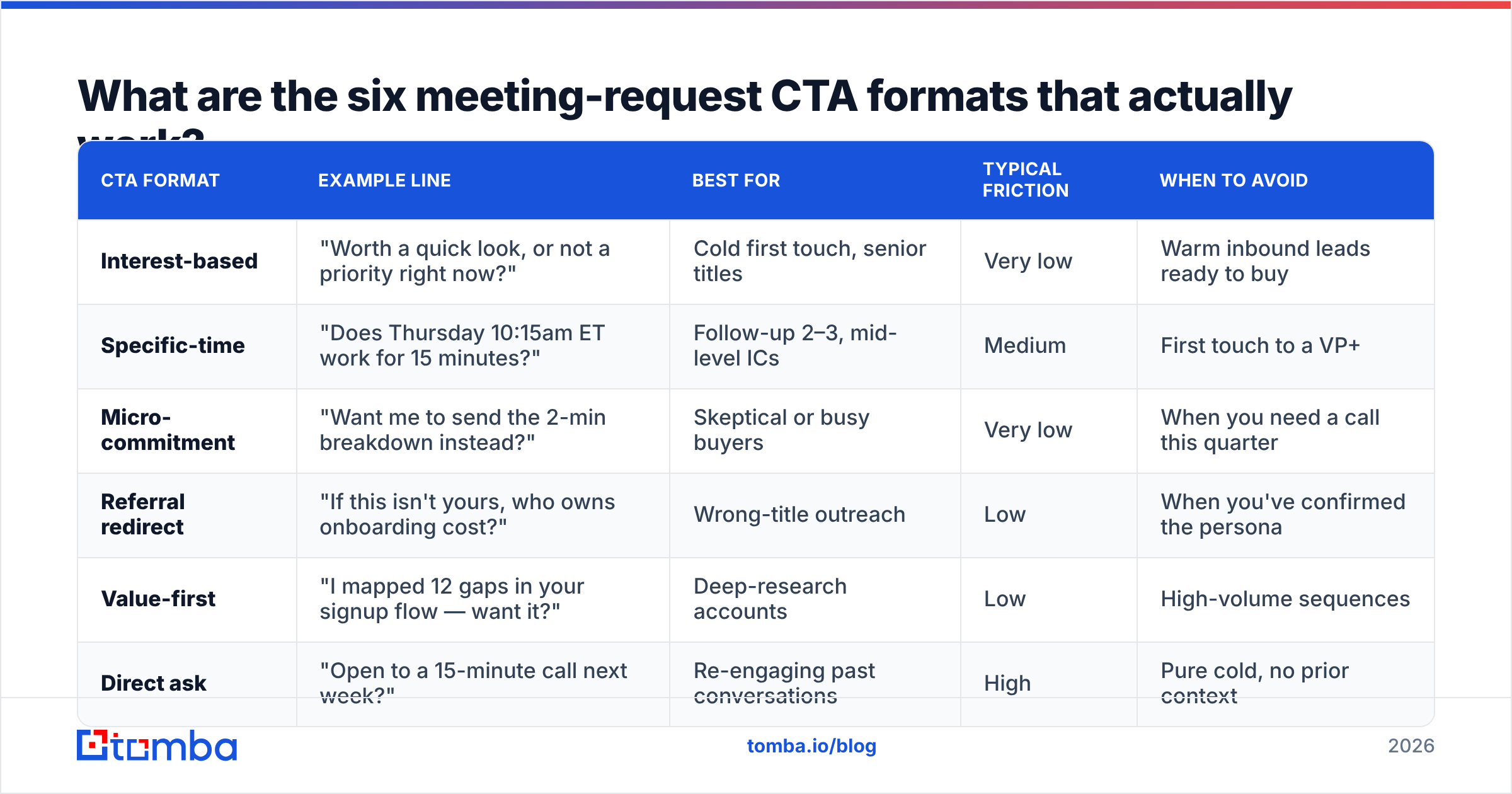
There is no single best ask. There are six, and each fits a different stage of relationship, seniority, and intent signal. Here's how they compare:
| CTA format | Example line | Best for | Typical friction | When to avoid |
|---|---|---|---|---|
| Interest-based | "Worth a quick look, or not a priority right now?" | Cold first touch, senior titles | Very low | Warm inbound leads ready to buy |
| Specific-time | "Does Thursday 10:15am ET work for 15 minutes?" | Follow-up 2–3, mid-level ICs | Medium | First touch to a VP+ |
| Micro-commitment | "Want me to send the 2-min breakdown instead?" | Skeptical or busy buyers | Very low | When you need a call this quarter |
| Referral redirect | "If this isn't yours, who owns onboarding cost?" | Wrong-title outreach | Low | When you've confirmed the persona |
| Value-first | "I mapped 12 gaps in your signup flow — want it?" | Deep-research accounts | Low | High-volume sequences |
| Direct ask | "Open to a 15-minute call next week?" | Re-engaging past conversations | High | Pure cold, no prior context |
The pattern across all six: the ask matches the amount of trust you've earned. On a first touch you've earned an opinion, not a calendar slot. By touch three, with two ignored emails behind you, a specific time is fine — you're removing decision friction instead of adding commitment.
Cognism, Gong, and Belkins have all published outbound teardowns landing on the same conclusion: low-friction CTAs win first-touch reply rate, while specific-time CTAs win later in the sequence. Gong's research library is worth reading directly if you want the call-recording data behind it.
How do you write the ask itself, line by line?#
Four ingredients. Miss one and the ask gets vague.
- Name the unit of time. "15 minutes" is a scope. "A quick chat" is an open-ended obligation. Buyers price open-ended obligations at 45 minutes and decline.
- Say what happens in that time. "Walk through how two other Series B ops teams cut list-building from 6 hours to 40 minutes" tells them the agenda. "Discuss how we can help" tells them nothing.
- Give one exit. "If this isn't a priority, just say 'not now' and I'll close the loop." This single line raises reply rate because it makes replying to decline feel easy — and half those "no" replies come back with a "but talk to Dana."
- Ask exactly one question. Two questions in a CTA halves your answer rate. Pick the opinion or the time slot, never both.
Applied, the whole ask is two sentences:
Worth 15 minutes next week to walk through how two other RevOps teams cut their enrichment spend by half? If it's not a priority this quarter, just tell me and I'll stop following up.
That's the whole thing. No Calendly, no "circle back", no "at your earliest convenience".
Should you include a Calendly link in a cold email?#
Not in the first one. Here's the honest trade-off.
A scheduling link removes a round-trip once someone has already decided to meet. In a cold email, they haven't decided anything, so the link does three things against you: it signals a sales-automation sequence, it adds a tracked external URL that some filters penalise, and it silently reframes your "opinion" question into a "book time now" demand.
The sequence that works:
- Email 1: interest-based ask, zero links.
- Reply from prospect: "Sure, what's this about?"
- Your reply: two-line context plus the scheduling link, or two proposed times.
If your outbound tool pushes the link into every touch by default, turn it off. And if link-heavy sending has already dented your sender reputation, fix that before rewriting CTAs — deliverability problems look exactly like copy problems in the dashboard.
How does the ask change by seniority?#
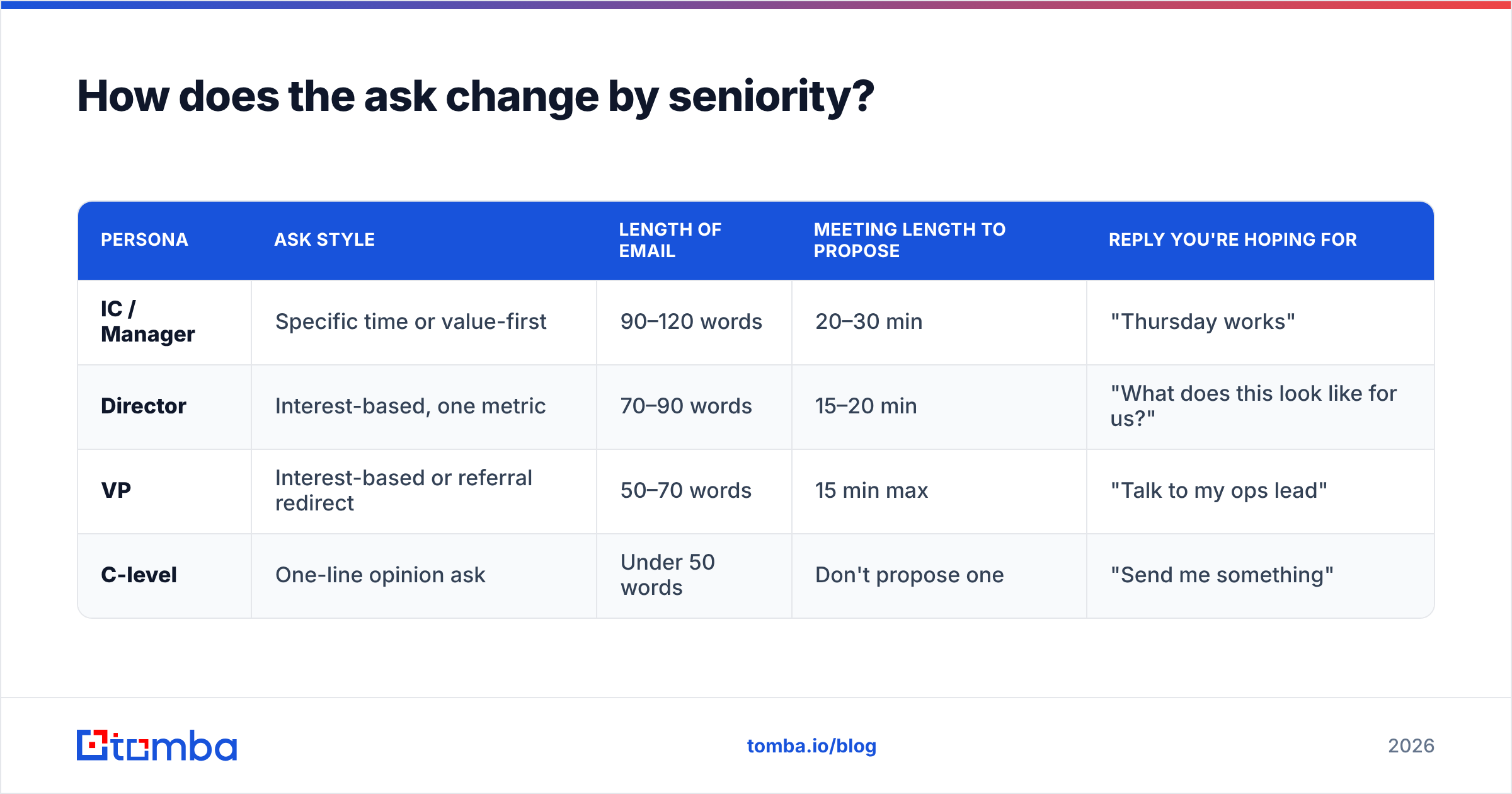
Seniority changes what the prospect is protecting. ICs protect their workload. Directors protect their team's roadmap. VPs and C-level protect their calendar above almost everything else.
| Persona | Ask style | Length of email | Meeting length to propose | Reply you're hoping for |
|---|---|---|---|---|
| IC / Manager | Specific time or value-first | 90–120 words | 20–30 min | "Thursday works" |
| Director | Interest-based, one metric | 70–90 words | 15–20 min | "What does this look like for us?" |
| VP | Interest-based or referral redirect | 50–70 words | 15 min max | "Talk to my ops lead" |
| C-level | One-line opinion ask | Under 50 words | Don't propose one | "Send me something" |
For C-level, "send me something" is a win, not a brush-off. Answer with a two-paragraph summary and then ask for the meeting. Trying to skip that step is where most reps torch a warm executive.
What are the mistakes that quietly kill the ask?#
These are the ones I flag most often in cold email reviews:
- Stacking two CTAs. "Would this be relevant? Also, are you free Tuesday?" The prospect answers neither.
- Asking for 30 minutes on a first touch. Half an hour of a stranger's time is a big ask. Fifteen is the ceiling cold.
- "Let me know if you'd like to learn more." Passive, unbounded, and it puts the work on them.
- Fake urgency. "Only two slots left this week" from an unknown sender reads as a script, because it is one.
- Burying the ask in paragraph three. The CTA should be the last line, alone, on its own line break.
- Asking a person who never received the email. Bad data is the invisible variable in every A/B test you'll run.
That last one deserves numbers. If 12% of your list is invalid, your "winning" CTA might just be the variant that happened to land in more real inboxes. Clean the list first, then test copy. A bulk email finder plus verification pass takes an afternoon and makes every downstream test trustworthy.
What does a full cold email with a strong ask look like?#
Three working examples, each built on a different CTA format.
1. Interest-based, first touch to a VP of Sales
Subject: your SDR ramp time
Hi Dana — saw you're hiring four SDRs this quarter after the Series B.
Most teams that scale that fast lose 6–8 weeks per rep to list-building instead of calling. We cut that step for Klaviyo's mid-market team down to about 40 minutes a week.
Is ramp speed something you're actively trying to fix right now, or already handled?
2. Referral redirect, wrong-title outreach
Subject: quick one on data hygiene
Hi Marcus — I think I've got the wrong person, so short version.
Your team's CRM shows a lot of duplicate company records from the two tools you're running in parallel. We've fixed that pattern for a few teams your size.
Who owns CRM data quality over there? Happy to send them the two-minute version.
3. Specific-time, third touch after silence
Subject: re: SDR ramp time
Dana — last one from me on this.
I put together a one-pager on how three post-Series B teams restructured their prospecting workflow. Takes 15 minutes to walk through.
Thursday 10:15am ET, or should I close this out?
Notice what's absent in all three: no "hope this finds you well", no "I wanted to reach out", no scheduling link, no two-question CTA. Each ends on a single question the prospect can answer in five words.
How do you test and improve your meeting ask?#
Treat the CTA as its own variable, not part of the body copy. That means one change per test, held for a full send cycle.
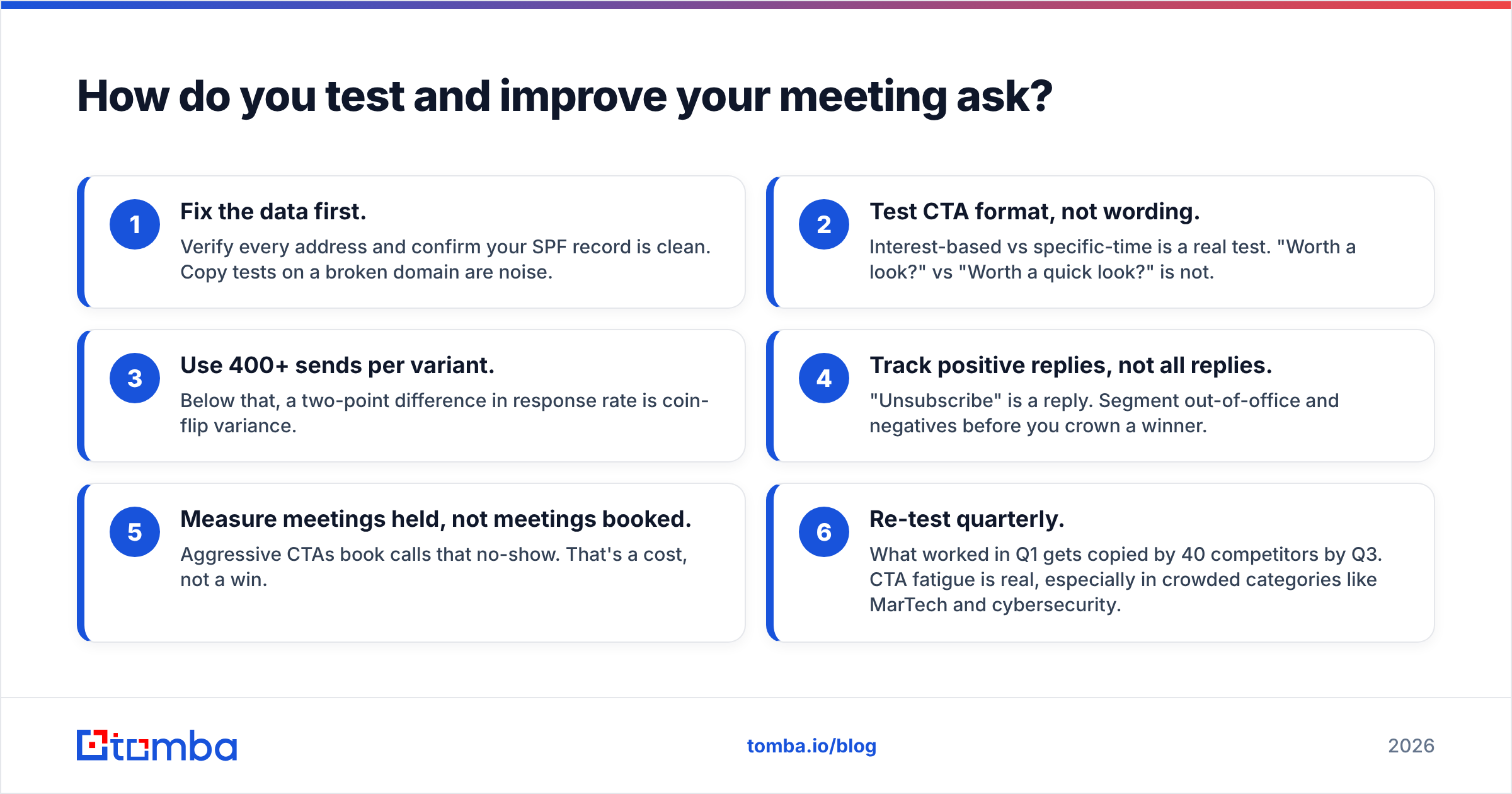
- Fix the data first. Verify every address and confirm your SPF record is clean. Copy tests on a broken domain are noise.
- Test CTA format, not wording. Interest-based vs specific-time is a real test. "Worth a look?" vs "Worth a quick look?" is not.
- Use 400+ sends per variant. Below that, a two-point difference in response rate is coin-flip variance.
- Track positive replies, not all replies. "Unsubscribe" is a reply. Segment out-of-office and negatives before you crown a winner.
- Measure meetings held, not meetings booked. Aggressive CTAs book calls that no-show. That's a cost, not a win.
- Re-test quarterly. What worked in Q1 gets copied by 40 competitors by Q3. CTA fatigue is real, especially in crowded categories like MarTech and cybersecurity.
If you want a broader benchmarking view of outbound tooling and reply-rate norms, G2's sales engagement category has enough practitioner reviews to sanity-check vendor claims. And for the deliverability side of the equation, HubSpot's email research publishes send-volume benchmarks worth comparing against your own.
Which CTA should you use if you only pick one?#
Use the interest-based ask on first touch. It's the safest default across seniorities, categories, and geographies, and it fails softly — a "no" still gets you information.
Then escalate. Touch two goes value-first. Touch three goes specific-time with a clean exit. That ladder mirrors how trust accumulates, and it's the structure behind almost every high-performing sequence I've reviewed.
One more time, because it's the part teams skip: your CTA can only perform as well as your list allows. A brilliant ask sent to a role that left the company in 2024 books zero meetings.
Get the ask in front of a real person. Tomba's Email Finder pulls verified professional addresses by domain, name, or company, so the meeting request you spent an hour writing actually lands in an active inbox. The free tier gives you 25 searches a month to test it against your current list; paid plans start at $49/mo on Starter, with Growth at $99/mo and Pro at $249/mo — full Tomba pricing is public. Verify first, then optimise the ask.
Related guides#
Ready to find emails that actually work?
Join 150,000+ professionals who stopped guessing and started sending. Free credits on signup — no credit card required.
Get the Tomba newsletter
Practical outbound tactics and product updates — once every two weeks.
About the author