How to Ask for Meeting Time in a Cold Email: 2026 Playbook
Most meeting requests die on the ask. Here is how to phrase, time, and structure a meeting request that actually gets a slot on the calendar — with scripts, data, and a CTA comparison table.
TL;DR
- The ask is the highest-leverage sentence in your email. A vague "let me know if you're interested" converts worse than a specific, low-commitment question.
- Interest-based asks ("Worth a look?") beat calendar-based asks ("Does Tuesday at 2pm work?") on first touch. Flip to a hard time proposal only after the prospect signals interest.
- Ask for 10-15 minutes, not 30. Smaller time blocks fit into gaps and lower the perceived cost of saying yes.
- Never send a calendar link in the first email. It moves work onto the recipient before they owe you anything.
- None of this matters if the email lands in the wrong inbox. Verify addresses before you optimize phrasing.
Why does the meeting ask decide your reply rate?#
Because it's the only sentence that asks the reader to do something. Everything above it — the personalization, the value prop, the social proof — is setup. The ask is the transaction.
Most reps spend 80% of their editing time on the opening line and about four seconds on the close. Then they wonder why a well-researched email gets a 2% reply rate. The opener buys you attention. The ask converts it. If the ask is ambiguous, expensive, or presumptuous, the attention leaks out and nothing happens.
Three failure modes account for most dead asks:
- The passive ask. "Let me know if this is something you'd be interested in." No action, no deadline, no cost estimate. The reader files it under "maybe later," which is a synonym for never.
- The oversized ask. "Do you have 30 minutes this week for a demo?" You've asked a stranger to give you half an hour based on one email. The math doesn't work for them.
- The presumptuous ask. "I've gone ahead and booked us for Thursday at 10 — here's the invite." This reads as entitlement to anyone who hasn't already agreed to talk.
The fix is not a magic phrase. It's matching the size of the ask to the amount of trust you've actually earned in that thread.
What are the seven ways to ask for meeting time?#
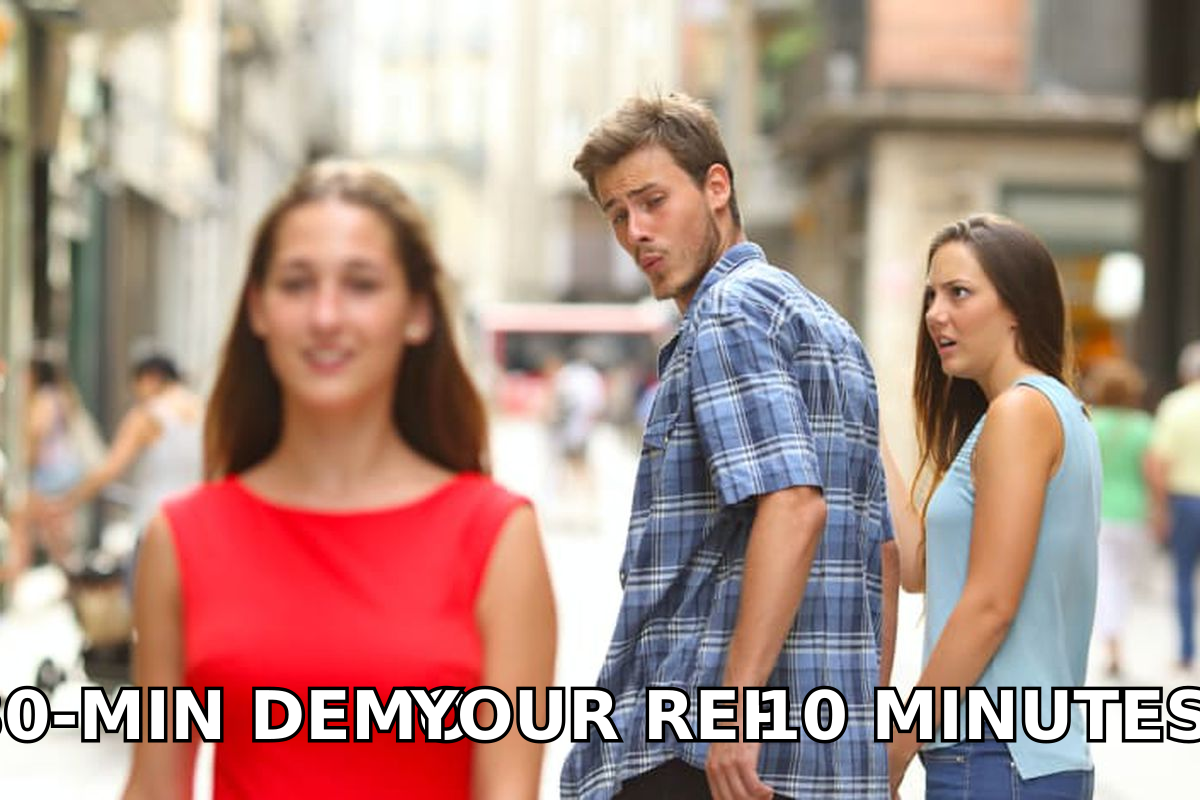
Each of these works — in a different context. The mistake is using one style for every stage.
| Ask type | Example phrasing | Best used on | Commitment level | Typical reply behavior |
|---|---|---|---|---|
| Interest check | "Worth a quick look?" | First cold touch | Very low | High reply rate, but many replies are questions, not bookings |
| Permission ask | "Open to me sending over a 2-min breakdown?" | First or second touch | Very low | Starts a thread without a calendar commitment |
| Time-boxed ask | "Do you have 10 minutes next week?" | Touch 2-3 after any signal | Low | Best balance of reply volume and booked calls |
| Alternative close | "Tuesday 2pm or Thursday 10am?" | After positive reply | Medium | Fast to book, but pushy if used cold |
| Single-slot proposal | "Would Wednesday at 3pm ET work?" | Warm reply, exec contacts | Medium | Easy to answer yes/no; easy to reschedule |
| Delegation ask | "Is someone on your team the right person for this?" | Wrong-contact or no-reply sequences | Low | Often produces a referral instead of a meeting |
| Calendar link | "Here's my calendar — grab any slot." | Inbound or explicitly agreed | High | Great post-agreement, terrible cold |
Read that table as a ladder. You climb it, you don't jump to the top rung on email one.
The four-part structure of a meeting request#
Every high-performing meeting ask has the same skeleton, regardless of phrasing:
- Relevance anchor — one clause that explains why this person, right now. "Saw you're hiring three SDRs this quarter."
- Compressed value claim — what changes for them, in one sentence, with a number if you have one. Not features.
- The sized ask — the specific action, with the time cost stated explicitly. "10 minutes" is a cost estimate; "a quick chat" is not.
- The easy exit — a phrase that makes "no" cheap. "If it's not a priority, just say so and I'll close the loop."
That last one is the piece most reps skip, and it's the one that lifts reply rate most reliably. Giving someone a graceful way out makes replying feel safe rather than like the start of a pursuit.
Should you ask for a specific time or leave it open?#
Depends entirely on whether the prospect has replied yet.
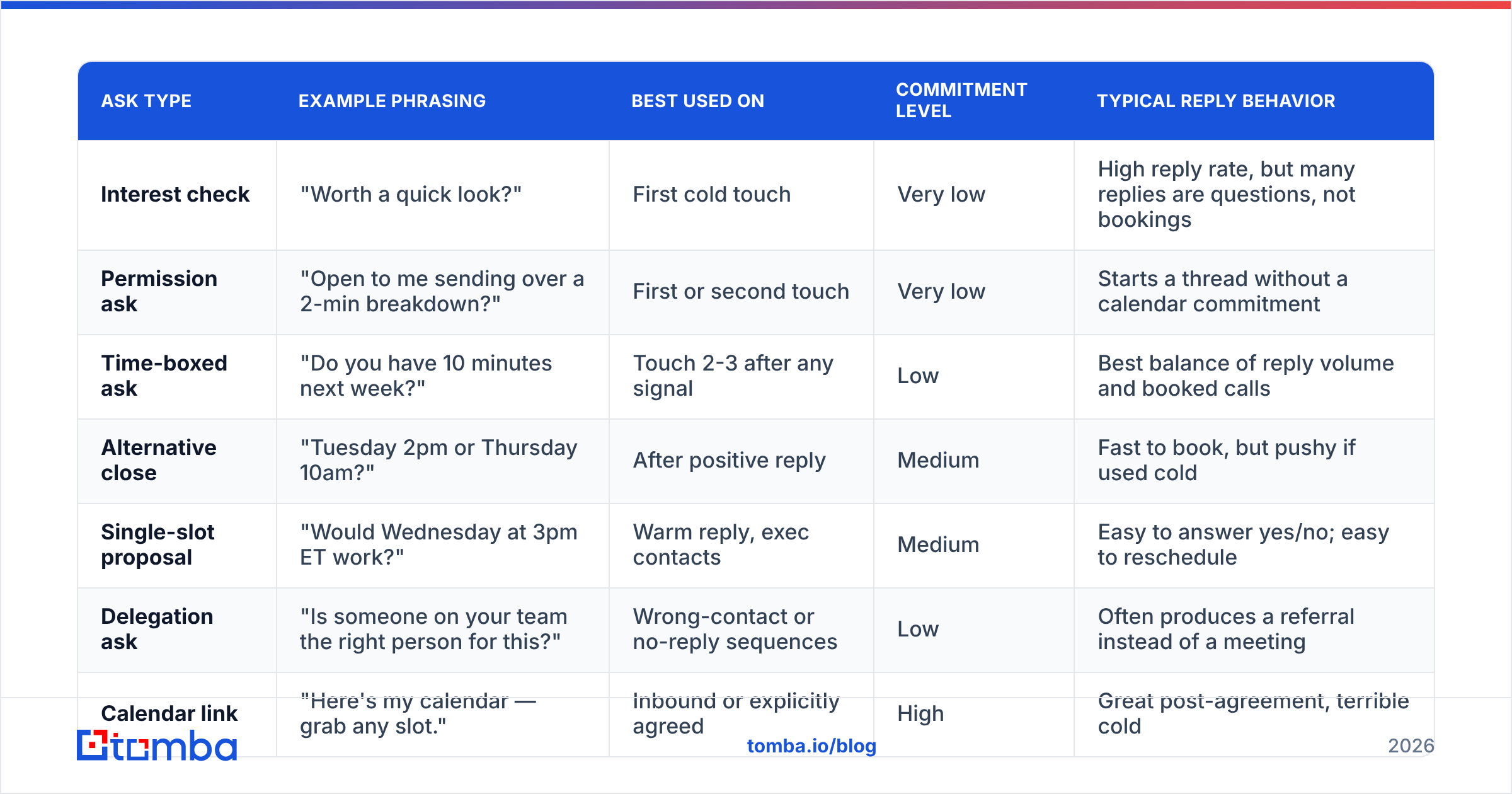
On a cold first touch, leave it open. Proposing "Tuesday at 2pm" to someone who has never heard of you asks them to make two decisions at once: do I care about this, and is my Tuesday afternoon free? Compound decisions get deferred. An interest-based ask separates the decisions — you're only asking "do I care?" first.
Once they reply with any positive signal, get specific immediately. This is where reps lose deals. A prospect writes back "sure, sounds interesting" and the rep answers "great, when works for you?" — handing the scheduling work back to the busiest person in the thread. Instead: propose two concrete slots with a timezone, and offer a fallback.
Here's the version that works:
Great — how about Tuesday 2pm ET or Wednesday 11am ET? Either works on my end. If neither fits, send me two windows and I'll make one work.
Two options is the sweet spot. One option feels like a test. Three or more turns into a scheduling puzzle.
Timezone is not optional. Writing "2pm" to a prospect in another region generates a clarifying round-trip that costs you a day and sometimes the meeting. Always append the zone.
How long should the meeting you ask for be?#
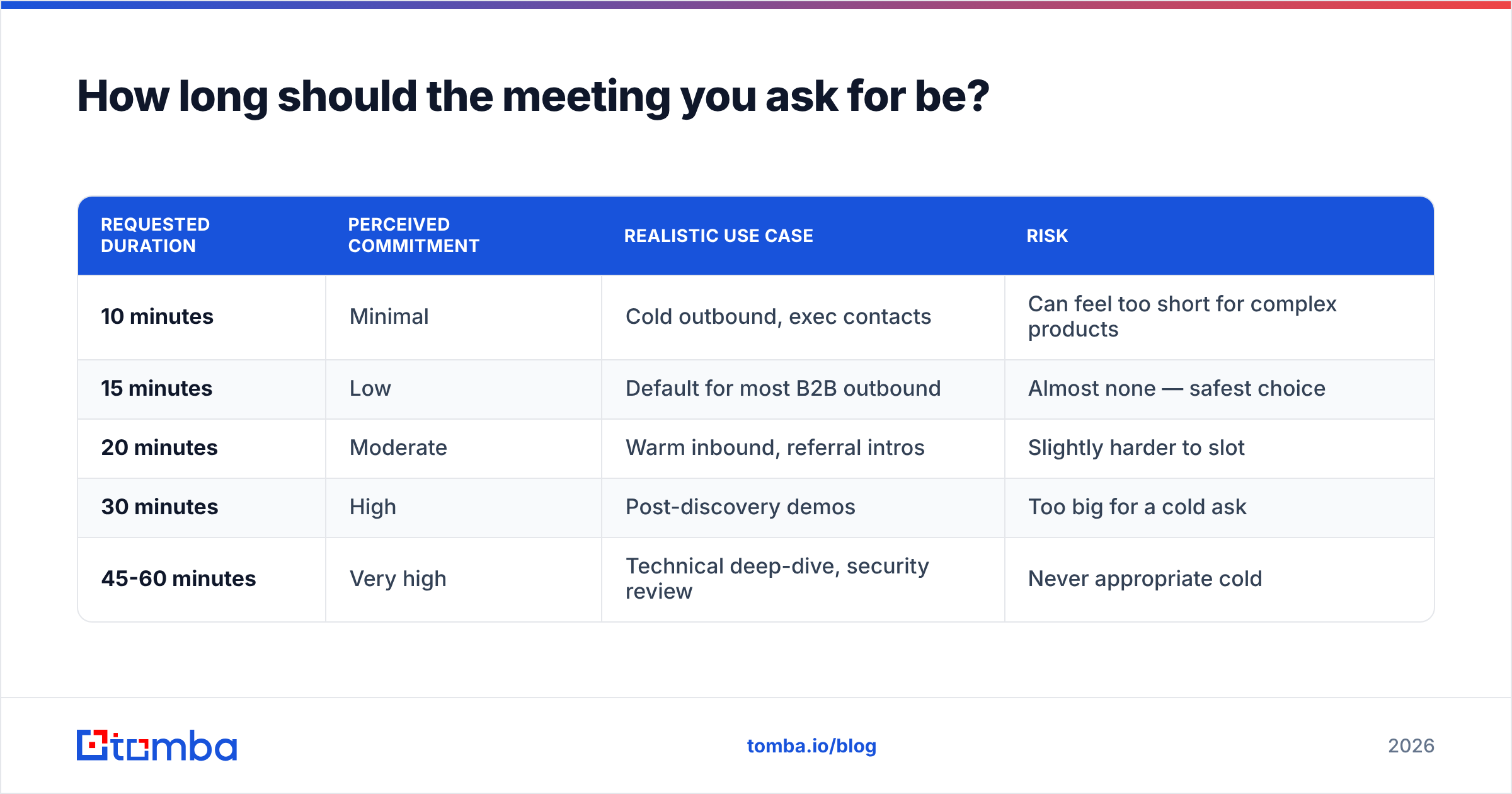
Ask for 10 to 15 minutes. Here's the reasoning, not just the rule.
A 30-minute request implies a demo, which implies preparation, which implies the prospect needs to have decided you're worth preparing for. A 15-minute request implies a conversation, which requires nothing from them. And 15-minute gaps exist in nearly every calendar; 30-minute gaps are rarer than reps assume.
There is a second, sneakier benefit: a short stated duration signals confidence. "I only need 10 minutes" implies you know exactly what you want to cover. "Do you have 45 minutes?" implies you plan to figure it out live.
| Requested duration | Perceived commitment | Realistic use case | Risk |
|---|---|---|---|
| 10 minutes | Minimal | Cold outbound, exec contacts | Can feel too short for complex products |
| 15 minutes | Low | Default for most B2B outbound | Almost none — safest choice |
| 20 minutes | Moderate | Warm inbound, referral intros | Slightly harder to slot |
| 30 minutes | High | Post-discovery demos | Too big for a cold ask |
| 45-60 minutes | Very high | Technical deep-dive, security review | Never appropriate cold |
If the conversation genuinely needs 30 minutes, book 15, run a great 15, and let them extend it. Prospects who want more time will offer it.
What meeting-request scripts actually get replies?#
Four scripts, four situations. Adapt the specifics — the structure is what matters.
1. Cold first touch, interest-based ask
Hi Sam — noticed Acme opened two new EMEA offices this quarter. Teams that expand that fast usually hit the same wall: their CRM data goes stale faster than reps can fix it.
We cut manual list-building for a similar team from ~6 hours a week to under one.
Worth a look, or is data hygiene not on the radar this quarter?
No calendar mention at all. The ask is a yes/no question about relevance, with a built-in exit.
2. Follow-up after no reply (touch 3)
Hi Sam — following up once on the below. If contact data quality isn't a priority right now, no problem at all, just reply "not now" and I'll stop.
If it is, I'd need 10 minutes to show you what we found on your domain.
The "just reply not now" line reliably produces replies. Some are no's — which is useful, because a fast no is worth more than a slow maybe.
3. Booking after a positive reply
Perfect. Tuesday 2pm ET or Thursday 10am ET — either open on your side?
I'll keep it to 15 and send the three things I want to cover beforehand so you can decide if it's worth the time.
The pre-send agenda is a small commitment from you that raises show-rate substantially.
4. Wrong contact / delegation ask
Hi Sam — I may have the wrong person. If prospecting data sits with someone else on the revenue team, could you point me their way? Happy to stop bothering your inbox either way.
Referrals from this script convert better than cold first touches, because they arrive with implicit endorsement.

When should you send the meeting request?#
Send timing matters less than most "best time to send" listicles claim, but it isn't zero.
The consistent finding across published outbound data — including HubSpot's sales research and vendor benchmark reports on G2 — is that mid-week mornings in the recipient's timezone outperform Monday mornings and Friday afternoons. The effect size is real but modest: think a few percentage points, not a doubling.
What matters far more:
- Recipient timezone, not yours. A perfectly-timed 9am send is worthless if it lands at 2am for them.
- Reply latency. When a prospect replies, answer within the hour if you can. Response speed correlates with booked meetings more strongly than send-day does.
- Sequence spacing. Three to four days between touches. Daily follow-ups read as pressure; two-week gaps lose the thread.
- Meeting proximity. Propose slots 2-5 business days out. Same-day feels frantic; three weeks out invites no-shows.
One more mechanical point: your carefully-timed email is irrelevant if it never reaches the inbox. Before you tune send windows, confirm your email deliverability fundamentals are in order — authentication records, warmed domain, clean list. A meeting request in spam has a 0% conversion rate regardless of phrasing.
What kills a meeting request that would otherwise work?#
Six things, roughly in order of damage done:
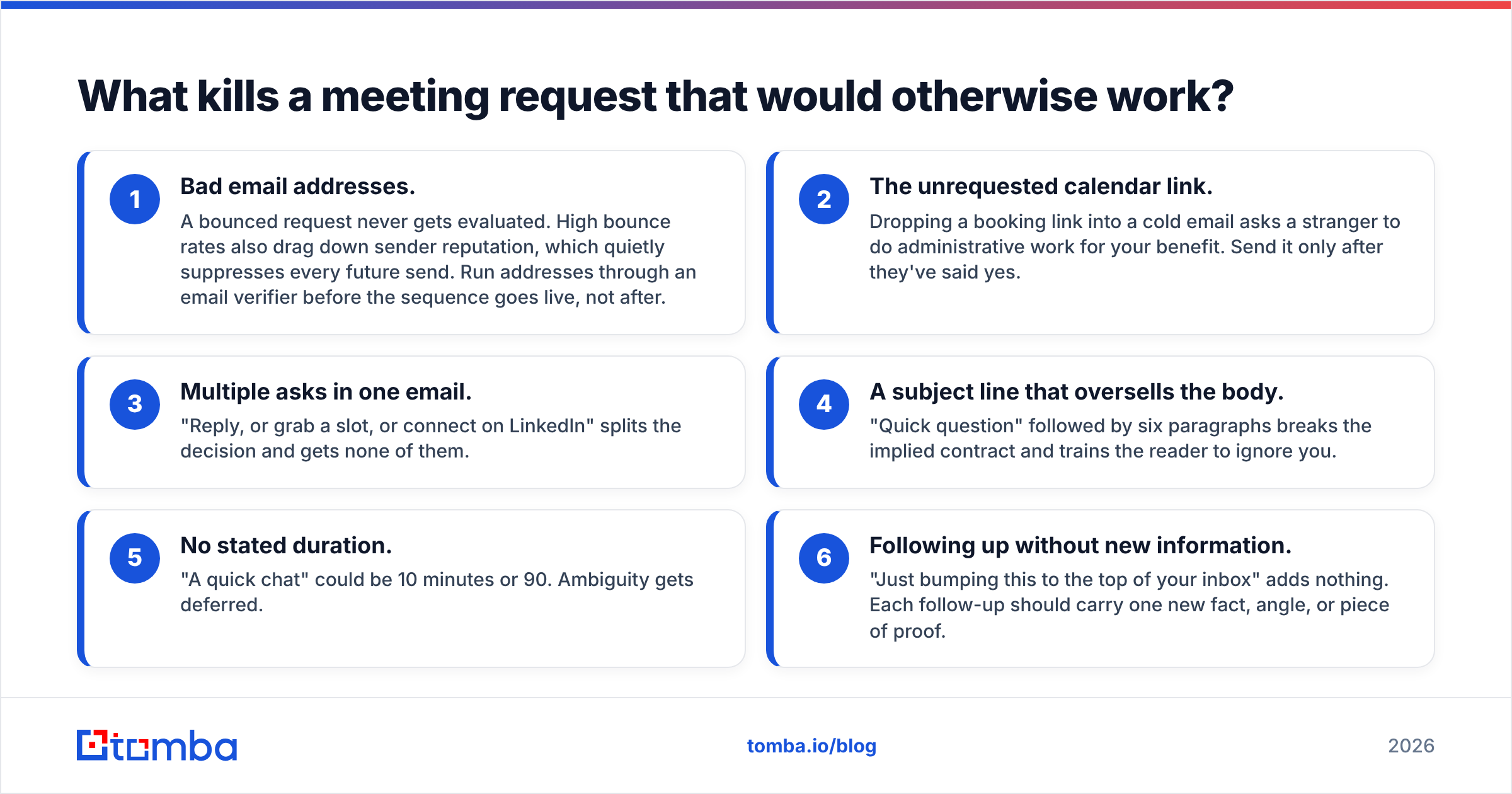
- Bad email addresses. A bounced request never gets evaluated. High bounce rates also drag down sender reputation, which quietly suppresses every future send. Run addresses through an email verifier before the sequence goes live, not after.
- The unrequested calendar link. Dropping a booking link into a cold email asks a stranger to do administrative work for your benefit. Send it only after they've said yes.
- Multiple asks in one email. "Reply, or grab a slot, or connect on LinkedIn" splits the decision and gets none of them.
- A subject line that oversells the body. "Quick question" followed by six paragraphs breaks the implied contract and trains the reader to ignore you.
- No stated duration. "A quick chat" could be 10 minutes or 90. Ambiguity gets deferred.
- Following up without new information. "Just bumping this to the top of your inbox" adds nothing. Each follow-up should carry one new fact, angle, or piece of proof.
Fix the first one and the rest matter more. Fix the rest and skip the first one, and you've optimized a message nobody receives.
How do you find the right person to ask in the first place?#
The best-phrased meeting request in the world fails if it goes to a departed VP or a role that has no budget authority.
Build the target list before the copy. That means identifying the specific human whose problem your product solves, confirming they still work there, and confirming their address resolves. A domain search surfaces the addresses and role patterns at a target company, which is faster than guessing at first.last@ formats and hoping.
For teams running volume, the workflow is: build the account list, pull contacts by role, verify in bulk, then write. Reversing that order — writing first, sourcing second — is how reps end up with beautiful sequences firing at dead inboxes. If you're pulling contacts from a mix of sources, a bulk email finder collapses the sourcing and verification steps into one pass.
Peers in this space handle sourcing differently and well — BookYourData, for example, sells pre-built, verified B2B lists if you'd rather buy a list than build one. The right approach depends on whether your ICP is narrow enough to justify per-account sourcing or broad enough that a purchased list gets you there faster. Both paths end in the same place: a verified address and a person who might actually reply.
How do you measure whether your ask is working?#
Track three numbers per sequence, not just "meetings booked":
- Reply rate — measures whether the email got read and whether the ask was answerable. Below 3% on a well-targeted list usually means the ask, not the targeting, is the problem.
- Positive reply rate — replies that aren't "no" or "unsubscribe." This is the true signal on ask quality.
- Reply-to-meeting rate — of the positive replies, how many turned into a calendar entry. If this is low, your problem is in the booking step (step 3 above), not the cold ask.
The diagnostic value comes from the split. High reply rate plus low reply-to-meeting rate means your cold ask is great and your scheduling follow-through is sloppy. Low reply rate with high conversion means your ask is fine but your list or subject line isn't. Tracking a single blended response rate hides both diagnoses.
Run one variable at a time. Change the ask style, hold everything else, run at least 200 sends per arm before drawing conclusions. Anything smaller is noise dressed as insight.
Start with a list that actually reaches inboxes#
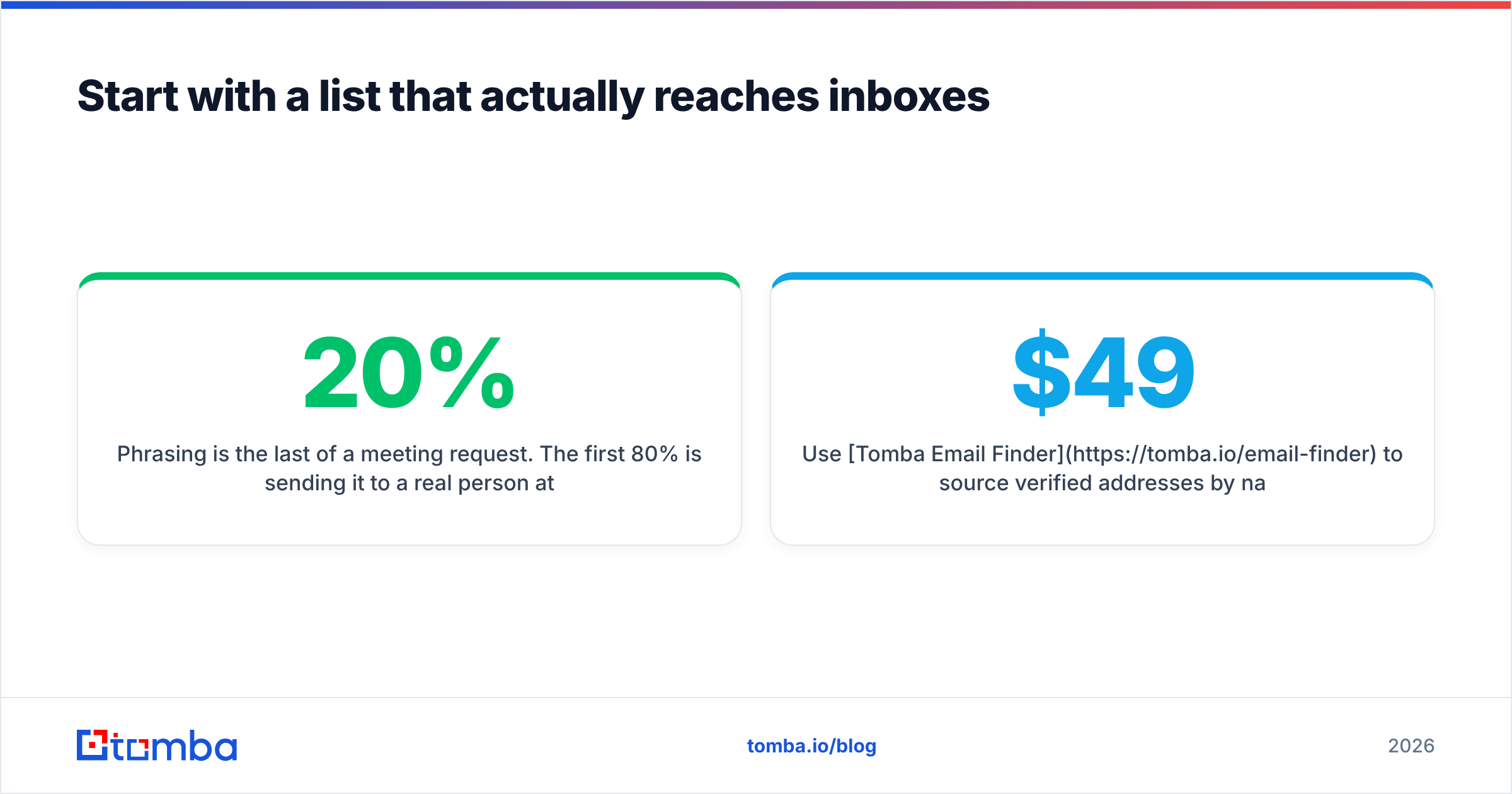
Phrasing is the last 20% of a meeting request. The first 80% is sending it to a real person at a real address who has the problem you solve.
Use Tomba Email Finder to source verified addresses by name, company, or domain before you write a single line of copy — 25 free searches a month to test it, then $49/mo on Starter with bulk and API access as you scale. Full Tomba pricing is public, no sales call required. Get the addresses right, size the ask correctly, and the calendar fills itself.
Related guides#
Ready to find emails that actually work?
Join 150,000+ professionals who stopped guessing and started sending. Free credits on signup — no credit card required.
Get the Tomba newsletter
Practical outbound tactics and product updates — once every two weeks.
About the author