How To Ask For Referrals In Sales: A 2026 Playbook
Most reps ask for referrals at the wrong moment, with the wrong words, and get nothing. Here is the timing, the exact scripts, and the follow-through system that turns one happy customer into three warm conversations.
TL;DR
- The best referral window is 30–90 days after a customer hits their first measurable win — not at contract signature, and not at renewal.
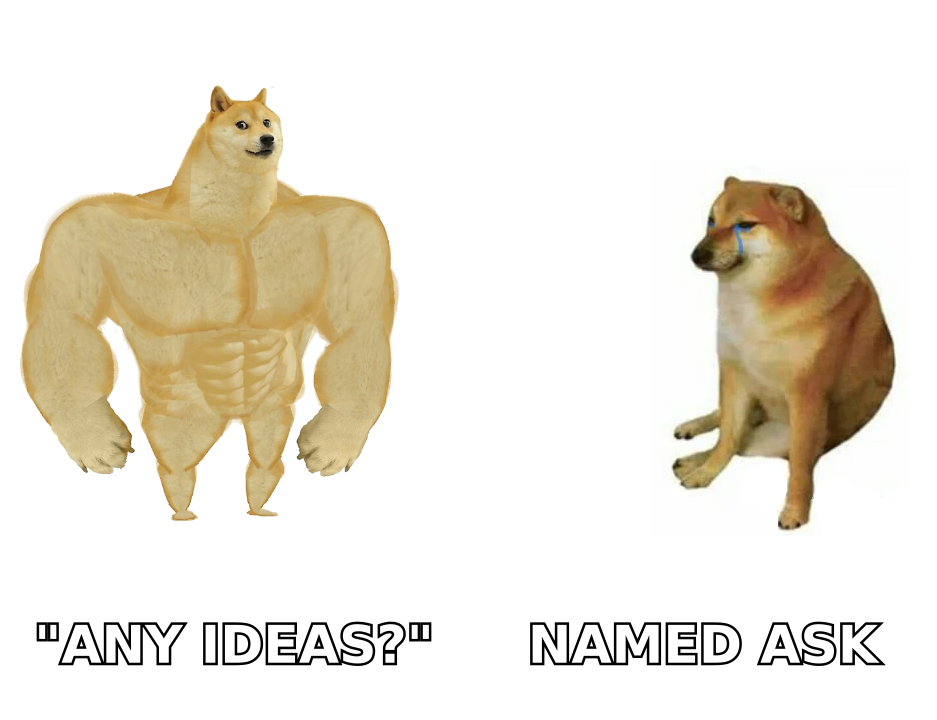
- Vague asks ("know anyone who'd benefit?") get vague answers. Named asks ("would an intro to Sarah at Northwind make sense?") convert 3–5x better because you did the thinking.
- Referrals close faster and churn less than cold-sourced deals, which is why they belong in your pipeline forecast, not your "nice to have" bucket.
- Build a referral system: a trigger, a script, a forwardable intro email, and a closed loop that tells the referrer what happened.
- Research the target before you ask. Knowing the account, the role, and a verified contact turns "I'll think about it" into "sure, I'll send a note."
Why do most referral asks fail?#
Because they're an afterthought. A rep finishes a good QBR, feels the warmth in the room, and blurts out "hey, if you know anyone who could use us, send them my way." The customer says "absolutely" — and nothing happens. Ever.
That failure has three causes, and all three are fixable.
1. You outsourced the work. "Know anyone?" asks your customer to scan their entire professional network, filter it against an ICP they've never seen, and decide who won't be annoyed. That's ten minutes of cognitive labor you just handed to someone who owes you nothing. Most people quietly decline by saying yes and forgetting.
2. You asked at a moment with no proof. Signature day feels celebratory to you. To your customer it's the moment of maximum unvalidated risk — they just spent money and have zero results. They are not going to stake their reputation on you yet.
3. There was no mechanism. No follow-up, no forwardable email, no reminder, no report back. The ask evaporated into the meeting notes.
Fix those and referral generation stops being luck. It becomes a repeatable prospecting channel that sits alongside outbound and inbound in your pipeline math.
When is the right time to ask for a referral?#
Timing is the single biggest lever. Ask before value is proven and you get politeness. Ask after value is proven and you get names.
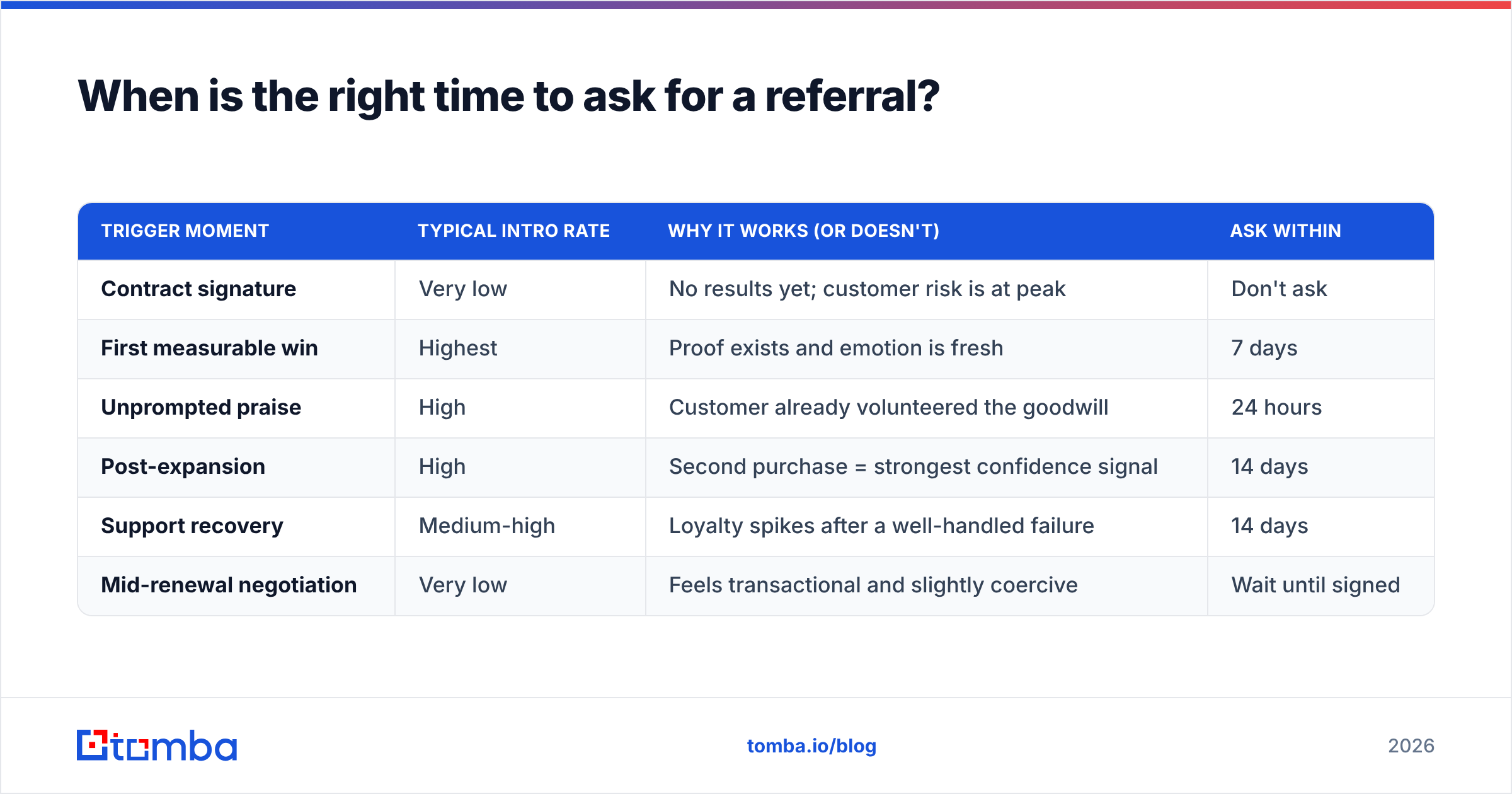
Here are the five windows worth building triggers around, ranked by how reliably they produce an actual intro:
- First measurable win (strongest). The customer just hit a number they care about — 30% faster onboarding, first closed deal from your data, a metric on a dashboard. Ask within a week of that moment while the feeling is fresh.
- Unprompted praise. A thank-you email, a positive NPS comment, a Slack message that says "this is great." Praise is consent. Respond to it with an ask within 24 hours.
- Successful expansion or upsell. They just voluntarily gave you more money. That's the strongest possible proof they believe in the product.
- Support recovery. Counterintuitive but real — a customer whose serious problem you fixed fast is often more loyal than one who never had a problem. Wait two weeks after resolution.
- Renewal, but only after signing. Never during the negotiation. Once the paperwork is done, the pressure is off and the ask feels clean.
Notice what's absent: the close. Closing day is the worst possible time, no matter how good the relationship felt.
| Trigger moment | Typical intro rate | Why it works (or doesn't) | Ask within |
|---|---|---|---|
| Contract signature | Very low | No results yet; customer risk is at peak | Don't ask |
| First measurable win | Highest | Proof exists and emotion is fresh | 7 days |
| Unprompted praise | High | Customer already volunteered the goodwill | 24 hours |
| Post-expansion | High | Second purchase = strongest confidence signal | 14 days |
| Support recovery | Medium-high | Loyalty spikes after a well-handled failure | 14 days |
| Mid-renewal negotiation | Very low | Feels transactional and slightly coercive | Wait until signed |
Set these as tasks in your CRM so the trigger fires whether or not the rep remembers. A referral program that depends on someone "feeling the moment" is not a program.
How do you actually phrase the ask?#
The core principle: do the work for them. Show up with a specific name, a specific reason, and a pre-written message they can forward in ten seconds.
Here are five scripts covering the situations you'll actually face.
Script 1 — The named ask (default, highest converting)#
"Quick one, unrelated to our roadmap. I noticed Sarah Chen runs RevOps at Northwind — she's connected to you on LinkedIn. She's dealing with the same data-decay problem you were six months ago. Would an intro make sense, or is that relationship not close enough? Totally fine either way."
Why it works: you named the person, named the reason, and gave an explicit permission to decline. That last part matters more than reps think — an easy "no" makes "yes" feel low-risk.
Script 2 — The category ask (when you don't have names yet)#
"You mentioned your old peer group from Datadog. Is there one or two people in that group running a similar team who'd find what we built useful? I'm not asking for a pitch — happy to just answer questions for them."
Narrows the search space from "your whole network" to a specific group they can picture.
Script 3 — The praise-triggered ask#
"That message made my week, thank you. Can I ask for something small in return? If there's one person who'd want the same result, I'd love an intro. And if you'd rather just leave a note on G2 instead, that's honestly just as useful to us."
Giving a second, lower-effort option converts the people who won't spend social capital but will spend five minutes.
Script 4 — The internal referral#
"You're getting value in marketing ops. Who owns this on the sales side? Even a quick 'you should talk to these two' in a Slack thread would help."
Cheapest referral in existence: same company, existing trust, no new logo risk. Most reps never ask.
Script 5 — The written follow-up (send after any verbal yes)#
"Thanks again for offering to introduce me to Sarah. I've written a short note below you can forward or edit — no pressure to use my words.
Sarah — meet Alex from Tomba. We had the same contact-data mess you and I talked about last quarter; they cleaned it up in about three weeks. Worth 20 minutes if the problem's still live. Alex, over to you."
The forwardable draft is the highest-leverage sentence in this entire post. Verbal yeses die from friction, not from insincerity.
What should you do before you ask?#
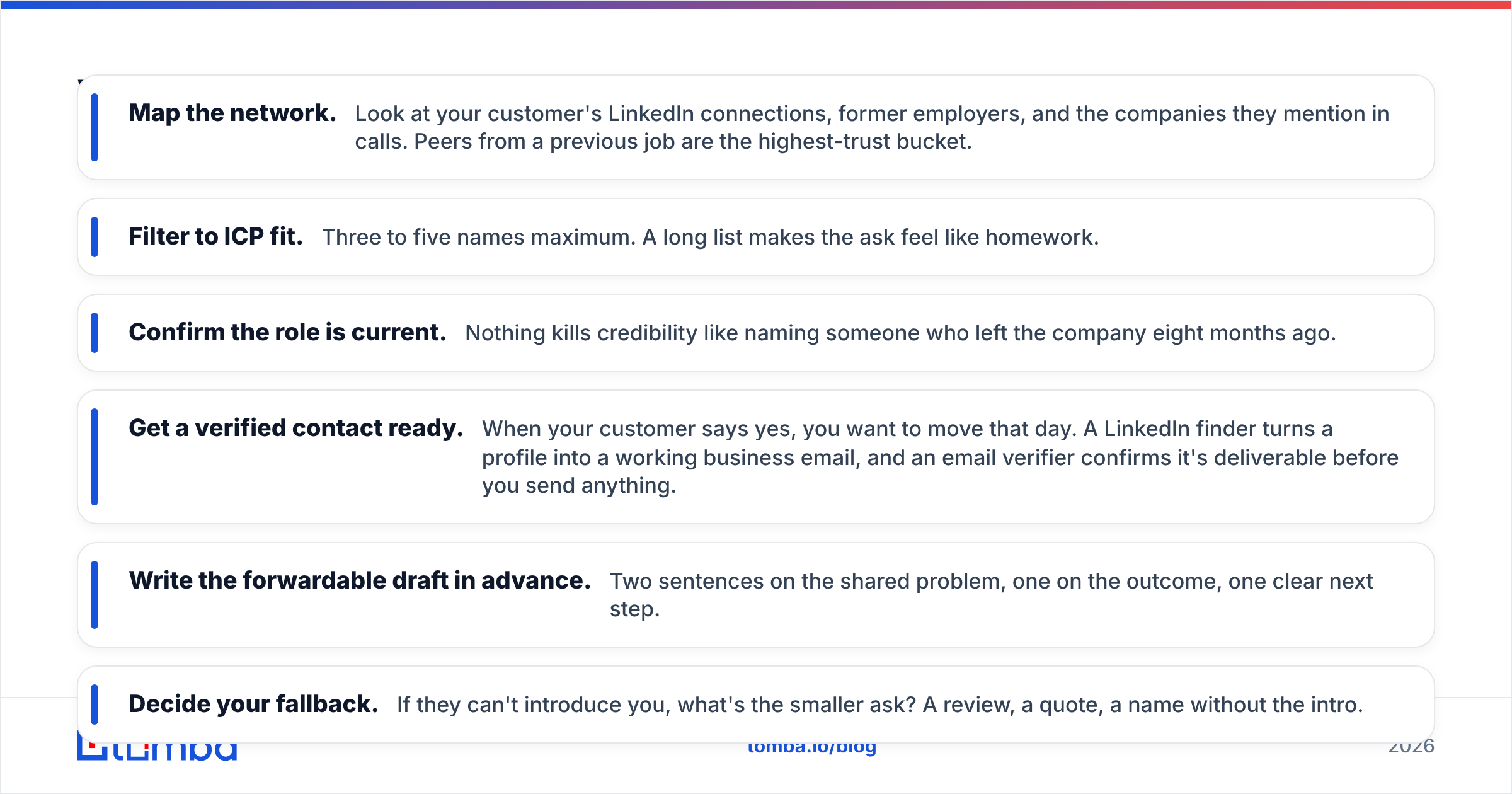
Preparation is what separates a named ask from a category ask, and named asks win. Before the conversation, spend fifteen minutes building a short target list you can put in front of your customer.
- Map the network. Look at your customer's LinkedIn connections, former employers, and the companies they mention in calls. Peers from a previous job are the highest-trust bucket.
- Filter to ICP fit. Three to five names maximum. A long list makes the ask feel like homework.
- Confirm the role is current. Nothing kills credibility like naming someone who left the company eight months ago.
- Get a verified contact ready. When your customer says yes, you want to move that day. A LinkedIn finder turns a profile into a working business email, and an email verifier confirms it's deliverable before you send anything.
- Write the forwardable draft in advance. Two sentences on the shared problem, one on the outcome, one clear next step.
- Decide your fallback. If they can't introduce you, what's the smaller ask? A review, a quote, a name without the intro.
That last point is where most referral programs leak. You will get a lot of "sure, send me something and I'll pass it on" — and then the contact details are wrong, the note is too long, or three days pass and momentum dies. Having the contact verified and the draft written means the whole thing takes your customer ninety seconds.
Are referrals really better than cold outbound?#
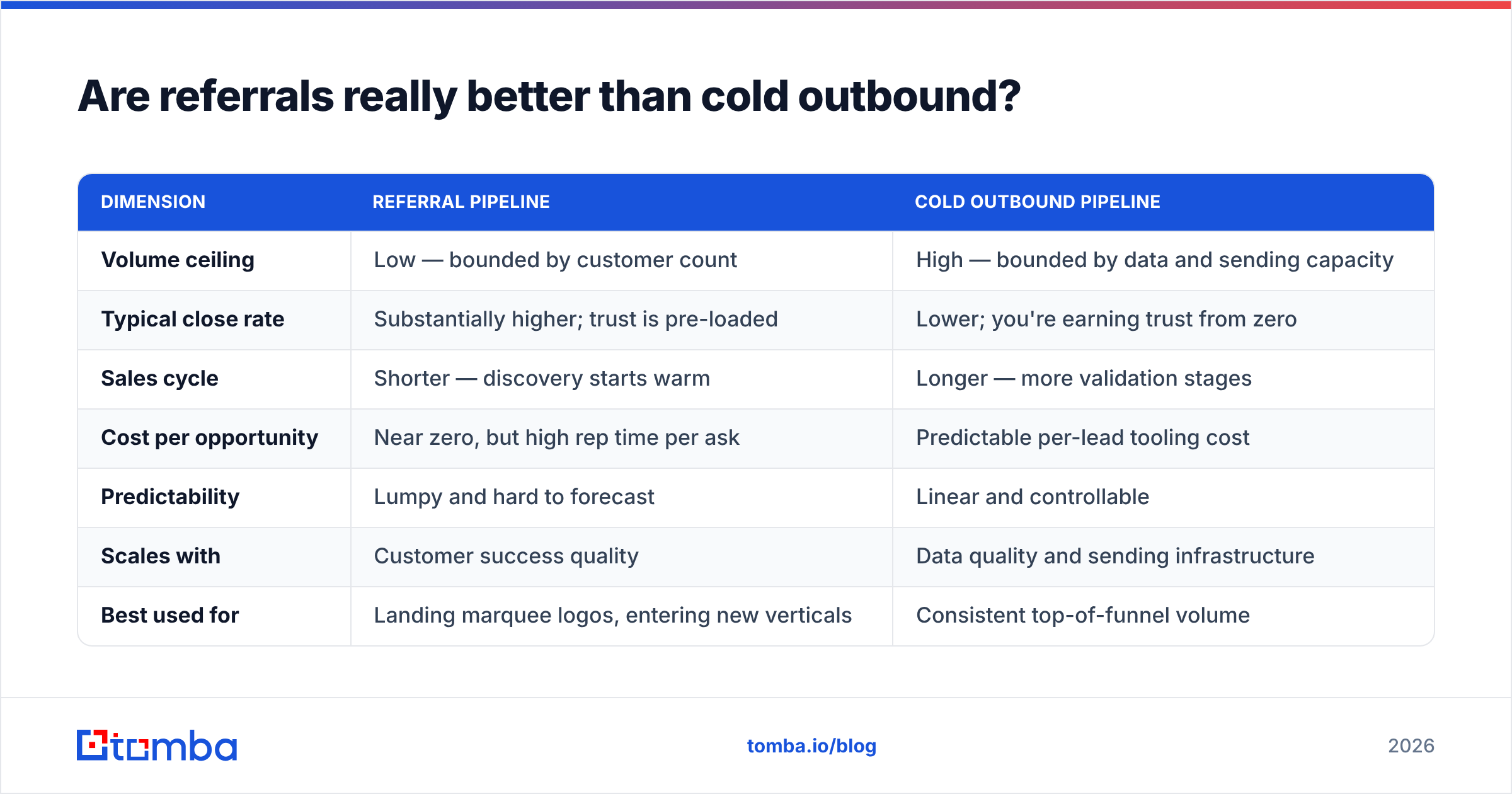
Yes, on close rate and cycle length — but not on volume. That trade-off is the entire strategic point, and it's why referrals should supplement rather than replace your other channels.
| Dimension | Referral pipeline | Cold outbound pipeline |
|---|---|---|
| Volume ceiling | Low — bounded by customer count | High — bounded by data and sending capacity |
| Typical close rate | Substantially higher; trust is pre-loaded | Lower; you're earning trust from zero |
| Sales cycle | Shorter — discovery starts warm | Longer — more validation stages |
| Cost per opportunity | Near zero, but high rep time per ask | Predictable per-lead tooling cost |
| Predictability | Lumpy and hard to forecast | Linear and controllable |
| Scales with | Customer success quality | Data quality and sending infrastructure |
| Best used for | Landing marquee logos, entering new verticals | Consistent top-of-funnel volume |
The honest read: referrals are your highest-quality channel and your least controllable one. If you need to triple pipeline next quarter, referrals won't get you there alone. If you need to break into a vertical where you have one strong logo, referrals are the fastest path in. Run both, and use referral-sourced accounts to build lookalike lists for outbound with a domain search across similar companies.
Research on buying behavior from HubSpot and analyst work from Gartner both point the same direction: buyers weight peer input above vendor input at nearly every stage. A referral doesn't just skip the cold open — it imports credibility you couldn't have manufactured.
How do you close the loop after the intro?#
Half of referral programs die here. The intro happens, the rep runs the deal, and the referrer never hears another word. That person will not refer you again.
Build a three-touch loop:
Touch 1 — within 24 hours. Reply-all to the intro thread, move the referrer to BCC, and thank them explicitly. "Moving you to BCC — thanks again, Marcus. Sarah, does Thursday at 2 work?"
Touch 2 — after the first meeting. One line, direct to the referrer. "Met with Sarah, great conversation, we're scoping a pilot. Appreciate you." No ask attached. This is pure reciprocity maintenance.
Touch 3 — at outcome, win or lose. If you won, say so and say thank you concretely. If you lost, say that too — it's disarming and it protects the referrer's relationship. People refer again when they know the last one was handled well.
Track all three in your CRM against a referral_source field. Without that field you can't attribute revenue to the channel, and a channel with no attribution eventually loses its budget and its attention.
What does a repeatable referral system look like?#
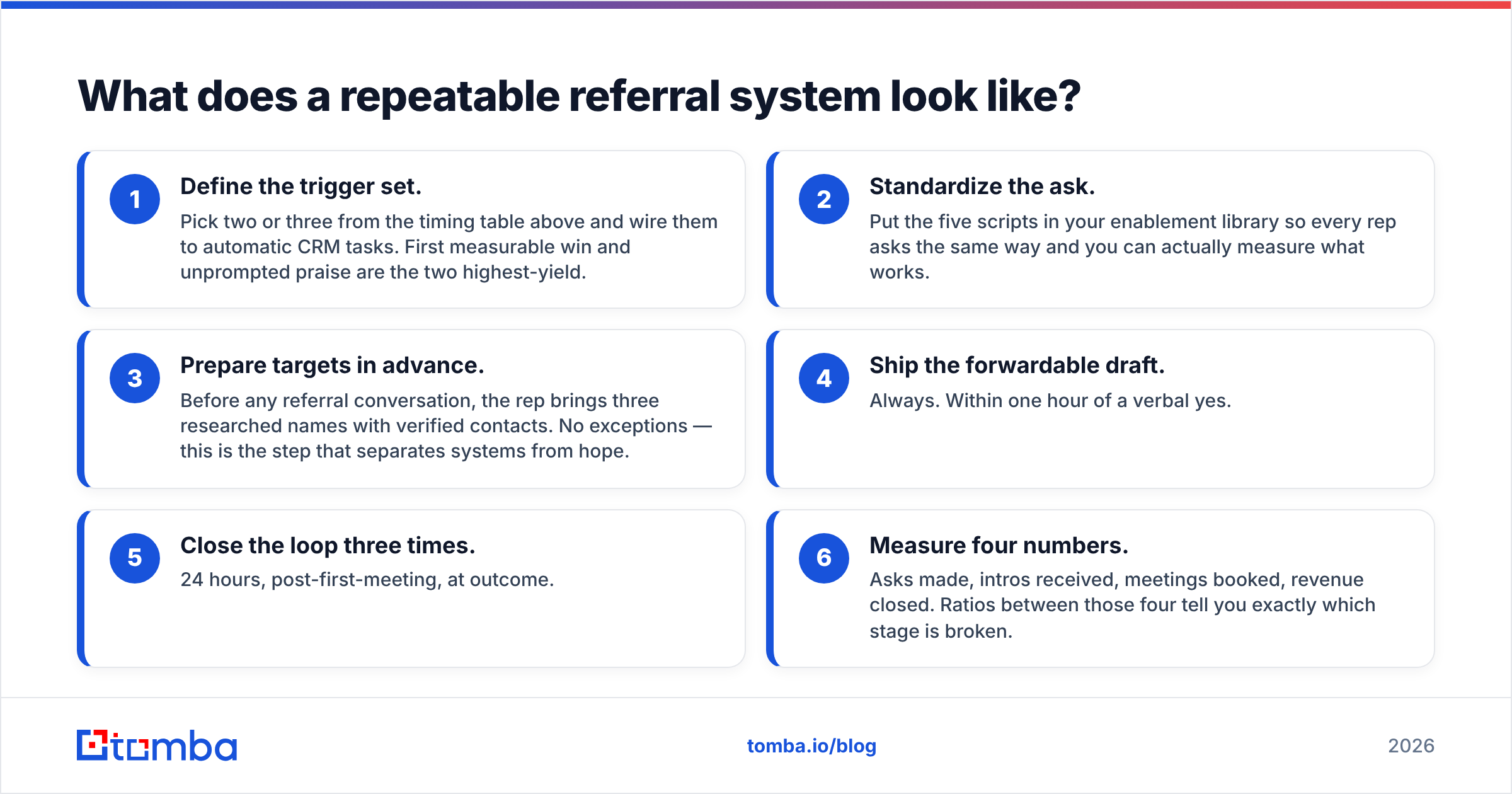
Individual scripts produce individual intros. A system produces a channel. Here's the minimum viable version:
- Define the trigger set. Pick two or three from the timing table above and wire them to automatic CRM tasks. First measurable win and unprompted praise are the two highest-yield.
- Standardize the ask. Put the five scripts in your enablement library so every rep asks the same way and you can actually measure what works.
- Prepare targets in advance. Before any referral conversation, the rep brings three researched names with verified contacts. No exceptions — this is the step that separates systems from hope.
- Ship the forwardable draft. Always. Within one hour of a verbal yes.
- Close the loop three times. 24 hours, post-first-meeting, at outcome.
- Measure four numbers. Asks made, intros received, meetings booked, revenue closed. Ratios between those four tell you exactly which stage is broken.
If asks-to-intros is low, your timing or your specificity is wrong. If intros-to-meetings is low, your forwardable draft is too long or your contact data is stale. If meetings-to-revenue is low, the problem isn't the referral program — it's qualification.
Feed referral-sourced accounts back into the top of your funnel too. When a referral lands you a customer in a new vertical, that's a signal to build a lookalike list. Enriching those accounts with contact enrichment turns one warm win into a repeatable segment rather than a one-off.
What mistakes should you avoid?#
- Asking too early. No proof, no referral. This is the number one error.
- Asking everyone equally. Concentrate on the customers who've expressed unprompted enthusiasm. Referral capacity is not evenly distributed.
- Making it about you. "Help me hit quota" is a worse frame than "I think Sarah has the problem you had."
- Skipping the draft. A verbal yes without a forwardable note converts at a fraction of the rate.
- Over-asking. One referral request per customer per quarter, maximum. Referral goodwill is a finite balance you can overdraw.
- Going silent afterwards. The fastest way to guarantee a customer never refers you twice.
Start with better target research#
The bottleneck in most referral programs isn't willingness — it's specificity. Customers want to help; they just don't want to do your prospecting for you. Show up with three researched names, a clear reason for each, and a verified contact ready to go, and the yes rate changes immediately.
That's where Tomba Email Finder fits. Identify the peers and adjacent teams worth asking about, confirm the contact details are live before you request the intro, and move the same day your customer says yes. The free tier covers 25 searches a month if you want to test the workflow on your next three referral conversations; paid Tomba plans start at $49/mo when you're ready to run it across the team.
Ask at the right moment, with the right name, and follow through three times. That's the whole playbook.
Related guides#
Ready to find emails that actually work?
Join 150,000+ professionals who stopped guessing and started sending. Free credits on signup — no credit card required.
Get the Tomba newsletter
Practical outbound tactics and product updates — once every two weeks.
About the author