How To Ask Open Ended Questions In Sales (2026 Guide)
Closed questions get you a yes. Open-ended questions get you a budget, a timeline, and a champion. Here are the exact frameworks, scripts, and mistakes to avoid.
TL;DR
- Open-ended questions start with what, how, why, walk me through, or tell me about — anything that cannot be answered with yes, no, or a number.
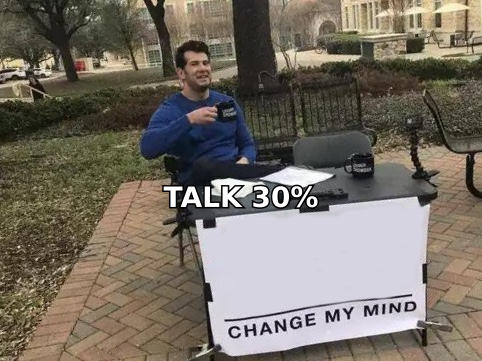
- The measurable goal is talk-time ratio. Top reps talk roughly 30-45% of a discovery call; the rest is the buyer explaining their own problem back to them.
- Use a three-layer sequence: a broad situation question, a follow-up that digs into impact, then a silent pause. The pause does more work than the question.
- Closed questions are not banned. They confirm, quantify, and close. Use them as punctuation, not as the paragraph.
- Questions only pay off if you are talking to someone who can answer them — get the right contact first with a tool like Tomba's email finder, then run the framework below.
What is an open-ended question in sales?#
An open-ended question is one your prospect cannot answer with a single word. "Do you have a budget for this?" is closed — the answer is yes or no and the conversation stalls. "How does budget get approved for tools like this at your company?" is open — now you are getting a process map, names of stakeholders, and a timeline you did not ask for.
Think of it like a doorway versus a keyhole. A closed question lets you peek at one specific fact. An open-ended question opens the door and lets the buyer walk you through the whole room, including the mess they were not planning to show you.
Technically, the difference is grammatical: closed questions begin with a verb (Do, Is, Are, Can, Will, Have), open questions begin with an interrogative or an imperative (What, How, Why, Walk me through, Tell me about, Describe). That single word choice changes the average response length from about 3 words to 40 or more.
The reason this matters commercially: buyers who articulate their own pain out loud commit to solving it at a much higher rate than buyers who nod along while you describe pain to them. You are not extracting information. You are helping them build the business case in their own vocabulary — which is the vocabulary that will get repeated internally when you are not in the room.
Why do closed questions kill discovery calls?#
Three failure modes show up on almost every recorded call.
- You get facts without context. "Are you using a CRM?" returns "Yes, Salesforce." You learn nothing about whether it is adopted, hated, or up for renewal in Q3.
- You control the agenda instead of the buyer. A rep firing ten closed questions runs an interrogation. Buyers answer defensively and volunteer nothing.
- You confirm your own hypothesis. Closed questions are leading by nature. "So speed is your main issue, right?" gets a polite yes and sends you into a demo that solves the wrong problem.
- Your talk-time inverts. Gong's conversation research has repeatedly found that successful discovery calls skew toward the buyer speaking more than the seller — closed questions guarantee the opposite.
None of that means closed questions are useless. They are precision instruments. "Is January realistic for a decision?" after twenty minutes of open discovery is a legitimate, useful commitment test. The mistake is opening with them.
How do open-ended and closed questions compare?#
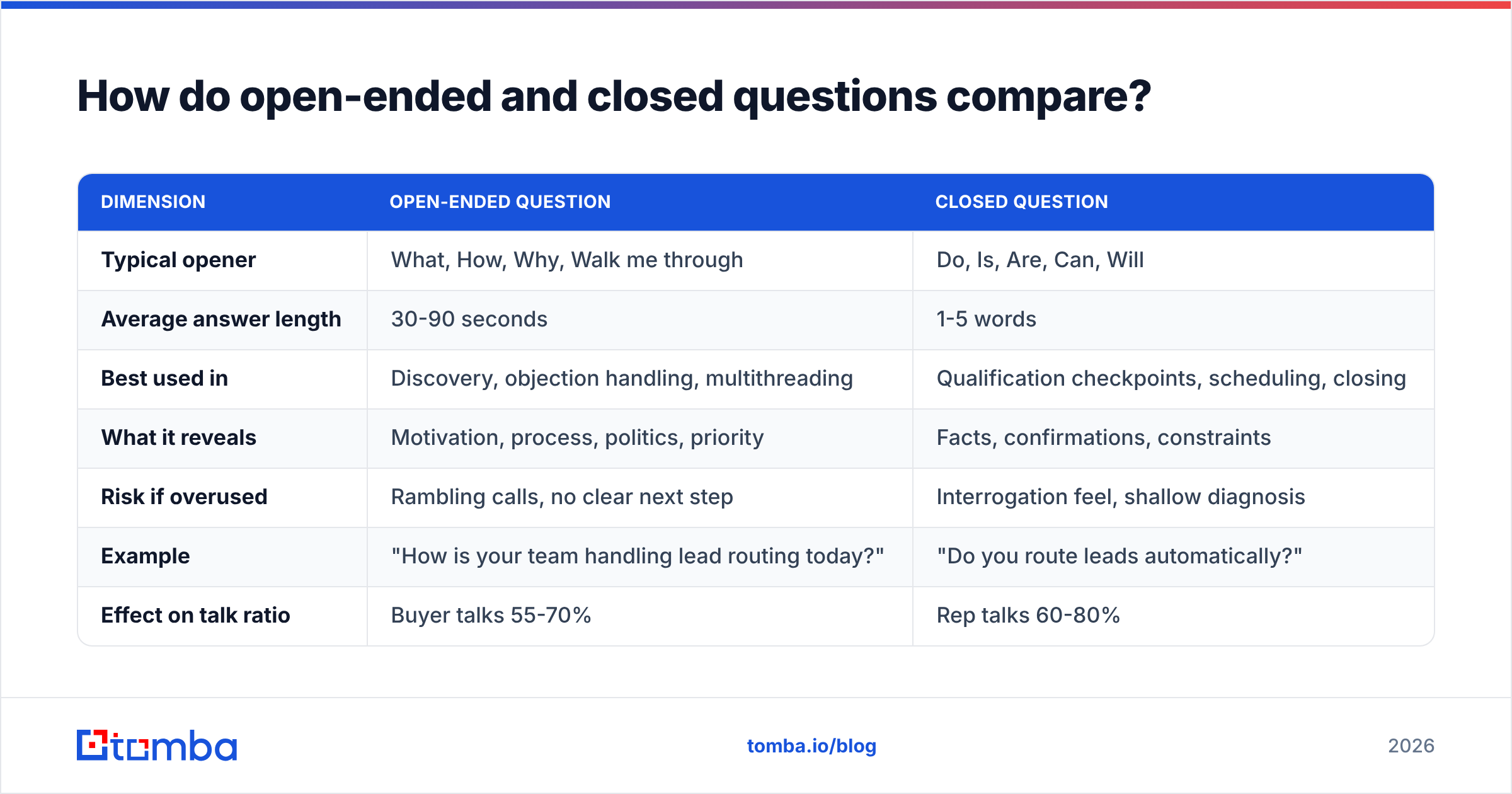
| Dimension | Open-ended question | Closed question |
|---|---|---|
| Typical opener | What, How, Why, Walk me through | Do, Is, Are, Can, Will |
| Average answer length | 30-90 seconds | 1-5 words |
| Best used in | Discovery, objection handling, multithreading | Qualification checkpoints, scheduling, closing |
| What it reveals | Motivation, process, politics, priority | Facts, confirmations, constraints |
| Risk if overused | Rambling calls, no clear next step | Interrogation feel, shallow diagnosis |
| Example | "How is your team handling lead routing today?" | "Do you route leads automatically?" |
| Effect on talk ratio | Buyer talks 55-70% | Rep talks 60-80% |
The practical rule: roughly 70% open, 30% closed on a first call. Flip the ratio on a closing call, where you are confirming rather than exploring.
What are the best open-ended sales questions to ask?#
Here is a working bank organized by call stage. Steal them verbatim and adapt the nouns.
Situation and context
- "Walk me through how your team handles [process] today, start to finish."
- "What made you take this call? Something must have changed recently."
- "Who else touches this process besides your team?"
Problem and impact
- "What happens downstream when [problem] occurs?"
- "How much of your week goes into working around this?"
- "What have you already tried, and where did it fall short?"
Priority and urgency
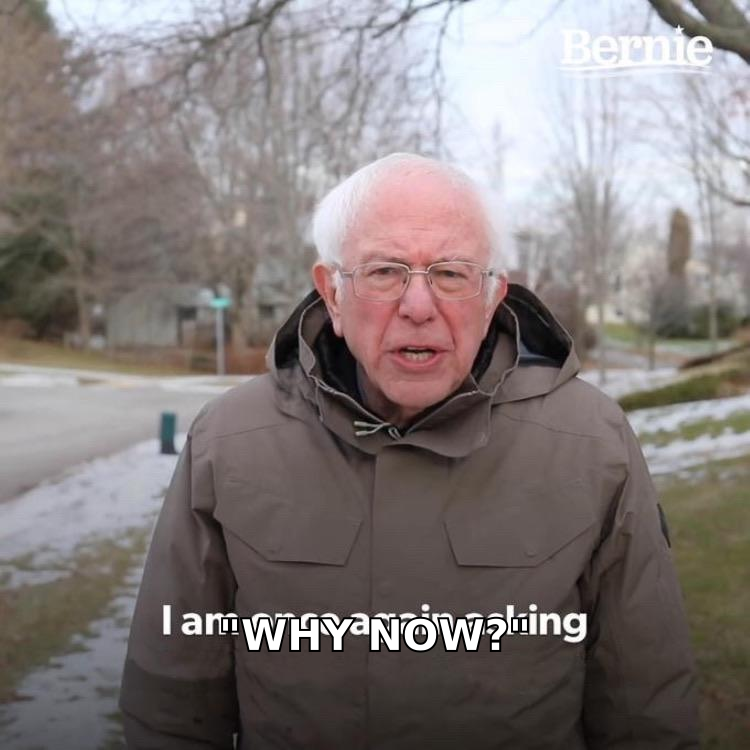
- "Why is this getting attention now rather than six months ago?"
- "What else is competing with this for budget this quarter?"
- "If nothing changes by year-end, what does that cost you?"
Decision process
- "How did the last tool like this get approved here?"
- "Who would need to be comfortable with this before it moves forward?"
- "What would make this an easy yes internally — and what would make it a hard no?"
Objection handling
- "Tell me more about that." (The most underused sentence in sales.)
- "What would need to be true for the price to make sense?"
- "When you say it's not the right time, what has to happen first?"
Notice that none of them contain your product. Discovery is not a soft demo.
How do you structure an open-ended question sequence?#
A single good question is a coin flip. A sequence is a system. Use this four-step loop and repeat it two or three times per call.
- Layer 1 — Broad situation. "Walk me through how your SDRs build a prospect list today." Low threat, easy to answer, generates raw material.
- Layer 2 — Specific mechanic. Pick one word from their answer and dig. They said "we scrape LinkedIn and clean it in a spreadsheet"? Ask: "What does the cleaning step actually involve?"
- Layer 3 — Quantified impact. "How many hours a week does that cleaning cost the team, and what does that displace?" Now you have a number the buyer chose, not one you asserted.
- Layer 4 — Silence. Count to four after the answer. Roughly a third of the time, the buyer keeps talking, and the second half of the answer is the honest one.
The trap most reps fall into is stacking. Do not ask "How does your team handle lead routing, and are you happy with it, or is that something you'd change?" That is three questions in a trench coat, and the buyer will answer only the easiest one. One question. Then stop.
A second trap is the fake-open question. "What do you think about how much time you're wasting on manual data entry?" is a closed leading question wearing a "what" costume. If your question contains the answer, it is not discovery.
How do you know your discovery questions are working?#
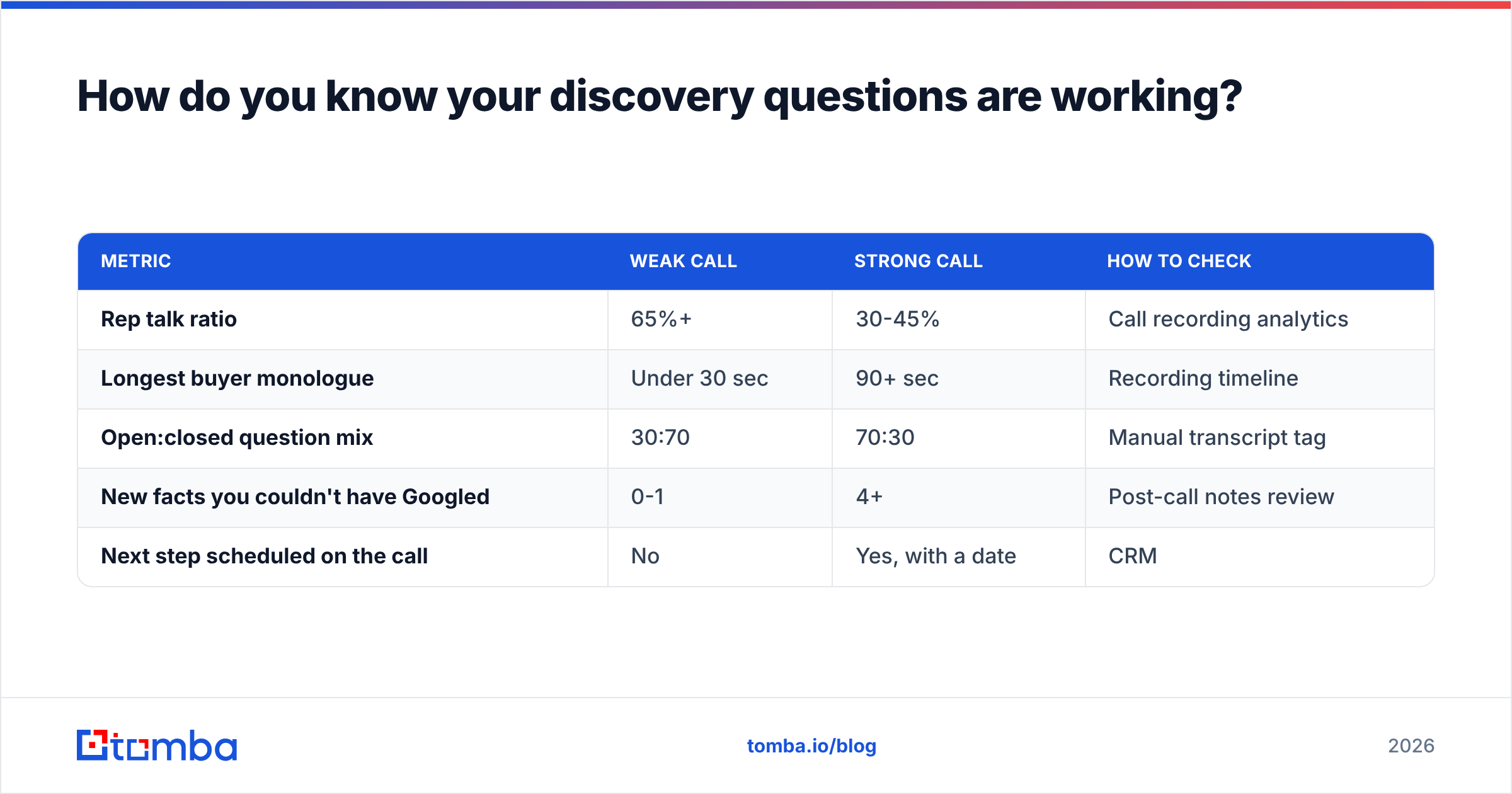
Measure four things per call. If you use a conversation intelligence tool, three of these are automatic; the fourth needs judgment.
| Metric | Weak call | Strong call | How to check |
|---|---|---|---|
| Rep talk ratio | 65%+ | 30-45% | Call recording analytics |
| Longest buyer monologue | Under 30 sec | 90+ sec | Recording timeline |
| Open:closed question mix | 30:70 | 70:30 | Manual transcript tag |
| New facts you couldn't have Googled | 0-1 | 4+ | Post-call notes review |
| Next step scheduled on the call | No | Yes, with a date | CRM |
That fourth row is the honest one. If everything you wrote in your CRM after the call was already on the company's website or LinkedIn page, you did not run discovery — you ran a presentation with pauses.
Track your own response rate alongside these call metrics. Reps who ask better questions tend to write better follow-up emails, because they have specific language to mirror back.
What are the most common mistakes when asking open-ended questions?#
- Asking questions you should have researched. "So what does your company do?" burns credibility in the first 60 seconds. Do the homework — company size, tech stack, recent funding, who reports to whom — before you dial. Tools like data enrichment fill in the firmographics so your call time goes to things you genuinely cannot look up.
- Interrupting the pause. Silence feels ten times longer to the person who asked the question. Let it sit.
- Not taking a note when they say something painful. Write the exact phrase down. Use it in the proposal. Buyers notice their own words.
- Treating "why" as an accusation. "Why did you choose that vendor?" can land as a challenge. Soften with framing: "I'm curious what tipped the decision toward them."
- Running discovery on the wrong person. The most beautifully sequenced question set is worthless on someone with no budget and no pain. Verify seniority and reachability first.
- Never circling back to close. Open questions expand. At some point you must contract with a closed one: "Does Thursday at 10 work to walk your CFO through this?"
How do open-ended questions work over email and LinkedIn?#
Different medium, same principle — with one adjustment: the question has to be answerable in one sentence, because nobody types a 90-second monologue into an email reply.
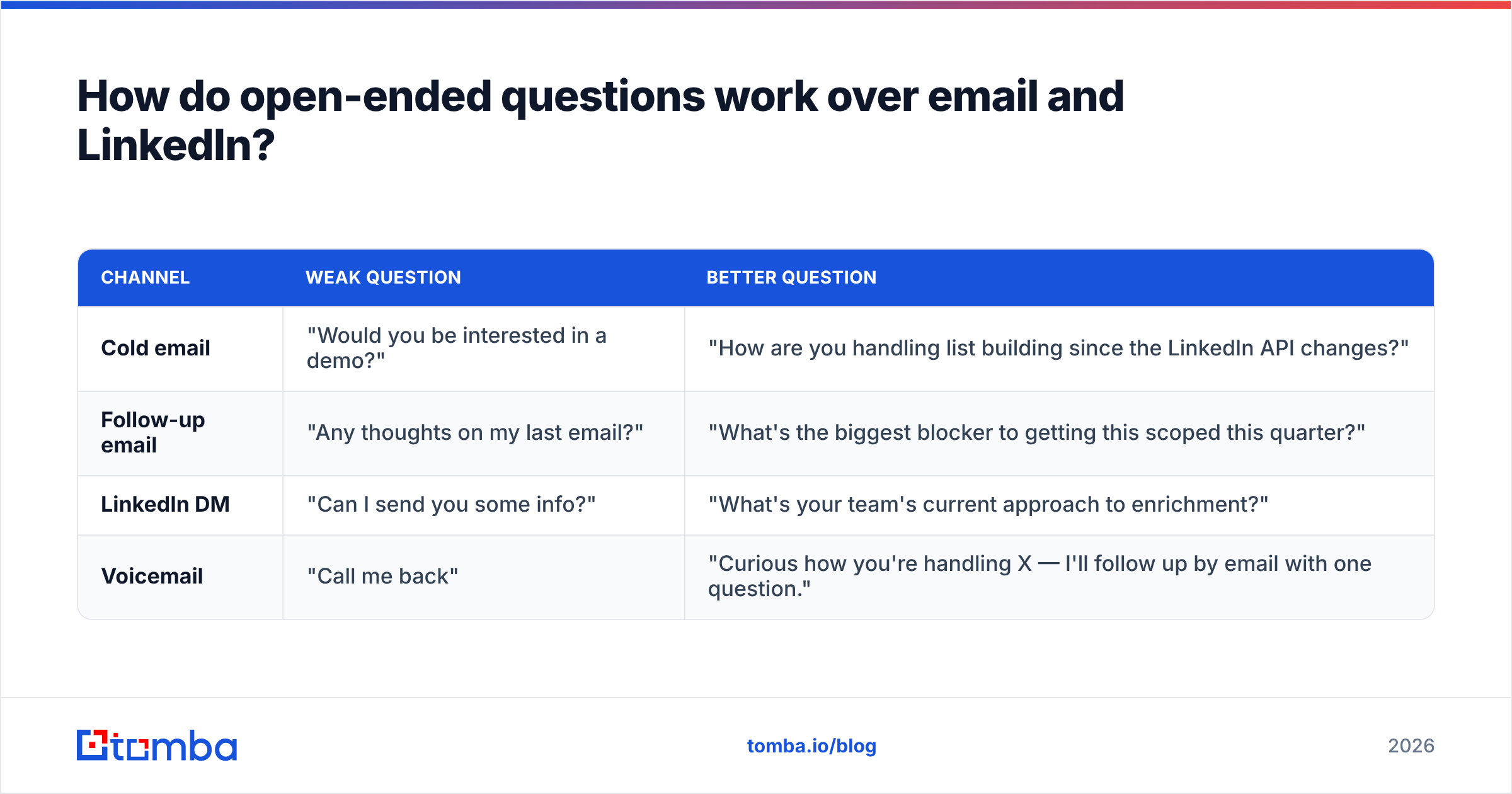
That means asymmetric effort. Your email should be short, and the question should be cheap to answer but still open. Compare:
| Channel | Weak question | Better question |
|---|---|---|
| Cold email | "Would you be interested in a demo?" | "How are you handling list building since the LinkedIn API changes?" |
| Follow-up email | "Any thoughts on my last email?" | "What's the biggest blocker to getting this scoped this quarter?" |
| LinkedIn DM | "Can I send you some info?" | "What's your team's current approach to enrichment?" |
| Voicemail | "Call me back" | "Curious how you're handling X — I'll follow up by email with one question." |
The cold-email version does double duty: it is a genuine question, and it signals that you researched their situation. If you are writing these at volume, our cold email templates library has question-led frameworks you can adapt rather than starting from a blank page.
One caveat specific to email: an open question sent to a bad address is worse than no question at all, because bounces damage your sender reputation and eventually stop even your good questions from landing. Run your list through an email verifier before a question-led sequence goes out.
How do you train a team to ask better questions?#
Individual reps improve by accident. Teams improve by process.
- Build a shared question bank. One document, organized by stage, with the exact wording that has worked. Not "ask about budget" — the literal sentence.
- Tag transcripts weekly. Pick two calls per rep. Count open versus closed. Ten minutes per rep, and it makes the metric real.
- Run silent-pause drills. Role-play where the rep asks one question and is forbidden from speaking for five seconds after the answer. It feels absurd; it changes behavior faster than any other exercise.
- Review the CRM notes, not the call. If the notes contain no direct quotes from the buyer, the questions were not open enough.
- Pair questions with research standards. Set a minimum pre-call research bar so no rep wastes discovery on facts available in ten seconds. HubSpot's sales research is a reasonable public benchmark for what "prepared" looks like across the industry.
The compounding effect is real: better questions produce better CRM data, better CRM data produces better forecasting, and better forecasting makes your revenue operations function something other than a guessing exercise. Question quality is upstream of pipeline quality.
Which tools support question-led selling?#
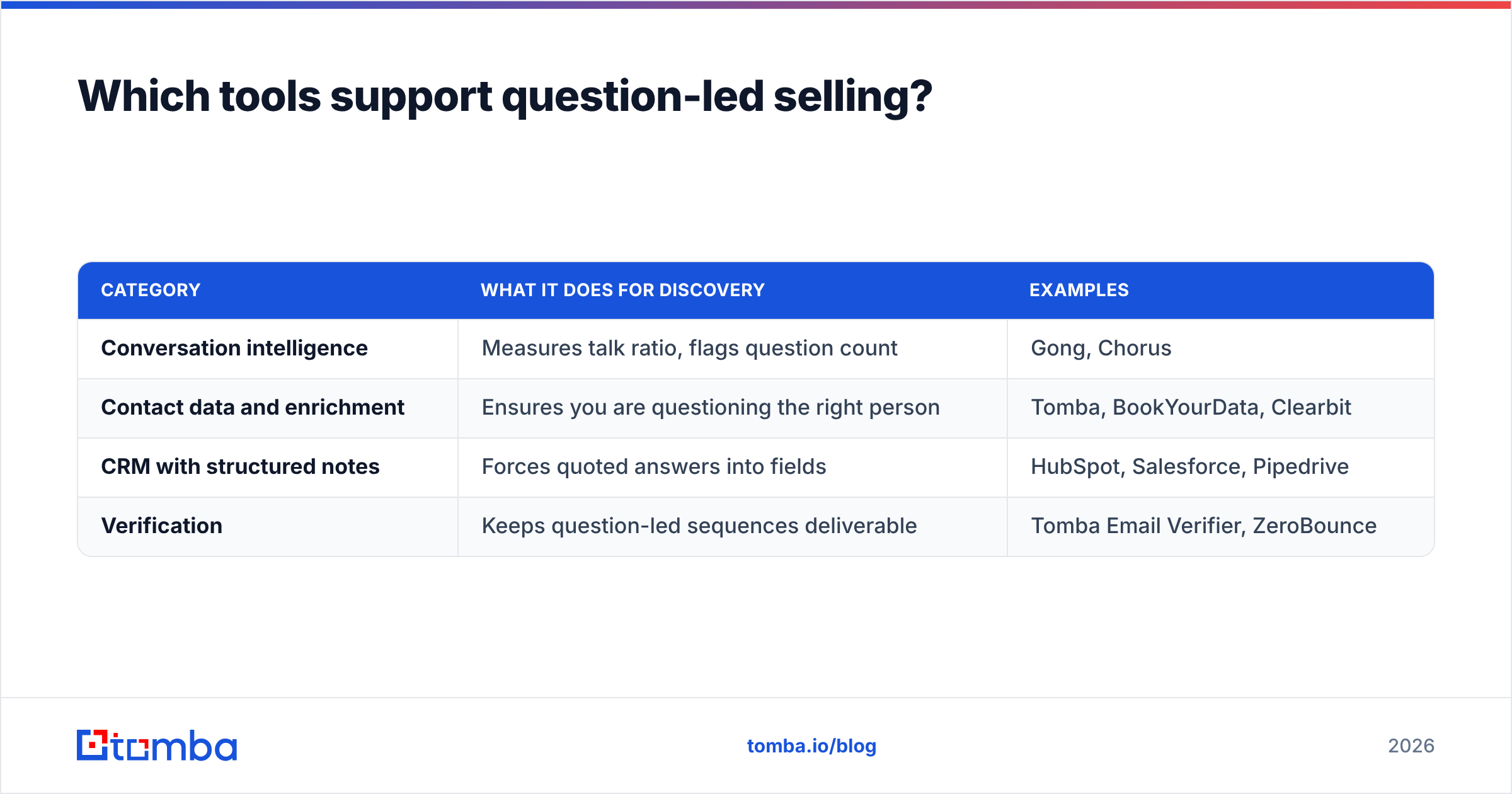
You do not need much. Three categories cover it.
| Category | What it does for discovery | Examples |
|---|---|---|
| Conversation intelligence | Measures talk ratio, flags question count | Gong, Chorus |
| Contact data and enrichment | Ensures you are questioning the right person | Tomba, BookYourData, Clearbit |
| CRM with structured notes | Forces quoted answers into fields | HubSpot, Salesforce, Pipedrive |
| Verification | Keeps question-led sequences deliverable | Tomba Email Verifier, ZeroBounce |
On the data side, cost matters because prospecting volume is where credits vanish. Tomba's free tier gives 25 searches a month to test the workflow, Starter runs $49/mo, Growth $99/mo, and Pro $249/mo — full Tomba pricing breaks down the credit allocations per tier. BookYourData is a solid option if you prefer buying pre-built lists over live lookups; the two approaches suit different motions, and plenty of teams run both.
Whatever you pick, the sequencing is the same: research the account, confirm the contact is real, then spend the call asking things you genuinely could not have found out on your own.
Where should you start tomorrow?#
Pick three questions from the bank above. Use only those three on your next five calls. Record the calls. Count your talk ratio. That is the entire program — five calls, three questions, one number.
Then fix the input side. The best discovery framework in the world cannot rescue a call with someone who does not own the problem. Use Tomba's Email Finder to reach the person who actually runs the process you want to ask about — search by domain, name, or company, verify before you send, and start the free tier at 25 searches a month before committing to a paid plan. Better questions asked to the right people is the whole job.
Related guides#
Ready to find emails that actually work?
Join 150,000+ professionals who stopped guessing and started sending. Free credits on signup — no credit card required.
Get the Tomba newsletter
Practical outbound tactics and product updates — once every two weeks.
About the author