How to Ask a Question in an Email That Actually Gets Answered
Most email questions get ignored because they ask for too much, too vaguely, or too late in the message. Here is the structure, phrasing, and follow-up cadence that gets replies from busy B2B buyers.
TL;DR
- Ask one question per email. Multi-question emails get answered at roughly half the rate of single-ask emails because they turn a 10-second reply into a task.
- Put the question in the first 40 words, not after your credentials. Mobile preview panes cut off around there.
- Make the answer cheap: closed questions ("Thursday or Friday?") outperform open ones ("What does your process look like?") for first-touch email.
- Verify the address before you obsess over the wording — a perfect question to a bouncing inbox scores zero. Use an email verifier first.
- Follow up on the same thread, restate the question in one line, and stop at four attempts.
Why do most email questions get ignored?#
Because they cost the reader more than they're worth.
Think of a question in an email like handing someone a form at a bus stop. If it's one checkbox, they'll do it while waiting. If it's a page of blanks with no pen, they'll pocket it and never look again. Every extra clause, every "also, quickly," every open-ended "thoughts?" adds a blank line to the form.
Three failure modes cause the bulk of unanswered questions:
- Buried ask. The question sits in paragraph three, after a company intro nobody requested. The reader never reaches it.
- Stacked asks. Four questions in one email. The recipient can't answer partially without feeling sloppy, so they answer none of it.
- Unbounded ask. "What are your goals for next quarter?" is a meeting, not an email. It requires drafting, so it gets deferred, then forgotten.
There's a fourth, quieter failure: the email never arrived. Bad data is the silent killer of reply rates, and no amount of copy polish fixes a hard bounce. Before you rewrite the question a fifth time, confirm the address is real.
What is the structure of a question email that gets a reply?#
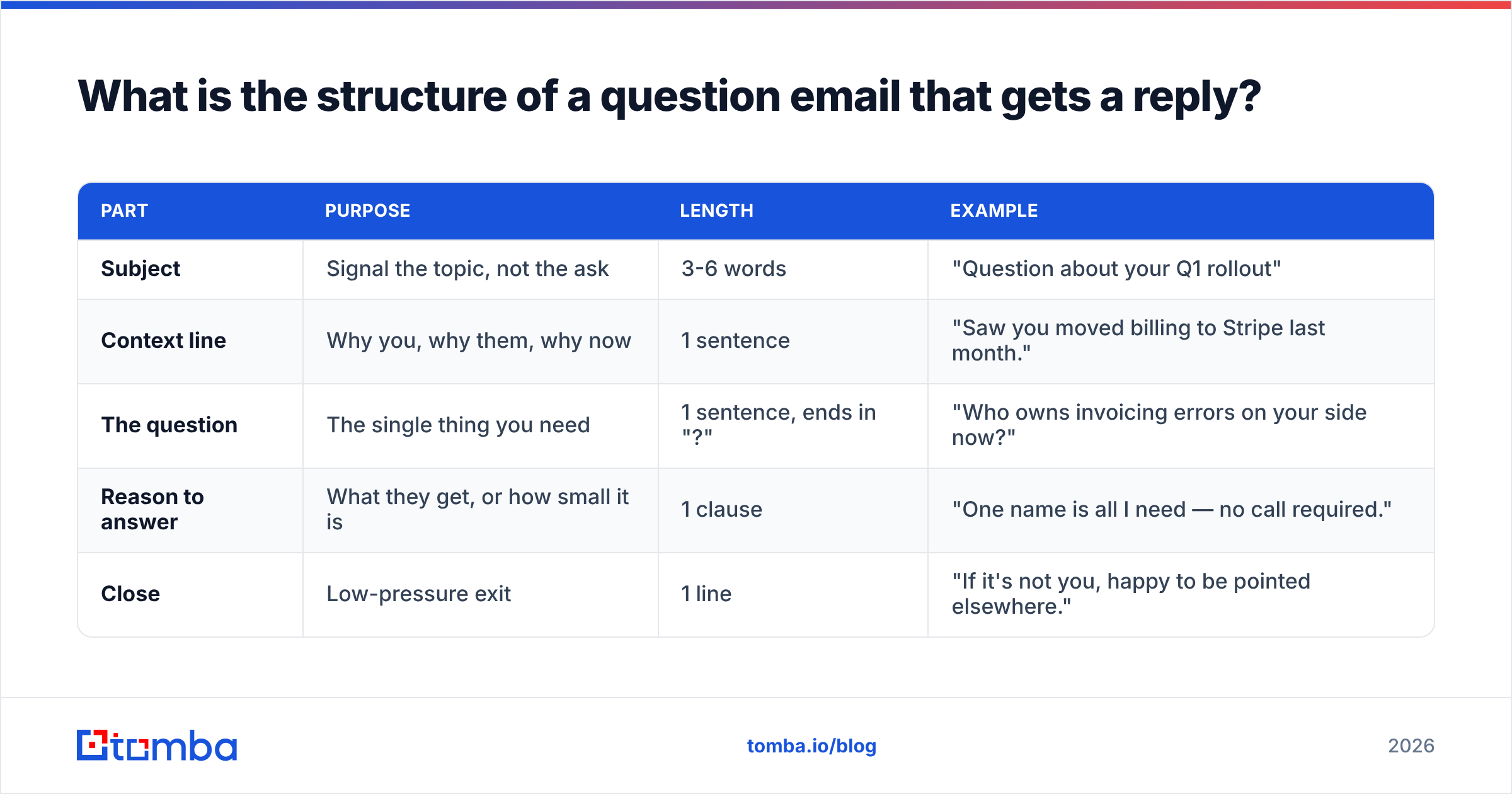
Five parts, in this order. Nothing else.
| Part | Purpose | Length | Example |
|---|---|---|---|
| Subject | Signal the topic, not the ask | 3-6 words | "Question about your Q1 rollout" |
| Context line | Why you, why them, why now | 1 sentence | "Saw you moved billing to Stripe last month." |
| The question | The single thing you need | 1 sentence, ends in "?" | "Who owns invoicing errors on your side now?" |
| Reason to answer | What they get, or how small it is | 1 clause | "One name is all I need — no call required." |
| Close | Low-pressure exit | 1 line | "If it's not you, happy to be pointed elsewhere." |
Total: under 90 words. Every email you send that follows this shape is legible on a phone without scrolling, which is where most B2B email is now triaged.
Note what's missing: your company boilerplate, a value proposition, a calendar link, and a second question. Those go in the reply, once the thread is alive.
Which question types get the highest response rates?#
Not all questions are equally expensive to answer. Rank them by the effort they demand:
- Binary — "Is Priya still handling vendor reviews?" Costs one word. Highest reply rate, lowest information yield.
- Multiple choice — "Tuesday 2pm or Thursday 10am?" Costs one word, and it moves the deal forward. Best ratio in cold outreach.
- Referral / routing — "Who's the right person for procurement questions?" Easy for the reader because it hands the problem off, and it's socially comfortable to answer.
- Narrow factual — "Are you on the legacy API or v3?" Costs a few seconds of recall.
- Scoped opinion — "Was the migration worth it for your team?" Costs a paragraph. Save for warm threads.
- Open discovery — "What's your biggest challenge with onboarding?" Costs real thought. This belongs on a call, not in a first email.
Cold first touch should live in tiers 1-3. Once someone has replied once, you've earned tier 4-5. Tier 6 questions in cold email are the single most common reason a well-targeted list underperforms — they read as homework assigned by a stranger.
How do you phrase the question itself?#
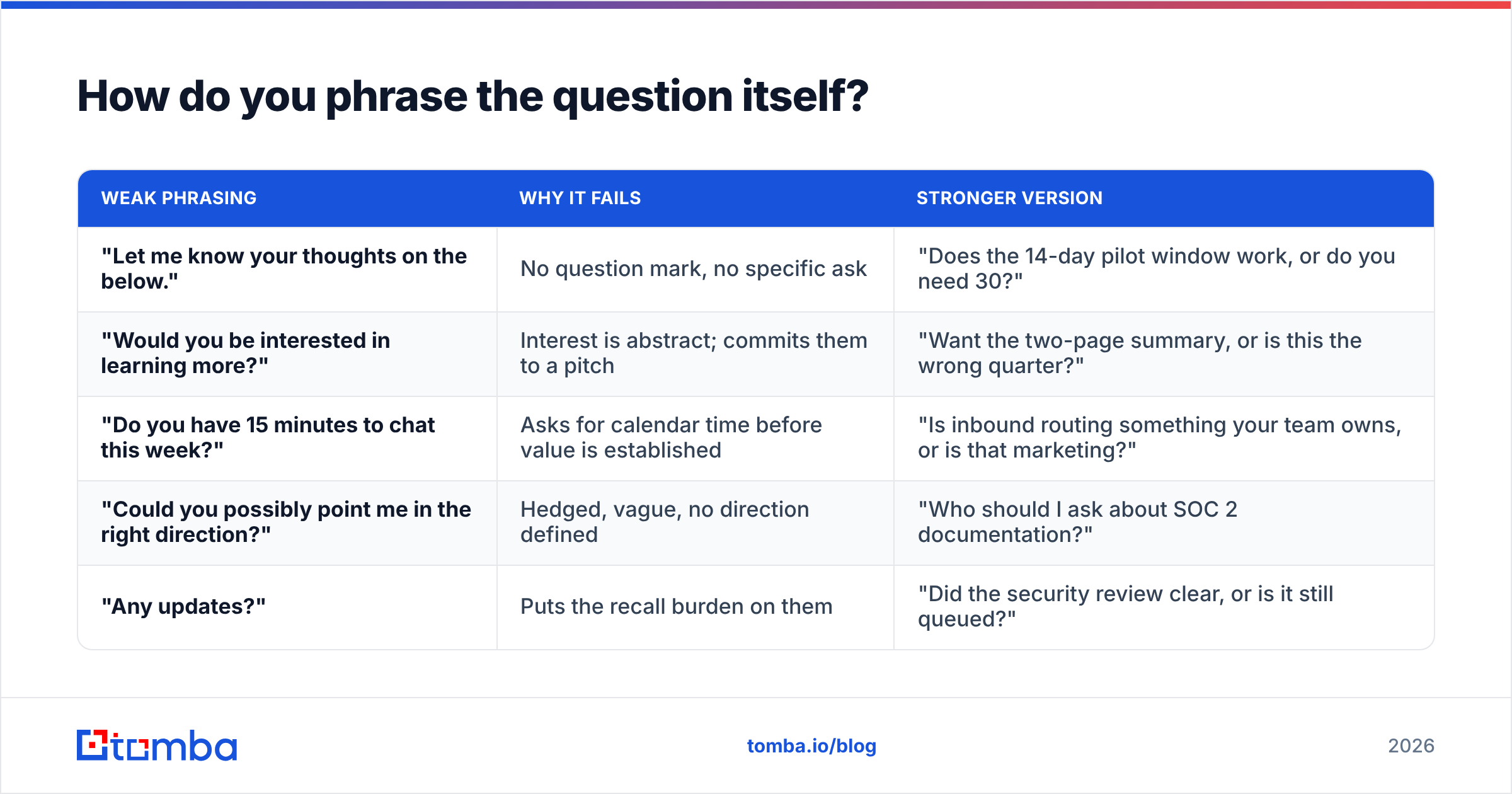
Phrasing is where good structure gets thrown away. Some concrete swaps:
| Weak phrasing | Why it fails | Stronger version |
|---|---|---|
| "Let me know your thoughts on the below." | No question mark, no specific ask | "Does the 14-day pilot window work, or do you need 30?" |
| "Would you be interested in learning more?" | Interest is abstract; commits them to a pitch | "Want the two-page summary, or is this the wrong quarter?" |
| "Do you have 15 minutes to chat this week?" | Asks for calendar time before value is established | "Is inbound routing something your team owns, or is that marketing?" |
| "Could you possibly point me in the right direction?" | Hedged, vague, no direction defined | "Who should I ask about SOC 2 documentation?" |
| "Any updates?" | Puts the recall burden on them | "Did the security review clear, or is it still queued?" |
Three rules underneath those swaps:
- Kill the hedges. "Just," "possibly," "I was wondering if maybe" — each one signals you don't expect an answer, which gives permission not to give one.
- Give an escape hatch. "…or is that someone else?" raises reply rates because "not me" is an easy, guilt-free answer. A no is worth more than silence.
- End with the question, not with pleasantries. The last line of an email carries disproportionate weight. Don't bury the ask above "Looking forward to hearing from you!"
A useful sanity check: read the email aloud and count how many decisions the recipient has to make. More than one? Cut.
If you want a starting library rather than a blank page, Tomba's cold email templates cover routing asks, pilot proposals, and re-engagement threads you can strip down to a single question.
Where should the question go in the email?#
First screen, always — and preferably in the first 40 words.
Mobile clients show roughly 30-45 words of preview text depending on device and settings. If your question isn't visible before the reader taps in, you're relying on curiosity to earn the tap. Curiosity is not a strategy at scale.
The practical layout:
- Line 1: context that proves this isn't a blast (something specific about them)
- Line 2: the question, on its own line, with whitespace above and below
- Line 3: the low-cost close
Whitespace does real work here. A question sitting alone on its own line is visually a form field. The same sentence embedded mid-paragraph is decoration.
For subject lines, describe the topic rather than performing the ask. "Quick question" is the most-used subject in B2B outreach and now reads as spam to most buyers. Something like "Invoicing owner at Acme?" tells the reader what's inside and pre-qualifies the open. If you're testing variants, a subject line tester will flag length and spam-trigger problems before you send.
How do you follow up without becoming noise?#
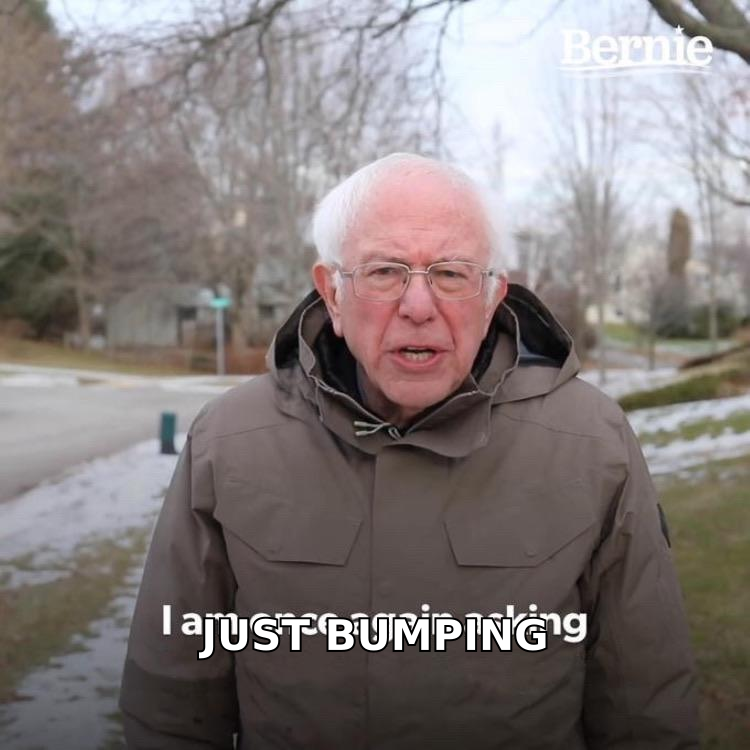
Restate the question. Do not "bump."
"Just following up" adds a message with zero new information, which trains the recipient to ignore the thread. Every follow-up should contain the question again, shortened, plus one new piece of context or an easier exit.
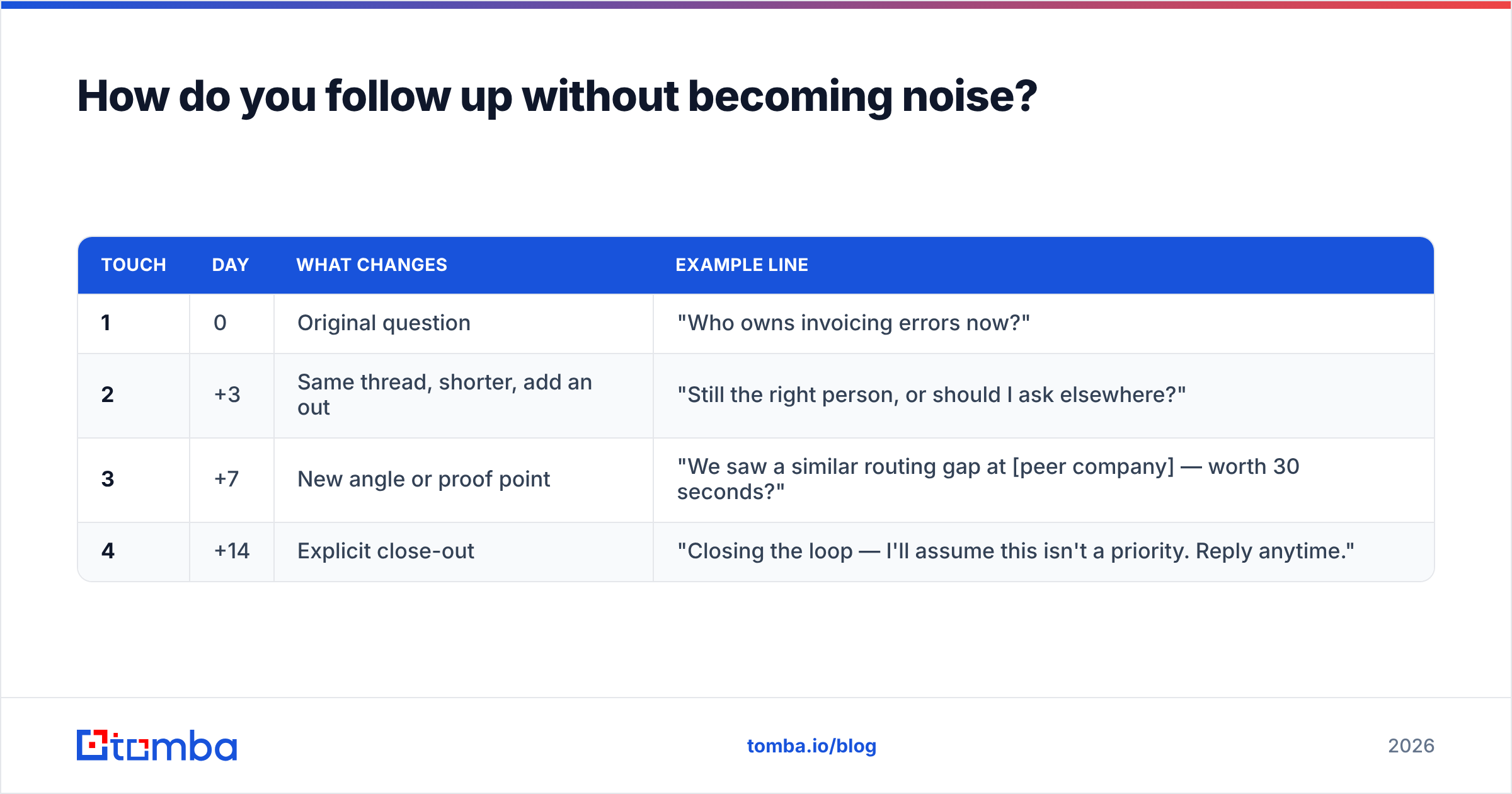
A cadence that works for a single-question thread:
| Touch | Day | What changes | Example line |
|---|---|---|---|
| 1 | 0 | Original question | "Who owns invoicing errors now?" |
| 2 | +3 | Same thread, shorter, add an out | "Still the right person, or should I ask elsewhere?" |
| 3 | +7 | New angle or proof point | "We saw a similar routing gap at [peer company] — worth 30 seconds?" |
| 4 | +14 | Explicit close-out | "Closing the loop — I'll assume this isn't a priority. Reply anytime." |
Stop at four. The breakup email at touch four reliably outperforms touches five through eight combined, because it prompts a decision instead of another deferral. It also protects your sender reputation — repeated unanswered sends to the same address feed spam-complaint signals that follow your domain, not just that campaign.
Reply-in-thread rather than starting a new one. Threading gives the reader instant context and keeps your message count on that contact visible to you.
Does data quality matter more than wording?#
Yes, and it isn't close.
Response rate is a product of three factors: did it arrive, was it the right person, and was the ask answerable. Copy only touches the third. A brilliantly phrased question sent to a stale address or the wrong department produces exactly nothing.
The order of operations that actually moves reply rate:
- Right person. A routing question to a VP of Engineering about procurement gets ignored regardless of phrasing. Confirm the role before writing.
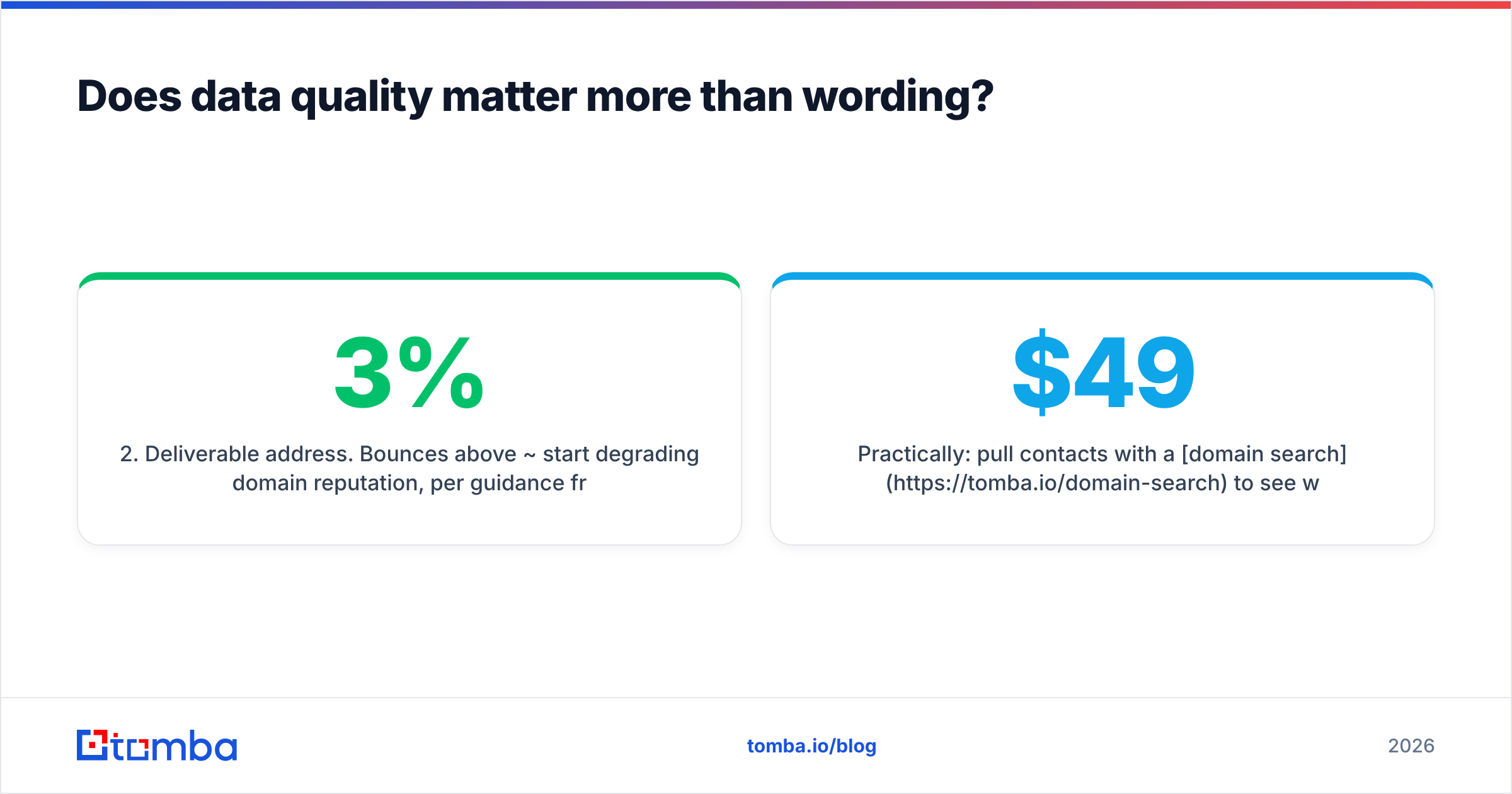
- Deliverable address. Bounces above ~3% start degrading domain reputation, per guidance from providers like Google's Postmaster documentation. Run the list through verification first.
- Answerable ask. Now the copy work matters.
Practically: pull contacts with a domain search to see who actually sits in the relevant function at a company, then verify. Tools in this category price differently — Tomba pricing runs a free tier at 25 searches/month, Starter at $49/mo, Growth at $99/mo, and Pro at $249/mo, with enterprise quoted separately. Peers like BookYourData take a prebuilt-database approach that suits teams who'd rather buy a verified list than search domain by domain; both models work, they just fit different workflows. Independent user reviews on G2 are a reasonable place to sanity-check claims before committing budget.
If you send in volume, wire the check into the workflow rather than running it manually — a bulk email finder pass before each campaign catches the addresses that went stale since your last send. People change jobs constantly; a list that verified clean in January is measurably worse by April.
What does a complete question email look like?#
Two examples, both under 80 words.
Routing ask (cold, tier 3):
Subject: Invoicing owner at Northwind?
Hi Dana — saw Northwind moved billing in-house last quarter.
Who's handling invoicing errors on your side now?
One name is all I need. If it's not your area, happy to be pointed elsewhere.
— Sam
Scheduling ask (warm, tier 2):
Subject: Pilot window — Thu or Tue?
Hi Dana — following your note about the March freeze.
Does a 14-day pilot starting Thursday work, or is Tuesday the 12th cleaner?
Either way I'll send the scope doc first so you can decide from it.
— Sam
Notice what neither does: pitch, list features, attach a deck, or ask a second question. The thread earns those later.
What should you do next?#
Fix the list before you fix the sentence. The highest-leverage change most teams can make to their question emails isn't the phrasing — it's making sure the question lands in a live inbox belonging to the person who can actually answer it.
Start with Tomba Email Finder to pull the right contact by name and domain, verify the result, then send one short email with one clear question in the first 40 words. Free tier covers 25 searches a month, which is enough to test the approach on a small list before you scale it. Get the address right, keep the ask to a single line, and follow up four times with new information each round — that combination does more for reply rate than any amount of rewriting.
Related guides#
Ready to find emails that actually work?
Join 150,000+ professionals who stopped guessing and started sending. Free credits on signup — no credit card required.
Get the Tomba newsletter
Practical outbound tactics and product updates — once every two weeks.
About the author