How to Be a Great Cold Caller: A 2026 Field Guide
Great cold callers are not born with a golden voice. They run a repeatable system: clean phone data, a 9-second opener, tight objection handling, and daily reps. Here is the full playbook.
TL;DR
- Great cold callers are made by three things: clean phone data, a rehearsed 9-second opener, and enough daily reps to make failure boring.
- The opener is the whole game. If you cannot earn 30 more seconds in your first two sentences, nothing else in your script matters.
- Talk-to-connect ratios collapse when your list is dirty. Bad numbers, wrong titles, and dead direct dials are the silent killer of most SDR quotas.
- Objections are not rejections. Five prepared responses cover roughly 80% of what you will hear on any given day.
- Track four metrics only: dials, connects, conversations over 2 minutes, and meetings booked. Everything else is noise.
What actually separates a great cold caller from an average one?#
Skill, not personality. The best cold callers I have watched are frequently soft-spoken, mildly awkward people who happen to have rehearsed their first eleven words four hundred times. The loud extrovert who "wings it" usually sits mid-pack.
Here is the uncomfortable arithmetic. If you make 60 dials a day and connect with 8 people, you get roughly 8 chances to be good. An average rep converts one of those into a real conversation. A great rep converts three. That gap is not charisma — it is preparation applied to a very small window.
Three levers control the outcome:
- Data quality — Are you calling a real direct dial for a real decision-maker at a company that plausibly has your problem? Get this wrong and the other two levers cannot save you.
- The first 9 seconds — Whether the prospect grants you permission to keep talking. This is a scripted, drilled, non-improvised moment.
- Volume with feedback — Reps compound only if you review them. 60 unreviewed dials teaches you nothing; 40 dials with 5 recordings reviewed teaches you a lot.

How do you build a call list that is worth dialing?#
Start with fit, then find the number. Reversed order — buying a giant list and hoping the fit sorts itself out — is why so many SDRs burn a quarter on dials that were never going to convert.
A workable list build looks like this:
- Define the trigger, not just the ICP. "Series B SaaS, 50-200 employees" is a filter. "Series B SaaS that just hired a VP of Sales in the last 60 days" is a reason to call today.
- Pull the accounts. LinkedIn Sales Navigator, G2 category pages, funding announcements, job boards, and your CRM's closed-lost pile all work.
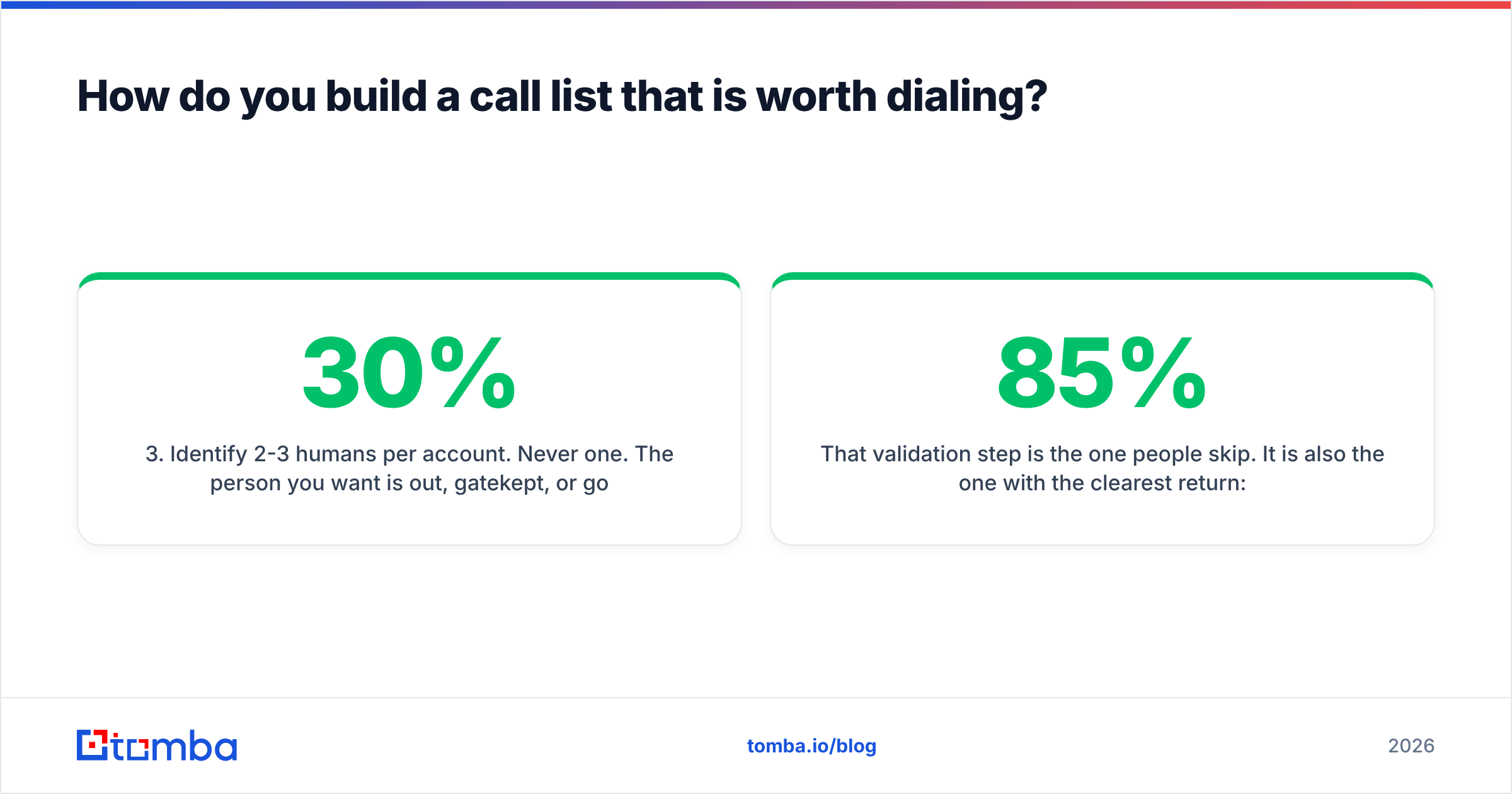
- Identify 2-3 humans per account. Never one. The person you want is out, gatekept, or gone in 30% of cases; a second name saves the account.
- Get the direct dial and the email. Mobile numbers connect at multiples of switchboard numbers. Use a phone finder for the number and an email finder for the address, because your best callback path is often a short email sent 90 seconds after a voicemail.
- Validate before you dial. Run numbers through a phone validator and emails through an email verifier. Ten minutes of hygiene reclaims an hour of dialing into disconnected lines.
- Enrich with one usable detail per contact. Job change, recent post, new office, tech stack. One sentence of specificity is worth more than five paragraphs of firmographics.
That validation step is the one people skip. It is also the one with the clearest return: a list where 85% of numbers ring a human will out-produce a list where 55% do, at identical effort.
What does a great cold call opener sound like?#
It sounds like a permission request that respects their time and immediately explains why them. Roughly 9 seconds, four moves:
Move 1 — Name and pattern interrupt. "Hi Sarah, this is Marc from Tomba. I know I'm an interruption — can I take 25 seconds and you tell me if it's relevant?"
Move 2 — The specific reason. "I'm calling because you posted three SDR roles this month and I work with sales leaders who are about to double a team on a data set that isn't ready for it."
Move 3 — The one-sentence problem. "Most teams find out their dial-to-connect rate is 12% after they've hired, not before."
Move 4 — A small ask. "Does that land at all, or am I way off?"
Notice what is absent: no "how are you today," no company history, no feature list, no "reaching out to see if." The ask at the end is deliberately easy to say no to, which is exactly why people answer it honestly.
Rehearse this until it is boring. Record yourself. The most common failure is not the words — it is speaking 30% too fast because of nerves, which reads as a script being read. Slow down and drop your pitch at the end of sentences.
What are the most common cold call objections and how do you handle them?#
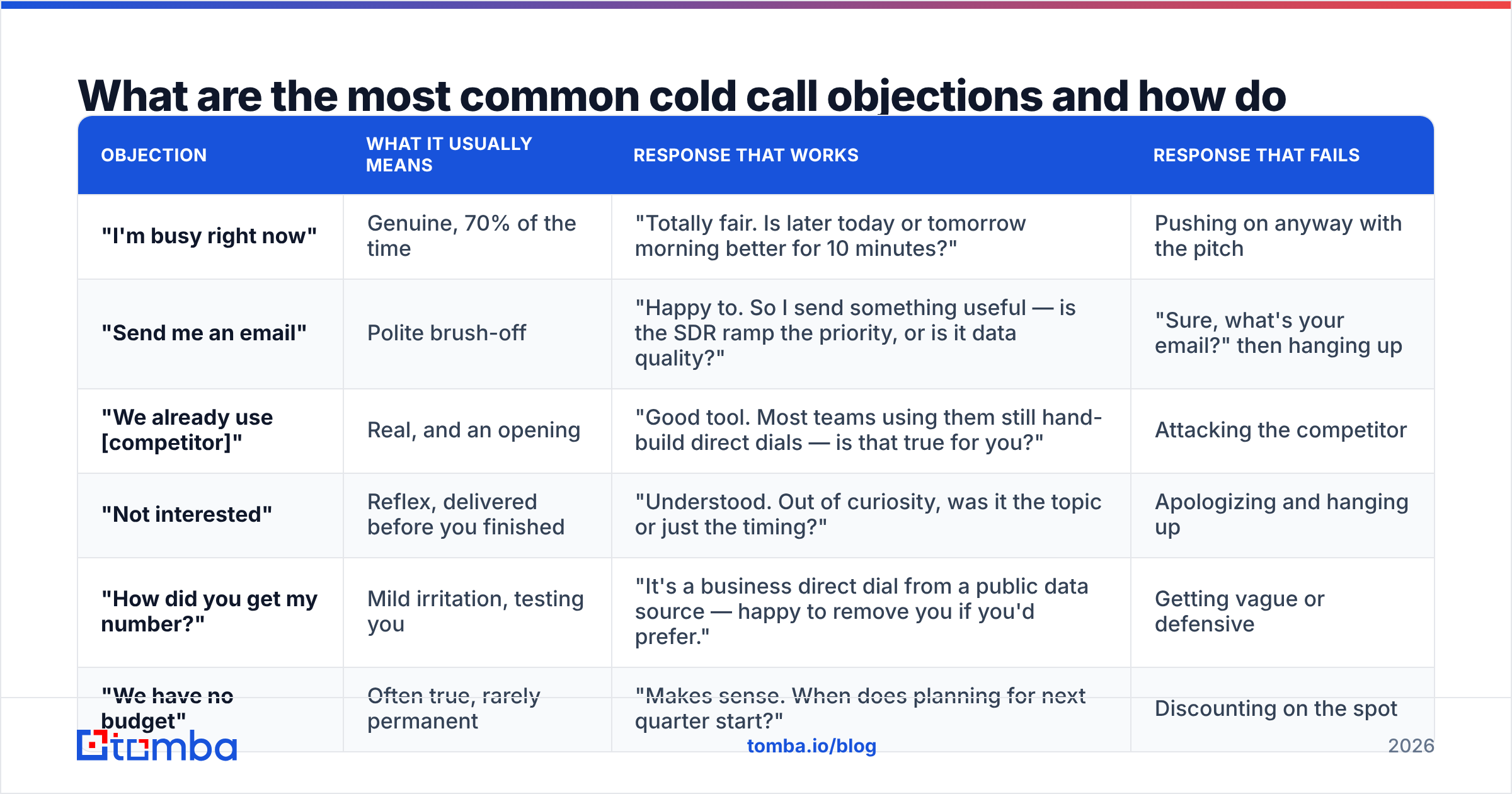
Five objections cover most days. Prepare all five and you stop being surprised, which is most of the battle.
| Objection | What it usually means | Response that works | Response that fails |
|---|---|---|---|
| "I'm busy right now" | Genuine, 70% of the time | "Totally fair. Is later today or tomorrow morning better for 10 minutes?" | Pushing on anyway with the pitch |
| "Send me an email" | Polite brush-off | "Happy to. So I send something useful — is the SDR ramp the priority, or is it data quality?" | "Sure, what's your email?" then hanging up |
| "We already use [competitor]" | Real, and an opening | "Good tool. Most teams using them still hand-build direct dials — is that true for you?" | Attacking the competitor |
| "Not interested" | Reflex, delivered before you finished | "Understood. Out of curiosity, was it the topic or just the timing?" | Apologizing and hanging up |
| "How did you get my number?" | Mild irritation, testing you | "It's a business direct dial from a public data source — happy to remove you if you'd prefer." | Getting vague or defensive |
| "We have no budget" | Often true, rarely permanent | "Makes sense. When does planning for next quarter start?" | Discounting on the spot |
The pattern across all six: acknowledge, do not argue, then ask one question. You are trying to convert a wall into a conversation, not to win a debate. A prospect who explains why they are not interested has just given you your next call's opening line.
One rule that saves careers: never lie about how you got the number. If your data came from a verified B2B source, say so plainly. Vagueness is what triggers complaints.
How many dials should you actually make per day?#
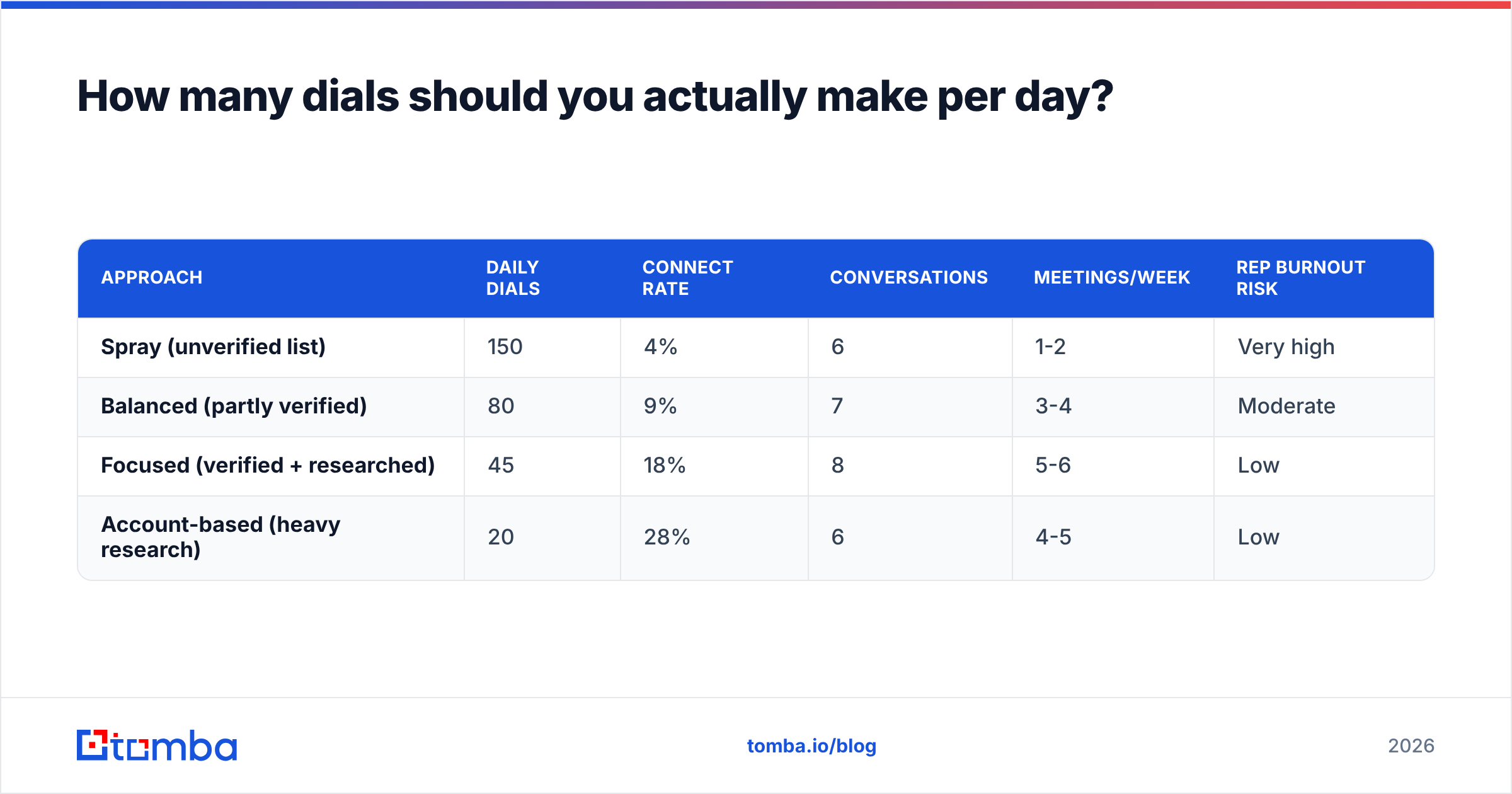
Fewer than the internet tells you, done better. The 150-dials-a-day advice is usually a symptom of a broken list, not a sign of work ethic.
Here is how the math shapes up across three approaches:
| Approach | Daily dials | Connect rate | Conversations | Meetings/week | Rep burnout risk |
|---|---|---|---|---|---|
| Spray (unverified list) | 150 | 4% | 6 | 1-2 | Very high |
| Balanced (partly verified) | 80 | 9% | 7 | 3-4 | Moderate |
| Focused (verified + researched) | 45 | 18% | 8 | 5-6 | Low |
| Account-based (heavy research) | 20 | 28% | 6 | 4-5 | Low |
The focused row is where most B2B teams should live. You make a third of the dials, have more real conversations, and book more meetings — because connect rate is doing the heavy lifting, and connect rate is a function of data, not effort.
Two structural habits matter more than raw count:
- Block your calling. Two 90-minute blocks beat eight hours of interrupted dialing. Momentum is real; the fifth call in a block is measurably better than the first.
- Call at the edges. 7:45-9:00 am and 4:30-6:00 pm local time consistently out-connect midday, because gatekeepers and calendars are lighter. HubSpot's sales research has covered this repeatedly, and every team I have seen test it confirms the same shape.
How do you use voicemail and email to multiply your dials?#
Treat the call as one channel in a three-touch motion, not a standalone event. A dial that ends in voicemail is not a wasted dial if you follow the sequence.
The pattern that works:
- Dial. No connect after 4-5 rings.
- Leave a 15-second voicemail. Name, company, one specific reason, and — critically — "I'll follow up by email in two minutes so you have this in writing." Do not leave your number twice. Nobody calls back.
- Send the email within 3 minutes. Subject line references the call: "Tried you just now — SDR ramp." Body is three sentences and one question.
- Second dial 48 hours later, different time of day.
- LinkedIn connect with no pitch on day 4.
That sequence turns a 9% connect rate into something closer to a 20% response rate, because you are giving three different ways to reply. The email leg only works if the address is right, which is why running your list through email verification before a calling sprint pays for itself. Bounced follow-ups also quietly damage your sender reputation, which costs you on every other campaign.
What should you track to actually get better?#
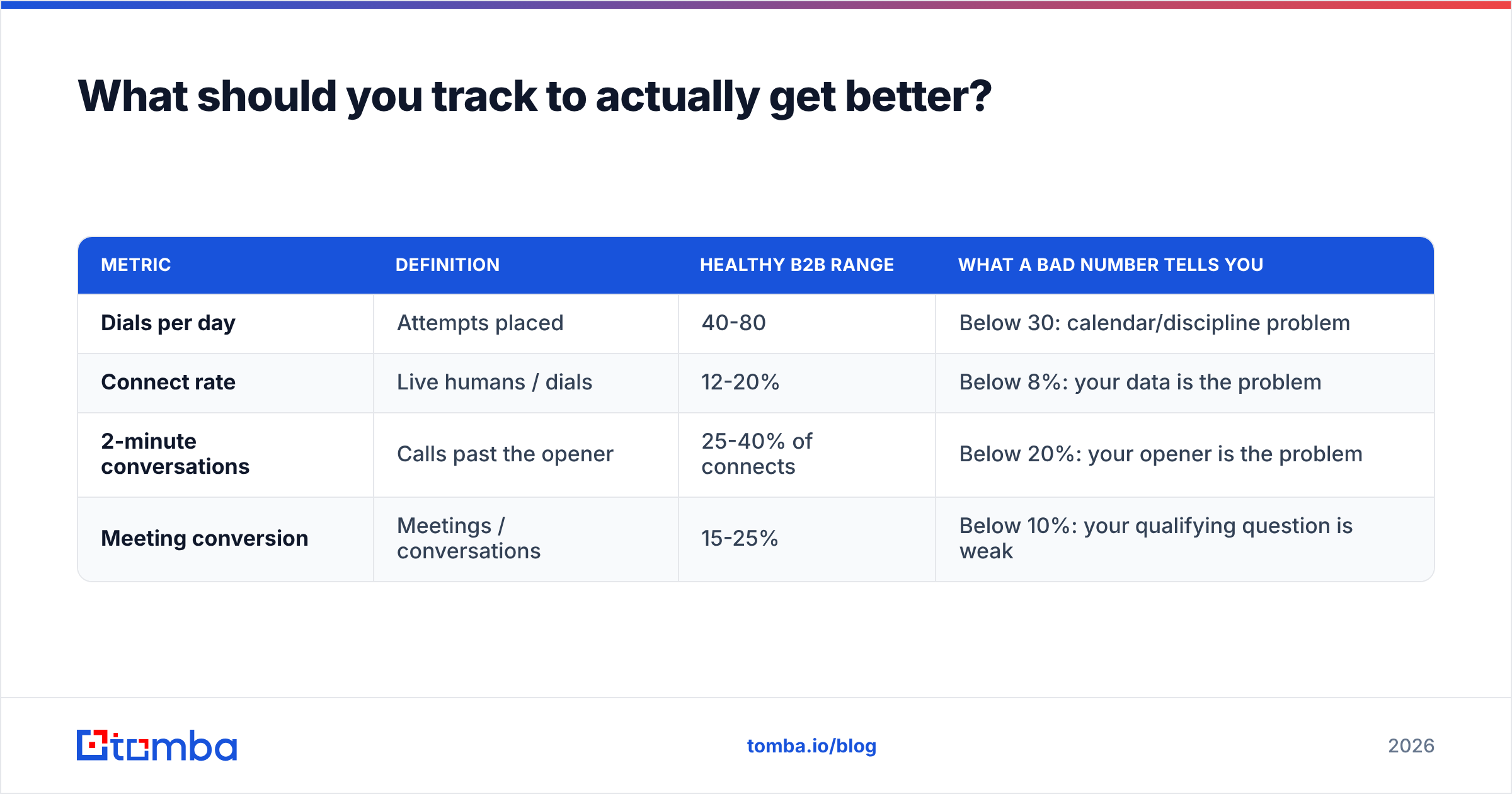
Four numbers. Anything more and you stop looking at any of them.
| Metric | Definition | Healthy B2B range | What a bad number tells you |
|---|---|---|---|
| Dials per day | Attempts placed | 40-80 | Below 30: calendar/discipline problem |
| Connect rate | Live humans / dials | 12-20% | Below 8%: your data is the problem |
| 2-minute conversations | Calls past the opener | 25-40% of connects | Below 20%: your opener is the problem |
| Meeting conversion | Meetings / conversations | 15-25% | Below 10%: your qualifying question is weak |
The diagnostic power here is the point. A low connect rate is never a coaching problem — no amount of role-play fixes a disconnected number. A low 2-minute rate is always an opener problem. Splitting these two apart stops managers from coaching the wrong thing, which is the single most common waste of a sales manager's week.
Record calls. Review two winners and two losers per week. Listen specifically for: how fast you spoke in the first 10 seconds, whether you asked a question in the first 30, and how long you talked before they did. Great callers talk about 45% of a discovery call. Average callers talk 75%.
Is cold calling still worth it in 2026?#
Yes, and increasingly so — because everyone else quit. Inbox saturation has pushed reply rates on cold email down across most B2B categories, while the phone has gotten quieter. Scarcity of callers is currently the cold caller's best asset.
Two caveats. First, cold calling is not a standalone channel anymore; it works as the interrupt layer on top of email and LinkedIn, not instead of them. Second, compliance is real. Know your obligations under the FTC's telemarketing rules for US calls and GDPR legitimate-interest requirements for EU contacts. B2B direct dials to business numbers are broadly permissible, but honoring removal requests immediately is non-negotiable — and it is also just good practice.
The teams winning on the phone in 2026 are not doing anything exotic. They are calling fewer, better-researched contacts, with verified numbers, using a rehearsed opener, and reviewing recordings weekly. That is the entire method.
Where should you start this week?#
Pick one thing and fix it for five days:
- If your connect rate is under 8% — stop everything and rebuild your list with verified direct dials. This is your bottleneck.
- If connects are fine but conversations are short — rewrite and drill your opener. 50 out-loud reps before Monday.
- If conversations are good but meetings are not — your closing ask is fuzzy. Replace "would you be open to a chat" with a specific day, time, and agenda.
- If everything is mediocre — cut dials by 40% and spend the reclaimed time on research and recordings.
Most of the compounding happens on the data side, and it happens fastest. Fixing an opener takes two weeks of drilling; fixing a list takes an afternoon.
If your list is the bottleneck — and for most teams it is — start there. Tomba's Email Finder pairs with domain search and phone lookup so you can build a verified, dial-ready list from a company domain in minutes instead of scraping LinkedIn by hand. The free tier gives you 25 searches a month to test your ICP before committing; paid plans start at $49/mo, with Growth at $99/mo for teams running full outbound motions. Check current Tomba pricing and build one clean 50-contact list this week. Then call it properly.
Related guides#
Ready to find emails that actually work?
Join 150,000+ professionals who stopped guessing and started sending. Free credits on signup — no credit card required.
Get the Tomba newsletter
Practical outbound tactics and product updates — once every two weeks.
About the author