How To Be Better At Sales Calls: The 2026 Practical Playbook
Most sales calls are lost before the phone rings. Here's the pre-call, opening, discovery, and objection system that separates reps who book meetings from reps who leave voicemails.
TL;DR
- Call quality is decided before you dial. Bad numbers, stale titles, and zero context cap your best day at mediocre.
- The first 30 seconds only need to do one thing: earn permission. Not pitch, not qualify, not "check in."
- Discovery works when you ask about consequences, not features. "What happens if this stays broken?" outperforms "What tools do you use?"
- Objections are almost never about the objection. Label it, confirm it, then ask one clarifying question before you respond.
- Track connect rate, conversation-to-meeting rate, and talk ratio. Ignore dial count as a standalone metric — it rewards volume over aim.
Why do most sales calls fail before you dial?#
Because the list is wrong.
You can have flawless tonality, a great discovery framework, and perfect objection handling — and still spend a whole afternoon calling a number that routes to a switchboard, a person who left 14 months ago, or a title that has no budget authority. That's not a skills problem. That's a data problem wearing a skills problem's clothes.
When reps ask how to be better at sales calls, they usually mean "how do I sound better." Sounding better is maybe 30% of it. The other 70% splits between who you called, why now, and what you knew before you opened your mouth.
Run this audit on your last 100 dials:
- How many rang a real, direct line? If under 60%, fix your data before you fix your script.
- How many contacts were still in the role you thought? Titles decay fast — roughly 25-30% of B2B contact records go stale every year.
- How many had a documented reason-to-call? A trigger event, a job posting, a tech-stack change, a funding round. If the answer is "they matched the ICP filter," that's not a reason.
- How many had a verified follow-up channel ready? A call without a same-day email or LinkedIn touch is a coin flip you only get to toss once.
- How many did you actually research for 90 seconds? Not 20 minutes. Ninety seconds.
Fix those five and your talk track barely has to change to double your meeting rate.

What separates a good sales call from a bad one?#
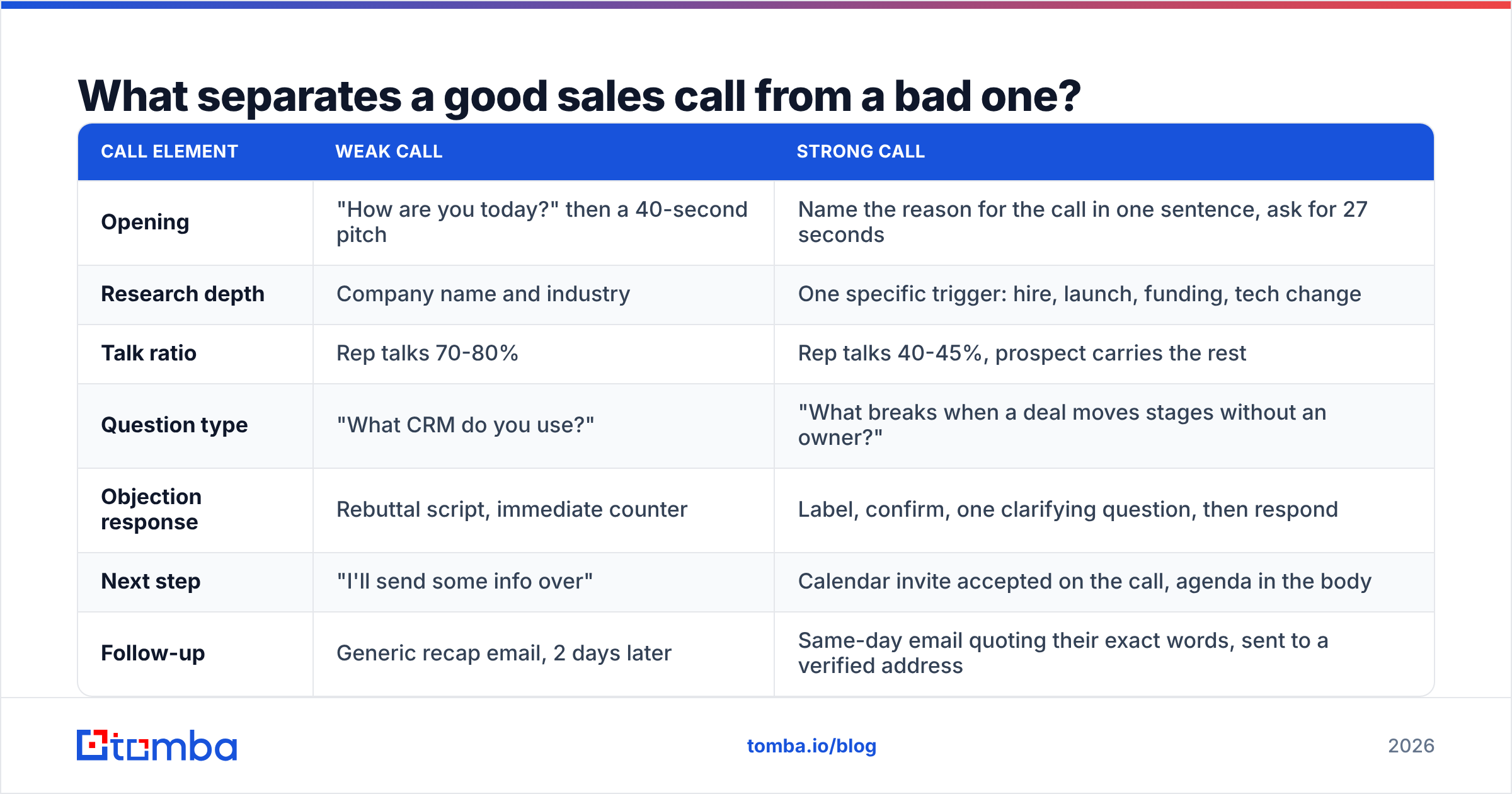
The gap isn't charisma. It's structure. Good calls follow a shape; bad calls follow the prospect's mood.
| Call element | Weak call | Strong call |
|---|---|---|
| Opening | "How are you today?" then a 40-second pitch | Name the reason for the call in one sentence, ask for 27 seconds |
| Research depth | Company name and industry | One specific trigger: hire, launch, funding, tech change |
| Talk ratio | Rep talks 70-80% | Rep talks 40-45%, prospect carries the rest |
| Question type | "What CRM do you use?" | "What breaks when a deal moves stages without an owner?" |
| Objection response | Rebuttal script, immediate counter | Label, confirm, one clarifying question, then respond |
| Next step | "I'll send some info over" | Calendar invite accepted on the call, agenda in the body |
| Follow-up | Generic recap email, 2 days later | Same-day email quoting their exact words, sent to a verified address |
Notice that only two rows are about talking. The rest are about preparation, restraint, and closing the loop. That ratio holds in real call libraries too — Gong's public research on sales conversations has repeatedly found that successful discovery calls skew toward the rep listening more and asking fewer, deeper questions rather than more of them.
How do you prepare for a sales call in 10 minutes?#
You don't need a dossier. You need four facts and a hypothesis. Here's the sequence that fits in ten minutes and survives a real calling block.
- Confirm the human. Right person, right title, right company, still employed. Thirty seconds on LinkedIn or an enrichment record. If you can't confirm, deprioritize — don't burn a dial confirming basics live.
- Confirm the number. A direct dial that fails validation is a dial you never should have spent. Running numbers through a phone validator before a block is the cheapest connect-rate improvement available to most teams.
- Find one trigger. A new VP of Revenue Ops. A job posting for three SDRs. A pricing page that just added a self-serve tier. Anything that makes "why now" answerable in one clause.
- Write one hypothesis. "I think they're hiring SDRs faster than they can source lists, so their reps are prospecting manually." You'll be wrong half the time — being wrong out loud is still better than being vague.
- Pre-load the follow-up. Have the verified email address open in a tab before you dial. The recap email should leave within ten minutes of hanging up, not tomorrow.
- Decide the ask. Not "learn more." A specific next step with a specific length: "20 minutes Thursday with whoever owns the data budget."
That's it. Ten minutes, six steps, repeatable across a 40-dial block if you batch steps 1-3 the night before.
What should the first 30 seconds actually sound like?#
Your opening has one job: buy permission for the next 90 seconds. It is not a pitch and it is not a qualification round.
The structure that consistently holds up:
Name + reason + permission + pause.
"Mohamed, this is Sara at Northwind. I'm calling because you posted three SDR roles last month and most teams that scale that fast hit a list-quality wall. Can I take 30 seconds to explain why I called, and you tell me if it's relevant?"
Three things are happening there. You said who you are without a résumé. You gave a reason that's about them, not you. And you asked for a small, bounded commitment — then you stopped talking.
The pause is the hard part. Most reps step on their own opening because silence feels like failure. It isn't. Silence is the prospect deciding, and interrupting that decision converts a "sure, go ahead" into a "not interested."
Things to delete from your opener permanently:
- "How are you doing today?" — signals a script before you've said anything of substance.
- "Did I catch you at a bad time?" — you're offering an exit before offering value.
- "I just wanted to reach out and..." — hedged, passive, and consumes three seconds of a 30-second budget.
- Any sentence describing your company's category before the prospect has agreed the problem exists.
How do you run discovery without sounding like an interrogation?#
Ask about consequences, not configurations.
Most discovery dies because reps collect facts they can't act on. "What CRM are you on?" gets you a noun. "What happens when a lead comes in and nobody's assigned to it?" gets you a story, a stakeholder, and usually a number.
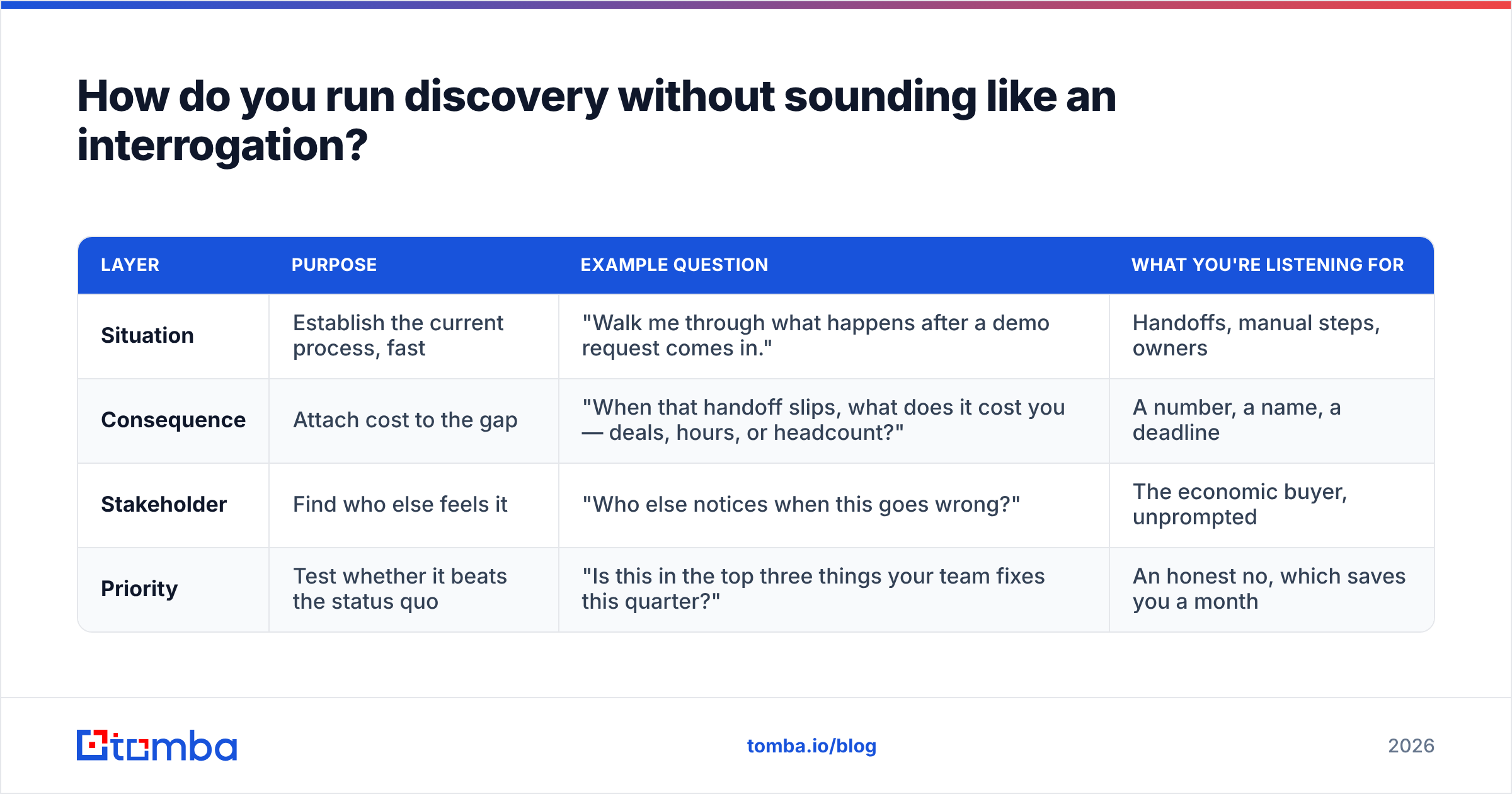
Structure a discovery call in three layers:
| Layer | Purpose | Example question | What you're listening for |
|---|---|---|---|
| Situation | Establish the current process, fast | "Walk me through what happens after a demo request comes in." | Handoffs, manual steps, owners |
| Consequence | Attach cost to the gap | "When that handoff slips, what does it cost you — deals, hours, or headcount?" | A number, a name, a deadline |
| Stakeholder | Find who else feels it | "Who else notices when this goes wrong?" | The economic buyer, unprompted |
| Priority | Test whether it beats the status quo | "Is this in the top three things your team fixes this quarter?" | An honest no, which saves you a month |
Spend roughly 60% of the call in the consequence layer. Situation questions are table stakes and the prospect is bored of answering them. Priority questions are where deals die honestly and early — which is a feature, not a bug. A clean "no, not this quarter" is worth more than a polite "send me something."
One tactical note: write down their exact phrasing. Not your paraphrase. If they say "our reps are basically doing archaeology every morning," that phrase goes in your recap email verbatim. It signals you listened in a way no summary can fake.
How do you handle objections without arguing?#
Label, confirm, clarify, respond. In that order, every time.
Most objection-handling training teaches rebuttals — a counter for each of the eight common brush-offs. That works on the objection you were given and fails on the objection they meant.
"We already have a vendor for that."
- Rebuttal approach: "Most of our customers had a vendor too, and here's why they switched..." — you're now arguing.
- Label + clarify: "Sounds like you've already solved this. Out of curiosity, if the current setup were doing everything you needed, would you be hiring for that role?"
"Send me an email."
- Rebuttal: "Sure, what's your address?" — you just lost the call and got a dead email.
- Label + clarify: "Happy to. So I don't send you something useless — is the data problem worth solving this quarter, or is it a next-year thing?"
"We don't have budget."
- Label + clarify: "Understood. Is that a 'no budget for anything new' or a 'this isn't ranked high enough to fund'? Those are different conversations."
The pattern: acknowledge without agreeing, then ask one question that separates a real constraint from a reflex. Roughly half of first-call objections are reflexes. The clarifying question costs you six seconds and salvages a meaningful share of them.
Which sales call metrics actually predict revenue?#
Dial count is the vanity metric of phone sales. It's easy to measure, easy to game, and correlates with revenue only when everything upstream is already healthy.
Track these instead:
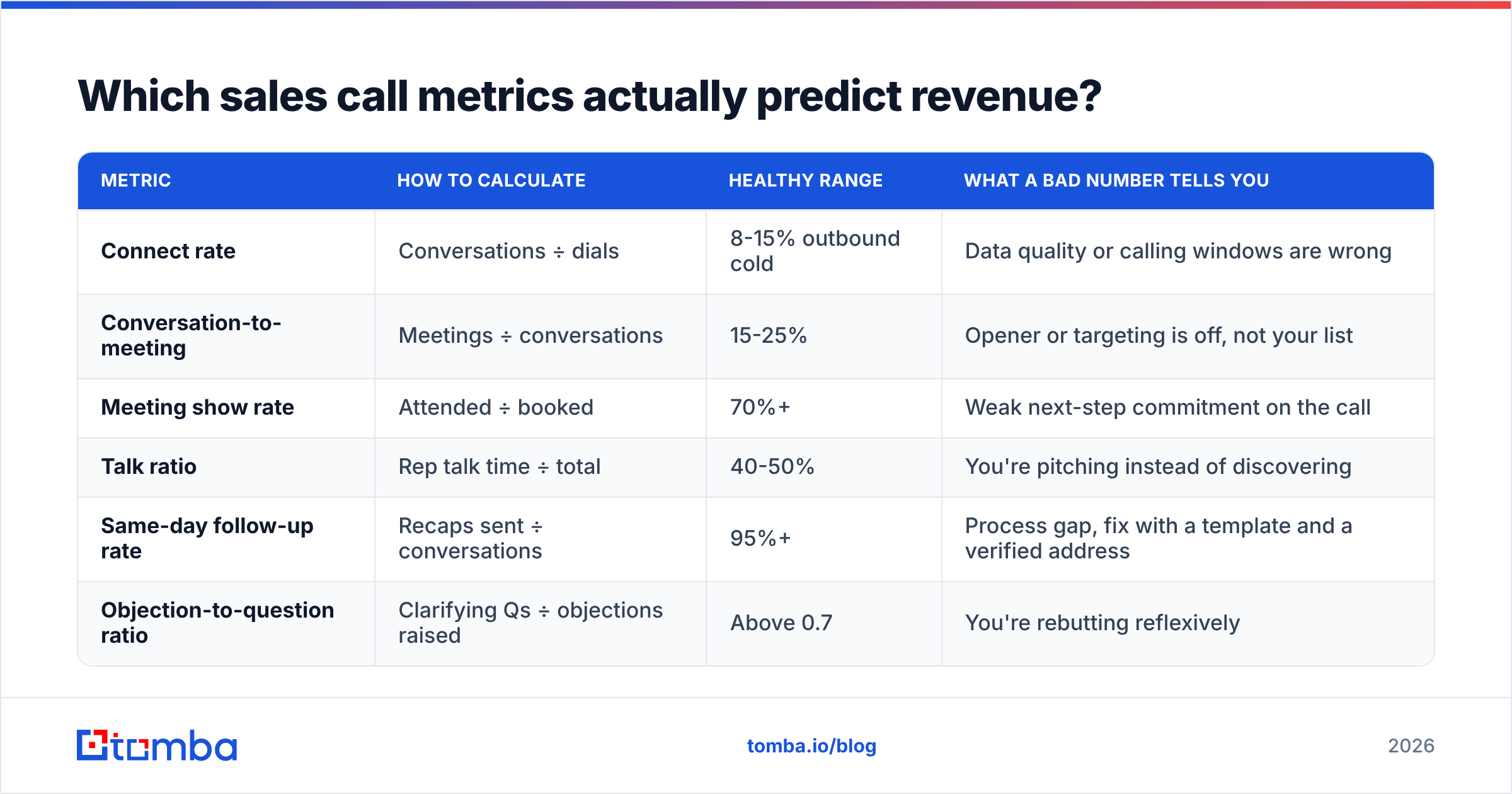
| Metric | How to calculate | Healthy range | What a bad number tells you |
|---|---|---|---|
| Connect rate | Conversations ÷ dials | 8-15% outbound cold | Data quality or calling windows are wrong |
| Conversation-to-meeting | Meetings ÷ conversations | 15-25% | Opener or targeting is off, not your list |
| Meeting show rate | Attended ÷ booked | 70%+ | Weak next-step commitment on the call |
| Talk ratio | Rep talk time ÷ total | 40-50% | You're pitching instead of discovering |
| Same-day follow-up rate | Recaps sent ÷ conversations | 95%+ | Process gap, fix with a template and a verified address |
| Objection-to-question ratio | Clarifying Qs ÷ objections raised | Above 0.7 | You're rebutting reflexively |
The diagnostic value is in the pairing. Low connect rate with a strong conversation-to-meeting rate means your pitch is fine and your list is broken. High connect rate with a weak meeting rate means the opposite. Most teams tune the wrong one for months because they only look at the top-line number.
For a broader view of how call outcomes roll into pipeline health, HubSpot's sales research library publishes annual benchmarks worth calibrating against — though treat any published benchmark as a directional range, not a target.
What tools actually make you better on the phone?#
Tools don't fix tonality. They fix the two things around the call: who you're calling and what happens after.
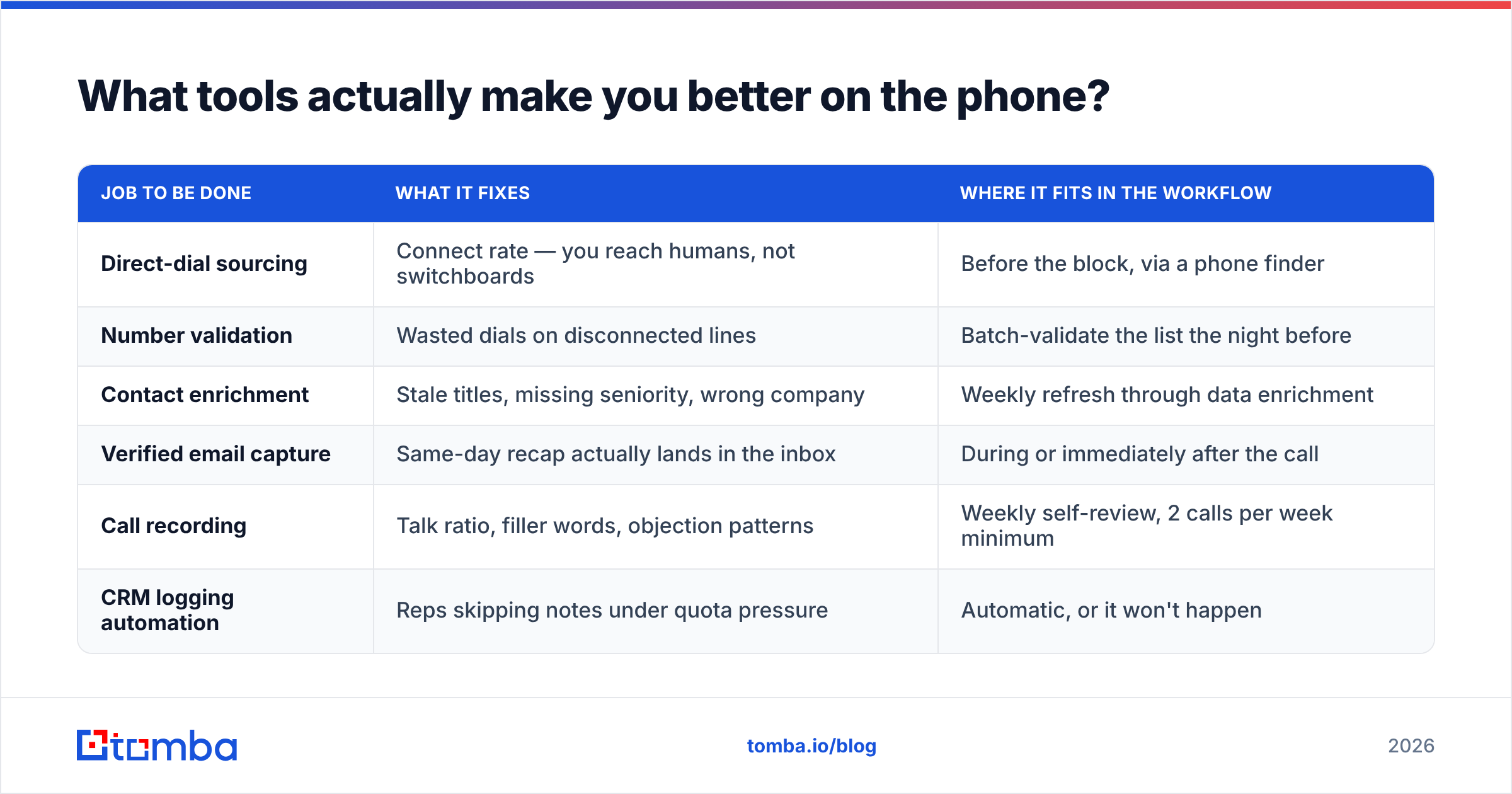
| Job to be done | What it fixes | Where it fits in the workflow |
|---|---|---|
| Direct-dial sourcing | Connect rate — you reach humans, not switchboards | Before the block, via a phone finder |
| Number validation | Wasted dials on disconnected lines | Batch-validate the list the night before |
| Contact enrichment | Stale titles, missing seniority, wrong company | Weekly refresh through data enrichment |
| Verified email capture | Same-day recap actually lands in the inbox | During or immediately after the call |
| Call recording | Talk ratio, filler words, objection patterns | Weekly self-review, 2 calls per week minimum |
| CRM logging automation | Reps skipping notes under quota pressure | Automatic, or it won't happen |
Two of those rows are about the phone. Four are about data and follow-through. That ratio is the point.
If you're building the stack from scratch, get the contact layer right first. Tomba pricing starts with a free tier at 25 searches per month for testing whether the data holds up on your accounts, then Starter at $49/mo and Growth at $99/mo for teams running real calling volume. Test on 50 known accounts before committing — any vendor's aggregate accuracy claim matters less than accuracy on your specific ICP.
How long does it take to actually get better?#
Six weeks of deliberate practice, not six months of volume.
Here's a cadence that works:
- Week 1-2: Fix the list. Validate numbers, refresh titles, add one trigger per account. Change nothing about your script. Measure connect rate before and after.
- Week 3-4: Rebuild the opener only. Record every call. Review two per week and count how many seconds you talked before the first pause.
- Week 5-6: Attack discovery. Replace three situation questions with three consequence questions. Track whether prospects give you a number unprompted.
Change one variable at a time or you won't know what worked. Reps who overhaul everything at once usually see a two-week bump from novelty, then regress, then conclude the training was useless.
Also: review your own calls. Not your manager's favorite calls, not a webinar library. Yours. Nothing exposes a bad habit faster than hearing yourself interrupt a prospect who was about to say something expensive.
Where should you start this week?#
Start with the list, because it's the only fix that improves every subsequent call automatically.
Pull your next 100 target accounts, confirm the humans are still in role, validate the direct dials, and have a verified email ready for each one before you pick up the phone. Then run your existing script unchanged for a week and compare the connect and conversation numbers. In most teams that single change moves the needle harder than any tonality coaching.
When you're ready to build that contact layer, start with the Tomba Email Finder — find verified professional addresses by name and domain, pair them with direct dials, and make sure every conversation you earn on the phone gets a same-day follow-up that actually reaches the inbox. The free tier is enough to test it against your own account list before you spend anything.
Related guides#
Ready to find emails that actually work?
Join 150,000+ professionals who stopped guessing and started sending. Free credits on signup — no credit card required.
Get the Tomba newsletter
Practical outbound tactics and product updates — once every two weeks.
About the author