How to Become an SDR in 2026: Skills, Pay, and 90-Day Plan
No degree, no quota history, no problem. Here is what SDR hiring managers actually test for in 2026, what the job pays by segment, and a 90-day ramp plan you can start before you get the offer.
TL;DR
- An SDR (sales development rep) owns the top of the funnel: research accounts, find contact data, run cold email/call/LinkedIn sequences, and book qualified meetings for an account executive. You do not close deals.
- You do not need a sales degree or prior quota experience. You need proof you can research, write short persuasive messages, and survive rejection — and you can build that proof in a weekend.
- Typical 2026 US bands run roughly $45k–$60k base with $60k–$85k OTE for SMB roles, higher for enterprise and tech-vertical teams. Non-US bands are lower but the structure is the same.
- The fastest interview shortcut is a mini prospecting portfolio: 25 real contacts you sourced yourself, three cold emails you wrote, and a one-page account plan.
- Learn one CRM, one sequencer, and one data/email-finding tool before day one. Ramping SDRs who already know the tooling get promoted 2–4 months earlier than those who don't.
What does an SDR actually do all day?#
An SDR is the scout, not the closer. Think of a restaurant: the AE cooks and serves the meal, the SDR is the person outside convincing the right people to walk in — and turning away the ones who won't like the menu.
A realistic day on a well-run team looks like this:
- 90–120 minutes of research and list building. Pull accounts that match the ICP, find the right titles, verify contact data, note a trigger (funding, hiring, tech change, new exec).
- 60–90 minutes of calls. 40–80 dials for SMB teams, fewer and more researched for enterprise.
- 60 minutes of email and LinkedIn. Sending sequenced touches, personalising the first line, replying to anyone who answers within minutes rather than hours.
- 30–60 minutes of handoff and admin. Logging activity in the CRM, writing meeting briefs for the AE, cleaning bad records.
- 30 minutes of feedback. Call reviews, message teardowns, pipeline sync with your AE.
The output metric is almost always qualified meetings booked and held, with activity metrics (dials, sends, connects) as leading indicators. Some teams also pay on pipeline created or opportunities accepted by the AE.
Do you need experience or a degree to become an SDR?#
No. SDR is the most common entry point into B2B tech sales precisely because it is trainable. Hiring managers screen for coachability and work rate far more than credentials. Backgrounds that convert well:
- Hospitality and retail — you already handle rejection and read people fast.
- Recruiting and customer support — you already run high-volume outreach and objection handling.
- Teaching, journalism, and non-profit fundraising — you already write clearly and ask for things.
- Recent grads with a project — the degree matters less than one artefact you built and can talk about.
What blocks candidates is rarely the résumé. It is showing up to the interview with no evidence you understand the job. Someone who says "I'm a people person" loses to someone who says "here are 25 contacts I sourced at Series-B fintechs, here's the email I'd send them, here's why."
What skills do SDR hiring managers actually test for?#
Five, in this order of weight:
- Written brevity. Can you say something useful in 60 words? Most SDR interviews include a written exercise. Practice by rewriting your own emails to half their length twice.
- Research instinct. Given a company URL, can you find the buyer, the trigger event, and a reason to reach out in under ten minutes?
- Objection resilience. Not "handling" objections with a script — staying curious after being told no. Expect a live roleplay.
- Process discipline. Can you run the same sequence 200 times without cutting corners? Managers probe this with "walk me through your last week hour by hour."
- Curiosity about the product's buyer. Anyone can memorise features. Candidates who can explain what the buyer's day is like win.
Notice what is missing: charisma. Modern SDR performance is a data-and-consistency job. The reps who hit quota are usually the ones whose lists are clean and whose follow-up never slips.
How much do SDRs get paid in 2026?#
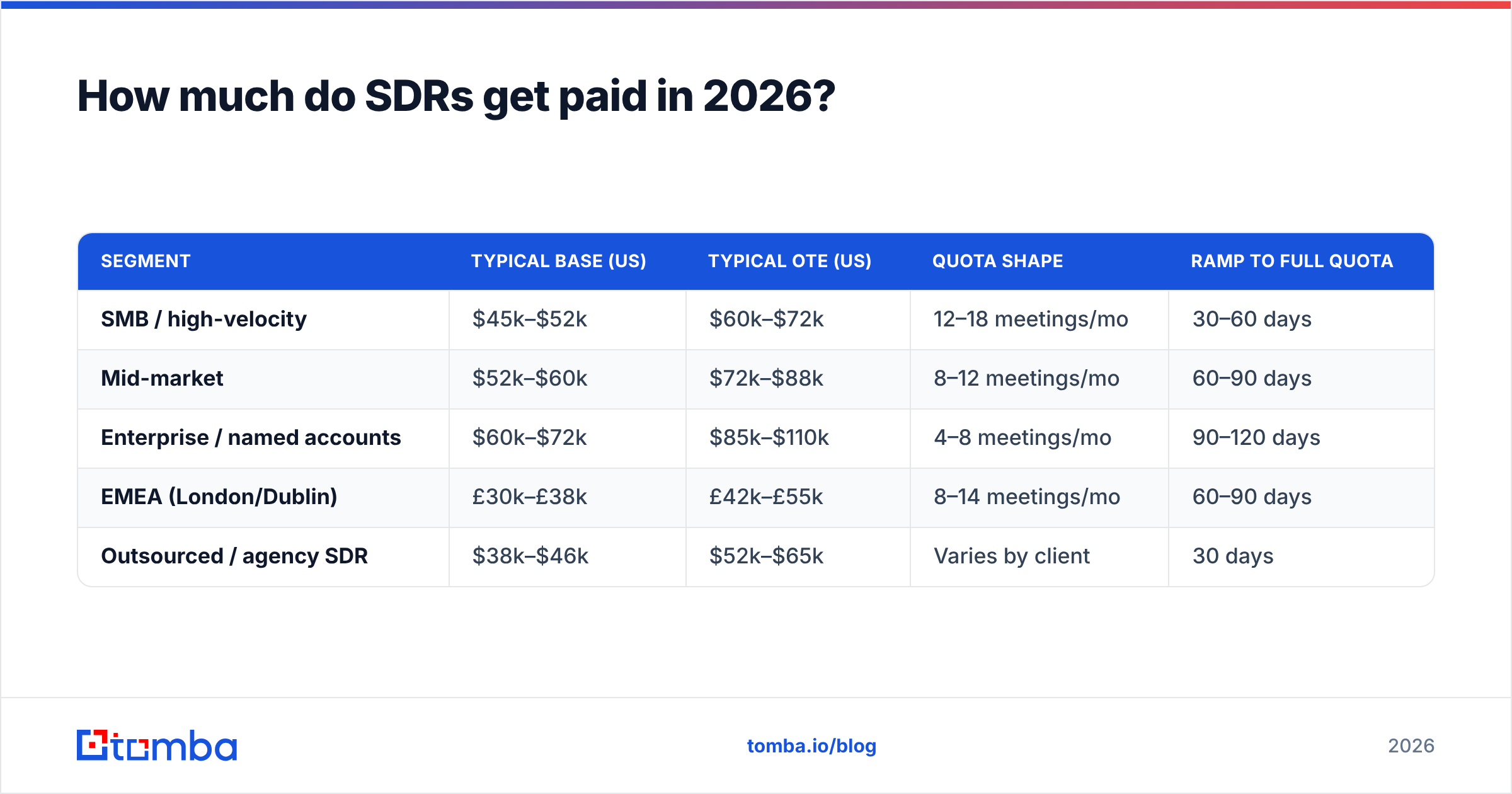
Compensation is split base + variable, usually 65/35 or 70/30. Bands vary heavily by market and segment, so treat these as advertised-range benchmarks rather than guarantees — check current listings on G2's software category pages for who is hiring, and cross-check comp on job boards before you negotiate.
| Segment | Typical base (US) | Typical OTE (US) | Quota shape | Ramp to full quota |
|---|---|---|---|---|
| SMB / high-velocity | $45k–$52k | $60k–$72k | 12–18 meetings/mo | 30–60 days |
| Mid-market | $52k–$60k | $72k–$88k | 8–12 meetings/mo | 60–90 days |
| Enterprise / named accounts | $60k–$72k | $85k–$110k | 4–8 meetings/mo | 90–120 days |
| EMEA (London/Dublin) | £30k–£38k | £42k–£55k | 8–14 meetings/mo | 60–90 days |
| Outsourced / agency SDR | $38k–$46k | $52k–$65k | Varies by client | 30 days |
Two things move your number more than anything else: segment (enterprise pays more per meeting) and industry (fintech, cyber, and dev tools pay above healthcare or logistics for the same title). Promotion to AE typically happens at 12–24 months, and the AE jump is where compensation roughly doubles.
Which SDR job should you take first?#
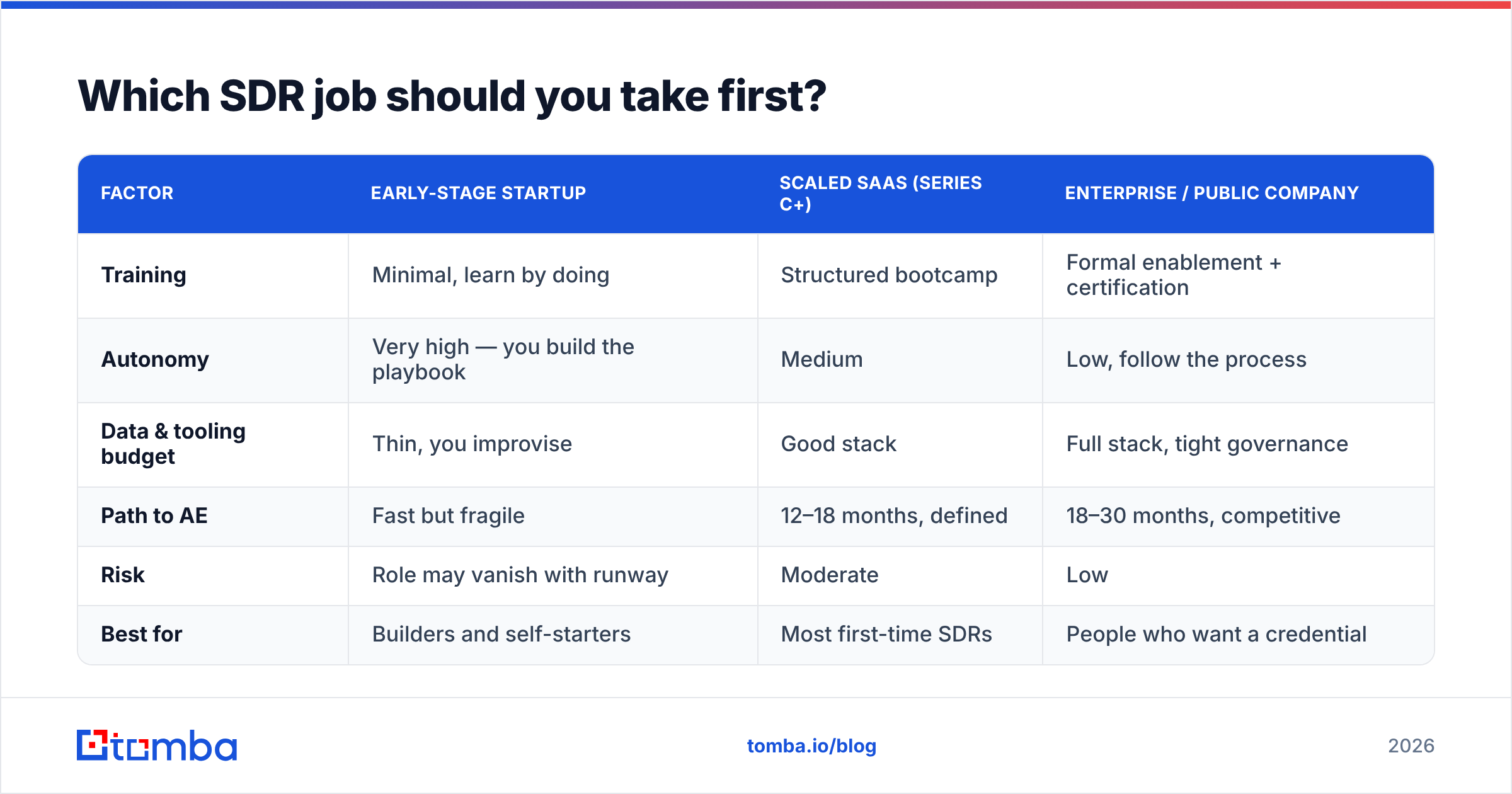
Not all SDR seats teach the same skills. If your goal is to be an AE in two years, optimise for coaching density and pipeline quality, not the biggest logo.
| Factor | Early-stage startup | Scaled SaaS (Series C+) | Enterprise / public company |
|---|---|---|---|
| Training | Minimal, learn by doing | Structured bootcamp | Formal enablement + certification |
| Autonomy | Very high — you build the playbook | Medium | Low, follow the process |
| Data & tooling budget | Thin, you improvise | Good stack | Full stack, tight governance |
| Path to AE | Fast but fragile | 12–18 months, defined | 18–30 months, competitive |
| Risk | Role may vanish with runway | Moderate | Low |
| Best for | Builders and self-starters | Most first-time SDRs | People who want a credential |
For a first role, scaled SaaS usually wins: enough structure to learn a repeatable process, enough freedom to experiment. HubSpot's sales blog and Salesforce's sales resources are both free and mirror the methodologies most of these teams train on, so reading them before your interview is a direct advantage.
How do you get the interview without sales experience?#
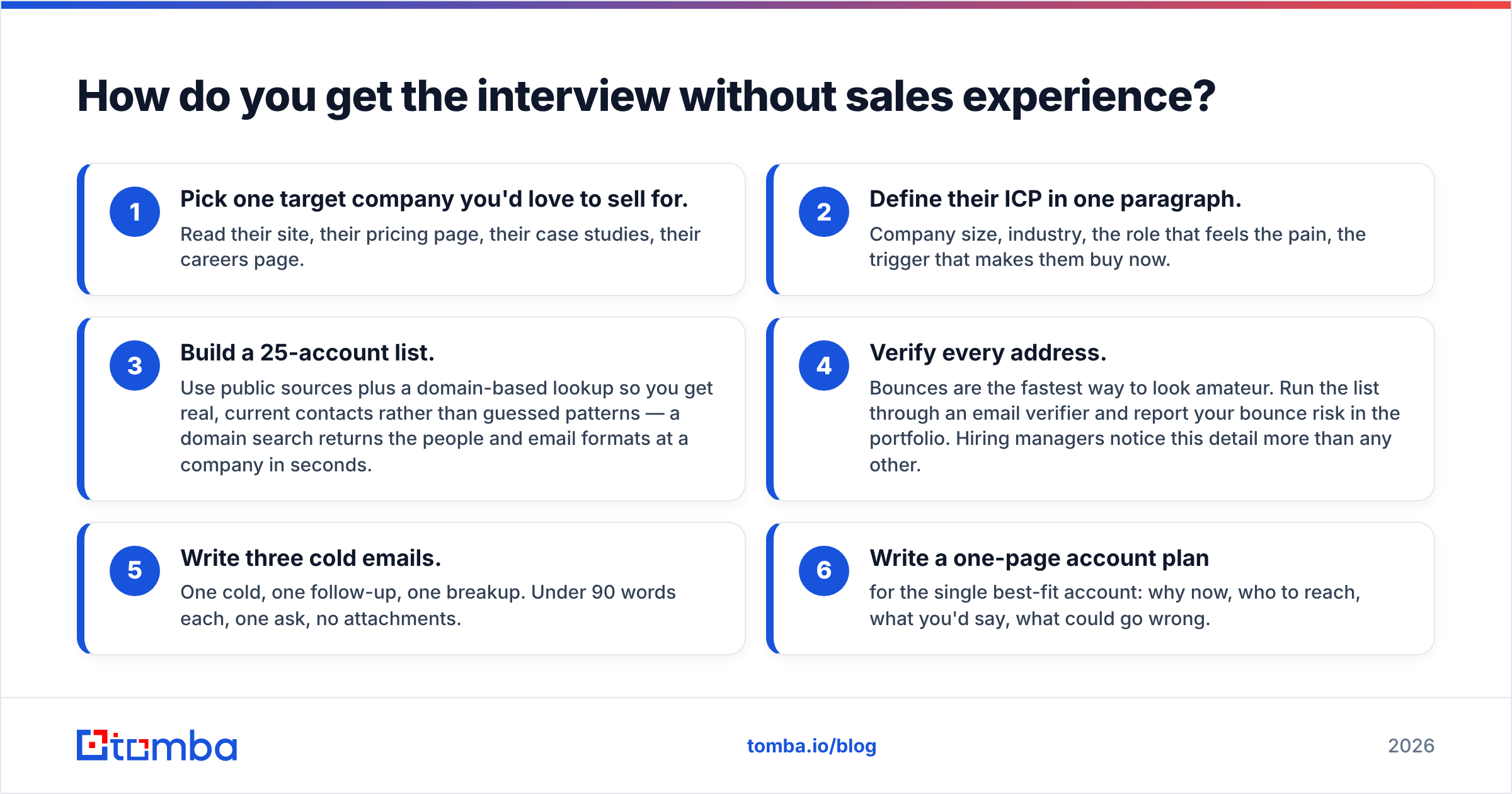
Build a prospecting portfolio. This is the single highest-leverage thing a career changer can do, and it takes about six hours.
- Pick one target company you'd love to sell for. Read their site, their pricing page, their case studies, their careers page.
- Define their ICP in one paragraph. Company size, industry, the role that feels the pain, the trigger that makes them buy now.
- Build a 25-account list. Use public sources plus a domain-based lookup so you get real, current contacts rather than guessed patterns — a domain search returns the people and email formats at a company in seconds.
- Verify every address. Bounces are the fastest way to look amateur. Run the list through an email verifier and report your bounce risk in the portfolio. Hiring managers notice this detail more than any other.
- Write three cold emails. One cold, one follow-up, one breakup. Under 90 words each, one ask, no attachments.
- Write a one-page account plan for the single best-fit account: why now, who to reach, what you'd say, what could go wrong.
Send it as a PDF with your application. It converts because almost nobody does it, and because it proves the three things the interview is meant to test — research, writing, and process.
What tools should you learn before day one?#
You do not need to master a stack. You need working literacy in four categories so your first week is about the market, not the software.
- CRM (Salesforce or HubSpot). Learn objects, activity logging, and how a lead becomes an opportunity. Free certifications exist for both.
- Sequencer (Outreach, Salesloft, Instantly, or similar). Learn what a sequence, step, and A/B variant are.
- Contact data and enrichment. How to go from "company name" to "verified email plus phone." A bulk email finder plus data enrichment is how good SDRs turn a scrape into a workable list.
- Deliverability basics. SPF, DKIM, warmup, and why sending 400 unverified emails from a new domain gets your whole team blocked. Learn what email deliverability means before you touch a send button.

Note the pattern: three of the four are really about data quality. New SDRs blame their scripts when meetings don't book. Nine times out of ten the list was wrong — wrong company, wrong title, or an address that never landed.
What does a strong first 90 days look like?#
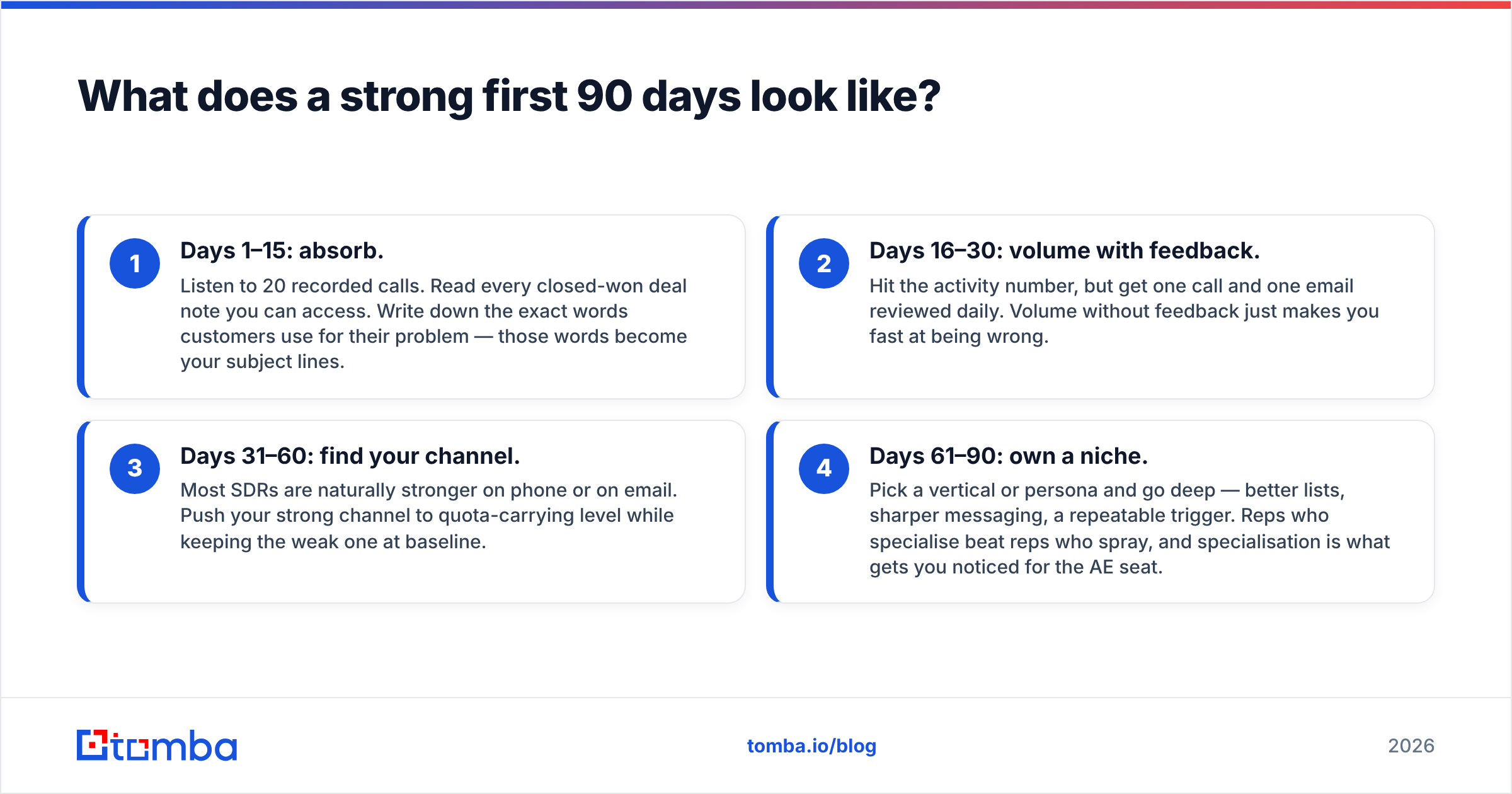
Your ramp is a promotion audition. Treat it like one.
- Days 1–15: absorb. Listen to 20 recorded calls. Read every closed-won deal note you can access. Write down the exact words customers use for their problem — those words become your subject lines.
- Days 16–30: volume with feedback. Hit the activity number, but get one call and one email reviewed daily. Volume without feedback just makes you fast at being wrong.
- Days 31–60: find your channel. Most SDRs are naturally stronger on phone or on email. Push your strong channel to quota-carrying level while keeping the weak one at baseline.
- Days 61–90: own a niche. Pick a vertical or persona and go deep — better lists, sharper messaging, a repeatable trigger. Reps who specialise beat reps who spray, and specialisation is what gets you noticed for the AE seat.
Track two numbers weekly that most SDRs ignore: bounce rate (should be under 3%) and response rate by persona. Those two tell you whether the problem is your data or your message, which is the only diagnostic that matters in the first quarter.
What mistakes keep new SDRs from getting promoted?#
- Treating the AE as a customer, not a partner. Booking meetings that don't qualify inflates your number and destroys your credibility. Ask your AE what a good meeting looks like, in writing, in week one.
- Personalising the wrong thing. "Congrats on the marathon" is not relevance. A trigger tied to the buyer's job is.
- Skipping the follow-up. Most booked meetings come from touch three through seven. Reps who quit after two touches lose half their pipeline to reps who don't.
- Working from a stale list. Contact data decays roughly 2–3% per month as people change jobs. Refresh, re-verify, and delete aggressively.
- Not documenting what works. The SDR who can show a manager "this sequence produced 14 meetings at a 9% reply rate" gets promoted. The one with the same results and no records does not.
Ready to build your SDR portfolio?#
The gap between "aspiring SDR" and "hired SDR" is usually one artefact: a real, verified list of prospects with messaging you wrote yourself. Start with the Tomba Email Finder — the free tier gives you 25 searches a month, enough to build your 25-account portfolio without spending anything, and paid plans start at $49/mo when you're ready to run volume. Find the buyers, verify the addresses, write the three emails, and walk into the interview with proof instead of adjectives.
Related guides#
Ready to find emails that actually work?
Join 150,000+ professionals who stopped guessing and started sending. Free credits on signup — no credit card required.
Get the Tomba newsletter
Practical outbound tactics and product updates — once every two weeks.
About the author