How to Book More Sales Meetings in 2026: A Practical Playbook
Most reps blame their pitch when meetings dry up. The real bottleneck is list quality, timing, and follow-up math. Here's the system that actually fills a calendar.
TL;DR
- Booking more meetings is a math problem before it's a copy problem: deliverable contacts x reply rate x meeting conversion. Fix the first number and the other two stop mattering as much.
- A 30% bounce rate does not just waste sends — it degrades your sender reputation and quietly suppresses the emails that would have converted.
- Multi-threading (3-4 contacts per account) roughly doubles account-level reply rates versus single-threaded outreach.
- Most reps stop at 2 touches. Meetings cluster in touches 3-7, across at least two channels.
- Track meetings-held, not meetings-booked. A 25% no-show rate makes a "great" week fictional.
Why do most reps book fewer meetings than they should?#
Because they optimize the wrong variable. Ask a rep who missed quota what went wrong and you'll hear "my messaging wasn't landing." Rewriting the message is visible, satisfying work. It's also usually the third-biggest lever.
Here's the actual chain. To book a meeting you need a contact who (1) exists, (2) receives your email, (3) is a plausible buyer, (4) replies, and (5) shows up. Steps 1 and 2 are data problems. Step 3 is a targeting problem. Only step 4 is a copy problem.
Think of it like a leaky hose. You can crank the tap harder — send more, write punchier — but if the hose has holes at the connector, most of the pressure never reaches the nozzle. Patch the connector first.
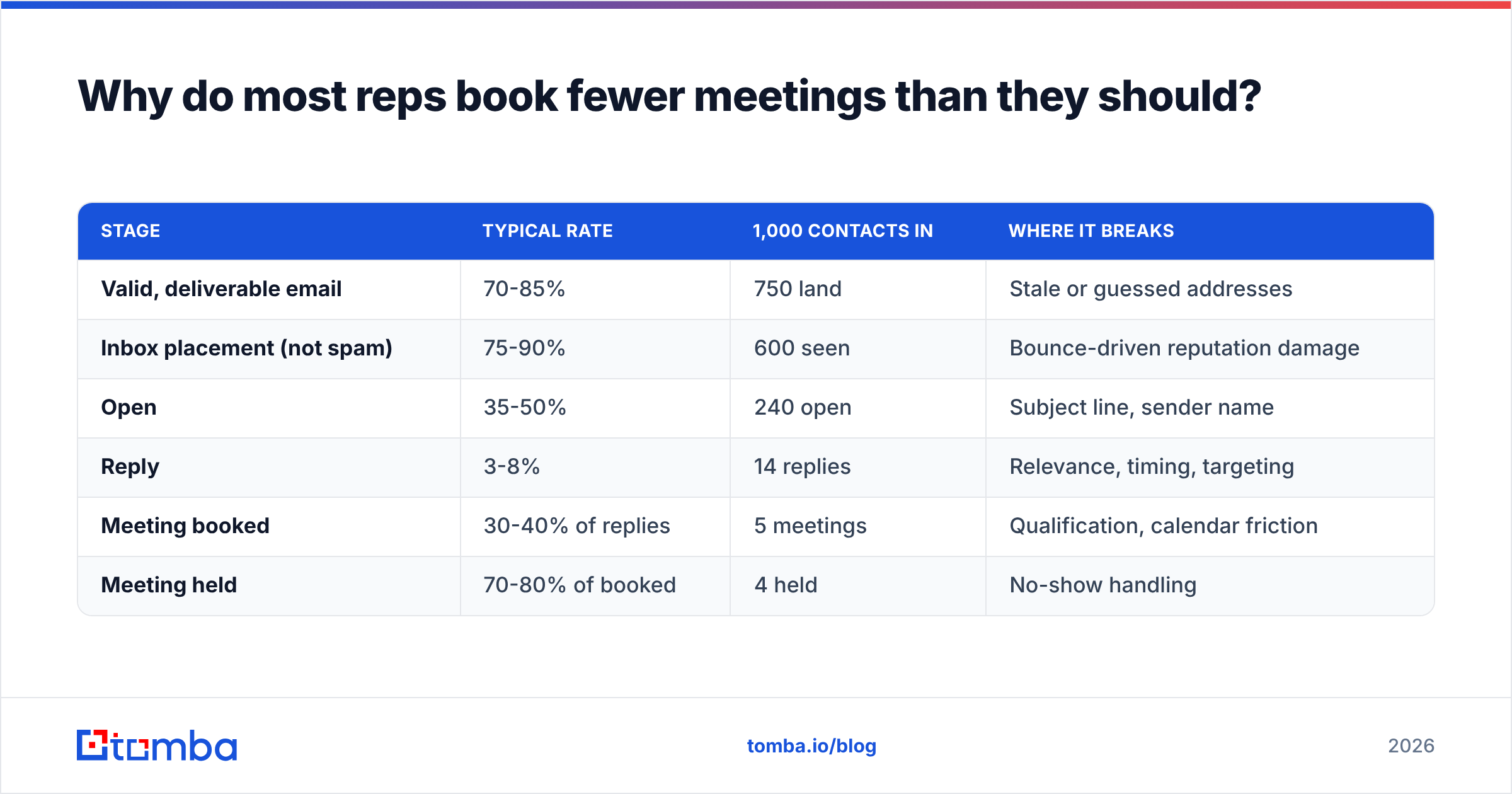
The typical outbound sequence loses volume like this:
| Stage | Typical rate | 1,000 contacts in | Where it breaks |
|---|---|---|---|
| Valid, deliverable email | 70-85% | 750 land | Stale or guessed addresses |
| Inbox placement (not spam) | 75-90% | 600 seen | Bounce-driven reputation damage |
| Open | 35-50% | 240 open | Subject line, sender name |
| Reply | 3-8% | 14 replies | Relevance, timing, targeting |
| Meeting booked | 30-40% of replies | 5 meetings | Qualification, calendar friction |
| Meeting held | 70-80% of booked | 4 held | No-show handling |
Five meetings from a thousand contacts. Now fix only the first row — take deliverability from 75% to 96% — and you end up near seven held meetings without touching a single word of copy. That's a 40% improvement from data hygiene alone.
What actually drives meeting volume?#
Four inputs, in descending order of leverage. Most teams work them in reverse order, which is why the effort feels expensive.
- Contact accuracy. Every invalid address is a triple loss: wasted send, wasted sequence slot, and a small hit to sender reputation that suppresses your good emails. Get bounce rate under 2% before you touch anything else.
- Account fit and timing. A perfect email to a company with no budget cycle, no trigger event, and no pain is a perfect email that gets deleted. Hiring signals, funding rounds, tech-stack changes, and leadership moves are what turn a cold contact into a warm one.
- Multi-threading. Reaching one person at an account gives you one chance and one gatekeeper. Reaching four gives you internal referrals — "actually, that's Sarah's call" is a warm intro you didn't have to ask for.
- Follow-up depth. The single most common failure in outbound is stopping too early. Two touches then silence is not a sequence; it's a coin flip.
- Channel mix. Email plus LinkedIn plus phone beats any single channel, because you're not competing with 120 other emails in an inbox — you're showing up where the noise is thinner.
- Calendar friction. Every extra step between "yes, interested" and a confirmed slot costs you meetings. A booking link in the reply beats a back-and-forth about Tuesday.
How do you build a prospect list that converts?#
Start narrow. A 200-contact list where every record is verified and every account matches your ICP will outperform a 5,000-contact scrape by a wide margin — and it won't burn your domain doing it.
The workflow that holds up:
Step 1 — Define the account, not the persona. Firmographics first: industry, headcount band, geography, and at least one qualifying signal (they use a complementary tool, they're hiring for a role your product supports, they raised recently). If you can't name the signal, you don't have a target account, you have a name.
Step 2 — Map 3-4 roles per account. Economic buyer, technical evaluator, and the person who feels the pain daily. Multi-threading is not spam if each message is genuinely relevant to that role's job.
Step 3 — Find the contacts. This is where an email finder earns its keep. Run domain search to pull the full contact map for a target company, then narrow by role. For accounts where you already have a name, a direct lookup is faster.
Step 4 — Verify before you send. Run the whole list through an email verifier. Catch-all domains deserve special handling — a catch-all accepts everything at the SMTP layer and tells you nothing, so use a dedicated catch-all verifier rather than assuming the address is good.
Step 5 — Enrich for personalization hooks. Job title alone is a weak hook. Recent role change, published content, tech stack, and headcount growth give you a first line that doesn't read like a template.
Step 6 — Segment before sequencing. One sequence for 500 mixed contacts produces mediocre results across the board. Three sequences for three segments of 160 each produce one clear winner you can double down on.
Is more volume better than better targeting?#
No — and the math isn't close once you account for domain damage.
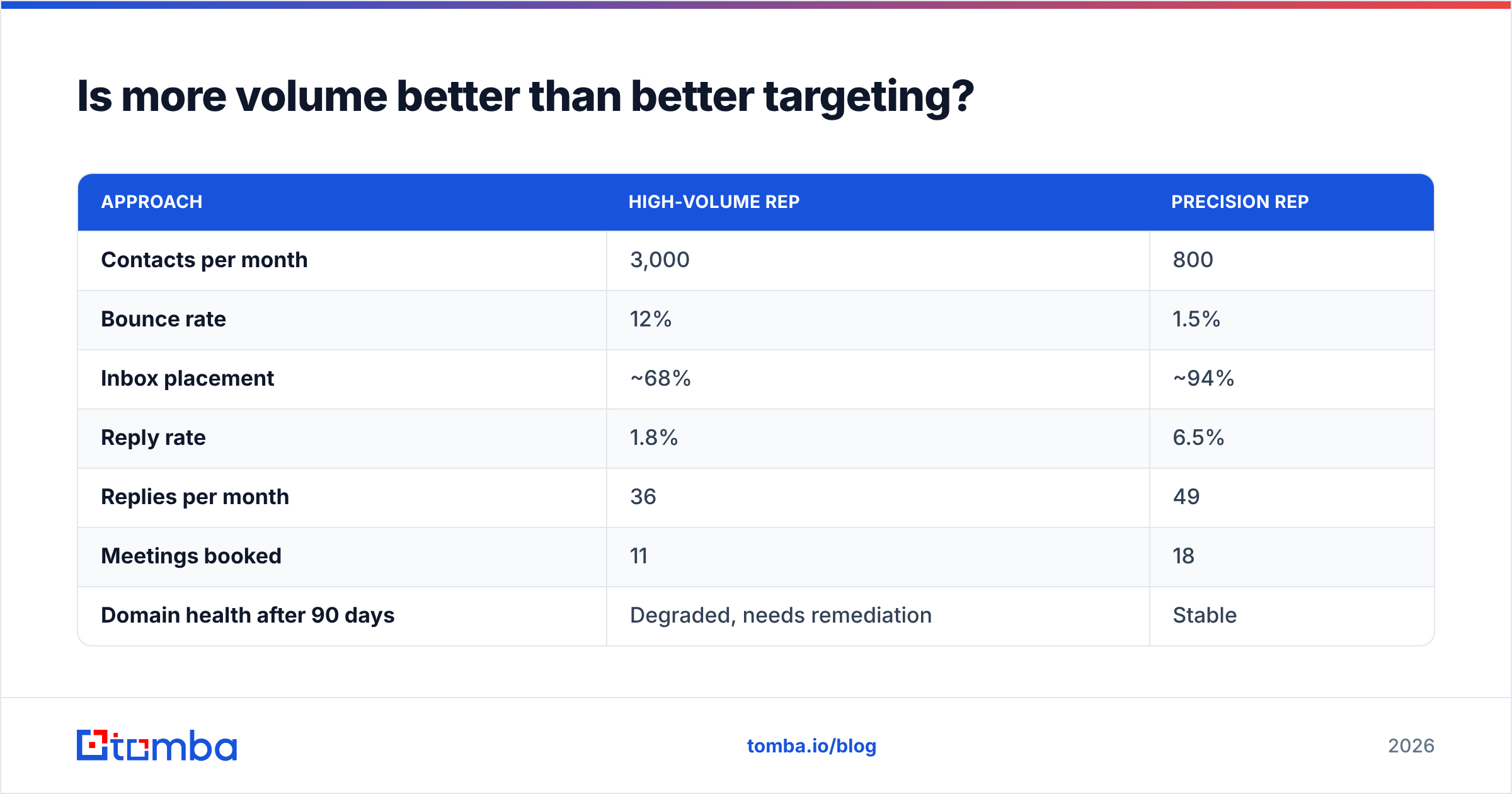
Compare two reps working the same market for a quarter:
| Approach | High-volume rep | Precision rep |
|---|---|---|
| Contacts per month | 3,000 | 800 |
| Bounce rate | 12% | 1.5% |
| Inbox placement | ~68% | ~94% |
| Reply rate | 1.8% | 6.5% |
| Replies per month | 36 | 49 |
| Meetings booked | 11 | 18 |
| Domain health after 90 days | Degraded, needs remediation | Stable |
| Hours spent per meeting | ~4.2 | ~2.1 |
The precision rep sends 73% fewer emails and books 64% more meetings. And critically, they end the quarter with a domain they can keep using. The volume rep ends it shopping for new sending domains — a cost that never shows up in the meeting count but shows up everywhere else.
This isn't an argument against scale. It's an argument for scaling a system that works rather than scaling one that doesn't. Once your 800-contact process converts at 6%, adding volume compounds. Adding volume to a 1.8% process just compounds the waste.
Google and Yahoo's bulk-sender requirements made this concrete: the official Google sender guidelines now put a hard spam-complaint ceiling on senders. Blast-and-pray isn't just inefficient anymore — it's actively throttled at the platform level.
How many touches does it take to book a meeting?#
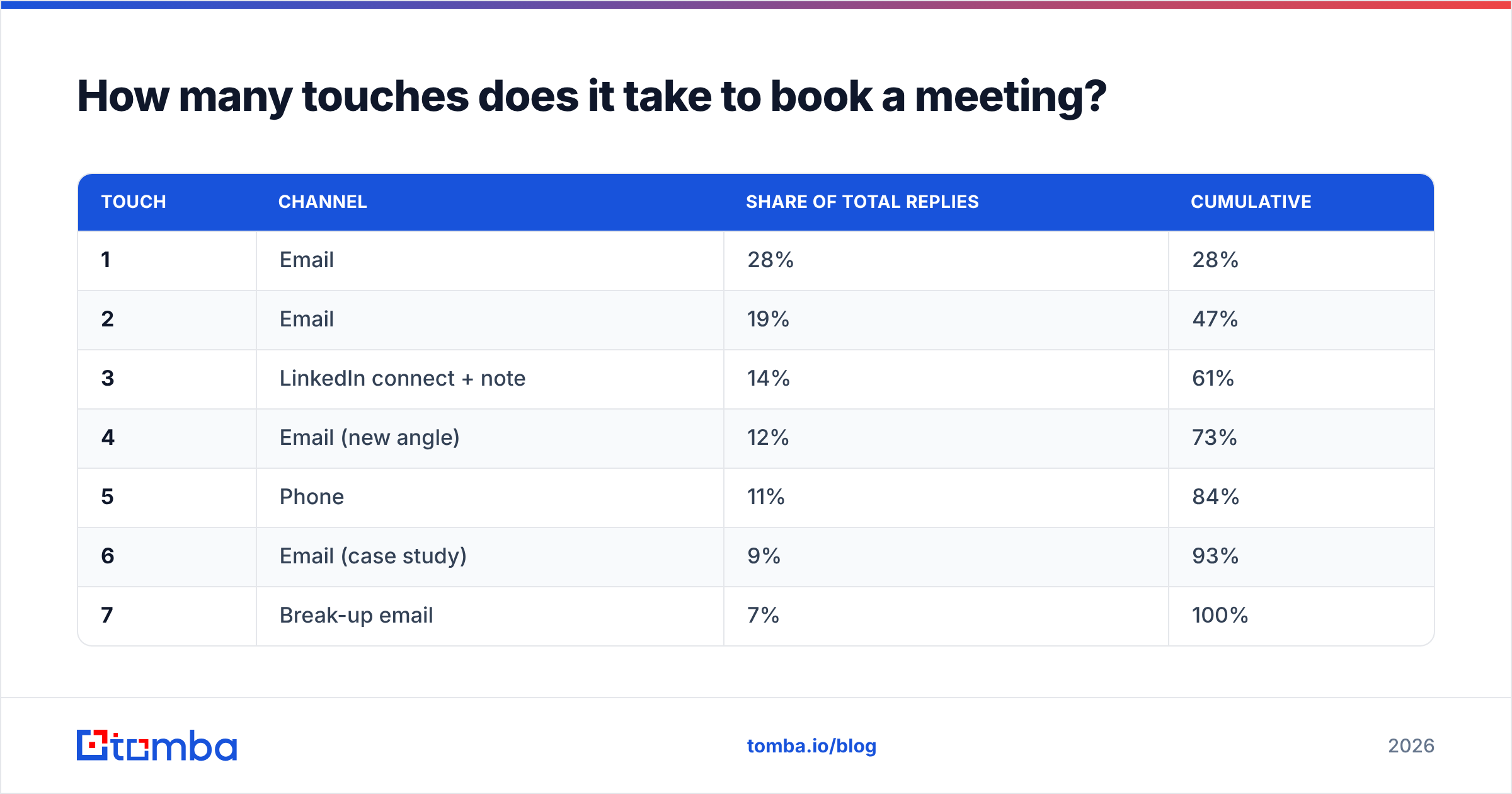
More than you're doing. Reply distribution across a typical B2B sequence looks roughly like this:
| Touch | Channel | Share of total replies | Cumulative |
|---|---|---|---|
| 1 | 28% | 28% | |
| 2 | 19% | 47% | |
| 3 | LinkedIn connect + note | 14% | 61% |
| 4 | Email (new angle) | 12% | 73% |
| 5 | Phone | 11% | 84% |
| 6 | Email (case study) | 9% | 93% |
| 7 | Break-up email | 7% | 100% |
If you stop after touch 2, you collect 47% of the available replies. Half your pipeline is sitting in touches you never sent. The reps who "have great luck with outbound" are usually just the reps who finished the sequence.
Two rules that keep long sequences from becoming harassment:
- Every touch needs a new reason to exist. "Just bumping this" is not a reason. A relevant customer story, a new data point, a question about something they posted — those are reasons.
- Change the channel, change the odds. Touch 3 on LinkedIn reaches a person who has 40 unread emails but 4 unread LinkedIn notifications. A LinkedIn finder bridges the two, so a profile you found on LinkedIn becomes a verified email in your sequence.
For phone touches, having a verified mobile matters more than having a switchboard number. A phone finder that returns direct dials turns touch 5 from a gatekeeper conversation into a real one.

Which tools actually help you book meetings?#
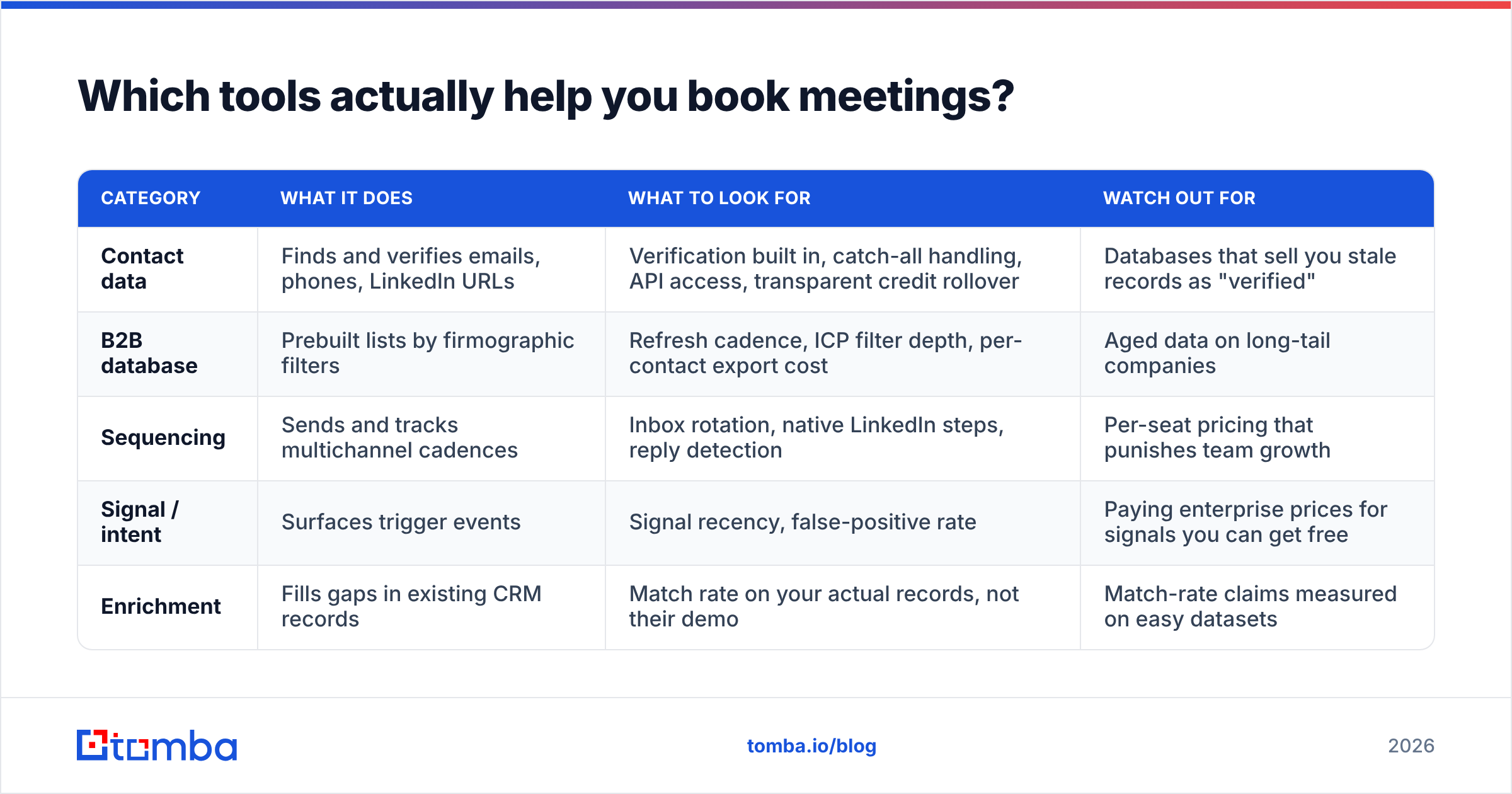
Categories matter more than brands. You need three things: contact data, sequencing, and signal. Some tools span two; almost none do all three well.
| Category | What it does | What to look for | Watch out for |
|---|---|---|---|
| Contact data | Finds and verifies emails, phones, LinkedIn URLs | Verification built in, catch-all handling, API access, transparent credit rollover | Databases that sell you stale records as "verified" |
| B2B database | Prebuilt lists by firmographic filters | Refresh cadence, ICP filter depth, per-contact export cost | Aged data on long-tail companies |
| Sequencing | Sends and tracks multichannel cadences | Inbox rotation, native LinkedIn steps, reply detection | Per-seat pricing that punishes team growth |
| Signal / intent | Surfaces trigger events | Signal recency, false-positive rate | Paying enterprise prices for signals you can get free |
| Enrichment | Fills gaps in existing CRM records | Match rate on your actual records, not their demo | Match-rate claims measured on easy datasets |
A note on cost structure, since it drives real decisions. Tomba pricing starts with a free tier at 25 searches/month, then Starter at $49/mo, Growth at $99/mo, and Pro at $249/mo, with Enterprise custom. For a rep working 800 verified contacts a month, that's well under a dollar per contact — against a fully loaded rep cost, the data is the cheapest line item in the stack. BookYourData takes a different, credit-based approach that suits teams who prefer buying prebuilt lists outright rather than searching per-record; both models work, and which fits depends on whether your ICP is broad or highly specific.
Whatever you pick, check the vendor's own accuracy methodology rather than the headline number. And read the review sites — G2's sales intelligence category is a reasonable sanity check on whether a vendor's support and billing match their marketing.
What should you measure to know it's working?#
Meetings booked is a vanity metric. Here's the scoreboard that actually predicts next quarter:
- Bounce rate. Under 2%. Above 5% and you have a data problem that will become a deliverability problem within weeks.
- Reply rate by segment, not overall. An overall 4% might be one segment at 9% and two at 1.5%. The average hides the answer.
- Meetings held / meetings booked. Under 75% means your qualification is loose or your confirmation process is missing. Send a confirmation the day before with an agenda; it moves this number 10-15 points.
- Touches per booked meeting. If it's under 3, you're only harvesting the easy yeses and leaving the rest.
- Accounts touched vs. contacts touched. Divide them. If the ratio is near 1.0, you're single-threading and capping your own ceiling.
- Cost per held meeting. Data spend plus tool spend plus rep hours, divided by held meetings. This is the number that survives a budget review.
Review these weekly, not monthly. Outbound feedback loops are short enough that a monthly cadence means you spend four weeks scaling a mistake.
How do you turn a reply into a booked meeting?#
You have roughly two hours before a warm reply cools. The teams that convert replies well do three unglamorous things:
Reply fast, from a human. Automated "great to hear from you" responses kill more meetings than they save. A two-line human reply within an hour converts dramatically better than a polished one the next day.
Propose, don't ask. "Does Thursday at 2pm or Friday at 10am work?" outperforms "when are you free?" because it removes a decision. Include a booking link as a fallback, not as the primary ask — links feel transactional when someone just wrote you a thoughtful reply.
Confirm and add value before the call. A short note the day before with a one-line agenda and one relevant resource does two things: it cuts no-shows, and it starts the meeting with the prospect already oriented. Teams that do this consistently run no-show rates in the 10-15% range instead of 25-30%.
If your reply-to-meeting conversion sits below 30%, the problem is almost never the calendar. It's that the replies you're getting are curious rather than qualified — which routes back to targeting, not to scheduling.
Where should you start this week?#
Pick one bottleneck, not five. Run last month's numbers through the funnel table at the top of this post and find your worst row.
- Bounce rate over 5%? Verify your entire active list before your next send. Nothing else you do this month will matter more.
- Reply rate under 2%? Your targeting is off, not your copy. Rebuild one segment of 150 accounts around a single clear trigger signal.
- Reply rate fine, meetings low? Your qualification is loose. Tighten the ICP filter and accept fewer, better replies.
- Meetings booked but not held? Add a confirmation touch. This is the cheapest fix on the list.
- Everything decent but flat? Add touches 5-7 and a second channel. The volume is already in your sequence — you just aren't sending it.
Then leave it alone for three weeks. Outbound changes need a full cycle to show signal, and changing four things at once means you'll never know which one worked.
Start with the input that gates everything else. Meeting volume is downstream of contact quality, and contact quality is the one variable you can fix this afternoon. Tomba Email Finder returns verified professional email addresses by domain, name, or company, with verification built into the same workflow — so the list you sequence next Monday is one you can actually reach. The free tier gives you 25 searches a month to test it against your own accounts before you commit to a plan.
Related guides#
Ready to find emails that actually work?
Join 150,000+ professionals who stopped guessing and started sending. Free credits on signup — no credit card required.
Get the Tomba newsletter
Practical outbound tactics and product updates — once every two weeks.
About the author