How to Break Into B2B Sales in 2026: A Step-by-Step Guide
No degree, no quota history, no network? Here is the exact 90-day path into a B2B sales role in 2026 — which roles to target, what hiring managers actually test, and how to prove you can prospect before anyone pays you.
TL;DR
- The fastest door into B2B sales in 2026 is the SDR/BDR seat — it hires for coachability and output, not for a degree or a quota history.
- Hiring managers no longer trust "I'm a people person." They test whether you can build a list, find a real contact, and write a message that gets a reply.
- Build a 3-part portfolio before you apply: a 50-account target list, 10 verified contacts with reasoning, and 3 personalized outbound sequences. This beats a polished resume almost every time.
- Expect $45K–$65K base for entry-level SDR roles in the US, with OTE around $70K–$95K. AE promotion typically lands 12–24 months in.
- The single highest-leverage skill you can show on day one is accurate contact data — most candidates send to guessed addresses and bounce out of the interview.
What does "breaking into B2B sales" actually mean in 2026?#
It means landing your first paid seat on a revenue team that sells to businesses rather than consumers. In practice that is one of four roles, and knowing which one you're aiming for changes everything about how you apply.
B2B sales is not one job. A company selling $8K/year software to marketing teams and a company selling $400K enterprise contracts to hospital systems both say "B2B sales" in the job title, but the entry paths are completely different. The first hires 22-year-olds with no experience. The second hires people with 5 years of industry credibility.
Your job is to target the first category deliberately, get 12–24 months of measurable output, then move wherever you want.
Here is what the entry landscape looks like right now:
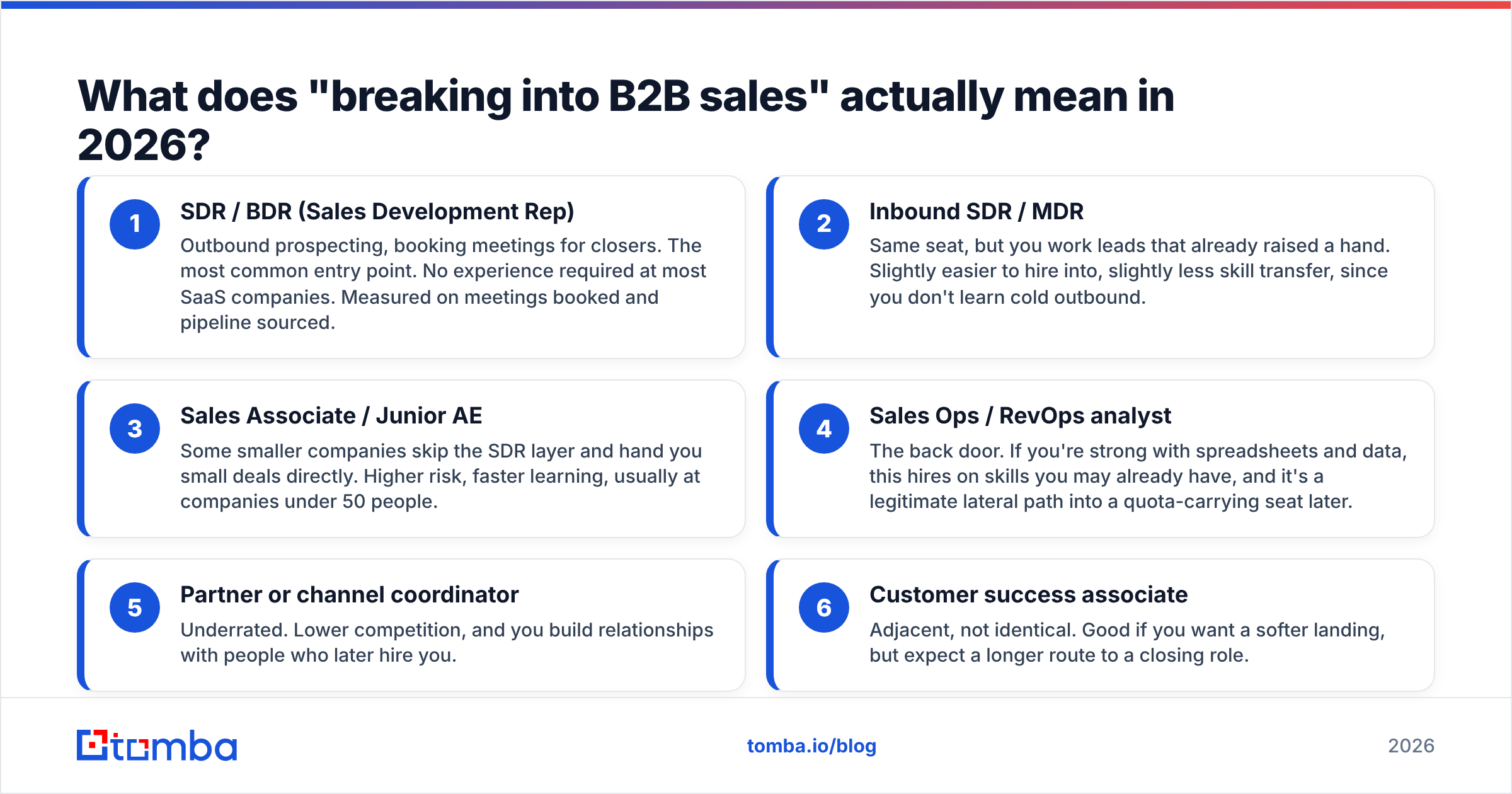
- SDR / BDR (Sales Development Rep) — Outbound prospecting, booking meetings for closers. The most common entry point. No experience required at most SaaS companies. Measured on meetings booked and pipeline sourced.
- Inbound SDR / MDR — Same seat, but you work leads that already raised a hand. Slightly easier to hire into, slightly less skill transfer, since you don't learn cold outbound.
- Sales Associate / Junior AE — Some smaller companies skip the SDR layer and hand you small deals directly. Higher risk, faster learning, usually at companies under 50 people.
- Sales Ops / RevOps analyst — The back door. If you're strong with spreadsheets and data, this hires on skills you may already have, and it's a legitimate lateral path into a quota-carrying seat later.
- Partner or channel coordinator — Underrated. Lower competition, and you build relationships with people who later hire you.
- Customer success associate — Adjacent, not identical. Good if you want a softer landing, but expect a longer route to a closing role.
Most people reading this should target #1. It has the highest volume of openings, the lowest formal barriers, and the clearest promotion ladder.
Do you need a degree or prior sales experience?#
No. And this is the part people waste months on.
Look at 200 SDR postings and you'll see "Bachelor's degree preferred" on maybe 60% of them. The word doing the work there is preferred. Sales orgs are the one function in B2B where measurable output overrides credentials almost completely, because the output is unambiguous — you either booked the meetings or you didn't.
What actually gets screened for:
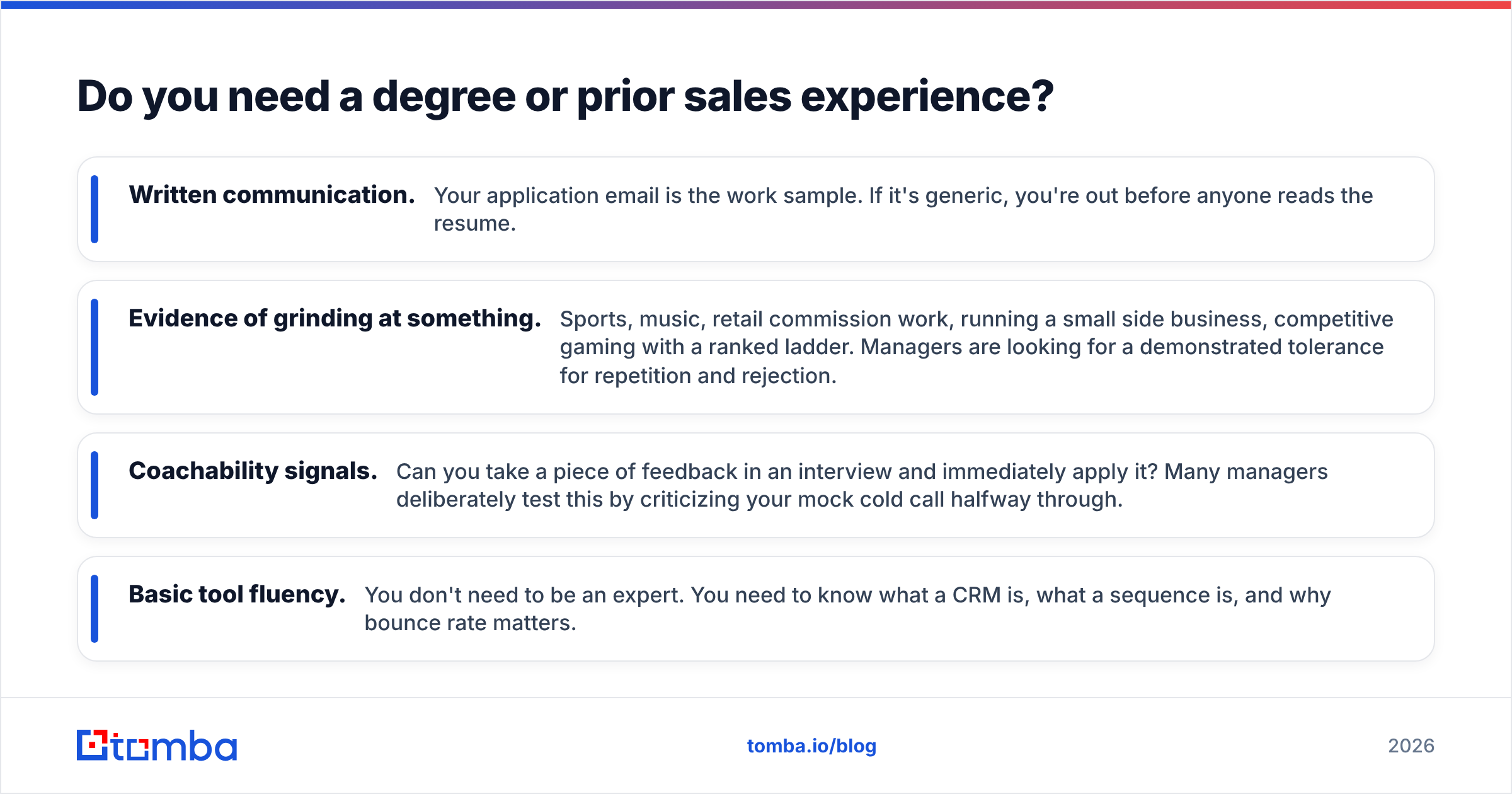
- Written communication. Your application email is the work sample. If it's generic, you're out before anyone reads the resume.
- Evidence of grinding at something. Sports, music, retail commission work, running a small side business, competitive gaming with a ranked ladder. Managers are looking for a demonstrated tolerance for repetition and rejection.
- Coachability signals. Can you take a piece of feedback in an interview and immediately apply it? Many managers deliberately test this by criticizing your mock cold call halfway through.
- Basic tool fluency. You don't need to be an expert. You need to know what a CRM is, what a sequence is, and why bounce rate matters.
What does not get screened for: your GPA, your major, whether you interned at a name-brand company, or how many "sales certifications" you bought.
Actually — use the placeholder:
What skills do B2B sales hiring managers actually test?#
Five, and they test them in a specific order. Prepare in this order too.
1. Can you research an account? You'll be given a company and asked what you'd say to them. Weak candidates recite the homepage. Strong candidates cite a hiring pattern, a funding round, a tech-stack change, or a leadership hire — and connect it to a plausible problem.
2. Can you find the right person? This is where most candidates fall apart. Knowing that the VP of Demand Gen is your buyer is useless if you can't reach them. Being able to say "I use domain search to pull the org's email pattern, then verify before sending" instantly separates you from the field.
3. Can you write 90 words that earn a reply? Not 300 words. Not a paragraph about your company's "innovative platform." A short, specific, one-ask message. This is the most teachable skill on the list and the one most candidates neglect.
4. Can you hold a phone conversation with a stranger? Mock cold calls are standard in the interview loop. You will be interrupted, objected to, and rushed. The test is not whether you're smooth — it's whether you stay calm and keep asking questions.
5. Can you manage your own activity? Given 40 accounts and a week, what's your plan? Managers want to hear a system, not enthusiasm.
Which entry-level sales role should you target?#
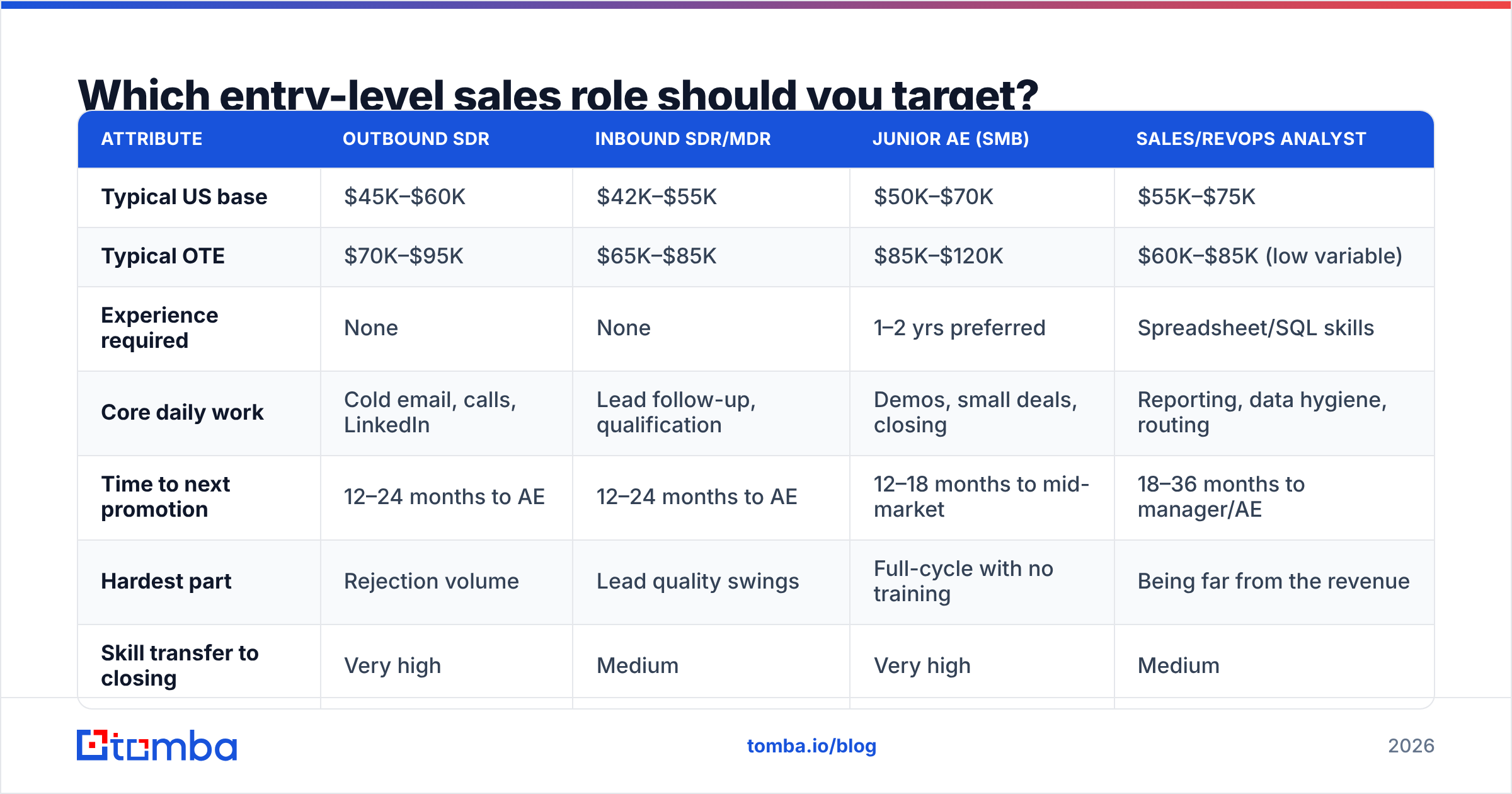
Compare the realistic options before you apply anywhere. The differences in ramp speed and long-term optionality are larger than the salary gaps suggest.
| Attribute | Outbound SDR | Inbound SDR/MDR | Junior AE (SMB) | Sales/RevOps Analyst |
|---|---|---|---|---|
| Typical US base | $45K–$60K | $42K–$55K | $50K–$70K | $55K–$75K |
| Typical OTE | $70K–$95K | $65K–$85K | $85K–$120K | $60K–$85K (low variable) |
| Experience required | None | None | 1–2 yrs preferred | Spreadsheet/SQL skills |
| Core daily work | Cold email, calls, LinkedIn | Lead follow-up, qualification | Demos, small deals, closing | Reporting, data hygiene, routing |
| Time to next promotion | 12–24 months to AE | 12–24 months to AE | 12–18 months to mid-market | 18–36 months to manager/AE |
| Hardest part | Rejection volume | Lead quality swings | Full-cycle with no training | Being far from the revenue |
| Skill transfer to closing | Very high | Medium | Very high | Medium |
| Hiring volume in 2026 | High | Medium | Medium | Medium |
If you're optimizing for long-term earning power, take the outbound SDR seat. The pain is front-loaded, and the skill — creating pipeline from nothing — is the one that never stops being valuable. AEs who came up through outbound consistently out-earn AEs who came up through inbound, because they can generate their own pipeline when marketing has a bad quarter.
How do you build a sales portfolio with zero experience?#
This is the move that compresses a six-month job search into six weeks. Almost nobody does it, which is exactly why it works.
Pick one company you'd genuinely want to work for. Then build the work product an SDR at that company would produce in their first week, and send it with your application.
Part 1 — The target account list (50 accounts). Define an ICP based on the company's existing customer logos. Pull 50 companies that match on industry, size, and one trigger signal (recent funding, new leadership, hiring for a relevant role, a specific tech in their stack). Put it in a sheet with a "why this account" column. That column is the whole point — it proves you think, rather than filter.
Part 2 — 10 verified contacts. From those accounts, identify 10 specific humans and their verified work emails. Include title, why they're the right entry point, and confirmation the address is deliverable. Use an email finder to pull the addresses and an email verifier to confirm they're safe to send to. A free tier gets you well past 10 contacts — Tomba's free plan includes 25 searches per month, which is enough to build this artifact without spending anything.
Part 3 — 3 personalized sequences. Three accounts, three 4-touch sequences (email, email, LinkedIn, call script). Show the research that drove each opener. Keep every email under 100 words.
Attach it as a single PDF or a shared doc link. Then write a five-sentence email to the hiring manager — whose address you found the same way — that says: I built the first week of the job. Here it is. Fifteen minutes?
Two things happen. You demonstrate every skill from the previous section simultaneously, and you generate a conversation that no applicant-tracking system can filter out.
What tools should you learn before your first interview?#
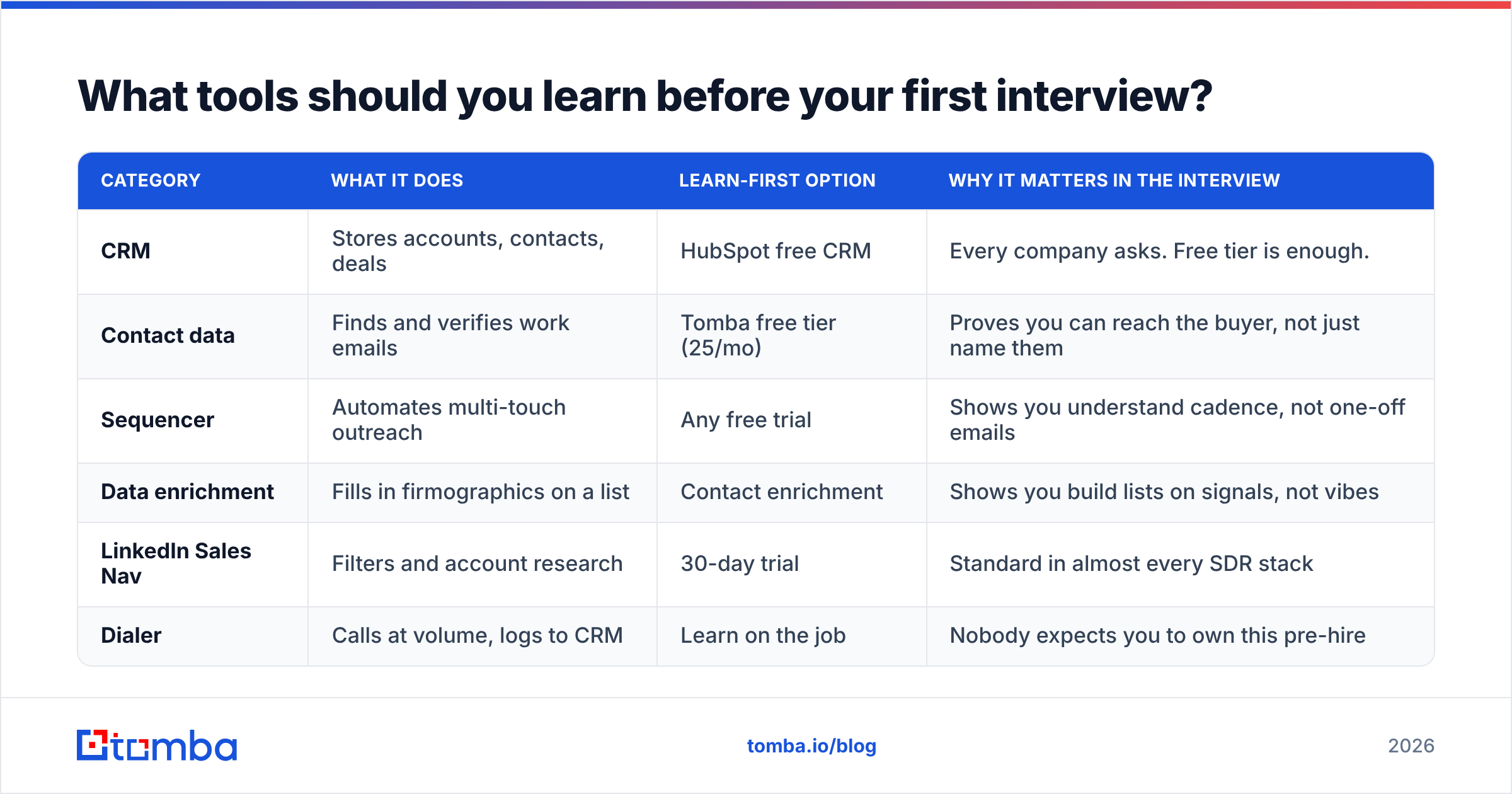
You don't need certifications. You need to have touched each category once so you can speak about it without bluffing.
| Category | What it does | Learn-first option | Why it matters in the interview |
|---|---|---|---|
| CRM | Stores accounts, contacts, deals | HubSpot free CRM | Every company asks. Free tier is enough. |
| Contact data | Finds and verifies work emails | Tomba free tier (25/mo) | Proves you can reach the buyer, not just name them |
| Sequencer | Automates multi-touch outreach | Any free trial | Shows you understand cadence, not one-off emails |
| Data enrichment | Fills in firmographics on a list | Contact enrichment | Shows you build lists on signals, not vibes |
| LinkedIn Sales Nav | Filters and account research | 30-day trial | Standard in almost every SDR stack |
| Dialer | Calls at volume, logs to CRM | Learn on the job | Nobody expects you to own this pre-hire |
Spend a weekend, not a semester. The goal is fluency in the vocabulary and one hands-on artifact per category — nothing more.
One caveat worth internalizing early: contact data quality is the difference between a working sequence and a burned domain. If 20% of your list bounces, your sender reputation drops and even your good emails stop landing. New reps learn this the expensive way. Learning it before you start makes you look like you've done the job.

How do you find and land the interviews?#
Volume plus specificity. Most candidates do one or the other.
Apply narrow, not wide. Twenty applications with a portfolio attached will outperform 300 generic ones. Pick companies where you can articulate a real reason for interest — you use the product, you know the market, you have a background in their customer's industry.
Go around the front door. Job boards are the most competitive channel. Instead, find the sales manager or Director of Sales Development directly and email them. Company career pages tell you who's hiring; a domain search tells you the org's email pattern so you can reach that manager without waiting on a recruiter queue.
Use adjacent channels. Sales communities (Pavlok, RevGenius, Sales Hacker Slack groups), LinkedIn comment sections under sales-leadership posts, and local meetups all produce warm intros faster than applying cold. Check G2 for fast-growing tools in a category you find interesting — fast-growing vendors hire SDRs constantly.
Track everything. Run your job search exactly like a pipeline: 50 target companies, stage each one, follow up on a cadence, log outcomes. Mention that you did this in the interview. It's the single most convincing thing an inexperienced candidate can say.
Follow up more than feels comfortable. Three to five touches over two weeks is normal and expected. Candidates who follow up get hired; candidates who send one email and wait do not. This is also a live audition — a hiring manager watching you follow up politely and persistently is watching you do the job.
What does the first 90 days on the job look like?#
Ramp is real and everyone struggles. Knowing the shape of it prevents you from quitting at week six.
Weeks 1–2 — Absorption. Product training, ICP, competitive landscape, tooling access. Take obsessive notes. Ask to shadow calls from day one, not day fifteen.
Weeks 3–6 — Volume with bad aim. You'll do a lot of activity with mediocre results. This is normal. Focus on rep count: 40+ dials or 60+ personalized emails a day, and one recorded call reviewed with your manager every week.
Weeks 7–12 — Pattern recognition. You start noticing which openers get replies, which titles engage, which industries ignore you. Your booked-meeting rate climbs. Most reps hit their first full quota somewhere in month 3 or 4.
The metric to protect above all others in this window is response rate, not activity volume. Activity is the input your manager can see; response rate is the signal that your messaging and your data are both working. If your response rate is near zero, check your data before you rewrite your copy — deliverability problems masquerade as messaging problems constantly. Salesforce's own sales research consistently shows reps spend a minority of their week actually selling; the reps who win are the ones who protect that selling time from bad-data cleanup.
What should you avoid doing?#
- Don't chase enterprise first. Enterprise sales rewards credibility you don't have yet. Start SMB or mid-market where deal cycles are short and you get 20x the reps.
- Don't pay for a "sales bootcamp." The portfolio project above costs nothing and signals more.
- Don't over-index on the resume. One clean page is fine. Your outbound to the hiring manager is the real application.
- Don't guess email addresses. Guessed addresses bounce, and a hiring manager who sees your outreach land in spam has all the information they need.
- Don't take the first offer blindly. Ask about ramp quota, average tenure of the SDR team, the SDR-to-AE promotion rate over the last year, and how many SDRs hit quota last quarter. If they dodge, that's your answer.
- Don't quit at month two. The curve is steep and then it isn't. Almost everyone who leaves early leaves right before it clicks.
Start with the data problem#
Every part of this — the portfolio, the outreach to hiring managers, the first 90 days on the job — runs on one thing: reaching the right person at a working address. That's the skill you can build before anyone pays you, and it's the one that keeps paying once they do.
Start free. Tomba's Email Finder gives you 25 searches per month at no cost — enough to build your 10-verified-contact portfolio piece and email the hiring managers directly. When you land the seat and need real volume, paid plans start at $49/month; full Tomba pricing is public, so you can also point at it in an interview when someone asks how you'd build a prospecting stack on a budget.
Build the list. Verify the contacts. Send the email. That's the job, and you can start doing it today.
Related guides#
Ready to find emails that actually work?
Join 150,000+ professionals who stopped guessing and started sending. Free credits on signup — no credit card required.
Get the Tomba newsletter
Practical outbound tactics and product updates — once every two weeks.
About the author