How to Build a B2B Brand in 2026: A 7-Step Operator Playbook
Most B2B brand advice stops at logos and tone of voice. This playbook shows the seven steps that actually move pipeline — positioning, proof, distribution, and the data layer underneath them.
TL;DR
- A B2B brand is not a logo or a color palette. It is the set of associations a buyer retrieves when a problem shows up — and the only reliable way to build it is repeated, specific exposure to the same point of view.
- Start with a positioning statement narrow enough to exclude people. Broad positioning ("we help teams grow") produces zero recall.
- Split budget roughly 60/40 between demand creation (brand, category, POV content) and demand capture (search, retargeting, outbound). Most B2B teams get this backwards.
- Distribution beats production. One strong POV distributed through founder LinkedIn, targeted outbound, podcasts, and partner channels outperforms ten blog posts nobody sees.
- Measure branded search volume, direct traffic, win rate against named competitors, and unaided recall in win/loss calls — not impressions.
What Does "B2B Brand" Actually Mean?#
A B2B brand is memory structure. When a VP of RevOps realizes their CRM data is 40% stale, whichever three vendors surface unprompted in that moment have a brand. Everyone else is competing on a Google search page with fourteen other blue links.
That definition matters because it changes what you build. Memory structure is created by repetition of distinctive, specific things — a phrase, a number, a founder's face, a recurring format, a strong opinion. It is not created by a rebrand deck.
The B2B Institute's work with the Ehrenberg-Bass Institute popularized the "95-5 rule": at any moment, roughly 95% of your addressable buyers are not in market. If your entire program is built around capturing the 5% who are searching right now, you are fighting the most expensive, most crowded auction in your category while ignoring the people who will buy in eighteen months.
Here's the practical split of what a B2B brand consists of:
- Positioning — the specific problem you own, stated in the buyer's language, narrow enough that some people self-select out.
- Proof — customer outcomes, benchmarks, and public data that make the positioning credible rather than aspirational.
- Distinctive assets — the visual, verbal, and format signals a buyer can identify in half a second: a logo, a recurring report, a founder's writing voice, a color, a phrase.
- Distribution — the owned, earned, and paid channels through which the above reaches the same accounts repeatedly.
- Experience — onboarding, docs, support responsiveness, and pricing transparency. In B2B this is the brand, because buyers talk to each other.
- Data layer — the contact and account data that decides whether steps 1-4 reach the right humans at all.
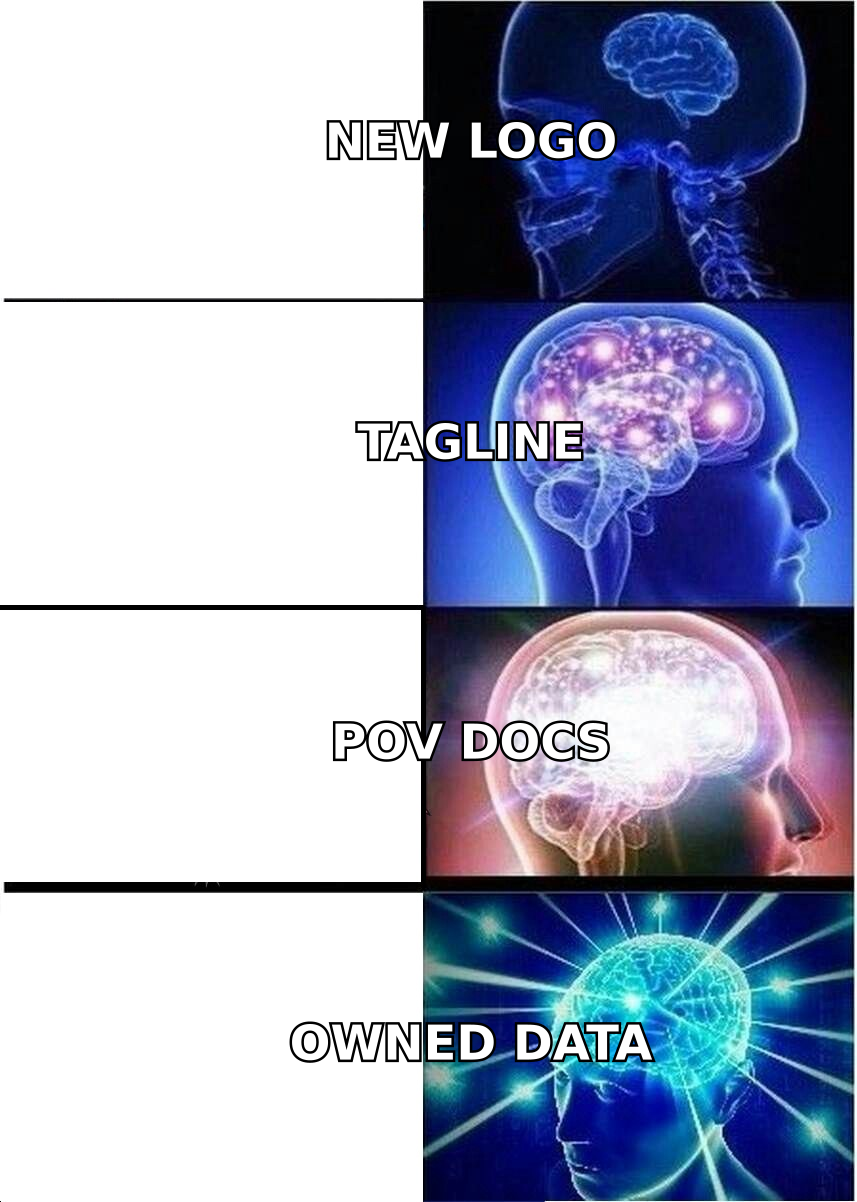
Most teams invest heavily in step 3, lightly in steps 1 and 4, and not at all in step 6. That order is backwards.
How Do You Write Positioning That Actually Sticks?#
Write it so that a competitor could not credibly put their name on it. That's the whole test.
Run this in a single working session with your founder, your top AE, and one customer-facing engineer. Do not turn it into a six-week agency engagement.
Step 1 — List the last 20 closed-won deals. For each one, write the sentence the buyer used when describing why they bought. Not your marketing copy. Their words, pulled from call recordings or the CRM notes.
Step 2 — Find the repeated noun. Across those 20, one problem noun recurs — "bounce rate," "duplicate records," "ramp time," "renewal risk." That noun is your category anchor.
Step 3 — Name the enemy. Strong B2B brands define themselves against something: a legacy tool, a manual process, a dominant but flawed assumption. "Spreadsheets" is a weak enemy because it's generic. "Buying a 200M-record database and hoping 30% of it is deliverable" is a strong enemy because it's specific and slightly uncomfortable.
Step 4 — Write the exclusion clause. Finish this sentence honestly: "This is a bad fit if you ___." A brand with no exclusion clause has no shape. If your answer is "nobody, we work for everyone," you have a utility, not a brand.
Step 5 — Compress to one sentence, then test it. Send the sentence to ten customers and ask: "Does this sound like us, or like any vendor?" If more than three say "any vendor," rewrite.
Positioning that survives this process gives every downstream asset a job. Positioning that skips it produces a website nobody remembers and a sales team that improvises a different story on every call.
Which Channels Build a B2B Brand Fastest?#
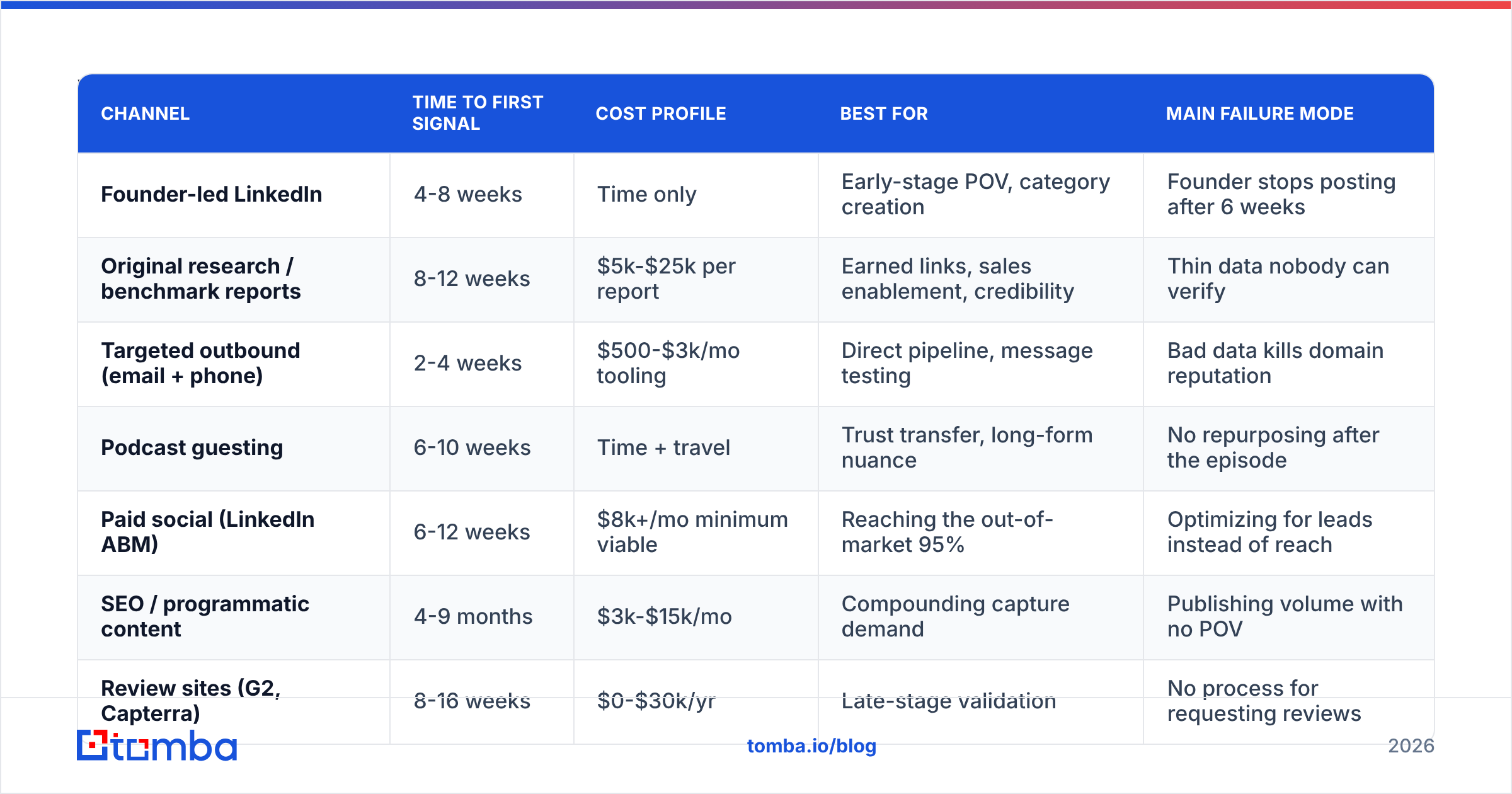
The channels that put a named human in front of a named account repeatedly. Here's how the realistic options compare for a team under 50 people.
| Channel | Time to first signal | Cost profile | Best for | Main failure mode |
|---|---|---|---|---|
| Founder-led LinkedIn | 4-8 weeks | Time only | Early-stage POV, category creation | Founder stops posting after 6 weeks |
| Original research / benchmark reports | 8-12 weeks | $5k-$25k per report | Earned links, sales enablement, credibility | Thin data nobody can verify |
| Targeted outbound (email + phone) | 2-4 weeks | $500-$3k/mo tooling | Direct pipeline, message testing | Bad data kills domain reputation |
| Podcast guesting | 6-10 weeks | Time + travel | Trust transfer, long-form nuance | No repurposing after the episode |
| Paid social (LinkedIn ABM) | 6-12 weeks | $8k+/mo minimum viable | Reaching the out-of-market 95% | Optimizing for leads instead of reach |
| SEO / programmatic content | 4-9 months | $3k-$15k/mo | Compounding capture demand | Publishing volume with no POV |
| Review sites (G2, Capterra) | 8-16 weeks | $0-$30k/yr | Late-stage validation | No process for requesting reviews |
| Customer community / Slack | 3-6 months | 0.5 FTE | Retention, word of mouth | Launching before you have 50 fans |
Two things fall out of that table.
First, nothing works in under a month. Any plan that promises brand lift in three weeks is measuring something other than brand.
First-party distribution — where you own the list — is the only channel whose cost does not inflate every year. Which is why the unglamorous work of building an accurate contact list matters more than the creative. You can have the sharpest point of view in your category and still have it land in spam because 22% of your list bounced.
That's the part most brand articles skip. Reach requires deliverability, and deliverability requires clean data. Run new contacts through an email verifier before a single campaign goes out, and use domain search to map the full buying committee at target accounts rather than emailing whoever you happened to find on LinkedIn.
How Should You Split Brand and Performance Budget?#
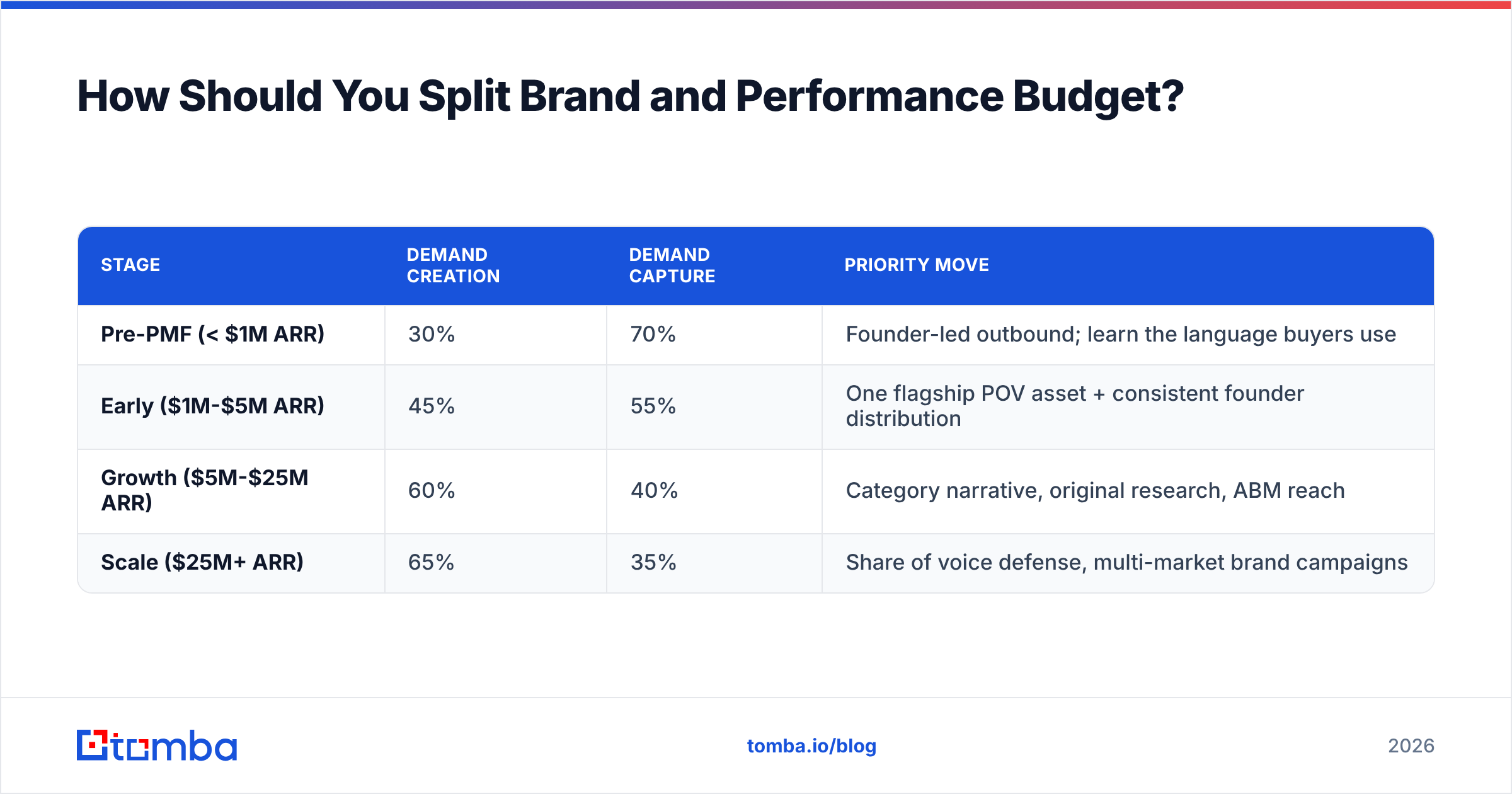
Roughly 60% demand creation, 40% demand capture — but the ratio shifts with company stage.
Les Binet and Peter Field's long-running analysis of IPA effectiveness data landed on a 60/40 brand-to-activation split across B2B categories, and the LinkedIn B2B Institute has published extensively on why B2B teams under-invest in the brand half. The logic is simple: activation converts existing demand, brand creates the demand that activation will convert twelve months from now. Cut brand and your CAC looks great for two quarters, then quietly doubles.
| Stage | Demand creation | Demand capture | Priority move |
|---|---|---|---|
| Pre-PMF (< $1M ARR) | 30% | 70% | Founder-led outbound; learn the language buyers use |
| Early ($1M-$5M ARR) | 45% | 55% | One flagship POV asset + consistent founder distribution |
| Growth ($5M-$25M ARR) | 60% | 40% | Category narrative, original research, ABM reach |
| Scale ($25M+ ARR) | 65% | 35% | Share of voice defense, multi-market brand campaigns |
Pre-PMF teams should absolutely over-index on capture. You cannot build a memory structure around a value proposition you haven't validated. But past $5M ARR, teams that keep spending 80% on capture are the ones who complain that "paid stopped working" — paid didn't stop working, they just ran out of people who already knew who they were.
What Does a Brand-Building Operating Cadence Look Like?#
Brand dies from inconsistency, not from bad creative. Lock a cadence and defend it.
Weekly
- Founder or subject-matter expert publishes 2-3 LinkedIn posts with a genuine opinion, not a recap of a blog post.
- One customer conversation recorded and mined for language.
- Outbound sequences reviewed for reply sentiment, not just reply rate.
Monthly
- One substantial owned asset: a benchmark, a teardown, an opinionated guide. Not five thin posts.
- Refresh target account list; re-verify contacts older than 90 days. B2B contact data decays around 25-30% annually as people change roles.
- Review branded search volume and direct traffic in Search Console and analytics.
Quarterly
- Win/loss interviews with at least five accounts, including losses. Ask the unaided recall question: "Which vendors came to mind when you started looking?"
- Message-market audit: does the website say what the sales team says?
- Share-of-voice check against your three named competitors.
Annually
- Positioning review. Not a rebrand — a check on whether the enemy you named is still the enemy your buyers feel.
- Refresh your flagship research so the number people cite is current.
The monthly re-verification item looks like housekeeping and is actually brand work. Every email that bounces at a target account is a brand impression you paid for and did not receive. Teams running list hygiene through a bulk email finder as a standing monthly task keep their sender reputation intact, which keeps their message in the inbox, which is where brand actually accumulates.
How Do You Measure Whether the Brand Is Working?#
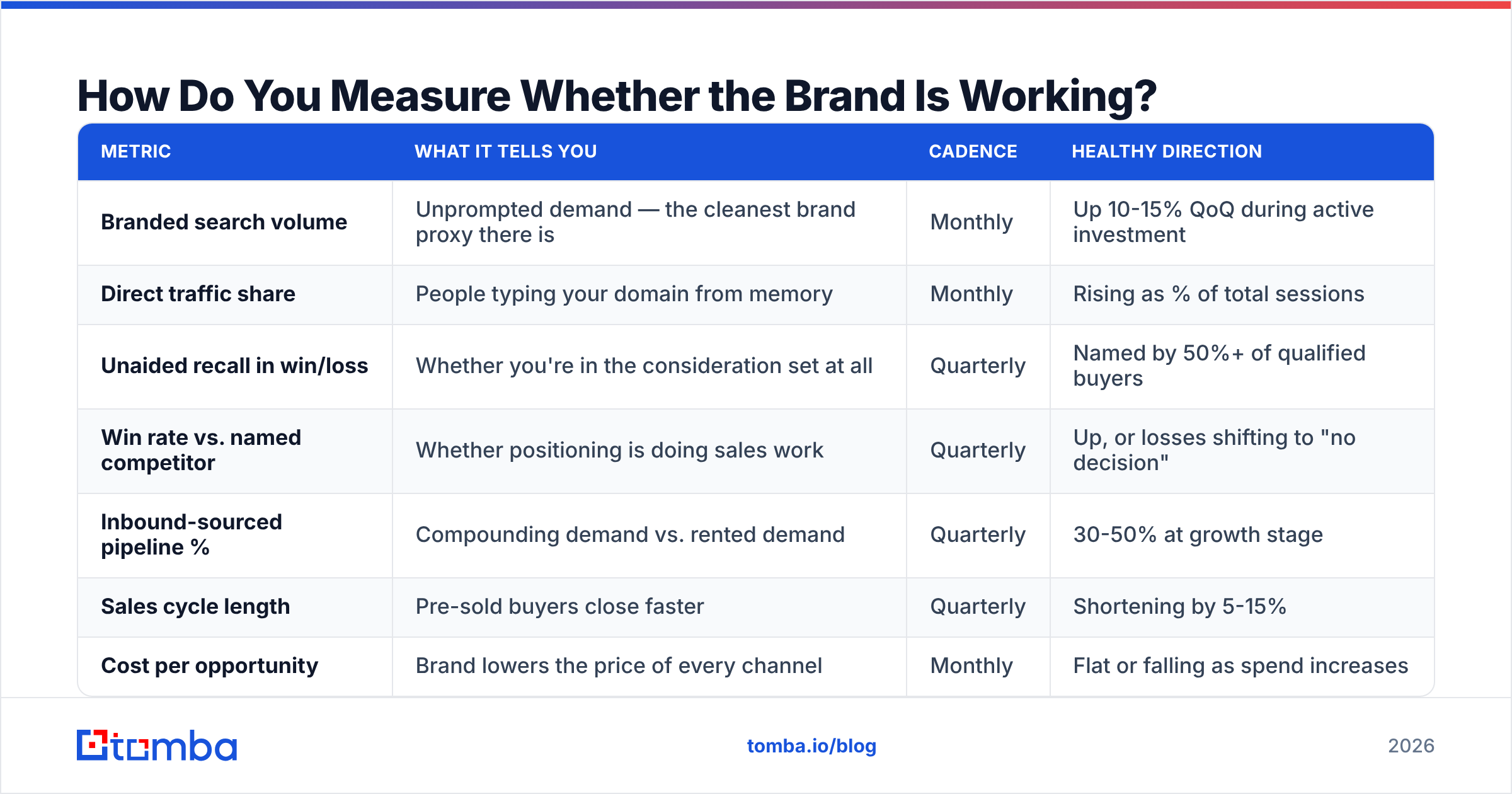
Track leading indicators of memory, not vanity metrics of exposure.
| Metric | What it tells you | Cadence | Healthy direction |
|---|---|---|---|
| Branded search volume | Unprompted demand — the cleanest brand proxy there is | Monthly | Up 10-15% QoQ during active investment |
| Direct traffic share | People typing your domain from memory | Monthly | Rising as % of total sessions |
| Unaided recall in win/loss | Whether you're in the consideration set at all | Quarterly | Named by 50%+ of qualified buyers |
| Win rate vs. named competitor | Whether positioning is doing sales work | Quarterly | Up, or losses shifting to "no decision" |
| Inbound-sourced pipeline % | Compounding demand vs. rented demand | Quarterly | 30-50% at growth stage |
| Sales cycle length | Pre-sold buyers close faster | Quarterly | Shortening by 5-15% |
| Cost per opportunity | Brand lowers the price of every channel | Monthly | Flat or falling as spend increases |
Impressions, follower count, and "engagement" belong in a channel report, not a brand report. They measure whether your media buy delivered, not whether anyone remembers you.
The single most underrated metric on that list is cost per opportunity holding flat while spend goes up. That is the signature of brand equity doing its job: you're reaching colder audiences and they're converting anyway, because they've heard of you.
What Are the Most Common B2B Branding Mistakes?#
Rebranding instead of repositioning. A new wordmark solves a design problem. If buyers can't articulate what you do, that's a language problem, and no amount of typography fixes it.
Writing for peers instead of buyers. Marketing teams write copy that impresses other marketers. Your buyer is a director of operations who has 40 minutes between meetings and needs to know if you solve their specific problem.
Treating thought leadership as a content quota. Twelve posts a month with no argument in any of them builds nothing. One genuinely contrarian, well-evidenced piece per month builds a reputation.
Ignoring the post-sale experience. In B2B, your customers are your distribution. Onboarding friction and slow support show up in G2 reviews and in private Slack groups where your next 50 buyers are asking for recommendations. G2 and Capterra reviews are read by buyers far more often than your homepage.
Building reach on rented land. Algorithm changes have wiped out more B2B pipelines than any competitor has. Convert attention into an owned list. Every LinkedIn follower who never gives you an email address is a follower you can lose overnight.
Skipping the data layer. You can execute all five of the above correctly and still fail if your outreach hits stale contacts. When a director changes companies, your beautifully positioned email goes to a dead mailbox — and the new person at that account never hears from you at all. This is where contact enrichment and periodic re-verification stop being an ops chore and start being a brand multiplier.
How Long Does It Take to Build a B2B Brand?#
Expect 90 days for internal alignment, 6-9 months for early external signal, and 18-24 months for measurable share-of-voice change in a competitive category.
A realistic first-year arc:
- Days 1-30: Positioning session, exclusion clause, message testing with ten customers. Rewrite homepage and one-pager.
- Days 31-90: Founder distribution cadence live. Target account list built and verified. First flagship asset scoped.
- Days 91-180: Flagship research or benchmark published and distributed across outbound, LinkedIn, and two podcasts. Review-site process running.
- Days 181-365: Second and third flagship assets. Paid reach layered onto the accounts already touched organically. First quarterly win/loss cycle produces unaided-recall data.
The teams that fail almost always fail between day 31 and day 90 — the stretch where the work is unglamorous, nothing is measurable yet, and the founder stops posting. That's the whole game. Consistency through the boring middle is the actual moat, and it's why most competitors won't have a brand: not because they can't, but because they'll quit in week seven.
Where Does Data Fit Into Brand Building?#
Every brand impression you intend to deliver requires a correct address to land at. That's the unglamorous foundation under positioning and creative.
Practically, that means three things. Build target account lists from firmographic criteria rather than whoever happens to be reachable. Map the entire buying committee — in B2B, an average deal involves 6-10 stakeholders, and reaching one of them is not reaching the account. And re-verify on a schedule, because a list built in January is meaningfully wrong by July.
If you're mapping committees at named accounts, start with domain-level discovery to see every role at a company, then verify before sending. Tools in this space vary in accuracy and pricing model; providers like BookYourData offer pay-as-you-go prospect lists that suit teams buying in bursts, while credit-based platforms fit teams running continuous programs. Check Tomba pricing against your actual monthly volume rather than the headline number — Tomba's free tier covers 25 searches a month for testing, with Starter at $49/mo, Growth at $99/mo, and Pro at $249/mo for teams running sustained account mapping.
Whichever tool you pick, the rule is the same: verified data first, then creative. Brilliant positioning delivered to a bounced address builds nothing.
Start With the List#
Positioning gives you something worth saying. Distribution decides whether anyone hears it — and distribution starts with knowing exactly who sits inside your target accounts.
Use the Tomba Email Finder to map the full buying committee at the accounts you actually want, verify before you send, and make sure every impression you paid for reaches a real person. Start on the free tier with 25 searches a month, and scale when the cadence proves itself.
Related guides#
Ready to find emails that actually work?
Join 150,000+ professionals who stopped guessing and started sending. Free credits on signup — no credit card required.
Get the Tomba newsletter
Practical outbound tactics and product updates — once every two weeks.
About the author