How to Build a Go to Market Strategy That Actually Ships
Most go-to-market plans die in a slide deck. Here is how to build a go to market strategy in 7 steps, with real ICP definitions, channel math, and a contact list your reps can actually work.
Learning how to build a go to market strategy comes down to four decisions and one page of math. This guide walks through all seven steps, in order.
TL;DR
- A go-to-market strategy is four decisions: who you sell to, what you promise them, how they buy, and what you spend per motion. Everything else is execution detail.
- Start with a quantified ICP, not a persona poster. If you cannot count the accounts, you cannot forecast the pipeline.
- Pick one primary motion (sales-led, product-led, partner-led, or community-led) and one supporting motion. Three motions at once is how seed-stage teams burn a runway.
- Your channel math has to close: target ARR ÷ ACV = deals needed, then work backwards through your win rate and reply rate to get the number of contacts you must source.
- Contact data quality is the silent killer. A perfect GTM plan built on a 40%-bounce list produces zero meetings.
What Is a Go-To-Market Strategy, Exactly?#
A go-to-market strategy is the plan that connects a product to a specific buyer through a specific set of channels at a specific cost. It answers four questions in order:
- Who is the buyer? Not "SaaS companies" — a countable segment with firmographic and behavioral filters you can query.
- What is the wedge? The single problem you solve better than the alternative, expressed in the buyer's language, not your feature list.
- How do they buy? Self-serve signup, a 3-call sales cycle, a 9-month procurement gauntlet, or through a partner's marketplace.
- What does it cost to acquire them? CAC by channel, payback period, and the point at which the motion stops being economic.
In most companies, "GTM strategy" gets used interchangeably with "launch plan" and "marketing plan." They are different things. A launch plan is a one-time event with a date. A marketing plan is a demand-generation budget. A GTM strategy is the operating model both of those hang off. You revisit it every quarter. You do not write it once for the board deck.
The other confusion: GTM is not solely a marketing function. Proper revenue operations treats GTM as the shared contract between marketing, sales, customer success, and product. If those four teams have different answers to "who is our buyer," you do not have a strategy — you have four strategies competing for the same budget.
What Are the Core Components of a GTM Strategy?#
Six components carry the weight. Skip any one and the plan leaks.
- Ideal Customer Profile (ICP) — the account-level filter: industry, headcount band, revenue band, tech stack, geography, funding stage. This must be queryable against a real database, not aspirational.
- Buyer personas and the buying committee — the human-level detail: who champions, who signs, who blocks. B2B deals over roughly $25K ACV typically involve 6-10 stakeholders, per Gartner's research on B2B buying.
- Value proposition and positioning — the wedge, the competitive alternative you displace, and the proof you can defend under scrutiny.
- Pricing and packaging — tiers, entry price, expansion levers. Pricing is a GTM decision, not a finance decision; it determines which motion is even viable.
- Channel and motion mix — where demand comes from and how it converts. Outbound, inbound, product-led, partner, community, events.
- Metrics and instrumentation — CAC, payback, win rate, sales cycle length, pipeline coverage. If you cannot measure the motion, you cannot fix it.
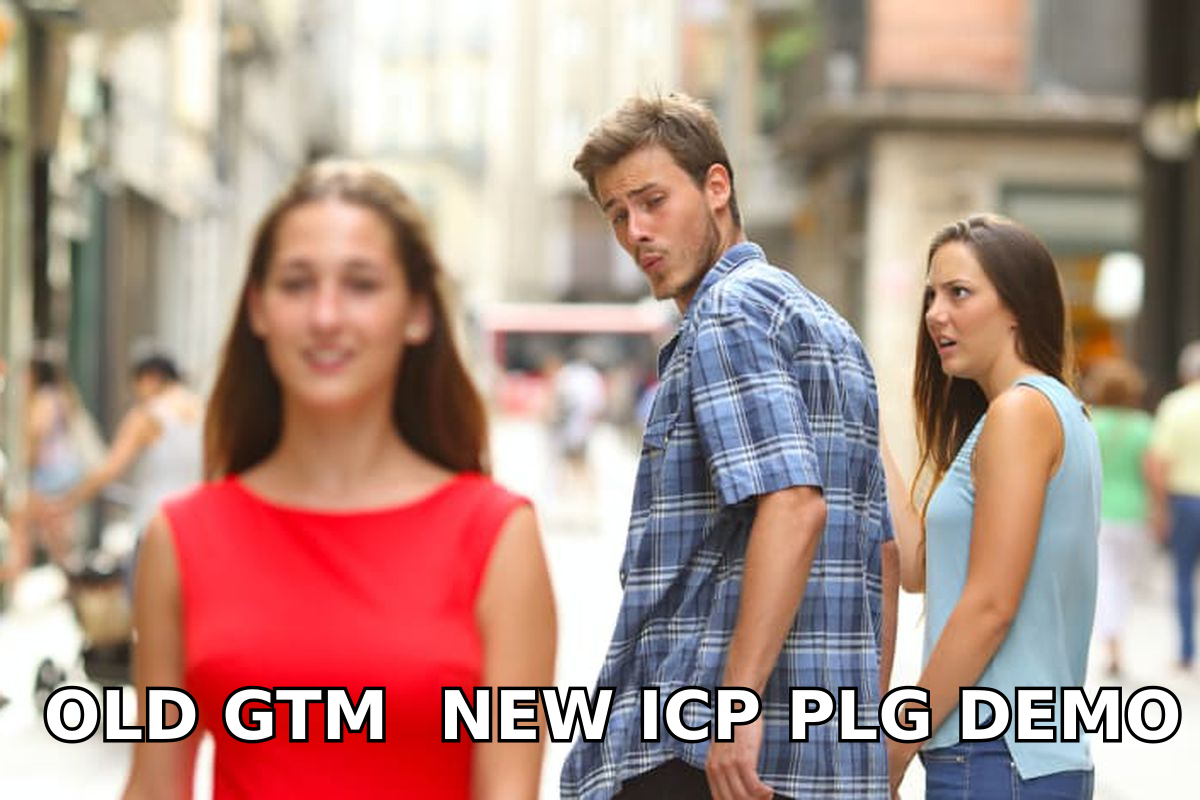
Here is how the four dominant motions compare in practice:
| Dimension | Sales-Led | Product-Led | Partner-Led | Community-Led |
|---|---|---|---|---|
| Typical ACV | $15K-$250K+ | $200-$15K | $10K-$100K | $500-$20K |
| Time to first revenue | 60-180 days | 1-14 days | 90-270 days | 120-365 days |
| Primary cost driver | AE + SDR headcount | Product eng + onboarding | Partner enablement + rev share | Content + community mgmt |
| CAC payback (healthy) | 12-18 months | 5-12 months | 9-15 months | 6-14 months |
| Data dependency | Very high (contact-level) | Low (self-identify) | Medium (account-level) | Low |
| Fails when | List quality is poor | Product needs services | Partners lack incentive | You are impatient |
Most companies under $10M ARR should run one primary motion plus one experiment. Running all four is tempting, and almost always wrong. Each motion needs its own tracking and its own comp plan. Each one also needs 2-3 quarters before the data means anything.
How Do You Define an ICP You Can Actually Count?#
Write the ICP as a database query, not a paragraph. If your ICP statement cannot be translated into filters, it is a mood board.
Bad ICP: "Mid-market SaaS companies that care about efficiency."
Usable ICP: "US and EU B2B SaaS companies, 50-500 employees, Series A through C, running HubSpot or Salesforce, with at least 3 open sales roles posted in the last 90 days."
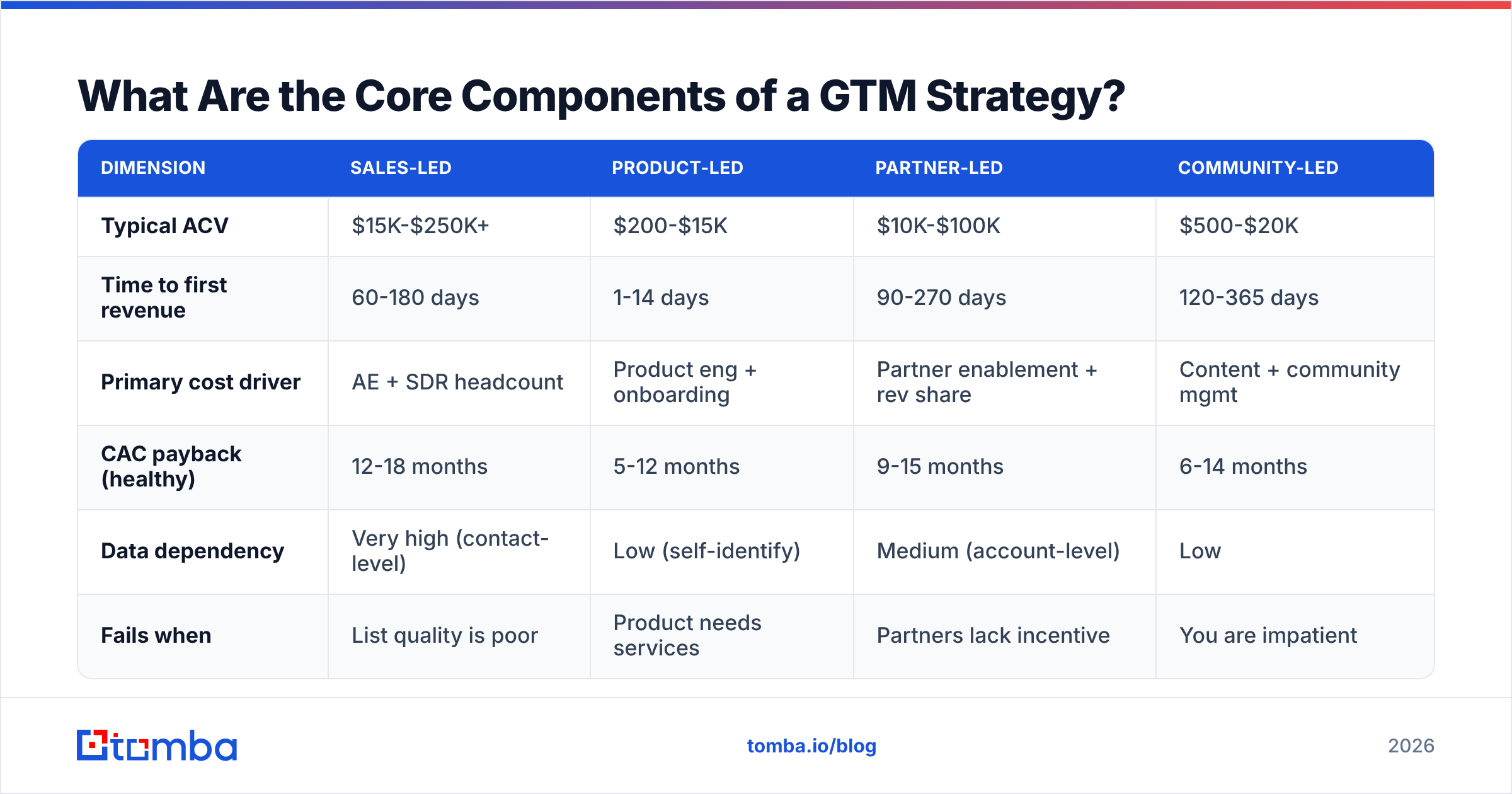
That second version is countable. You can run it against a B2B database and get back a number — say, 4,200 accounts. Now the forecast has a ceiling, which changes every downstream decision. If the segment holds 4,200 accounts and you need 120 new customers this year, you need a 2.9% account-level conversion rate. That is aggressive but survivable. If the segment is 400 accounts, you need 30%. Now you know you must either widen the ICP or move upmarket on price.
Build the ICP from evidence, not intuition:
- Pull your best 20 customers. Sort by net revenue retention and gross margin, not logo size.
- Find the shared attributes. Look for the non-obvious ones — a shared tool in the stack, a common trigger event, a specific job title that appeared in every deal.
- Test the negative. Pull your 20 worst customers (churned, discounted, support-heavy) and find what they share. Those attributes become exclusion filters.
- Size the resulting segment. Run the filters against real data. If the count is under 1,000 accounts, your GTM has to be account-based by necessity.
- Re-run it quarterly. ICPs drift. The segment that worked at $2M ARR usually is not the segment that works at $10M.
The trigger-event layer is what separates a decent ICP from a good one. Hiring signals, funding rounds, tech-stack changes, and leadership hires all mark a window where budget is moving. A website visitor reveal layer adds another trigger: accounts already researching you, which convert at multiples of cold accounts.
How Do You Pick the Right GTM Motion?#
Let price and complexity choose for you. There is a rough rule that holds up: your ACV determines how much human touch you can afford.
- Under $2K ACV — you cannot afford a salesperson. Product-led or community-led, with self-serve checkout.
- $2K-$20K ACV — inside sales with heavy inbound support, or product-led with a sales-assist layer for expansion.
- $20K-$100K ACV — outbound-led with SDR/AE split. This is where sales automation and contact data quality pay for themselves.
- Over $100K ACV — account-based, enterprise field sales, long cycles, partner and executive-sponsor motions.
The second input is buying complexity. If the buyer must involve security review, legal, and procurement, product-led alone will stall at the exact moment your trial expires. If the buyer can swipe a card and see value in 10 minutes, an SDR calling them is pure margin destruction.
Run a small experiment before you commit headcount. Ninety days, one motion, a fixed budget, and a pre-agreed success threshold. For outbound, that threshold is usually simple: can we book 10 qualified meetings from 1,000 well-targeted contacts? If yes, the motion scales with list volume. If no, the problem is the list, the message, or the ICP. Diagnose in that order, because list quality is the cheapest thing to fix.
How Do You Build the Channel Math?#
Work backwards from the revenue target. Every GTM plan should include this arithmetic on one page, and most do not.
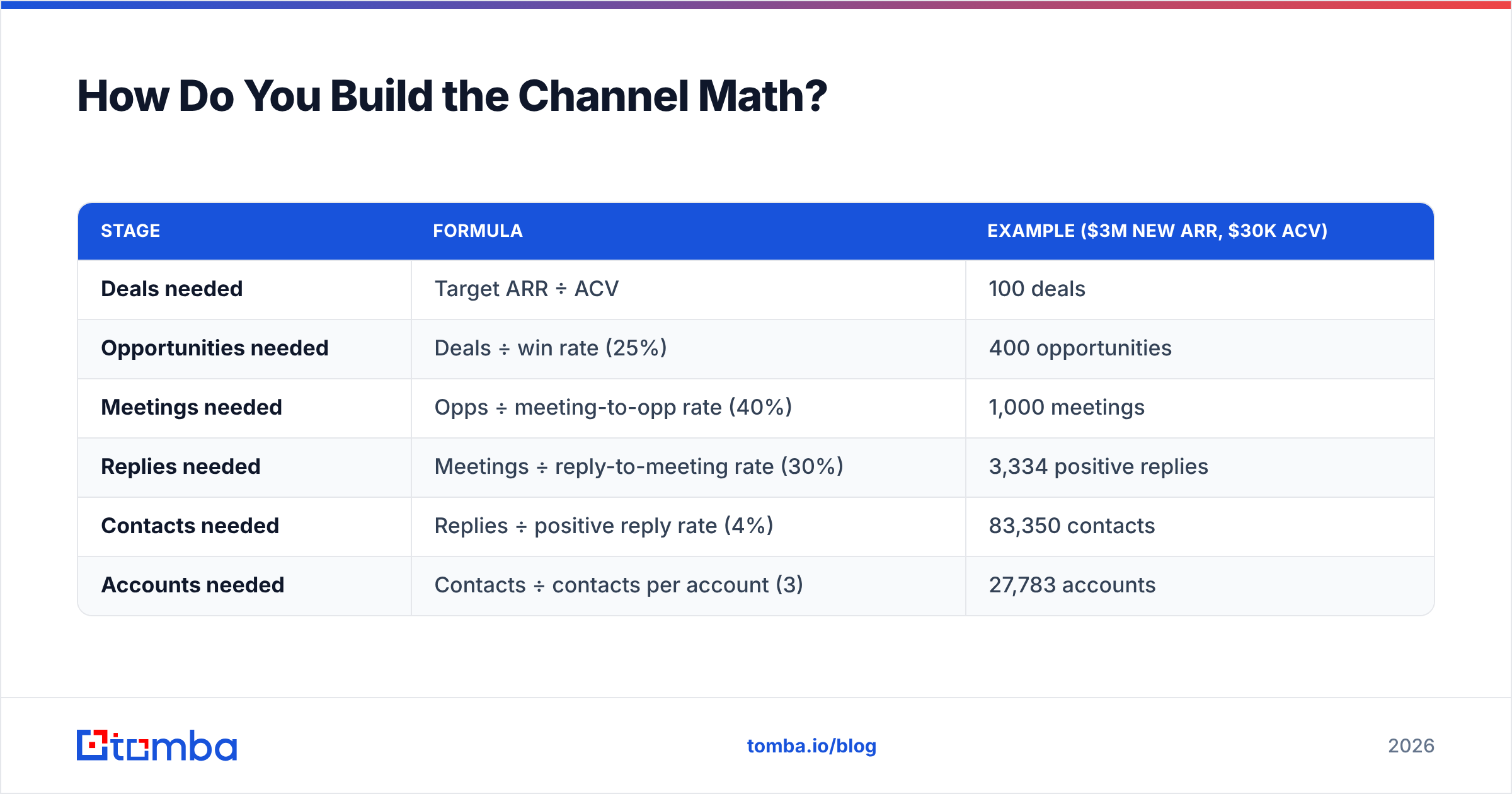
Start with the target, then divide through each conversion stage:
| Stage | Formula | Example ($3M new ARR, $30K ACV) |
|---|---|---|
| Deals needed | Target ARR ÷ ACV | 100 deals |
| Opportunities needed | Deals ÷ win rate (25%) | 400 opportunities |
| Meetings needed | Opps ÷ meeting-to-opp rate (40%) | 1,000 meetings |
| Replies needed | Meetings ÷ reply-to-meeting rate (30%) | 3,334 positive replies |
| Contacts needed | Replies ÷ positive reply rate (4%) | 83,350 contacts |
| Accounts needed | Contacts ÷ contacts per account (3) | 27,783 accounts |
Two things usually break when teams run this for the first time. First, the required contact volume is far larger than expected. If your ICP only holds 5,000 accounts, the math is telling you that outbound cannot carry the whole target alone. Second, the top of the funnel is brutally sensitive. Moving your positive response rate from 4% to 6% cuts required contact volume by a third, which is cheaper than hiring two more SDRs.
This is also where data quality stops being an abstract concern. Say 25% of those 83,350 contacts bounce. You have not just lost 25% of your volume. You have also damaged sender reputation across the whole domain, which drags down deliverability for the valid 75% too. Running the list through an email verifier before the first send is the highest-ROI 20 minutes in the entire plan.
How to Build a Go to Market Strategy, Step by Step#
Seven steps, roughly 6-8 weeks for a team that is not starting from zero.
Step 1 — Segment and size (week 1). Define the ICP as filters. Count the accounts. If the count does not support the revenue target, revise the ICP or the target now, before anyone builds a deck.
Step 2 — Map the buying committee (week 1-2). For your top 10 accounts, list every title that touched the last deal. You are looking for the pattern: which title starts the conversation, which one kills it, which one signs. That mapping decides who you prospect first.
Step 3 — Write the positioning (week 2-3). One sentence naming the competitive alternative, the differentiated capability, and the value it produces. Test it on five customers before it reaches a landing page. If they rephrase it back to you incorrectly, rewrite it.
Step 4 — Set pricing and packaging (week 3). Entry tier that removes friction, a middle tier where most revenue lands, and an enterprise tier that anchors. Public pricing speeds up PLG and slows down enterprise; pick deliberately.
Step 5 — Build the target list (week 4-5). This is the step that gets rushed and should not be. Turn your ICP filters into a real account list, add the right contacts at each account, and verify every address. A domain search run across your account list gets you the named contacts and email patterns per company. Enrichment then fills in titles, LinkedIn profiles, and phone numbers for routing to the right rep.
Step 6 — Instrument and launch (week 6). Wire up the CRM stages so they match the channel math above. Every stage in the table needs a field you can report on. Launch with a limited cohort — 500 contacts, not 80,000 — so you can read the signal before you burn the list.
Step 7 — Review at 30/60/90 (ongoing). At 30 days you are checking deliverability and reply rate. At 60 days you are checking meeting-to-opportunity conversion. At 90 days you are checking whether closed-won deals match the ICP you defined in step one. That last check tells you whether the strategy is real.
What Are the Most Common GTM Mistakes?#
Defining the ICP by who is easy to reach. Reachability is a data problem, not a strategy input. Teams narrow their ICP to whoever they happen to have contact data for. That quietly shrinks the market to the size of their worst vendor's coverage.
Confusing a launch with a strategy. A launch is a spike. If the plan ends on launch day, you have bought a week of traffic and no repeatable motion.
Running every channel at 20% effort. Five half-committed channels produce five inconclusive datasets. One channel at full effort produces a decision.
Skipping the negative ICP. Knowing who not to sell to protects margin more than any discount policy. Every logo that churns at month seven cost you a full CAC plus onboarding.
Treating data as a one-time purchase. B2B contact data decays roughly 25-30% per year through job changes alone. That figure shows up again and again in vendor benchmarks and in HubSpot's own database-decay research. A list you bought 14 months ago is not the list you tested.
No single owner. GTM strategy needs one accountable person, usually a head of revenue or a GTM lead. Committee ownership produces documents, not decisions.
How Do You Know the GTM Strategy Is Working?#
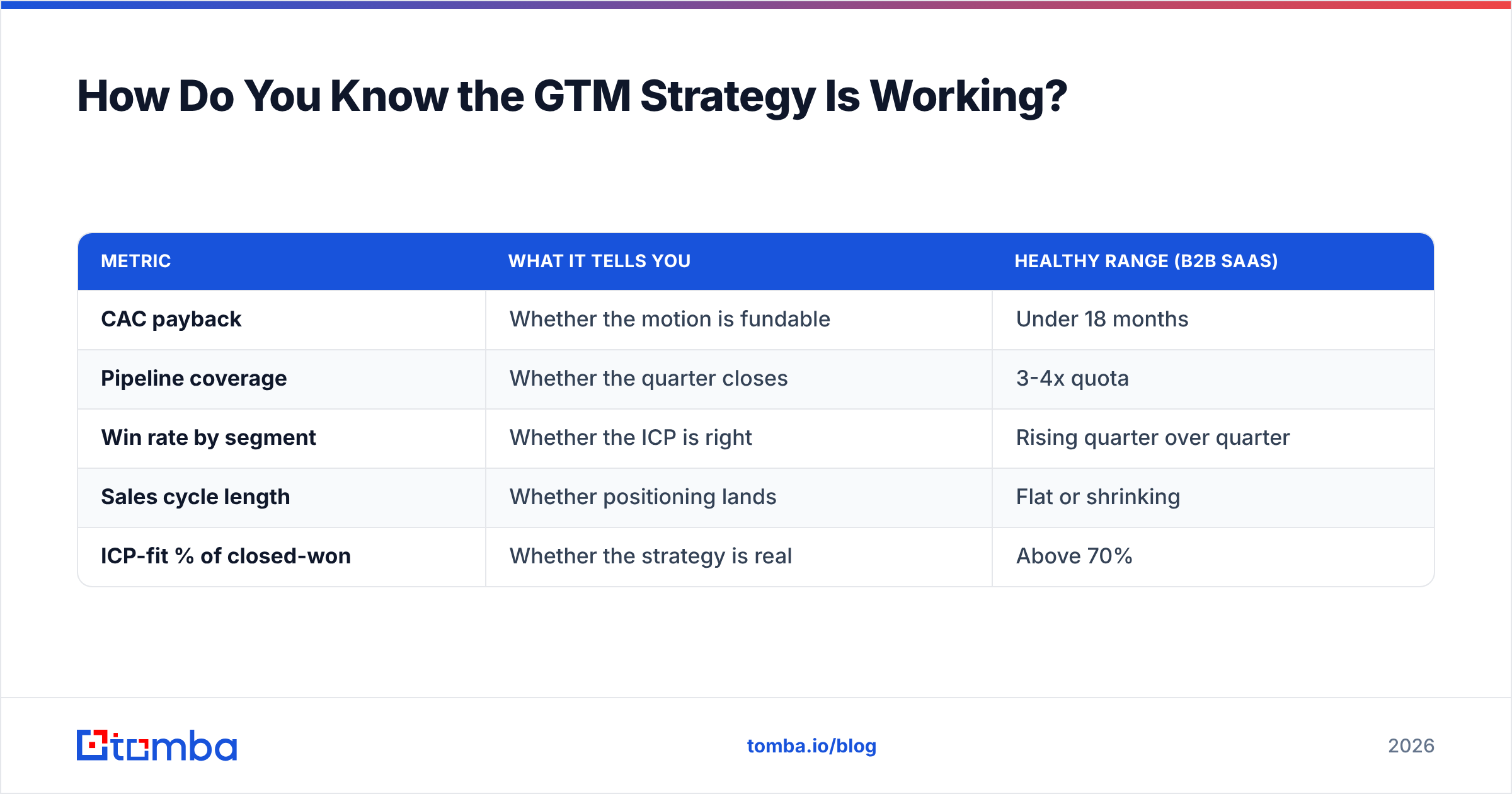
Track five numbers, monthly, on one dashboard:
| Metric | What it tells you | Healthy range (B2B SaaS) |
|---|---|---|
| CAC payback | Whether the motion is fundable | Under 18 months |
| Pipeline coverage | Whether the quarter closes | 3-4x quota |
| Win rate by segment | Whether the ICP is right | Rising quarter over quarter |
| Sales cycle length | Whether positioning lands | Flat or shrinking |
| ICP-fit % of closed-won | Whether the strategy is real | Above 70% |
That last metric is the one nobody tracks and everybody should. If 70% of your closed-won deals fall outside the ICP you documented in step one, the market is telling you your ICP is wrong. Listen to it. Rewriting the ICP based on who actually buys is not failure — it is the entire point of running the review.
Cross-reference these against public benchmark data rather than internal folklore. G2's software buyer behavior reports and Forrester's B2B buying studies both publish cycle-length and committee-size baselines you can sanity-check against.
Which Tools Do You Need to Execute a GTM Plan?#
Fewer than the average stack diagram suggests. You need four capabilities: a CRM as the system of record, a data source that turns your ICP into contactable people, a sequencing tool that sends and tracks, and an analytics layer that closes the loop. Everything else is optimization.
The easiest layer to underinvest in is data, because its failure mode is invisible for the first month. Bad data does not throw an error. It just produces a slightly worse reply rate. You blame your copy, then your offer, then the market. Then you finally check bounce rates and find the real cause. Buying data from a peer platform like BookYourData and sourcing it directly through a finder API are both reasonable paths. What matters is that whatever enters your sequencer was verified in the last 30 days.
If your GTM plan leans on outbound at any real volume, start by turning your ICP into a verified contact list. Tomba's Email Finder resolves names and domains into verified professional email addresses. Domain search covers whole accounts, and bulk processing handles list-scale work. The free tier gives you 25 searches to test coverage against your own ICP first. Paid plans start at $49/mo on Starter and $99/mo on Growth, with full Tomba pricing published. Run your first 500 target accounts through it, verify the results, and see whether the channel math in this post holds up against your real reply rate. That one test will teach you more about how to build a go to market strategy than another quarter of planning.
Related guides#
Ready to find emails that actually work?
Join 150,000+ professionals who stopped guessing and started sending. Free credits on signup — no credit card required.
Get the Tomba newsletter
Practical outbound tactics and product updates — once every two weeks.
About the author