How to Build a Lead Funnel That Actually Converts in 2026
Most lead funnels leak at the data layer, not the copy layer. Here is a 6-stage build you can ship in a week, with the metrics, tools, and cost math laid out side by side.
TL;DR
- A lead funnel is not a landing page. It is six connected stages — source, capture, qualify, enrich, nurture, hand-off — and it breaks at whichever stage you never measured.
- Most B2B funnels leak worst at stage 4 (data quality), not stage 2 (copy). Bad contact data kills 20-30% of an outbound funnel before a single word gets read.
- Budget roughly $200-$600/month in tooling for a two-person team: form/landing tool, an email finder, a sending platform, and a CRM.
- Track four numbers only at first: visitor→lead, lead→MQL, MQL→meeting, meeting→opportunity. Everything else is decoration.
- Build it in this order: hand-off first, source last. Funnels built front-to-back always dump leads into a void.
What is a lead funnel, and how is it different from a sales funnel?#
A lead funnel is the machinery that turns a stranger into a contact record your sales team is willing to call. A sales funnel takes it from there — pipeline stages, proposals, close. People blur the two, then wonder why marketing and sales argue about lead quality every Monday.
Think of it like a water treatment plant. Raw water comes in from several sources (rivers, wells, rain capture). It passes through screens, then filters, then chemical treatment, then testing — and only water that clears the last test goes into the pipes people drink from. Your lead funnel is the treatment plant. The pipes are your sales team. If you skip the testing stage, the complaints show up downstream, and nobody blames the plant.
The six stages, in the order they actually operate:
- Source — where attention originates: SEO, paid, LinkedIn, communities, events, partner referrals, outbound lists.
- Capture — the moment identity is exchanged for value: form fill, demo request, chat, or a found-email in outbound's case.
- Qualify — scoring against ICP fit and intent so you can route, not just collect.
- Enrich — filling in the missing 80% of the record: verified email, phone, company size, tech stack, LinkedIn.
- Nurture — sequenced touches until the lead is ready, or clearly is not.
- Hand-off — the routing rules, SLAs, and CRM fields that make a rep pick up the phone.
Why should you build the funnel backwards?#
Because a funnel that ends nowhere is a lead-destruction machine. Start at stage 6 and work up.
Ask the reps a blunt question: what has to be true for you to call this person within an hour? You will get a specific list — title band, company headcount, a verified direct email, a phone number, and a reason for the call. That list is your funnel spec. Every upstream stage exists to produce records that satisfy it.
Teams that build front-to-back do the opposite. They launch a lead magnet, collect 400 emails, dump them in a spreadsheet, and discover three weeks later that 60% are personal Gmail addresses from students, and no rep has touched any of them. The CRM fills with dead weight, and the next quarter's forecast is built on it.
Concretely, backwards build order looks like this:
- Define the accepted-lead standard with sales. Write it down. Six to ten fields, maximum.
- Configure CRM fields and routing to match that standard, including a rejection reason picklist.
- Set the nurture tracks — one for "right fit, wrong time", one for "unknown fit, needs education".
- Wire enrichment so records arrive complete rather than getting completed by hand.
- Write the qualification rules — scoring thresholds, disqualifiers, and what happens to leads that fail.
- Then, and only then, turn on sources.
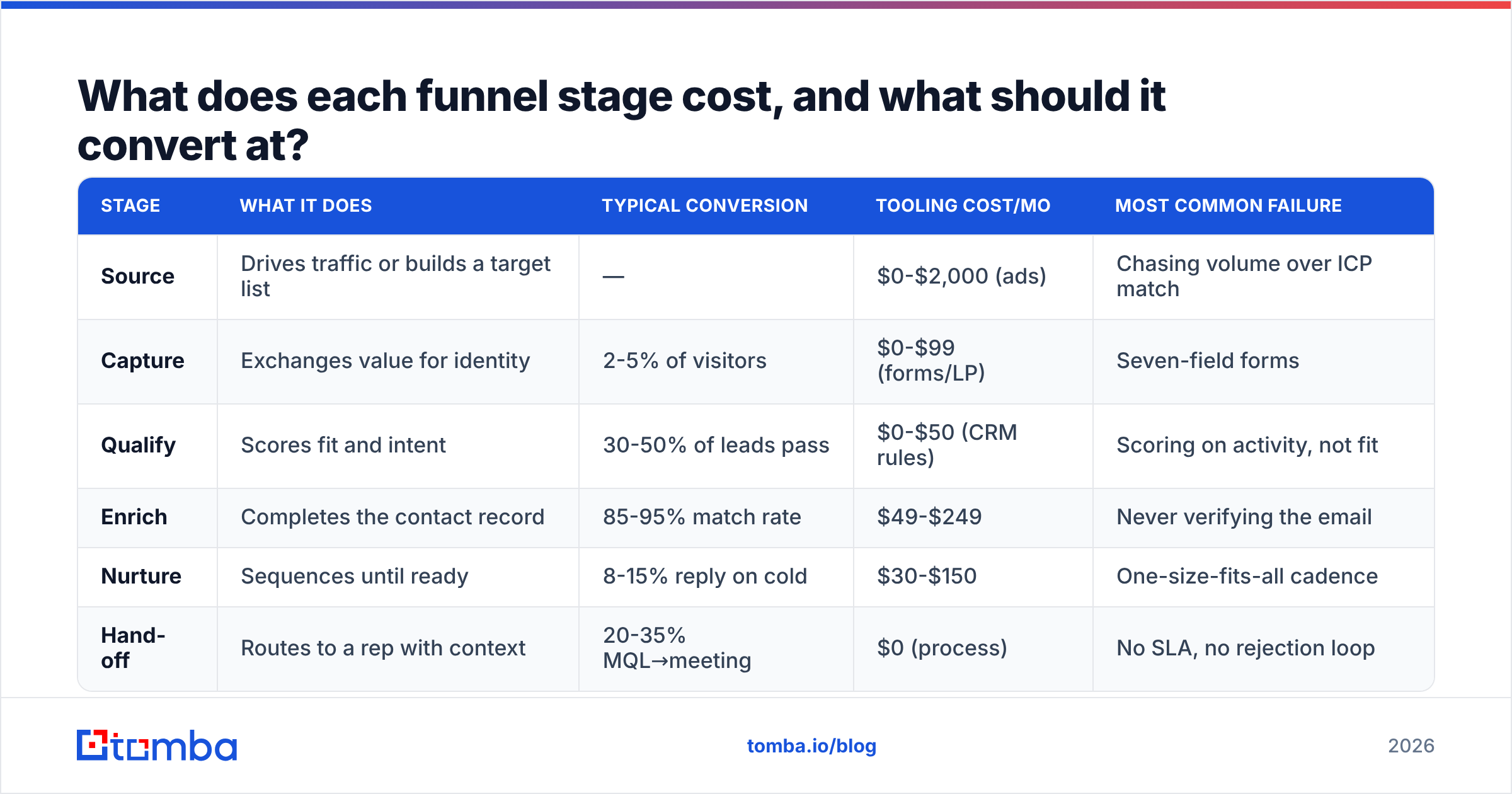
What does each funnel stage cost, and what should it convert at?#
Here are the working benchmarks most B2B teams should plan against. Treat them as starting assumptions to beat, not laws.
| Stage | What it does | Typical conversion | Tooling cost/mo | Most common failure |
|---|---|---|---|---|
| Source | Drives traffic or builds a target list | — | $0-$2,000 (ads) | Chasing volume over ICP match |
| Capture | Exchanges value for identity | 2-5% of visitors | $0-$99 (forms/LP) | Seven-field forms |
| Qualify | Scores fit and intent | 30-50% of leads pass | $0-$50 (CRM rules) | Scoring on activity, not fit |
| Enrich | Completes the contact record | 85-95% match rate | $49-$249 | Never verifying the email |
| Nurture | Sequences until ready | 8-15% reply on cold | $30-$150 | One-size-fits-all cadence |
| Hand-off | Routes to a rep with context | 20-35% MQL→meeting | $0 (process) | No SLA, no rejection loop |
Two lines in that table deserve attention. First, capture at 2-5% means a 10,000-visitor month yields 200-500 leads — if your number is 0.4%, the problem is the offer, not the button color. Second, enrich at 85-95% is achievable, but only if you verify. An unverified 95% "match rate" is a vanity number; bounces will tell you the truth two days later.
How do you build the outbound half of the funnel?#
Inbound and outbound feed the same treatment plant through different intake pipes. Outbound is where data quality decides everything, because you are constructing the lead record from scratch instead of having the prospect hand it to you.
The working sequence:
- Build the account list first, not the contact list. Filter by firmographics you can defend — headcount band, industry, geography, funding stage, or a tech signal. 200 well-chosen accounts beat 5,000 scraped ones.
- Identify the roles, not the names. Decide you need "Head of RevOps or VP Sales" at each account. Then find who holds that role.
- Find the contact details. This is where a domain search does the heavy lifting: give it a company domain and get back the people, their roles, and the company's email pattern. For known names, an email finder resolves first name + last name + domain into a deliverable address.
- Verify before sending. Every address goes through an email verifier — and catch-all domains get a separate pass, since a catch-all accepts everything and tells you nothing. A catch-all verifier is the difference between a 2% bounce rate and a 14% one.
- Enrich for personalization inputs. Job title, recent role change, company headcount, and the tech they run give you the one specific line that makes a cold email land.
- Load into sequencing, with the verification status as a gate. Anything not marked deliverable never enters a send.
That step-4 discipline is what protects your sender reputation. Google and Yahoo's bulk sender requirements, in force since 2024, put a hard spam-complaint ceiling on senders — and mailbox providers read high bounce rates as a list-quality signal. A funnel that pumps unverified addresses into a sequencer is a funnel that eventually stops delivering anything, including to the good contacts.
Which tools should you use at each stage?#
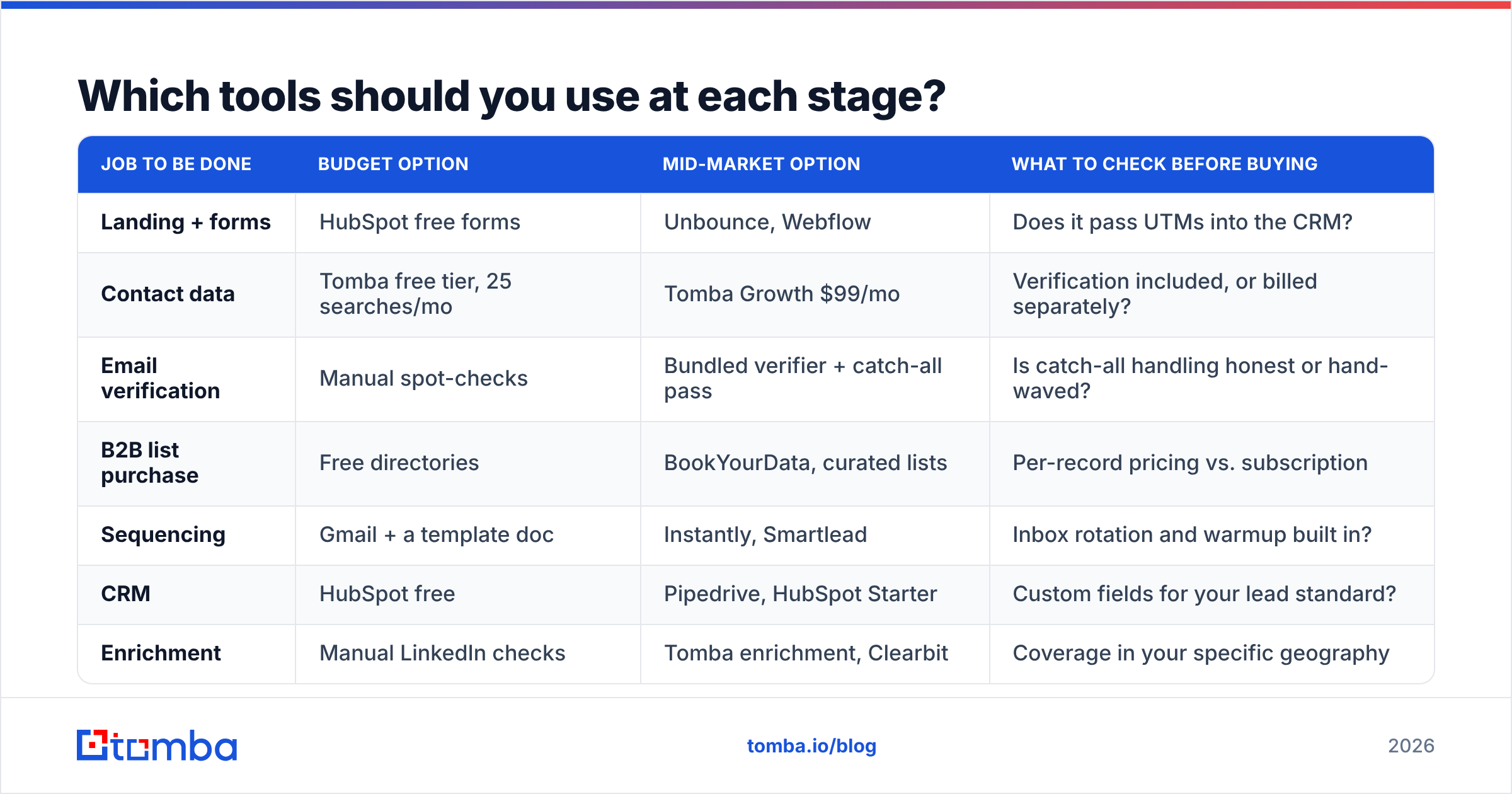
You do not need a 12-tool stack. You need one tool per job, and integrations between them. Here is how the common options compare for a small B2B team.
| Job to be done | Budget option | Mid-market option | What to check before buying |
|---|---|---|---|
| Landing + forms | HubSpot free forms | Unbounce, Webflow | Does it pass UTMs into the CRM? |
| Contact data | Tomba free tier, 25 searches/mo | Tomba Growth $99/mo | Verification included, or billed separately? |
| Email verification | Manual spot-checks | Bundled verifier + catch-all pass | Is catch-all handling honest or hand-waved? |
| B2B list purchase | Free directories | BookYourData, curated lists | Per-record pricing vs. subscription |
| Sequencing | Gmail + a template doc | Instantly, Smartlead | Inbox rotation and warmup built in? |
| CRM | HubSpot free | Pipedrive, HubSpot Starter | Custom fields for your lead standard? |
| Enrichment | Manual LinkedIn checks | Tomba enrichment, Clearbit | Coverage in your specific geography |
A few notes on that grid. BookYourData sells contacts on a pay-per-record model, which suits teams doing occasional bursts of list-building rather than continuous prospecting — different economics from a subscription, and worth modelling both against your monthly volume. HubSpot's free CRM is genuinely usable as the hand-off layer for a team under ten people. And for real user sentiment on any of these, G2 category pages are more honest than vendor sites, provided you read the two-star reviews first.
On the data layer specifically: Tomba's pricing runs Free (25 searches/mo), Starter at $49/mo, Growth at $99/mo, and Pro at $249/mo, with the email finder, verifier, domain search, catch-all verifier, and enrichment sitting under the same account. For a funnel build, that matters less as a feature list and more as a plumbing decision — one API key across find, verify, and enrich means fewer sync failures between stages 3 and 4.
How do you qualify leads without over-engineering scoring?#
Start with two axes and nothing more: fit and intent.
Fit is static and knowable from the record — company size, industry, title, geography. Intent is behavioral — pages visited, demo requested, pricing page views, reply sentiment. Score each 0-10, plot leads on a 2x2, and route:
- High fit, high intent → straight to a rep, one-hour SLA.
- High fit, low intent → nurture track A, with account-level monitoring.
- Low fit, high intent → self-serve path or a template response. Do not burn rep hours here.
- Low fit, low intent → newsletter, or nothing.
That is it. Do not add a 40-point weighted model in month one; you have no conversion data to calibrate it with. Revisit after 90 days, when you can look back at closed-won deals and see which attributes actually predicted them. Your definition of a marketing qualified lead should be a rule you can explain in one sentence to a new hire.
The disqualifier list matters as much as the score. Write down what auto-rejects a lead — competitor domain, student email, wrong region, headcount under your floor — and enforce it at capture time rather than in a rep's inbox.
What metrics tell you which stage is leaking?#
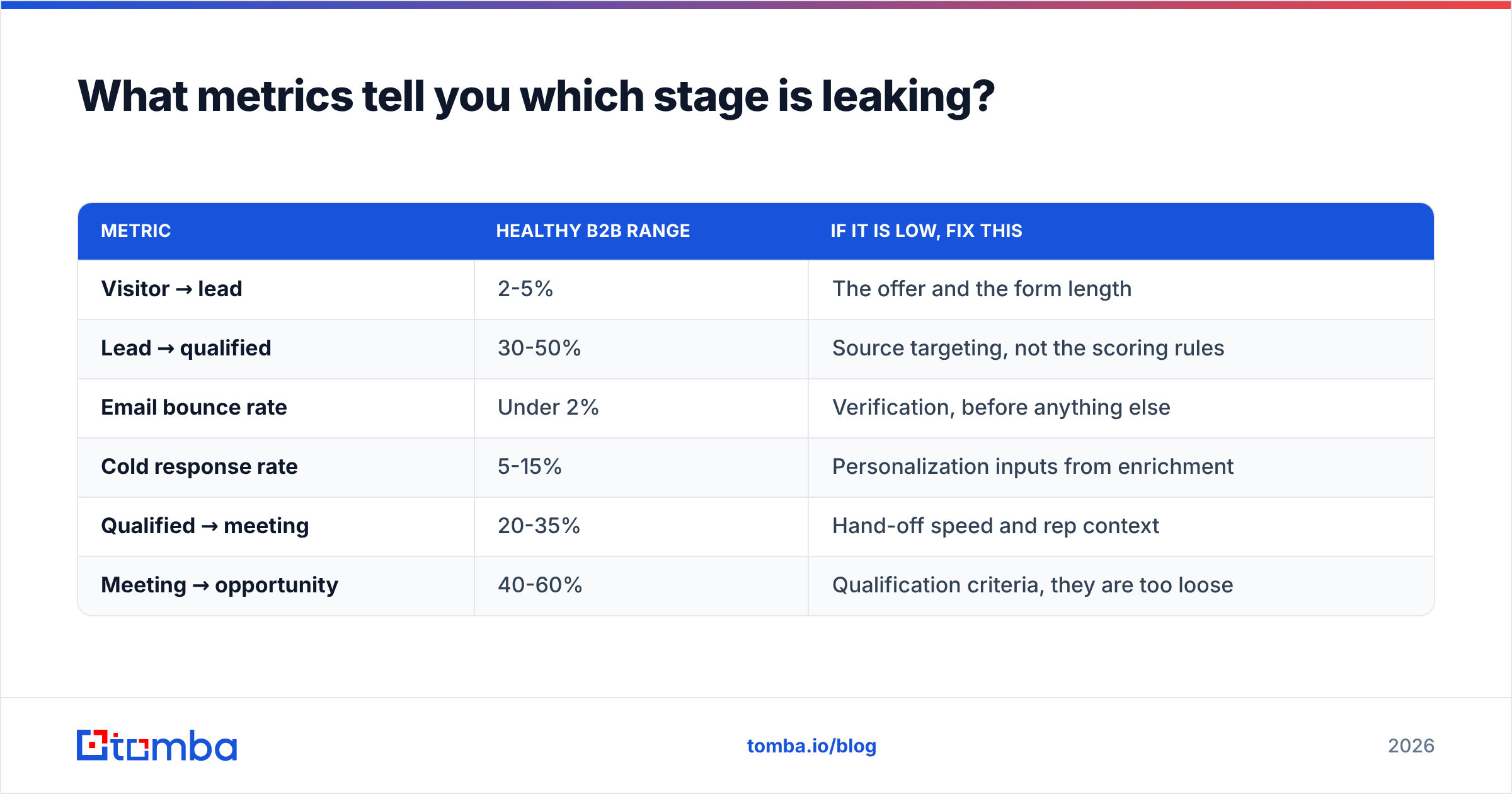
Measure stage-to-stage conversion, never just the top and the bottom. A funnel that reports "3% visitor-to-customer" tells you nothing actionable. A funnel that reports each transition tells you exactly where to spend next week.
| Metric | Healthy B2B range | If it is low, fix this |
|---|---|---|
| Visitor → lead | 2-5% | The offer and the form length |
| Lead → qualified | 30-50% | Source targeting, not the scoring rules |
| Email bounce rate | Under 2% | Verification, before anything else |
| Cold response rate | 5-15% | Personalization inputs from enrichment |
| Qualified → meeting | 20-35% | Hand-off speed and rep context |
| Meeting → opportunity | 40-60% | Qualification criteria, they are too loose |
Read those top to bottom during a weekly review and the leak announces itself. High lead volume with a low qualified rate means you are buying the wrong traffic. Good qualified rate with a low meeting rate means the hand-off is broken — usually a missing SLA or a rep who cannot see why the lead scored well. High bounces means stage 4 was skipped, full stop.
One caution on attribution: last-touch attribution will convince you that branded search and direct traffic generate all your leads. They do not — they capture demand that other channels created. Analyst work from Forrester and others has argued this point for years. Use last-touch for operational routing decisions and something multi-touch for budget decisions.
How long does it take to build, realistically?#
A functioning v1 takes about two weeks of focused work for one person. Not two months.
- Days 1-2: Sit with sales, write the accepted-lead standard, configure CRM fields and routing rules.
- Days 3-4: Build the capture asset — one landing page, one offer, three form fields. Not five assets.
- Days 5-7: Wire the data layer. API keys for finding and verifying, a Zapier integration or direct API call to enrich on capture, dedupe rules on the CRM side.
- Days 8-10: Write two nurture tracks and one outbound sequence. Four to five touches each.
- Days 11-12: Build the target account list and run find + verify against it.
- Days 13-14: Turn on one source. One. Measure for two weeks before adding a second.
The discipline of launching one source is what makes the numbers readable. Three sources at once and you cannot tell which one is producing the 40% qualified rate and which one is producing the 8%.
What breaks most often after launch?#
Four failure modes account for most funnel decay:
- Data rot. B2B contact data decays at roughly 25-30% per year — people change jobs, companies rebrand, domains get consolidated. A list built in January is meaningfully worse by September. Re-verify quarterly with a bulk verify pass rather than discovering it through bounces.
- Silent form breakage. A field renames, an integration deauthorizes, and leads stop flowing with no error message anywhere. Set a weekly alert on lead volume by source; a zero is a fire, not a slow week.
- Nurture fatigue. The same eight-email track running for eighteen months against a list that has already seen it. Rotate content quarterly and suppress anyone who has completed a track.
- Hand-off drift. The lead standard was agreed in week one and quietly ignored by month four, when a rep started cherry-picking. Audit rejection reasons monthly — if the picklist is unused, the process is not being followed.
None of these are exotic. They are all maintenance, and they all get skipped because the funnel "already works". Put a 30-minute recurring calendar block on funnel maintenance and you will outperform teams with twice your budget.
Where should you start this week?#
Pick the stage with the worst number, not the stage that is most fun to work on. For most teams reading this, that is the data layer — because it is invisible until you measure it, and because it silently caps every stage downstream of it.
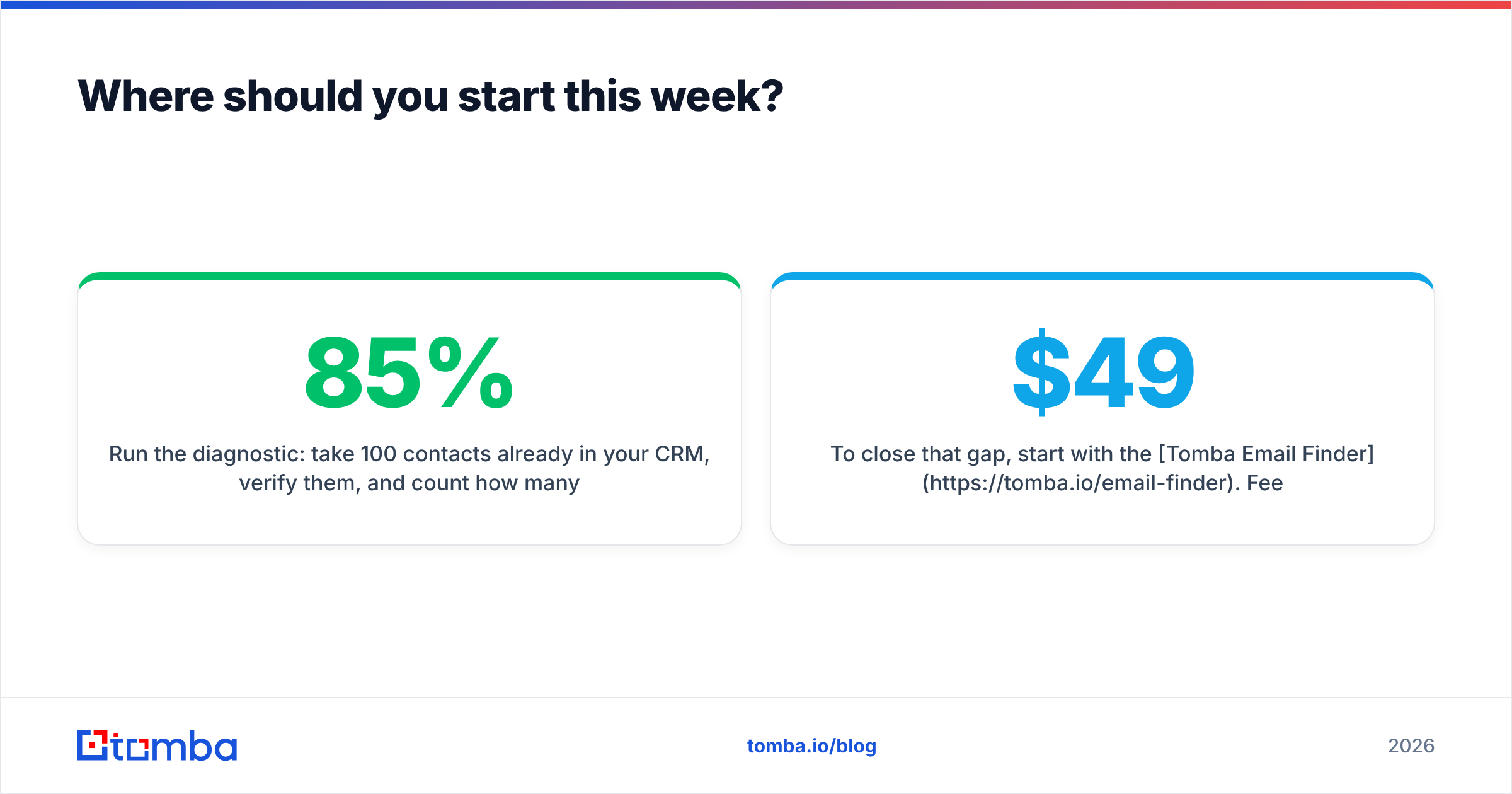
Run the diagnostic: take 100 contacts already in your CRM, verify them, and count how many come back deliverable. If it is under 85%, your funnel has been leaking there the whole time, and no amount of subject-line testing will fix it.
To close that gap, start with the Tomba Email Finder. Feed it a name and a company domain — or run a domain search to get the whole team and the company's email pattern — and every result comes back with a verification status and its sources, so you know what you are sending to before you send it. The free tier gives you 25 searches a month to run the diagnostic above; Starter at $49/mo covers a typical two-rep outbound motion, and Growth at $99/mo handles serious list-building. Fix stage four, and the six stages start behaving like a funnel instead of a sieve.
Related guides#
Ready to find emails that actually work?
Join 150,000+ professionals who stopped guessing and started sending. Free credits on signup — no credit card required.
Get the Tomba newsletter
Practical outbound tactics and product updates — once every two weeks.
About the author