How to Build a Sales Pipeline That Actually Closes in 2026
A sales pipeline is not a CRM tab — it is a forecast. Here are the 7 stages, the exit criteria, the math, and the data quality rules that keep deals moving instead of rotting.
TL;DR
- A sales pipeline is a forecasting instrument, not a to-do list. Every stage must have an exit criterion a skeptical manager can audit — otherwise your forecast is fiction.
- Build backwards from your revenue target: target ÷ average deal size ÷ win rate = opportunities needed, then multiply by your top-of-funnel conversion rate to get required contacts.
- Seven stages cover almost every B2B motion. More than nine and reps stop updating the CRM; fewer than five and you cannot diagnose where deals die.
- Pipeline dies from bad data more often than bad selling. Bounced emails and stale titles silently inflate stage-one counts by 20-40% in most teams.
- Run a weekly hygiene ritual: age out stalled deals, re-verify contact data, and recalculate stage conversion rates monthly — not quarterly.
What is a sales pipeline, and how is it different from a funnel?#
A sales pipeline is the ordered set of stages a specific deal moves through, from first contact to signed contract, where each stage has a defined entry condition, an exit criterion, and a historical conversion rate.
The everyday analogy: a funnel is the weather forecast for your whole region — "40% chance of rain this month." A pipeline is the sprinkler system in your yard, with valves you can open and close, and a gauge on each one. The funnel describes volume in aggregate. The pipeline tracks individual deals and tells you which valve is stuck.
That distinction matters because most teams that say "our pipeline is broken" actually have a funnel problem (not enough qualified contacts entering) or a definition problem (nobody agrees what "qualified" means). Before you redesign anything, decide which one you have.
Three things make a pipeline real rather than decorative:
- Stage definitions written from the buyer's behavior, not the rep's activity. "Sent a proposal" is a rep action. "Buyer has confirmed budget owner and timeline in writing" is a buyer signal. Only the second one predicts anything.
- Exit criteria that a third party can verify. If your sales manager cannot look at a deal record and independently agree it belongs in Stage 4, the stage is a vibe.
- Conversion rates measured per stage, refreshed monthly. Without these you cannot forecast, and you cannot tell whether a new play worked.
How do you calculate how much pipeline you actually need?#
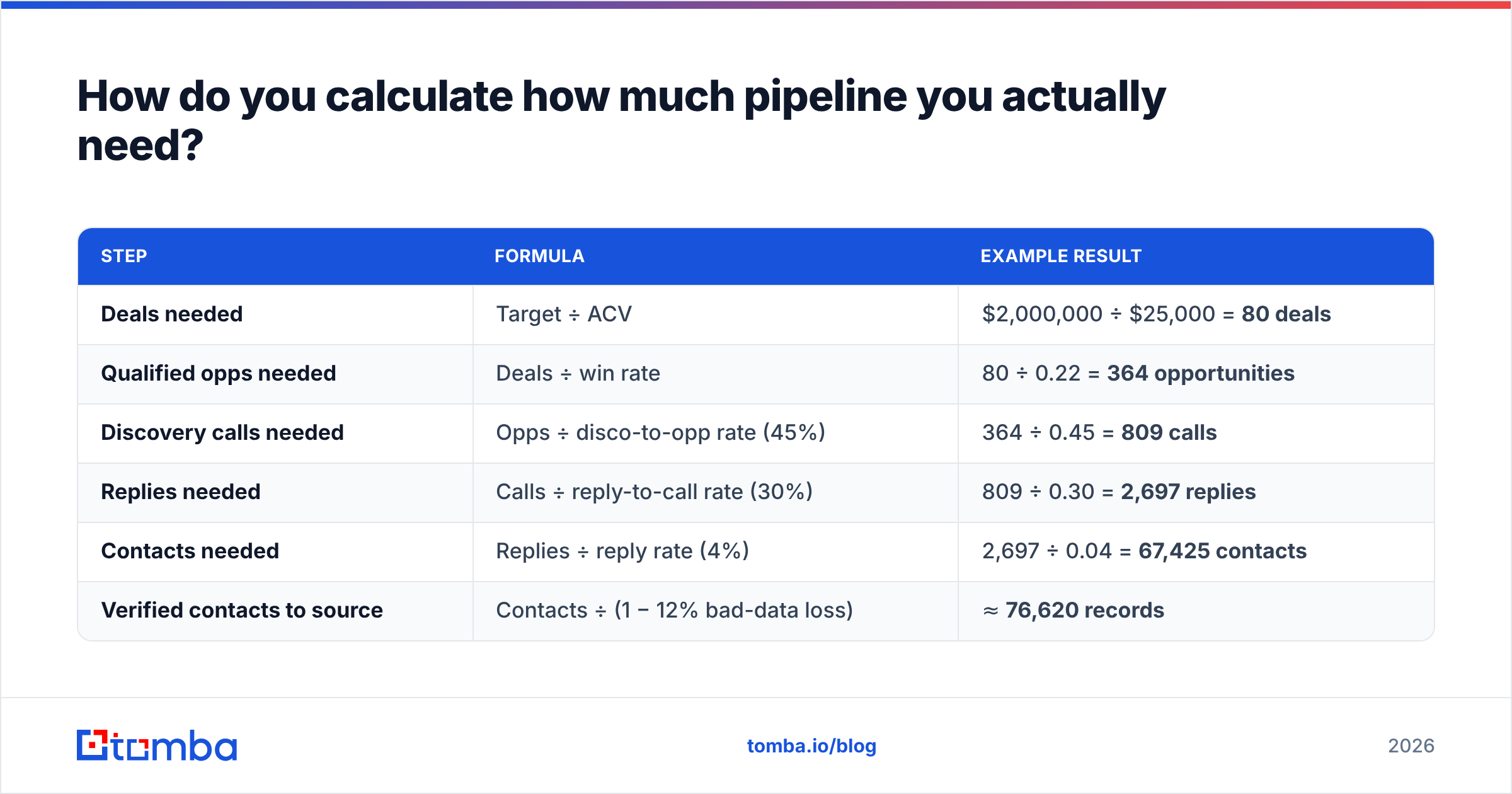
Start from the revenue number and work backwards. This is arithmetic, not strategy, and it takes ten minutes.
Assume a $2M annual new-business target, a $25,000 average contract value, and a 22% win rate from qualified opportunity to closed-won.
| Step | Formula | Example result |
|---|---|---|
| Deals needed | Target ÷ ACV | $2,000,000 ÷ $25,000 = 80 deals |
| Qualified opps needed | Deals ÷ win rate | 80 ÷ 0.22 = 364 opportunities |
| Discovery calls needed | Opps ÷ disco-to-opp rate (45%) | 364 ÷ 0.45 = 809 calls |
| Replies needed | Calls ÷ reply-to-call rate (30%) | 809 ÷ 0.30 = 2,697 replies |
| Contacts needed | Replies ÷ reply rate (4%) | 2,697 ÷ 0.04 = 67,425 contacts |
| Verified contacts to source | Contacts ÷ (1 − 12% bad-data loss) | ≈ 76,620 records |
Two things usually shock people at this point. First, the top-of-funnel volume is far larger than anyone guessed. Second, the last row — the data-quality tax — is the cheapest lever in the whole table. Lifting your deliverable-contact rate from 88% to 97% removes roughly 7,000 wasted records from the sourcing requirement without touching your messaging, your reps, or your product.
That is why teams serious about pipeline construction verify contacts before they load them, not after bounces roll in. A quick pass through an email verifier at import time costs a fraction of a cent per record and protects the sender reputation that everything downstream depends on.
What are the seven stages of a B2B sales pipeline?#
Here is a template that works for most $10K-$150K ACV B2B motions. Adapt the names; do not skip the exit criteria.
- Sourced — A contact exists with a verified email and a role that matches your ICP. Exit: email verified deliverable and account matches at least two ICP firmographic filters.
- Engaged — The contact has replied, booked, or taken a meaningful action (demo request, pricing page visit twice). Exit: two-way communication on record.
- Discovery — A structured call has happened. Exit: documented pain, current-state process, and named decision maker.
- Qualified Opportunity — The deal enters the forecast. Exit: budget range confirmed, timeline stated by the buyer, and an evaluation criterion in writing.
- Validation — Technical fit, security review, pilot, or reference calls. Exit: no open blocking objection from any stakeholder.
- Negotiation — Commercials, legal, procurement. Exit: redlines resolved and signer identified.
- Closed Won / Closed Lost — Terminal, with a mandatory structured loss reason.
Notice that stages 1 and 2 are volume stages and stages 4 through 6 are forecast stages. Never mix them in the same dashboard. Volume stages answer "are we prospecting enough?" Forecast stages answer "will we hit the number?" Combining them produces the classic hockey-stick chart that flatters everyone and predicts nothing.
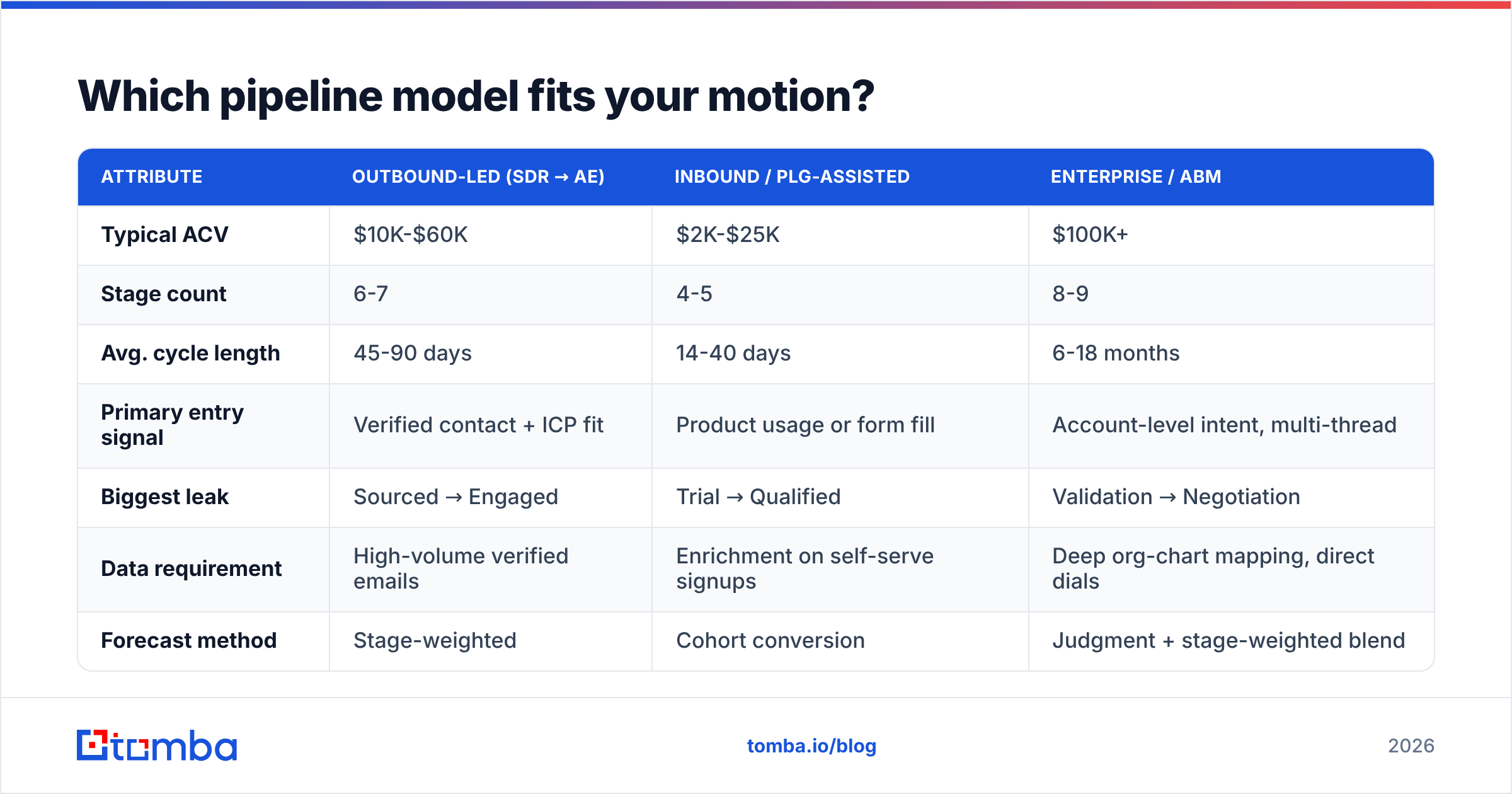
Which pipeline model fits your motion?#
Not every business should run the same seven stages. The three dominant patterns:
| Attribute | Outbound-led (SDR → AE) | Inbound / PLG-assisted | Enterprise / ABM |
|---|---|---|---|
| Typical ACV | $10K-$60K | $2K-$25K | $100K+ |
| Stage count | 6-7 | 4-5 | 8-9 |
| Avg. cycle length | 45-90 days | 14-40 days | 6-18 months |
| Primary entry signal | Verified contact + ICP fit | Product usage or form fill | Account-level intent, multi-thread |
| Biggest leak | Sourced → Engaged | Trial → Qualified | Validation → Negotiation |
| Data requirement | High-volume verified emails | Enrichment on self-serve signups | Deep org-chart mapping, direct dials |
| Forecast method | Stage-weighted | Cohort conversion | Judgment + stage-weighted blend |
Most teams misidentify their own row. If your reps spend more time researching accounts than emailing them, you are running an ABM motion on an outbound budget. Pick the row honestly, then staff and tool for it. Gartner's B2B buying research is a useful reality check here: buyers spend only about 17% of the purchase journey with any supplier's sales team, which is why stage definitions built around rep activity keep breaking.
How do you fill the top of the pipeline without wrecking deliverability?#
Volume and deliverability pull in opposite directions, and the resolution is data quality rather than restraint.
Source from multiple channels, not one list. A pipeline fed exclusively by one purchased list decays at the same rate across the whole cohort — you get a cliff instead of a curve. Blend: inbound forms, website visitor reveal for anonymous traffic, LinkedIn engagement, partner referrals, and targeted domain search against your ICP account list.
Verify before you send, every time. Contact data decays at roughly 22-30% per year in B2B, and the decay is not evenly distributed — it concentrates in exactly the fast-growing companies you most want to sell to. Re-verify any record older than 90 days before it enters a sequence.
Handle catch-all domains deliberately. A large share of enterprise domains accept all mail, which means standard verification returns "unknown." Treat unknowns as a separate cohort, send to them from a secondary domain, and use a catch-all verifier to score which are actually likely to resolve rather than guessing.
Cap volume per sending identity. Deliverability collapses from concentration, not total volume. Ten mailboxes sending 30 a day beats one sending 300, and this is well documented in Google's bulk sender guidelines.
Enrich, do not just collect. A row with only an email is a lottery ticket. A row with title, seniority, company size, and tech stack lets you route and personalize, which is what actually lifts the 4% reply rate in the math above. Running new records through contact enrichment at intake is the difference between a list and a pipeline.
How do you keep the pipeline from rotting?#
Pipeline hygiene is unglamorous and it is where most of the ROI hides. Four rituals, run on a fixed cadence:
- Weekly: age-out review. Any deal that has not moved stages in more than 1.5× the average time-in-stage gets flagged. The rep either advances it with evidence, or moves it to Closed Lost / Nurture. No third option. Teams that enforce this typically discover 25-40% of their reported pipeline is dead on the first pass.
- Weekly: next-step audit. Every forecast-stage deal must have a scheduled next meeting on the calendar with the buyer. No date, no forecast. This single rule does more for forecast accuracy than any AI scoring model.
- Monthly: conversion-rate recalculation. Recompute stage-to-stage rates on a trailing 90-day window. If Discovery → Qualified drops five points, you have a qualification problem this month, not next quarter.
- Quarterly: data re-verification sweep. Push the entire active database through a bulk verify run. Suppress hard bounces, re-find replacements for people who changed jobs, and update titles.

The job-change signal deserves special attention. When a champion leaves, you lose the deal — but you also gain a warm contact at a new account. Teams that monitor this systematically turn their biggest source of pipeline decay into a source of pipeline creation. A reverse email lookup on a bounced address often surfaces where the person landed.
How do you forecast from the pipeline you built?#
Three methods, in ascending order of reliability:
Stage-weighted forecasting. Assign a probability to each stage from your own historical data — not the CRM defaults, which are invented. If 22% of Qualified Opportunities close, Stage 4 is worth 22%, full stop. Sum weighted values across all open deals. Simple, mechanical, and roughly right at volume; unreliable below ~30 open deals.
Cohort / velocity forecasting. Track how much value entered Stage 4 each month and how much of that cohort closed within the average cycle length. This catches problems stage-weighting hides — a pipeline that looks healthy in aggregate but has stopped adding new cohorts.
Commit / best-case / pipeline three-tier. Reps categorize each deal, managers apply historical accuracy adjustments per rep. Slower, but the only method that works in low-volume enterprise motions.
Pipeline velocity is the single metric worth putting on the wall:
Velocity = (Number of opportunities × Avg deal value × Win rate) ÷ Average sales cycle length in days
Improving any of the four inputs improves revenue, but they are not equally easy. Win rate and deal size move slowly. Cycle length responds to process changes. Opportunity count responds fastest of all — and it responds directly to how many verified, well-matched contacts you can put in front of your reps each week.
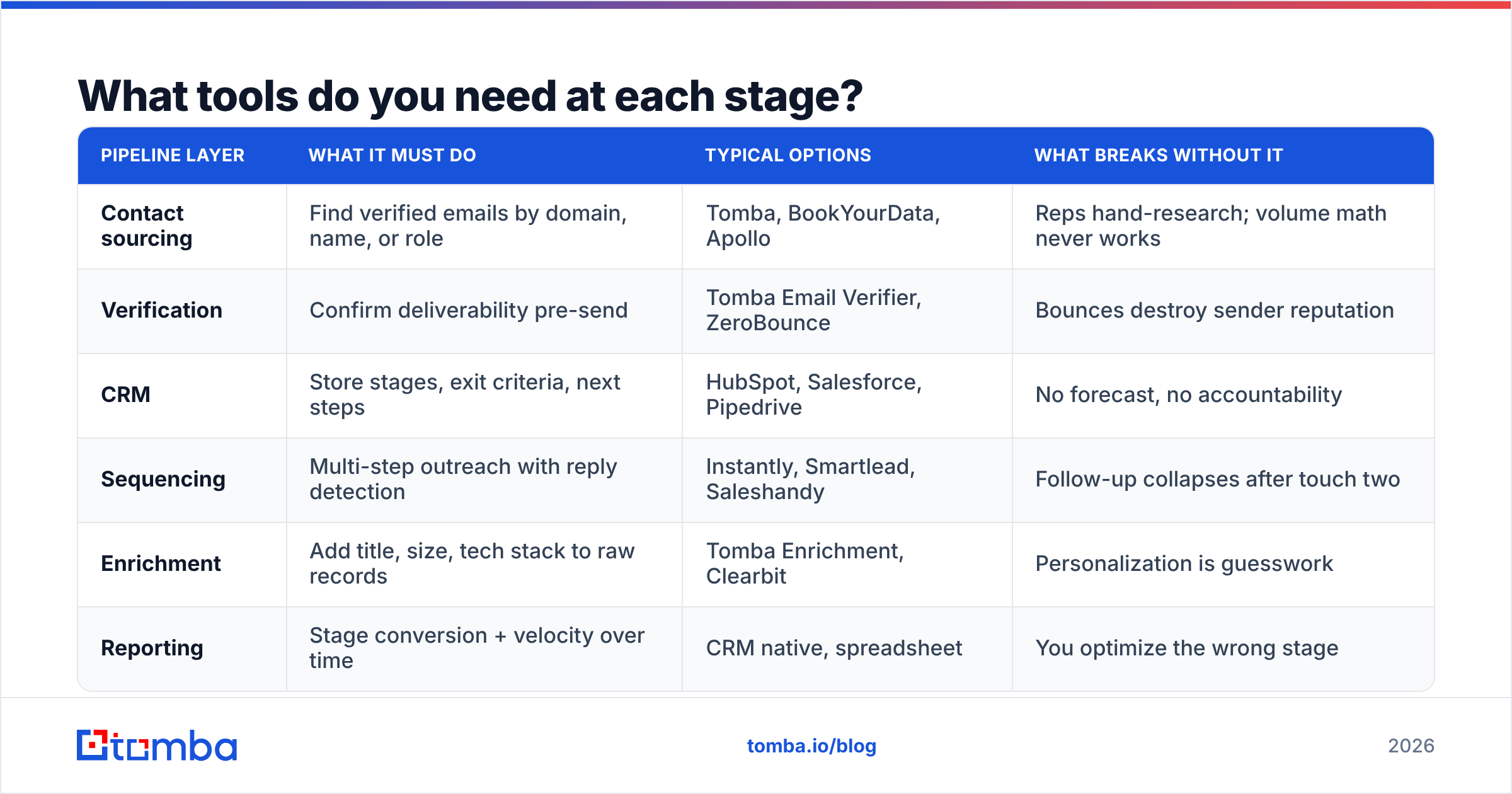
What tools do you need at each stage?#
You need fewer tools than vendors will tell you, and the ones you need are unglamorous.
| Pipeline layer | What it must do | Typical options | What breaks without it |
|---|---|---|---|
| Contact sourcing | Find verified emails by domain, name, or role | Tomba, BookYourData, Apollo | Reps hand-research; volume math never works |
| Verification | Confirm deliverability pre-send | Tomba Email Verifier, ZeroBounce | Bounces destroy sender reputation |
| CRM | Store stages, exit criteria, next steps | HubSpot, Salesforce, Pipedrive | No forecast, no accountability |
| Sequencing | Multi-step outreach with reply detection | Instantly, Smartlead, Saleshandy | Follow-up collapses after touch two |
| Enrichment | Add title, size, tech stack to raw records | Tomba Enrichment, Clearbit | Personalization is guesswork |
| Reporting | Stage conversion + velocity over time | CRM native, spreadsheet | You optimize the wrong stage |
On sourcing specifically, the honest picture is that different tools win at different jobs. BookYourData is strong when you want a pre-built, pay-as-you-go list with broad coverage and no subscription commitment — useful for teams testing a new segment. Tomba is strongest when you are working from an account list and need to find and verify contacts at specific domains programmatically, with Tomba pricing starting free at 25 searches per month and moving to $49/mo (Starter), $99/mo (Growth), and $249/mo (Pro). Apollo bundles sourcing with sequencing, which is convenient until you want to change either half independently.
Check current buyer sentiment on G2's sales intelligence category before committing to any annual contract — coverage claims move faster than review scores do.
For CRM, the practical advice is boring: pick one your reps will actually update, then configure exit criteria as required fields on stage transition. A HubSpot or Salesforce instance with enforced required fields beats a beautiful custom setup nobody fills in.
What are the most common pipeline-building mistakes?#
- Stages named after rep activities. "Proposal Sent" tells you nothing about buyer intent. Rename to the buyer signal that must be true.
- Probability percentages inherited from CRM defaults. Your CRM does not know your win rate. Replace every default within the first 90 days of data.
- Counting unverified contacts as pipeline. A bounced email was never a lead. Verification belongs at intake, not at post-mortem.
- One giant "Qualified" stage. If more than 40% of open deals sit in a single stage, that stage is doing too much work and needs splitting.
- Reviewing pipeline monthly. Stalled deals compound. Weekly is the minimum viable cadence for anything with a cycle shorter than six months.
- No mandatory loss reason. Without structured loss data, you cannot tell a pricing problem from a qualification problem, and you will fix the wrong one.
Frequently asked questions#
How many stages should a sales pipeline have? Five to seven for most B2B teams. Below five you cannot diagnose leaks; above nine, CRM update compliance falls off sharply and the extra granularity buys nothing.
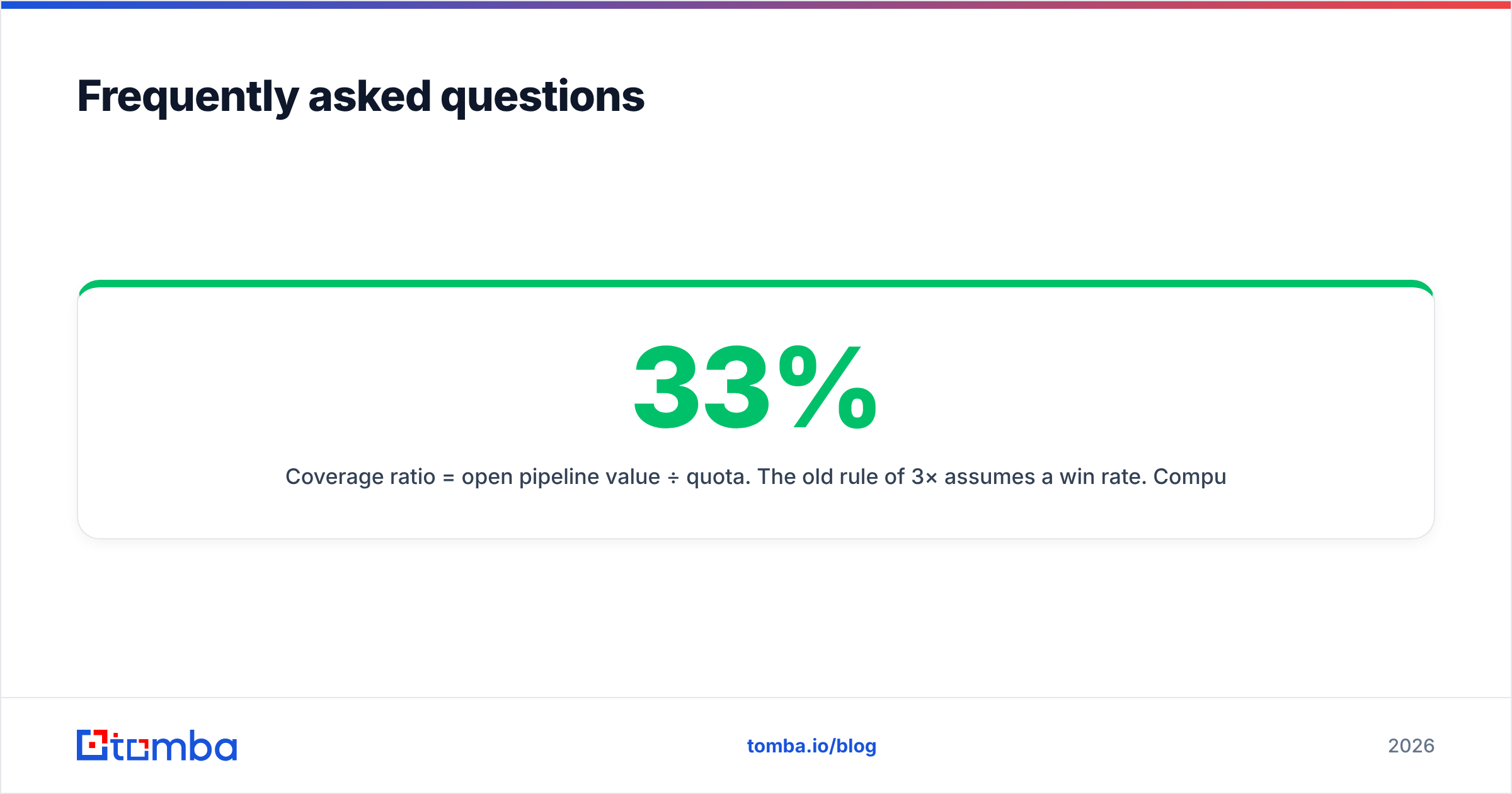
How much pipeline coverage do I need? Coverage ratio = open pipeline value ÷ quota. The old rule of 3× assumes a 33% win rate. Compute yours: if you win 22%, you need roughly 4.5× coverage, and if you win 40%, 2.5× is enough. Using a generic multiple is how teams end up chronically short.
How often should I re-verify contact data? Re-verify anything older than 90 days before it enters a sequence, and sweep the full active database quarterly. B2B contact data decays fast enough that annual cleanup is functionally the same as no cleanup.
Should new pipeline stages be added when we launch a new product? Usually no. Add a deal-type field instead and report conversion rates split by type. Adding stages fragments your historical data and makes every trend line restart at zero.
Build the top of your pipeline on data that does not bounce#
Every number in the coverage math above depends on one input you control directly: how many verified, ICP-matched contacts reach your reps each week. Stage definitions and forecast models cannot fix an empty or bad-data top of funnel.
Start there. Use the Tomba Email Finder to find professional email addresses by domain, name, or company, verify them before they ever hit a sequence, and load only deliverable records into Stage 1. The free tier gives you 25 searches a month to test coverage against your own account list — run it against ten target domains you already know well, and judge the hit rate for yourself before you pay anyone anything.
Related guides#
Ready to find emails that actually work?
Join 150,000+ professionals who stopped guessing and started sending. Free credits on signup — no credit card required.
Get the Tomba newsletter
Practical outbound tactics and product updates — once every two weeks.
About the author