How to Build a Sales Process That Reps Actually Follow
Most sales processes die in a Notion doc nobody opens. Here is a seven-stage framework with exit criteria, data requirements, and the tooling that keeps reps inside the process.
TL;DR
- A sales process is not a list of stage names. It is a set of buyer-verifiable exit criteria that decide when a deal moves forward, stalls, or dies.
- Build it backwards: start from closed-won deals, reverse-engineer the steps that actually happened, then codify them. Do not copy a template off a vendor blog.
- Seven stages cover most B2B motions: Target, Engage, Discover, Qualify, Validate, Propose, Close. Anything beyond nine stages gets ignored.
- Process fails on data before it fails on discipline. Bad contact records mean skipped stages, phantom pipeline, and forecasts nobody trusts.
- Instrument three numbers per stage — conversion rate, days in stage, and slip rate — and review them monthly. Everything else is decoration.
Sales processes get written far more often than they get followed. The usual pattern: a VP builds a beautiful eight-stage flow in a slide deck, the RevOps lead maps it to CRM stages, everybody nods in the kickoff, and six weeks later half the pipeline is sitting in "Discovery" with no next step booked. The document was fine. The problem was that nothing in the process forced a decision.
This guide covers how to build a sales process that survives contact with real reps and real buyers — the stage architecture, the exit criteria, the data layer underneath it, and the metrics that tell you whether it's working.
What is a sales process, exactly?#
A sales process is a repeatable, defined sequence of stages a deal passes through from first touch to closed, where each stage has an entry trigger, a required set of activities, and an objective exit criterion.
Three words carry the weight there: repeatable, defined, and objective.
Repeatable means your top rep and your newest hire run the same play. Defined means a stage change is not a judgment call. Objective means the exit criterion is something a third party could verify from the CRM record — "buyer confirmed budget range in writing" passes; "seems interested" does not.
The distinction that trips people up is process versus methodology. Your process is the operational spine — stages, criteria, handoffs. Your methodology (MEDDPICC, SPIN, Challenger, Sandler) is the questioning and qualification framework you run inside the stages. You need both, but they solve different problems. A methodology without a process gives you good conversations that never advance. A process without a methodology gives you clean stage movement on deals that were never real.
Why do most sales processes fail?#
Four failure modes account for nearly everything:
- Stages describe rep activity, not buyer commitment. "Demo Scheduled" tells you what your rep did. "Buyer confirmed the demo attendees include the economic decision maker" tells you where the deal actually stands. Stages named after your actions produce pipeline that looks healthy right up to the moment it doesn't close.
- No exit criteria, so stage movement becomes a mood ring. If a rep can drag a deal to Proposal because the call "went well," your stage-conversion data is noise. You cannot forecast off vibes.
- The process ignores how the buyer buys. Gartner's B2B buying research has consistently found that buyers spend the majority of their purchase journey doing independent research and internal consensus-building, with only a small slice of that time in direct supplier meetings. A process built purely around seller milestones is blind to most of what determines the outcome.
- The data underneath is rotten. Reps skip qualification because contact records are missing decision makers, emails bounce, and phone numbers are dead. Process discipline collapses when following the process is more expensive than working around it.
That last one is the least-discussed and most fixable. Before you rewrite a single stage definition, audit what percentage of your open opportunities have a verified email for the economic buyer. If it's under 60%, your process problem is a data problem wearing a costume.
How do you build a sales process step by step?#
Work backwards from outcomes, not forwards from theory.
Step 1 — Pull your last 30 to 50 closed-won deals. Not the ones you wish you'd won. The actual wins. For each, reconstruct the sequence: who was contacted first, what triggered the first meeting, when the second stakeholder appeared, what the buyer asked for before signing.
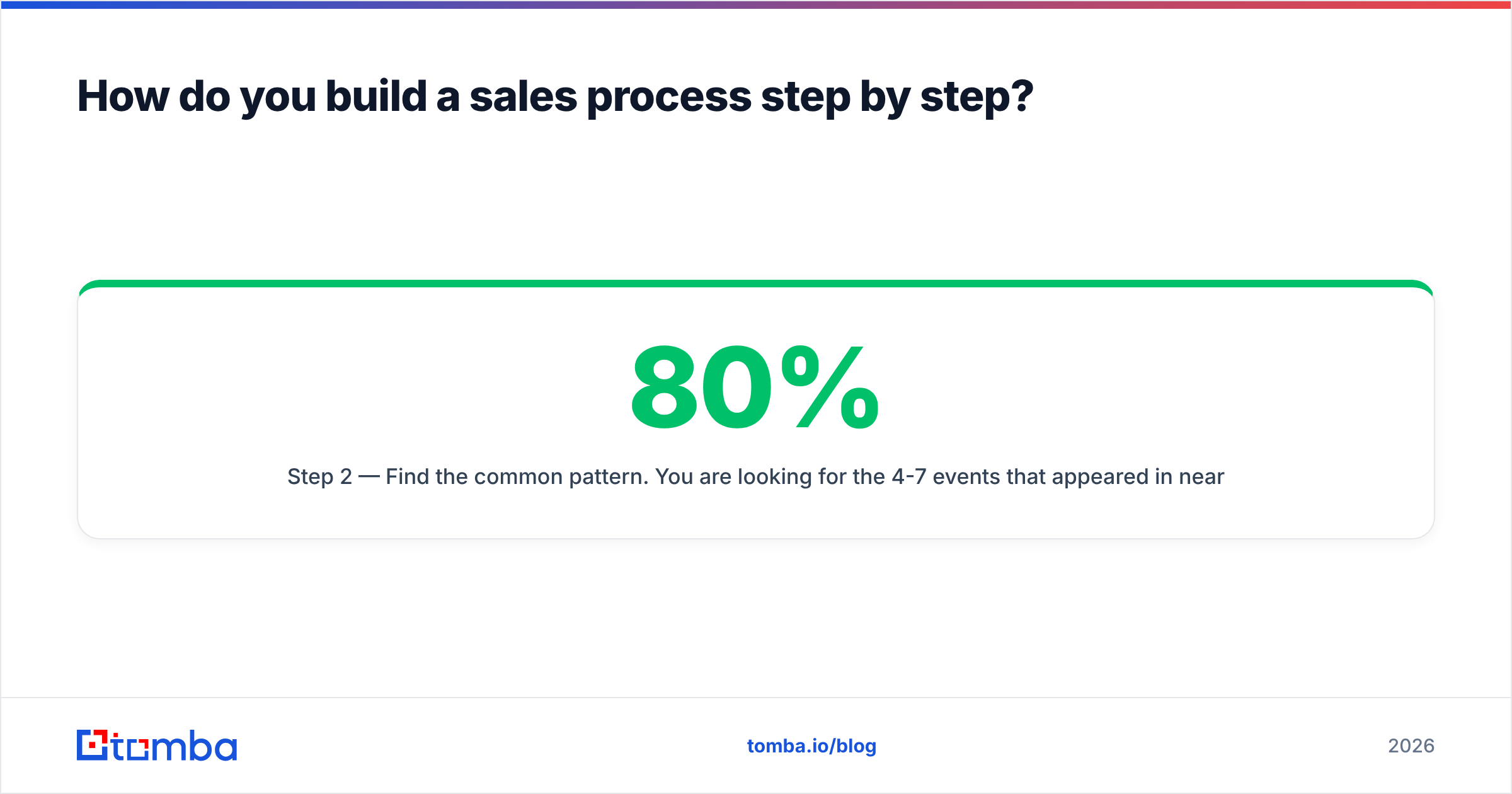
Step 2 — Find the common pattern. You are looking for the 4-7 events that appeared in nearly every win and were absent in most losses. Those events — not your intuition — become your stages. If "security review" showed up in 80% of wins and 20% of losses, it's a stage gate, not a footnote.
Step 3 — Write exit criteria as observable facts. Each stage gets one sentence in this shape: A deal exits Stage N when [specific, verifiable buyer action] has occurred and is documented in [CRM field]. If you can't name the field, the criterion isn't real.
Step 4 — Define the disqualification path. Every stage needs an explicit "kill it" rule. Processes without one accumulate zombie deals, which is how a pipeline shows 4x coverage while the forecast quietly craters.
Step 5 — Map required data to each stage. Which contact records, which firmographic fields, which enrichment must exist before the deal advances. This is where most processes are silently under-specified.
Step 6 — Instrument, then pilot with one team for a full sales cycle before rolling it company-wide. You will find out fast which criteria reps route around.
What are the seven stages of a B2B sales process?#
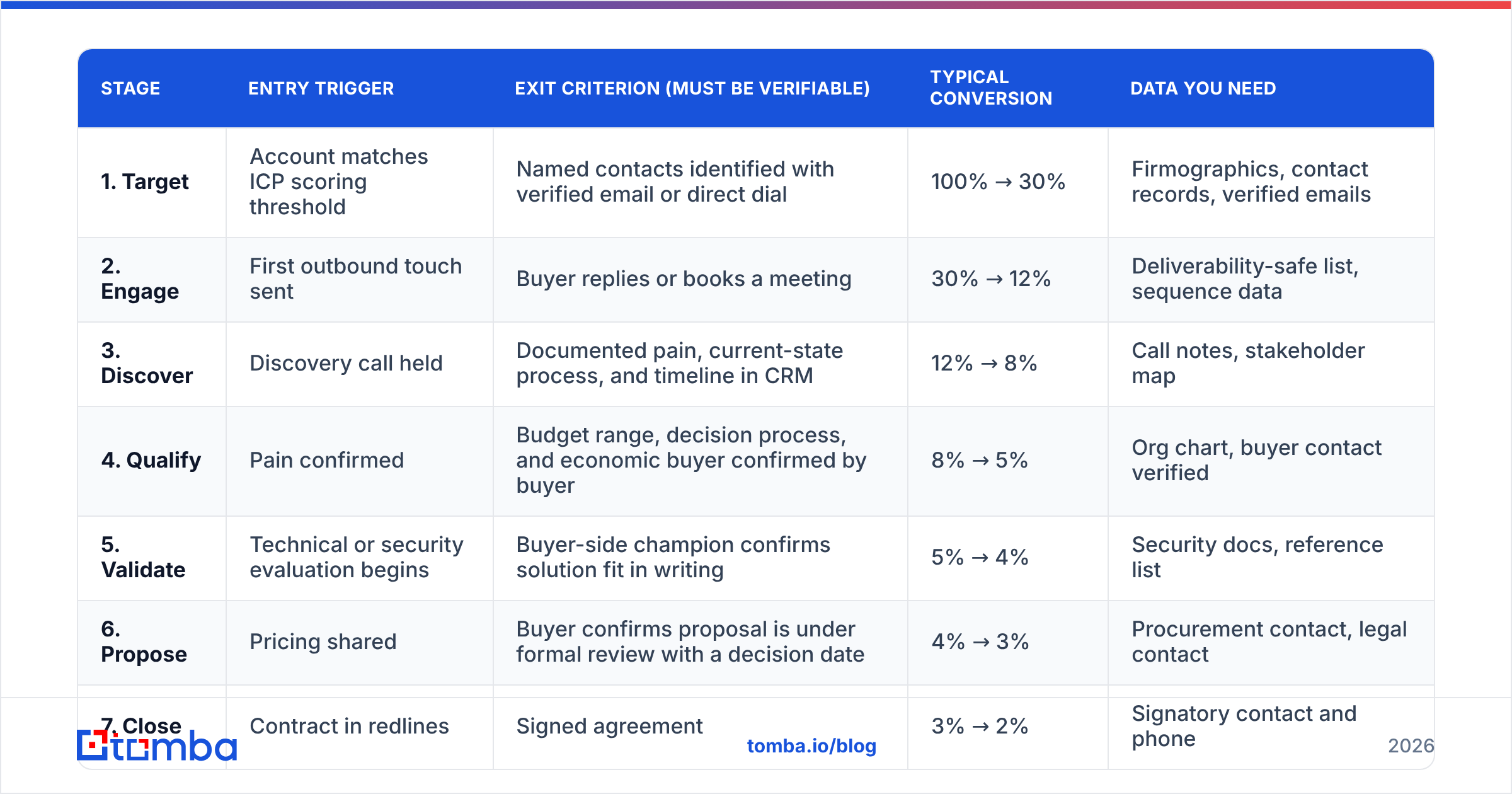
Here's a reference architecture. Adapt the criteria; keep the structure.
| Stage | Entry trigger | Exit criterion (must be verifiable) | Typical conversion | Data you need |
|---|---|---|---|---|
| 1. Target | Account matches ICP scoring threshold | Named contacts identified with verified email or direct dial | 100% → 30% | Firmographics, contact records, verified emails |
| 2. Engage | First outbound touch sent | Buyer replies or books a meeting | 30% → 12% | Deliverability-safe list, sequence data |
| 3. Discover | Discovery call held | Documented pain, current-state process, and timeline in CRM | 12% → 8% | Call notes, stakeholder map |
| 4. Qualify | Pain confirmed | Budget range, decision process, and economic buyer confirmed by buyer | 8% → 5% | Org chart, buyer contact verified |
| 5. Validate | Technical or security evaluation begins | Buyer-side champion confirms solution fit in writing | 5% → 4% | Security docs, reference list |
| 6. Propose | Pricing shared | Buyer confirms proposal is under formal review with a decision date | 4% → 3% | Procurement contact, legal contact |
| 7. Close | Contract in redlines | Signed agreement | 3% → 2% | Signatory contact and phone |
Conversion figures are illustrative benchmarks for a mid-market SaaS motion — measure your own and replace them. The point of writing them down is that the ratios between stages tell you where the process leaks.
Two rules about stage count. Fewer than four stages and you lose forecasting resolution. More than nine and reps stop updating the CRM accurately, which destroys the data you built the process to generate. Seven is a comfortable middle for most B2B motions with a 30-120 day cycle.
What exit criteria actually work?#
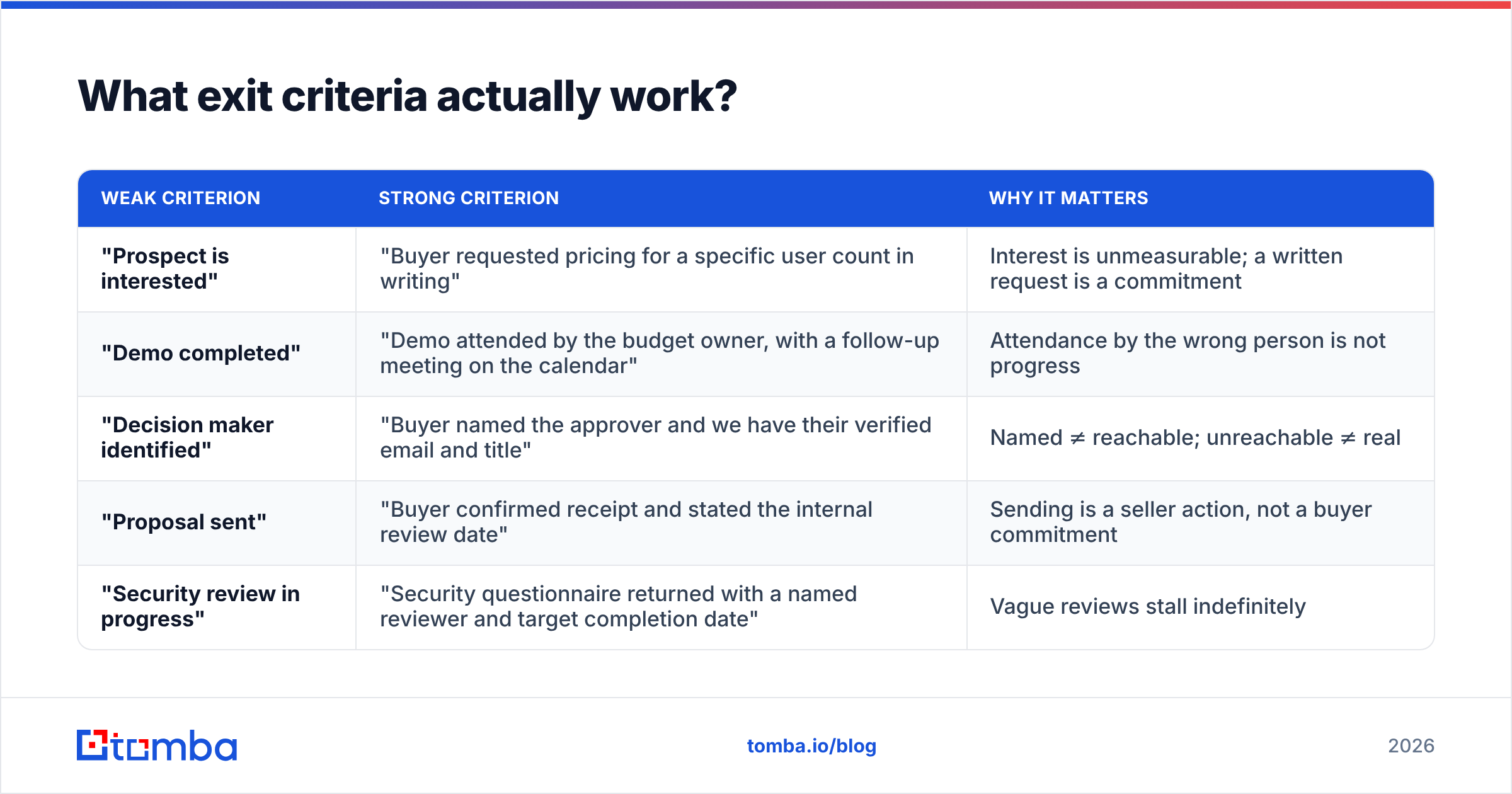
The test for a good exit criterion: could a manager who has never spoken to the buyer confirm it from the CRM record alone? Compare:
| Weak criterion | Strong criterion | Why it matters |
|---|---|---|
| "Prospect is interested" | "Buyer requested pricing for a specific user count in writing" | Interest is unmeasurable; a written request is a commitment |
| "Demo completed" | "Demo attended by the budget owner, with a follow-up meeting on the calendar" | Attendance by the wrong person is not progress |
| "Decision maker identified" | "Buyer named the approver and we have their verified email and title" | Named ≠ reachable; unreachable ≠ real |
| "Proposal sent" | "Buyer confirmed receipt and stated the internal review date" | Sending is a seller action, not a buyer commitment |
| "Security review in progress" | "Security questionnaire returned with a named reviewer and target completion date" | Vague reviews stall indefinitely |
Notice how many strong criteria depend on having a real, reachable contact. "We have their verified email and title" is not a paperwork detail — it's the difference between a deal that can advance and one that's a story your rep is telling themselves. This is where an email verifier belongs inside the process itself: make verification a stage requirement, not a hygiene task somebody does quarterly.
How does data quality gate each stage?#
Your process is only as executable as the contact data behind it. Map data requirements to stages explicitly:
- Target stage — coverage. Can you reach anyone at this account? Run a domain search against the target domain to see how many contacts and which email pattern the company uses before a rep spends a minute on research.
- Engage stage — deliverability. Sending to unverified addresses damages sender reputation and suppresses inbox placement for every subsequent deal. Verify before the first send, not after the bounces.
- Qualify stage — completeness. You cannot confirm an economic buyer you cannot contact. Enrichment at this stage should fill title, seniority, and direct contact channel.
- Validate stage — multithreading. Deals with a single contact close at materially lower rates than multithreaded ones. Make "at least three engaged contacts" a hard exit criterion and give reps the tooling to find contacts two and three quickly.
- Close stage — reachability under pressure. When a contract stalls in legal, email is often too slow. Having a direct number for the signatory, sourced through a phone finder, turns a two-week stall into a two-day one.
The practical implementation is a set of required CRM fields per stage, enforced by validation rules. Reps grumble for two weeks and then stop noticing. What they do notice is that stage-two deals stop evaporating.
Which tools support a sales process, and where do they fit?#
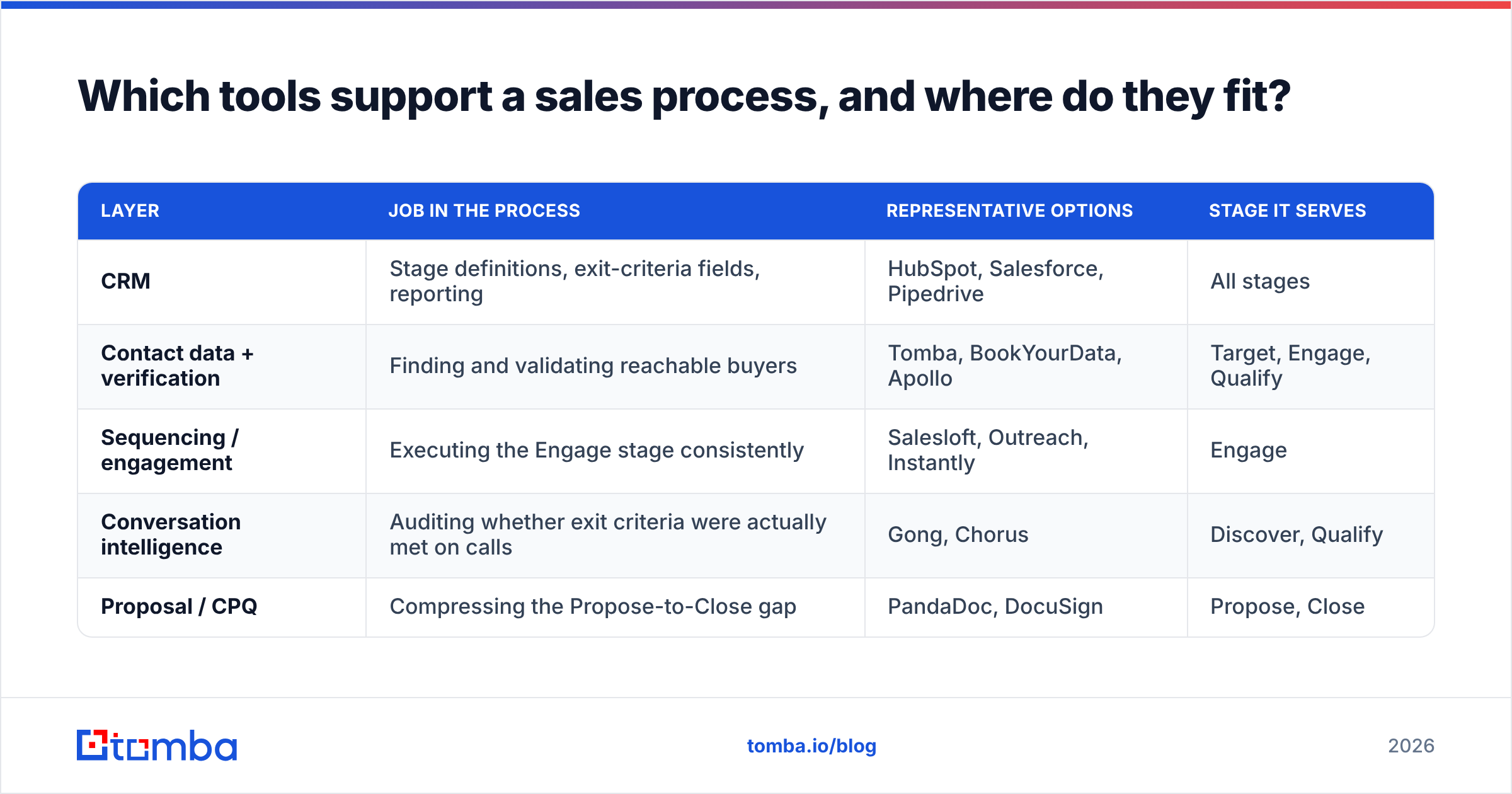
Tooling should map to stages, not the other way around. Buying an all-in-one platform before you've defined stages usually means adopting the vendor's process by default.
| Layer | Job in the process | Representative options | Stage it serves |
|---|---|---|---|
| CRM | Stage definitions, exit-criteria fields, reporting | HubSpot, Salesforce, Pipedrive | All stages |
| Contact data + verification | Finding and validating reachable buyers | Tomba, BookYourData, Apollo | Target, Engage, Qualify |
| Sequencing / engagement | Executing the Engage stage consistently | Salesloft, Outreach, Instantly | Engage |
| Conversation intelligence | Auditing whether exit criteria were actually met on calls | Gong, Chorus | Discover, Qualify |
| Proposal / CPQ | Compressing the Propose-to-Close gap | PandaDoc, DocuSign | Propose, Close |
A note on the data layer, since it's the one people underbuy: your two real requirements are accuracy (does the address exist and accept mail) and coverage (does the provider have anyone at this account at all). Vendors differ meaningfully on both, and they differ by region and company size. BookYourData is strong for pre-built, filterable B2B lists when you want volume up front. Tomba's model is search-and-verify — you supply the domain or the name, it returns the address with a confidence score and the public sources it came from. Different shapes for different stages: list-buy for top-of-funnel coverage, on-demand lookup for the specific stakeholder that appeared in stage four.
Whichever you pick, check the pricing shape against your volume. Tomba's plans run from a free tier at 25 searches per month to Starter at $49/mo, Growth at $99/mo, and Pro at $249/mo — see the full Tomba pricing breakdown. Credit-based tools get expensive fast when a process requires enrichment at three separate stages, so model your per-deal data cost before you commit annually.
How do you measure whether the process is working?#
Track three numbers per stage and one across the whole funnel.
Per stage:
- Stage conversion rate — what percentage of deals entering the stage exit forward. A sudden drop tells you where the process breaks. A rate near 100% tells you the stage isn't gating anything and should be merged.
- Days in stage — median, not mean. Deals sitting at 3x median are stalled regardless of what the rep says on the forecast call.
- Slip rate — how often deals move backward or get pushed past their expected close date. High slip in Propose usually means Qualify criteria are being skipped.
Across the funnel: win rate segmented by lead source and deal size. If process adoption is real, win-rate variance between reps should compress over two quarters. If it doesn't, either the process isn't being followed or it isn't the thing driving wins.
Review cadence matters more than dashboard sophistication. A 30-minute monthly review of stage conversion with the frontline managers beats a real-time dashboard nobody opens. Bring one question: which stage criterion did we bypass on the deals we lost?
How do you get reps to actually follow it?#
Adoption is a design problem, not a compliance problem.
- Make the compliant path the fast path. If logging exit criteria takes four clicks and skipping it takes zero, you have designed for skipping. Pre-fill what you can via enrichment and integrations so the rep types less, not more.
- Enforce at one gate, not seven. Pick the single highest-leverage stage — usually Qualify — and make that transition genuinely blocking. Soft-guide the rest. Total enforcement produces creative data entry.
- Coach off the criteria in every 1:1. If managers inspect deals by asking "how's it feeling," reps learn the criteria are theater.
- Kill the process debt annually. Stages that never gate anything and fields nobody reads should be deleted. A process that only grows is a process reps eventually route around.
- Show the payoff. When a rep sees that deals meeting the Qualify criteria close at 3x the rate of those that skipped it, the argument ends. Publish that number.
One more thing worth saying plainly: a sales process is a hypothesis about how your buyers buy, and buyers change. Revisit the closed-won reconstruction from Step 1 once a year. The stages that stopped predicting anything are the ones to cut.
Where should you start this week?#
Do the smallest version first. Pull 20 closed-won deals, reconstruct the sequence, and write exit criteria for the two stages where you leak the most pipeline. Ship those two into the CRM as required fields. Measure conversion for one full sales cycle. Then expand.
Skipping straight to a seven-stage rollout with 40 required fields is how process initiatives die in month two.
And if your audit turns up what it usually turns up — that a big share of open opportunities have no verified contact for the economic buyer — fix the data layer before you touch the stage definitions. The Tomba Email Finder finds and verifies professional email addresses by domain, name, or company, with a confidence score and source list on every result, so the "identify the decision maker" criterion stops being the stage where deals go to die. Start on the free tier at 25 searches a month, run it against your stalled pipeline, and see how many of those deals were stalled for a reason you can actually fix.
Related guides#
Ready to find emails that actually work?
Join 150,000+ professionals who stopped guessing and started sending. Free credits on signup — no credit card required.
Get the Tomba newsletter
Practical outbound tactics and product updates — once every two weeks.
About the author