How to Build a Sales Team in 2026: A Step-by-Step Playbook
Hiring reps is the easy part. This playbook covers the sequencing, comp math, ramp benchmarks, and data stack that decide whether your first eight sales hires pay for themselves or burn 18 months of runway.
TL;DR
- Do not hire a sales team until founder-led selling has produced roughly 10-15 closed deals from a repeatable motion. Before that, you are paying reps to run experiments you should be running yourself.
- Hire in pairs, not singles. Two AEs give you a control group; one AE gives you an anecdote you cannot interpret.
- Budget 5-9 months to full productivity for a mid-market AE, and assume the fully loaded cost of a first rep is $180K-$280K in year one once comp, tooling, and management time are counted.
- Your data layer is a hiring decision. A rep who spends 12 hours a week hunting contact details is a $60K/year researcher wearing an AE title.
- Build the scorecard, the comp plan, and the ramp plan before the first interview. Retrofitting them after you have hired is how teams end up with unfixable quota disputes.
Why do most first sales teams fail?#
Because they were hired to find product-market fit, not to scale it.
Think of it like a restaurant. Founder-led selling is the chef cooking every plate personally — slow, expensive, but the only way to learn which dishes people actually pay for. Hiring a sales team is opening a second kitchen and handing over the recipe. If the recipe is still changing weekly, the second kitchen produces chaos, not throughput.
The pattern shows up in the numbers. Bridge Group data on SaaS sales organizations has consistently put average AE tenure in the 2.5-year range with roughly a third of reps missing quota in a given year. When a first team fails, the post-mortem almost never says "we hired bad people." It says some version of: the ICP was fuzzy, the pitch was undocumented, the leads were unqualified, or the quota was invented.
Four preconditions before you post a job description:
- A repeatable close. At least 10-15 deals closed by founders, ideally with fewer than three distinct buyer personas among them.
- A written ICP. Company size, industry, tech stack, trigger event, and the title that signs. Written down, not in someone's head.
- A pipeline source that does not depend on your network. Outbound, inbound, or partner — but a real, measurable channel.
- Twelve months of runway past the hire date. Sales hires are cash-flow negative for two to three quarters. Hiring into nine months of runway forces you to fire before you learn anything.
What roles should you hire first, and in what order?#
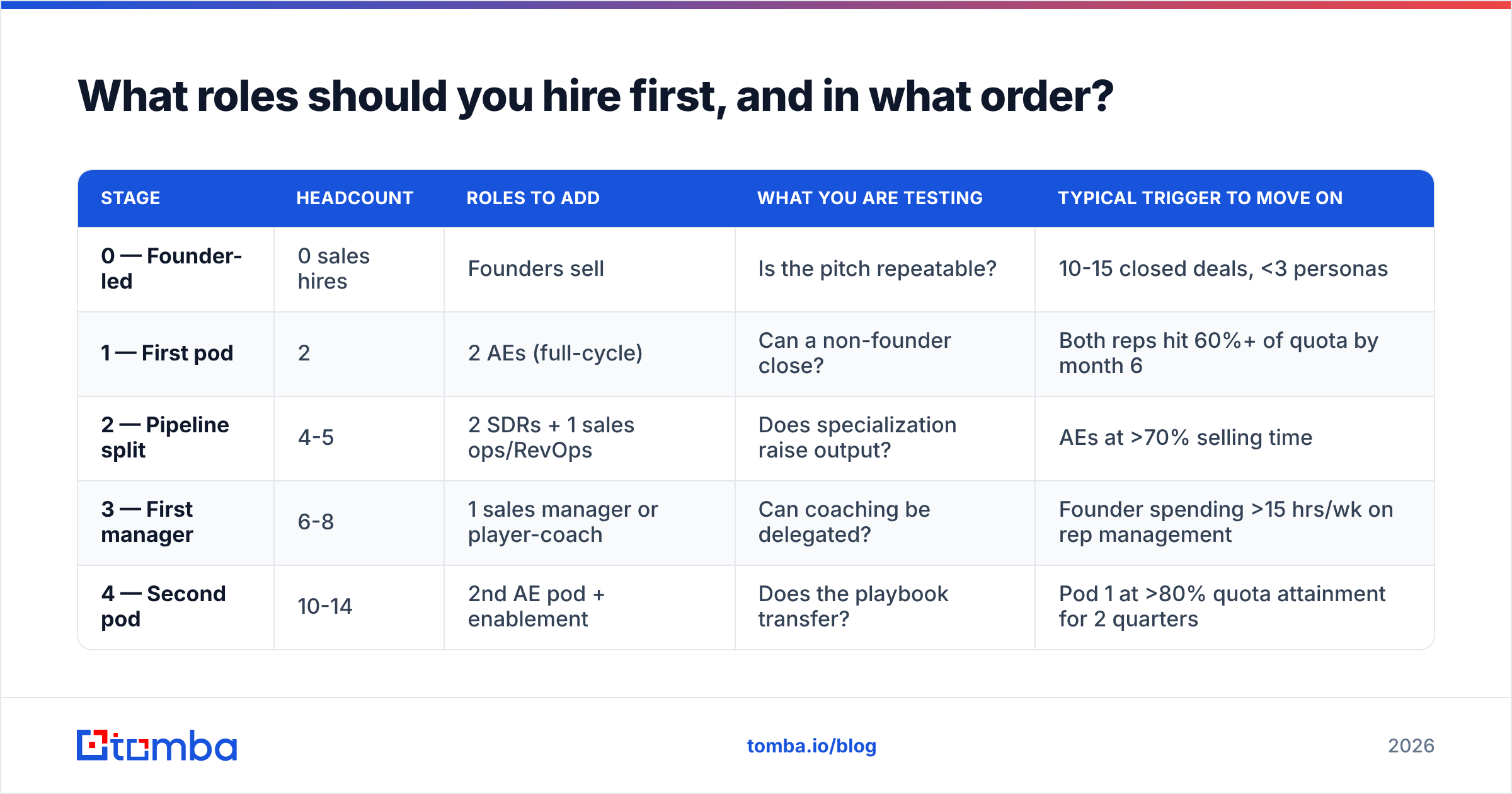
Start with two AEs, then add SDR support, then add a manager. Not the reverse.
The single most common sequencing error is hiring a VP of Sales first, expecting them to build the machine. A VP hired before a repeatable motion exists will do one of two things: sell personally (in which case you paid VP comp for an AE) or spend six months building process around a motion that does not exist yet.
| Stage | Headcount | Roles to add | What you are testing | Typical trigger to move on |
|---|---|---|---|---|
| 0 — Founder-led | 0 sales hires | Founders sell | Is the pitch repeatable? | 10-15 closed deals, <3 personas |
| 1 — First pod | 2 | 2 AEs (full-cycle) | Can a non-founder close? | Both reps hit 60%+ of quota by month 6 |
| 2 — Pipeline split | 4-5 | 2 SDRs + 1 sales ops/RevOps | Does specialization raise output? | AEs at >70% selling time |
| 3 — First manager | 6-8 | 1 sales manager or player-coach | Can coaching be delegated? | Founder spending >15 hrs/wk on rep management |
| 4 — Second pod | 10-14 | 2nd AE pod + enablement | Does the playbook transfer? | Pod 1 at >80% quota attainment for 2 quarters |
Two notes on this table. First, "full-cycle AE" at stage 1 is deliberate — you want reps who can prospect and close, because you do not yet know where the bottleneck is. Second, RevOps at 4-5 heads sounds early. It is not. Someone has to own the CRM schema, the pipeline definitions, and the data hygiene, and if nobody owns it by head five, you will spend a quarter cleaning it at head fifteen. If revenue operations is nobody's job, it becomes everybody's excuse.
How do you write a sales scorecard that actually filters?#
Replace "5+ years experience" with observable, testable behaviors.
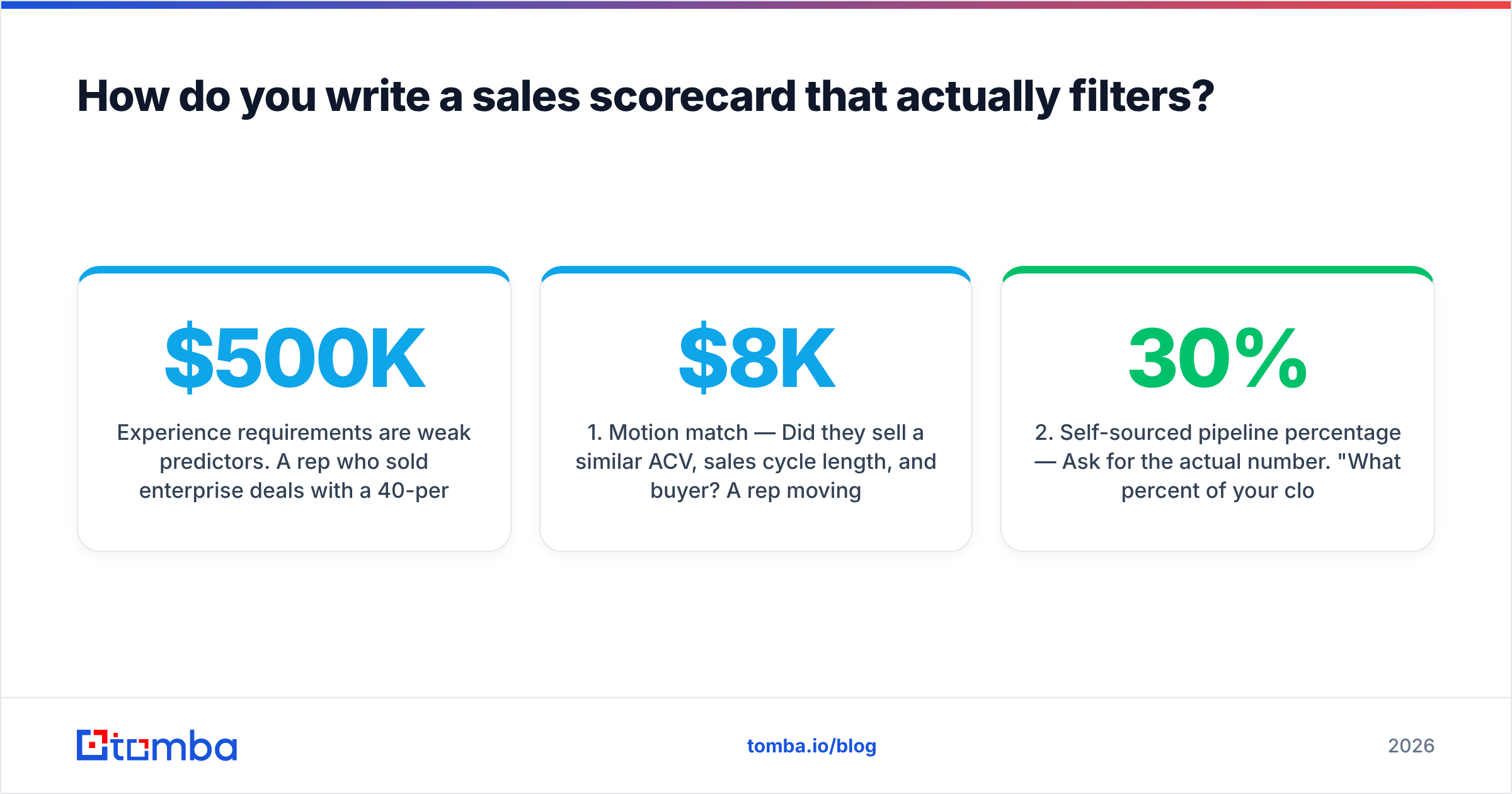
Experience requirements are weak predictors. A rep who sold $500K enterprise deals with a 40-person marketing team feeding them inbound has learned a job that has almost nothing in common with cold-starting a territory at a Series A company.
Build the scorecard around four dimensions:
- Motion match — Did they sell a similar ACV, sales cycle length, and buyer? A rep moving from $8K annual contracts to $80K ones is changing careers, not jobs.
- Self-sourced pipeline percentage — Ask for the actual number. "What percent of your closed revenue last year came from pipeline you generated yourself?" Anything above 30% at an early-stage company is strong. Vague answers here are the highest-signal red flag in the whole interview.
- Coachability under live pressure — Run a mock discovery call, give one specific piece of feedback, then run a second short call. You are measuring the delta, not the first performance.
- Written communication — Ask for a cold email to a named prospect at a real target account, written on the spot in 15 minutes. Half of B2B selling in 2026 is asynchronous writing.
Then verify. Backdoor references — people who worked alongside the candidate but were not on the reference list — are worth more than the three names a candidate hands you. A reverse email lookup or a quick pass through your network on LinkedIn will usually surface two or three former colleagues within a few minutes.
What should you actually pay a sales team?#
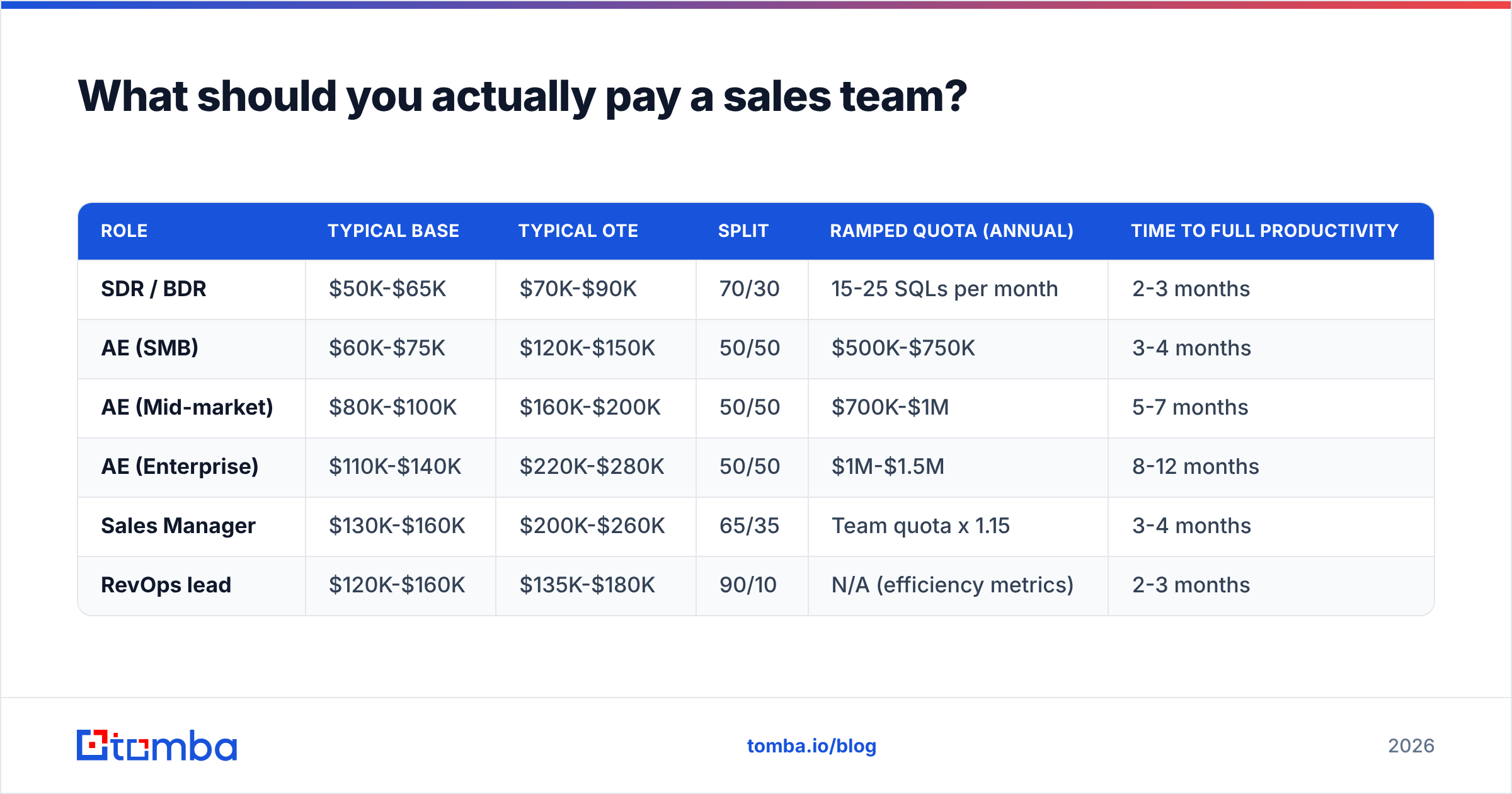
Anchor on OTE ranges by role, then check that your quota supports a 3-5x return on comp.
The rule most operators use: a rep's annual quota should be roughly 4-5x their on-target earnings in a healthy SMB/mid-market motion, and 3-4x in enterprise where cycles are longer. If your quota math produces less than 3x, the team will never be gross-margin positive.
| Role | Typical base | Typical OTE | Split | Ramped quota (annual) | Time to full productivity |
|---|---|---|---|---|---|
| SDR / BDR | $50K-$65K | $70K-$90K | 70/30 | 15-25 SQLs per month | 2-3 months |
| AE (SMB) | $60K-$75K | $120K-$150K | 50/50 | $500K-$750K | 3-4 months |
| AE (Mid-market) | $80K-$100K | $160K-$200K | 50/50 | $700K-$1M | 5-7 months |
| AE (Enterprise) | $110K-$140K | $220K-$280K | 50/50 | $1M-$1.5M | 8-12 months |
| Sales Manager | $130K-$160K | $200K-$260K | 65/35 | Team quota x 1.15 | 3-4 months |
| RevOps lead | $120K-$160K | $135K-$180K | 90/10 | N/A (efficiency metrics) | 2-3 months |
Numbers are US-market medians for B2B SaaS in 2026 and vary widely by region and ACV; check current ranges on G2's software categories and public comp surveys before you commit. Three design principles matter more than the exact figures:
- Uncapped commission. Capping upside sends the message that overperformance is a problem. It is not.
- Accelerators past 100%. A 1.5x multiplier on revenue above quota costs you almost nothing on the deals that would not have happened otherwise.
- Clawbacks on early churn. If a deal churns inside 90 days, commission comes back. This aligns reps against selling to bad fits, which is the single most expensive habit a young sales org can develop.
How long does ramp really take?#
Longer than your board deck assumes. Plan for revenue in month 6, not month 3.
A useful ramp model breaks the first two quarters into stages with explicit exit criteria:
- Weeks 1-2 — Absorption. Product, ICP, competitive landscape, and 10 recorded calls (5 wins, 5 losses). Exit criterion: can deliver the demo unassisted.
- Weeks 3-4 — Shadow and co-sell. Rep runs discovery with a founder on the line. Exit criterion: two discovery calls scored 4/5 or better on the scorecard.
- Weeks 5-8 — Owned pipeline, assisted close. Rep sources and runs their own deals; founder joins for pricing and negotiation. Exit criterion: $50K-plus of self-sourced pipeline.
- Weeks 9-16 — Full cycle at 50% quota. Rep owns everything. Quota is set at half. Exit criterion: 70% attainment against the ramped number.
- Weeks 17-26 — Full quota. Standard plan applies.
Track leading indicators throughout, not just closed revenue. Meetings booked, discovery-to-demo conversion, and response rate on outbound tell you in week 4 what closed-won will tell you in week 20. If a rep's reply rate is a third of the team average at week 6, that is a coaching problem you can still fix. Finding it at week 20 means you fix it by firing.
What tools does a new sales team actually need?#
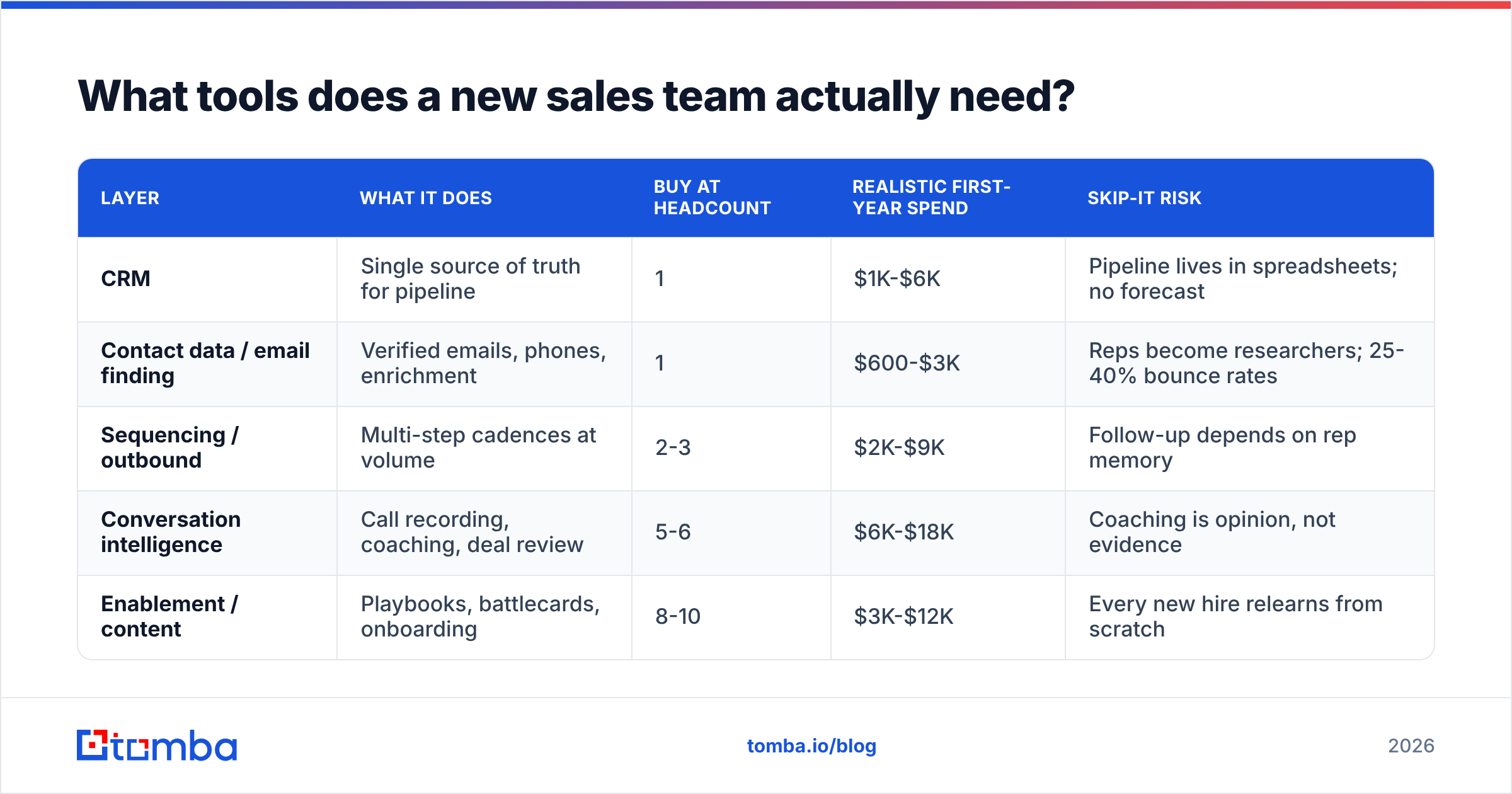
Four categories, in this order: CRM, contact data, sequencing, conversation intelligence. Everything else is optional at under 10 reps.
The trap is buying a $40K/year all-in-one platform at three reps because it bundles everything. You end up paying enterprise pricing for seat counts you will not reach for two years, and you lock in a data source before you know whether it covers your ICP.
| Layer | What it does | Buy at headcount | Realistic first-year spend | Skip-it risk |
|---|---|---|---|---|
| CRM | Single source of truth for pipeline | 1 | $1K-$6K | Pipeline lives in spreadsheets; no forecast |
| Contact data / email finding | Verified emails, phones, enrichment | 1 | $600-$3K | Reps become researchers; 25-40% bounce rates |
| Sequencing / outbound | Multi-step cadences at volume | 2-3 | $2K-$9K | Follow-up depends on rep memory |
| Conversation intelligence | Call recording, coaching, deal review | 5-6 | $6K-$18K | Coaching is opinion, not evidence |
| Enablement / content | Playbooks, battlecards, onboarding | 8-10 | $3K-$12K | Every new hire relearns from scratch |
On the CRM layer, pick something your team will actually update. HubSpot and Salesforce sit at opposite ends of the setup-cost spectrum; at under ten reps, configuration speed usually beats configurability.
The contact data layer is where new teams most often underinvest, and it is the one that compounds. A rep sending 40 cold emails a day at a 30% bounce rate is not just wasting 12 emails — they are damaging domain sender reputation, which quietly reduces deliverability for the entire team. Running your list through an email verifier before a campaign takes minutes and protects an asset that takes months to rebuild.
For sourcing, teams generally combine two approaches: a broad B2B database for list-building against the ICP, plus on-demand lookup for the specific accounts reps are actively working. BookYourData is a solid option for pre-built, pay-as-you-go lists when you want volume without a subscription commitment, and it is a reasonable fit for teams that prefer to buy contacts in batches rather than run continuous enrichment. If your motion is more account-by-account — a rep identifies a target, then needs the right contact at that company — a domain search or email finder workflow tends to be cheaper per usable contact, since you pay only for what you actually work.
Most teams end up using both. The mistake is picking one and forcing it to cover the other's job.
How do you manage the team once it exists?#
Run a weekly rhythm with three fixed meetings and one number per rep.
Sales management fails when it becomes ad-hoc status checking. The structure that scales from 2 reps to 20:
- Monday pipeline review (45 min, team). Every deal over a threshold, stage by stage. Focus on movement since last week, not deal size.
- Wednesday 1:1 (30 min, per rep). One coaching topic, chosen from call recordings, plus blockers. Not a forecast repeat.
- Friday number (15 min, team). Activity and outcome metrics posted publicly. Meetings booked, pipeline created, closed-won.
The one number per rep should be a leading indicator during ramp and a lagging one after. For a new SDR: qualified meetings held. For a ramped AE: pipeline created, because it predicts next quarter while closed-won only reports on last one.
On forecasting, resist the temptation to build a complex weighted model at under ten reps. Ask two questions per deal: what has to be true for this to close this month, and what is the last thing the buyer did? Deals where the answer to the second question is "they took our call" are not deals. A stalled pipeline is the leading cause of inflated forecasts, and it is visible in ten minutes if you look at last-activity dates instead of stage labels.
Set a fair win rate baseline from founder-led deals, then expect new reps to land 60-70% of that in their first two quarters. If they beat it, your enablement is working. If a whole cohort undershoots it, the problem is upstream — lead quality, ICP drift, or a pitch that only worked because a founder was delivering it.
What does the first-year budget look like?#
Roughly $400K-$600K in fully loaded cost for a first pod of two AEs plus tooling.
| Line item | Two-AE pod, year one |
|---|---|
| Base salary (2 x $80K) | $160,000 |
| Commission at 70% attainment | $112,000 |
| Payroll tax + benefits (~25%) | $68,000 |
| Recruiting (20% of base, if agency) | $32,000 |
| Tool stack (CRM, data, sequencing) | $9,000-$18,000 |
| Founder/manager time (0.3 FTE) | $45,000 |
| Total | $426,000-$435,000 |
Against that, two mid-market AEs at 70% of a $700K ramped quota produce roughly $980K in bookings. That is a workable ratio in year one — barely — and it becomes a good one in year two when ramp cost disappears and attainment climbs. It becomes a disaster if either rep churns at month 8, which is why the scorecard and the ramp plan matter more than the sourcing.
Recruiting cost is the line most founders underestimate and the easiest to reduce. Sourcing candidates directly through targeted outreach — rather than a 20% agency fee — is a meaningful saving at this scale, and the same bulk email finder workflow your reps use for prospecting works identically for candidate outreach.
Where should you start this week?#
Pick the stage you are actually at, not the one you want to be at:
- Zero sales hires, under 10 closed deals: do not hire. Document the pitch, write the ICP, record your own calls.
- 10-15 closed deals, no reps: write the scorecard and comp plan, then open two AE roles simultaneously.
- Two reps, six months in: measure attainment against the ramped number, not the full one. Decide on SDR support based on selling-time percentage.
- Five-plus reps, no process owner: hire RevOps before your next AE. The next rep will produce more if the system works than if there is simply one more of them.
Whichever stage you are at, the input that gates all of them is contact data. A sales team without verified, current contact information is a team spending its most expensive hours doing research. Tomba's Email Finder gives every rep verified professional emails by name and domain, with a free tier at 25 searches per month to test coverage against your ICP before you commit, then Starter at $49/mo and Growth at $99/mo as the team scales. Check the full Tomba pricing breakdown, run 20 of your target accounts through it, and see how much of your reps' week you get back.
Related guides#
Ready to find emails that actually work?
Join 150,000+ professionals who stopped guessing and started sending. Free credits on signup — no credit card required.
Get the Tomba newsletter
Practical outbound tactics and product updates — once every two weeks.
About the author