How to Build an Ideal Customer Profile That Actually Works
Most ICPs are a slide nobody opens. Here is a 7-step process to build an ideal customer profile from closed-won data, score it, and turn it into a working prospect list.
TL;DR
- An ideal customer profile describes the company you should sell to, not the person. Personas come after, and they are a different document.
- Build it from your last 20-50 closed-won deals, not from a whiteboard brainstorm. Retention and expansion data beat opinion every time.
- Score accounts on 5-8 attributes maximum. Anything more and reps stop using it.
- An ICP that lives in a slide deck is worthless. It only matters once it becomes a filter you run against a data source to generate a live list.
- Re-validate quarterly. Most ICPs drift within two quarters of a pricing change or a new product line.
What is an ideal customer profile, and how is it different from a persona?#
An ideal customer profile (ICP) is a description of the company that gets the most value from your product, fastest, at the lowest cost to serve. A persona is a description of the human inside that company who feels the pain and signs the contract.
Think of it like fishing. The ICP is the lake — depth, temperature, what lives there. The persona is the specific fish and the lure that works on it. Pick the wrong lake and the world's best lure catches nothing.
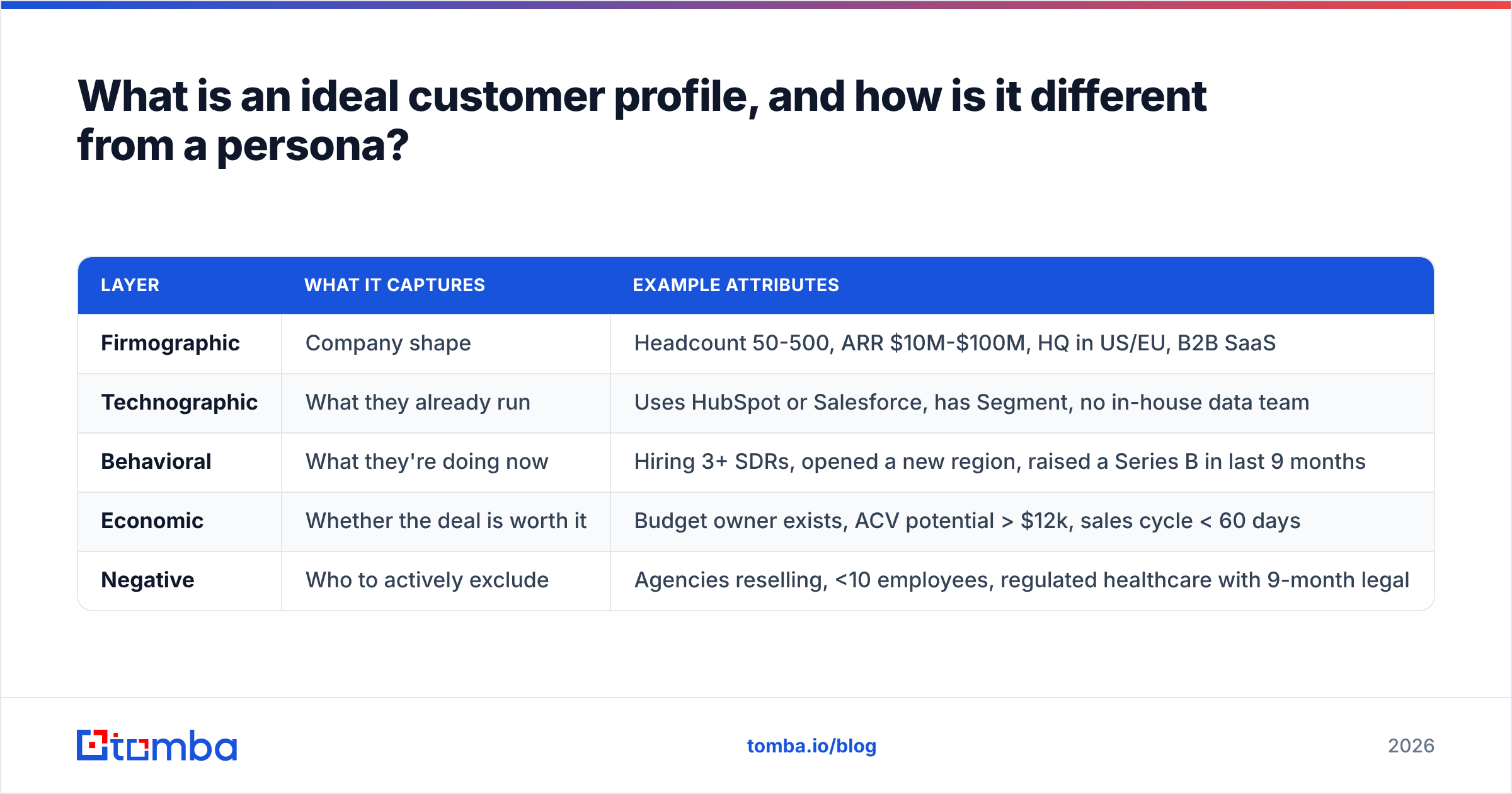
Concretely, an ICP is a set of firmographic, technographic, and behavioral attributes:
| Layer | What it captures | Example attributes |
|---|---|---|
| Firmographic | Company shape | Headcount 50-500, ARR $10M-$100M, HQ in US/EU, B2B SaaS |
| Technographic | What they already run | Uses HubSpot or Salesforce, has Segment, no in-house data team |
| Behavioral | What they're doing now | Hiring 3+ SDRs, opened a new region, raised a Series B in last 9 months |
| Economic | Whether the deal is worth it | Budget owner exists, ACV potential > $12k, sales cycle < 60 days |
| Negative | Who to actively exclude | Agencies reselling, <10 employees, regulated healthcare with 9-month legal |
That last row matters more than people expect. A good ICP is defined as much by what it excludes as what it includes. If your ICP does not disqualify anyone, it is not an ICP — it is a wish.

Why do most ideal customer profiles fail?#
Three reasons, in order of frequency.
1. They're built from aspiration, not evidence. Someone puts "enterprise, 1,000+ employees" in the doc because enterprise logos look good on the website. Then the actual closed-won list is full of 80-person companies that bought in three weeks. The document and the revenue disagree, and reps quietly follow the revenue.
2. They're too broad to act on. "B2B companies in North America that care about efficiency" describes about 4 million businesses. An ICP has to reduce your universe to something a team can actually work — usually 2,000 to 20,000 accounts, not two million.
3. They never leave the slide. This is the big one. The ICP gets presented at a QBR, everyone nods, and nobody translates it into a search query, a saved filter, or a scoring rule inside the CRM. Six weeks later reps are back to prospecting whoever replied last.
The fix for all three is the same: build it from data you already have, keep it to a handful of attributes, and end the process with a list — not a deck.
How do you build an ideal customer profile in 7 steps?#
Here is the sequence. Budget about a day for steps 1-4 if your CRM data is clean, a week if it isn't.
- Pull your closed-won cohort. Export the last 20-50 won deals. If you have fewer than 20, include qualified opportunities and lean harder on qualitative interviews. Under 10 customers, skip the analysis and go straight to interviews.
- Filter for the good wins. Not all revenue is equal. Keep only accounts that (a) renewed at least once or are past 6 months, (b) had a sales cycle at or under your median, and (c) haven't burned support. This is the single highest-leverage step — it's the difference between profiling customers and profiling good customers.
- Tag attributes across the cohort. For each account, record headcount, industry, revenue band, tech stack, region, buying trigger, champion title, ACV, and time-to-value. Spreadsheet is fine.
- Find the attributes that actually separate. Compare the good-wins cohort against your closed-lost and churned cohorts. An attribute only earns a spot in the ICP if it appears far more often in wins than in losses. "They have a website" is common to both — useless. "They already run a marketing automation platform" appearing in 80% of wins and 30% of losses — that's a signal.
- Interview 5-8 customers to explain the why. Data tells you which attributes correlate; customers tell you the mechanism. Ask what broke right before they went looking, who else they evaluated, and what almost stopped the deal.
- Write the profile as a scorecard, not prose. Five to eight attributes, each weighted, with a threshold for "in ICP" vs "adjacent" vs "out."
- Operationalize it into a live list. Turn the scorecard into filters on a B2B database or enrichment source, generate the account list, then find the contacts. If step 7 doesn't happen, steps 1-6 were a hobby.
What does a good ICP scorecard look like?#
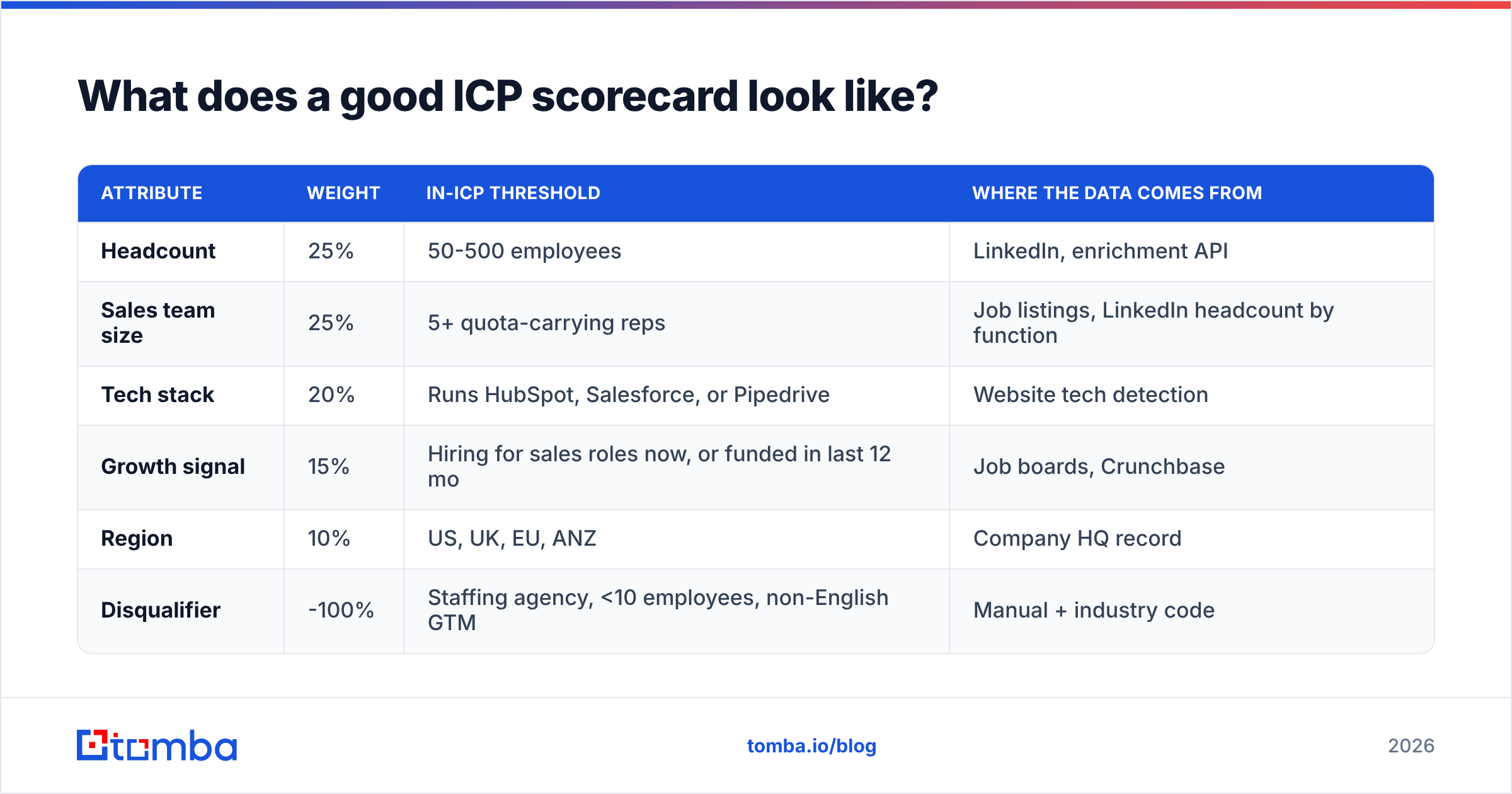
Keep it brutally short. Here's a working example for a mid-market sales-tooling vendor:
| Attribute | Weight | In-ICP threshold | Where the data comes from |
|---|---|---|---|
| Headcount | 25% | 50-500 employees | LinkedIn, enrichment API |
| Sales team size | 25% | 5+ quota-carrying reps | Job listings, LinkedIn headcount by function |
| Tech stack | 20% | Runs HubSpot, Salesforce, or Pipedrive | Website tech detection |
| Growth signal | 15% | Hiring for sales roles now, or funded in last 12 mo | Job boards, Crunchbase |
| Region | 10% | US, UK, EU, ANZ | Company HQ record |
| Disqualifier | -100% | Staffing agency, <10 employees, non-English GTM | Manual + industry code |
Score every account out of 100. Above 70 is core ICP and gets full outbound investment. Between 45 and 70 is adjacent — worth a lighter-touch sequence. Below 45 you don't work, no matter how nice the logo would look. Write that rule down, because it's the one people break.
A note on weighting: don't agonize. The precision of the weights matters far less than the discipline of having a cutoff. Teams spend two weeks tuning percentages and zero minutes enforcing the "below 45, don't touch it" rule. Reverse that ratio.
Which data do you need, and where does it come from?#
You need three tiers, and they come from different places.
Tier 1 — first-party (your CRM). Closed-won, closed-lost, churn reasons, sales cycle length, ACV, support ticket volume. Free, already yours, usually messy. Clean it before you analyze it; a field that's 40% empty will produce a confident, wrong conclusion.
Tier 2 — firmographic and technographic enrichment. Headcount, industry, revenue band, funding, HQ, tech stack. This is where an enrichment provider earns its keep. Running contact enrichment across your closed-won list fills the gaps your CRM never captured, and — crucially — the same enrichment fields become the filters you use to find lookalikes later. Use identical field definitions for analysis and for prospecting, or your ICP won't be reproducible.
Tier 3 — intent and trigger data. Hiring signals, funding rounds, leadership changes, tech adoption. This is the layer that turns a static ICP into a prioritized queue. An account can match your firmographics perfectly and still not be worth calling this month; a trigger tells you when the month is now.
Practical tooling note: once you've defined the account list, you still need people to contact inside it. That's a separate motion — domain search to pull the contact map for each target company, then a verification pass so your bounce rate doesn't torch your sending domain. Building a beautiful ICP and then blasting it with unverified addresses is a common and expensive own-goal.

How do you validate the ICP before betting the quarter on it?#
Run a controlled test rather than a full rollout. The cheapest version takes four weeks:
- Build two lists of 200 accounts each. List A scores 70+ on your scorecard. List B scores 45-69. Same messaging, same sequence, same reps if possible.
- Track three metrics: reply rate, meeting-booked rate, and opportunity-created rate. Reply rate alone will mislead you — curiosity replies are cheap.
- Look for a 2x gap or better on meeting-booked rate between A and B. If A and B perform the same, your scorecard isn't separating anything and you've weighted the wrong attributes.
- Check qualitatively too. Ask reps which accounts felt easier. Rep intuition is a lagging indicator of a real pattern, and it's free.
If List A underperforms List B — it happens — you've likely built an ICP from your biggest customers rather than your best ones. Big and good are not synonyms. Go back to step 2 and re-filter on time-to-value and retention instead of ACV.
According to Gartner's research on B2B buying, buying groups now involve six to ten stakeholders, which is exactly why account-level fit matters more than individual persona fit. If the company shape is wrong, no amount of persona-perfect messaging saves the deal.
What are the most common ICP mistakes?#
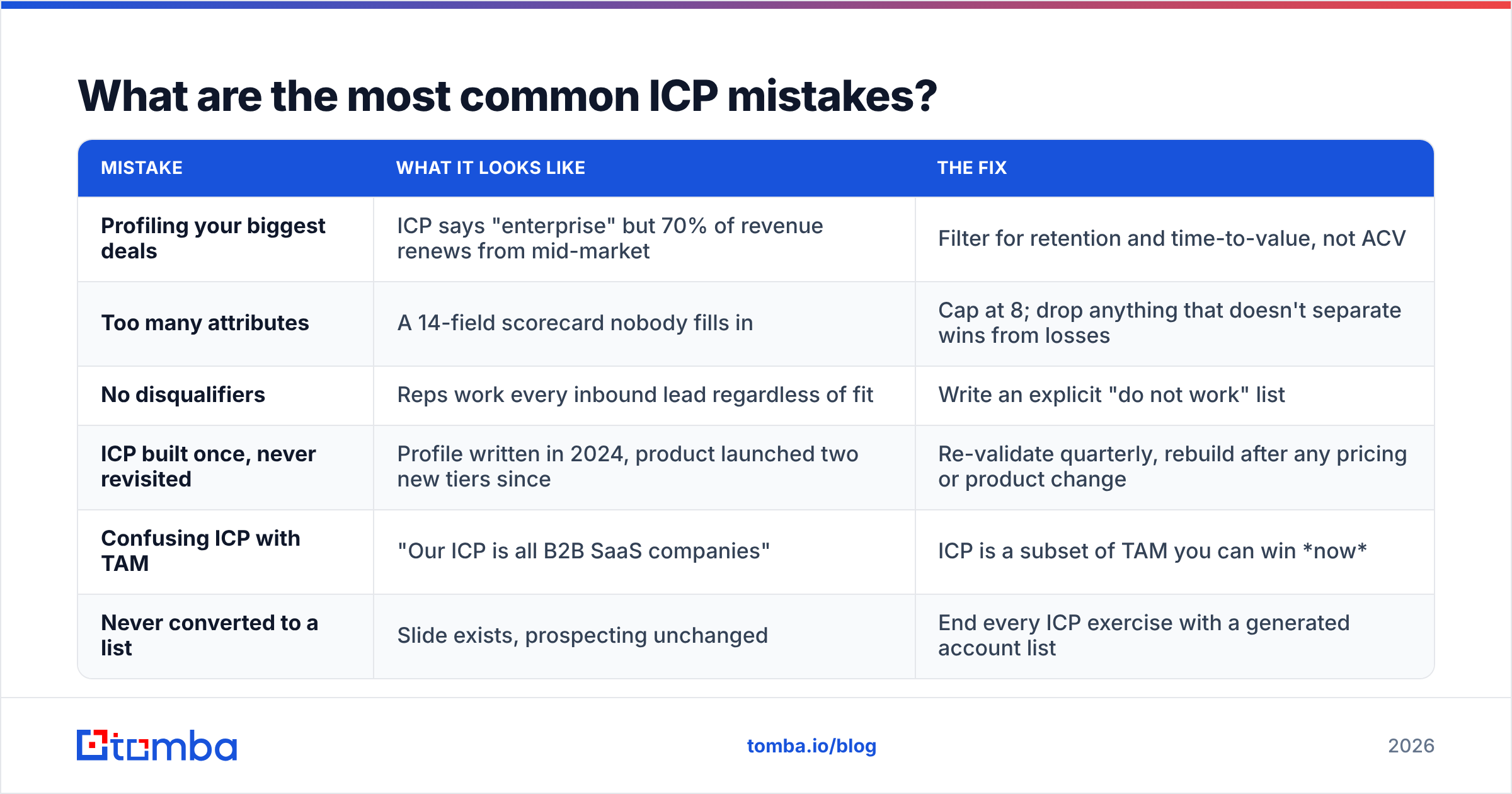
| Mistake | What it looks like | The fix |
|---|---|---|
| Profiling your biggest deals | ICP says "enterprise" but 70% of revenue renews from mid-market | Filter for retention and time-to-value, not ACV |
| Too many attributes | A 14-field scorecard nobody fills in | Cap at 8; drop anything that doesn't separate wins from losses |
| No disqualifiers | Reps work every inbound lead regardless of fit | Write an explicit "do not work" list |
| ICP built once, never revisited | Profile written in 2024, product launched two new tiers since | Re-validate quarterly, rebuild after any pricing or product change |
| Confusing ICP with TAM | "Our ICP is all B2B SaaS companies" | ICP is a subset of TAM you can win now |
| Never converted to a list | Slide exists, prospecting unchanged | End every ICP exercise with a generated account list |
One more, subtler than the rest: treating the ICP as a marketing artifact. If sales, marketing, and customer success are each working from a different definition of "good fit," you don't have an ICP — you have three. The document has to be jointly owned, ideally by revenue operations, and it has to be the same object that drives ad targeting, lead scoring, and outbound list-building.
How do you turn the ICP into a working prospect list?#
This is the step that converts strategy into pipeline. Four moves:
- Translate scorecard attributes into search filters. Headcount range, industry codes, tech stack, region. Every attribute in your scorecard should map to a filterable field in whatever data source you use. If an attribute can't be filtered on, it can't be prospected on — either find a proxy or drop it.
- Generate the account list, then de-duplicate against the CRM. You do not want reps emailing an existing customer or an open opportunity. Deduplicate before enrichment, not after — you'll pay for the same record twice otherwise.
- Map contacts inside each account. For every target company, identify the 2-4 roles in the buying group. Pull verified work emails and, where the motion calls for it, direct dials. Verified is doing real work in that sentence: run the list through an email verifier before it touches a sequencing tool.
- Prioritize by trigger, not alphabetically. Within your ICP-matched list, sort by recency of buying signal. A 75-score account that just posted three sales-role openings outranks an 88-score account that has been static for a year.
For teams doing this at volume, the account-list-to-contact-list step is worth automating end to end. Tools with a bulk email finder or an API let you feed a domain list in and get a verified contact map out, which keeps the ICP filter and the prospecting list in sync instead of drifting apart across three spreadsheets.
How often should you rebuild your ICP?#
Review quarterly, rebuild on triggers. The calendar review is a 30-minute check: did the last quarter's closed-won cohort look like the profile? If more than a third of new wins fall outside the ICP, the profile is stale.
Rebuild from scratch — full seven steps — whenever one of these happens:
- Pricing change. New price points move which companies can afford you and which find you cheap enough to buy without procurement.
- New product line or tier. A self-serve tier usually has a completely different ICP from the enterprise motion. Two products, two ICPs.
- New market or region. Firmographic thresholds rarely transfer. A "mid-market" company in Germany and in the US are different animals.
- Sustained CAC increase. Rising acquisition cost with flat conversion often means you've exhausted the core ICP and started working the adjacent tier without admitting it.
Vendors publish useful benchmark data on this — G2's buyer behavior reports and HubSpot's annual sales trends research are both reasonable external sanity checks when your internal sample is small. Use them to challenge your assumptions, not to replace your own data. Your closed-won list beats any industry average, because it reflects your product, your pricing, and your team.
Put the ICP to work#
The gap between a company with a working ICP and one without isn't the quality of the document — it's whether the document ends in a list of accounts and verified contacts that reps open on Monday morning.
Once your scorecard is written, the fastest path from profile to pipeline is: filter your target accounts, pull the contact map for each domain, verify, sequence. Tomba's Email Finder handles the middle two steps — feed it the domains that match your ICP and get verified professional email addresses back, with a free tier of 25 searches a month to test your first list before committing. Paid plans start at $49/mo (Starter), with Growth at $99/mo and Pro at $249/mo as volume grows; full Tomba pricing is on the site.
Build the profile from evidence, cap it at eight attributes, enforce the cutoff, and end every ICP exercise with a list. That's the whole job.
Related guides#
Ready to find emails that actually work?
Join 150,000+ professionals who stopped guessing and started sending. Free credits on signup — no credit card required.
Get the Tomba newsletter
Practical outbound tactics and product updates — once every two weeks.
About the author