How to Build Credibility in Sales: A 2026 Field Guide
Credibility is not charisma — it is a set of repeatable behaviors buyers can verify. Here are the seven that move deals, plus a scoring rubric to audit your own calls.
Nobody really teaches you how to build credibility in sales. You get told to be confident, be helpful, add value. A buyer cannot check any of that. This guide covers the parts they can check.
TL;DR
- Credibility in sales is not a personality trait. It is the evidence a buyer has that you are accurate, prepared, and willing to say the inconvenient thing.
- The fastest credibility killer in 2026 outbound is a wrong fact in the first 30 seconds. Wrong name, wrong role, bounced email. Data hygiene is a trust behavior, not an ops chore.
- Seven behaviors do most of the work: pre-call research, specific proof, disqualifying yourself, precise language, visible follow-through, third-party validation, and admitting limits.
- Score your own calls against a rubric before the buyer scores you. Most reps lose credibility on things they never hear feedback about.
- Tools help at the edges. No tool rescues a rep who overclaims.
What does credibility actually mean in a sales context?#
Credibility is the buyer's running estimate of how much of what you say will turn out to be true.
That's it. It is not likeability, not rapport, not the number of times you say their first name. Buyers form the estimate quickly and update it slowly. Every verifiable claim you make either adds to the balance or draws it down. That goes for claims about their industry, their stack, their timeline, and your product.
Academic work on trust splits it into competence (do you know things?) and benevolence (are you on my side?). Sales credibility sits at the intersection. A rep who knows the category cold but pushes a bad-fit package has competence without benevolence. A rep who is warm and helpful but keeps mispronouncing the product name has the reverse. Neither closes at a healthy win rate.
The practical consequence: credibility is built out of small, checkable things. That is good news. Checkable things can be trained.
Why is credibility harder to earn in 2026 than it was five years ago?#
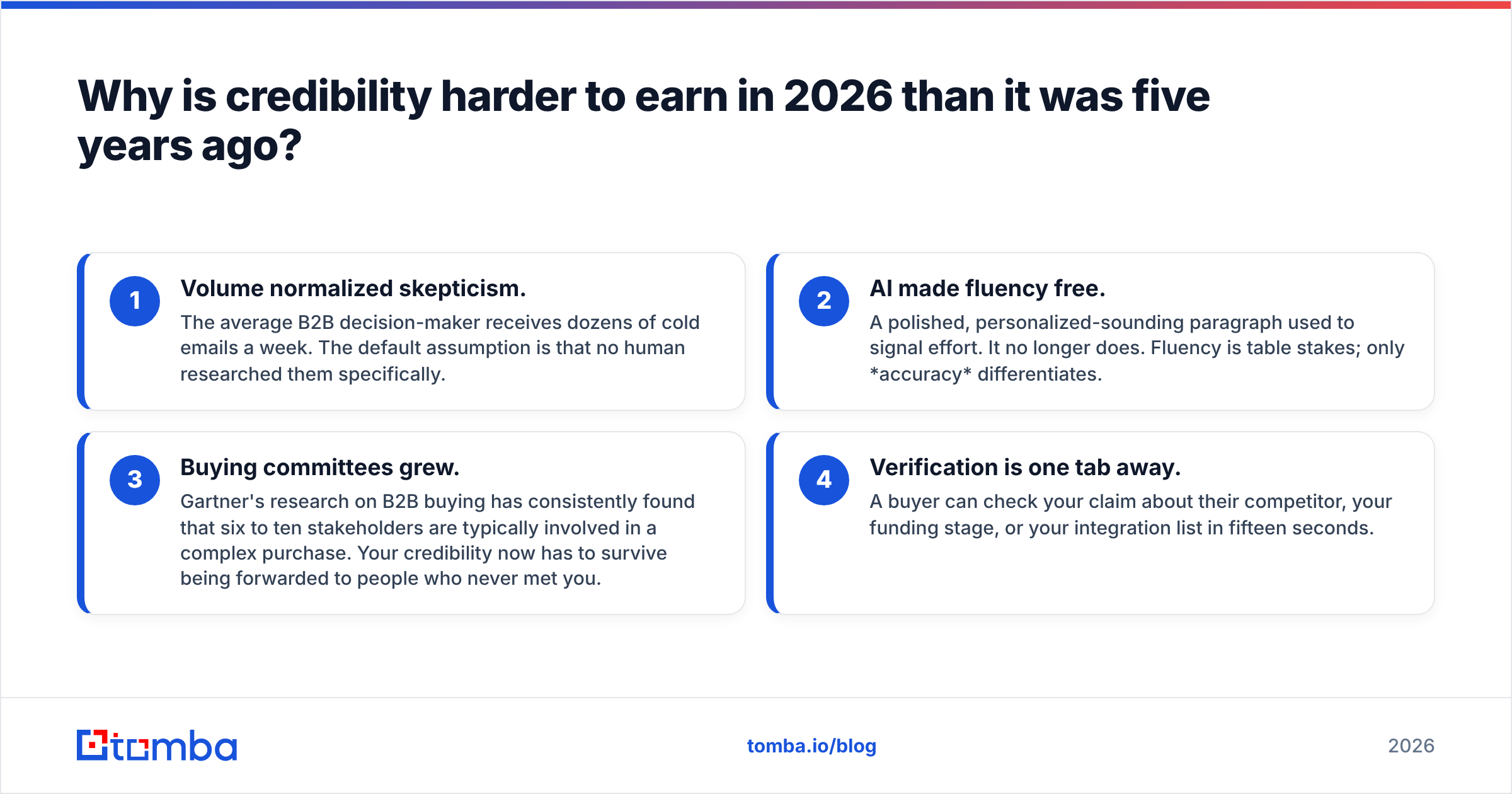
Because buyers now assume the outreach they receive was generated, not written.
Three shifts compounded:
- Volume normalized skepticism. The average B2B decision-maker gets dozens of cold emails a week. The default assumption is that no human researched them.
- AI made fluency free. A polished, personalized-sounding paragraph used to signal effort. It no longer does. Fluency is table stakes. Only accuracy differentiates.
- Buying committees grew. Gartner's research on B2B buying finds six to ten stakeholders in a typical complex purchase. Your credibility now has to survive being forwarded to people who never met you.
- Verification is one tab away. A buyer can check your claim in fifteen seconds.
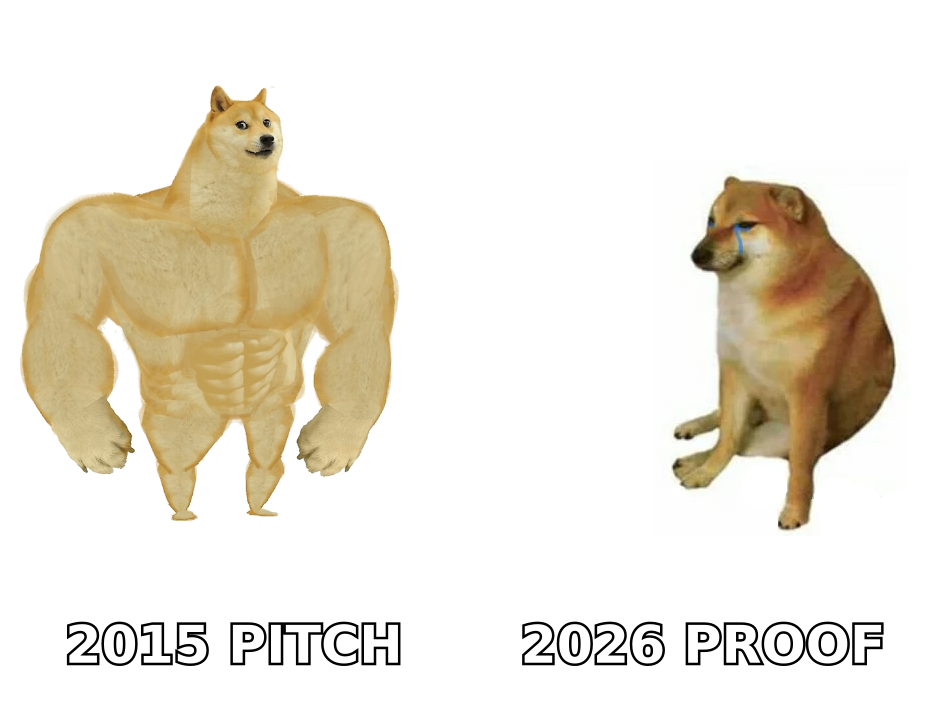
The bar moved from sounding informed to being correct. Those are very different disciplines.
How to build credibility in sales: the seven behaviors#
Here are the behaviors, ordered roughly by how early in the cycle they matter.
Before the first call
- Do research a buyer could not do about themselves. Not "I saw you're hiring SDRs." That's a job board. Try: "You've posted three SDR roles in EMEA but your careers page still routes EU applicants to the US entity — is the EMEA build-out running ahead of the legal entity?" That's a fact plus an inference. Inference is what signals thought.
- Make proof specific and falsifiable. "We help companies grow revenue" is noise. "A 40-person team in your category cut list-build time from 9 hours a week to about 90 minutes; I can introduce you to their ops lead" is a claim someone could check. Specificity is only credible when you'd survive the check.
On the call
- Disqualify yourself out loud. The highest-leverage move is telling a prospect they're a bad fit before they figure it out. "If you're buying primarily for intent data, we're the wrong call." A rep who has said no once is believed the next time they say yes.
- Use precise language about your own product. Say "supported in beta" when it's beta. Say "on the roadmap, no date" when there's no date. Every vague hedge that later resolves badly costs more than the deal you were protecting.
- Follow through visibly and early. Send the thing you promised within the hour, not the week. The promise-to-delivery gap is the cheapest trust signal available, and most reps waste it.
Once the deal gets real
- Bring third-party validation, not just your own. Analyst notes, G2 reviews, a customer's public engineering blog. Evidence you didn't author carries more weight than any deck slide.
- Name the limits of what you know. "I don't know how our SOC 2 scope handles that sub-processor — let me get the exact answer by Thursday" beats a confident guess every time. Then hit Thursday.
None of these require charisma. All of them require preparation and a willingness to lose a deal for the right reason.
How does data accuracy affect your credibility?#
More than almost anything else you control, because bad data fails publicly and instantly.
Consider what a prospect sees when your data is wrong:
- Wrong job title in the opener → you didn't check LinkedIn.
- Email bounces and you resend to a guessed variant → you're spraying.
- You reference a "recent funding round" that closed in 2023 → your data is stale.
- You address the VP of Sales who left eight months ago → you bought a list.
Each of these is a small, unrecoverable signal. And unlike a weak discovery question, you never get feedback on them. The prospect just stops responding.
So pre-send verification is a credibility issue, not only a deliverability one. Running addresses through an email verifier before a sequence goes out is the same move as checking a stat before you quote it. Same with using data enrichment to confirm the person still holds the role you think they hold. Skip it and you are making unverified claims to a stranger. That is the textbook definition of not credible.
A useful internal rule: never state a fact about a prospect that you haven't seen at its source in the last 90 days.
What separates a credible rep from a merely confident one?#
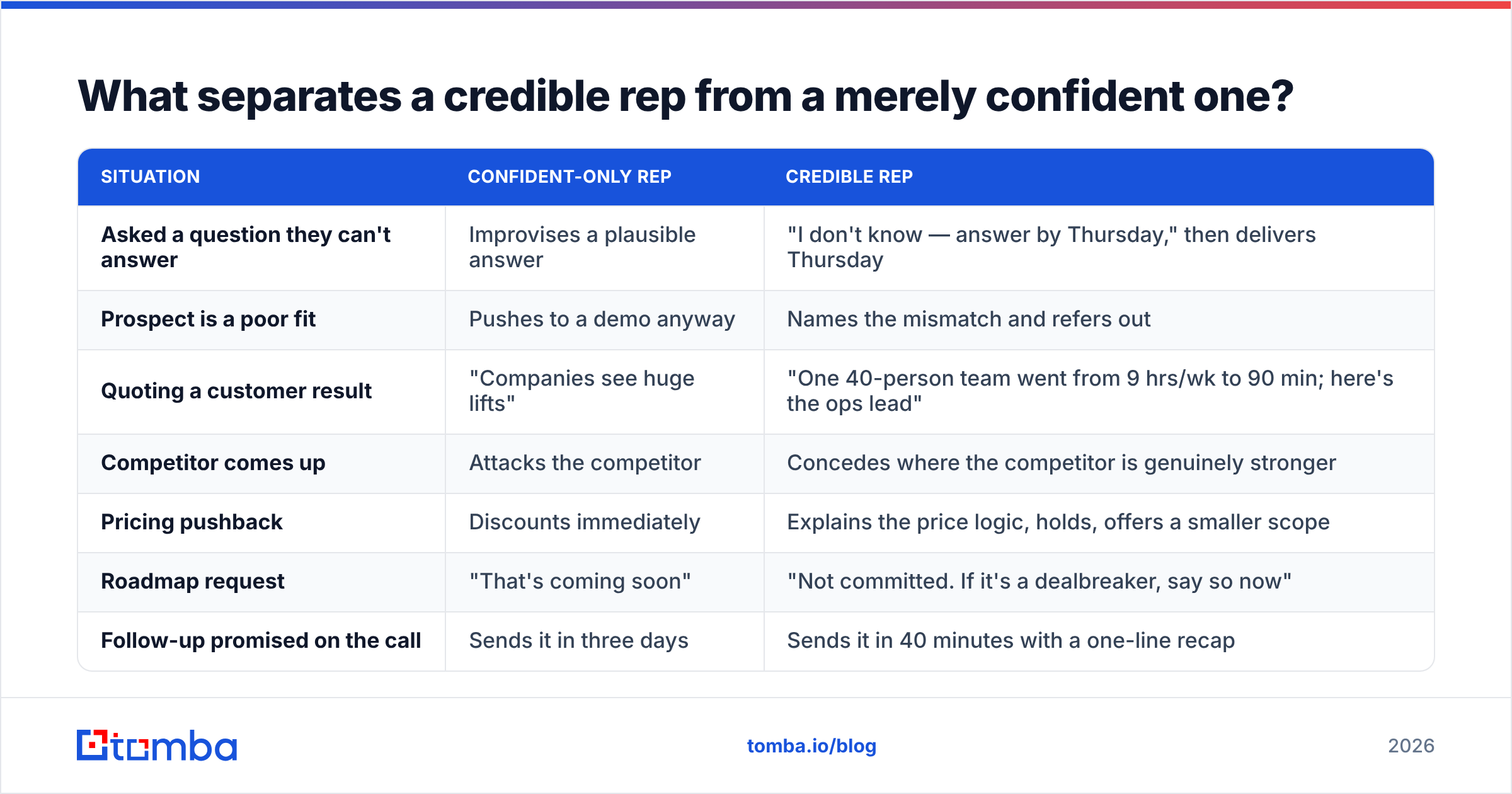
Confidence is a delivery style. Credibility is a track record. The table below is how the difference shows up in practice.
| Situation | Confident-only rep | Credible rep |
|---|---|---|
| Asked a question they can't answer | Improvises a plausible answer | "I don't know — answer by Thursday," then delivers Thursday |
| Prospect is a poor fit | Pushes to a demo anyway | Names the mismatch and refers out |
| Quoting a customer result | "Companies see huge lifts" | "One 40-person team went from 9 hrs/wk to 90 min; here's the ops lead" |
| Competitor comes up | Attacks the competitor | Concedes where the competitor is genuinely stronger |
| Pricing pushback | Discounts immediately | Explains the price logic, holds, offers a smaller scope |
| Roadmap request | "That's coming soon" | "Not committed. If it's a dealbreaker, say so now" |
| Follow-up promised on the call | Sends it in three days | Sends it in 40 minutes with a one-line recap |
Read down the right-hand column and notice what it costs: short-term deal velocity. Credibility is purchased with pipeline you deliberately give up. That is why it is rare, and why it compounds.
How do you measure credibility before the buyer does?#
Score your own calls. Pull three recordings from the last two weeks. Grade each one against a fixed rubric. Almost nobody does this part.
The five-item credibility audit:
- Claim density check. Count every factual claim you made about the prospect's business. How many could you cite a source for right now? Target: 100%. Most reps land near 60%.
- Hedge count. Count "kind of," "I think," "should be able to," "pretty much." These are not humility. They are unfinished preparation. Target: fewer than three per call.
- Concession count. Did you concede one thing — a limitation, a competitor strength, a bad-fit signal? Zero concessions on a 30-minute call reads as a pitch. Target: at least one.
- Promise-to-delivery lag. Time between "I'll send you X" and X arriving. Target: under two hours.
- Correction rate. How often did you walk back something you said? Every instance is a credibility withdrawal. Target: zero.
Run this monthly. The numbers are unflattering the first time, and that is the point. The rubric surfaces failures the buyer never tells you about.
Want a wider view? Watch your response rate on second and third touches. First-touch reply rates measure your subject line. Later-touch reply rates measure whether the first touch earned you the benefit of the doubt.
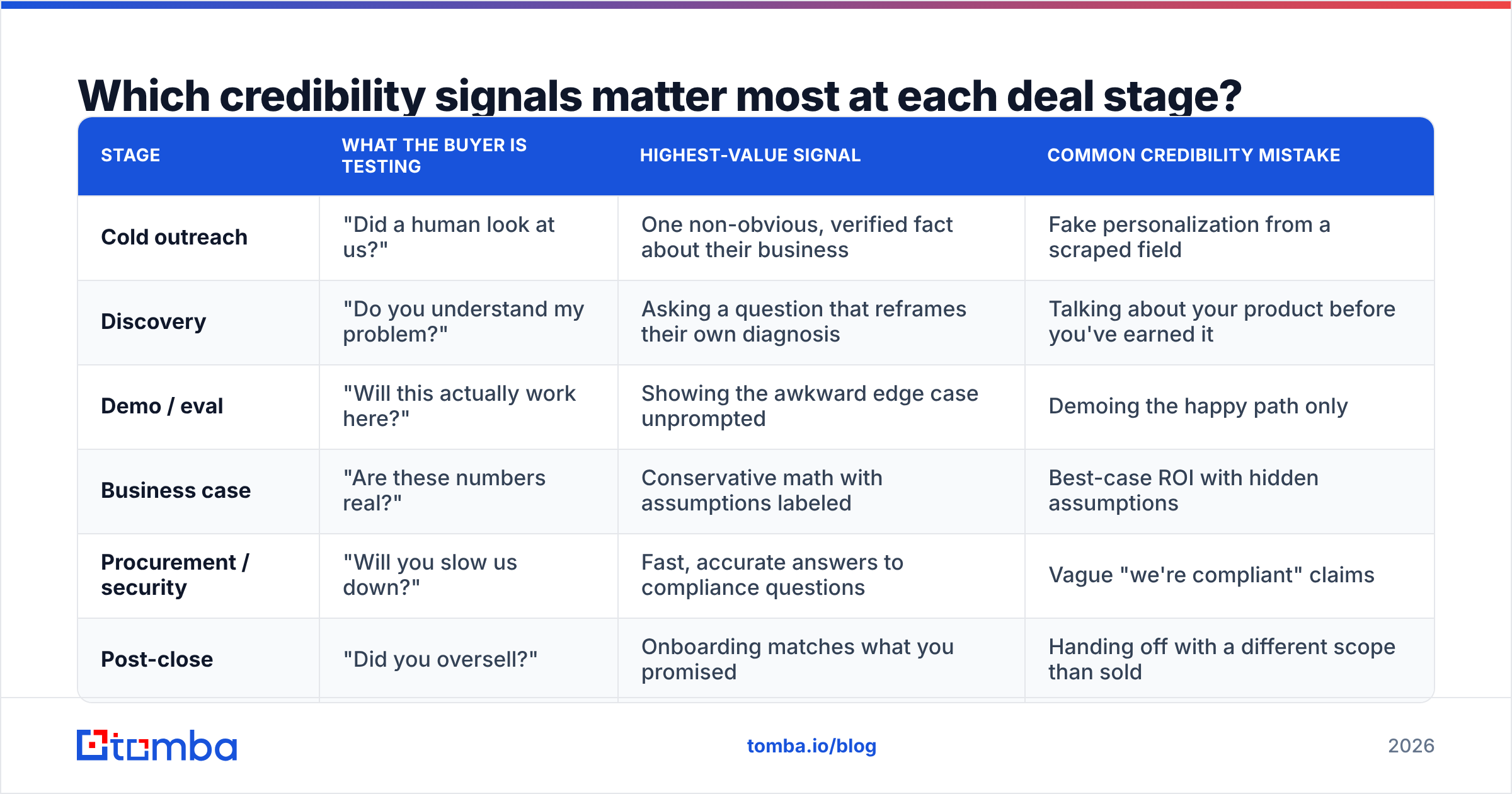
Which credibility signals matter most at each deal stage?#
Different evidence carries weight at different moments. Matching the signal to the stage is most of the skill.
| Stage | What the buyer is testing | Highest-value signal | Common credibility mistake |
|---|---|---|---|
| Cold outreach | "Did a human look at us?" | One non-obvious, verified fact about their business | Fake personalization from a scraped field |
| Discovery | "Do you understand my problem?" | Asking a question that reframes their own diagnosis | Talking about your product before you've earned it |
| Demo / eval | "Will this actually work here?" | Showing the awkward edge case unprompted | Demoing the happy path only |
| Business case | "Are these numbers real?" | Conservative math with assumptions labeled | Best-case ROI with hidden assumptions |
| Procurement / security | "Will you slow us down?" | Fast, accurate answers to compliance questions | Vague "we're compliant" claims |
| Post-close | "Did you oversell?" | Onboarding matches what you promised | Handing off with a different scope than sold |
The pattern across the right-hand column: every mistake is a form of overclaiming. Credibility damage is almost never caused by saying too little.
Can tools help you build credibility, or do they get in the way?#
Both — and the split is predictable.
Tools help when they make you more accurate. They hurt when they make you more voluminous at the same accuracy.
Concretely:
- Helps: contact verification before send. Bad addresses damage your sender reputation and your standing with anyone who does get the mail.
- Helps: enrichment that confirms title, company size, and tenure at the source, so your opener is factually correct.
- Helps: CRM discipline that surfaces what was actually promised last call, so your follow-through is exact.
- Hurts: any tool that 10x's send volume without more research depth. More sends at lower accuracy means more people who now know you didn't check.
- Hurts: AI personalization that invents claims from thin inputs. A generated line about a prospect's "recent expansion into fintech" is worse than no personalization when it turns out to be wrong.
The honest framing: tooling raises your credibility ceiling only if the accuracy bar stays fixed while volume rises. Most teams do the opposite.
There are legitimate options for the data layer. If you want a large pre-built list to filter, providers like BookYourData are built around depth of coverage. If you want to find and verify contacts at a named set of target accounts, a real-time email finder plus domain search fits better. Neither is universally right. The question is whether you're filtering down from a universe or building up from a list.
What does a credible outbound sequence actually look like?#
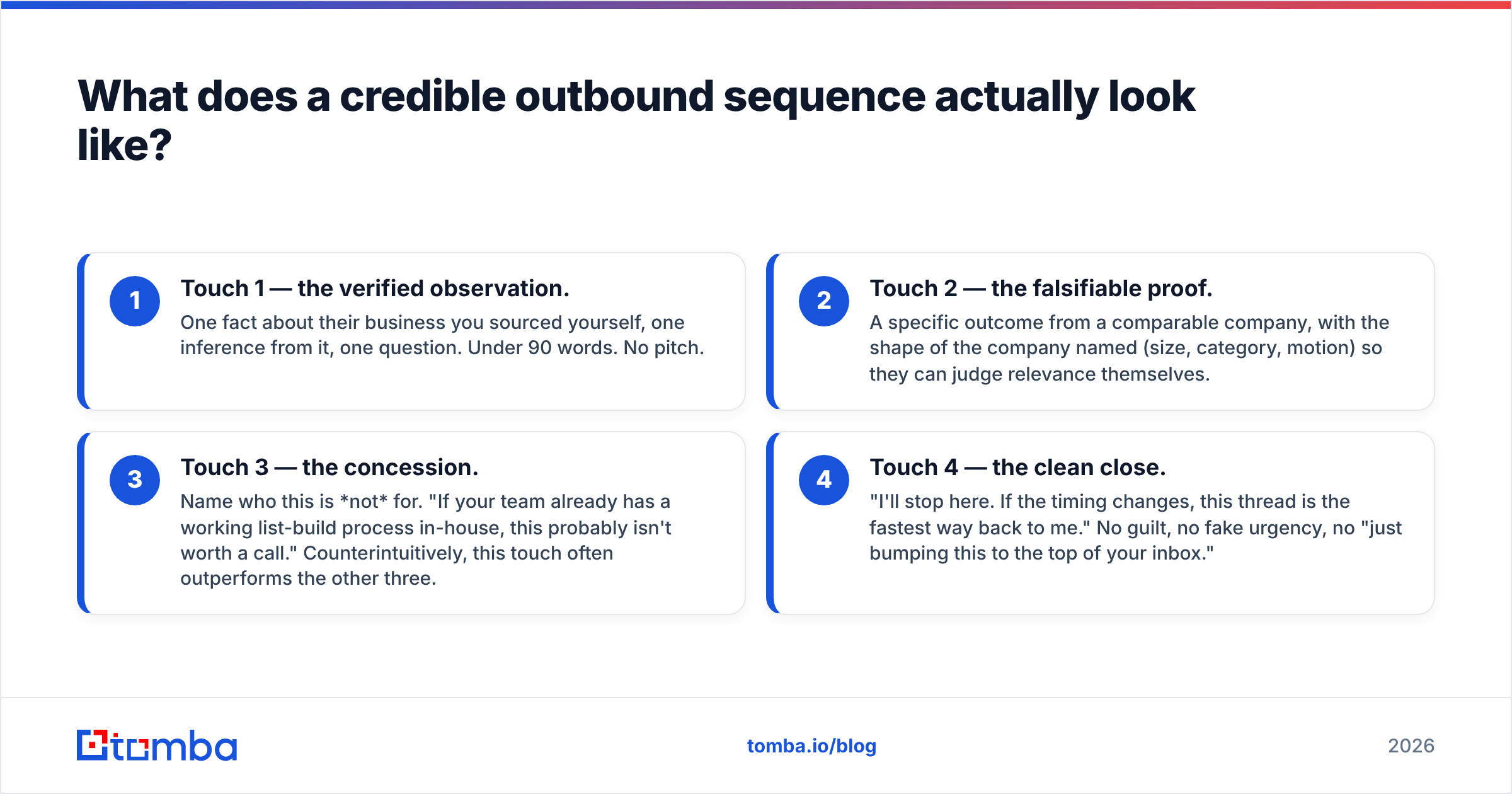
Fewer touches, each carrying more evidence.
A workable four-touch structure:
- Touch 1 — the verified observation. One fact about their business you sourced yourself, one inference from it, one question. Under 90 words. No pitch.
- Touch 2 — the falsifiable proof. A specific outcome from a comparable company. Name the shape of that company — size, category, motion — so they can judge relevance themselves.
- Touch 3 — the concession. Name who this is not for. "If your team already has a working list-build process in-house, this probably isn't worth a call." This touch often outperforms the other three.
- Touch 4 — the clean close. "I'll stop here. If the timing changes, this thread is the fastest way back to me." No guilt, no fake urgency, no "just bumping this."
Notice that none of these touches contains a superlative. Superlatives are the linguistic signature of low credibility: "revolutionary," "game-changing," "the leading platform." HubSpot's sales research points at what buyers report directly. They trust specific, modest claims over broad, impressive ones.
Want the structural version? Keep a short library of cold email templates that enforce the shape — one fact, one inference, one ask. Templates that supply words produce identical-sounding outbound. Templates that supply structure produce accurate outbound.
How do you rebuild credibility after you've damaged it?#
Directly, once, and without over-explaining.
If you sent a wrong fact, misquoted a price, or promised a feature that isn't real:
- Correct it in the next message, unprompted. Before they catch it. "I said X on Tuesday. That was wrong — the actual number is Y. Here's the source."
- Do not bundle the correction with a new ask. A correction attached to a meeting request reads as a pretext.
- Fix the process out loud if the error was systemic. "That came from a stale record on our side; I've re-verified the whole account." This turns a one-off error into evidence of rigor.
- Accept the slower cycle. A recovered relationship moves at a reduced pace for a while. Pushing to make up time re-damages what you just repaired.
The reps who recover well treat a correction as routine rather than a crisis. Buyers know everyone gets things wrong. What they watch is what you do in the ten minutes after you notice.
Where should you start this week?#
If you take two things from this guide on how to build credibility in sales, take these:
- Audit your data before your next sequence. Run the list through verification, confirm titles, drop anything you can't source. This costs an hour and removes the most common credibility failure entirely.
- Add one concession to every call. One limitation, one competitor strength, one bad-fit signal. Track your second-meeting rate over 30 days.
Everything else builds on those two: research depth, the proof library, follow-through discipline. Accuracy first, then evidence, then judgment.
Start with the data layer. The fastest credibility win for most reps is simply not being wrong about who they're contacting. Tomba's Email Finder returns verified professional addresses with source attribution. The name, role, and address in your opener are correct before you hit send, and you can see where each result came from. The free tier includes 25 searches a month, with Starter at $49/mo and Growth at $99/mo if you need volume. Full Tomba pricing is on the site. Fix the accuracy layer, and every behavior above gets easier to execute.
Related guides#
Ready to find emails that actually work?
Join 150,000+ professionals who stopped guessing and started sending. Free credits on signup — no credit card required.
Get the Tomba newsletter
Practical outbound tactics and product updates — once every two weeks.
About the author