How to Build Follow Up Email Sequences That Get Replies
Most cold outreach dies after email one. Here is the exact sequence structure, timing, and copy angles that turn a single ignored email into a booked meeting — plus what to stop doing.
TL;DR
- Roughly 60-70% of replies to a cold campaign arrive after the first email — a single-send campaign throws away most of its own pipeline.
- Five to seven steps over 18-24 business days is the range that works for most B2B offers. Fewer leaves money on the table; more burns the domain and the brand.
- Every follow-up needs a new reason to exist: a new angle, a new proof point, a new question. "Bumping this to the top of your inbox" is not a reason.
- Sequence quality collapses if the underlying data is bad. Bounces from step 1 poison deliverability for steps 2-7, so verify before you send, not after.
- Break-up emails still work, but only when they genuinely close the loop instead of faking scarcity.
Why do follow-up sequences outperform single sends?#
Because attention is a lottery and you only get more tickets by entering more draws.
Think of a cold email like knocking on an office door. The person inside might be on a call, in a meeting, or staring at 200 unread messages. One knock proves nothing about their interest — it only tells you whether they happened to be free at that exact second. Follow-ups are additional knocks at different times of day, which is a fundamentally different test than "do they want what I'm selling."
The data backs the intuition. Across published B2B outreach benchmarks, first emails typically land somewhere between 1% and 5% reply rate, and cumulative reply rate roughly doubles or triples by step four. That is not because the fourth email is better written. It is because the fourth email catches a different version of the same person.
There's a second, less obvious reason. Sequences give you the space to test angles. If you have exactly one email, you have to cram value prop, proof, and ask into 90 words. If you have five, you can spend step 1 on a single pain point, step 3 on a customer story, and step 5 on a direct close. Each one is cleaner and shorter, and short emails outperform long ones almost universally in cold outbound.
How many emails should a follow-up sequence have?#
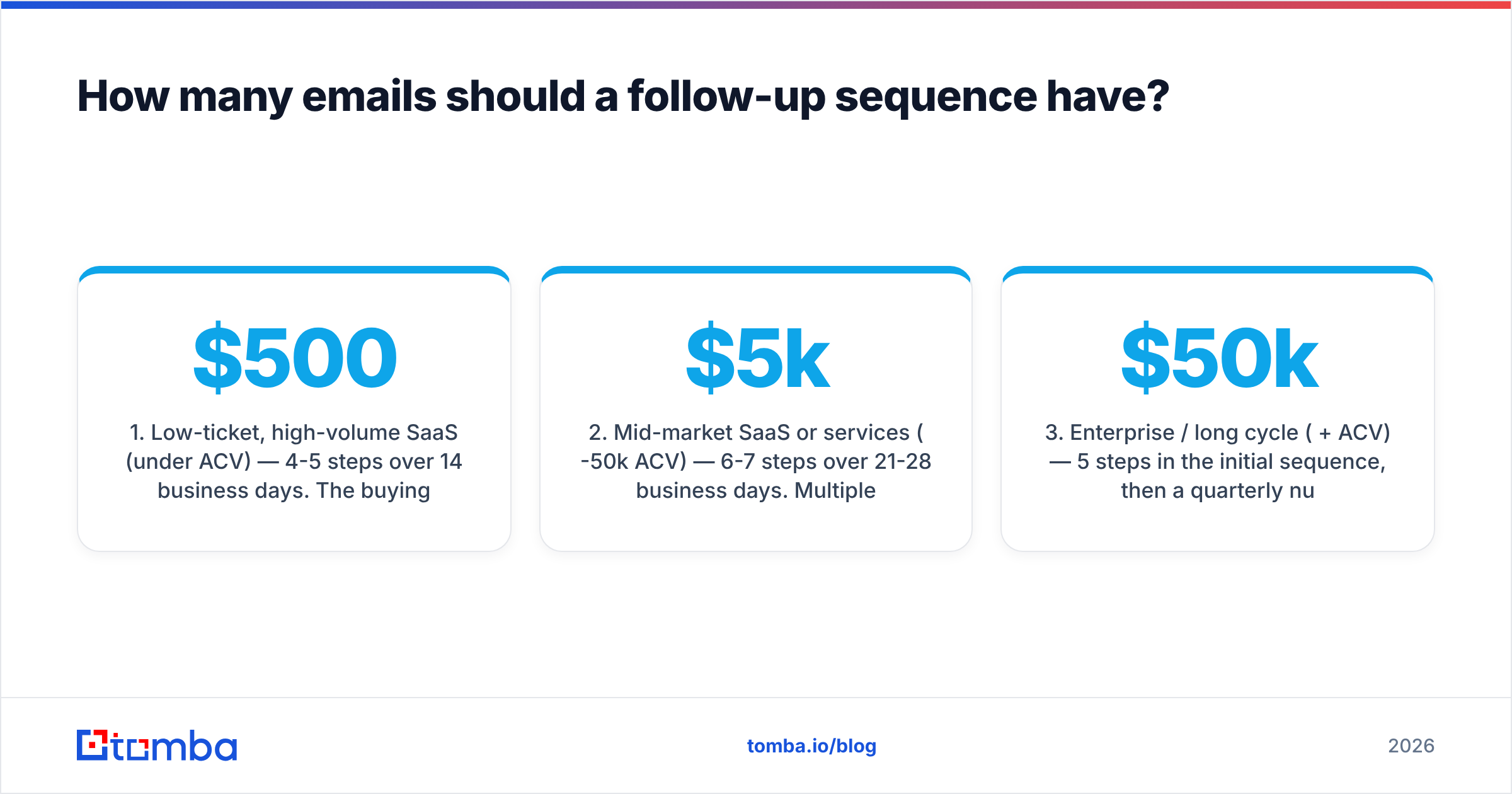
Five to seven for most B2B offers. Here is how the ranges break down by scenario:
- Low-ticket, high-volume SaaS (under $500/mo ACV) — 4-5 steps over 14 business days. The buying decision is fast and the prospect either cares or doesn't. Extra steps mostly generate unsubscribes.
- Mid-market SaaS or services ($5k-50k ACV) — 6-7 steps over 21-28 business days. Multiple stakeholders, longer evaluation, more legitimate reasons someone goes quiet mid-thread.
- Enterprise / long cycle ($50k+ ACV) — 5 steps in the initial sequence, then a quarterly nurture loop. Persistence here should look like relevance, not frequency. Trigger-based re-entry (funding round, new exec hire, job posting) beats calendar-based nagging.
- Recruiting or partnership outreach — 3-4 steps. The ask is personal, and heavy sequencing reads as spam faster than it does in a commercial context.
- Event or webinar invites — 3 steps, all inside a 10-day window, because the deadline does the persuading for you.
The cap matters as much as the floor. Past step seven, incremental reply rate on most campaigns falls below the spam-complaint rate you're generating. That trade is never worth it, because complaints compound across every future campaign from that domain.
What should each step in the sequence actually say?#
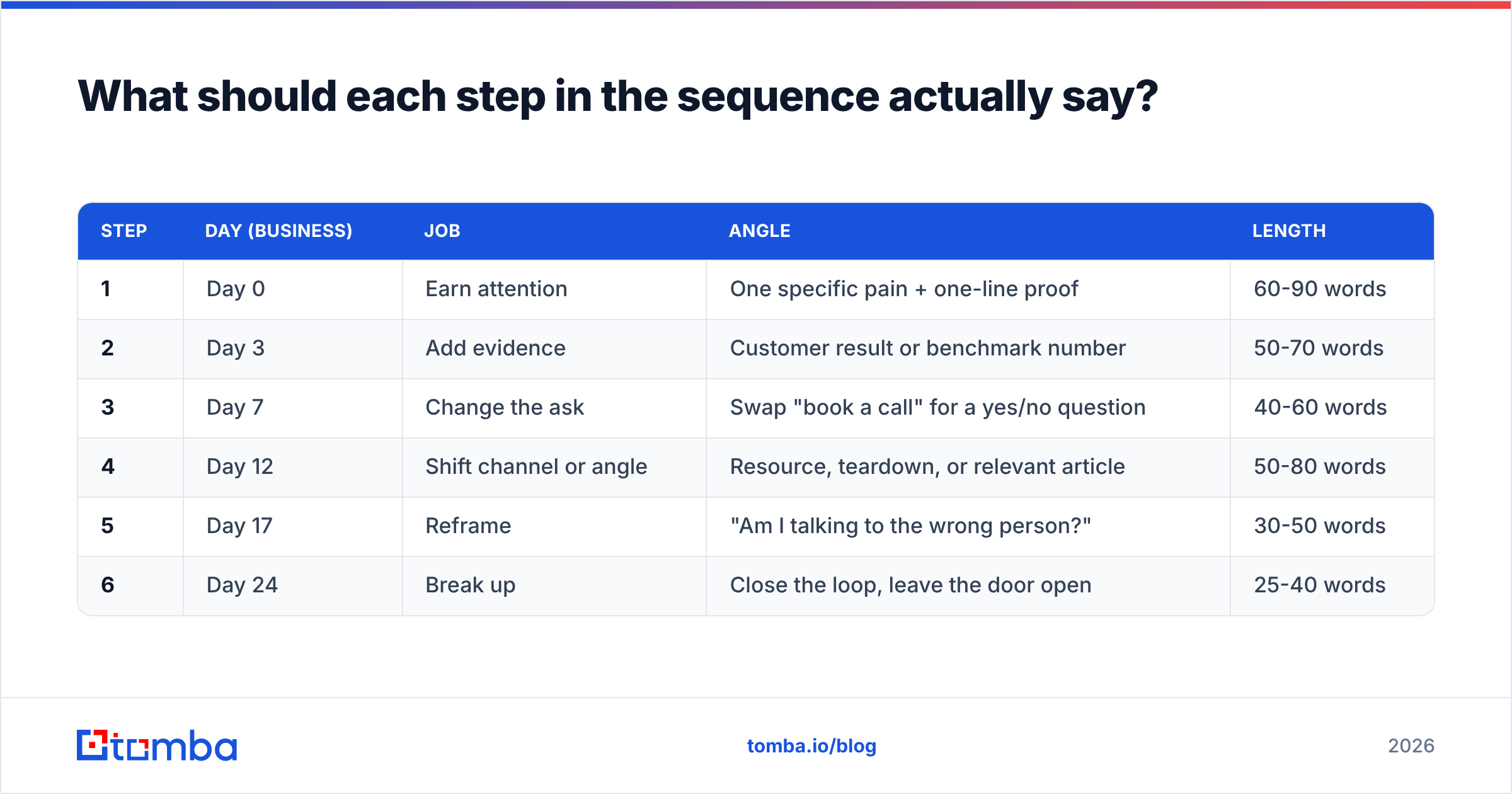
Each step needs a distinct job. If you can swap two emails in your sequence without noticing, one of them is filler.
| Step | Day (business) | Job | Angle | Length |
|---|---|---|---|---|
| 1 | Day 0 | Earn attention | One specific pain + one-line proof | 60-90 words |
| 2 | Day 3 | Add evidence | Customer result or benchmark number | 50-70 words |
| 3 | Day 7 | Change the ask | Swap "book a call" for a yes/no question | 40-60 words |
| 4 | Day 12 | Shift channel or angle | Resource, teardown, or relevant article | 50-80 words |
| 5 | Day 17 | Reframe | "Am I talking to the wrong person?" | 30-50 words |
| 6 | Day 24 | Break up | Close the loop, leave the door open | 25-40 words |
A few notes on why this shape works.
Step 1 should not sell. It should prove you did five minutes of homework and name a problem the prospect already talks about internally. If your first line could be pasted into any other company's email, rewrite it.
Step 3's ask change is the highest-leverage edit in most sequences. "Worth a 15-minute call Thursday?" asks for a calendar commitment from a stranger. "Is reply rate something your team is actively trying to fix this quarter, or is it parked?" asks for a one-word answer. The second gets responses from people who would never have booked, and those responses give you something to work with.
Step 5 is the permission-to-redirect email. Half the time you are emailing the wrong title. Asking directly — "If this sits with someone else on your team, happy to reach out to them instead" — routinely produces internal forwards, which convert at multiples of cold.
Step 6, the break-up, must actually break up. Say you're closing the file, say what you'll do with their contact (nothing, or a note to check back in six months), and mean it. Fake break-ups followed by more emails train prospects to ignore you permanently.
How do you time follow-ups without being annoying?#
Use expanding intervals, count in business days, and stay inside one thread.
Expanding intervals — 3, 4, 5, 5, 7 days — mirror how interest actually decays. Early follow-ups are cheap because the first email is still faintly in memory. Later ones need more spacing so they read as persistence rather than pressure.
Count in business days, always. A three-calendar-day gap that spans a weekend lands Monday morning alongside 80 other emails. A three-business-day gap lands mid-week, mid-morning, which is where reply rates consistently peak in published send-time studies.
On threading: replying inside the original thread keeps context visible and gives the recipient the full history in one place. It also means your step-4 email carries the subject line the prospect already ignored three times, which is why some teams break the thread once — usually at step 4 — with a fresh subject and a fresh angle. Test it; the result varies by industry more than any guide will admit.
One hard rule regardless of timing: if someone replies with anything other than "not interested," the sequence stops and a human takes over. Automated step 5 firing after a real conversation started is the single fastest way to lose a warm deal.
What breaks follow-up sequences before the copy ever matters?#
Bad data. A sequence is a multiplier on your list quality, and multiplying garbage produces more garbage, faster.
Here is the mechanism. Mailbox providers watch bounce rate as a primary spam signal. A campaign with a 3% bounce on step 1 has already told Google and Microsoft something unflattering about the sender before step 2 goes out. Steps 2 through 6 then land in Promotions or Spam for the valid addresses on the list, and you conclude your follow-up copy doesn't work — when in fact it was never seen.
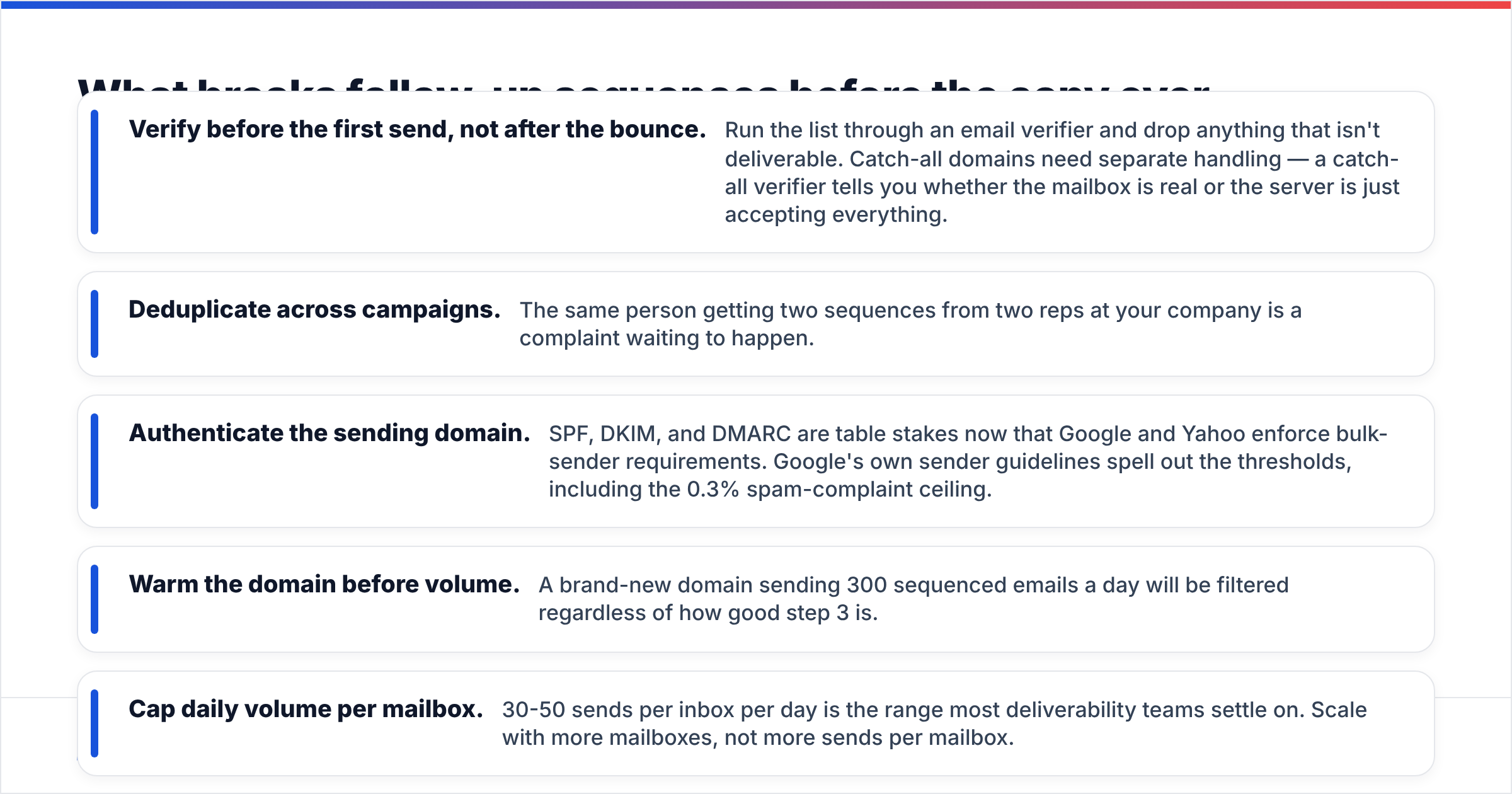
The fix is boring and non-negotiable:
- Verify before the first send, not after the bounce. Run the list through an email verifier and drop anything that isn't deliverable. Catch-all domains need separate handling — a catch-all verifier tells you whether the mailbox is real or the server is just accepting everything.
- Deduplicate across campaigns. The same person getting two sequences from two reps at your company is a complaint waiting to happen.
- Authenticate the sending domain. SPF, DKIM, and DMARC are table stakes now that Google and Yahoo enforce bulk-sender requirements. Google's own sender guidelines spell out the thresholds, including the 0.3% spam-complaint ceiling.
- Warm the domain before volume. A brand-new domain sending 300 sequenced emails a day will be filtered regardless of how good step 3 is.
- Cap daily volume per mailbox. 30-50 sends per inbox per day is the range most deliverability teams settle on. Scale with more mailboxes, not more sends per mailbox.
Poor email deliverability is the reason most "our sequences stopped working" complaints resolve without anyone touching the copy.
Which sequence-building tools should you use?#
The stack splits into three jobs: find and verify contacts, send and schedule the sequence, and track what happened. Very few tools do all three well, and the ones that claim to usually compromise on data quality.
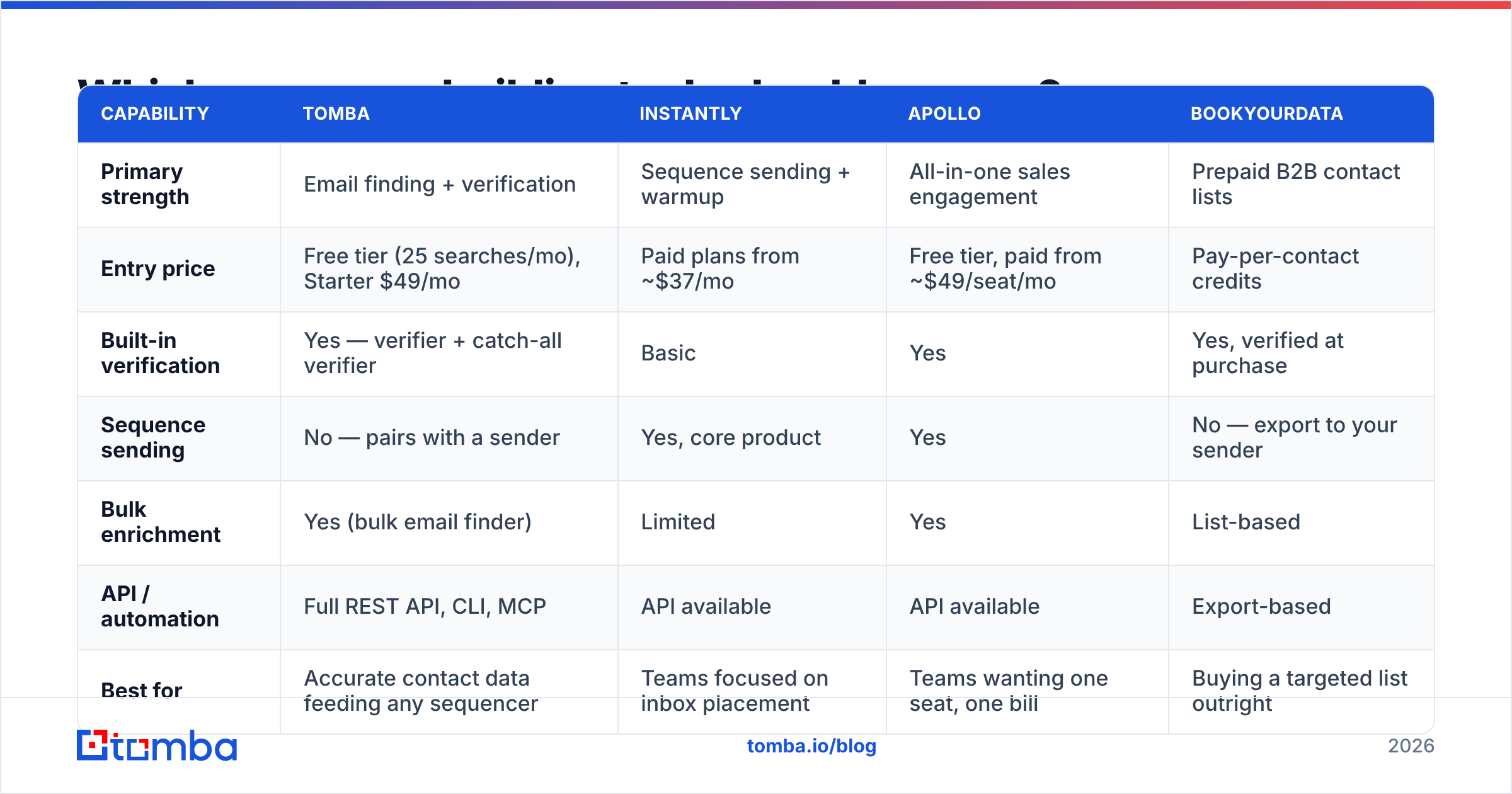
| Capability | Tomba | Instantly | Apollo | BookYourData |
|---|---|---|---|---|
| Primary strength | Email finding + verification | Sequence sending + warmup | All-in-one sales engagement | Prepaid B2B contact lists |
| Entry price | Free tier (25 searches/mo), Starter $49/mo | Paid plans from ~$37/mo | Free tier, paid from ~$49/seat/mo | Pay-per-contact credits |
| Built-in verification | Yes — verifier + catch-all verifier | Basic | Yes | Yes, verified at purchase |
| Sequence sending | No — pairs with a sender | Yes, core product | Yes | No — export to your sender |
| Bulk enrichment | Yes (bulk email finder) | Limited | Yes | List-based |
| API / automation | Full REST API, CLI, MCP | API available | API available | Export-based |
| Best for | Accurate contact data feeding any sequencer | Teams focused on inbox placement | Teams wanting one seat, one bill | Buying a targeted list outright |
The practical pattern most teams land on: source and verify contacts in a data tool, push them into a dedicated sender, and keep CRM as the system of record. Trying to run all three from a single all-in-one usually means accepting whichever leg is weakest — most often the data.
If you're evaluating consolidation, G2's sales engagement category is a reasonable place to compare sender feature sets side by side, since the reviews break out deliverability complaints specifically.
How do you measure whether the sequence is working?#
Track per-step, not per-campaign. A campaign-level 4% reply rate hides everything useful.
Instrument these four metrics at every step:
- Reply rate by step — tells you which emails earn their place. Any step under 0.5% incremental reply is a candidate for deletion.
- Positive reply share — replies split into interested / not now / not interested / wrong person. A sequence with high replies and low positives has a targeting problem, not a copy problem.
- Unsubscribe and complaint rate by step — if these spike at step 5, your later emails are reading as pressure. Shorten them or cut one.
- Meetings per 100 contacted — the only number that maps to revenue. Reply rate optimizations that don't move this are vanity.
Run one variable at a time. Changing subject line, opener, and CTA simultaneously across a 500-contact test tells you nothing except that something changed. HubSpot's research on email engagement is a useful sanity check on whether your baselines are normal for your segment before you start optimizing.
Also: give tests enough volume. Reply-rate differences under two percentage points need several hundred contacts per variant to mean anything. Most "we tested it and B won" conclusions in outbound are noise.
What does a working sequence look like end to end?#
Concretely, for a mid-market SaaS selling to RevOps leaders:
Step 1 (Day 0) — Subject: "RevOps handoff at [Company]". Opens with a specific observation about their tech stack from a job posting. Names one pain: leads sitting untouched between MQL and SDR. Ends with a soft question, no calendar link.
Step 2 (Day 3) — Reply in thread. One customer sentence: "[Similar company] cut that handoff gap from 40 hours to 4." Asks whether their number is closer to 40 or 4.
Step 3 (Day 7) — New thread, new subject. Yes/no question only: "Is speed-to-lead on the roadmap this half, or is it a next-year problem?"
Step 4 (Day 12) — Shares a genuinely useful resource — a teardown, a benchmark, a checklist — with no ask attached. This step exists to earn the right to ask again.
Step 5 (Day 17) — Wrong-person check. "If this belongs with your marketing ops lead, tell me who and I'll take it off your plate."
Step 6 (Day 24) — Break-up. Three sentences. Closing the file, here's the one resource worth keeping, door's open.
Notice what's absent: no "just circling back," no "did you see my last email," no guilt. Every step gives before it asks, and each one could stand alone if it were the only email the prospect ever read.
Before any of that runs, the list behind it needs to be real. Pull contacts with a domain search against your target account list, verify every address, and only then load the sequence. Skipping that step is how good copy gets filed as spam.
Start with contacts that actually exist#
A six-step sequence sent to a 12% invalid list is worse than a one-step sequence sent to a clean one — the bounces don't just waste sends, they degrade every campaign you run from that domain afterward.
Build the list first. Tomba Email Finder finds professional addresses by domain, name, or company, with verification built into the same workflow so nothing unverified reaches your sequencer. The free tier covers 25 searches a month if you want to test the data quality against your own known-good contacts before committing; paid plans start at $49/mo on Starter. Check the current Tomba pricing for bulk and API volumes, then point your cleaned list at whichever sender you already trust.
Related guides#
Ready to find emails that actually work?
Join 150,000+ professionals who stopped guessing and started sending. Free credits on signup — no credit card required.
Get the Tomba newsletter
Practical outbound tactics and product updates — once every two weeks.
About the author