How to Calculate ACV: Formula, Examples, and Benchmarks
ACV looks like a one-line formula until you hit ramps, multi-year terms, and one-time fees. Here is the exact math, four worked examples, and the reporting traps that quietly inflate the number your board sees.
TL;DR
- ACV (Annual Contract Value) = total recurring contract value ÷ contract length in years. A $36,000 three-year deal has an ACV of $12,000, not $36,000.
- Exclude one-time fees (onboarding, implementation, training) from ACV by default, and state that policy in your metrics dictionary so finance and sales stop arguing about it.
- Ramped deals break the simple formula. Decide once whether you report average ACV across the term or year-one ACV, then never mix the two in the same chart.
- Blended ACV across SMB and enterprise is close to meaningless. Segment it, or you will size quotas and pipeline off a number that describes no real customer.
- ACV drives everything downstream: quota capacity, pipeline coverage, CAC payback, and how many verified contacts your reps actually need each month.
What is ACV, and why does it matter?#
ACV is the average annualized recurring revenue from a single customer contract. It answers one question: if this deal ran for exactly twelve months, how much recurring revenue would it produce?
Knowing how to calculate ACV matters because almost every planning number in a B2B org is derived from it. Quota is a multiple of ACV. Pipeline coverage is a multiple of quota. Headcount plans, commission rates, CAC payback targets, and the number of new opportunities you need each quarter all trace back to that one figure. Get ACV wrong by 30% and every downstream plan inherits the error, usually without anyone noticing until a quarter has already been missed.
The reason teams get it wrong is not the arithmetic. It is that real contracts are messy: 18-month terms, ramped pricing, usage overages, a $9,000 implementation fee, a discount that applies only in year one. The formula is trivial. The policy decisions around it are where teams lose accuracy.
How do you calculate ACV? The formula and four worked examples#
The base formula:
ACV = Total Recurring Contract Value ÷ Contract Term in Years
Here is the process, step by step:
- Start with total contract value (TCV). Everything the customer committed to across the full term, as signed.
- Strip out non-recurring line items. Implementation, onboarding, migration, custom development, and training fees are one-time. They belong in TCV, not ACV.
- Convert the term to years. An 18-month contract is 1.5 years. A 30-month contract is 2.5 years. Do not round to the nearest year — that is where a 20% distortion sneaks in.
- Divide. Recurring value ÷ years = ACV.
- Decide how to treat ramps. If pricing changes year over year, either report the average across the term or explicitly label the number "year-one ACV."
- Apply the same rule to every deal. Consistency beats precision. A slightly imperfect rule applied uniformly produces usable trend data; a perfect rule applied inconsistently does not.
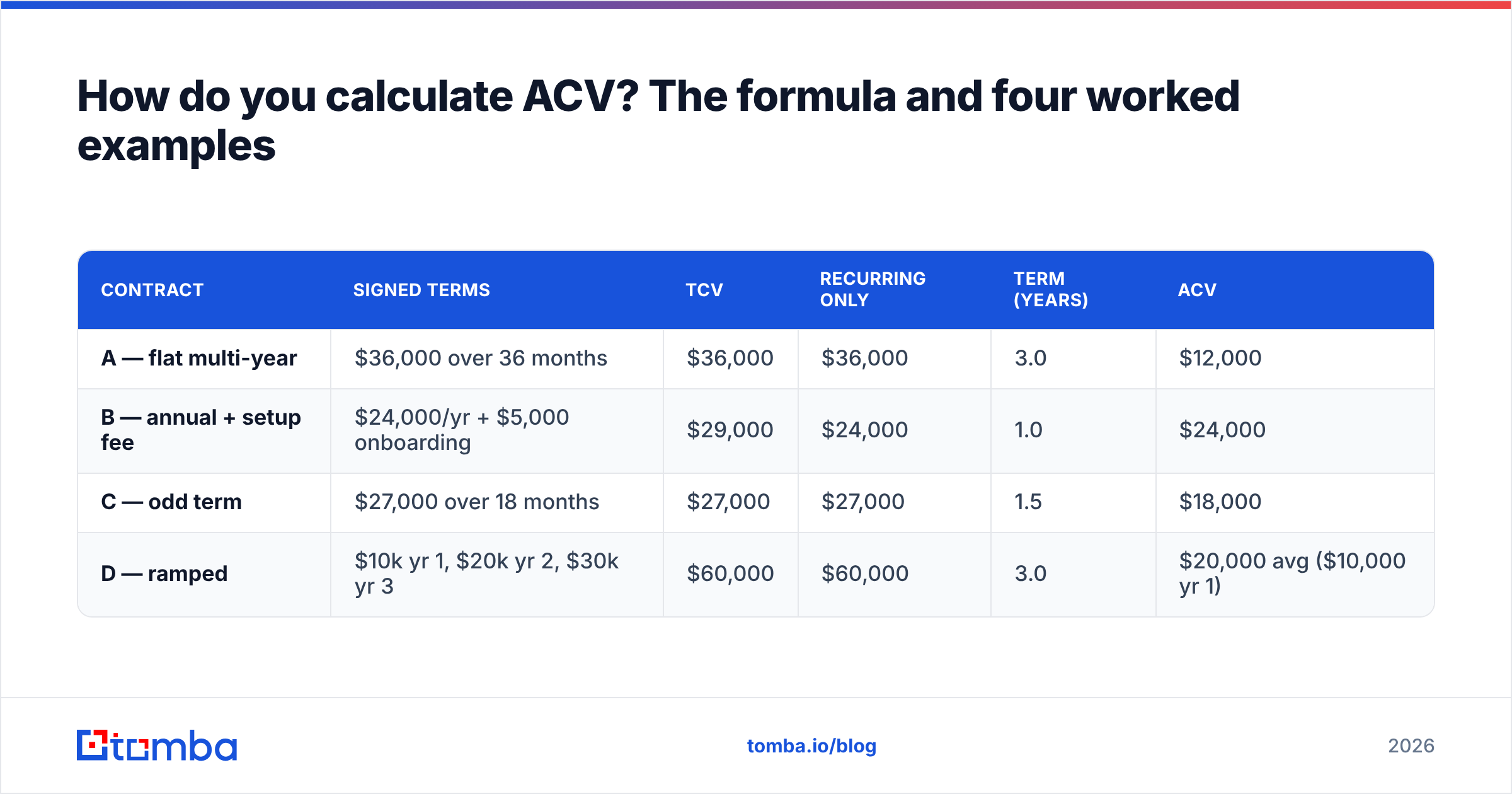
Now run it against four contracts that look nothing alike:
| Contract | Signed terms | TCV | Recurring only | Term (years) | ACV |
|---|---|---|---|---|---|
| A — flat multi-year | $36,000 over 36 months | $36,000 | $36,000 | 3.0 | $12,000 |
| B — annual + setup fee | $24,000/yr + $5,000 onboarding | $29,000 | $24,000 | 1.0 | $24,000 |
| C — odd term | $27,000 over 18 months | $27,000 | $27,000 | 1.5 | $18,000 |
| D — ramped | $10k yr 1, $20k yr 2, $30k yr 3 | $60,000 | $60,000 | 3.0 | $20,000 avg ($10,000 yr 1) |
Contract D is the one that starts arguments. Average ACV of $20,000 is correct for valuation and cohort analysis. Year-one ACV of $10,000 is correct for cash planning and for paying the rep. Both are defensible. What is not defensible is a dashboard where some ramped deals are booked at average and others at year one.
Contract B is the second most common failure. If your CRM sums every line item on the opportunity, that $5,000 onboarding fee becomes recurring revenue in your reporting, and your ACV is overstated by 21% for every deal that includes services. Multiply that across a year of bookings and your renewal forecast is fiction.
What is the difference between ACV, TCV, ARR, and MRR?#
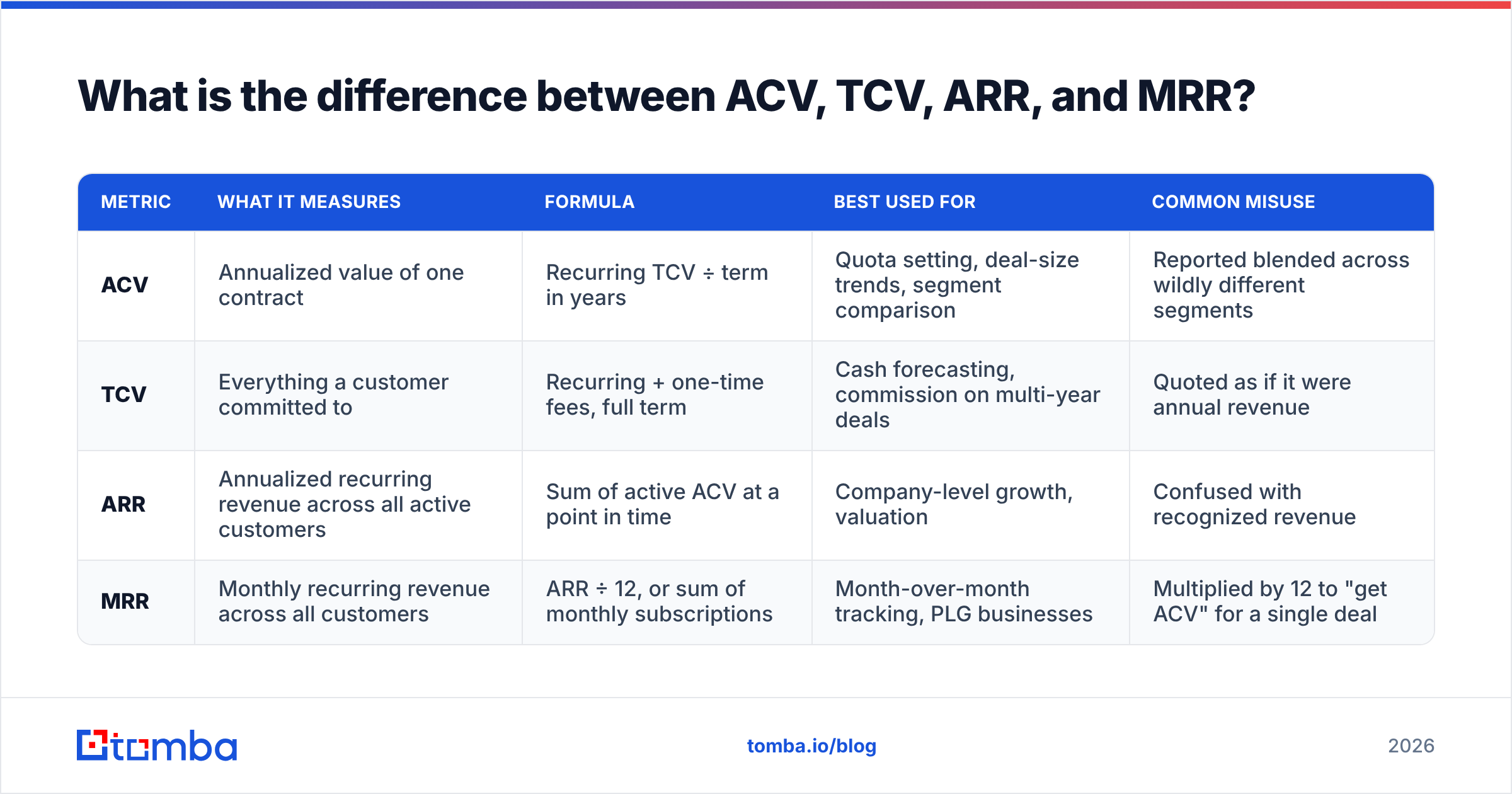
These four get used interchangeably in meetings, which is how a board deck ends up comparing an ACV number to an ARR number and concluding growth stalled.
| Metric | What it measures | Formula | Best used for | Common misuse |
|---|---|---|---|---|
| ACV | Annualized value of one contract | Recurring TCV ÷ term in years | Quota setting, deal-size trends, segment comparison | Reported blended across wildly different segments |
| TCV | Everything a customer committed to | Recurring + one-time fees, full term | Cash forecasting, commission on multi-year deals | Quoted as if it were annual revenue |
| ARR | Annualized recurring revenue across all active customers | Sum of active ACV at a point in time | Company-level growth, valuation | Confused with recognized revenue |
| MRR | Monthly recurring revenue across all customers | ARR ÷ 12, or sum of monthly subscriptions | Month-over-month tracking, PLG businesses | Multiplied by 12 to "get ACV" for a single deal |
The distinction that trips people up most: ACV is a per-contract metric, ARR is a portfolio metric. Your ARR is roughly the sum of the ACVs of every live contract. Asking "what's our ACV?" without specifying a segment or cohort is like asking for the average temperature of a house with the oven on and a window open.
Note also that ACV is a bookings-and-planning metric, not an accounting one. Recognized revenue follows ASC 606 rules and will not match your ACV number in any given month. That is expected. Problems start when a RevOps team tries to reconcile the two and quietly reshapes ACV to match the ledger. Keep the sales metric as a sales metric. The broader discipline of keeping these definitions clean and consistent across teams is exactly what revenue operations exists to enforce.
What counts as recurring, and what does not?#
Draw the line once and write it down. A workable default:
- Include: base subscription, per-seat fees, platform fees, committed usage minimums, annualized committed overages, contracted support tiers.
- Exclude: implementation, onboarding, data migration, custom development, training days, travel, hardware, one-off professional services.
- Judgment call: uncommitted usage above the minimum. Most teams exclude it from ACV at booking and true it up at renewal. If usage overage regularly exceeds 20% of base for your product, model it separately rather than burying it.
The judgment-call bucket is where usage-based businesses struggle, and it is why some consumption-heavy vendors have moved to reporting "committed ACV" alongside "realized ACV." If your revenue is meaningfully usage-driven, report both. One number will not carry the load.
What is a good ACV benchmark by segment?#
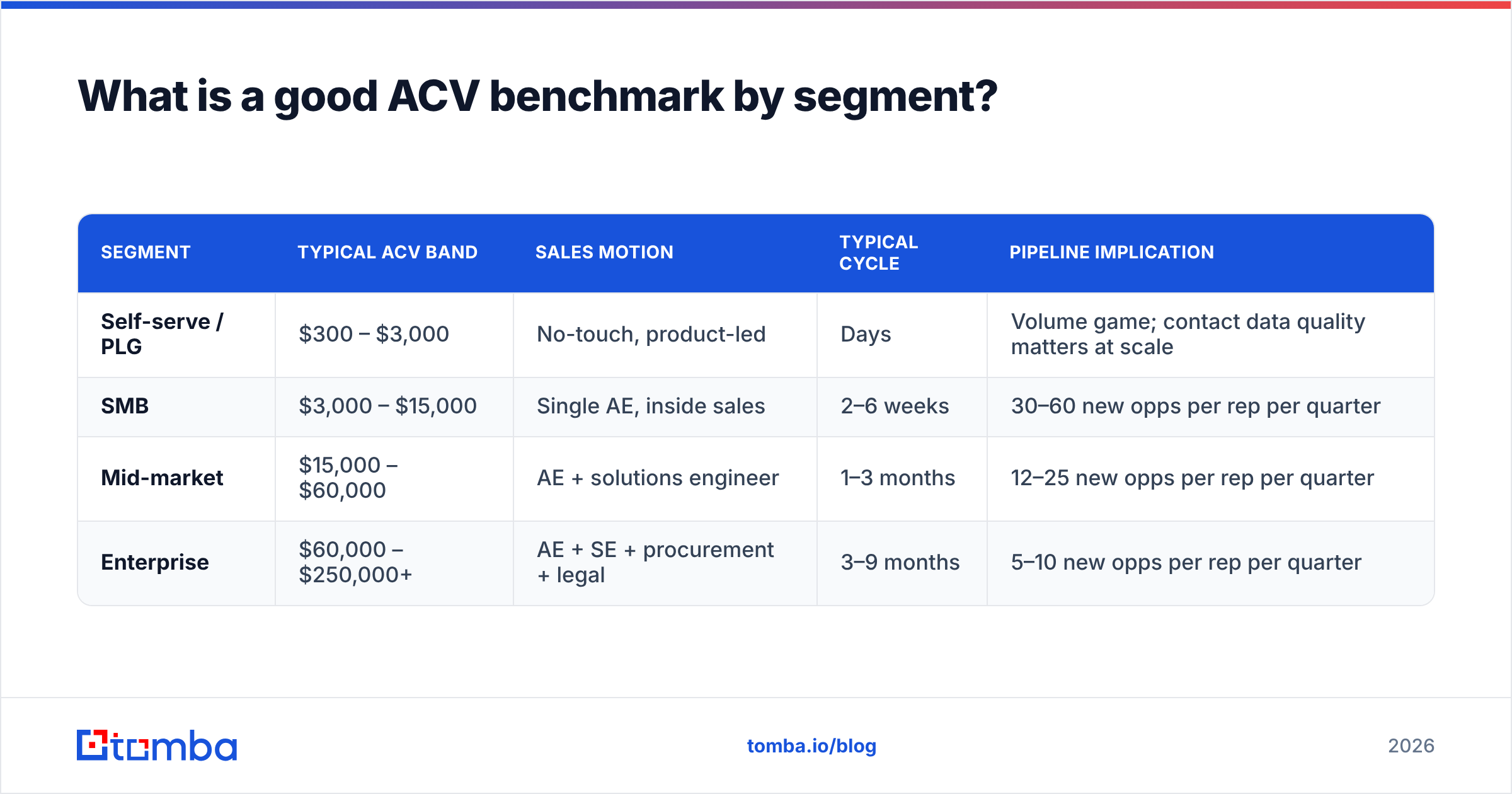
There is no universal target — ACV is a function of who you sell to and what problem you solve, not a quality score. But the ranges below are directionally useful for sanity-checking whether your go-to-market motion matches your deal size. Treat them as rough bands, not gospel; vendor research from firms like Gartner and peer data on G2 will be more precise for your specific category.
| Segment | Typical ACV band | Sales motion | Typical cycle | Pipeline implication |
|---|---|---|---|---|
| Self-serve / PLG | $300 – $3,000 | No-touch, product-led | Days | Volume game; contact data quality matters at scale |
| SMB | $3,000 – $15,000 | Single AE, inside sales | 2–6 weeks | 30–60 new opps per rep per quarter |
| Mid-market | $15,000 – $60,000 | AE + solutions engineer | 1–3 months | 12–25 new opps per rep per quarter |
| Enterprise | $60,000 – $250,000+ | AE + SE + procurement + legal | 3–9 months | 5–10 new opps per rep per quarter |
The practical test: your ACV must support your cost to acquire. If you run a full enterprise motion — SE support, security review, procurement cycles, multiple stakeholders — on $8,000 deals, the math does not close no matter how good the reps are. Either ACV goes up or the motion gets cheaper. A rough guardrail used across B2B SaaS is that fully loaded CAC should be recovered within 12 months of ACV; if you need three years of ACV to pay back acquisition, you have a segment mismatch, not a sales execution problem.

How do you use ACV to plan quota and pipeline?#
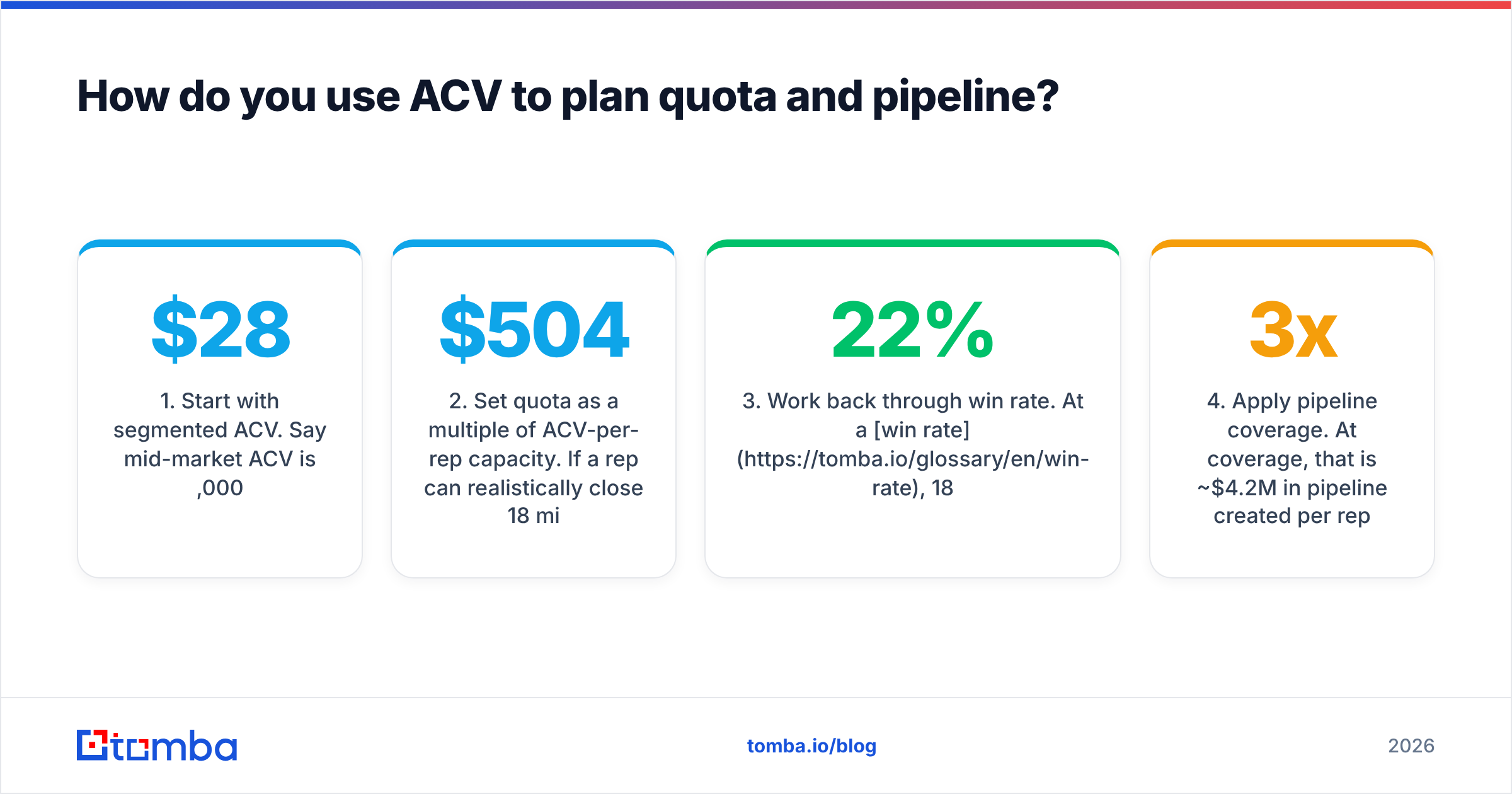
This is where ACV stops being a reporting curiosity and starts driving behavior. The chain runs like this:
- Start with segmented ACV. Say mid-market ACV is $28,000.
- Set quota as a multiple of ACV-per-rep capacity. If a rep can realistically close 18 mid-market deals a year, capacity is $504,000. Quota lands somewhere near that, adjusted for ramp.
- Work back through win rate. At a 22% win rate, 18 closed deals require roughly 82 qualified opportunities.
- Apply pipeline coverage. At 3x coverage, that is ~$4.2M in pipeline created per rep per year.
- Convert to top-of-funnel volume. If 6% of contacted accounts become qualified opportunities, 82 opps require about 1,370 contacted accounts — per rep, per year.
- Check the data requirement. 1,370 contacted accounts with 2–3 stakeholders each means 3,000–4,000 verified contacts. Bounced or stale records come straight off the top of that number.
Step 6 is the one most planning models skip, and it is the one that quietly breaks the whole chain. If 20% of your contact data is invalid, you did not lose 20% of your emails — you lost 20% of your pipeline, which at a 22% win rate is roughly $100,000 of ACV per rep. Running lists through an email verifier before a sequence starts is not a hygiene task; it is a direct input to the ACV plan. The same logic applies to enriching thin records: an account with one contact and no title is a fraction of an opportunity compared with one where you have mapped three stakeholders, which is what contact enrichment is for.
Higher ACV segments change the data requirement rather than removing it. Enterprise deals need fewer accounts but far more contacts per account — champion, economic buyer, technical evaluator, procurement, sometimes security. Notice that the ACV math tells you which data problem to solve: volume and validity for SMB, depth and org mapping for enterprise.
What are the most common ACV calculation mistakes?#
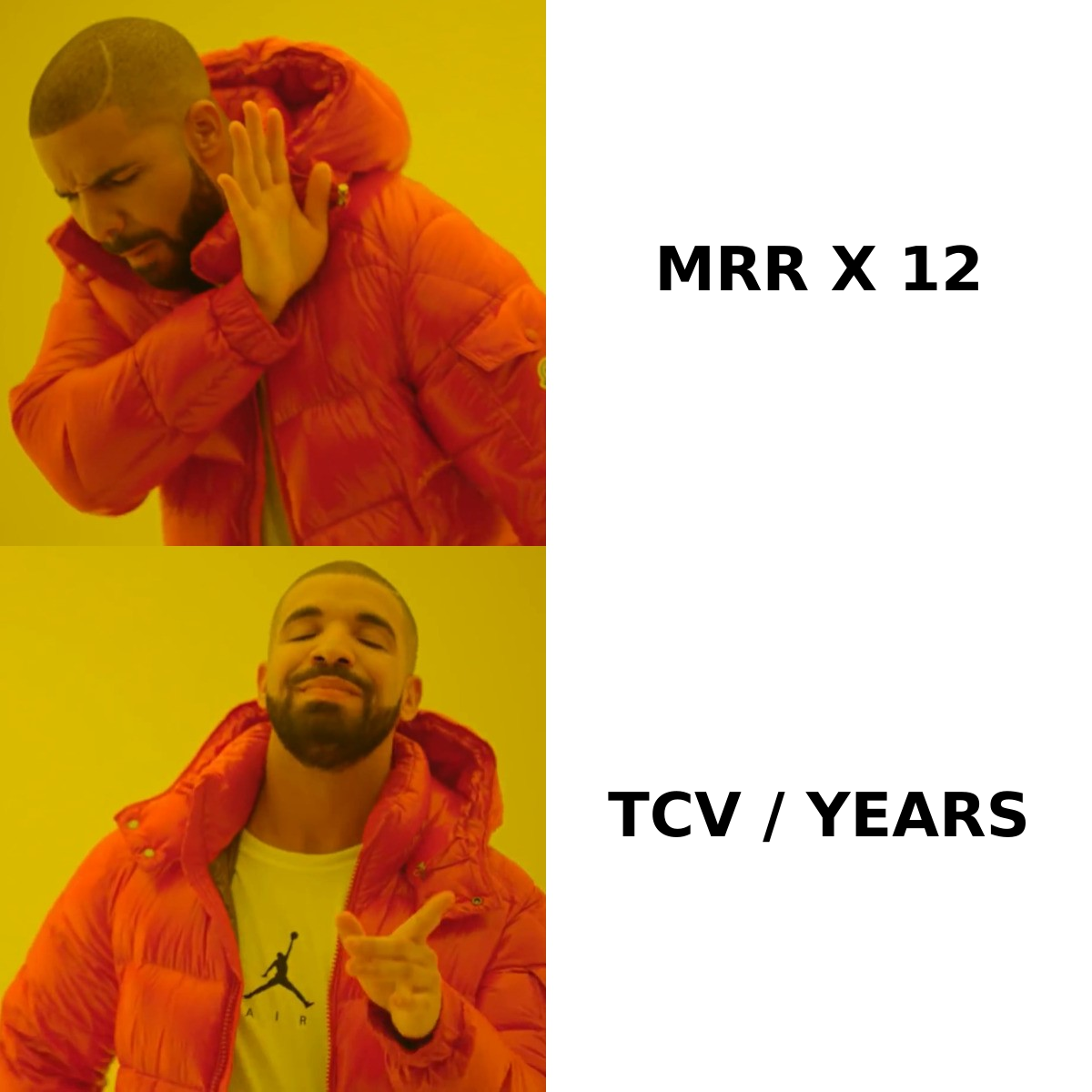
Multiplying MRR by 12 for a single deal. MRR × 12 gives you annualized run rate at a moment in time. On a ramped or discounted contract it will not equal ACV, and on a multi-year deal with an escalator it will not even be close.
Including one-time fees. Covered above, but worth repeating because it is the single most frequent source of inflation. A services-heavy sale can overstate ACV by 20–40%.
Rounding odd terms. Treating an 18-month deal as one year overstates ACV by 50%. Treating it as two years understates it by 25%. Use decimals.
Blending segments. A quarter with one $180,000 enterprise deal and nine $9,000 SMB deals has a mean ACV of $26,100 — a number that describes zero customers in the cohort. Report median alongside mean, and always report by segment.
Silently changing the definition mid-year. If you switch from year-one to average ACV in Q3, every trend line in your board deck becomes uninterpretable. Version your metric definitions the way you would version an API, and note the change on the chart.
Ignoring churn and downgrades. ACV at booking is not ACV at renewal. Track net ACV retention separately, or your growth model assumes a customer base that no longer exists. HubSpot's sales resources and Salesforce both publish useful frameworks for tying booking metrics to retention reporting.
How often should you recalculate ACV?#
Recalculate at three moments, not continuously:
- At booking, for every closed-won deal — this feeds the bookings report.
- Quarterly by segment, to catch drift in deal size before it invalidates quota plans. A 15% slide in mid-market ACV over two quarters means your pipeline coverage target is already too low.
- At annual planning, when quotas, headcount, and territory design are set off segmented ACV and win rate.
Anything more frequent is noise. Anything less and you will be planning next year's targets on data that describes a market you no longer sell into.
Turn your ACV plan into actual pipeline#
The ACV math above ends in a concrete number: how many verified, correctly-titled contacts each rep needs to hit quota. That is the part no formula generates for you.
Tomba Email Finder closes that gap — find professional email addresses by domain, name, or company, verify them before they enter a sequence, and enrich thin records so your rep-per-account math holds up in practice. Start on the free tier with 25 searches a month to test accuracy against your own target accounts, then scale on the $49/mo Starter or $99/mo Growth plan once you know what your segment's contact requirement actually looks like. Full Tomba pricing is public, so you can slot the cost straight into your CAC payback model alongside the ACV number you just calculated.
Related guides#
Ready to find emails that actually work?
Join 150,000+ professionals who stopped guessing and started sending. Free credits on signup — no credit card required.
Get the Tomba newsletter
Practical outbound tactics and product updates — once every two weeks.
About the author