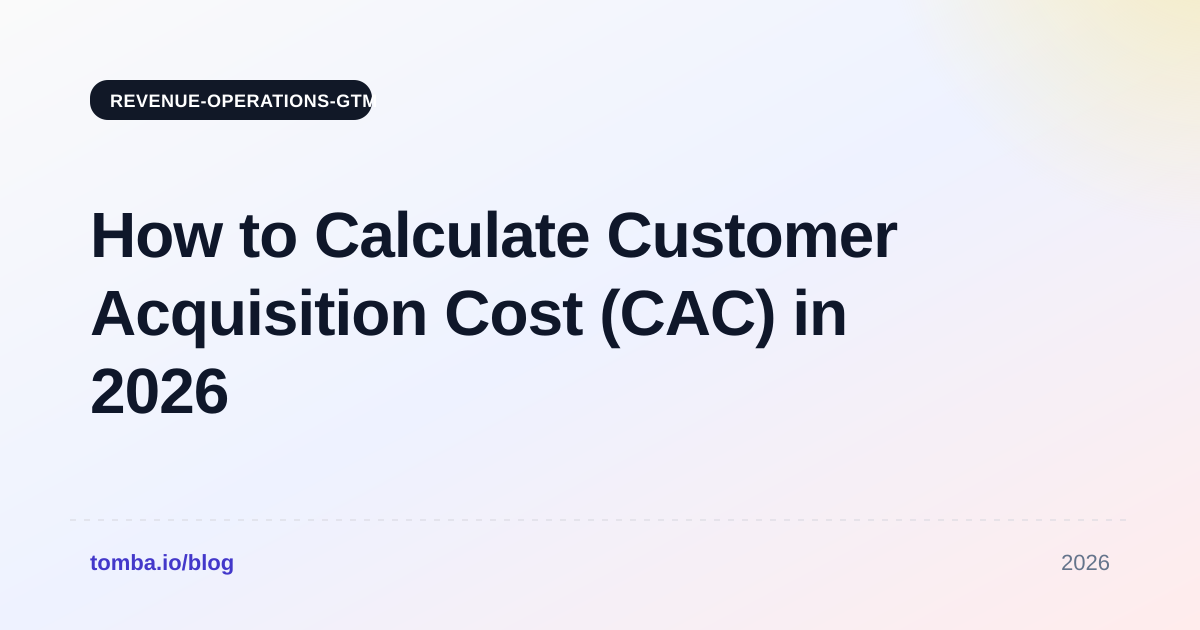
How to Calculate Customer Acquisition Cost (CAC) in 2026
Most CAC numbers are wrong because they leave out salaries, tools, and the lag between spend and closed deals. Here is the formula, the fixes, and the benchmarks that make CAC usable.
Here is how to calculate customer acquisition cost: add up everything you spent on sales and marketing in a period, then divide by the new customers you won in that period. The math takes a minute. The inputs are the hard part, and that is where most teams go wrong.
TL;DR
- CAC = total sales and marketing spend in a period, divided by new customers acquired in that same period. The formula is trivial; the inputs are where teams go wrong.
- Most reported CAC is understated by 40-60% because it excludes salaries, commissions, contractor fees, and software licenses.
- Track three numbers, not one: blended CAC, paid CAC, and CAC by channel. They answer different questions.
- Apply a lag offset. If your sales cycle is 90 days, dividing Q1 spend by Q1 customers is arithmetic, not measurement.
- CAC only means something next to LTV and payback period. A $3,000 CAC is great at $30,000 LTV and fatal at $2,000.
What is customer acquisition cost, exactly?#
Customer acquisition cost is the total amount you spend to convert one new paying customer. Everything you spend on sales and marketing over a period, divided by the number of customers who started paying in that period.
$$CAC = \frac{Sales\ Spend + Marketing\ Spend}{New\ Customers\ Acquired}$$
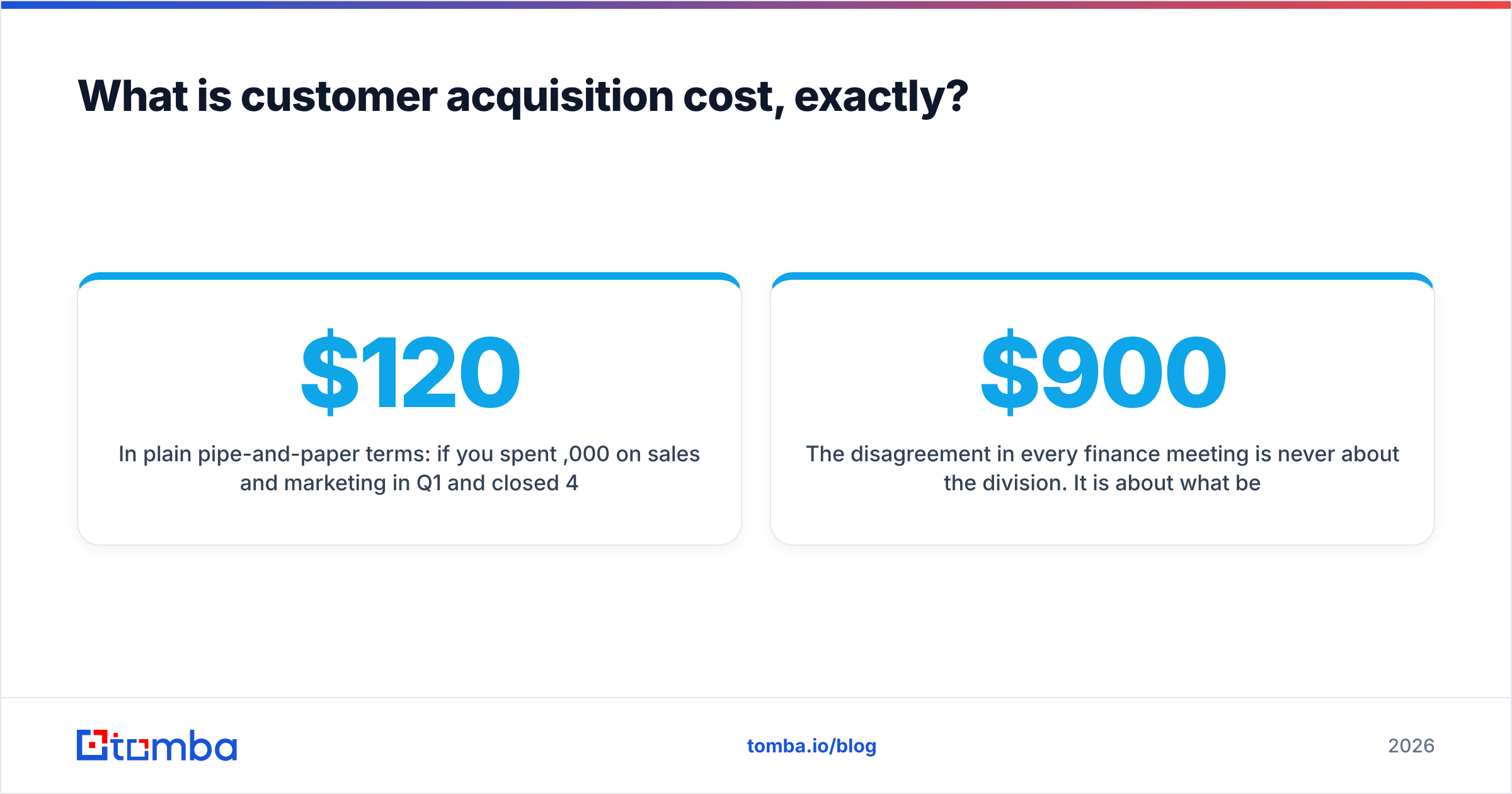
In plain pipe-and-paper terms: if you spent $120,000 on sales and marketing in Q1 and closed 40 new customers, your CAC is $3,000.
The disagreement in every finance meeting is never about the division. It is about what belongs in the numerator. A growth lead who counts only ad spend reports a CAC of $900. The CFO who counts the two SDRs, the AE's base, the commission, the CRM seats, and the agency retainer reports $4,100 for the same quarter. Both are using the same formula.
Getting this right matters more than most metrics on your dashboard. CAC sets the ceiling on how fast you can grow. Revenue operations teams treat it as the gate on every channel budget decision.

How to calculate customer acquisition cost step by step#
Five steps. Do them in order and the number holds up under audit.
- Pick a window that matches your sales cycle. Monthly works for self-serve and PLG. Quarterly is the safe default for B2B with a 30-90 day cycle. Use annual only for enterprise deals that take 6+ months.
- Sum every acquisition cost in the window. Paid media, content production, events, agency and contractor fees, sales and marketing salaries, commissions, and the full software stack.
- Count new customers, not logos or leads. A customer is someone who paid. Exclude upgrades, expansion revenue, reactivated accounts, and free trials that never converted.
The last two steps are the ones most teams skip.
- Divide, then apply the lag offset. If your average cycle is 90 days, match Q1 spend against Q2 closes. Skip it and fast-growing teams look far more efficient than they are.
- Segment the result. Break CAC out by channel, by segment (SMB, mid-market, enterprise), and by new business versus blended. One company-wide number hides everything actionable.
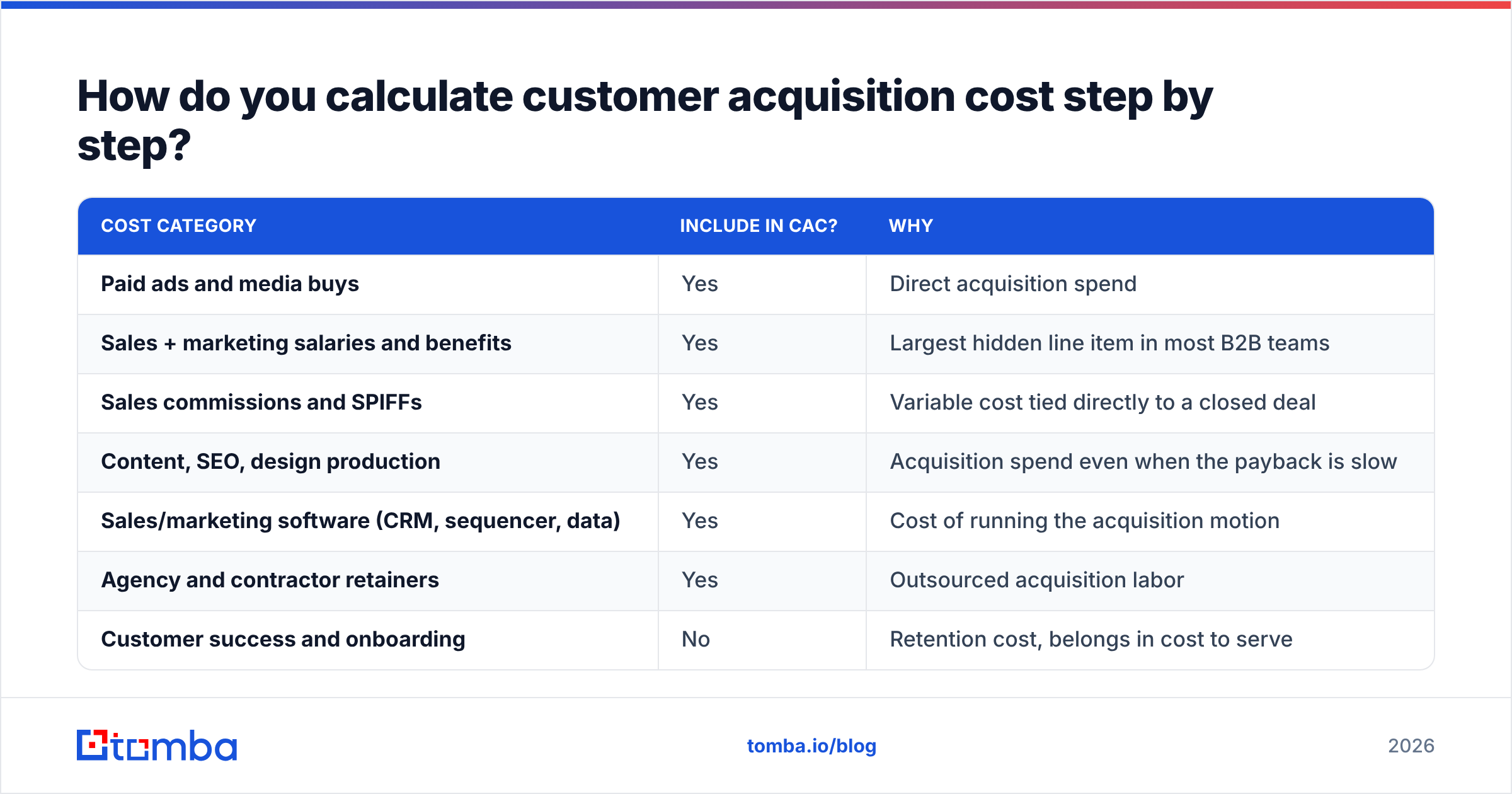
Step 2 is where the leakage happens. Here is what belongs in the numerator and what does not.
| Cost category | Include in CAC? | Why |
|---|---|---|
| Paid ads and media buys | Yes | Direct acquisition spend |
| Sales + marketing salaries and benefits | Yes | Largest hidden line item in most B2B teams |
| Sales commissions and SPIFFs | Yes | Variable cost tied directly to a closed deal |
| Content, SEO, design production | Yes | Acquisition spend even when the payback is slow |
| Sales/marketing software (CRM, sequencer, data) | Yes | Cost of running the acquisition motion |
| Agency and contractor retainers | Yes | Outsourced acquisition labor |
| Customer success and onboarding | No | Retention cost, belongs in cost to serve |
| Engineering and product salaries | No | Product cost, not acquisition |
| Rent, legal, general admin overhead | No | Distorts channel comparison |
| Expansion and upsell campaigns | No | Expansion CAC is a separate metric |
What is the difference between blended CAC and paid CAC?#
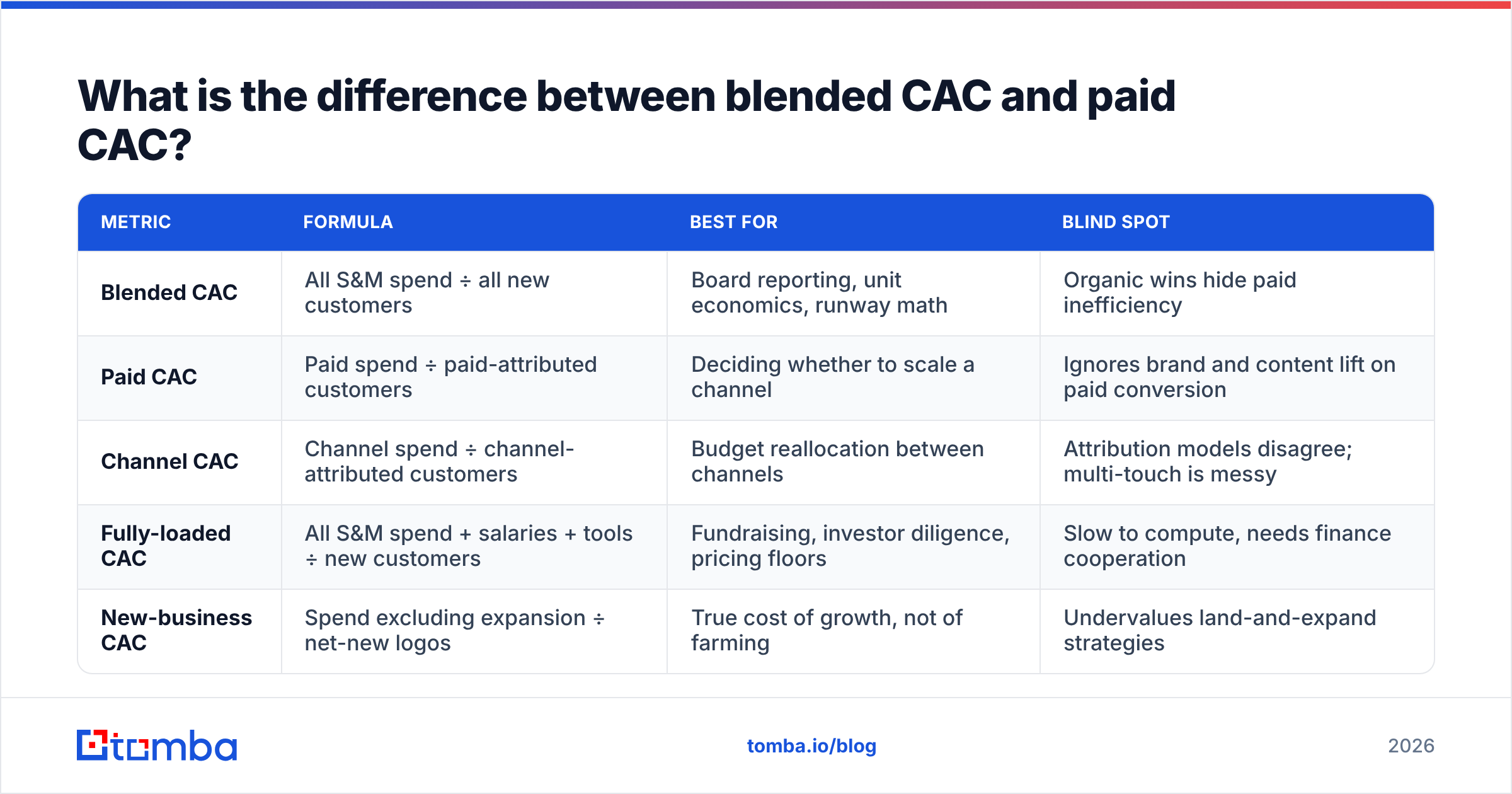
Blended CAC divides all acquisition spend by all new customers, including the ones who arrived organically. Paid CAC divides only paid spend by only paid-attributed customers. They answer different questions. Mixing them up is the most common reporting error after leaving out salaries.
| Metric | Formula | Best for | Blind spot |
|---|---|---|---|
| Blended CAC | All S&M spend ÷ all new customers | Board reporting, unit economics, runway math | Organic wins hide paid inefficiency |
| Paid CAC | Paid spend ÷ paid-attributed customers | Deciding whether to scale a channel | Ignores brand and content lift on paid conversion |
| Channel CAC | Channel spend ÷ channel-attributed customers | Budget reallocation between channels | Attribution models disagree; multi-touch is messy |
| Fully-loaded CAC | All S&M spend + salaries + tools ÷ new customers | Fundraising, investor diligence, pricing floors | Slow to compute, needs finance cooperation |
| New-business CAC | Spend excluding expansion ÷ net-new logos | True cost of growth, not of farming | Undervalues land-and-expand strategies |
The practical rule is simple. Report blended CAC to the board and finance. Use paid or channel CAC internally when you decide where the next $10,000 goes. If your blended CAC is improving while your paid CAC is degrading, you are riding organic growth while quietly burning paid budget.
What counts as a good CAC in 2026?#
There is no universal target, because CAC is meaningless without the revenue it produces. The only benchmark that travels across companies is the LTV:CAC ratio and the CAC payback period.
- LTV:CAC below 1:1 — you lose money on every customer. Stop and fix pricing or targeting.
- LTV:CAC around 3:1 — the widely cited healthy baseline for SaaS. Sustainable and fundable.
- LTV:CAC above 5:1 — often a signal you are underinvesting in growth, not a badge of efficiency.
- CAC payback under 12 months — strong for SMB and mid-market SaaS.
- CAC payback 12-18 months — normal for enterprise with high contract values.
- CAC payback over 24 months — a cash-flow problem regardless of how good the ratio looks.
Ranges vary a lot by motion and geography. Self-serve B2B SaaS often lands in the low hundreds of dollars per customer. SMB sales-assisted lands in the low thousands. Enterprise runs into the tens of thousands. Treat any published figure as a starting hypothesis. Compare it against your own trailing four quarters instead. Gartner and Forrester both publish segment-level go-to-market benchmarks worth reading before you set an internal target.
Payback period is the metric operators actually steer by:
$$CAC\ Payback = \frac{CAC}{Monthly\ Recurring\ Revenue \times Gross\ Margin}$$
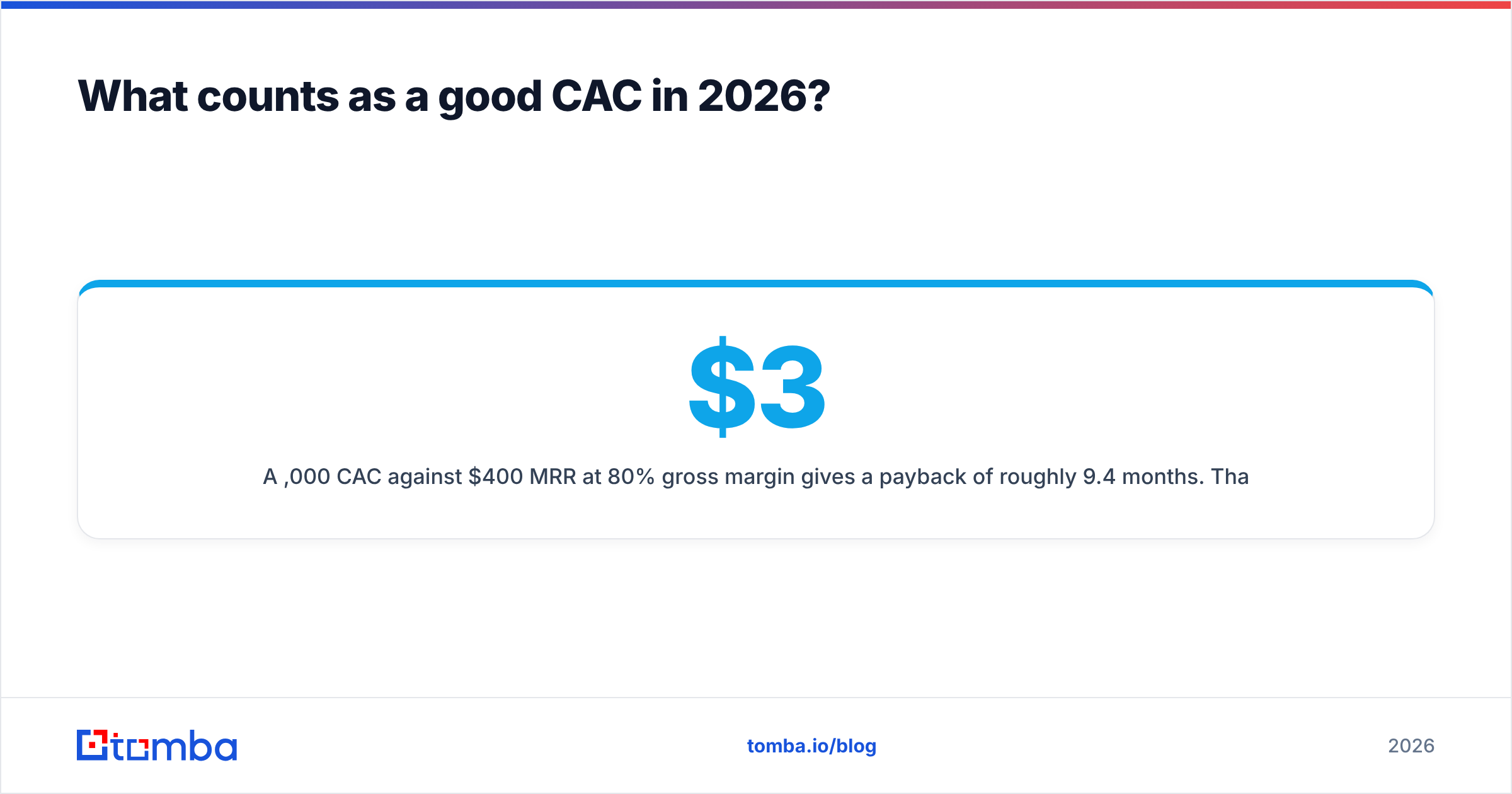
A $3,000 CAC against $400 MRR at 80% gross margin gives a payback of roughly 9.4 months. That is a business you can finance. The same $3,000 CAC against $120 MRR gives 31 months. You will run out of cash before those customers pay you back.
What makes CAC calculations go wrong?#
Five failure modes account for nearly every bad CAC number.
Excluding people costs. Salaries and commissions are usually the largest acquisition expense in a B2B org. Leaving them out is not conservative, it is fiction.
Ignoring the time lag. Spend in month one produces customers in month three. Same-period division flatters growth and punishes any month you scale spend.
Counting the wrong denominator. Marketing qualified leads, trials, and demos are not customers. If your denominator is leads, you are calculating cost per lead and calling it CAC.
Attribution guesswork. Last-touch attribution routinely over-credits branded search and under-credits content and outbound. Pick a model, document it, and keep it stable — comparability over time beats theoretical accuracy.
Dirty CRM data. This is the quiet one. Duplicate records inflate customer counts and deflate CAC. Bounced contacts inflate outbound spend against nothing. Unverified lists mean you count meetings against addresses that never existed. Running your list through an email verifier before a campaign is a CAC input, not a hygiene chore.
How do you reduce customer acquisition cost?#
CAC comes down two ways: spend less per attempt, or convert more of the attempts you already pay for. The second lever is almost always cheaper.
Fix your data before you fix your budget. If 22% of your outbound list bounces, roughly a fifth of your SDR salary is being spent on nothing. Verified contacts, correct titles, and current companies improve every downstream conversion rate without adding a dollar of spend. Tools like data enrichment and a proper email finder shift cost per meeting more than most creative tests do.
Tighten the ICP instead of widening the funnel. Narrower targeting lowers volume and raises conversion. Most teams discover their CAC problem is really a targeting problem once they segment by firmographic band.
Shorten the sales cycle. Every extra week a deal sits in pipeline is loaded salary cost. Better qualification early is a CAC lever disguised as a process change.
Shift mix toward compounding channels. Paid media CAC rises as you scale it; content and referral CAC tends to fall. The trade is time — build the compounding channels before you need them.
Reduce churn. Technically this raises LTV rather than lowering CAC, but the ratio you actually manage improves either way, and it is usually the fastest available win. HubSpot has published extensively on the retention-to-acquisition-cost relationship if you want the longer argument.
Instrument channel-level CAC weekly. You cannot reallocate what you do not measure. A monthly roll-up is too slow to catch a channel degrading mid-quarter.
How do you track CAC in practice?#
Keep it boring and repeatable. A single spreadsheet or dashboard with four columns — period, fully-loaded spend, new customers (lag-adjusted), CAC — beats an elaborate attribution model nobody trusts.
Pull spend from finance, not from the ad platforms. Platform-reported spend excludes salaries and usually disagrees with the invoice. Pull customer counts from billing, not the CRM, because billing knows who actually paid.
Then review it on a fixed cadence with the same definitions every time. Consistency beats precision. A CAC that is 10% off but calculated the same way every quarter still shows you the trend, and the trend is what you steer on. A perfectly precise CAC recalculated with new rules each quarter tells you nothing.
If outbound is a meaningful share of acquisition, add two metrics next to CAC: cost per verified contact and cost per booked meeting. Both catch data-quality problems weeks before they show up as a CAC increase. Both are numbers you can act on the same day. Check Tomba pricing against your current cost per verified contact. If you pay more than a few cents per validated address, that line item is worth revisiting.
Where should you start?#
If you are still working out how to calculate customer acquisition cost for your own business, start with one number. Calculate fully-loaded blended CAC for your last four quarters. Do not segment, do not model attribution, do not build a dashboard. Just get four honest numbers with salaries included and a lag offset applied. The trend across those four points will tell you whether you have an efficiency problem, a targeting problem, or no problem at all.
Then segment by channel, and only then start optimizing.
If outbound is where your acquisition spend concentrates, the highest-leverage fix is usually contact accuracy. Bad data burns rep hours, inflates the numerator, and shrinks the denominator at the same time. The Tomba Email Finder gives you verified professional email addresses by domain, name, or company. The free tier covers 25 searches a month, so you can test it against your own list first. Plans start at $49/mo for Starter and $99/mo for Growth — a rounding error against a single wasted SDR month, and a direct cut to the cost side of the CAC equation.
Related guides#
Ready to find emails that actually work?
Join 150,000+ professionals who stopped guessing and started sending. Free credits on signup — no credit card required.
Get the Tomba newsletter
Practical outbound tactics and product updates — once every two weeks.
About the author