How to Call Warm Leads: The 7-Step Playbook That Converts
Warm leads decay in minutes, not days. Here is a 7-step framework for calling them: timing windows, opening lines, objection handling, and the data checks that keep you off voicemail.
TL;DR
- A warm lead is anyone who took a trackable action toward you in the last 30 days — demo request, pricing page visit, second email reply, webinar attendance, free-trial signup. Intent decays fast, so speed beats polish.
- Call within five minutes of the trigger when you can. Past one hour, connect rates fall off a cliff and the "I saw you were looking at…" opener stops feeling relevant and starts feeling creepy.
- Open by naming the trigger in one sentence, ask permission for 30 seconds, then ask a diagnostic question. Do not pitch in the first 20 seconds.
- Bad phone data kills more warm calls than bad scripts. Verify the direct dial and the email before the rep ever picks up the handset.
- Track connect rate, conversation rate, and meetings-per-100-dials separately. A high dial count with a low connect rate is a data problem, not an effort problem.
What counts as a warm lead in 2026?#
A warm lead is a person whose behavior gives you a specific, recent, defensible reason to call. That's it. Not "they're in our ICP." Not "they downloaded an ebook in 2024." Recency and specificity are what make the call warm — the moment you can't name the trigger out loud in one sentence, you're cold calling with extra steps.
Most teams over-classify. If your CRM says 4,000 warm leads and your reps book six meetings a week, your definition is broken. Tighten it with three tests:
- Is the trigger under 30 days old? Intent has a half-life. A pricing page visit from six weeks ago is a cold lead wearing a warm badge.
- Did the person act, or did the account act? An account-level intent spike tells you where to dig. It does not tell you who to dial. You still need the individual.
- Can you say the trigger without sounding surveillance-y? "You requested the pricing sheet on Tuesday" works. "Our system noticed you spent 4 minutes 12 seconds on our security page" does not.
- Is there a real phone number attached? A warm lead you cannot reach is a note in a database. Reachability is part of the definition, not an afterthought.
Everything else — job title, company size, tech stack — is qualification. It matters, but it doesn't make a lead warm.
Why do warm calls fail more often than they should?#
Because reps treat the warmth as permission to skip the work. The three failure patterns show up in almost every call review:
The rep assumes intent equals readiness. Someone downloaded a comparison guide; the rep opens with "so, what are you looking to solve?" as though a purchase decision is underway. Downloading a guide means curiosity, not budget. Match your ask to the size of the signal.
The rep leads with the company, not the trigger. Fifteen seconds of "we're a platform that helps revenue teams…" and the prospect has already mentally hung up. The trigger is your entire right to be on the phone. Say it first.
The rep waits. This is the biggest one. Speed-to-lead research has been consistent for a decade and a half — the odds of a meaningful conversation collapse as minutes pass. HubSpot's sales research library and most sales-engagement vendors put the practical window at under five minutes for inbound demo requests. After an hour you are calling a stranger who has already booked with someone faster.

How fast should you call a warm lead?#
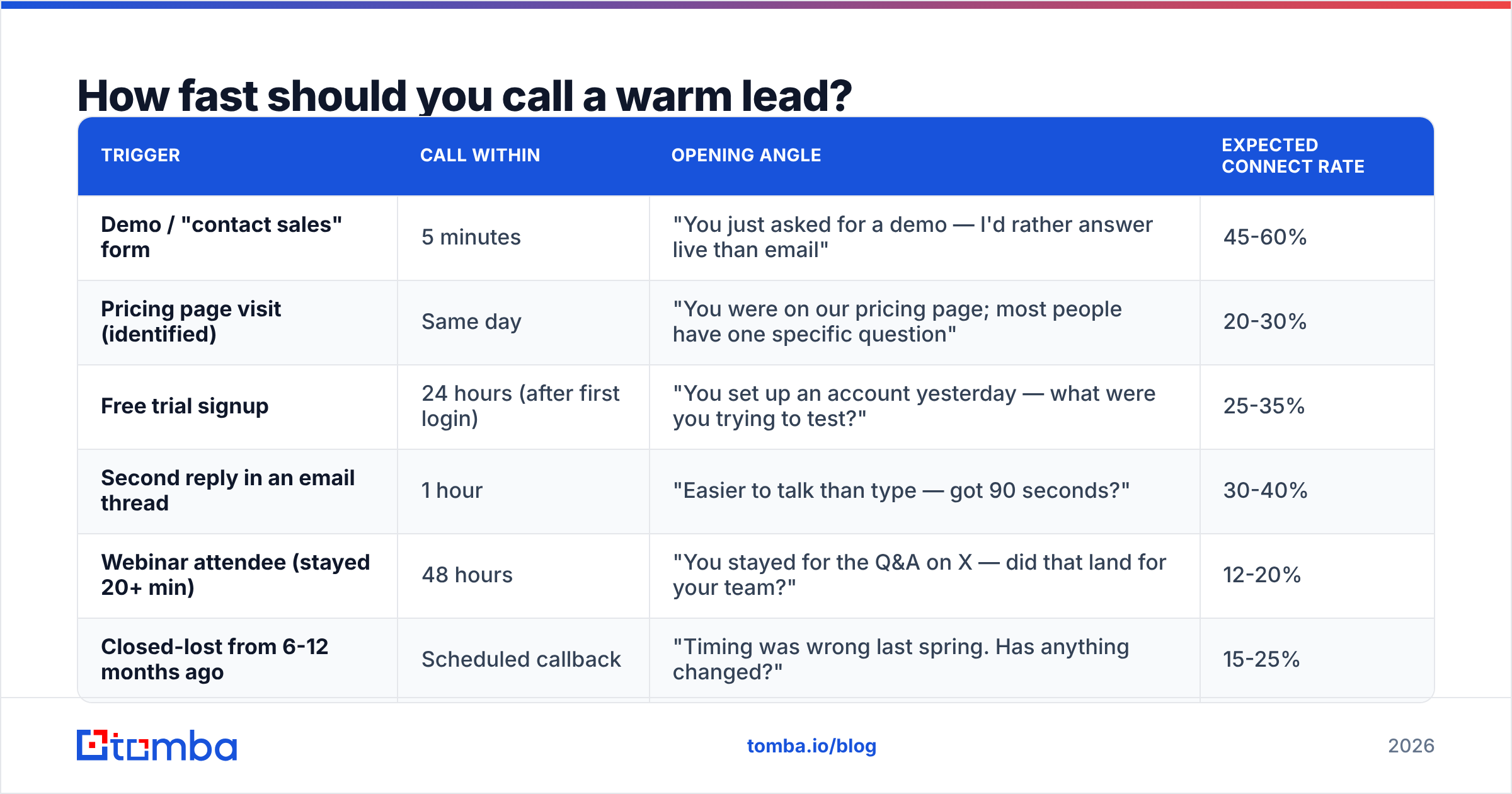
It depends on the trigger. Not every signal deserves a five-minute response, and treating them all the same burns your best hours on low-intent noise. Here's a practical routing table:
| Trigger | Call within | Opening angle | Expected connect rate |
|---|---|---|---|
| Demo / "contact sales" form | 5 minutes | "You just asked for a demo — I'd rather answer live than email" | 45-60% |
| Pricing page visit (identified) | Same day | "You were on our pricing page; most people have one specific question" | 20-30% |
| Free trial signup | 24 hours (after first login) | "You set up an account yesterday — what were you trying to test?" | 25-35% |
| Second reply in an email thread | 1 hour | "Easier to talk than type — got 90 seconds?" | 30-40% |
| Webinar attendee (stayed 20+ min) | 48 hours | "You stayed for the Q&A on X — did that land for your team?" | 12-20% |
| Closed-lost from 6-12 months ago | Scheduled callback | "Timing was wrong last spring. Has anything changed?" | 15-25% |
The ranges above are directional; your numbers will vary by segment and country. What matters is the ordering. A demo request and a webinar attendee are not the same lead, and calling them with the same urgency means you're either too slow on the first or wasting cycles on the second.
One caveat on identified pricing-page visits: only call the individual if you actually identified the individual. If your website visitor reveal tooling gives you the account and you're inferring the person, that's a research task, not a warm call — treat it as an account play and pick the right contact deliberately.
What should the first 20 seconds sound like?#
Four beats, in order. Total time: under 20 seconds.
Beat 1 — Name and trigger (5 seconds). "Hi Maria, this is Sam from Northwind. You requested the pricing sheet about an hour ago."
Beat 2 — Permission (3 seconds). "Is now a terrible time, or do you have 30 seconds?" The negative framing gets a truer answer than "do you have a minute?" and gives them an easy, honest out that doesn't end the relationship.
Beat 3 — Reason, not pitch (5 seconds). "I'm calling because the sheet doesn't explain the part everyone asks about — how the seat tiers work when you have contractors."
Beat 4 — Diagnostic question (5 seconds). "How many people would actually be in the tool day to day?"
Notice what's missing: no company boilerplate, no "how are you today," no value proposition. You earn the right to explain the product by first proving you know why they raised their hand. If the prospect answers Beat 4 with a real number, you have a conversation. If they answer with "just researching," you have a nurture — book a 15-minute follow-up and get off the phone politely.
A note on tone: warm calls should be lower energy than cold calls, not higher. The prospect already knows who you are. Aggressive enthusiasm reads as a mismatch with the small, quiet action they took. Match their temperature.
How do you structure the rest of the call?#
Once you're past the opener, run the same five-part structure every time so your call reviews are comparable:
- Diagnose before you demo. Two or three questions about the current process, the workaround they're using, and who else is affected. You are looking for a cost — hours, dollars, churn, risk — not a feature request.
- Play back the problem in their words. "So invoicing runs through a shared inbox and two people manually reconcile it every Friday." If they correct you, good. That correction is the real problem statement.
- Give one relevant proof point. One. A customer in the same segment with the same workaround. Skip the logo slide recital.
- Name the obvious objection before they do. "The usual pushback here is the migration — happy to walk through what that actually takes." Pre-empting builds more trust than parrying.
- Ask for a specific, small next step. Not "does that sound interesting?" but "can I get 25 minutes with you and whoever owns billing on Thursday?" Specific asks convert; vague ones create ghosting.
- Confirm the follow-up in writing while still on the call. Send the calendar invite before you hang up. A meeting that isn't on a calendar didn't happen.
That's the whole call. Ten to fifteen minutes on a good day. Longer conversations are usually a sign the rep is presenting rather than qualifying.
Which warm-lead sources actually convert?#
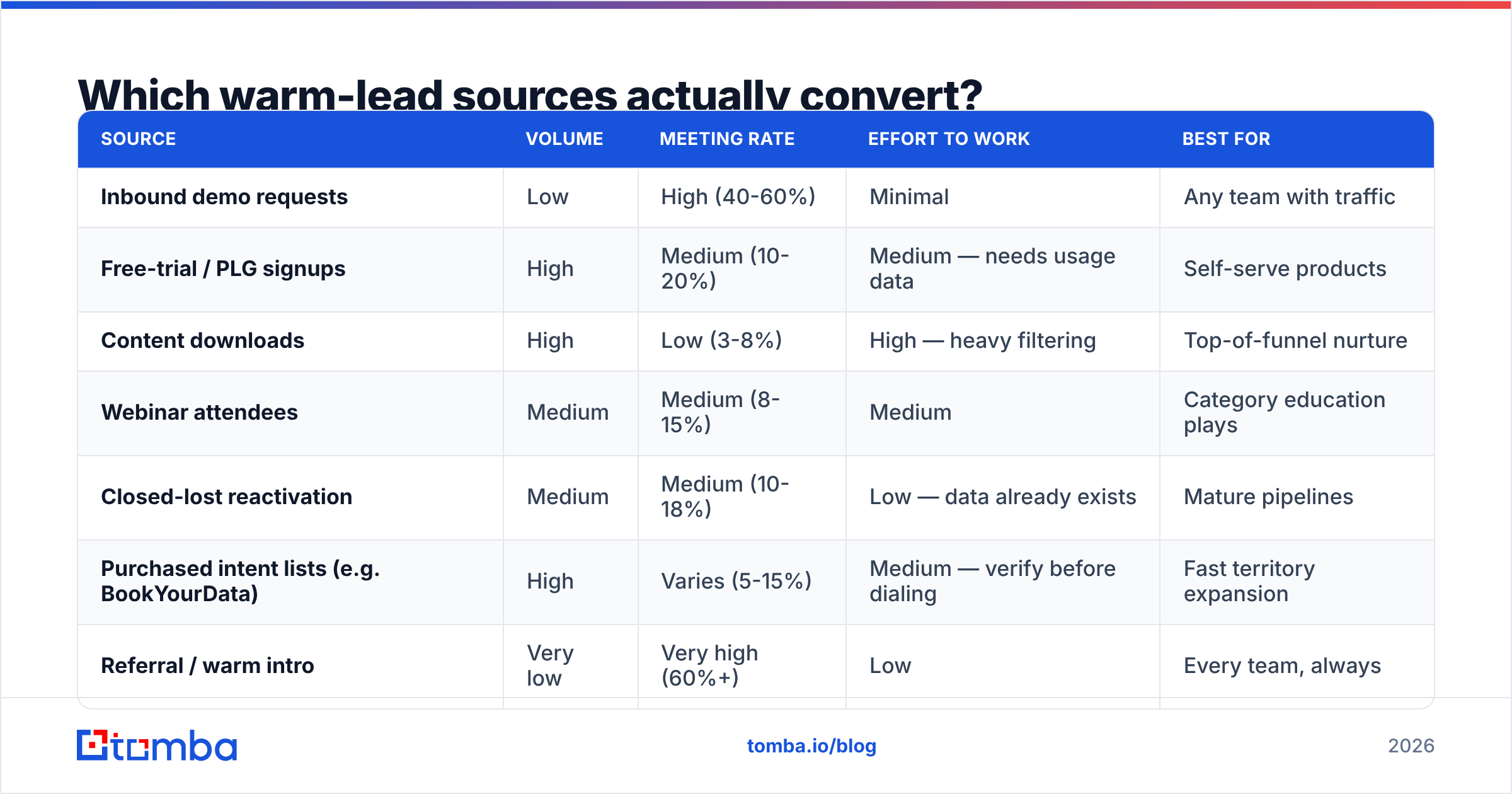
Not all warmth is equal, and the sources that produce the most volume rarely produce the best meetings. Here's how the common sources stack up:
| Source | Volume | Meeting rate | Effort to work | Best for |
|---|---|---|---|---|
| Inbound demo requests | Low | High (40-60%) | Minimal | Any team with traffic |
| Free-trial / PLG signups | High | Medium (10-20%) | Medium — needs usage data | Self-serve products |
| Content downloads | High | Low (3-8%) | High — heavy filtering | Top-of-funnel nurture |
| Webinar attendees | Medium | Medium (8-15%) | Medium | Category education plays |
| Closed-lost reactivation | Medium | Medium (10-18%) | Low — data already exists | Mature pipelines |
| Purchased intent lists (e.g. BookYourData) | High | Varies (5-15%) | Medium — verify before dialing | Fast territory expansion |
| Referral / warm intro | Very low | Very high (60%+) | Low | Every team, always |
Two takeaways. First, referrals and demo requests deserve your best reps and your fastest response — they're scarce and they convert. Second, high-volume sources like content downloads and purchased lists are only economical if the enrichment and verification step is automated. Working them by hand is how SDR teams end up with 200 dials and two conversations.
Reputable list providers can be a genuinely good on-ramp when you're entering a new segment and have no first-party signal yet. The discipline is the same either way: verify before you dial, and don't pretend a list record is a warm lead until the prospect does something.
How do you get accurate phone numbers before you dial?#
This is the unglamorous half of learning how to call warm leads, and it's where most of the leakage happens. A perfect script against a disconnected number produces nothing.
Build a pre-dial data check into the routing step, not the rep's morning:
- Resolve the person, not just the account. Firmographic intent gives you a company. Use a domain search to pull the right contacts at that company before anyone picks up a phone.
- Find and validate the direct dial. Switchboard numbers are a tax on your day. A phone finder plus a phone validator pass tells you whether the line is live, mobile or landline, and which country it routes to — which also keeps you compliant with local calling rules.
- Keep the email in sync. Roughly a third of your warm calls end in voicemail. The follow-up email is the actual conversion event, so a valid address matters as much as the number. Run addresses through an email verifier before the sequence fires.
- Enrich the record with the trigger. Title, headcount, and tech stack via data enrichment tell the rep how to frame the call. The trigger tells them why they're calling. Reps need both on one screen.
Do this once, centrally, and your dial-to-conversation ratio improves without changing a single word of the script.
What do you say when they say "I was just looking"?#
The four objections that dominate warm calls, and the responses that keep the conversation alive:
"I was just doing research." — "Totally fair. What kicked off the research?" This almost always surfaces a real trigger: a renewal, a headcount change, a failed tool. If nothing surfaces, schedule a check-in for 60 days out and move on.
"I'm not the decision maker." — "Makes sense. Who ends up owning this, and what would they need to see from you to take it seriously?" You're recruiting a champion, not asking for a handoff.
"Just send me some information." — "Happy to. So I send the right thing instead of a 40-page PDF — is the question more about pricing or about how it fits with your current stack?" One question converts a brush-off into a qualification.
"We already use [competitor]." — "Good tool. Most people who talk to us are happy with it and have one specific gap — usually reporting or data coverage. Is either of those a thing for you?" Never disparage the incumbent. Find the seam.
The pattern in all four: acknowledge, ask one narrow question, and let them decide whether to keep going. Warm leads punish pressure harder than cold ones because they had a positive impression to lose.
How do you handle voicemail and follow-up?#
Assume 50-70% of warm dials go to voicemail. Plan for it rather than treating it as failure.
Leave a message under 20 seconds with exactly three elements: your name, the trigger, and a promise of a follow-up email with a subject line you name out loud. "Hi Maria, Sam from Northwind — you grabbed the pricing sheet this morning. I'm sending a note titled 'seat tiers + contractors,' the answer's in there. If it's easier to talk, my number's in the signature." That's it. No pitch, no callback beg.
Then run the cadence: call plus email on day one, a second call at a different hour on day three, a LinkedIn touch on day five, and a break-up email on day nine. Varying the time of day matters more than adding touches — most people are reachable in a two-hour window you haven't tried yet. Tracking your response rate per channel tells you where to spend the extra touch.
What metrics prove the motion is working?#
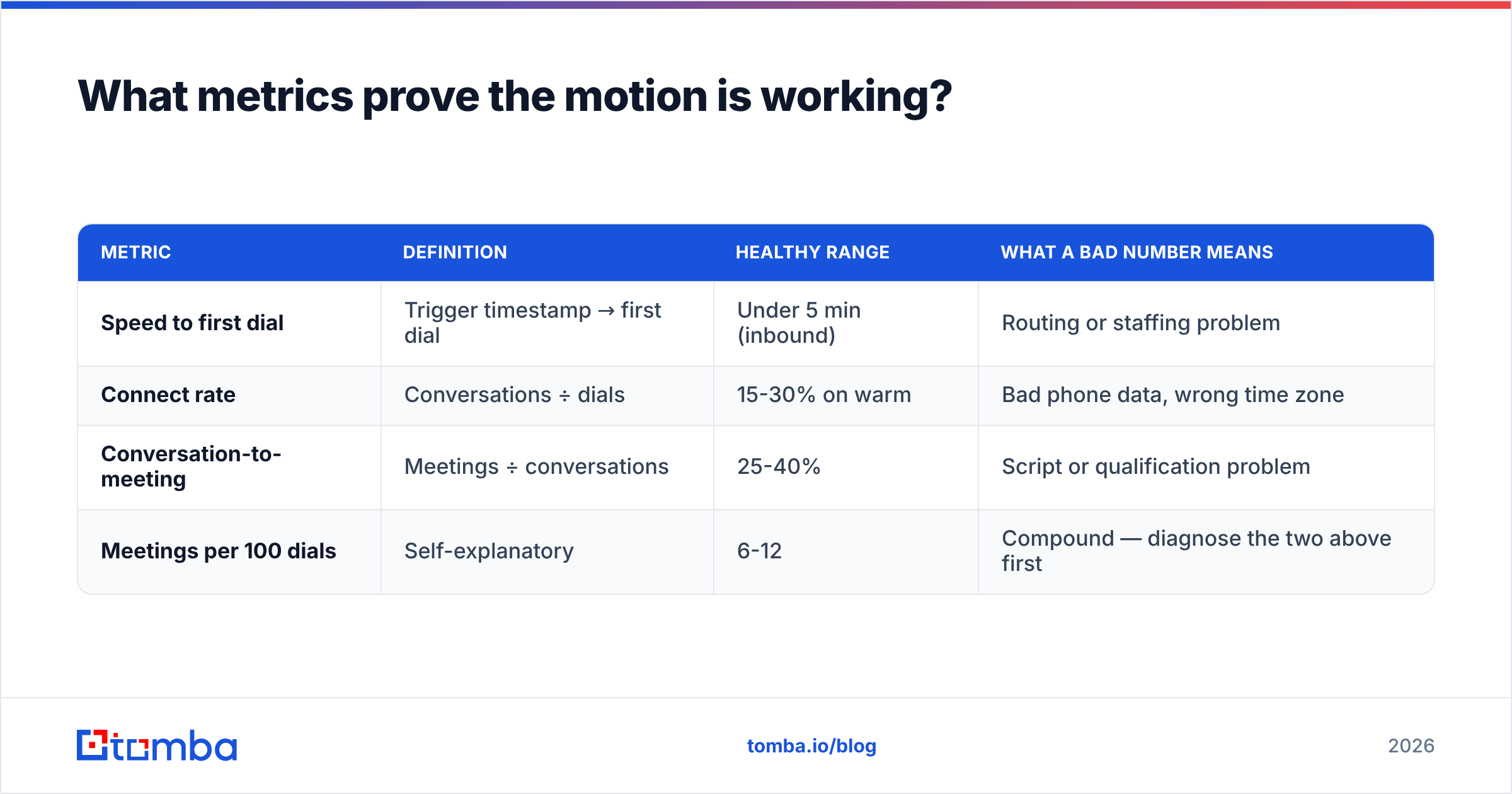
Four numbers, reviewed weekly:
| Metric | Definition | Healthy range | What a bad number means |
|---|---|---|---|
| Speed to first dial | Trigger timestamp → first dial | Under 5 min (inbound) | Routing or staffing problem |
| Connect rate | Conversations ÷ dials | 15-30% on warm | Bad phone data, wrong time zone |
| Conversation-to-meeting | Meetings ÷ conversations | 25-40% | Script or qualification problem |
| Meetings per 100 dials | Self-explanatory | 6-12 | Compound — diagnose the two above first |
Diagnose in that order. If connect rate is low, no amount of script coaching helps — go fix the data. If connect rate is healthy and conversation-to-meeting is weak, the problem is in the first 20 seconds, and you should be listening to recordings. Analyst coverage of sales engagement from Gartner and buyer reviews on G2 are useful for benchmarking tooling, but your own weekly cohort numbers are the only benchmark that reflects your segment.
Where should you start this week?#
Pick your highest-intent trigger — probably inbound demo requests — and fix three things: route them to a live rep in under five minutes, standardize the four-beat opener, and verify the phone number and email before the record hits a queue. Leave everything else alone until those three are stable. Teams that try to overhaul the entire warm-calling motion at once usually end up with a new script and the same connect rate.
Then widen. Add trial signups. Add closed-lost reactivation. Each new source gets the same treatment: define the trigger, set the response window, verify the contact data, measure the four metrics.
Ready to fix the data half? Most warm-calling programs stall because the contact record is incomplete, not because the reps can't sell. Tomba's Email Finder resolves verified work emails by name and domain, and pairs with phone finding, verification, and enrichment on the same credits — so your reps dial live numbers and follow up at addresses that land. Start free with 25 searches a month, or check Tomba pricing — plans run $49/mo (Starter), $99/mo (Growth), and $249/mo (Pro) when you're ready to scale the list.
Related guides#
Ready to find emails that actually work?
Join 150,000+ professionals who stopped guessing and started sending. Free credits on signup — no credit card required.
Get the Tomba newsletter
Practical outbound tactics and product updates — once every two weeks.
About the author