How to Collect First Party Data in 2026: A Practical Playbook
Third-party cookies are gone and purchased lists decay fast. This playbook shows how to collect first party data channel by channel, so your GTM team can actually activate it — plus what to do when the data is thin.
TL;DR
- How to collect first party data, in one line: capture it directly from the people who use your site, product, emails, or sales team. You own it. No ad platform can take it away.
- The highest-yield B2B sources are gated content, product usage logs, visitor identification, sales-call notes, and progressive form profiling. Start with two, not seven.
- Consent is the collection mechanism, not a legal afterthought. A clear value exchange lifts opt-in rates more than any form-field tweak.
- Raw first-party signals are usually incomplete: a domain with no name, a name with no email. Enrichment closes those gaps without turning your dataset into a purchased list.
- Measure by activation rate — what share of collected records got used in a campaign — not by row count.
What is first-party data, and why does it matter now?#
First-party data is information you collect directly from your own audience through your own channels. Form submissions, product telemetry, purchase history, email engagement, support tickets, survey responses, sales-call transcripts. You are the original collector. Nobody sold it to you.
Think of it like a restaurant keeping its own reservation book instead of renting a table-booking list from the mall next door. The mall's list tells you people walk past. Your book tells you who came, what they ordered, and when they'll be back.
The distinction that trips people up is second-party versus third-party. Second-party data is someone else's first-party data shared with you directly — a co-marketing partner handing over webinar registrants. Third-party data is aggregated by a broker from sources you can't inspect, then sold to you and forty competitors.
The urgency is structural. Chrome has finished deprecating third-party cookies for most traffic. Apple's Mail Privacy Protection broke open-rate tracking years ago. GDPR and CCPA enforcement made "we bought a list" an expensive posture. Gartner has told CMOs to rebuild around owned data since 2022. The teams that did it early aren't scrambling now.
There's also a quality argument that has nothing to do with privacy law. First-party data is fresher. A record you captured last Tuesday from your own form beats a record a broker scraped eighteen months ago. That older record has already been resold nine times.
What are the main types of first-party data you can collect?#
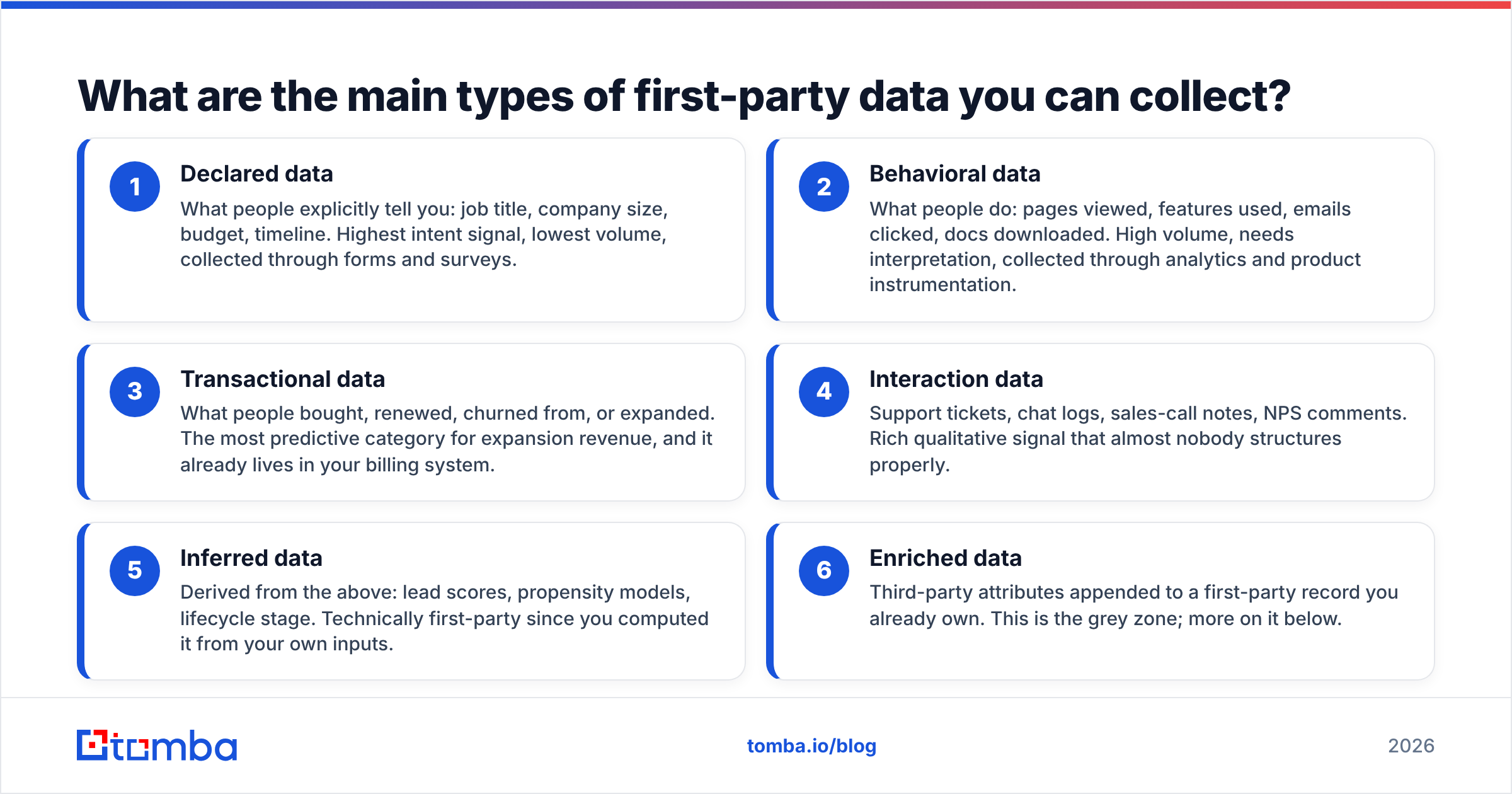
Not all first-party data is equally useful. Here's how the categories break down by effort and payoff:
- Declared data — What people tell you outright: job title, company size, budget, timeline. Highest intent signal, lowest volume. You collect it through forms and surveys.
- Behavioral data — What people do: pages viewed, features used, emails clicked, docs downloaded. High volume, needs interpretation. You collect it through analytics and product instrumentation.
- Transactional data — What people bought, renewed, churned from, or expanded. The most predictive category for expansion revenue, and it already lives in your billing system.
- Interaction data — Support tickets, chat logs, sales-call notes, NPS comments. Rich qualitative signal that almost nobody structures properly.
- Inferred data — Derived from the above: lead scores, propensity models, lifecycle stage. Still first-party, since you computed it from your own inputs.
- Enriched data — Third-party attributes appended to a first-party record you already own. This is the grey zone; more on it below.
Most B2B teams over-invest in category 1 and ignore categories 3 and 4. Your billing system and your support inbox hold the most predictive data in the company.
How to collect first party data on your website#
Your website is the widest funnel you control. Three mechanisms, ordered by how much friction they add:
Zero-friction: visitor identification. Reverse-IP and pixel-based tools match anonymous company traffic to a firmographic profile. Nobody has to fill out a form. You learn that someone at a 400-person logistics company read your pricing page three times. You don't get a name. Tools like Tomba's website visitor reveal sit in this bucket. The catch: company-level resolution is solid, but person-level resolution on shared IPs is not. Treat any vendor claiming 90%+ person-level match rates with suspicion.
Low-friction: progressive profiling. Ask for email on the first form. Ask for company size on the second. Ask for budget on the fourth. HubSpot's research on form conversion has shown for years that each extra field costs you submissions. Progressive profiling gets you the same eight fields across four visits. The alternative is losing 60% of visitors on one long form.
Higher-friction: gated value. Benchmark reports, calculators, templates, and assessment tools. The gate must be worth the trade. A three-page PDF behind a nine-field form is a bad deal, and your bounce rate says so. An interactive ROI calculator that returns a personalized number is a good deal. People will give you a work email for it.
One tactic consistently outperforms: build a free tool instead of a report. Reports get downloaded once. Tools get bookmarked and re-used, and every re-use is another behavioral data point. Tomba's own free email checker works on that model.
How to collect first party data from your product and sales team#
The website is where most guides stop. That's a mistake. The richest data lives after signup.
Product instrumentation. Every feature activation, every failed workflow, every seat added. Define an event schema before you start firing events. Skip that step and you'll spend next Q3 untangling button_clicked from btn_click_v2. Product usage data is what makes a real product-qualified lead motion possible. Pageviews only let you guess.
Sales call capture. Your reps collect first-party data in every discovery call and drop 90% of it. Structured call notes with required fields — current tooling, decision timeline, competing vendor — turn conversations into a queryable dataset. If your reps hate CRM fields, that's a form-design problem, not a discipline problem. Cut it to three required fields.
Support and churn interviews. The single best source of competitive intelligence you have. When someone churns and tells you where they went, that's first-party competitive data no analyst firm will sell you.
Email engagement. Post-MPP, opens are noise. Clicks, replies, and forwards still carry signal. Track link-level clicks, not aggregate opens, and feed them into your lead management scoring model.
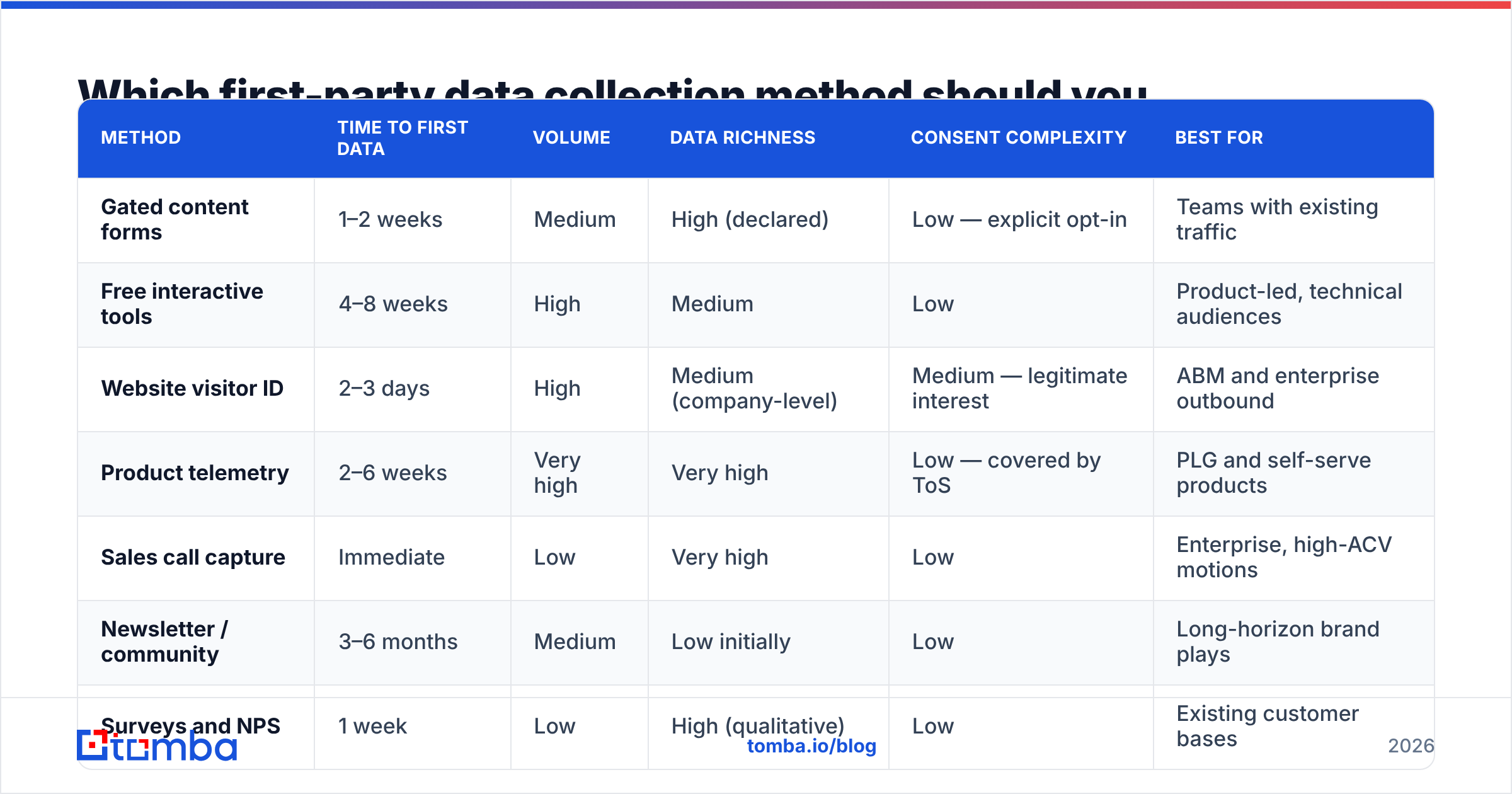
Which first-party data collection method should you choose?#
It depends on your traffic volume, your sales motion, and how fast you need usable records. Here's the honest comparison:
| Method | Time to first data | Volume | Data richness | Consent complexity | Best for |
|---|---|---|---|---|---|
| Gated content forms | 1–2 weeks | Medium | High (declared) | Low — explicit opt-in | Teams with existing traffic |
| Free interactive tools | 4–8 weeks | High | Medium | Low | Product-led, technical audiences |
| Website visitor ID | 2–3 days | High | Medium (company-level) | Medium — legitimate interest | ABM and enterprise outbound |
| Product telemetry | 2–6 weeks | Very high | Very high | Low — covered by ToS | PLG and self-serve products |
| Sales call capture | Immediate | Low | Very high | Low | Enterprise, high-ACV motions |
| Newsletter / community | 3–6 months | Medium | Low initially | Low | Long-horizon brand plays |
| Surveys and NPS | 1 week | Low | High (qualitative) | Low | Existing customer bases |
Starting from zero with real traffic? Run gated content and visitor identification in parallel. Pre-traffic? Pair sales call capture with product telemetry. It's the only combination that produces anything usable inside a quarter.
How do you stay compliant while collecting first-party data?#
Compliance is a design constraint on collection, not a legal review at the end. Four rules cover most of it:
Collect for a stated purpose. GDPR's purpose limitation principle is simple. You can't gather emails for a whitepaper and then bulk-add them to a cold sequence. State the purpose at collection, in plain language, on the form.
Make consent granular and separable. One checkbox for "send me the report." A separate one for "send me product updates." Bundled consent is invalid under GDPR. It also tanks your engagement rates, because half your list never wanted the second thing.
Keep a consent audit trail. Timestamp, IP, form version, and the exact wording shown. When a regulator or an enterprise buyer asks you to prove someone opted in, you need a record, not a memory.
Set a retention clock. Data you collected in 2021 and never used isn't an asset. It's a liability. Define TTLs per data type and enforce them.
The CCPA/CPRA framework adds a right-to-delete and right-to-know layer for California residents. Roughly twenty US states now have similar laws. Building deletion workflows once, properly, is cheaper than retrofitting them per jurisdiction.
Worth naming plainly: B2B outreach to a work email under legitimate interest is legal in much of the EU and the UK. You need to show relevance and offer an easy opt-out. "First-party only" doesn't mean "opt-in only." It means you know where every record came from.
What do you do when your first-party data is incomplete?#
This is where most playbooks go quiet, and it's the actual daily problem.
You will end up with records like these. A company domain from visitor identification and nothing else. A LinkedIn profile from a rep's prospecting with no contact route. A form fill with a personal Gmail address from someone who clearly works at a target account.
Three legitimate ways to close those gaps without buying a list:
Pattern-based email resolution. Take a verified first name, last name, and company domain. From the company's known email format, you can derive the likely work email. That isn't purchased data. It's deterministic inference from information you already hold. A domain search returns the format a company actually uses, and an email finder resolves a specific person against it.
Verification before send. Every derived or aged address should pass through an email verifier before it enters a sequence. This protects your sender reputation, the single most expensive thing to rebuild once damaged. Catch-all domains need separate treatment. A plain SMTP check returns "accept-all" and tells you nothing.
Attribute enrichment. Appending firmographics — headcount, industry, tech stack, funding — to a record you already own. The record stays first-party; the attributes are appended context. That's materially different from buying 50,000 rows of strangers.
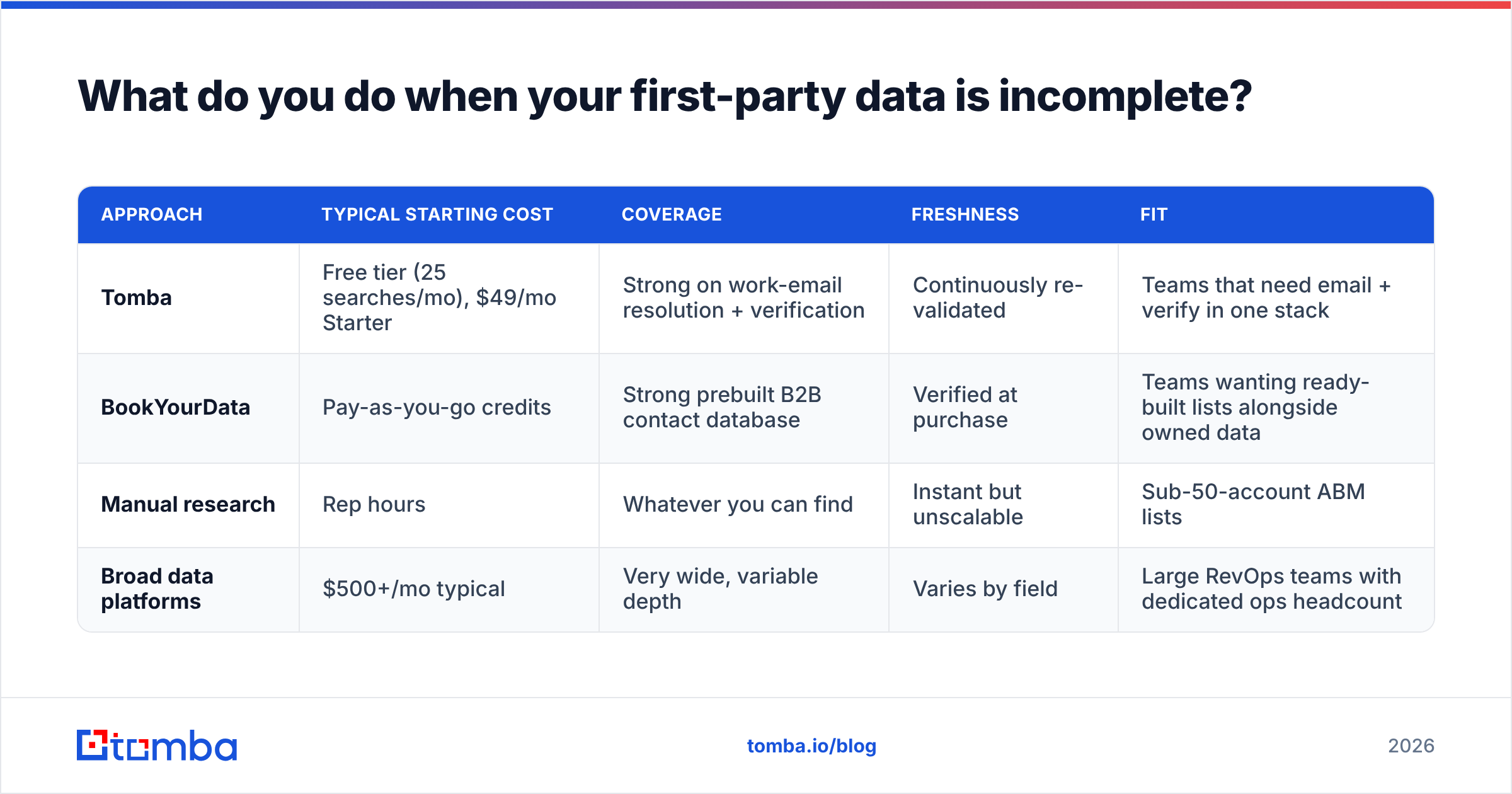
Where should the enrichment layer come from? Options split along cost and coverage:
| Approach | Typical starting cost | Coverage | Freshness | Fit |
|---|---|---|---|---|
| Tomba | Free tier (25 searches/mo), $49/mo Starter | Strong on work-email resolution + verification | Continuously re-validated | Teams that need email + verify in one stack |
| BookYourData | Pay-as-you-go credits | Strong prebuilt B2B contact database | Verified at purchase | Teams wanting ready-built lists alongside owned data |
| Manual research | Rep hours | Whatever you can find | Instant but unscalable | Sub-50-account ABM lists |
| Broad data platforms | $500+/mo typical | Very wide, variable depth | Varies by field | Large RevOps teams with dedicated ops headcount |
BookYourData is a reasonable complement when you need net-new coverage in a segment you get no traffic from. It does the prebuilt-list job well. Tomba's angle is different. It resolves and verifies contacts against domains and names you already have, which is exactly the shape of the first-party gap-filling problem. Full Tomba pricing starts free and scales to Growth at $99/mo and Pro at $249/mo.
For volume work, run gap-filling as a batch job instead of one record at a time. The bulk email finder and the Tomba API both handle list-level enrichment, so your first-party records get completed on ingest rather than six weeks later.
How do you measure whether your first-party data program is working?#
Row count is a vanity metric. Four numbers matter:
Activation rate. Of the records you collected last quarter, what share entered a campaign, sequence, or sales conversation? Below 40% means you're collecting data you have no plan for.
Completeness rate. What share of records have every field your routing rules require? A lead with no company size can't be routed, so it can't be worked.
Deliverability on collected records. Bounce rate on first-party records should sit under 2%. Above that, your forms are accepting garbage or your records have aged out.
Time-to-usable. Days between capture and the record being enriched, scored, routed, and in front of a human. Most teams sit at three weeks. Sub-48-hours is achievable, and it roughly doubles connect rates on inbound.
Put these in a dashboard your GTM leadership actually looks at. A program nobody measures reverts to a spreadsheet graveyard within two quarters.
Where should you start this quarter?#
Pick one collection channel and one gap-filling method. That's it.
Week 1–2: instrument your highest-traffic page and add one well-designed gated asset with granular consent. Week 3–4: wire a verification step so nothing enters your CRM unverified. Week 5–8: add product telemetry or structured call capture, depending on your motion. Week 9+: build the activation dashboard.
Teams that fail at this try to build a customer data platform first. Teams that succeed collect two hundred good records, activate them, prove the lift, and then earn the budget for infrastructure. That is how to collect first party data without stalling for a year.
Ready to close the gaps in the data you already own? Most first-party records arrive incomplete — a name and a domain, or a domain and nothing else. The Tomba Email Finder resolves verified work emails from the names and domains your funnel already captured. The free tier gives you 25 searches a month, so you can test it on real data before you pick a plan. Run it against a hundred existing records and see how many were one field away from being workable.
Related guides#
Ready to find emails that actually work?
Join 150,000+ professionals who stopped guessing and started sending. Free credits on signup — no credit card required.
Get the Tomba newsletter
Practical outbound tactics and product updates — once every two weeks.
About the author