How to Divide Sales Territories: A 2026 Playbook for RevOps
Territory design decides more of your quota attainment than your pitch deck does. Here are five division models, the data you need before you draw a single line, and the math that keeps reps from fighting over accounts.
TL;DR
- How to divide sales territories is a data problem first and a map problem second. If you cannot count and score your accounts, any split you draw is guesswork.
- Five models dominate: geographic, industry, account-size, named-account, and hybrid. Most teams above 8 reps end up hybrid.
- Balance on workload and opportunity, not headcount. Equal account counts with unequal pipeline mean half your reps miss quota.
- Rebalance on a fixed cadence — annual in stable markets, twice a year in fast ones. Write the handoff rule down. Ad-hoc reshuffles destroy trust.
- Budget 2–4 weeks for data prep: enrichment, deduplication, and contact coverage checks. That step is where most territory plans quietly fail.
How to divide sales territories: what it actually means#
Dividing sales territories means giving each rep a defined slice of your market. No overlaps. Every account has exactly one owner, and every rep has a fair shot at quota.
Think of newspaper delivery routes. You don't give each carrier the same number of houses. You give each one the same number of minutes on foot. Some routes are dense apartment blocks. Others are spread-out suburbs. Equal house counts would be unfair. Equal effort is the goal.
Territory design works the same way. The unit you balance on is not accounts. It is workload (how much time coverage takes) and opportunity (how much revenue is really there). Get both right and comp plans, forecasts, and quotas get easier. Get them wrong and you spend the year settling account disputes.
Research from Forrester and practitioner data cited across G2 point the same way. Teams that plan territories formally hit quota more often than teams that let coverage just happen. The reason is simple. Formal planning surfaces the accounts nobody was calling.
What data do you need before drawing any lines?#
Do this step first. Every model below assumes a clean, enriched account list. Most teams don't have one. They find that out three weeks into rollout.
Start with these four inputs:
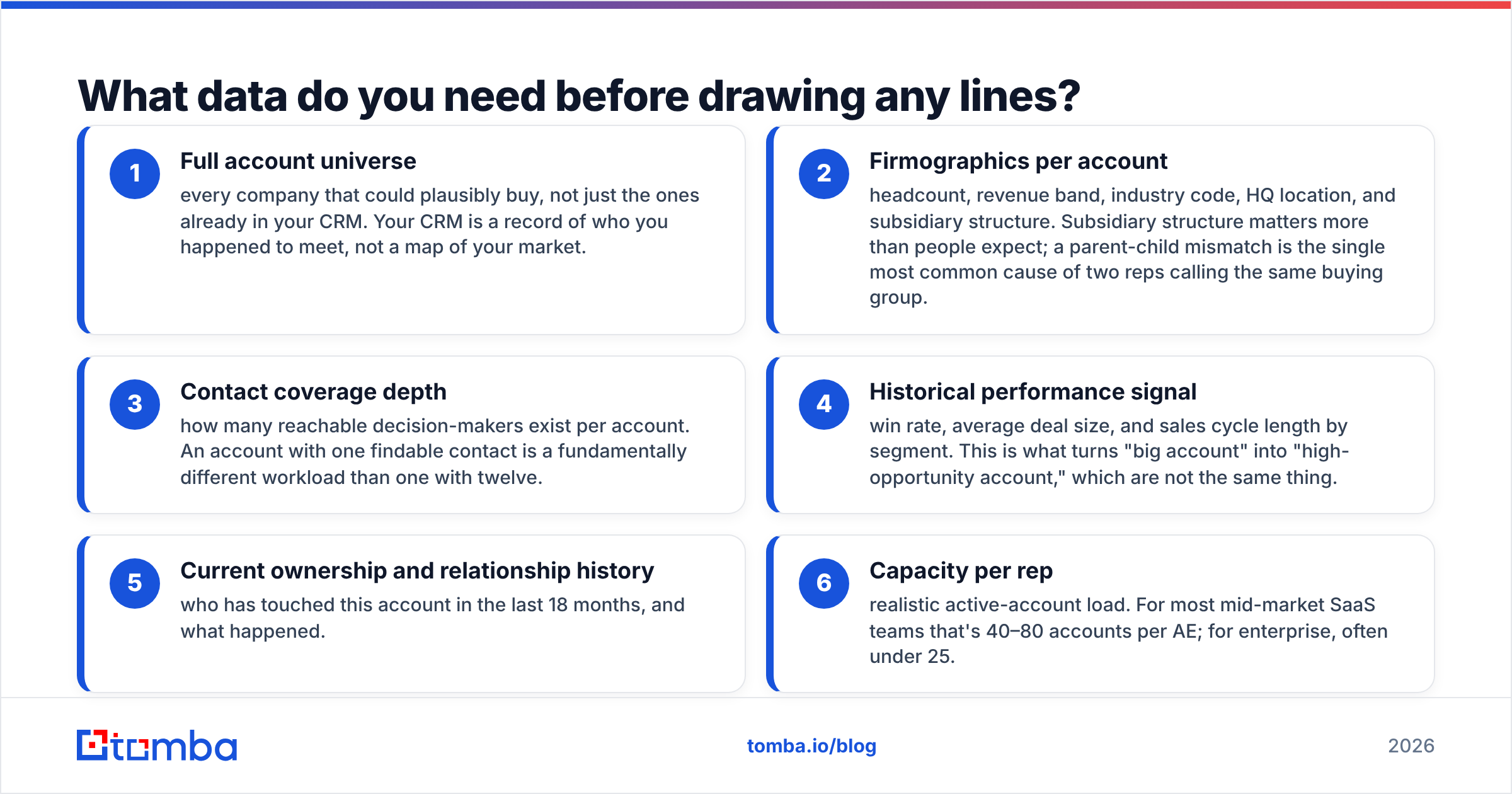
- Full account universe — every company that could plausibly buy, not just the ones already in your CRM. Your CRM records who you happened to meet. It is not a map of your market.
- Firmographics per account — headcount, revenue band, industry code, HQ location, and parent-child structure. Subsidiary structure matters more than people expect. A parent-child mismatch is the top cause of two reps calling the same buying group.
- Contact coverage depth — how many reachable decision-makers each account has. An account with one findable contact is a different workload than one with twelve.
- Historical performance signal — win rate, average deal size, and cycle length by segment. This is what turns "big account" into "high-opportunity account." They are not the same thing.
Then layer on the ownership and capacity picture:
- Current ownership and relationship history — who touched this account in the last 18 months, and what happened.
- Capacity per rep — a realistic active-account load. Mid-market SaaS teams run 40–80 accounts per AE. Enterprise teams often stay under 25.
Items 2 and 3 are where data enrichment earns its keep. Run your raw account list through a domain search to count reachable contacts per company. That turns a flat list of logos into a workload-weighted map.
Reach matters more than size here. An account where you can reach the VP of Ops, the CFO, and two directors deserves more planning weight than one where you can only reach a generic inbox.

Which territory division models actually work?#
Five models cover almost every real deployment. None is best in every case. The right one depends on how your buyers cluster.
| Model | How you split | Best when | Main failure mode | Typical team size |
|---|---|---|---|---|
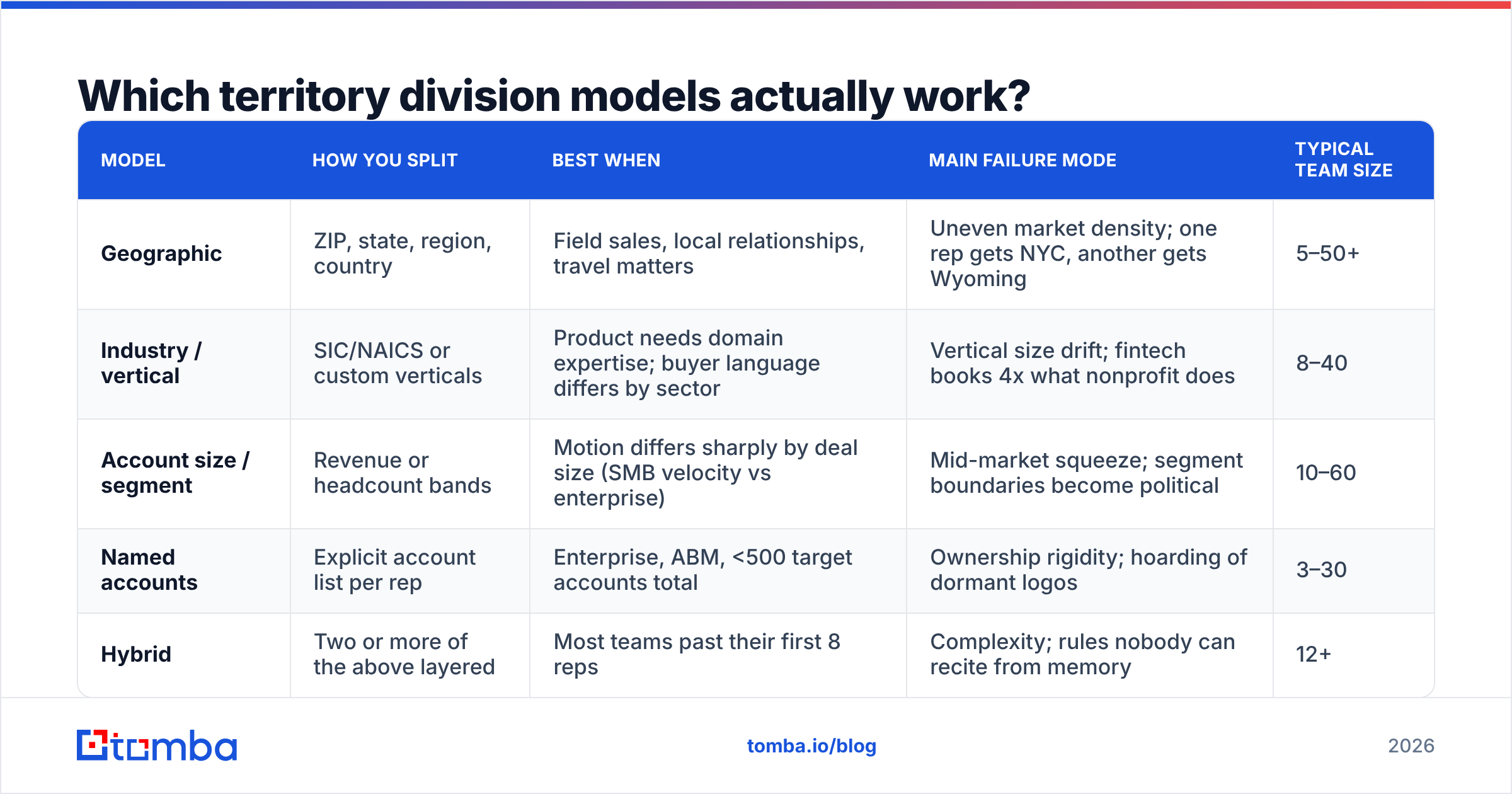
| Geographic | ZIP, state, region, country | Field sales, local relationships, travel matters | Uneven market density; one rep gets NYC, another gets Wyoming | 5–50+ |
| Industry / vertical | SIC/NAICS or custom verticals | Product needs domain expertise; buyer language differs by sector | Vertical size drift; fintech books 4x what nonprofit does | 8–40 |
| Account size / segment | Revenue or headcount bands | Motion differs sharply by deal size (SMB velocity vs enterprise) | Mid-market squeeze; segment boundaries become political | 10–60 |
| Named accounts | Explicit account list per rep | Enterprise, ABM, <500 target accounts total | Ownership rigidity; hoarding of dormant logos | 3–30 |
| Hybrid | Two or more of the above layered | Most teams past their first 8 reps | Complexity; rules nobody can recite from memory | 12+ |
Geographic#
The default. Still the right call when travel, timezone, or local rules shape the sale. Split on ZIP or metro instead of state where you can. State lines rarely match market density. The trap is treating land area as a proxy for opportunity.
Industry / vertical#
Strong when your buyers speak different dialects. A rep who has run twenty healthcare deals closes faster than a generalist. The trap is drift. Verticals grow at different rates, so a balanced split in January is lopsided by September.
Account size / segment#
The cleanest match between motion and territory. SMB reps run volume. Enterprise reps run depth. The trap is the mid-market line. Accounts that cross it mid-cycle spark ownership fights unless you wrote the rule down first.
Named accounts#
The enterprise standard. Each rep gets a finite list. It works well with account-based marketing. The trap is dormancy. Reps hold accounts they have not touched in a year. Add a "use it or release it" clause.
Hybrid#
What most teams actually run. Geography at the top level, verticals or segments underneath. That is fine, as long as the rule fits on one slide. If a new rep cannot say the ownership rule in one sentence, it is too complex.
How do you balance territories fairly?#
Balance on a score, not a headcount. Here is a formula you can build in a spreadsheet today.
Territory Opportunity Score = (Addressable Accounts × Avg Deal Size × Segment Win Rate) − Coverage Cost
Coverage Cost is a rough proxy for effort: accounts × average touches to first meeting, adjusted for travel or timezone friction.
Run every candidate territory through it. Aim for scores within ±15% of each other. Any wider and your comp plan does the apologizing.
Start with three scoring steps:
- Score every account on opportunity (deal size × fit × propensity) and effort (contacts needed, cycle length, travel).
- Sum scores into candidate territories using the model you picked.
- Check the spread. Sort territories by total score. If the top is more than 1.3x the bottom, redraw.
Then pressure-test the draft before anyone sees a map:
- Stress-test the edges. Look at the 20 accounts sitting nearest each boundary. Those are your future disputes. Assign them explicitly by name.
- Check capacity. A territory with a great score, 200 accounts, and one rep is not a territory. It is a wish.
- Publish the rule and the map together. Reps accept a tough draw when they can see the logic.
One more thing quietly kills balance: duplicate accounts. The same company shows up as "Acme Corp," "Acme Corporation," and "acme.com." It gets counted three times and split across two reps. Run a deduplicate pass before you score anything.
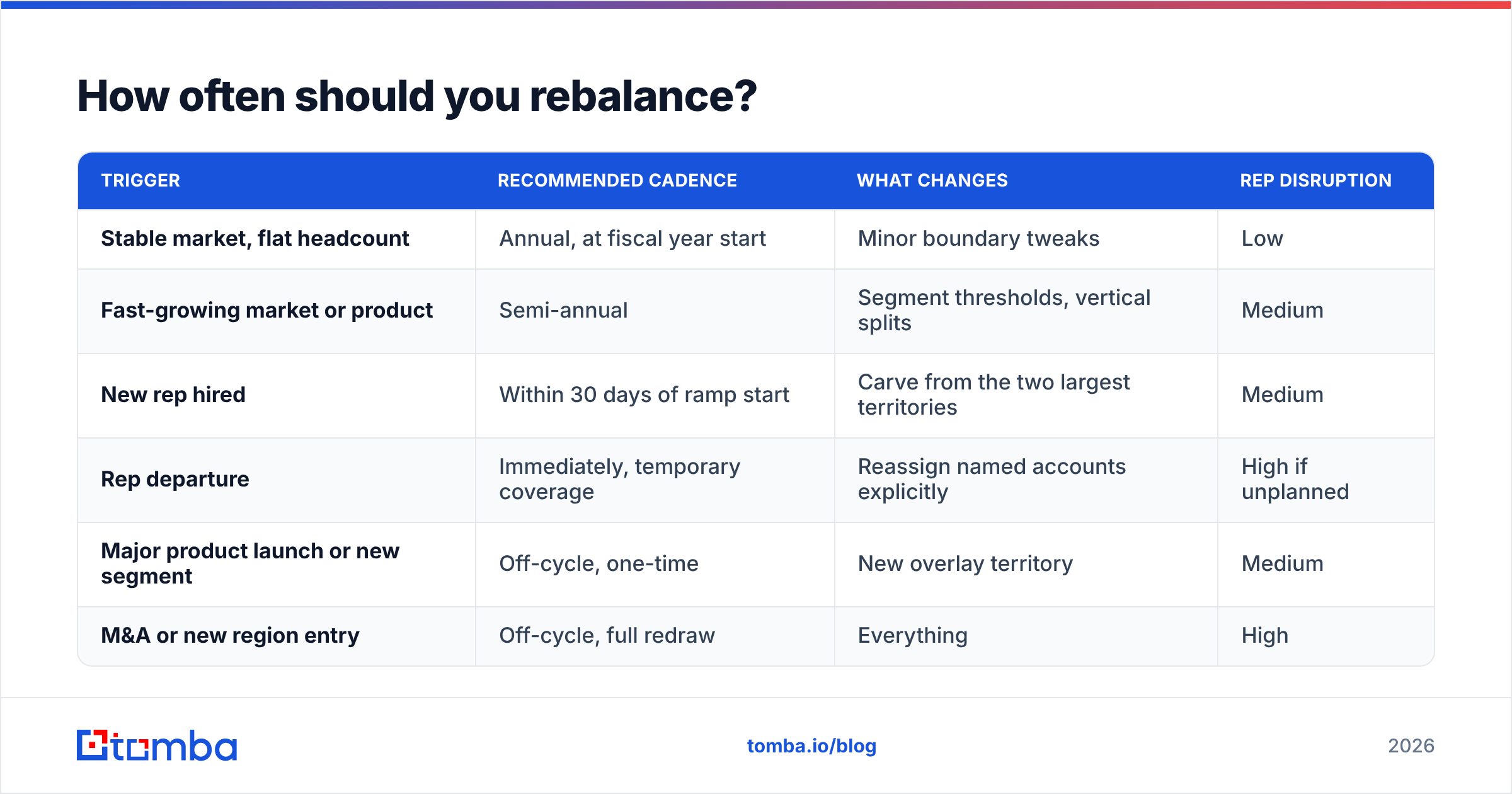
How often should you rebalance?#
On a schedule, announced ahead of time. The cadence matters less than the predictability.
| Trigger | Recommended cadence | What changes | Rep disruption |
|---|---|---|---|
| Stable market, flat headcount | Annual, at fiscal year start | Minor boundary tweaks | Low |
| Fast-growing market or product | Semi-annual | Segment thresholds, vertical splits | Medium |
| New rep hired | Within 30 days of ramp start | Carve from the two largest territories | Medium |
| Rep departure | Immediately, temporary coverage | Reassign named accounts explicitly | High if unplanned |
| Major product launch or new segment | Off-cycle, one-time | New overlay territory | Medium |
| M&A or new region entry | Off-cycle, full redraw | Everything | High |
Two rules make rebalancing survivable:
- Grandfather in-flight deals. Any opportunity past a set stage stays with the original rep through close. Put the stage in the policy, not in a Slack thread.
- Give 30 days' notice. Reps need time to hand off relationships. Surprise reassignments are the fastest way to lose your best AE.
What tools do you need to execute this?#
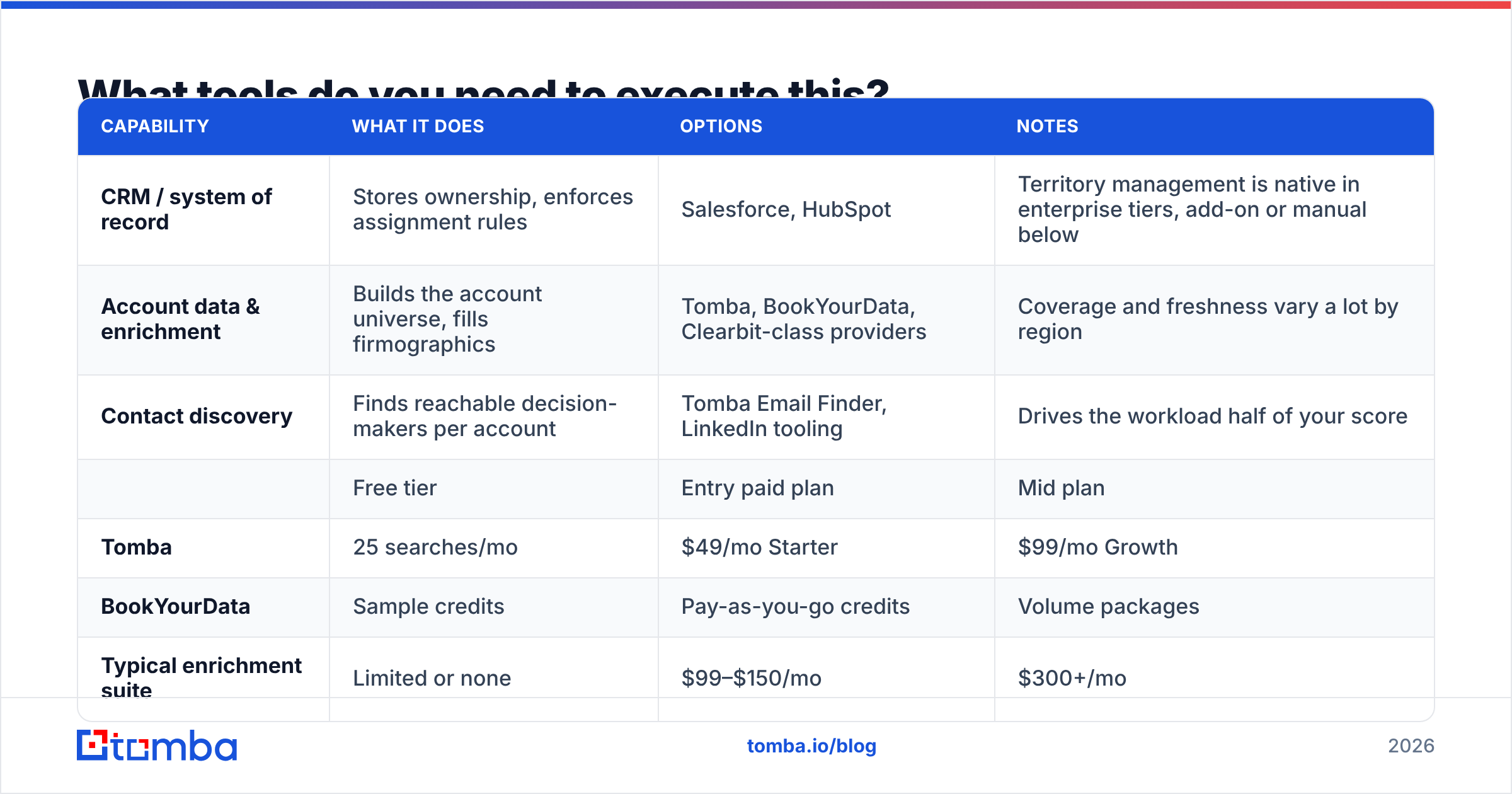
You need three capabilities. They may or may not live in the same tool.
| Capability | What it does | Options | Notes |
|---|---|---|---|
| CRM / system of record | Stores ownership, enforces assignment rules | Salesforce, HubSpot | Territory management is native in enterprise tiers, add-on or manual below |
| Account data & enrichment | Builds the account universe, fills firmographics | Tomba, BookYourData, Clearbit-class providers | Coverage and freshness vary a lot by region |
| Contact discovery | Finds reachable decision-makers per account | Tomba Email Finder, LinkedIn tooling | Drives the workload half of your score |
For the data layer, pricing shapes what is feasible. A 5,000-account territory map means thousands of lookups. At that scale, per-credit cost stops being an abstraction.
| Free tier | Entry paid plan | Mid plan | Fits territory work when | |
|---|---|---|---|---|
| Tomba | 25 searches/mo | $49/mo Starter | $99/mo Growth | You need bulk domain-level contact counts and API access |
| BookYourData | Sample credits | Pay-as-you-go credits | Volume packages | You want a prepaid list without a subscription commitment |
| Typical enrichment suite | Limited or none | $99–$150/mo | $300+/mo | You need intent signals layered on firmographics |
Both approaches work. BookYourData's credit model suits a one-time territory build. You buy what you need and stop. A subscription with API access suits teams that re-run coverage checks each quarter and wire enrichment into the CRM. Check current Tomba pricing before you budget, since credit allowances shift.
The workflow most RevOps teams land on:
- Export or build the account universe (CRM export plus market list).
- Enrich firmographics and dedupe.
- Count contacts per domain to get workload weight.
- Score, split, and stress-test boundaries in a sheet.
- Load ownership back into the CRM with an effective date.
- Verify contacts before reps start dialing. A territory full of bounced addresses looks like a rep problem, but it is a data problem. An email verifier pass here saves weeks of misplaced blame.
What mistakes should you avoid?#
Most plans fail on the data side first:
- Balancing on account count. The most common error. 200 accounts in a crowded metro is not the same as 200 in a greenfield region.
- Ignoring existing relationships. A rep with three warm champions at an account you are about to reassign carries value no score captures. Handle it by exception, but handle it.
- Drawing territories before cleaning data. Duplicates, dead domains, and closed businesses inflate some territories and not others.
The rest are process failures:
- No written boundary rule. Decide in advance who owns an account that grows from 400 to 600 employees. Otherwise you decide it in a heated meeting.
- Overlapping named accounts across overlays. Product specialists and AEs both "owning" an account, with no defined primary, creates duplicate outreach. Buyers notice.
- Rebalancing reactively. Every off-cycle redraw teaches reps that today's pipeline may not be theirs tomorrow. That belief shows up in prospecting effort within a quarter.
- Skipping the capacity check. Balanced territories that each need 300 touches a week are a plan for burnout, not coverage.
How do you roll it out without losing the team?#
Sequence it deliberately. This is the part of how to divide sales territories that most plans skip.
Week 1–2: Build and clean the account universe. Enrich, dedupe, and count reachable contacts.
Week 3: Score accounts and draft two or three candidate splits. Do not show reps a single option. Alternatives make the logic visible.
Week 4: Review with frontline managers, not just leadership. Managers know which accounts are actually warm.
Week 5: Publish the map, the rule, and the effective date together. Include the grandfathering policy and the dispute process in the same document.
Week 6: Effective date. Run a weekly boundary-dispute review for the first month, then drop to monthly.
Track two metrics afterward. Attainment variance across territories should tighten. Ownership disputes per month should fall to near zero by month three. If variance stays wide after two quarters, your scoring model is wrong, not your reps.
Ready to build the data layer under your territory map?#
Territory design lives or dies on the account data underneath it. Before you draw a line, you need two numbers per account: how many companies are genuinely addressable, and how many decision-makers you can actually reach at each one.
That is the job the Tomba Email Finder does. Domain-level contact discovery turns a flat list of logos into a workload-weighted map you can split fairly. Start on the free tier with 25 searches and test coverage against your own list. Scale into Starter at $49/mo or Growth at $99/mo once you run full territory builds. Your reps will argue about plenty this year. Do not let the map be one of them.
Related guides#
// get started
Find, verify and enrich your first contacts today
Start on the free plan with 25 searches a month, then scale when your team is ready.
Free plan · No credit card required · GDPR & CCPA
// about the author