How to Drive Revenue With Intent Data: A 2026 Playbook
Intent data only makes money when it triggers a specific action within hours. Here is the 6-step operating system for turning surge signals into pipeline — plus what to ignore.
TL;DR
- Intent data does not create demand. It reprioritizes the demand that already exists — so the revenue comes from speed of response, not from the signal itself.
- The three signal types (first-party, second-party/bidstream, third-party research co-op) have wildly different accuracy. First-party is the only one you should trust unfiltered.
- A surge signal is worthless without a routable contact. Most teams lose the deal between "Acme is researching CRM migration" and "here is the VP of Ops' verified email."
- Build the loop in this order: define topics → set surge thresholds → resolve accounts to people → verify contacts → route in under 24 hours → measure lift against a holdout.
- Expect a realistic outcome of 1.5-2.5x meeting rate on intent-flagged accounts versus cold, not the 10x figure vendors quote.
What is intent data, really?#
Intent data is a record of what buying-committee members at a company are reading, searching, and clicking before they ever talk to you. Think of it like a bookstore clerk noticing the same customer standing in the espresso-machine aisle three days in a row. The clerk did not create the interest. She just knows who to approach first.
Technically, intent data is aggregated content-consumption behavior mapped to a company (via IP resolution, cookie/ID graphs, or publisher logins) and scored against a topic taxonomy. When consumption of a topic exceeds an account's own historical baseline, the vendor flags a "surge."
Three things follow from that definition, and most failed intent programs ignore all three:
- It is account-level, not person-level. You learn that someone at Acme read four articles about data warehouses. You do not learn who. Every dollar of ROI depends on closing that gap.
- It is a baseline delta, not an absolute. A 5,000-person enterprise always consumes some content. The signal is the deviation, which is why raw "topic reads" columns are noise.
- It decays fast. Research bursts typically resolve into a shortlist within two to four weeks. A signal you action on day 21 is worth a fraction of the same signal on day 2.
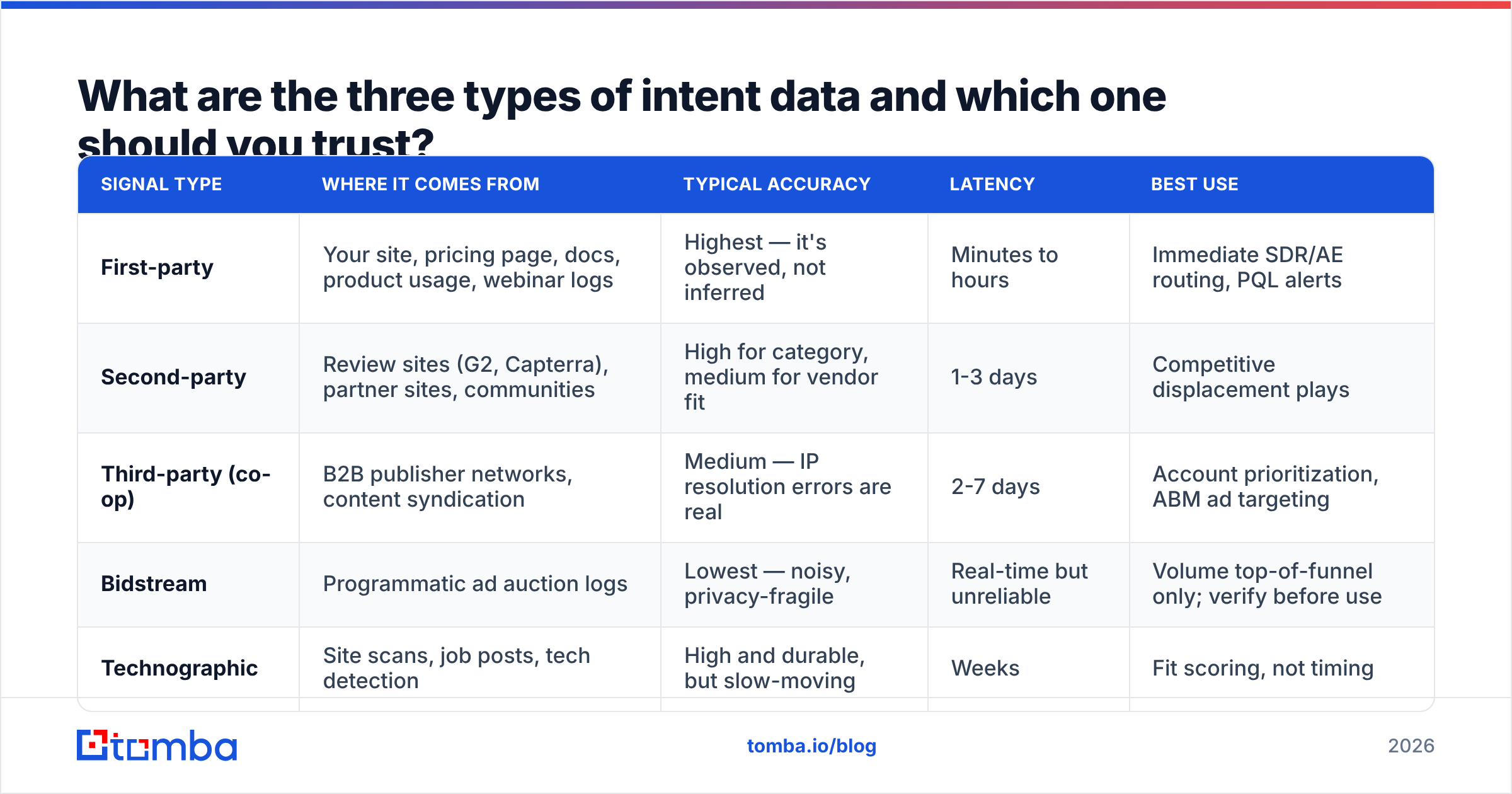
What are the three types of intent data and which one should you trust?#
Not all intent is created equal, and the pricing does not track the accuracy. Here is the honest breakdown.
| Signal type | Where it comes from | Typical accuracy | Latency | Best use |
|---|---|---|---|---|
| First-party | Your site, pricing page, docs, product usage, webinar logs | Highest — it's observed, not inferred | Minutes to hours | Immediate SDR/AE routing, PQL alerts |
| Second-party | Review sites (G2, Capterra), partner sites, communities | High for category, medium for vendor fit | 1-3 days | Competitive displacement plays |
| Third-party (co-op) | B2B publisher networks, content syndication | Medium — IP resolution errors are real | 2-7 days | Account prioritization, ABM ad targeting |
| Bidstream | Programmatic ad auction logs | Lowest — noisy, privacy-fragile | Real-time but unreliable | Volume top-of-funnel only; verify before use |
| Technographic | Site scans, job posts, tech detection | High and durable, but slow-moving | Weeks | Fit scoring, not timing |
The practical rule: use first- and second-party intent to decide who to contact today, and third-party intent to decide which accounts belong in the territory at all. Teams that invert this — buying an expensive third-party feed and asking reps to call every surging account — burn the rep's trust in the data within a quarter, and after that, no amount of dashboard polish brings it back.
G2's Buyer Intent product is a good example of second-party intent that is worth its price because the behavior (comparing you against a named competitor) is unambiguous. Compare that to a bidstream feed that flags an account because an employee's ad-blocker leaked a request from a home IP shared with a coworking space.

How do you turn an intent signal into revenue in six steps?#
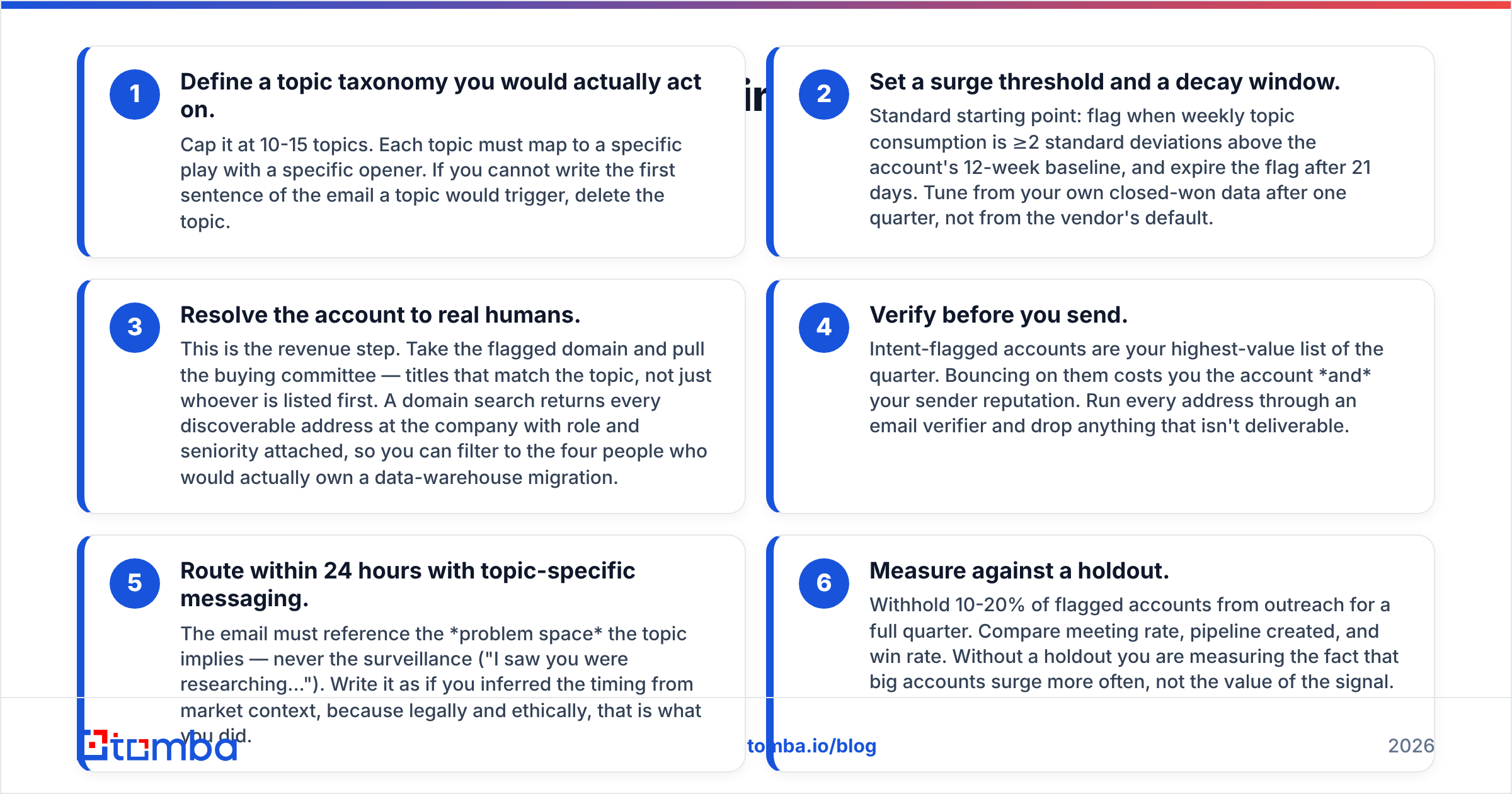
Here is the operating system. Run it in order — skipping step 3 is the single most common failure mode.
- Define a topic taxonomy you would actually act on. Cap it at 10-15 topics. Each topic must map to a specific play with a specific opener. If you cannot write the first sentence of the email a topic would trigger, delete the topic.
- Set a surge threshold and a decay window. Standard starting point: flag when weekly topic consumption is ≥2 standard deviations above the account's 12-week baseline, and expire the flag after 21 days. Tune from your own closed-won data after one quarter, not from the vendor's default.
- Resolve the account to real humans. This is the revenue step. Take the flagged domain and pull the buying committee — titles that match the topic, not just whoever is listed first. A domain search returns every discoverable address at the company with role and seniority attached, so you can filter to the four people who would actually own a data-warehouse migration.
- Verify before you send. Intent-flagged accounts are your highest-value list of the quarter. Bouncing on them costs you the account and your sender reputation. Run every address through an email verifier and drop anything that isn't deliverable.
- Route within 24 hours with topic-specific messaging. The email must reference the problem space the topic implies — never the surveillance ("I saw you were researching..."). Write it as if you inferred the timing from market context, because legally and ethically, that is what you did.
- Measure against a holdout. Withhold 10-20% of flagged accounts from outreach for a full quarter. Compare meeting rate, pipeline created, and win rate. Without a holdout you are measuring the fact that big accounts surge more often, not the value of the signal.
Why do most intent programs stall at step 3?#
Because "Acme Corp is surging on topic X" is not something a rep can act on. It is a company name. The rep still has to find the right five people, get their addresses, confirm they're valid, and write something relevant — and by the time that manual work is done, the surge window is half gone.
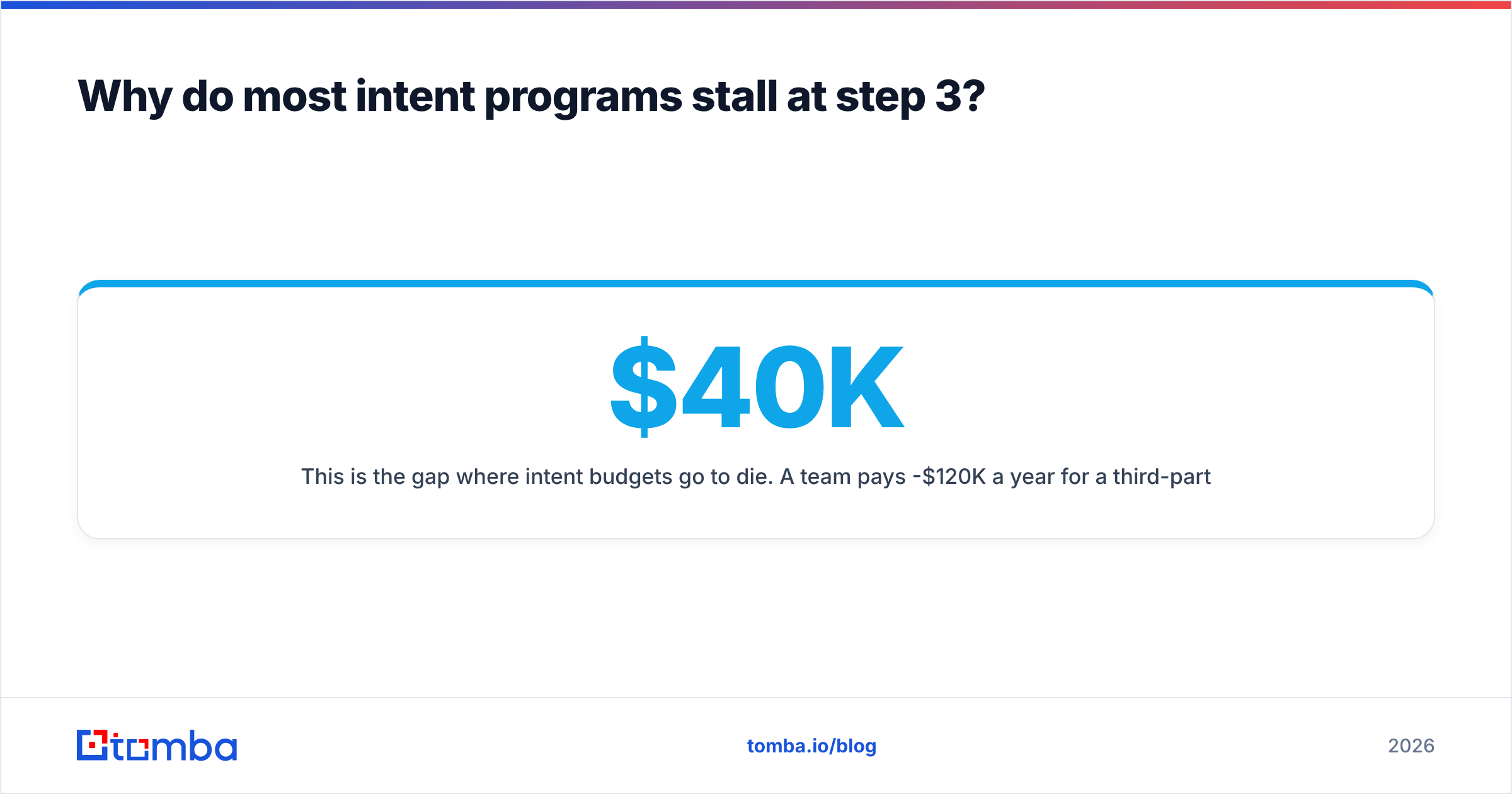
This is the gap where intent budgets go to die. A team pays $40K-$120K a year for a third-party feed, dumps the flagged accounts into a CSV, and hands it to SDRs who spend 40% of their week doing contact discovery by hand. The signal was fine. The activation layer was missing.
Fixing it means treating contact resolution as an automated pipeline stage, not a rep task:
- Enrich the domain automatically the moment a surge fires — pull decision-maker emails, titles, and LinkedIn profiles into your CRM record without a human in the loop. A bulk email finder or the Tomba API can process the full flagged-account list in one pass.
- Filter by title relevance to the topic, not by generic seniority. A "container orchestration" surge routes to platform engineering, not to the CFO.
- Verify in the same run. Deliverability checks are cheap compared to a burned domain.
- Push the finished contact set to the sequencer with the topic name as a merge field, so the rep opens a pre-contextualized task instead of a blank research assignment.

How should you write to an intent-flagged account?#
Differently than you think. The temptation is to reveal the signal. Resist it — "I noticed your team has been researching X" reads as creepy, invites a privacy question you don't want to answer on the first touch, and is often wrong at the person level anyway (the surge may have come from a colleague three floors away).
Better structure, in four beats:
- Open on the trigger's implied problem. "Most ops teams that outgrow spreadsheet-based routing hit the same wall around 40 reps." No surveillance, full relevance.
- Name a specific peer outcome. One customer, one number, one timeframe. Vague social proof is worse than none.
- Make one narrow ask. A 12-minute call about one question, not "a quick chat to explore synergies."
- Give them an exit. "If routing isn't a priority this quarter, tell me and I'll close the loop."
Send it from a warmed domain with clean authentication. If your SPF, DKIM, and DMARC are not in order, intent data just helps you land in more spam folders faster. Check your SPF record before you scale sends, and read HubSpot's guidance on deliverability fundamentals if inbox placement is already shaky.
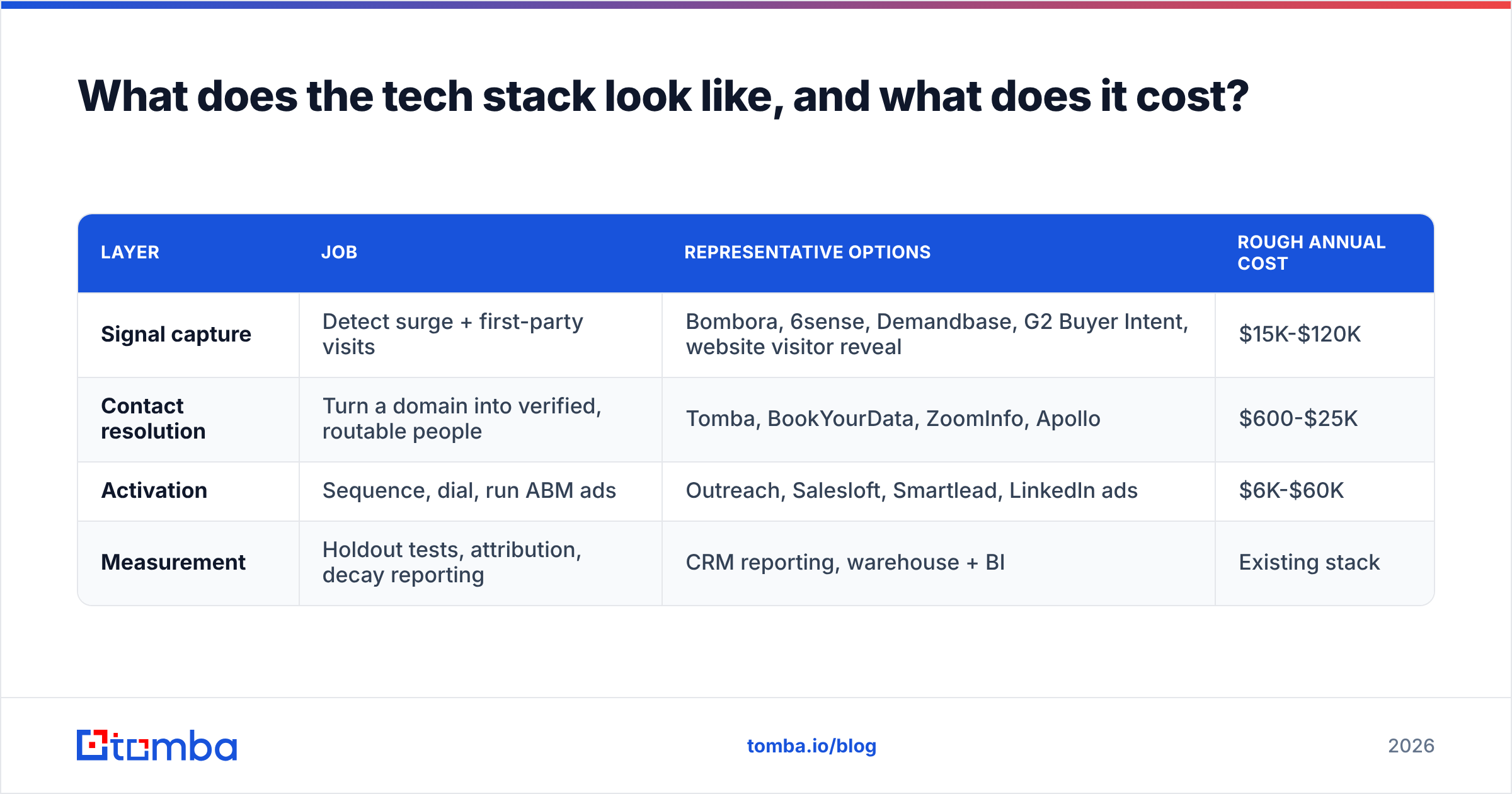
What does the tech stack look like, and what does it cost?#
You need four layers. Most teams over-invest in layer one and under-invest in layer two, which is exactly backwards.
| Layer | Job | Representative options | Rough annual cost |
|---|---|---|---|
| Signal capture | Detect surge + first-party visits | Bombora, 6sense, Demandbase, G2 Buyer Intent, website visitor reveal | $15K-$120K |
| Contact resolution | Turn a domain into verified, routable people | Tomba, BookYourData, ZoomInfo, Apollo | $600-$25K |
| Activation | Sequence, dial, run ABM ads | Outreach, Salesloft, Smartlead, LinkedIn ads | $6K-$60K |
| Measurement | Holdout tests, attribution, decay reporting | CRM reporting, warehouse + BI | Existing stack |
On the resolution layer specifically, the price spread is enormous for similar output. Tomba starts free at 25 searches a month, with Starter at $49/mo, Growth at $99/mo, and Pro at $249/mo — enough to resolve a few thousand flagged accounts per quarter without a procurement cycle. BookYourData is a solid choice if you want pre-built, region-filtered lists you can buy outright rather than query on demand; the two solve slightly different problems and plenty of teams run both. Enterprise platforms bundle resolution into a six-figure contract, which makes sense only if you also need their intent and orchestration layers.
See full Tomba pricing if you're sizing the resolution layer against a specific account volume.
A useful sanity check before you sign anything: Forrester's B2B research on intent consistently finds that intent programs underperform when they're bought as a data purchase rather than built as a process change. The vendor is not the variable. The 24-hour routing SLA is.
How do you measure whether intent data actually drove revenue?#
Four metrics, in this order of trustworthiness:
- Holdout lift on meeting rate. Flagged-and-worked accounts versus flagged-and-withheld. This is the only clean causal read you will get. Expect 1.5-2.5x if the program is healthy.
- Time-to-first-touch on flagged accounts. Your leading indicator. If the median is above 72 hours, fix operations before you renegotiate the data contract.
- Win rate delta. Slower to read (a full sales cycle), but the number that justifies renewal.
- Signal precision. Of accounts flagged, what percentage were genuinely in-market on a topic you sell? Sample 50 by hand each quarter and ask the rep. Under 30% precision means your topic taxonomy is too broad or your feed is bidstream-heavy.
What to ignore: total flagged accounts, topic volume charts, and anything the vendor's dashboard shows as a growing green line. Volume is a cost, not an achievement.
What are the common mistakes to avoid?#
- Treating intent as a lead source. It is a prioritization layer over accounts you already targeted. If a surging account fails your ICP fit criteria, it is still not a customer.
- Buying topics you don't sell. Broad topics inflate flag counts and destroy precision.
- No decay rule. Stale flags accumulate until the list is indistinguishable from your full TAM.
- Skipping verification. High-value list plus unverified addresses equals bounce rate spike right when it hurts most.
- Revealing the signal in the email. Creepy, legally awkward, and frequently wrong at the individual level.
- No holdout. Without it, every intent renewal conversation is a matter of opinion.
Getting the activation layer right#
Intent data tells you when. It never tells you who, and "who" is where the revenue is. The teams that make intent pay for itself are the ones that shrink the distance between a surge alert and a verified decision-maker in a sequence from days to minutes.
That's the job of Tomba's Email Finder: feed it a flagged domain and the titles your topic implies, get back verified, deliverable addresses for the people who actually own the problem — via the app, the API, or a bulk run over your whole surge list. Start on the free tier with 25 searches to test it against last quarter's flagged accounts, and see how many of them you could have reached while the window was still open.
Related guides#
// get started
Find, verify and enrich your first contacts today
Start on the free plan with 25 searches a month, then scale when your team is ready.
Free plan · No credit card required · GDPR & CCPA
Get the Tomba newsletter
Product and data updates
// about the author