How to End an Email to a Client: Sign-Offs That Get Replies
Your closing line decides whether a client replies today or forgets you by Friday. Here are the sign-offs, CTAs, and P.S. lines that actually move deals — plus the ones killing your reply rate.
TL;DR
- The sign-off word ("Best," vs "Regards,") matters far less than the closing sentence directly above it — that line carries the ask.
- End with one specific, low-friction request — a yes/no question or a two-option time slot beats "let me know your thoughts" every time.
- Match formality to the relationship stage: cold first touch, active project, renewal, and escalation each need a different close.
- "Thanks in advance" and "Just following up" measurably underperform. Replace them with a deadline or a reason.
- A closing block has four parts: value recap → CTA → sign-off → signature. Skip any one and the reply rate drops.
Why does the end of an email decide whether a client replies?#
Because it's the last thing they read before deciding what to do. Everything above your closing line is context. The closing line is instruction.
Think of it like ending a phone call. If you hang up with "anyway, talk soon," nothing happens. If you hang up with "I'll send the revised scope by Thursday — can you confirm the budget ceiling before then?" both people know exactly what happens next. Email works identically, except the client is skimming on a phone between meetings and gives your message maybe eight seconds.
Most sales and account emails fail at the bottom, not the top. The pitch is fine. The context is fine. Then the writer runs out of nerve and closes with "Let me know if you have any questions!" — which asks the client to invent the next step themselves. Busy people don't invent next steps. They archive.
Your closing block is doing three jobs at once:
- Reducing decision cost — the ask should take under 30 seconds to satisfy.
- Setting a clock — a soft deadline or a named date stops the message from sliding into "later."
- Signalling relationship stage — a first-touch close and a fourth-month close should not read the same.
What are the four parts of a strong email closing?#
Every high-performing client email ends with the same structure, whether it's a cold pitch or a project update:
- Value recap (optional, one line) — remind them what's in it for them, not what you need. "This should cut about six hours a week off your reporting."
- The CTA — a single, specific, answerable request. One ask. Never two.
- The sign-off — the word or short phrase before your name. Formality dial, nothing more.
- The signature block — name, role, company, one link. Not five links, not a quote, not a legal disclaimer nobody reads.
That order matters. Value before ask makes the ask feel earned. Ask before sign-off keeps it in the reader's short-term memory when they hit reply.
Which sign-offs work best for client emails in 2026?#
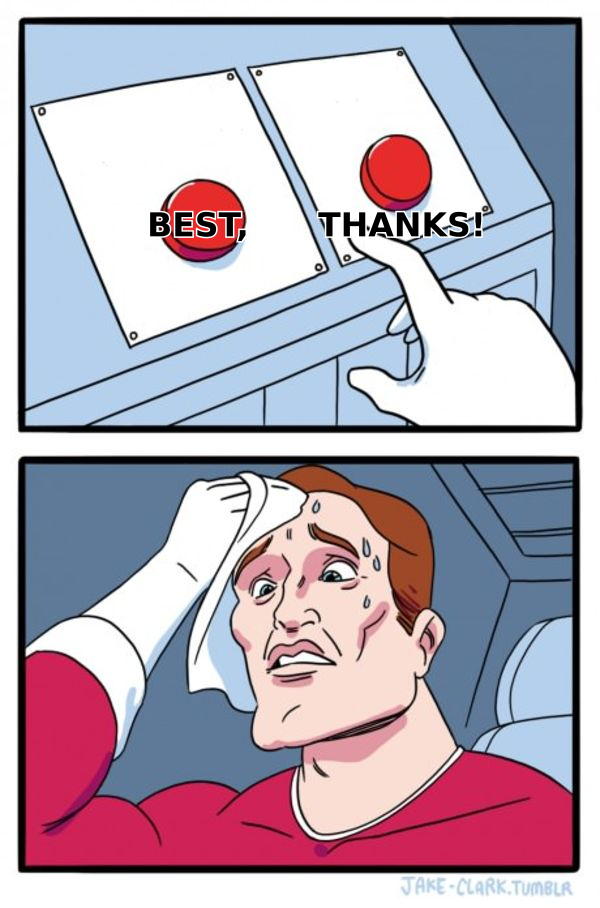
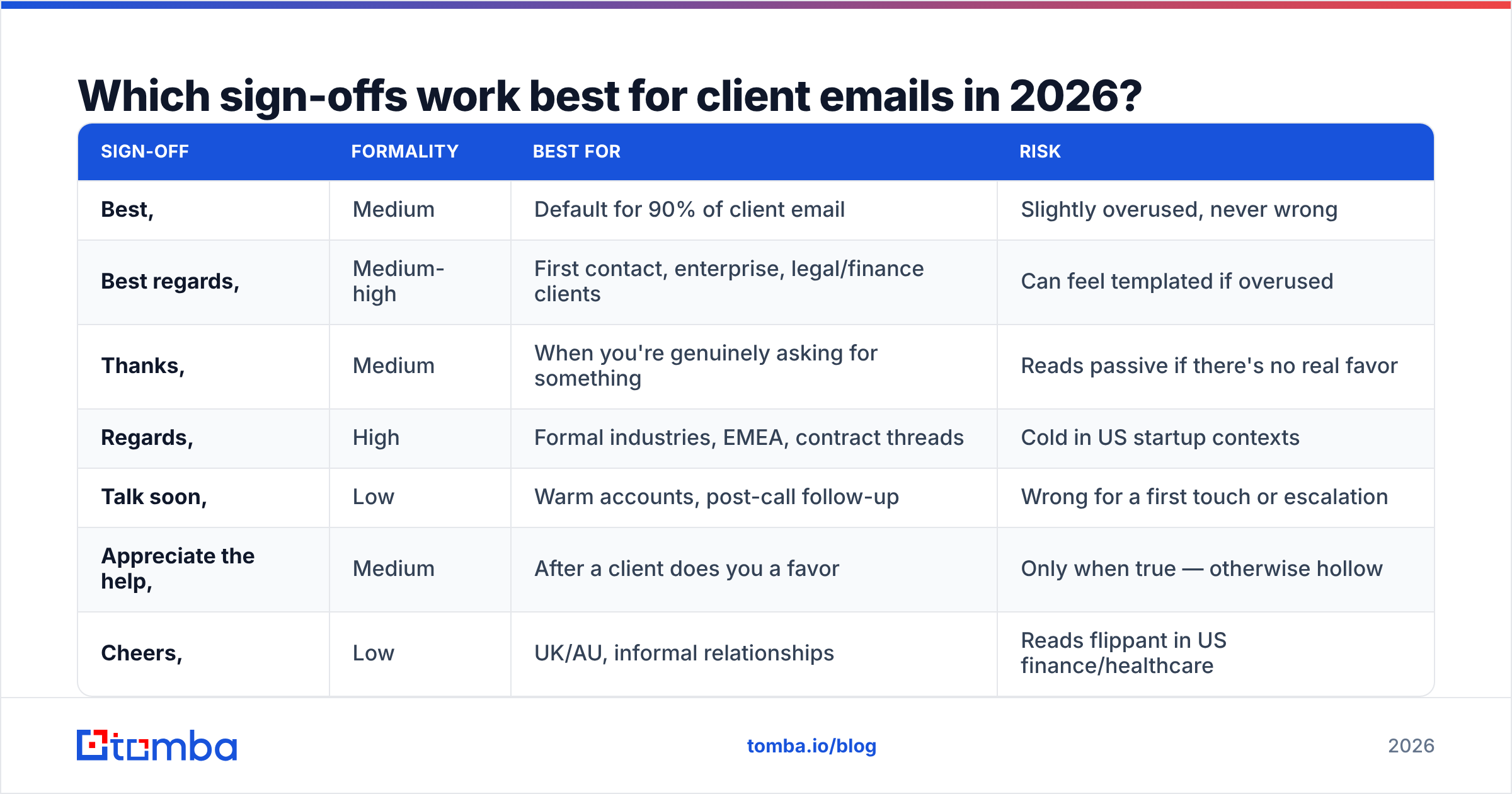
Here's the honest ranking. Sign-off choice is low-stakes compared to your CTA, but the wrong one still creates friction — either it reads as stiff, or it reads as if you don't take the account seriously.
| Sign-off | Formality | Best for | Risk |
|---|---|---|---|
| Best, | Medium | Default for 90% of client email | Slightly overused, never wrong |
| Best regards, | Medium-high | First contact, enterprise, legal/finance clients | Can feel templated if overused |
| Thanks, | Medium | When you're genuinely asking for something | Reads passive if there's no real favor |
| Regards, | High | Formal industries, EMEA, contract threads | Cold in US startup contexts |
| Talk soon, | Low | Warm accounts, post-call follow-up | Wrong for a first touch or escalation |
| Appreciate the help, | Medium | After a client does you a favor | Only when true — otherwise hollow |
| Cheers, | Low | UK/AU, informal relationships | Reads flippant in US finance/healthcare |
| Sincerely, | Very high | Contracts, formal notices, disputes | Stiff and dated in day-to-day email |
Two hard rules. First, never use "Yours truly," "Warmest regards," or "Respectfully yours" in B2B unless you're writing a legal notice — they read as either archaic or sarcastic. Second, do not end without any sign-off in a client relationship under six months old; bare-name closes signal familiarity you haven't earned yet.
The one gray zone is "Thanks in advance." It presumes compliance before the client has agreed to anything. Some readers find it efficient; a meaningful share find it pushy. When in doubt, split it: make the ask in the CTA line, then close with a plain "Thanks,".
How should the closing CTA change by relationship stage?#
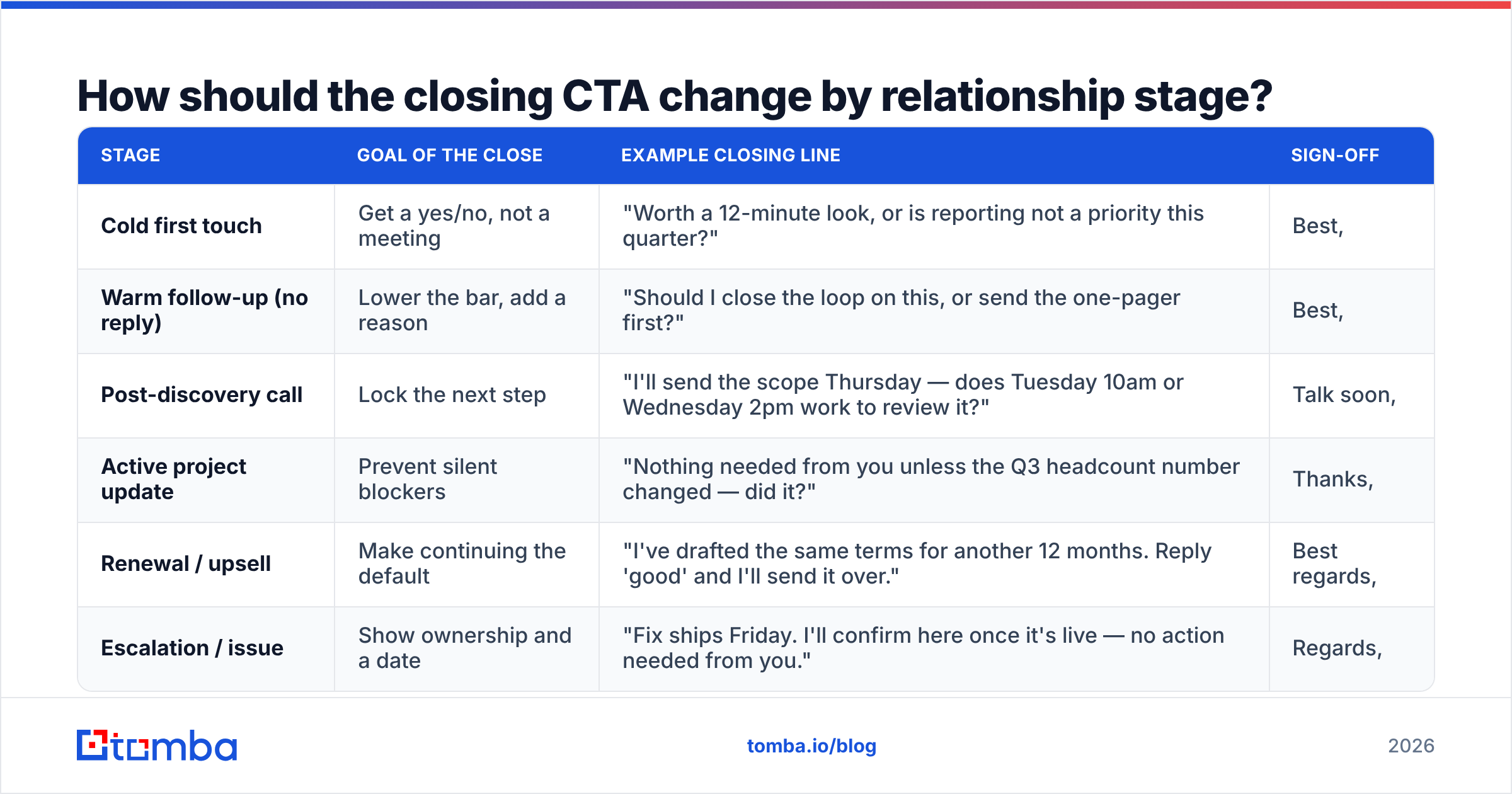
This is where most writers copy-paste one closing across every situation and wonder why the cold ones underperform. The stage of the relationship changes what a reasonable ask even looks like.
| Stage | Goal of the close | Example closing line | Sign-off |
|---|---|---|---|
| Cold first touch | Get a yes/no, not a meeting | "Worth a 12-minute look, or is reporting not a priority this quarter?" | Best, |
| Warm follow-up (no reply) | Lower the bar, add a reason | "Should I close the loop on this, or send the one-pager first?" | Best, |
| Post-discovery call | Lock the next step | "I'll send the scope Thursday — does Tuesday 10am or Wednesday 2pm work to review it?" | Talk soon, |
| Active project update | Prevent silent blockers | "Nothing needed from you unless the Q3 headcount number changed — did it?" | Thanks, |
| Renewal / upsell | Make continuing the default | "I've drafted the same terms for another 12 months. Reply 'good' and I'll send it over." | Best regards, |
| Escalation / issue | Show ownership and a date | "Fix ships Friday. I'll confirm here once it's live — no action needed from you." | Regards, |
Notice what the strong lines share: they're answerable in one word or one click. "Yes." "Tuesday." "Good." A close that requires the client to compose a paragraph is a close that gets postponed indefinitely.
For cold outreach specifically, HubSpot's sales research has long pointed at the same pattern — interest-based questions outperform meeting requests on first touch, because "are you the right person?" costs the reader nothing while "do you have 30 minutes Thursday?" costs them a calendar decision.
What closing lines should you stop using?#
These are the six most common reply-rate killers, and what to write instead.
- "Let me know your thoughts." — No specific ask, no deadline. Replace with a binary question: "Does the phased rollout work, or do you need it all live in January?"
- "Just following up." — Adds zero new information and apologizes for existing. Replace with a reason to reply now: "Circling back because the Q4 onboarding slots close on the 15th."
- "Looking forward to hearing from you." — Puts the burden entirely on the client. Replace with what you'll do: "I'll check back Thursday unless I hear otherwise."
- "Please don't hesitate to reach out." — Filler that says nothing. Delete it; nobody was hesitating.
- "Hope this helps!" — Fine for a support reply, weak for anything with a next step. Replace with the next step.
- "Thanks in advance for your prompt attention to this matter." — Reads as a collections letter. Replace with "Thanks — a yes/no by Friday is all I need."
And one structural mistake: stacking two asks. "Can you confirm the budget, and also let me know who owns procurement?" gets you neither answer. Pick the one that unblocks you and save the other for the reply thread.
How do you write the P.S. line without being gimmicky?#
A P.S. is the second-most-read part of an email after the subject line, because eyes jump to the bottom before reading the middle. That makes it valuable and easy to abuse.
Use a P.S. when you have something true, short, and non-essential:
- Social proof: "P.S. — the Ridgeline team ran this exact setup last quarter; happy to intro you."
- A genuine deadline: "P.S. — pricing on the annual tier changes on Oct 1."
- A low-cost freebie: "P.S. — I pulled the competitor breakdown either way. Want it?"
- A human note: "P.S. — congrats on the Series B, saw it on the wire."
Do not use a P.S. to restate the CTA. That reads as nagging, and it dilutes the ask above it. And never put more than one P.S. in a client email; a P.P.S. in B2B reads as a 2009 infomercial.
Does the signature block affect reply rates?#
Yes, mostly by getting out of the way. A bloated signature pushes your CTA further from the reply button and looks like marketing rather than a person writing to a person.
Keep it to four lines: name, role, company, one link. Add a phone number only if you actually want calls. Skip the inspirational quote, the six social icons, the tracking pixel banner, and the 200-word confidentiality boilerplate unless legal requires it.
If you're standardizing across a team, a consistent block matters more than a clever one — build it once with an email signature generator and roll it out, rather than letting eleven reps improvise eleven layouts. And if your emails go to mobile-heavy audiences, test that the image-free version still reads correctly; many corporate clients block images by default.
One more deliverability note: heavy HTML signatures with multiple images and tracking links raise spam scores. If replies have quietly dropped across the board, run the message through a spam checker before you blame your copy. Sign-off wording can't rescue an email that landed in a junk folder — email deliverability problems look exactly like "the client ignored me."
What does a complete closing block look like?#
Three worked examples, cold to warm.
Cold first touch, mid-market SaaS:
Most ops leads I talk to are pulling this report by hand every Monday. If that's you, I can show what the automated version looks like in about ten minutes.
Is reporting a Q4 priority for your team, or should I check back in January?
Best,
Dana Ruiz
Account Executive, Northline
northline.io
Post-call follow-up:
Recap from today: phased rollout, two seats to start, SSO in phase two.
I'll have the scope doc over by Thursday morning. Does Tuesday 10am or Wednesday 2pm work to walk through it?
Talk soon,
Dana
Renewal:
Year one shipped 14% under the original budget and cut close time by nine days.
I've drafted the same terms for another 12 months. Reply "good" and I'll send it for signature — no call needed unless you want one.
Best regards,
Dana
Each one ends with exactly one question, answerable in a sentence. That's the whole trick.
How do you test which closings actually work for your list?#
Sign-off advice is cheap; your own data is not. Run it properly:
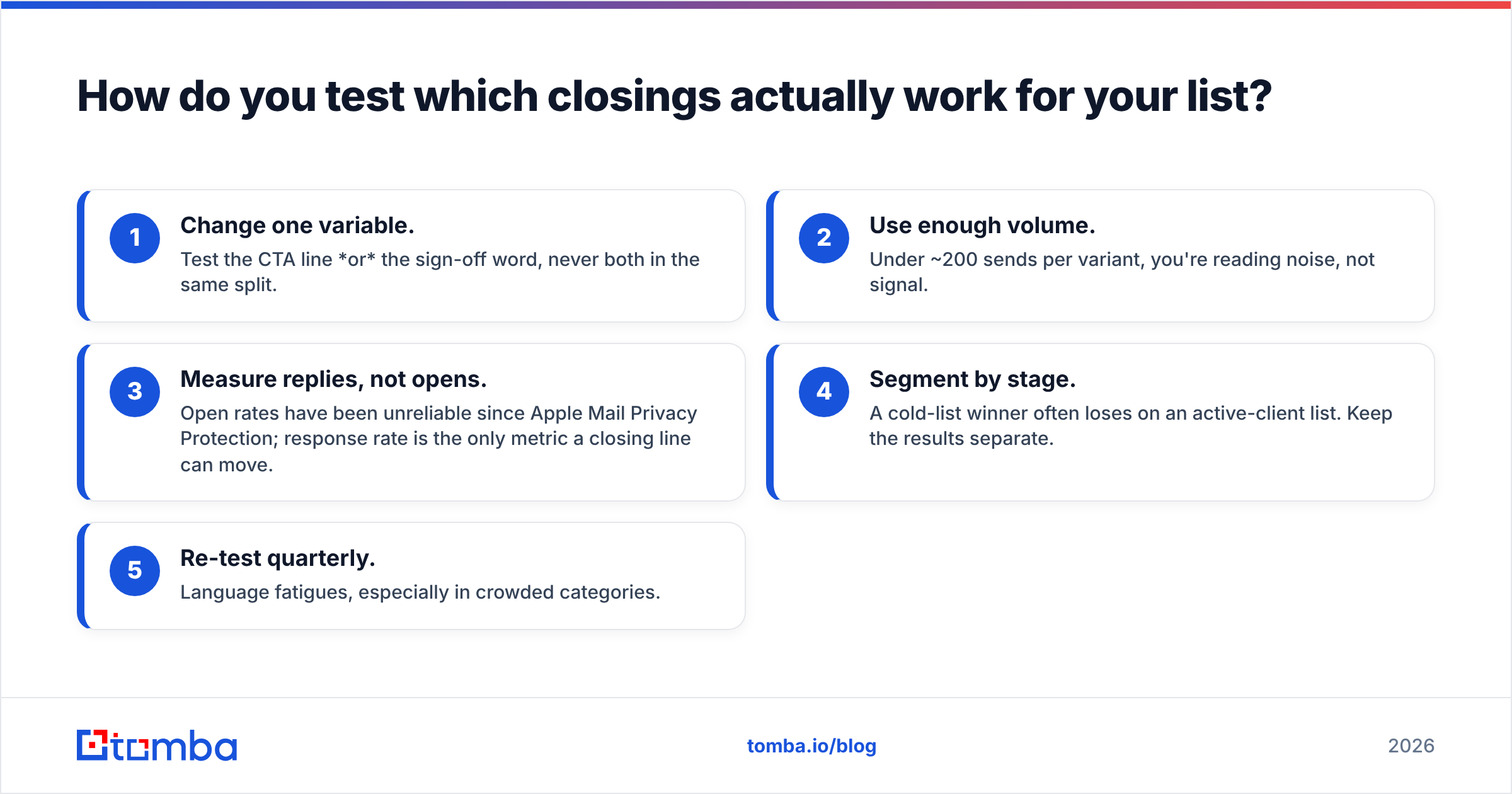
- Change one variable. Test the CTA line or the sign-off word, never both in the same split.
- Use enough volume. Under ~200 sends per variant, you're reading noise, not signal.
- Measure replies, not opens. Open rates have been unreliable since Apple Mail Privacy Protection; response rate is the only metric a closing line can move.
- Segment by stage. A cold-list winner often loses on an active-client list. Keep the results separate.
- Re-test quarterly. Language fatigues, especially in crowded categories.
Two external references worth keeping honest about: vendor benchmark studies (the ones you'll find on G2 category pages) are directional at best, since every dataset skews toward that vendor's customer base. And Gmail's bulk-sender guidelines matter more to your reply rate than any sign-off choice, because they determine whether the email is seen at all.
Also worth noting: the strongest closing line in the world does nothing if the address is wrong. Before you optimize wording, make sure the list is clean — bounced sends damage sender reputation, and a damaged domain quietly suppresses everything you send afterward. Running contacts through an email verifier before a campaign removes the variable entirely.
Quick reference: closing formality by client type#
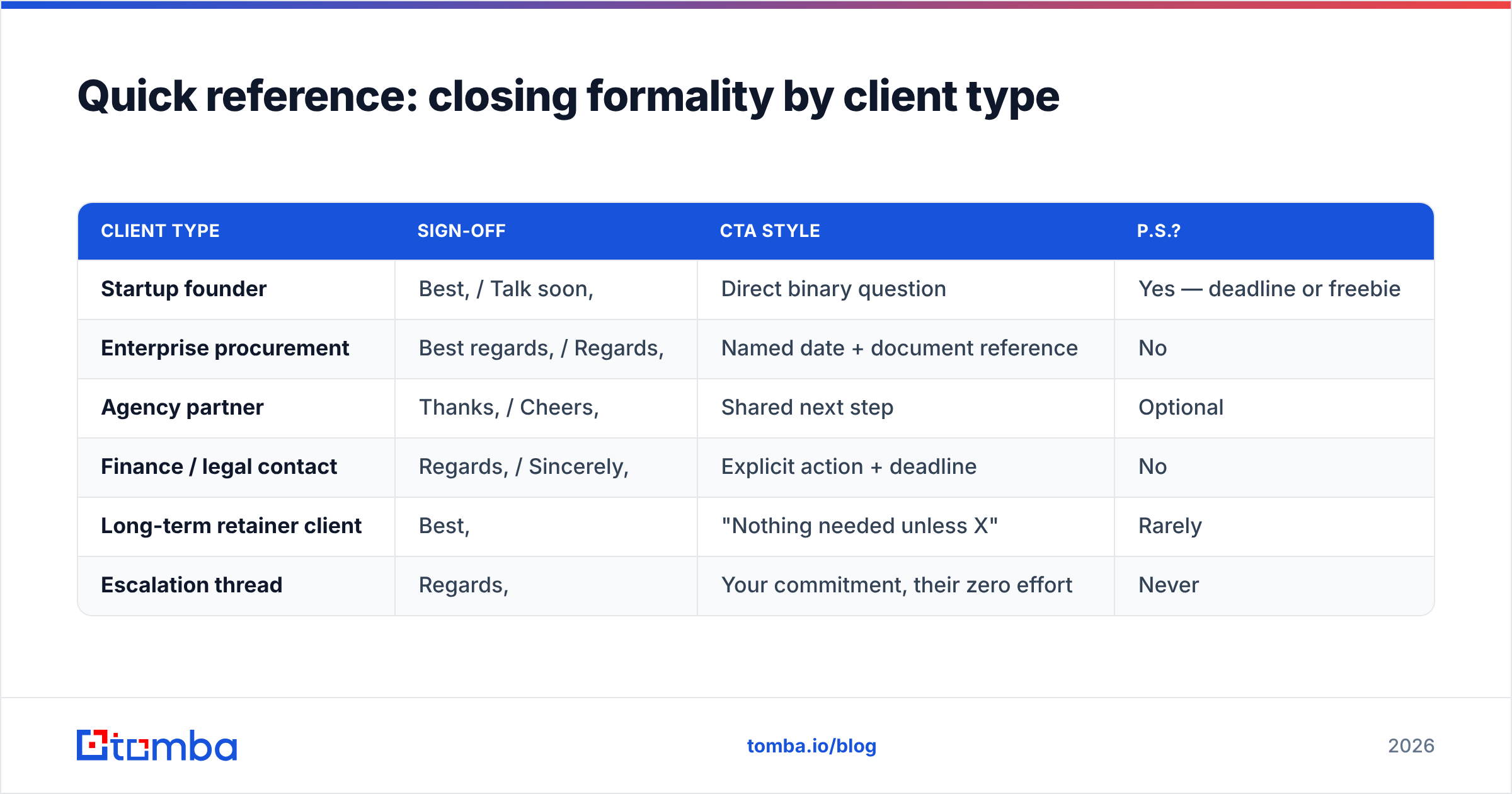
| Client type | Sign-off | CTA style | P.S.? |
|---|---|---|---|
| Startup founder | Best, / Talk soon, | Direct binary question | Yes — deadline or freebie |
| Enterprise procurement | Best regards, / Regards, | Named date + document reference | No |
| Agency partner | Thanks, / Cheers, | Shared next step | Optional |
| Finance / legal contact | Regards, / Sincerely, | Explicit action + deadline | No |
| Long-term retainer client | Best, | "Nothing needed unless X" | Rarely |
| Escalation thread | Regards, | Your commitment, their zero effort | Never |
Use this as a default, then override it based on how the client writes to you. If they close with "cheers" and one-line replies, matching their register beats following a chart.
Where should you go from here?#
Fix the closing line first, then fix the list. Rewrite your five most-used templates so each ends with one binary question and a named date — that alone typically moves reply rate more than any subject-line experiment. Then make sure those carefully written emails are reaching real inboxes.
That's the part most teams skip. If you're reaching out to new client contacts, the Tomba Email Finder gets you verified, deliverable addresses by name and domain, so your closing CTA lands in front of a human instead of bouncing off a dead alias. The free tier covers 25 searches a month, and paid Tomba plans start at $49/mo when you're ready to scale outreach across a full client list.
Related guides#
// get started
Find, verify and enrich your first contacts today
Start on the free plan with 25 searches a month, then scale when your team is ready.
Free plan · No credit card required · GDPR & CCPA
Get the Tomba newsletter
Product and data updates
// about the author