How to End an Email to Get a Response: 2026 Playbook
Your closing line decides whether a prospect replies or archives you. Here are the sign-offs, CTAs, and P.S. lines that actually pull responses in 2026 — plus the ones killing your reply rate.
TL;DR
- The last three lines of your email do more work than the subject line once someone has opened it. That's where the decision to reply or archive happens.
- One question, one action, zero optionality. "Let me know your thoughts" is not a call to action — it's a request for volunteer labor.
- Interest-based CTAs ("Worth a look?") outperform calendar-based CTAs ("Do you have 15 minutes Tuesday at 2pm?") on cold traffic, and flip on warm traffic.
- Sign-offs matter less than people think, but "Thanks in advance" and "Cheers" behave measurably differently by region and seniority.
- None of this matters if the email lands in spam or the address bounces. Verify first, optimize copy second.
You wrote a good email. Relevant trigger, tight middle paragraph, no jargon. Then you closed with "Let me know if you'd like to learn more!" and got nothing.
That ending is the problem. The close is where the reader converts intent into action, and most closes are built to be ignored — they're polite, open-ended, and require the recipient to invent the next step themselves. This guide breaks down exactly how to end an email to get a response: the CTA structures that work, the sign-offs that don't matter as much as LinkedIn thinks, and the mechanical checks that have to pass before any of it counts.
Why does the ending of an email decide whether you get a reply?#
Think of an email like a checkout page. The subject line is the ad, the body is the product description, and the close is the "Buy now" button. You can have a great ad and a great product page, and still get zero conversions because the button says "Learn more about our options" instead of "Buy now."
Readers scan cold email in a predictable pattern: subject → first line → last line → middle (only if the last line was interesting). That means your closing sentence gets read early, out of order, and by people who haven't yet processed your value prop. It has to survive on its own.
Three things happen in a strong close:
- You reduce the decision to one binary. Yes or no, not "what should I do with this."
- You lower the cost of replying. A one-word reply beats a calendar booking on cold traffic.
- You give a reason the reply is worth their time. Not your time. Theirs.
Most closes fail on the first one. When you ask for "thoughts," "feedback," or "a quick chat if it makes sense," you're handing the reader an open-ended writing assignment. They defer. Deferred emails get archived.
What are the CTA types, and which one should you use?#
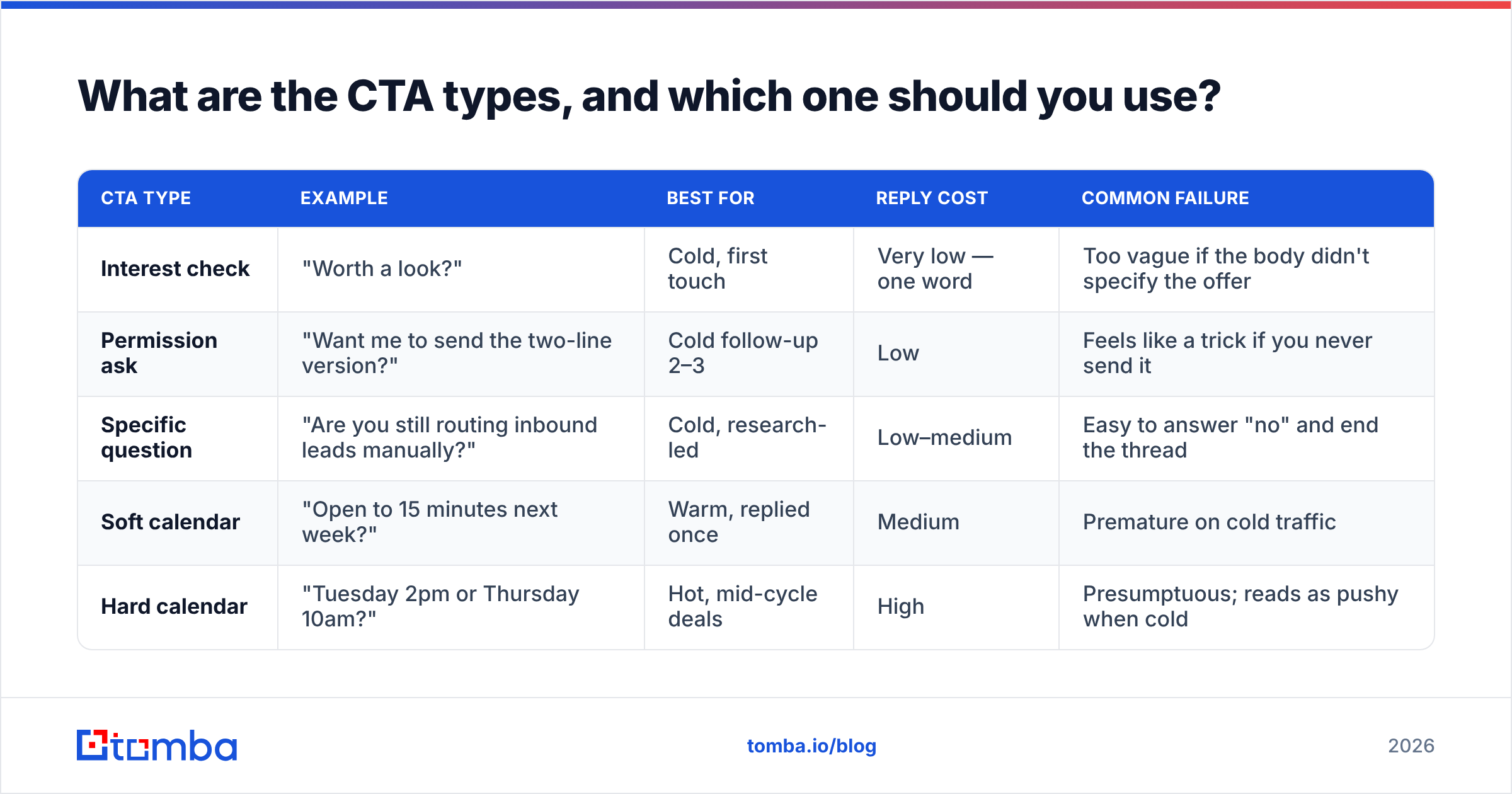
There are five workable closing CTA structures. They are not interchangeable — each fits a different temperature of relationship.
| CTA type | Example | Best for | Reply cost | Common failure |
|---|---|---|---|---|
| Interest check | "Worth a look?" | Cold, first touch | Very low — one word | Too vague if the body didn't specify the offer |
| Permission ask | "Want me to send the two-line version?" | Cold follow-up 2–3 | Low | Feels like a trick if you never send it |
| Specific question | "Are you still routing inbound leads manually?" | Cold, research-led | Low–medium | Easy to answer "no" and end the thread |
| Soft calendar | "Open to 15 minutes next week?" | Warm, replied once | Medium | Premature on cold traffic |
| Hard calendar | "Tuesday 2pm or Thursday 10am?" | Hot, mid-cycle deals | High | Presumptuous; reads as pushy when cold |
The pattern most teams get wrong: they start at hard calendar on email one. You're asking someone who has never heard of you to give up a named slot in their week. The reply cost is enormous relative to the trust you've earned, which is zero.
Start at the low-cost end and escalate as the thread warms. A "Worth a look?" that earns a "sure" is worth more than three unanswered "Tuesday at 2pm?" attempts, because now you have a live thread and permission.
The four rules of a closing CTA#
- One ask only. If you close with a question and a link and a calendar and an attachment, you've created a decision tree. People don't traverse decision trees in an inbox — they close the tab.
- Make the reply shorter than the email. If answering you takes more effort than reading you, the math is against a response.
- Frame value on their side. "So I can show you our platform" is your outcome. "So you can see whether your current list has a bounce problem" is theirs.
- Never end on an apology. "Sorry to bother you" and "I know you're busy" pre-frame the email as an imposition and give the reader permission to treat it as one.
Which sign-off should you actually use?#
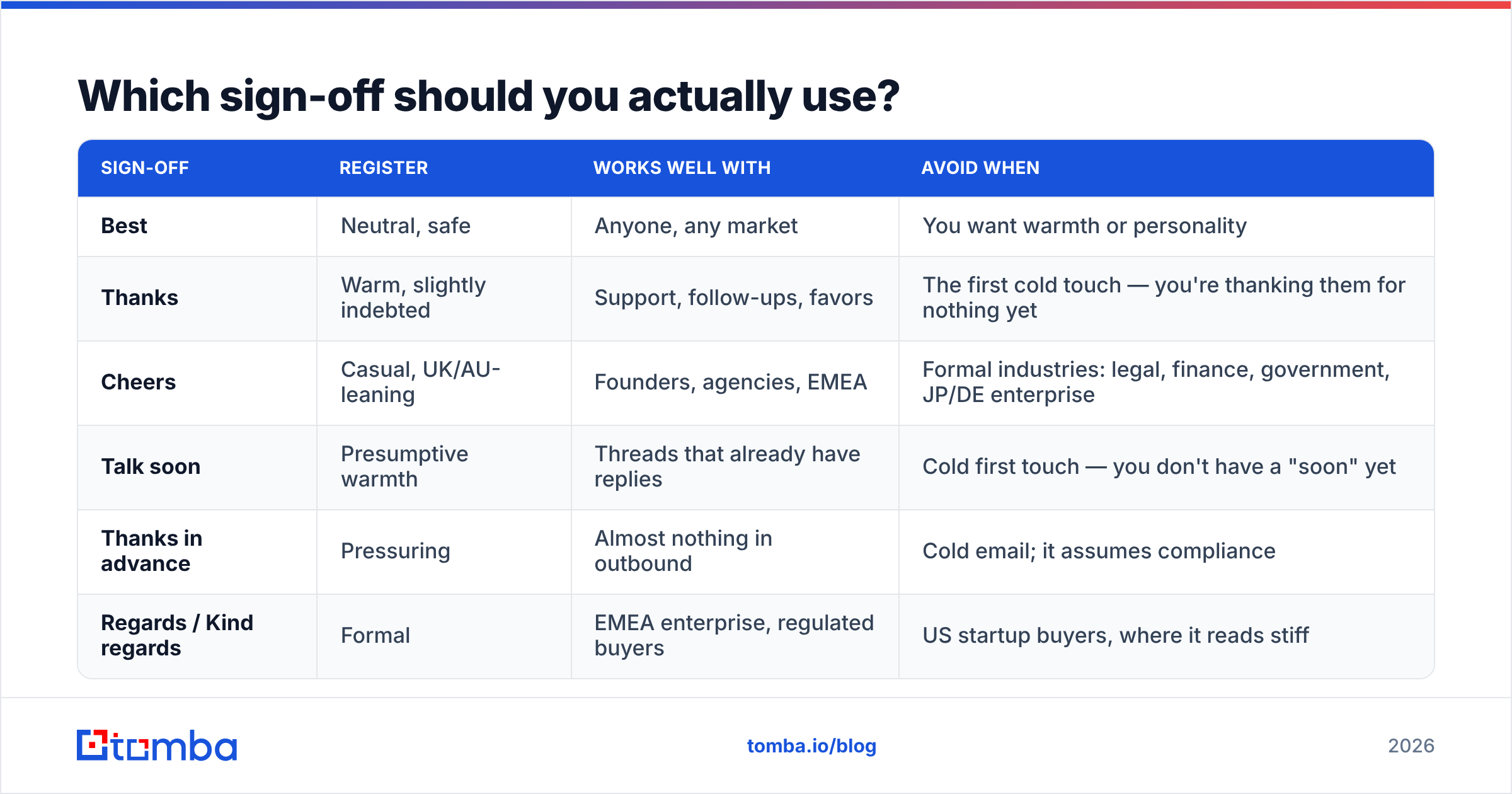
The sign-off is the least important part of the ending, and the part people argue about most. It matters at the margins: it signals register, region, and how much you're trying.
| Sign-off | Register | Works well with | Avoid when |
|---|---|---|---|
| Best | Neutral, safe | Anyone, any market | You want warmth or personality |
| Thanks | Warm, slightly indebted | Support, follow-ups, favors | The first cold touch — you're thanking them for nothing yet |
| Cheers | Casual, UK/AU-leaning | Founders, agencies, EMEA | Formal industries: legal, finance, government, JP/DE enterprise |
| Talk soon | Presumptive warmth | Threads that already have replies | Cold first touch — you don't have a "soon" yet |
| Thanks in advance | Pressuring | Almost nothing in outbound | Cold email; it assumes compliance |
| Regards / Kind regards | Formal | EMEA enterprise, regulated buyers | US startup buyers, where it reads stiff |
The honest read: "Best" and "Thanks" are safe defaults that will never cost you a deal. "Thanks in advance" is the one measurable negative — it presumes the recipient will do what you asked before they've agreed to, and senior buyers notice. If you're testing anything in your sign-off, test removing it entirely in short one-line follow-ups, where a bare first name reads faster and more human.
Your signature block matters more than the sign-off word. Keep it to name, role, company, and one link. Every extra badge, banner image, and social icon adds weight, adds image-load risk, and adds spam-filter surface area. If you need a clean baseline, an email signature generator produces something lightweight enough to not fight your deliverability.
What closing lines actually pull replies?#
Here are seven closing structures that hold up across industries, with the reason each works.
- "Worth a look?" — Three words, binary, zero commitment implied. The highest-response cold closer in most tests because the reply cost is one word.
- "Is this on your roadmap for Q1, or is it a next-year problem?" — Gives a graceful no. Counterintuitively raises replies, because "next-year problem" is an easy, face-saving answer that keeps the thread alive.
- "Want me to send the 90-second version?" — Permission-based. You're asking to send something, not asking for time. Follow through with something genuinely 90 seconds long.
- "Who owns [specific function] on your side these days?" — Routing question. Even a non-buyer can answer it, and a referral from inside the org outperforms a cold touch to the right person.
- "If I'm off base, just say 'not us' and I'll close the loop." — Explicit permission to reject. Reduces the guilt-silence that kills threads and gives you clean list hygiene.
- "Reply with '2' and I'll send the teardown." — Ultra-low friction. Works when the offer in the body is concrete and clearly valuable.
- "Last note from me — should I close this out?" — The breakup close. Reliably the second-highest-reply email in most sequences, because loss aversion does the work.
Notice what none of them do: none say "let me know your thoughts," none stack two asks, and none ask for a calendar slot on the first touch.
What about the P.S. line?#
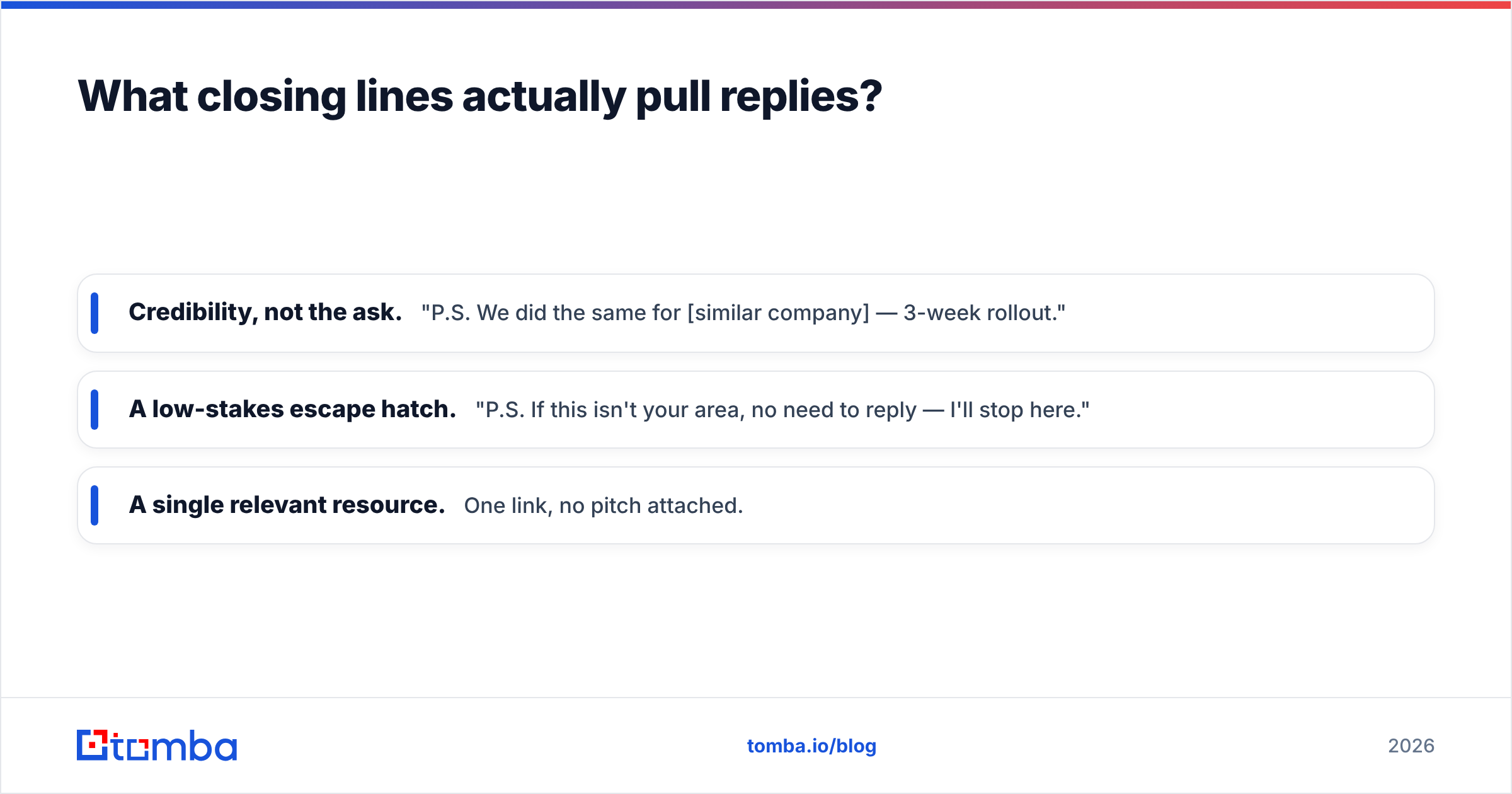
The P.S. is the most-read line in an email after the first line, because it sits visually apart and reads like an aside. Use it for one of three things:
- Credibility, not the ask. "P.S. We did the same for [similar company] — 3-week rollout."
- A low-stakes escape hatch. "P.S. If this isn't your area, no need to reply — I'll stop here."
- A single relevant resource. One link, no pitch attached.
Do not put your primary CTA in the P.S. It splits attention with the close above it and creates the two-ask problem.
How do you follow up without becoming noise?#
Most replies don't come from email one. They come from the third or fourth touch, which means your closing strategy has to escalate across the sequence rather than repeat.
A workable ladder:
- Email 1 — interest check. "Worth a look?"
- Email 2 (day 3) — new angle, permission ask. Different proof point, "want the two-line version?"
- Email 3 (day 7) — specific routing question. "Who owns this on your side?"
- Email 4 (day 12) — soft calendar. Only if there's been any engagement signal.
- Email 5 (day 18) — breakup. "Should I close this out?"
Each one changes the ask. Re-sending "just bumping this up" with the same close is how you train people to filter you. There's no new information in a bump, so there's no new reason to reply.
Two practical constraints. First, keep follow-ups shorter than the original — by email four you should be at two sentences. Second, keep them in-thread. Breaking a new thread for each touch fragments context and looks like a different campaign.
If you want the underlying benchmarks on what "good" looks like before you judge your own numbers, the response rate definition is worth reading alongside your own campaign data — a lot of teams compare against open rates and draw the wrong conclusion.
What kills replies before your closing line ever matters?#
You can write a perfect close and still get nothing, because the email never reached a human. Three mechanical failures dominate.
The address is wrong or dead. A bounce is a non-reply that also damages your sender reputation. If your bounce rate is above 3%, no amount of copy testing will move your reply rate — you're optimizing a broken funnel. Run your list through an email verifier before you send, and treat catch-all domains as a separate risk bucket rather than assuming they're valid.
The email landed in spam. Link count, image weight, spam-trigger phrases, and unauthenticated domains all matter more than sign-off choice. Check your SPF record and DMARC alignment before blaming your CTA. Google's own sender guidelines are the authoritative baseline for bulk senders — read them, don't guess.
You emailed the wrong person. The best close in the world fails against someone with no authority and no pain. Routing questions ("who owns this?") partially rescue this, but the real fix is upstream targeting.
That upstream step is where most reply-rate problems actually live. If you're building lists by guessing patterns like first.last@company.com, you're sending a meaningful percentage of your volume into the void. Tools that resolve and verify the address before send — Tomba, Hunter, BookYourData, and similar providers — solve a different problem than copy testing, and it's the one that has to be solved first.
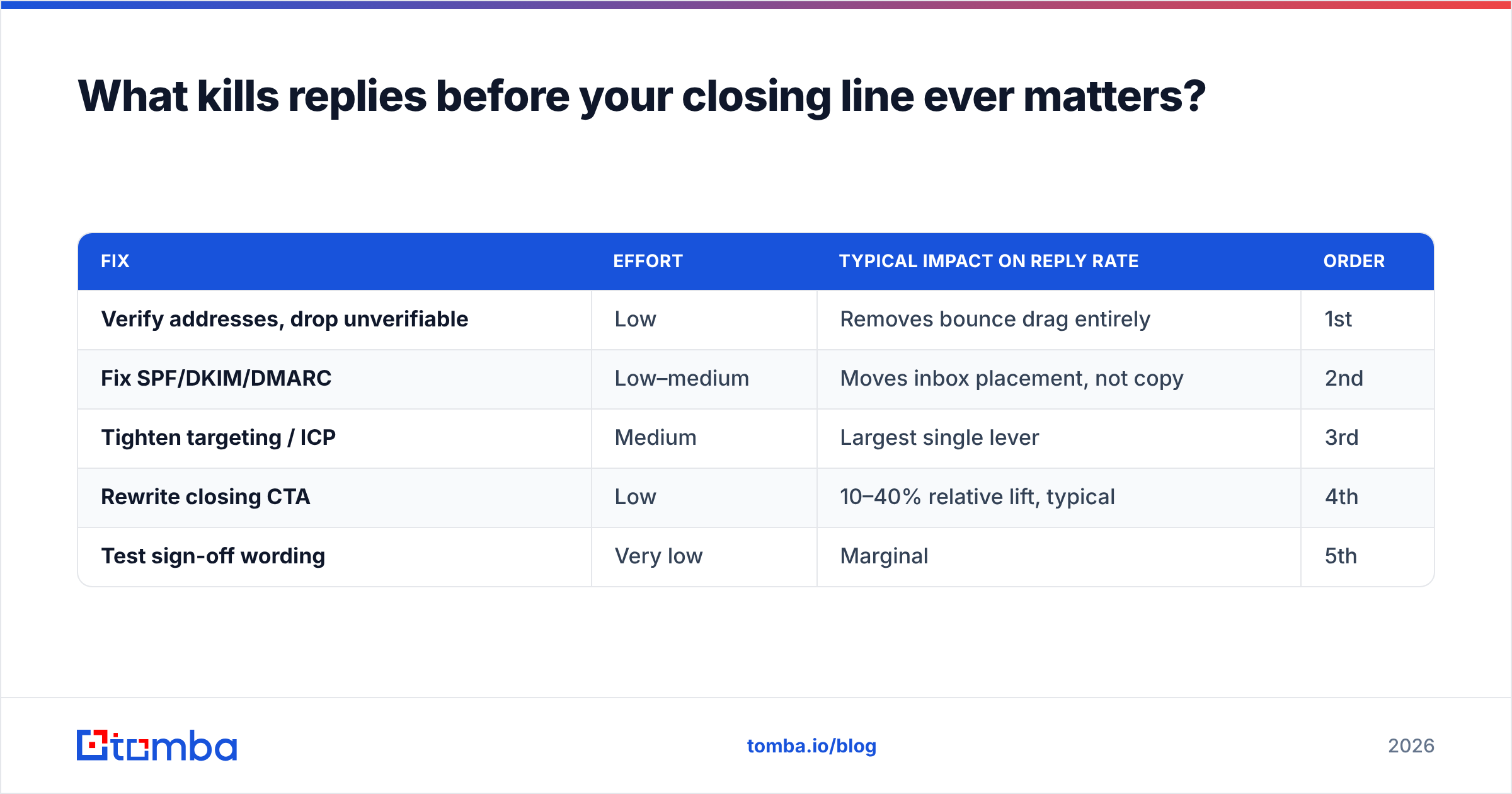
| Fix | Effort | Typical impact on reply rate | Order |
|---|---|---|---|
| Verify addresses, drop unverifiable | Low | Removes bounce drag entirely | 1st |
| Fix SPF/DKIM/DMARC | Low–medium | Moves inbox placement, not copy | 2nd |
| Tighten targeting / ICP | Medium | Largest single lever | 3rd |
| Rewrite closing CTA | Low | 10–40% relative lift, typical | 4th |
| Test sign-off wording | Very low | Marginal | 5th |
Copy is the fourth lever, not the first. Teams that skip straight to A/B testing "Best" against "Cheers" while running a 12% bounce rate are polishing the wrong surface.
How do you test your closing lines properly?#
Test one variable at a time, on enough volume to mean something.
- Sample size. Under 300 sends per variant, you're reading noise. Reply rates on cold email are low single digits; a 2% vs 3% difference on 100 sends is not a result.
- One variable. Change the CTA or the sign-off, not both. If you also changed the subject line, you learned nothing about your close.
- Measure replies, not opens. Open tracking is increasingly unreliable with privacy proxies inflating counts. Replies are the only clean signal for a closing line.
- Segment by temperature. A CTA that wins on cold traffic often loses on warm, and vice versa. Aggregate numbers hide this.
- Run it twice. A winner that doesn't replicate on a second cohort wasn't a winner.
Keep a simple record: variant, segment, sends, replies, positive replies. Positive reply rate is the metric that maps to pipeline; raw reply rate includes "unsubscribe me," which is useful for hygiene but not for revenue. If you want structured starting points rather than writing from scratch, a library of cold email templates gives you closes you can fork and test rather than invent.
For a broader view of where email fits against other channels in reply-rate terms, HubSpot's sales research publishes ongoing benchmark data worth checking your own numbers against.
What's the fastest checklist before you hit send?#
Run this on every campaign, in this order:
- Every address verified, catch-alls flagged separately, bounces removed.
- Authentication passing — SPF, DKIM, DMARC aligned on the sending domain.
- One ask in the close, phrased as a binary question.
- Reply cost under 10 words for the recipient.
- Signature under four lines, one link, no images.
- Sign-off is neutral — "Best" or "Thanks," not "Thanks in advance."
- P.S. carries proof or an exit, never the primary CTA.
If all seven pass and you still get silence, the problem is targeting or offer, not the ending. That's a different fix — and a more expensive one, which is exactly why it's worth ruling out the cheap fixes first.
Start with a list that can actually reply#
The best closing line in your sequence is worth nothing if it lands on an address that doesn't exist. Before you spend another cycle testing "Worth a look?" against "Open to 15 minutes?", make sure every contact in your list is a real, reachable, currently-employed human.
Tomba Email Finder resolves verified professional addresses by name, domain, or company, with verification built into the same flow — so your reply-rate tests measure your copy instead of your bounce rate. The free tier covers 25 searches a month if you want to check your list quality before committing, and Tomba pricing starts at $49/mo for Starter when you're ready to run real volume.
Fix the deliverability floor first. Then your closing line finally gets a fair test.
Related guides#
// get started
Find, verify and enrich your first contacts today
Start on the free plan with 25 searches a month, then scale when your team is ready.
Free plan · No credit card required · GDPR & CCPA
// about the author