How to Find a Sales Mentor in 2026: A Practical Playbook
Most reps ask for mentorship the wrong way and get ignored. Here's a concrete process for finding a sales mentor, writing the ask, and running the relationship so it survives past month two.
TL;DR
- The fastest path to a sales mentor is not a cold LinkedIn DM to a VP with 40,000 followers. It's a two-level-up operator inside your own network graph — a former manager, a top rep at a peer company, or a community moderator who already knows your name.
- Ask for one specific thing first (a 20-minute teardown of a real deal), not "mentorship." Open-ended asks have the worst conversion rate of any outreach you will ever send.
- Run four or five parallel conversations, not one. Mentorship fit is a hit-rate game, roughly one in four sticks past the second call.
- Formal programs (Sales Assembly, RevGenius, Bravado) give you structure and vetting; informal mentors give you candor and speed. Most strong reps end up with both.
- The mechanics of the ask are identical to good outbound: a correct email address, a specific hook, and a small first request. Use a real email finder instead of guessing at firstname@ and hoping.
Why is finding a sales mentor harder than it looks?#
Because you're competing for the scarcest resource in the profession: an experienced closer's unstructured time.
The people you want as mentors — someone who has carried a $2M number, survived two down markets, and can tell you why your multi-threading is failing — are exactly the people whose calendars are already full. Every one of them gets a handful of "can I pick your brain?" messages a month. Most go unanswered, not out of arrogance but out of triage.
That means the problem isn't finding people. It's engineering an ask that costs the mentor almost nothing to say yes to, and then earning the right to a bigger ask later. Sales reps already know how to do this — it's the same motion as landing a meeting with a VP of Engineering. Most just never apply it to their own career.
There's a second trap. A lot of reps look for a mentor who is famous rather than one who is relevant. A LinkedIn thought leader with 100k followers who last carried a bag in 2016 will give you content, not coaching. A director at a company two stages ahead of yours, selling into your buyer persona, will give you something usable on Tuesday.
What kind of sales mentor do you actually need?#
Match the mentor to the gap. Four archetypes cover most situations, and you probably need a different one now than you will in eighteen months.
- The skills mentor — a senior AE or top-quartile rep one or two levels above you. Best for discovery quality, objection handling, negotiation, and call structure. Highest frequency (biweekly), most immediately useful, easiest to land because peers say yes more often than executives.
- The career mentor — a director or VP who has made the transitions you want to make (AE to manager, SMB to enterprise, IC to leadership). Lower frequency (monthly or quarterly), higher leverage. They tell you which promotions are real and which are title inflation.
- The domain mentor — someone who sells into your exact buyer, even at a different company. If you're selling security software to CISOs, a mentor who has sold to 200 CISOs is worth more than a generalist with twice the tenure.
- The peer mentor (or pod) — three to five reps at your level who meet weekly to trade call recordings and deal reviews. Zero status barrier, highest accountability, and the only format where you get reciprocal value, which is why it survives longest.
- The internal sponsor — not technically a mentor, but adjacent: someone inside your company with the political capital to put your name in rooms you're not in. Sponsorship beats mentorship for compensation outcomes. You earn it with visible results, not with a coffee request.
Pick one primary and one secondary. Trying to recruit all five at once reads as scattered and none of the relationships get enough reps to matter.
Where do you find sales mentors in 2026?#
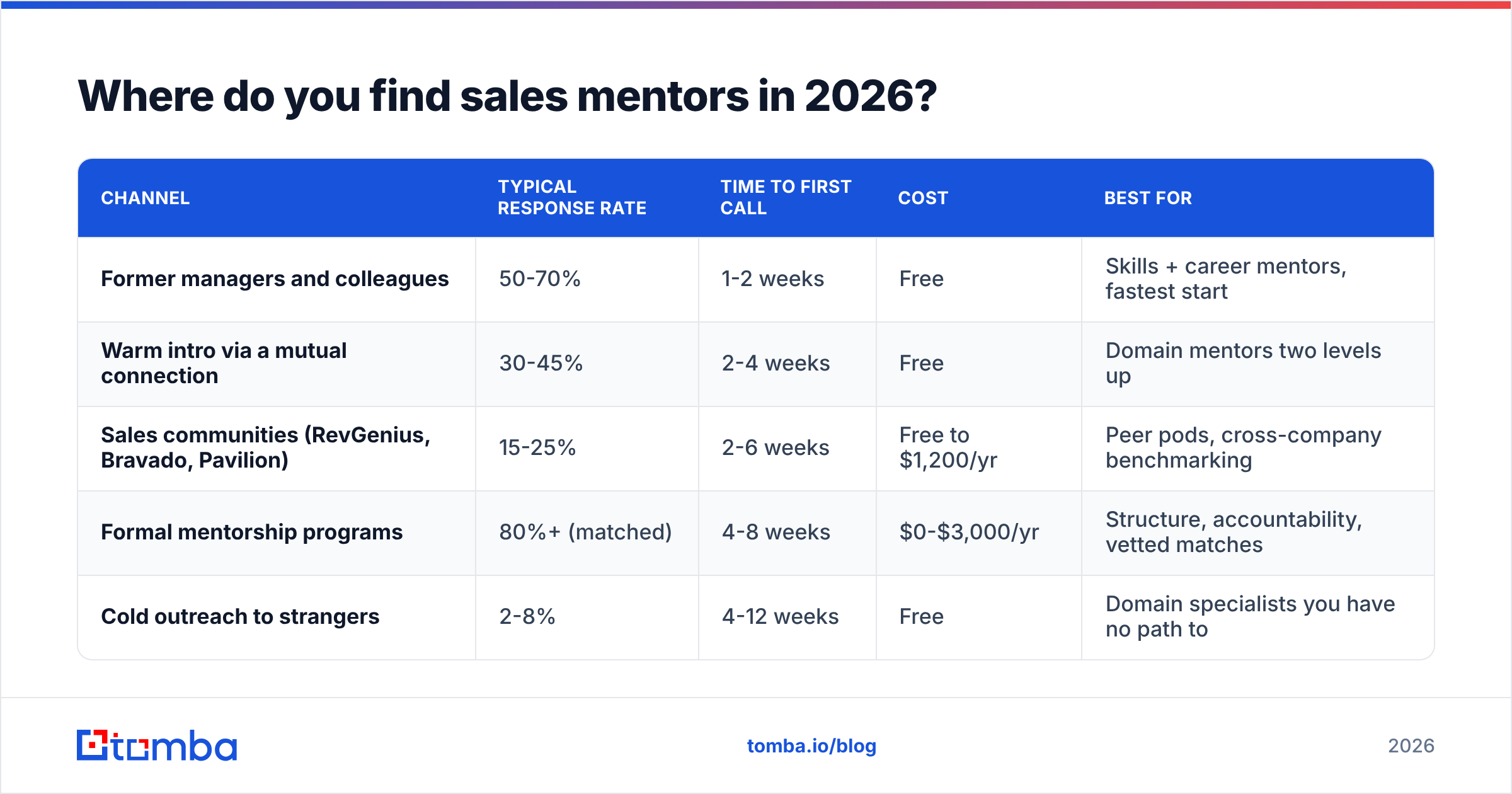
Five channels, ranked by realistic response rate rather than by size of audience.
| Channel | Typical response rate | Time to first call | Cost | Best for |
|---|---|---|---|---|
| Former managers and colleagues | 50-70% | 1-2 weeks | Free | Skills + career mentors, fastest start |
| Warm intro via a mutual connection | 30-45% | 2-4 weeks | Free | Domain mentors two levels up |
| Sales communities (RevGenius, Bravado, Pavilion) | 15-25% | 2-6 weeks | Free to $1,200/yr | Peer pods, cross-company benchmarking |
| Formal mentorship programs | 80%+ (matched) | 4-8 weeks | $0-$3,000/yr | Structure, accountability, vetted matches |
| Cold outreach to strangers | 2-8% | 4-12 weeks | Free | Domain specialists you have no path to |
Start at the top of that table and work down. Most reps do the exact opposite — they open with cold DMs to strangers because it feels less vulnerable than asking a former boss, then conclude that "nobody responds to mentorship requests."
Your alumni graph is underrated. Every manager you've had, every AE who sat next to you, every SE who ran your demos — that's twenty to fifty people who already have an opinion about your work ethic. Half of them have moved to better companies since. A message that opens "you managed me at [company] in 2023 and I still use the MEDDIC framework you drilled into us" converts at an order of magnitude above anything you can write to a stranger.
Communities work if you contribute first. Pavilion, RevGenius, and Bravado all have thousands of members, and the members who get mentors are the ones who answered fifteen questions in the channel before asking one. Social selling mechanics apply here exactly: give visible value in public, then move to DMs.
Formal programs trade candor for reliability. Sales Assembly and similar programs will match you with someone in weeks and hold both of you to a cadence. The downside is that a matched mentor sometimes gives you polished, HR-safe advice. Informal mentors will tell you your manager is the problem.
How do you write the mentorship ask?#
Treat it as outbound. Same rules: research, specificity, a small first commitment, and an easy out.
Here's the structure that works, with the reasoning behind each line:
Subject: 20 min on enterprise discovery — from a rep who read your Sales Hacker post

Hi [Name],

You wrote in [specific post/talk] that most reps run discovery as
qualification instead of diagnosis. I've been sitting on a $180k deal
where the champion loves us and procurement has gone silent for three
weeks — which I now think is a discovery failure, not a procurement one.

I'm an AE at [Company], selling [product] into [persona]. Two years in,
top third of the team, trying to break into enterprise.

Would you be open to 20 minutes where I walk you through that specific
deal and you tell me what I missed? Happy to send the deal summary in
advance so we don't spend the call on context.

If the timing is bad, no problem at all — I'll keep reading.

[Your name]
Five things that message does that a typical request doesn't:
- It proves you consumed their work. Not "I love your content" — a specific claim they made, restated accurately.
- It names one problem, not a life stage. "Help me grow" is unanswerable. "Why did procurement go dark" is a question a senior seller enjoys answering.
- It caps the commitment at 20 minutes. No open-ended "mentorship."
- It offers pre-work. Sending the deal summary in advance signals you'll do the labor.
- It gives a graceful no. Removes the social cost of declining, which paradoxically raises the yes rate.
Do not attach a calendar link on the first message to someone senior. It inverts the status dynamic. Offer times after they say yes.
How do you find the right contact details without being creepy?#
You need two things: the correct email, and a reason you're allowed to have it.
LinkedIn DMs to people with 20k+ followers go into a queue nobody reads. InMail is marginally better and still gets ignored. Email remains the highest-response channel for a considered, well-written ask — but only if it actually lands in an inbox.
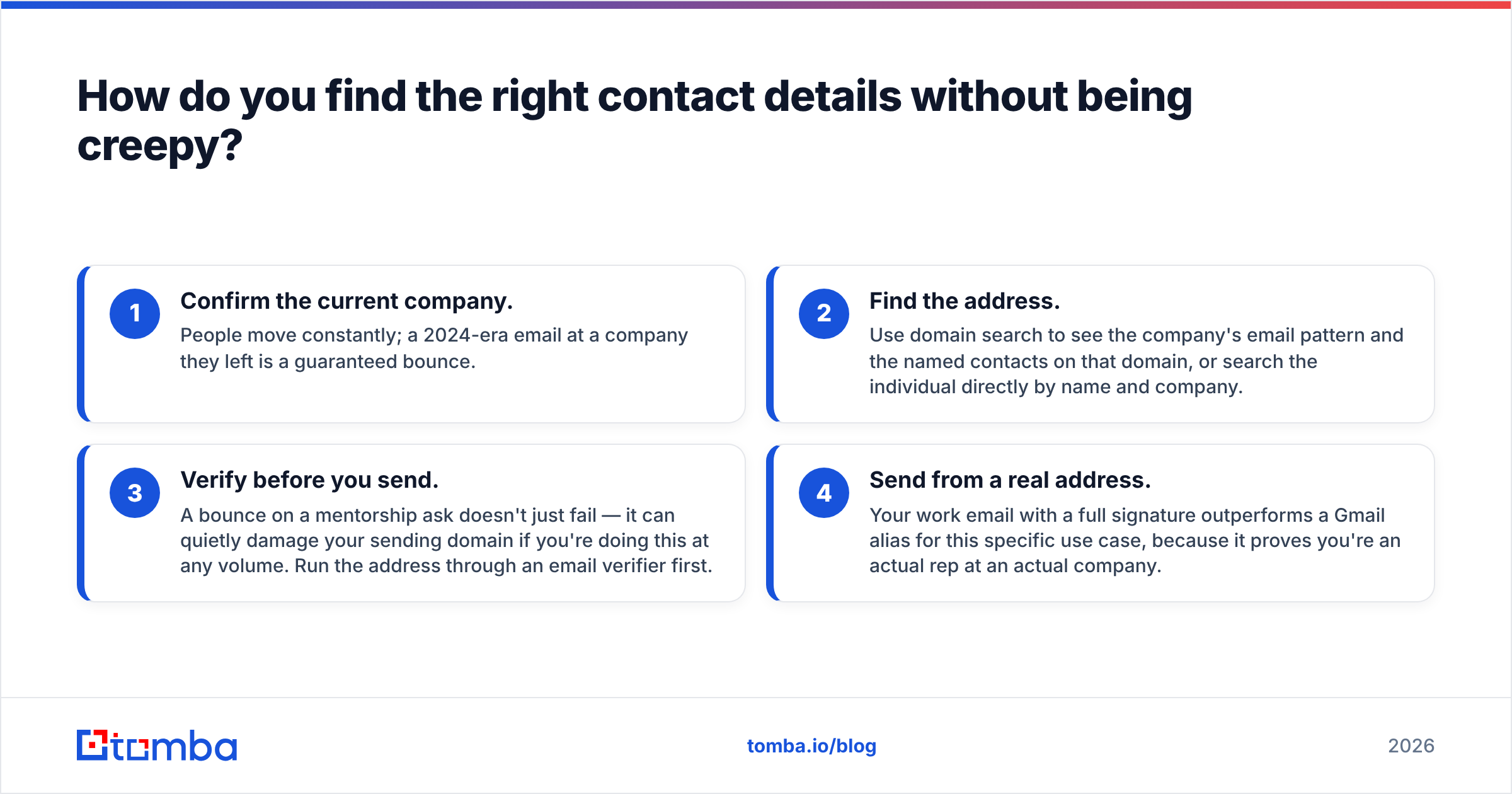
The practical workflow:
- Confirm the current company. People move constantly; a 2024-era email at a company they left is a guaranteed bounce.
- Find the address. Use domain search to see the company's email pattern and the named contacts on that domain, or search the individual directly by name and company.
- Verify before you send. A bounce on a mentorship ask doesn't just fail — it can quietly damage your sending domain if you're doing this at any volume. Run the address through an email verifier first.
- Send from a real address. Your work email with a full signature outperforms a Gmail alias for this specific use case, because it proves you're an actual rep at an actual company.
One boundary worth stating plainly: finding a professional email address at a company is normal business practice. Finding a personal address, a home phone, or messaging someone across three channels in a day is not. One channel, two touches maximum — an initial message and a single follow-up seven to ten days later. If both go unanswered, that's your answer, and you move to the next name on the list.
For reference on what "normal" looks like, HubSpot's research on sales outreach consistently shows follow-up beyond two or three touches yields diminishing returns on non-transactional asks — and a mentorship request is about as non-transactional as it gets.
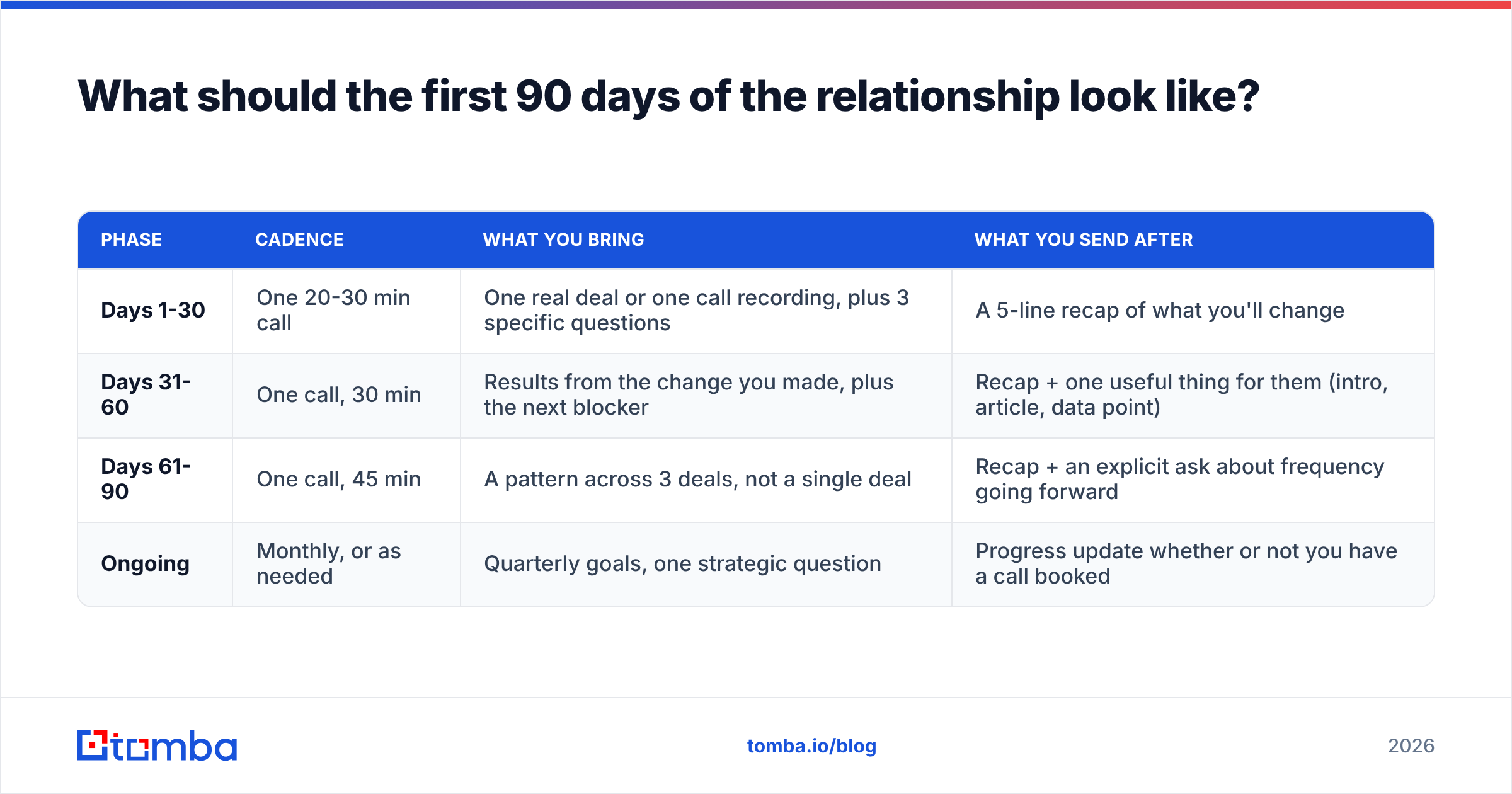
What should the first 90 days of the relationship look like?#
Most mentorships die in week six, not week one. The failure mode is always the same: the mentee shows up with nothing specific, the mentor free-associates for 30 minutes, and both quietly conclude it isn't worth rescheduling.
Structure prevents that. Here's a cadence that holds up:
| Phase | Cadence | What you bring | What you send after |
|---|---|---|---|
| Days 1-30 | One 20-30 min call | One real deal or one call recording, plus 3 specific questions | A 5-line recap of what you'll change |
| Days 31-60 | One call, 30 min | Results from the change you made, plus the next blocker | Recap + one useful thing for them (intro, article, data point) |
| Days 61-90 | One call, 45 min | A pattern across 3 deals, not a single deal | Recap + an explicit ask about frequency going forward |
| Ongoing | Monthly, or as needed | Quarterly goals, one strategic question | Progress update whether or not you have a call booked |
Three rules that make the difference:
- Never arrive empty. A specific artifact — a call recording, an email thread, a deal in Gong — turns an abstract conversation into a working session. Ambiguous questions get ambiguous answers.
- Close the loop. The single highest-value thing you can send a mentor is: "I did what you said, here's what happened." Almost nobody does this, and it's why the ones who do get unlimited access.
- Give something back. You have things a senior person wants: what tooling your company actually uses, what your buyers are saying, an intro to someone on your team. A mentorship that's purely extractive expires.
Is a paid sales coach better than a free mentor?#
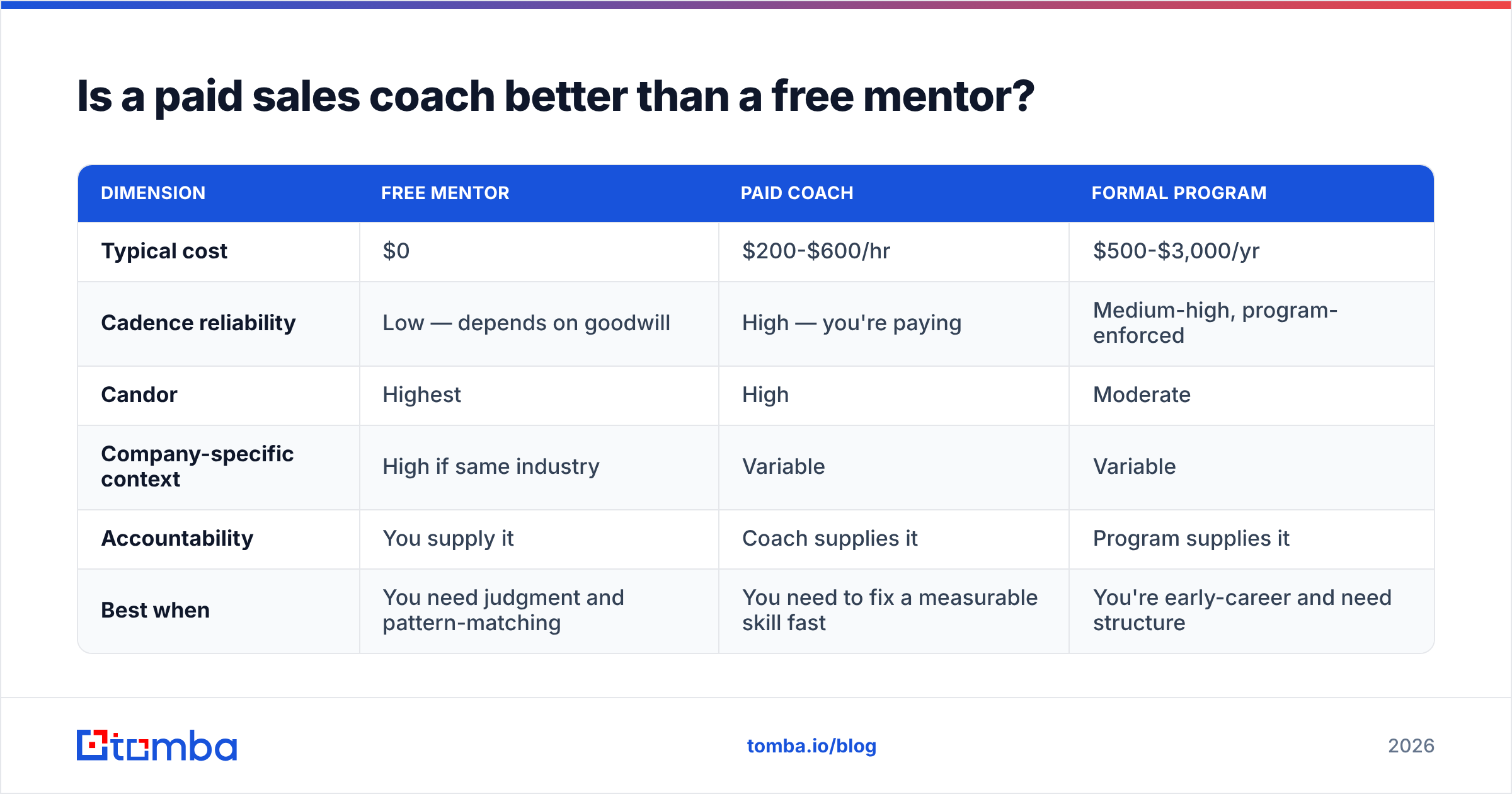
Different products. Neither replaces the other.
| Dimension | Free mentor | Paid coach | Formal program |
|---|---|---|---|
| Typical cost | $0 | $200-$600/hr | $500-$3,000/yr |
| Cadence reliability | Low — depends on goodwill | High — you're paying | Medium-high, program-enforced |
| Candor | Highest | High | Moderate |
| Company-specific context | High if same industry | Variable | Variable |
| Accountability | You supply it | Coach supplies it | Program supplies it |
| Best when | You need judgment and pattern-matching | You need to fix a measurable skill fast | You're early-career and need structure |
Buy a coach when you have one specific, measurable deficiency and a deadline — your close rate on multi-stakeholder deals is 11% and you have two quarters to fix it. Find a mentor when the question is directional: should I take the enterprise seat, is this company going to make it, is my manager sandbagging my territory.
The G2 category listings are a reasonable place to sanity-check coach pricing, though be aware most reviews there come from buyers of team-wide programs rather than individual reps.
How do you find mentors outside your own network?#
When the warm paths are exhausted, you're doing prospecting — so use prospecting tools.
The repeatable version looks like this:
- Source by content, not by title. Find people who have published something specific about your motion: a conference talk, a podcast episode, a long LinkedIn post with real numbers. An author finder pulls the contact behind bylined articles, which is a much better filter than "VP of Sales, 500+ connections."
- Build a list of 20, not 3. At a 5-10% response rate on cold asks, three names gets you nothing. Twenty gets you one or two conversations, and one of those sticks.
- Segment by relevance. Same buyer persona, same deal size, same sales cycle length. Rank the list before you write a single message.
- Personalize the first line, template the rest. The specific-claim opener has to be genuinely researched. The body can be structural.
- Track it like a pipeline. Sent, opened, replied, called, recurring. If you wouldn't run outbound without a CRM view, don't run mentor sourcing without one either.
For volume list-building of this kind, some reps buy verified contact data rather than sourcing it manually — providers like BookYourData sell pre-verified B2B contacts by title and industry, which is a legitimate shortcut when your target profile is well defined. If you'd rather find and verify contacts one at a time as you research each person, a search-and-verify tool fits the workflow better and avoids paying for records you'll never use. Either way, check Tomba pricing against per-record list costs before committing — for a 20-name mentor list, the free tier is usually enough.
What are the signs you've got the wrong mentor?#
Cut the relationship cleanly if you see these. Staying out of politeness costs you a quarter.
- They only tell you what worked in their era. Advice built on 2015 outbound volumes doesn't survive contact with 2026 inbox filtering.
- Every answer is a story about them. Some of that is normal and useful. All of it is a monologue you're subsidizing with your time.
- They can't say anything critical. A mentor who never tells you something uncomfortable isn't engaged enough to be useful.
- Sessions keep getting rescheduled. Twice is life. Four times is a signal — they're not bought in, and continuing to chase costs you goodwill you'll want later.
- You leave with inspiration but no action. Motivation is not the deliverable. If you can't name one thing you'll do differently, the format is broken.
Exiting is easy and does not burn the relationship: "This has been genuinely helpful and I know your calendar is packed — let's go to quarterly instead of monthly, and I'll send you updates in between." Nobody is offended by less work.
What's the fastest path from zero to a first mentor call?#
A one-week version, if you want to start today:
- Day 1 — List 25 names: every former manager, every strong rep you've worked with, five people who've published something relevant to your motion.
- Day 2 — Rank by relevance to your current gap. Cut to the top 12.
- Day 3 — Find and verify contact details for all 12. Confirm current employer before anything else.
- Day 4 — Write 12 messages. One researched opening line each, same body structure, one specific 20-minute ask.
- Day 5 — Send. Log them.
- Day 12 — Single follow-up on non-responders. Then stop.
- Weeks 2-3 — Run the calls that book. Send a five-line recap within 24 hours of each.
Expect two to four replies and one to two calls from twelve messages. That's a normal, healthy result — the same math as any well-targeted outbound sequence.
Get the contact details right, then send the ask#
The hard part of finding a sales mentor is the thinking: knowing which gap you're closing, choosing people whose experience actually maps to your motion, and writing an ask small enough to say yes to. The mechanical part — getting a working email address for the twelve people on your list — should take you fifteen minutes, not an afternoon of guessing at name formats.
That's what the Tomba Email Finder is for. Search by name and company, get the verified professional address, and spend your energy on the message instead of the lookup. The free tier includes 25 searches a month, which covers a full mentor list with room left over; paid plans start at $49/mo when you scale the same workflow to actual prospecting.
Build the list. Verify the addresses. Send twelve good messages. One of them will change how you sell.
Related guides#
// get started
Find, verify and enrich your first contacts today
Start on the free plan with 25 searches a month, then scale when your team is ready.
Free plan · No credit card required · GDPR & CCPA
// about the author