How To Find Newly Registered Businesses: 2026 Playbook
New company registrations are the cleanest buying signal in B2B — nobody owns the account yet. Here are seven data sources, the cost of each, and how to turn a registry filing into a verified contact.
TL;DR
- Newly registered businesses are the rare B2B segment with no incumbent vendor — every category is an open field for roughly 90 days after formation.
- Most national registries publish new-entity filings for free: Companies House (UK), SEC EDGAR and state Secretary of State portals (US), and OpenCorporates as an aggregator.
- Registry data gives you a company name, address, filing date, and officer names — it almost never gives you a working email, so enrichment is a mandatory second step.
- Paid signal feeds (Crunchbase, Vainu, ZoomInfo, BookYourData) buy you speed and structure; free registries plus a scraper plus an email finder buy you margin.
- The winning workflow is: registry pull → domain resolution → contact enrichment → verification → outreach within 14 days of filing.
Why do newly registered businesses convert better than mature accounts?#
Because nobody has sold them anything yet.
Think of a mature account as a house that already has furniture in every room. To sell them a couch, you first have to convince them to throw one out. A company registered three weeks ago is an empty house. They need a bank, an accountant, payroll software, insurance, a website, a CRM, a phone system, and a domain — and they need all of it inside one quarter.
That compression creates three advantages:
- No switching cost. You are not displacing an incumbent, so your deal cycle skips the rip-and-replace objection entirely.
- Budget is being allocated right now. Formation triggers a burst of spending that decays fast. Miss the window and the founder has already picked a competitor.
- Low competitive density on outreach. Most sales teams prospect by firmographics — headcount, revenue, tech stack — and a two-week-old company has none of those attributes yet, so it never surfaces in standard filters.
The trade-off is honest: new registrations churn hard, and a meaningful share never trade at all. Roughly a fifth of new businesses fail in their first year, which means your list will contain shells, holding companies, and people who registered an LLC and never touched it again. Volume and speed compensate for that quality gap.

Where does new business registration data actually come from?#
Every incorporation creates a public record. The question is which layer of that record you pull from.
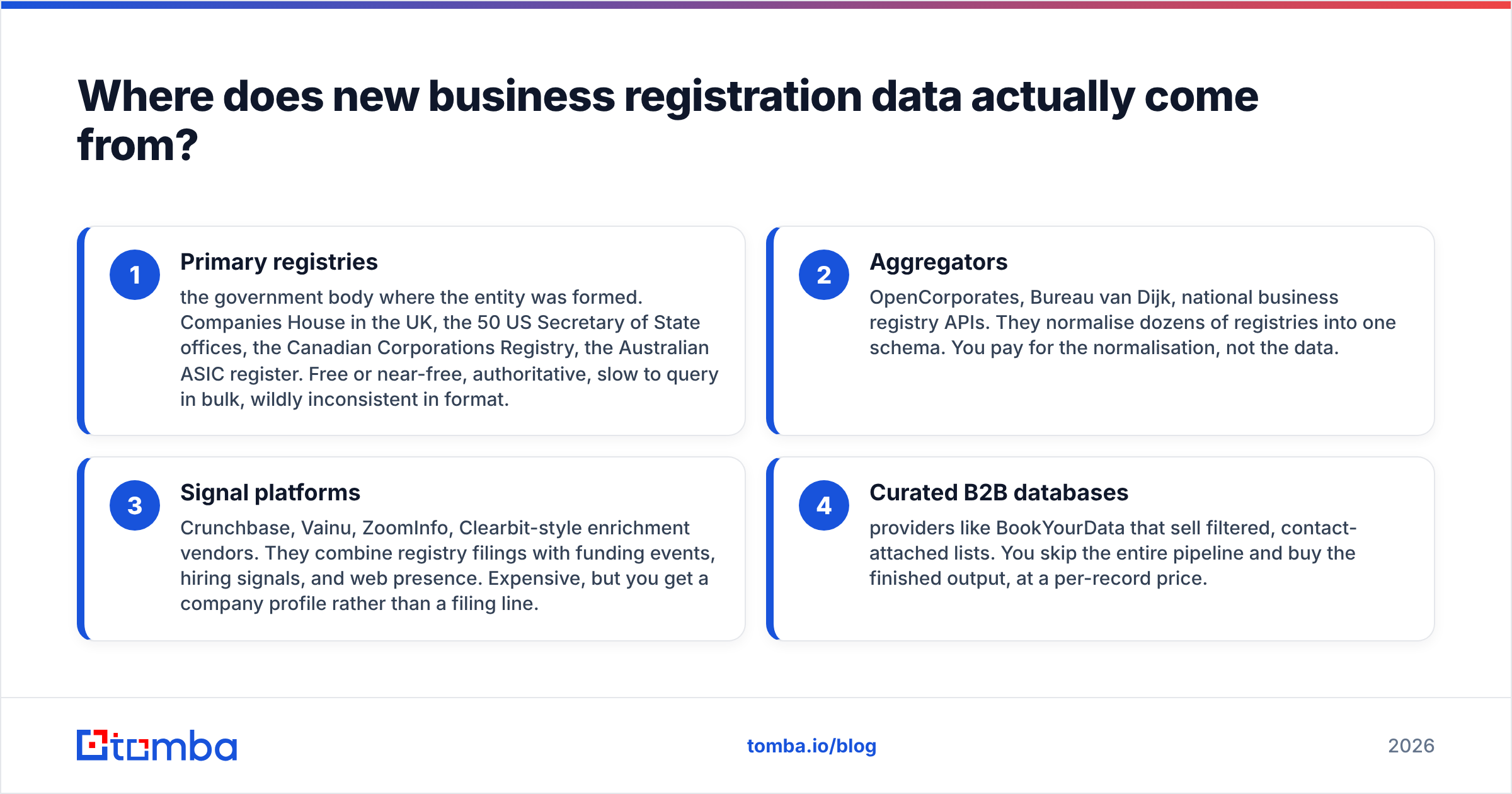
There are four tiers, and the tier you pick determines your cost per lead and your time-to-contact.
- Primary registries — the government body where the entity was formed. Companies House in the UK, the 50 US Secretary of State offices, the Canadian Corporations Registry, the Australian ASIC register. Free or near-free, authoritative, slow to query in bulk, wildly inconsistent in format.
- Aggregators — OpenCorporates, Bureau van Dijk, national business registry APIs. They normalise dozens of registries into one schema. You pay for the normalisation, not the data.
- Signal platforms — Crunchbase, Vainu, ZoomInfo, Clearbit-style enrichment vendors. They combine registry filings with funding events, hiring signals, and web presence. Expensive, but you get a company profile rather than a filing line.
- Curated B2B databases — providers like BookYourData that sell filtered, contact-attached lists. You skip the entire pipeline and buy the finished output, at a per-record price.
Most teams that do this well operate at tier 1 or 2 for discovery and then bolt on an enrichment layer for contacts. That is where the margin lives.
What are the seven methods for finding newly registered businesses?#
Here is the practical menu, ordered from cheapest to most turnkey.
1. National company registries (direct). Companies House publishes a free daily "new incorporations" feed and a full REST API. US Secretary of State sites vary — Delaware, California, Texas, and Florida all publish searchable new-filing lists, several with bulk download. Cost: free. Effort: high, because you need a scraper per jurisdiction.
2. OpenCorporates. The largest open database of companies, covering 140+ jurisdictions with an API and an incorporation-date filter. Free for light non-commercial use, licensed for commercial pulls. This is the single best starting point if you sell across multiple countries.
3. SEC EDGAR and Form D filings. Not registrations exactly, but Form D filings surface newly funded private companies within 15 days of first sale. Free, structured, and disproportionately high-value because these companies just raised money.
4. Business licence and permit records. Cities and counties publish new licence issuances — liquor licences, contractor permits, food service permits, health inspections. Underrated for local and vertical SaaS, because a permit implies actual operation rather than a paper entity.
5. Domain registration and web-presence signals. A new company usually registers a domain within days of incorporation. Newly-registered-domain lists plus a tech-stack check tell you which entities are actually building something. Pair this with a website tech stack lookup to see what they already bought.
6. Funding and news trackers. Crunchbase, Dealroom, and regional startup press cover the subset of new companies with capital. Small volume, very high intent.
7. Curated new-business list providers. BookYourData and similar vendors sell pre-filtered lists with verified contacts already attached. If your team's constraint is engineering time rather than budget, this is the rational buy — you trade cost-per-record for zero build time.
Which data source should you choose?#
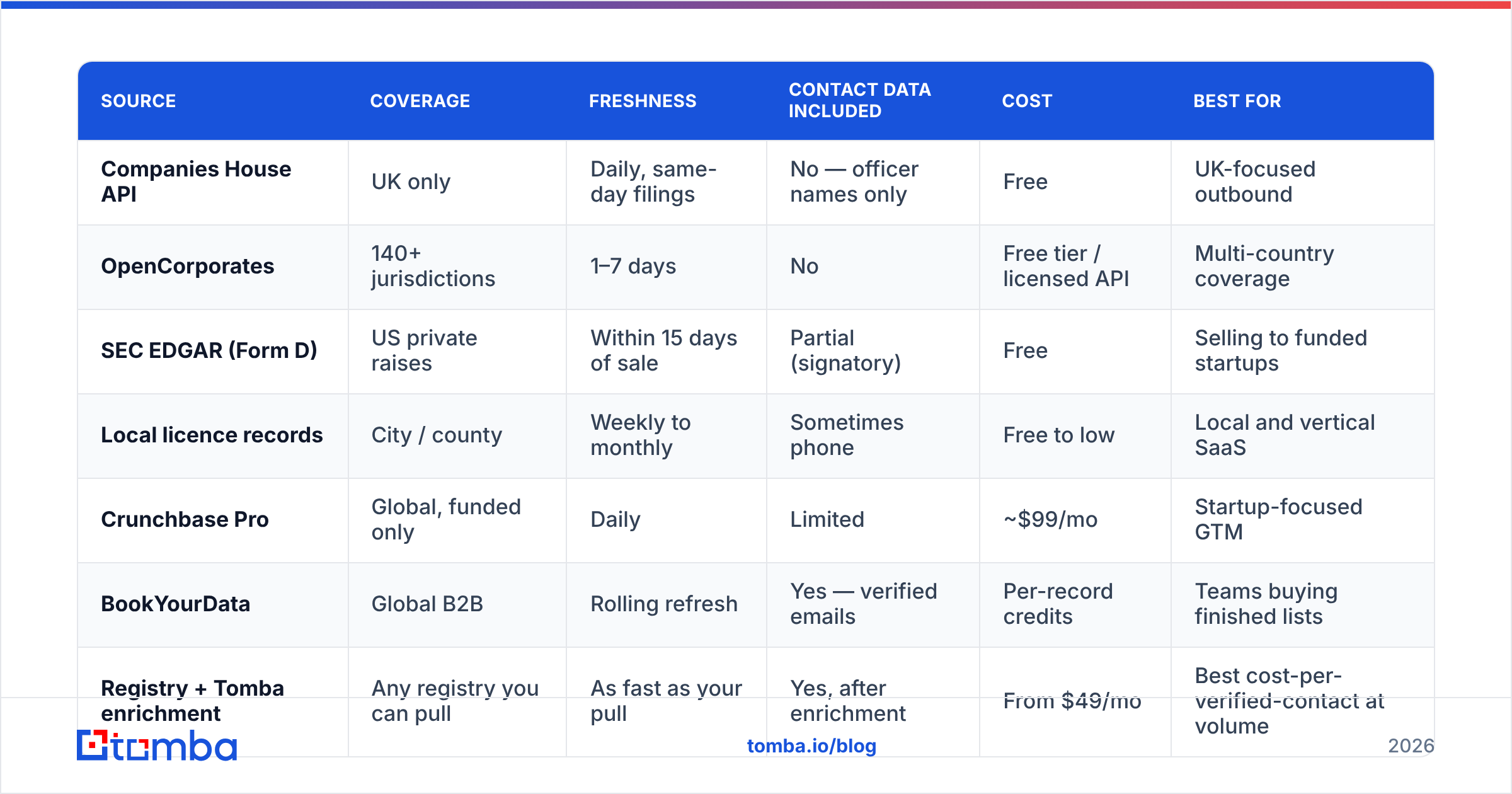
| Source | Coverage | Freshness | Contact data included | Cost | Best for |
|---|---|---|---|---|---|
| Companies House API | UK only | Daily, same-day filings | No — officer names only | Free | UK-focused outbound |
| OpenCorporates | 140+ jurisdictions | 1–7 days | No | Free tier / licensed API | Multi-country coverage |
| SEC EDGAR (Form D) | US private raises | Within 15 days of sale | Partial (signatory) | Free | Selling to funded startups |
| Local licence records | City / county | Weekly to monthly | Sometimes phone | Free to low | Local and vertical SaaS |
| Crunchbase Pro | Global, funded only | Daily | Limited | ~$99/mo | Startup-focused GTM |
| BookYourData | Global B2B | Rolling refresh | Yes — verified emails | Per-record credits | Teams buying finished lists |
| Registry + Tomba enrichment | Any registry you can pull | As fast as your pull | Yes, after enrichment | From $49/mo | Best cost-per-verified-contact at volume |
The table hides one detail worth stating plainly: only the bottom two rows hand you something you can email. Everything above is a company name and an address. That gap is the actual work.
How do you turn a registry filing into a contact you can email?#
A filing gives you three fields you can build on: legal entity name, registered address, and officer or director names. Here is the chain that converts those into a verified inbox.
Step 1 — Resolve the entity to a live domain. Legal names rarely match trading names ("Northgate Holdings Ltd" trades as "Northgate"). Run the company name through a company website finder to map entity to domain. Discard anything with no web presence after 60 days — those are usually dormant shells.
Step 2 — Pull the people. With a domain in hand, run a domain search to list every discoverable address on that domain, plus the email pattern the company uses (first.last@, finitial+last@, and so on). New companies are small, so this often returns the entire team.
Step 3 — Match the registered officer to an address. You already have the director's name from the filing. Feed name plus domain into an email finder and you get the founder's direct address rather than a hello@ catch-all. This is the step that separates a 2% reply rate from a 12% one.
Step 4 — Verify before you send. New domains have new mail servers, and misconfigured MX records are common in the first month. Run every address through an email verifier and route anything ambiguous through catch-all handling. Sending to a brand-new domain with a bounce-heavy list is the fastest way to damage your sender reputation.
Step 5 — Enrich for context. Headcount, funding, and tech stack turn a generic pitch into a relevant one. Contact enrichment fills the gaps registry data never had.
Step 6 — Automate the loop. Once the chain works manually, wire it into a scheduled job with the Tomba API or push the whole registry pull through the bulk email finder. A daily registry delta of 300 companies is not something you process by hand.
What does this cost at realistic volume?#
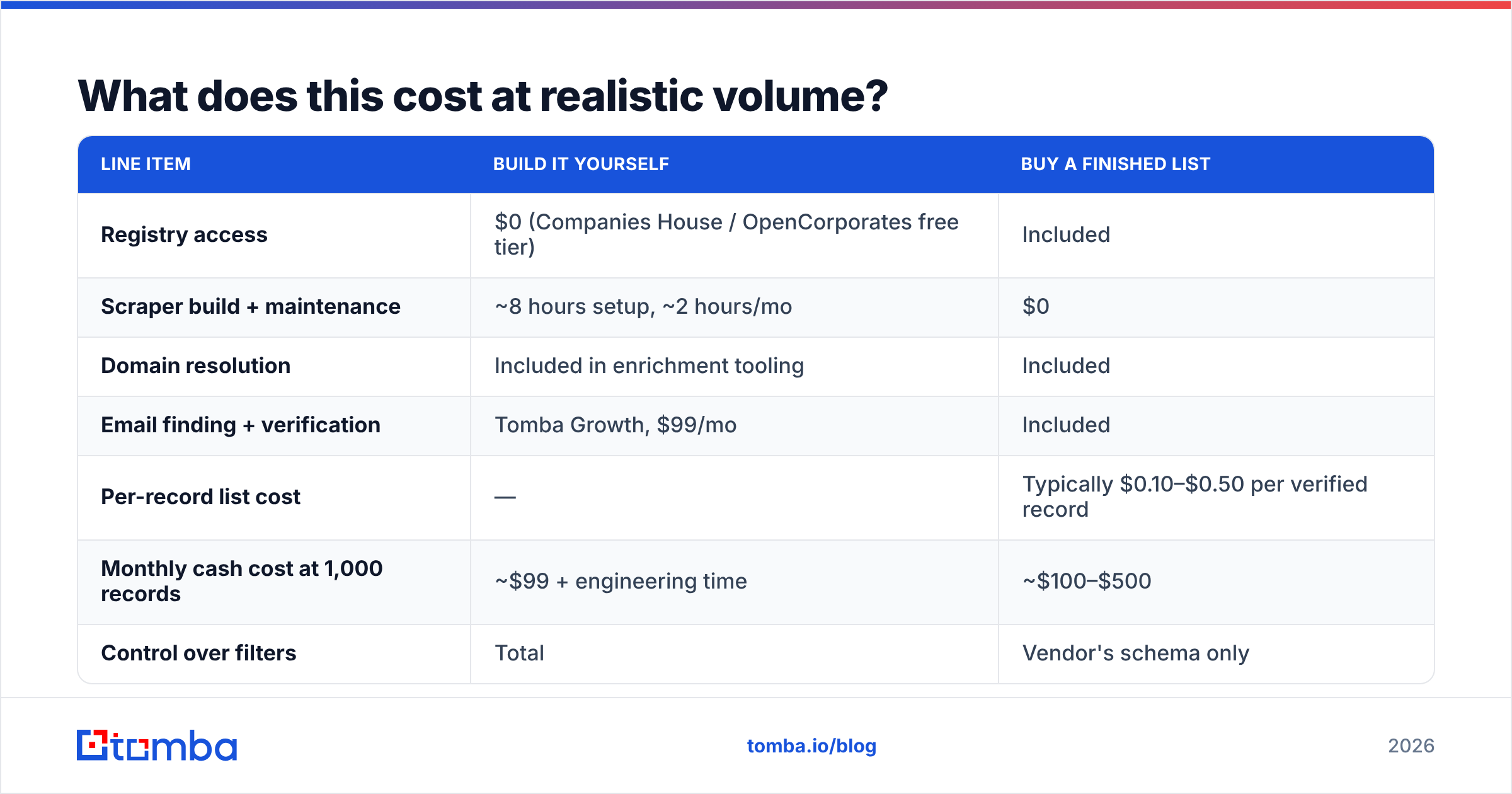
Assume you want 1,000 newly registered companies per month with a decision-maker contact on each.
| Line item | Build it yourself | Buy a finished list |
|---|---|---|
| Registry access | $0 (Companies House / OpenCorporates free tier) | Included |
| Scraper build + maintenance | ~8 hours setup, ~2 hours/mo | $0 |
| Domain resolution | Included in enrichment tooling | Included |
| Email finding + verification | Tomba Growth, $99/mo | Included |
| Per-record list cost | — | Typically $0.10–$0.50 per verified record |
| Monthly cash cost at 1,000 records | ~$99 + engineering time | ~$100–$500 |
| Control over filters | Total | Vendor's schema only |
The honest read: at 1,000 records a month the two paths cost about the same in cash, and the buy-side wins on time. The build-side pulls ahead at scale — at 10,000 records, per-record pricing compounds while an enrichment subscription does not. Check current Tomba pricing against your volume before assuming either way.
How fast do you need to move after a filing?#
Faster than most teams are comfortable with.
The formation-driven buying burst is front-loaded. Practical guidance from teams running this motion:
- Days 0–7: Too early for most offers. The founder is still dealing with banking and the registered agent. Good window for banking, accounting, and formation-adjacent services only.
- Days 7–30: The sweet spot for infrastructure — email, domain, website, CRM, payroll, insurance. The company now has a domain, so enrichment actually resolves.
- Days 30–90: Best window for growth tooling — analytics, marketing, sales software. They have a product and a first customer to think about.
- Day 90+: Vendor selection is largely done in the obvious categories. You are now displacing an incumbent, and your response rate drops accordingly.
Build your pull cadence around the window that matches your product. Daily deltas for days 7–30 offers; weekly is fine if you sell into the 30–90 window.
What are the legal and compliance limits?#
Registry data is public, but "public" is not the same as "free to email."
Three constraints to respect:
- GDPR (EU/UK). Company officer data on a public register is lawfully processed under legitimate interest for B2B outreach, but you must document the assessment, disclose your source in the first message, and honour opt-outs immediately. Registered addresses of sole traders can be personal data — treat those more carefully.
- CAN-SPAM (US). Requires accurate headers, a physical address, and a working unsubscribe. It does not require prior consent for B2B email, which is why US new-business outreach is more permissive.
- Registry terms of use. Several Secretary of State portals prohibit bulk scraping or commercial resale in their terms even though the data is public. Read them, or use a licensed aggregator that has already handled it.
Reviews on G2 and vendor documentation will tell you which providers indemnify you on sourcing. That matters more than a small price difference if you sell into Europe.
How do you write to a company that is two weeks old?#
Differently than you write to an established account.
Founders of brand-new companies are not evaluating vendors on a scorecard. They are drowning. The email that works acknowledges the moment without being creepy about how you found them.
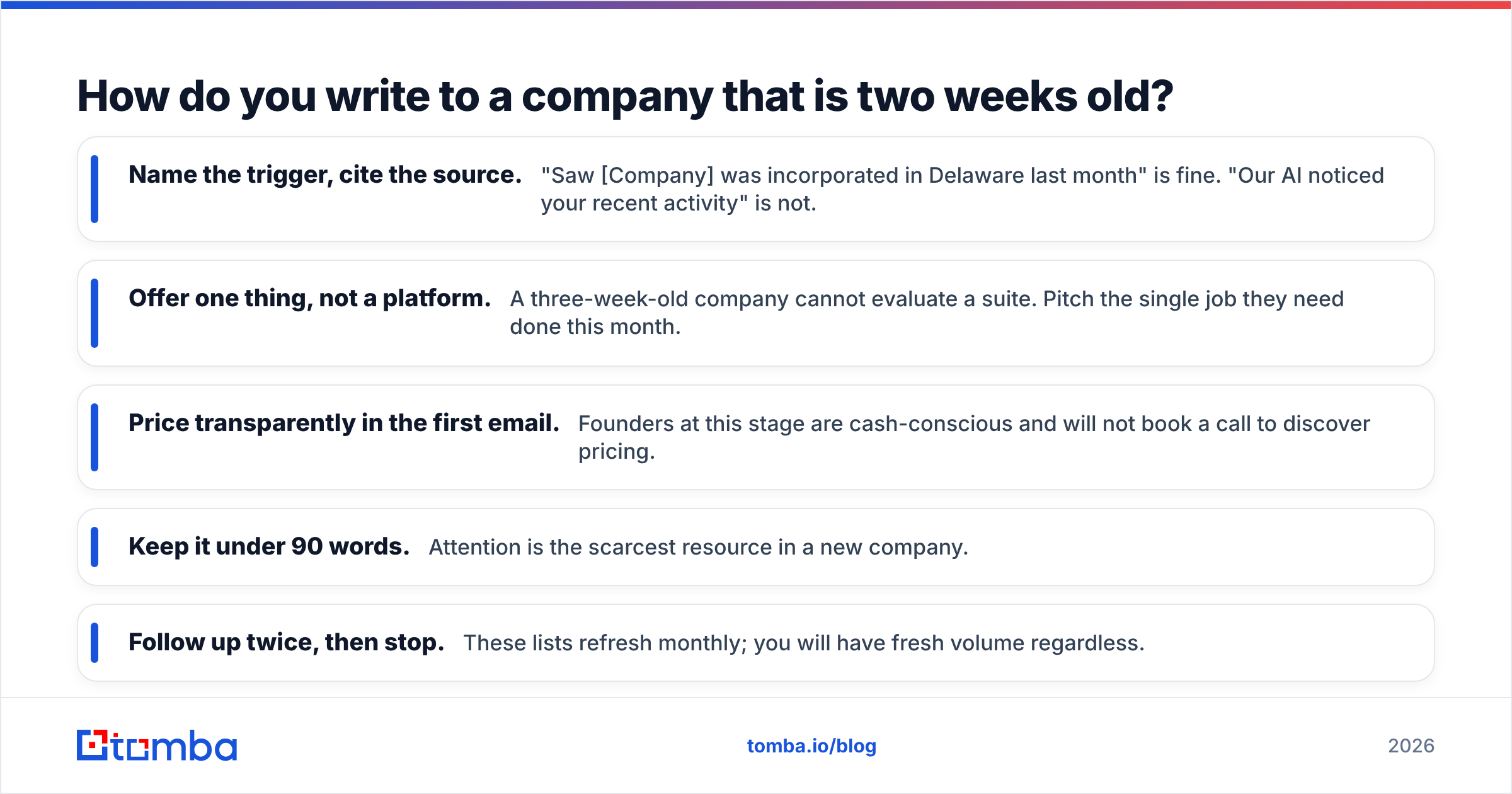
- Name the trigger, cite the source. "Saw [Company] was incorporated in Delaware last month" is fine. "Our AI noticed your recent activity" is not.
- Offer one thing, not a platform. A three-week-old company cannot evaluate a suite. Pitch the single job they need done this month.
- Price transparently in the first email. Founders at this stage are cash-conscious and will not book a call to discover pricing.
- Keep it under 90 words. Attention is the scarcest resource in a new company.
- Follow up twice, then stop. These lists refresh monthly; you will have fresh volume regardless.
If you want a starting structure, the cold email templates library has founder-outreach formats you can adapt. For subject lines specifically, HubSpot's sales email research is a reasonable benchmark for what still lands in 2026.
What mistakes kill this play?#
Four failure modes account for most of it.
Emailing shell entities. A large share of new registrations never trade. Filter for a live domain and any web presence before you spend an enrichment credit — it cuts your list by 30–50% and roughly doubles your reply rate.
Skipping verification on new domains. Freshly configured mail servers produce unusual verification results. Treat catch-all domains as a separate segment with a lower send volume rather than blending them into your main list.
Prospecting the registered agent, not the founder. Formation services list themselves as the registered office. If your address resolves to an incorporation agent's domain, you found a lawyer, not a buyer.
Sending from a cold domain to cold domains. Both sides being new is the worst possible deliverability setup. Warm your sending domain properly first — the email warmup calculator will tell you how long you actually need before hitting volume.
Start with the contact layer#
Registry data is a solved problem — it is free, it is public, and a weekend of scripting gets you a daily feed of every company formed in your market. What is not solved is turning "Northgate Holdings Ltd, incorporated 14 August, director J. Patel" into jpatel@northgate.com with confidence that it will not bounce.
That is exactly the gap the Tomba Email Finder closes. Feed it the officer name and the resolved domain, get back a scored, verified address, and run the whole thing in bulk through the API when your registry pull grows past what a human can process. The free tier gives you 25 searches a month to test the workflow on a single jurisdiction before you commit; Starter at $49/mo covers most single-market outbound teams, and Growth at $99/mo handles the 1,000-record-a-month cadence described above.
Pull the registry. Resolve the domain. Verify the address. Send within 30 days. That is the entire play.
Related guides#
// get started
Find, verify and enrich your first contacts today
Start on the free plan with 25 searches a month, then scale when your team is ready.
Free plan · No credit card required · GDPR & CCPA
// about the author