How to Formally Introduce Yourself via Email (2026 Guide)
A formal introduction email has seven moving parts, and most people get three of them wrong. Here are the structures, greetings, templates, and timing that actually earn a reply in 2026.
TL;DR
- A formal introduction email is seven parts: subject, greeting, who you are, why you're writing to them, credibility, a single ask, and a clean sign-off. Miss the "why them" and the rest doesn't matter.
- Keep it under 150 words. Formal means precise, not long. Long emails read as unfocused, not respectful.
- "Dear [First Name]," is the safe 2026 default for most business contexts. "To Whom It May Concern" signals you didn't do the research.
- One ask per email. A 15-minute call, a document review, an intro — pick one and make it easy to say yes to.
- Deliverability is half the battle: a perfectly written intro sent to a guessed address never gets read. Confirm the address before you send.
What does it mean to formally introduce yourself via email in 2026?#
Formal no longer means stiff. It means the email respects three things: the recipient's time, their seniority, and the fact that they didn't ask to hear from you.
Think of it like knocking on a neighbor's door versus walking into a friend's kitchen. With the friend, you skip the preamble. With the neighbor, you say who you are, why you're at the door, and what you need — in that order, briefly, and then you stop talking. A formal introduction email is the door-knock version.
Practically, that translates to a few rules that separate formal from casual:
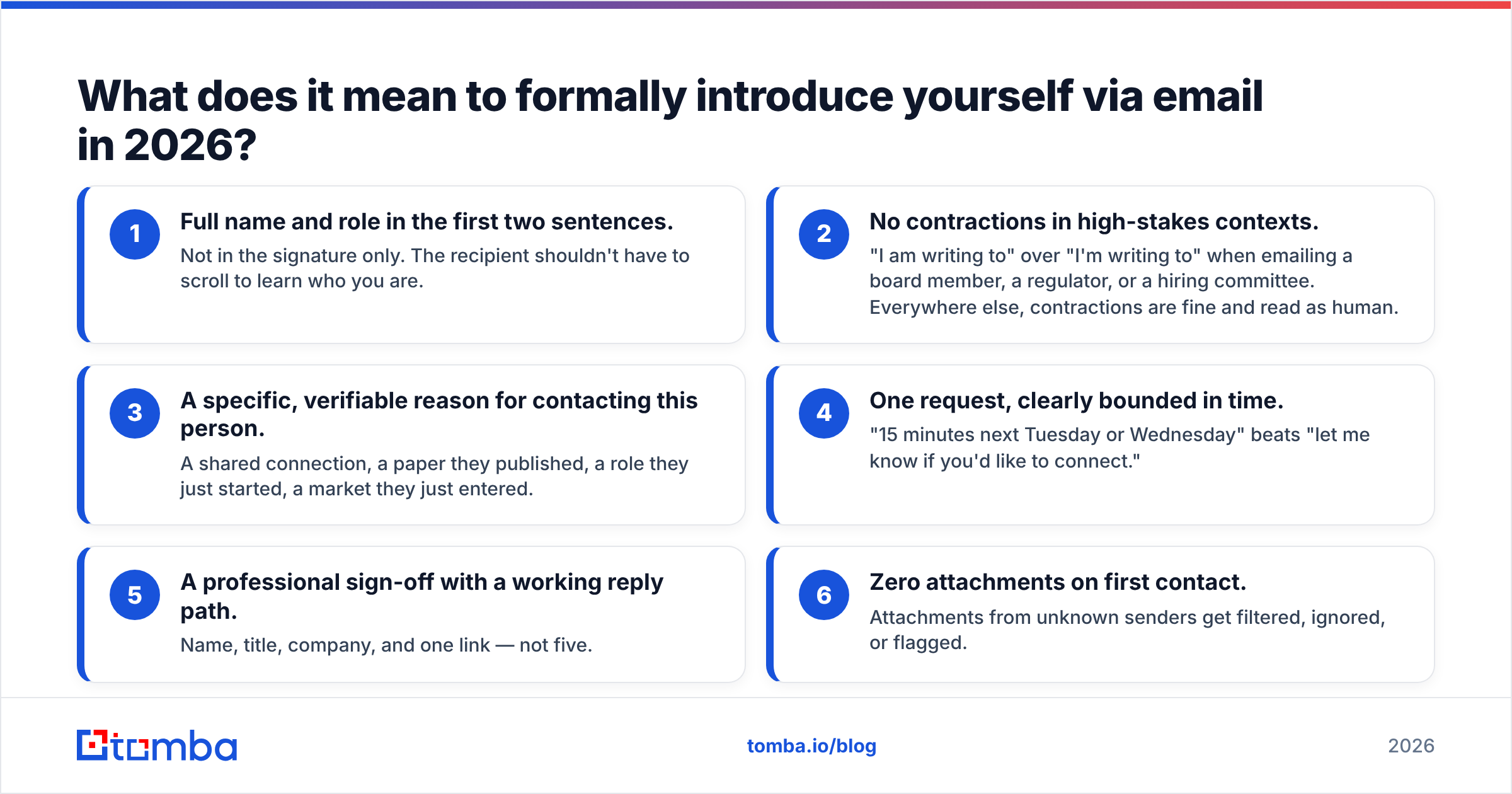
- Full name and role in the first two sentences. Not in the signature only. The recipient shouldn't have to scroll to learn who you are.
- No contractions in high-stakes contexts. "I am writing to" over "I'm writing to" when emailing a board member, a regulator, or a hiring committee. Everywhere else, contractions are fine and read as human.
- A specific, verifiable reason for contacting this person. A shared connection, a paper they published, a role they just started, a market they just entered.
- One request, clearly bounded in time. "15 minutes next Tuesday or Wednesday" beats "let me know if you'd like to connect."
- A professional sign-off with a working reply path. Name, title, company, and one link — not five.
- Zero attachments on first contact. Attachments from unknown senders get filtered, ignored, or flagged.
What are the seven parts of a formal introduction email?#
Every strong introduction email has the same skeleton. The wording changes; the structure does not.
| Part | Purpose | Length | Common mistake |
|---|---|---|---|
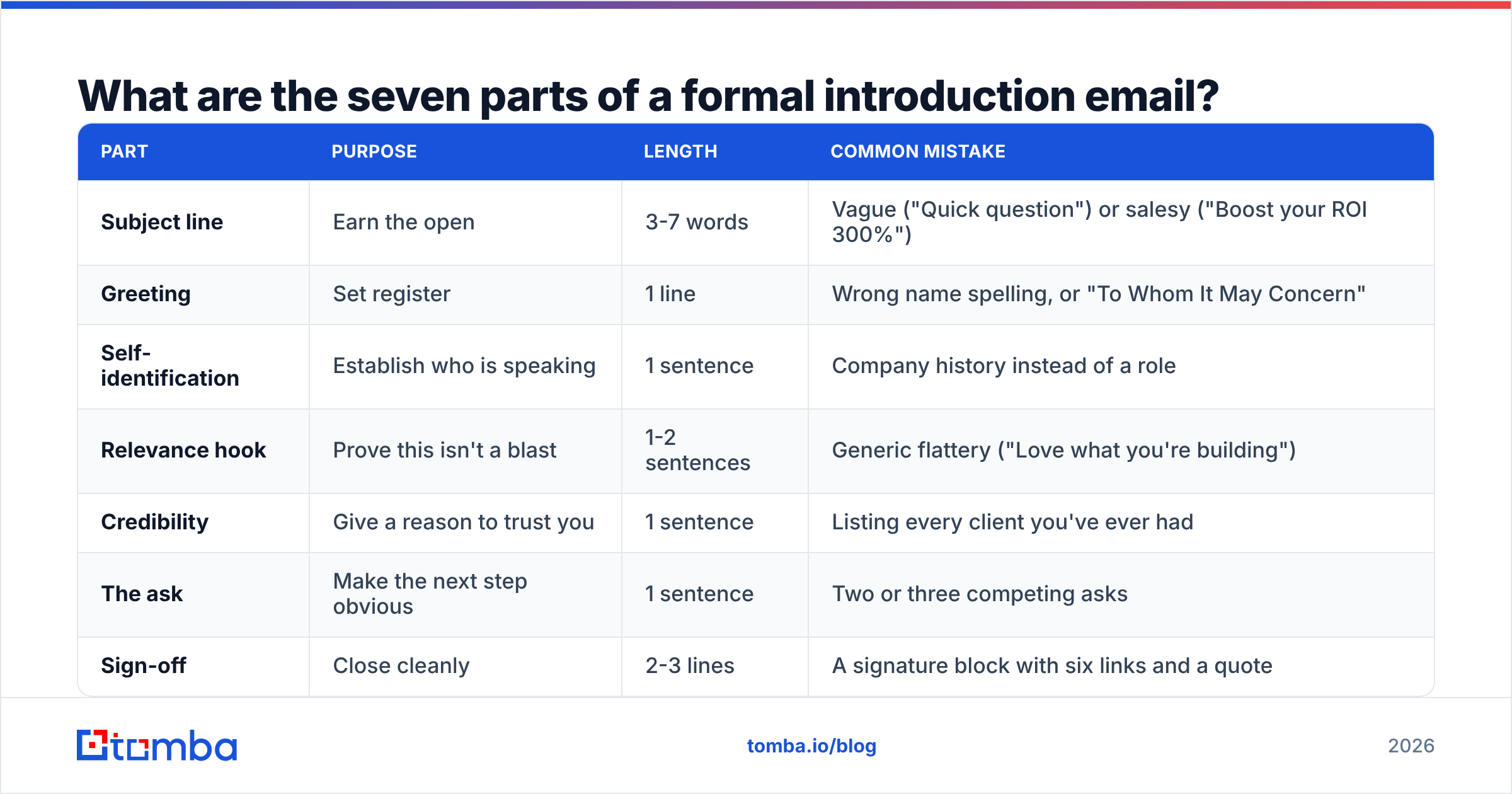
| Subject line | Earn the open | 3-7 words | Vague ("Quick question") or salesy ("Boost your ROI 300%") |
| Greeting | Set register | 1 line | Wrong name spelling, or "To Whom It May Concern" |
| Self-identification | Establish who is speaking | 1 sentence | Company history instead of a role |
| Relevance hook | Prove this isn't a blast | 1-2 sentences | Generic flattery ("Love what you're building") |
| Credibility | Give a reason to trust you | 1 sentence | Listing every client you've ever had |
| The ask | Make the next step obvious | 1 sentence | Two or three competing asks |
| Sign-off | Close cleanly | 2-3 lines | A signature block with six links and a quote |
Notice the length column. The entire body is five to seven sentences. If your draft is longer, you're likely explaining your product instead of explaining your reason for writing.
How do you write a subject line that gets opened?#
Match the subject line to the register of the email. A formal introduction with a clickbait subject line creates a mismatch that reads as manipulation.
Four patterns that hold up:
- Referral:
Introduction from [Mutual Contact]— the highest-performing formal pattern by a wide margin, because it borrows trust. - Context:
[Your Company] x [Their Company] — partnership question - Role-based:
Question about [Their Team]'s Q1 hiring plan - Event-anchored:
Following up from [Conference Name]
Keep it under 50 characters so it survives mobile truncation. Avoid all-caps, exclamation points, and currency symbols — spam filters weight them, and human readers discount them.
If you're testing variations at volume, run drafts through a subject line tester before you commit a whole sequence to one phrasing. HubSpot's sales blog has published years of open-rate benchmarks worth reading if you want the underlying data rather than the folklore.
Wait — that image should render as a plain markdown image:
Which greeting should you use?#
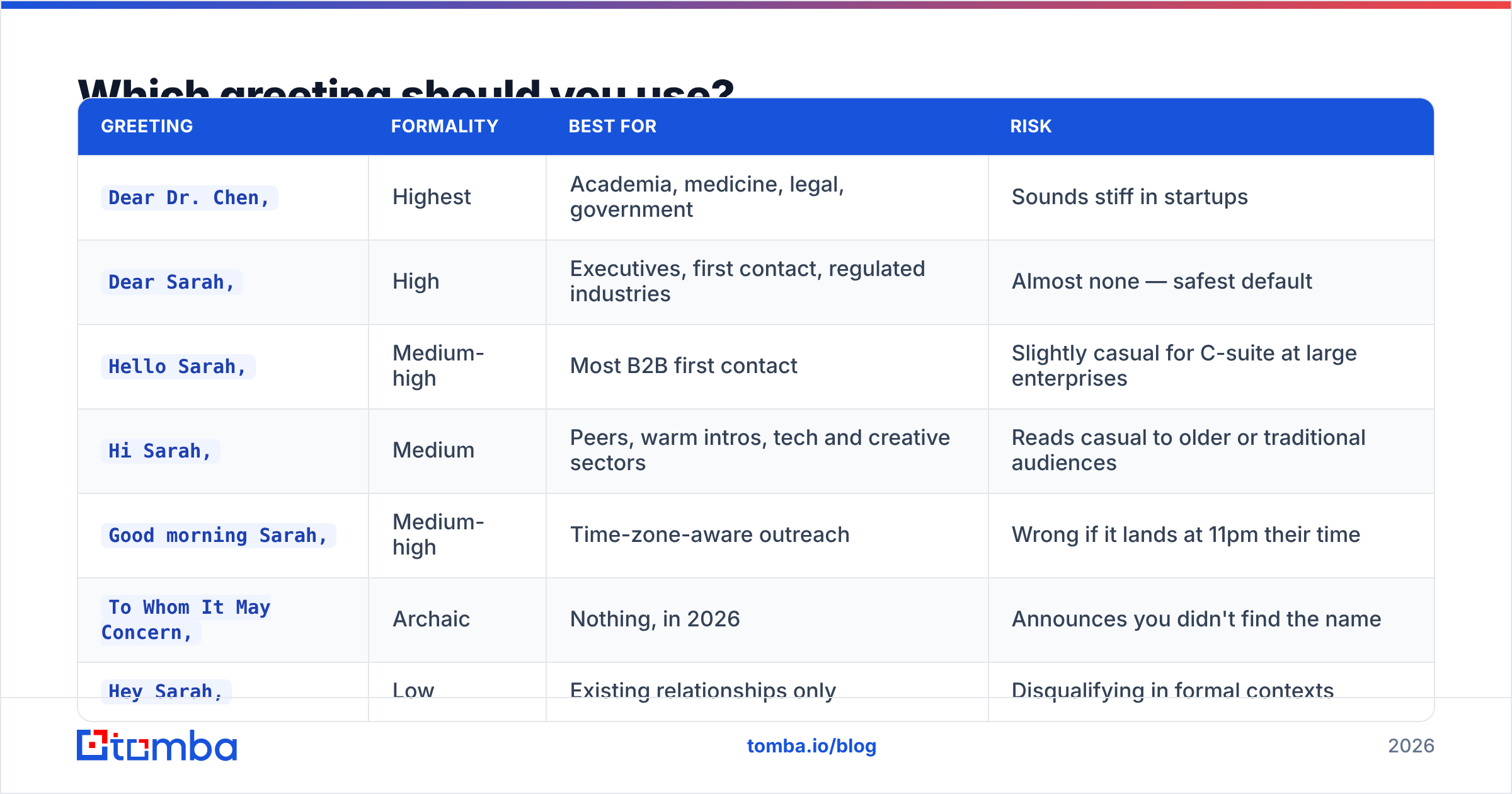
The greeting sets the entire register of the email in four words. Here's how the common options compare in a business context.
| Greeting | Formality | Best for | Risk |
|---|---|---|---|
Dear Dr. Chen, |
Highest | Academia, medicine, legal, government | Sounds stiff in startups |
Dear Sarah, |
High | Executives, first contact, regulated industries | Almost none — safest default |
Hello Sarah, |
Medium-high | Most B2B first contact | Slightly casual for C-suite at large enterprises |
Hi Sarah, |
Medium | Peers, warm intros, tech and creative sectors | Reads casual to older or traditional audiences |
Good morning Sarah, |
Medium-high | Time-zone-aware outreach | Wrong if it lands at 11pm their time |
To Whom It May Concern, |
Archaic | Nothing, in 2026 | Announces you didn't find the name |
Hey Sarah, |
Low | Existing relationships only | Disqualifying in formal contexts |
Two mechanical rules that matter more than the choice itself. First, spell the name exactly as they spell it — check their LinkedIn or company bio, not your CRM, which is often stale. Second, if you cannot find a name, fix that problem rather than working around it. A domain search will usually surface the right named contact and their email pattern in seconds, which is faster than composing a nameless greeting you already know underperforms.
The Wikipedia entry on salutations is a useful reference if you're writing across cultures — conventions in Germany, Japan, and Brazil differ enough to matter.
What should the body actually say?#
Here is the pattern, sentence by sentence, with a worked example.
Sentence 1 — who you are.
My name is Amara Okafor and I lead partnerships at Northwind Analytics.
Sentence 2-3 — why them, specifically.
I read your announcement last week about opening the Lisbon office, and I noticed you're hiring three data engineers there. We work with four other companies that expanded into Iberia in the last 18 months.
Sentence 4 — credibility, one line.
We handled the same data-residency questions for Kelvin Labs during their EU launch.
Sentence 5 — the ask.
Would you be open to a 15-minute call on Tuesday or Thursday next week to compare notes?
Sentence 6 — the exit.
If it's not the right time, no problem at all — I'll leave it with you.
That last line does real work. Giving an explicit out reduces the social pressure of the email, and in practice it increases reply rates rather than lowering them, because it makes "no thanks" a cheap, complete response instead of an awkward one.
Formal, semi-formal, or cold outreach — which register fits?#
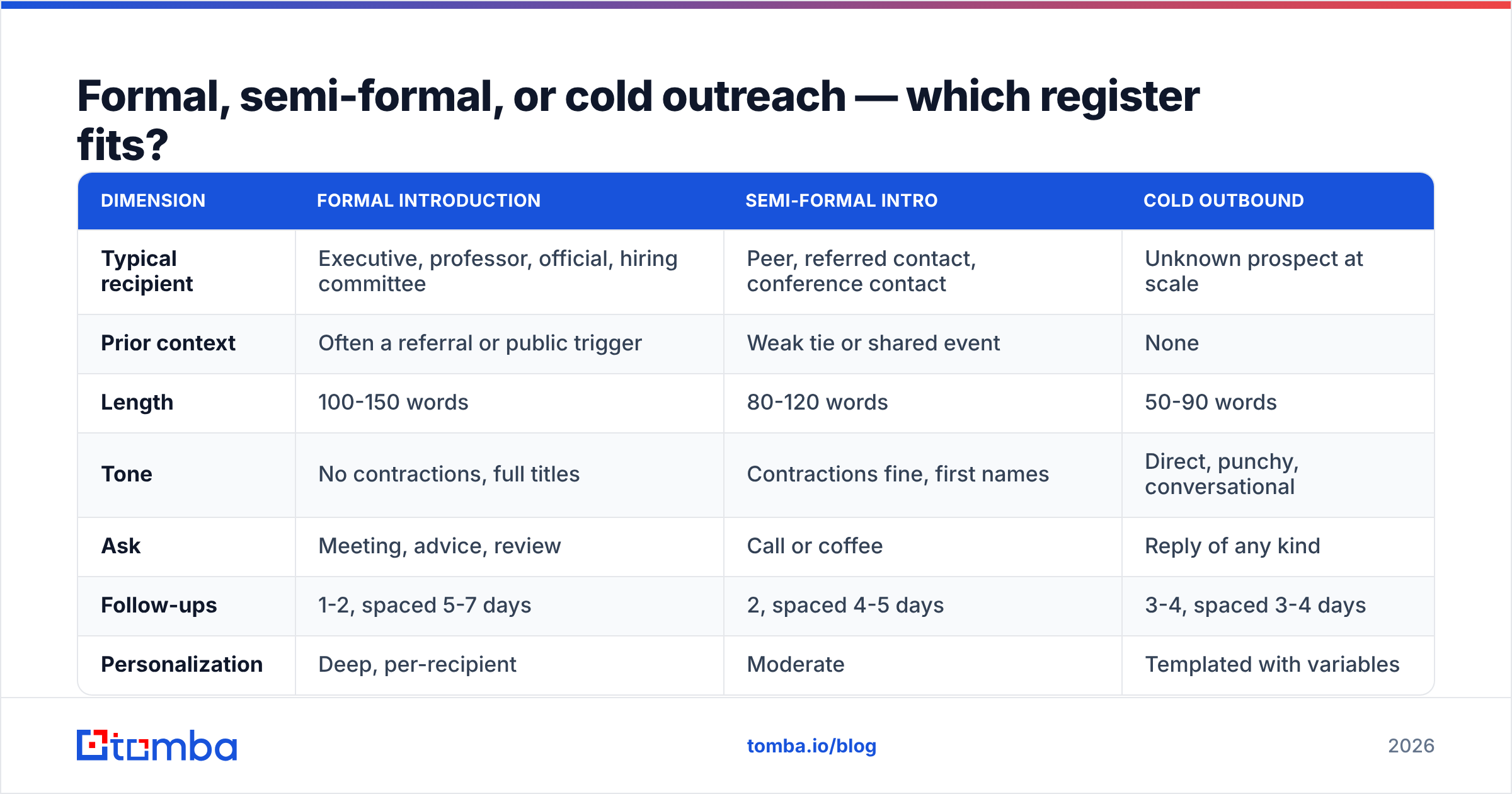
People conflate "formal introduction email" with "cold email." They overlap but they aren't the same thing, and the differences change what you write.
| Dimension | Formal introduction | Semi-formal intro | Cold outbound |
|---|---|---|---|
| Typical recipient | Executive, professor, official, hiring committee | Peer, referred contact, conference contact | Unknown prospect at scale |
| Prior context | Often a referral or public trigger | Weak tie or shared event | None |
| Length | 100-150 words | 80-120 words | 50-90 words |
| Tone | No contractions, full titles | Contractions fine, first names | Direct, punchy, conversational |
| Ask | Meeting, advice, review | Call or coffee | Reply of any kind |
| Follow-ups | 1-2, spaced 5-7 days | 2, spaced 4-5 days | 3-4, spaced 3-4 days |
| Personalization | Deep, per-recipient | Moderate | Templated with variables |
| Realistic reply rate | 25-45% (warm) | 15-30% | 3-8% |
Reading across a row tells you what to change. If you're writing to a university department head, you're in column one: longer, more careful, fewer follow-ups, no marketing language. If you're running a 500-contact campaign, column three applies and a "formal" register will actually hurt you — it reads as a form letter dressed up.
What are five templates you can adapt today?#
1. Referral introduction
Subject: Introduction from Marcus Hale
Dear Priya,
My name is Daniel Reyes and I run demand generation at Corvid Systems. Marcus Hale suggested I reach out after we spoke about your team's attribution rebuild.
We solved a nearly identical multi-touch attribution problem at Bellrock last year, and Marcus thought the approach might be relevant to what you're scoping.
Would a 20-minute call on Wednesday or Friday be useful? If the timing is wrong, I'm happy to send over the write-up instead.
Best regards,
Daniel Reyes
Demand Generation, Corvid Systems
2. New-role introduction
Subject: New account lead for [Company]
Dear Ms. Alvarez,
I'm Jonah Weiss, and I've taken over as your account lead following Rachel's move to the product team. I wanted to introduce myself directly rather than let the change appear in a ticket.
I've read through the last six months of your account notes, including the migration timeline in March. Nothing changes on your side.
Would you be open to a 15-minute call this month so I can hear your priorities firsthand?
Kind regards,
Jonah Weiss
3. Job-seeker introduction
Subject: Senior Data Engineer application — Amara Okafor
Dear Dr. Lindqvist,
My name is Amara Okafor. I am applying for the Senior Data Engineer role on your platform team, and I wanted to introduce myself directly.
For the past four years I have built streaming pipelines at Vantage Freight, where I reduced end-to-end latency from 40 minutes to under 90 seconds. Your recent talk on schema evolution described the exact problem I spent 2025 solving.
My application is in the system. If it would be helpful, I would welcome 15 minutes to answer questions directly.
Sincerely,
Amara Okafor
4. Event follow-up
Subject: Following up from SaaStr — pricing conversation
Hello Tom,
I'm Lina Park from Meridian. We spoke briefly at SaaStr on Thursday about usage-based pricing and the migration headaches it creates for existing accounts.
You mentioned you were three months into that transition. We ran the same migration across 1,100 accounts last year and kept churn flat.
Worth a 20-minute call to compare notes? Tuesday or Thursday next week both work.
Best,
Lina Park
5. Partnership inquiry
Subject: Meridian x Northwind — integration question
Dear Sam,
My name is Chris Duran and I lead partnerships at Meridian. Seven of our mutual customers have asked us for a native Northwind integration in the last quarter.
Rather than build speculatively, I would rather understand your roadmap first.
Is there 15 minutes in the next two weeks to discuss whether this is worth pursuing on your side?
Regards,
Chris Duran
Adapt the structure, not the sentences. If you want more starting points, the cold email templates library covers adjacent scenarios.
How do you make sure the email actually reaches them?#
This is where most well-written introductions die. You can draft a perfect six-sentence email and send it to s.chen@company.com when the company pattern is sarah.chen@company.com. The bounce doesn't just cost you one reply — repeated bounces damage your sender reputation, which quietly degrades every future email you send from that domain.
Three habits fix this:
- Find the address instead of guessing it. An email finder resolves a name and company domain to a real, sourced address rather than a permutation. Tomba's free tier gives you 25 searches a month, which is enough for hand-crafted formal outreach; paid plans start at $49/mo on Tomba pricing if you're doing this weekly.
- Verify before sending. An email verifier runs SMTP and syntax checks so you know the mailbox exists before the message leaves your outbox. For one-off formal emails this takes ten seconds and eliminates the most embarrassing failure mode.
- Watch your sending domain's health. Google's bulk sender guidelines spell out the authentication and complaint-rate thresholds that determine whether your mail lands in the inbox at all. Even a handful of formal emails a week benefit from correct SPF and DKIM records.
For higher-volume introduction campaigns, a bulk email finder plus verification pass on the list before you send is standard practice — it keeps bounce rates under 2%, which is roughly where mailbox providers stop paying close attention to you.

How long should you wait before following up?#
For formal introductions, wait five to seven business days. Anything shorter reads as pressure; anything longer and the context is gone.
Send at most two follow-ups. The first restates the ask in one sentence and adds one new piece of value — a relevant article, a data point, a case study link. The second is a two-line close-out:
Dear Priya,
I don't want to clutter your inbox, so this is my last note on this. If the timing changes, my line is open.
Best regards,
Daniel
That close-out email routinely outperforms the original in reply volume, because it removes the obligation to engage. Track your response rate across both the initial send and the follow-ups so you learn which stage is actually producing conversations.
What mistakes kill formal introduction emails?#
- Leading with your company instead of their situation. Nobody reads paragraph one of your About page voluntarily.
- Multiple asks. A call, a demo, and a whitepaper download in one email means no decision gets made.
- Attachments on first contact. They trip filters and signal risk. Link instead, or offer to send.
- Fake personalization. "I loved your recent post" without naming the post is worse than no personalization.
- Signature bloat. Six social links, a legal disclaimer, and a banner image dilute the one link you actually want clicked. A clean email signature generator output is three lines.
- Sending Monday 9am. Every automated sequence in the world fires then. Tuesday through Thursday, mid-morning in the recipient's time zone, faces less competition.
- Guessed addresses. Covered above, and still the most common one.
Where should you start?#
Write the six-sentence version first, then cut it to five. Pick one greeting from the table that matches the recipient's world, name a specific reason you're contacting them and not someone else, and end with one time-bounded ask plus an easy exit.
Then confirm the address is real before you hit send. The Tomba Email Finder resolves a name and company domain into a verified, sourced professional email — free for your first 25 searches a month, and $49/mo on Starter when introductions become a routine part of your week. A well-written formal introduction is worth very little if it lands in a mailbox that doesn't exist.
Related guides#
// get started
Find, verify and enrich your first contacts today
Start on the free plan with 25 searches a month, then scale when your team is ready.
Free plan · No credit card required · GDPR & CCPA
Get the Tomba newsletter
Product and data updates
// about the author