How to Generate Leads for B2B in 2026: A Practical Playbook
Most B2B lead gen advice is a list of channels. This is the actual sequence: define the account list, build verified contact data, pick two channels, and measure cost per qualified meeting.
TL;DR
- B2B lead generation is four steps in order: define the account list, build accurate contact data, run two channels well, and measure cost per qualified meeting. Skipping step two is why most outbound fails.
- Outbound email still produces the cheapest qualified meetings for most sub-$50k ACV products — but only when bounce rate stays under 3%. Above that, your domain reputation eats the results.
- Inbound (SEO, content, community) has a 4-9 month lag but a much lower marginal cost per lead once it compounds. Run it in parallel, not instead.
- Paid search works for high-intent, category-aware buyers. It's a terrible way to create demand for a product nobody is searching for yet.
- Track one number weekly: cost per sales-accepted meeting. Every channel decision gets easier once you have it.
What does "generating leads" actually mean in B2B?#
A lead is a person at a company who matches your ideal customer profile and has shown you're worth a conversation. That's it. Everything else — MQL, SQL, PQL, "engaged contact" — is your internal accounting.
The confusion costs money. Teams celebrate 400 newsletter signups and then wonder why the pipeline is flat, because 380 of those signups were competitors, students, and people who wanted the free template. B2B lead generation is not a volume game with a quality problem attached. It's a targeting game where volume is the last variable you turn up.
Here's the sequence that actually works, in dependency order:
- Define the account list. Which 500-2,000 companies could realistically buy this? Filter by industry, headcount, tech stack, funding stage, or geography — whatever actually predicts fit for your product.
- Identify the people. Two to four roles per account: the economic buyer, the champion, and whoever feels the pain daily. Named humans, not "marketing@".
- Build verified contact data. Work emails, verified. Phone numbers where the motion needs them. This is the step that determines whether the next two steps work at all.
- Choose two channels, not six. Email plus LinkedIn. Or SEO plus paid search. Two channels executed well beat six executed badly, every time.
- Instrument the funnel. Sent → replied → meeting booked → meeting held → opportunity. If you can't see the drop-off, you can't fix it.
- Review cost per qualified meeting every week. Kill what doesn't clear the bar within one full sales cycle.
Steps 1 through 3 are unglamorous and they're where the leverage lives. Most teams start at step 4.
Why does contact data quality decide everything downstream?#
Because everything downstream is gated on delivery. A brilliant sequence sent to a stale list is a brilliant sequence nobody reads.
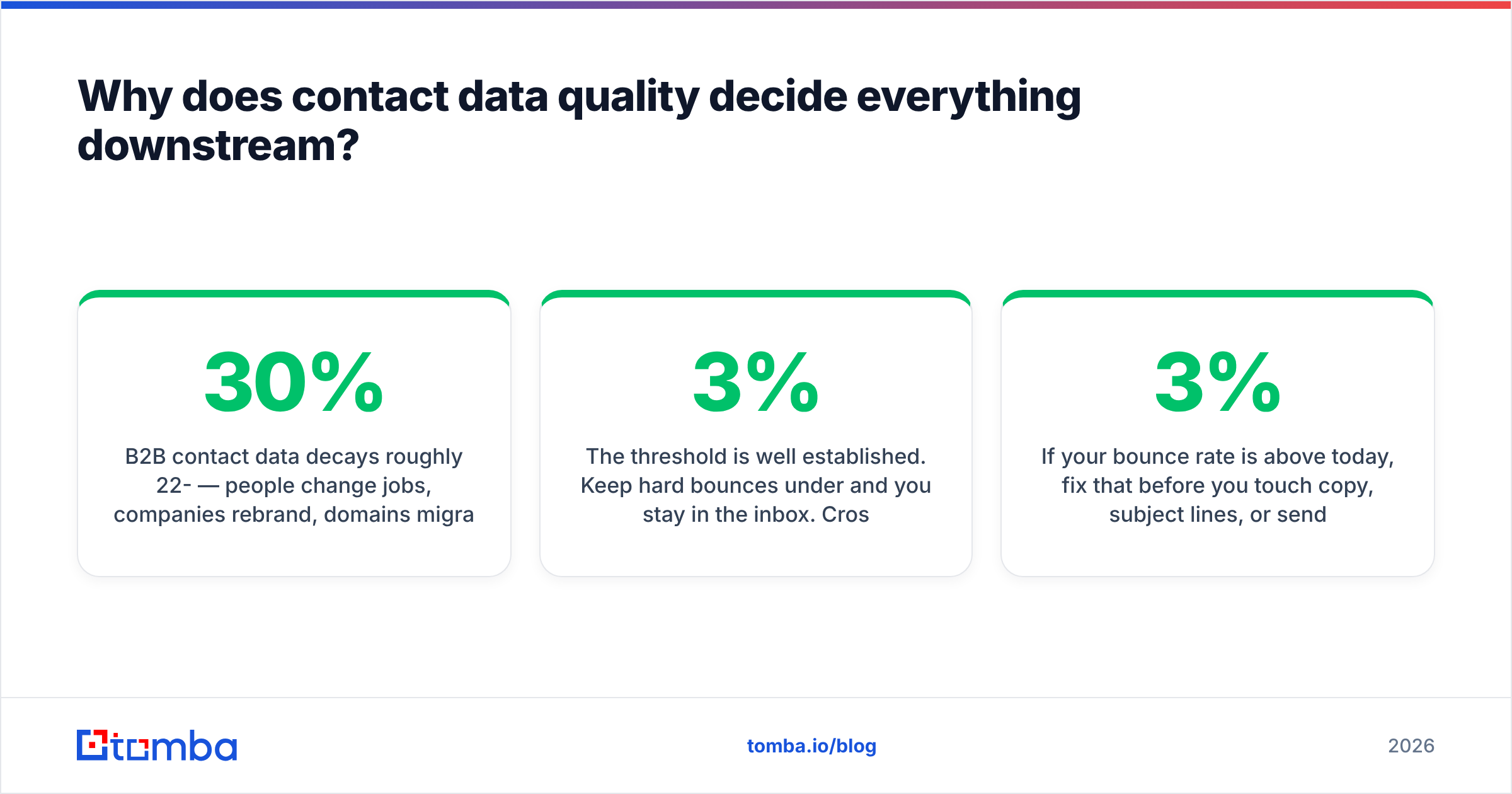
B2B contact data decays roughly 22-30% per year — people change jobs, companies rebrand, domains migrate after acquisitions. A list you scraped in January is meaningfully worse by June. When you send to that decayed list, three things happen at once: bounces spike, mailbox providers throttle you, and your sender reputation drops for every future send — including to the good addresses.
The threshold is well established. Keep hard bounces under 3% and you stay in the inbox. Cross 5% and Google and Microsoft start filing your mail in spam by default, and recovery takes weeks of reduced volume. Understanding email deliverability as a reputation system rather than a technical setting is the mental shift most teams make one campaign too late.

So the practical workflow is:
- Find — resolve names and domains into work emails using an email finder or domain search rather than guessing patterns.
- Verify — run every address through an email verifier before it enters a sequence. Non-negotiable.
- Handle catch-alls separately — catch-all domains accept everything at the SMTP layer, so standard verification returns "unknown." A catch-all verifier uses additional signals to score them. Send to them in a lower-volume segment, or skip them entirely early on.
- Enrich — add headcount, funding, tech stack, and role seniority so your segmentation and personalization have something to work with.
- Re-verify quarterly — treat your database as perishable inventory, not an asset.
If your bounce rate is above 3% today, fix that before you touch copy, subject lines, or sending volume. Nothing else you change will matter as much.
Which B2B lead generation channels actually work in 2026?#
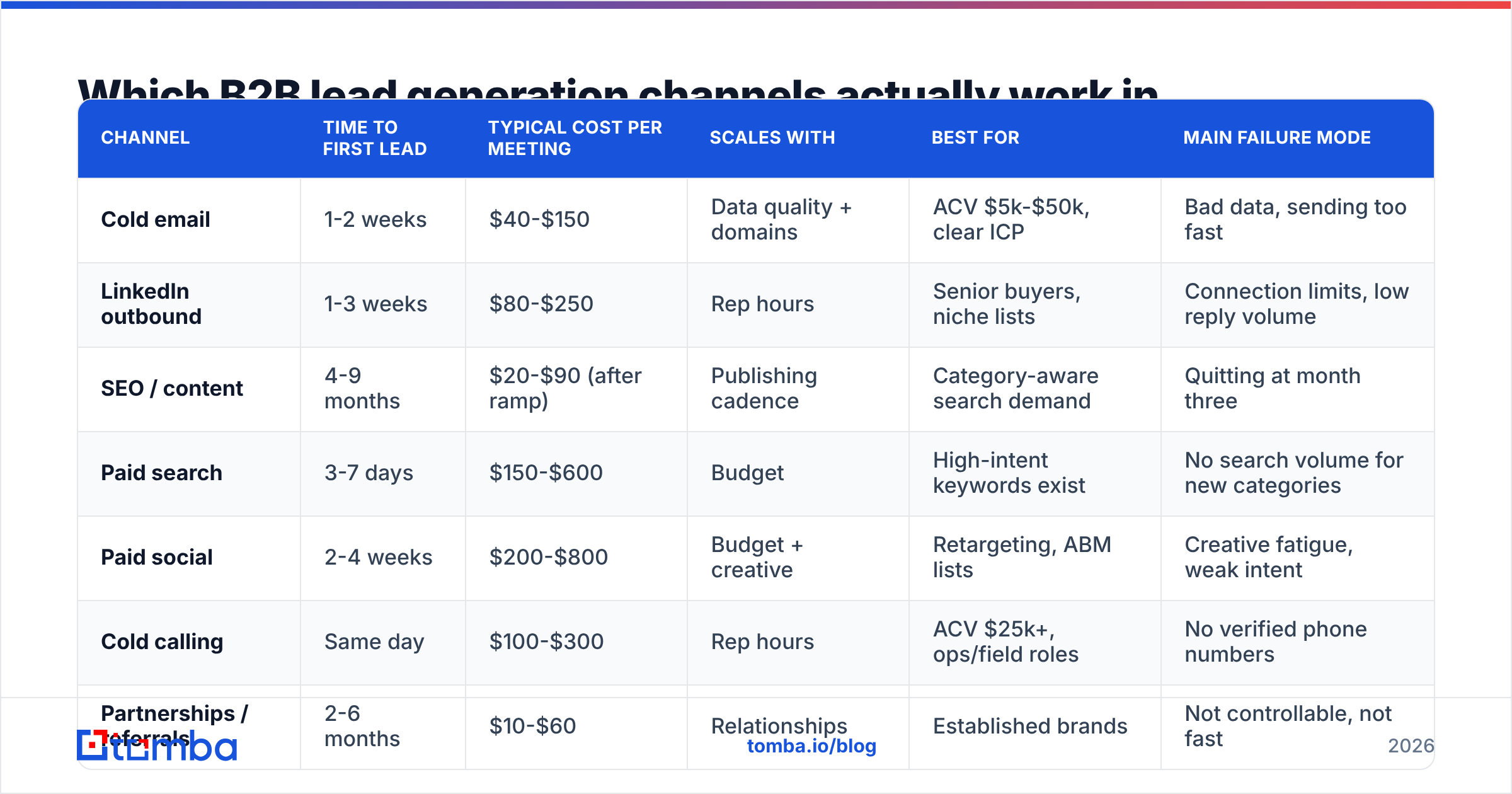
Every channel works for somebody. The question is which ones work for your ACV, your sales cycle, and your team size. Here's an honest comparison based on how these channels typically behave for B2B SaaS and services companies:
| Channel | Time to first lead | Typical cost per meeting | Scales with | Best for | Main failure mode |
|---|---|---|---|---|---|
| Cold email | 1-2 weeks | $40-$150 | Data quality + domains | ACV $5k-$50k, clear ICP | Bad data, sending too fast |
| LinkedIn outbound | 1-3 weeks | $80-$250 | Rep hours | Senior buyers, niche lists | Connection limits, low reply volume |
| SEO / content | 4-9 months | $20-$90 (after ramp) | Publishing cadence | Category-aware search demand | Quitting at month three |
| Paid search | 3-7 days | $150-$600 | Budget | High-intent keywords exist | No search volume for new categories |
| Paid social | 2-4 weeks | $200-$800 | Budget + creative | Retargeting, ABM lists | Creative fatigue, weak intent |
| Cold calling | Same day | $100-$300 | Rep hours | ACV $25k+, ops/field roles | No verified phone numbers |
| Partnerships / referrals | 2-6 months | $10-$60 | Relationships | Established brands | Not controllable, not fast |
| Events / webinars | 4-10 weeks | $200-$900 | Budget + audience | Enterprise, long cycles | Registrations that never attend |
Two things stand out. First, cold email and referrals are the cheapest per meeting — but referrals aren't a lever you can pull on demand, and cold email only stays cheap when the data is clean. Second, the fast channels (paid, calling) cost 3-5x more per meeting than the slow ones. That's the actual trade: you either pay in money or you pay in months.
Pick based on your constraint. Funded and racing to prove a motion? Paid plus outbound. Bootstrapped with 18 months of runway? Outbound plus SEO, and start the SEO now because it needs the time.
How do you build a targeted B2B lead list from scratch?#
Start with your customers, not with a filter panel.
Pull your last 20 closed-won accounts and find what they share that your losses don't. Not the demographics you assumed — the actual pattern. It's often something specific: they all had a VP of Ops but no RevOps team, or they'd all just raised a Series A, or they all ran a particular billing platform. That signal is your list definition.
Then build it:
1. Source the account list. Export from a B2B database, scrape a relevant directory or association member list, or pull from job-board signals (companies hiring for the role you sell to are companies with the problem you solve). Aim for 500-2,000 accounts, not 50,000.
2. Map the buying group. Modern B2B purchases involve six to ten people, according to Gartner's research on buying groups. You don't need all of them. You need the person who feels the pain and the person who signs. Two to four named contacts per account.
3. Resolve contact details. This is where a bulk email finder earns its keep — upload the account and name list, get back work emails at scale, then verify. Doing this one contact at a time in a browser extension is fine for 40 accounts and unworkable at 800.
4. Enrich for segmentation. Headcount, industry, tech stack, funding. You need these to split the list into segments that get genuinely different messaging — not the same email with {{company}} swapped in.
5. Score and sequence by tier. Tier 1 gets manual research and a personalized first line. Tier 2 gets segment-level personalization. Tier 3 gets the volume sequence. Your rep hours go where the deal size justifies them.
6. Suppress aggressively. Existing customers, open opportunities, recent unsubscribes, competitors, and anyone a teammate contacted in the last 90 days. Nothing burns credibility faster than three reps from the same company emailing one prospect in a week.
A 900-account list where every contact is verified and correctly tiered will outperform a 40,000-row purchased CSV. This isn't a moral point about data hygiene — it's arithmetic. The small list has a higher delivery rate, a higher reply rate, and doesn't torch the domain you'll need next quarter.
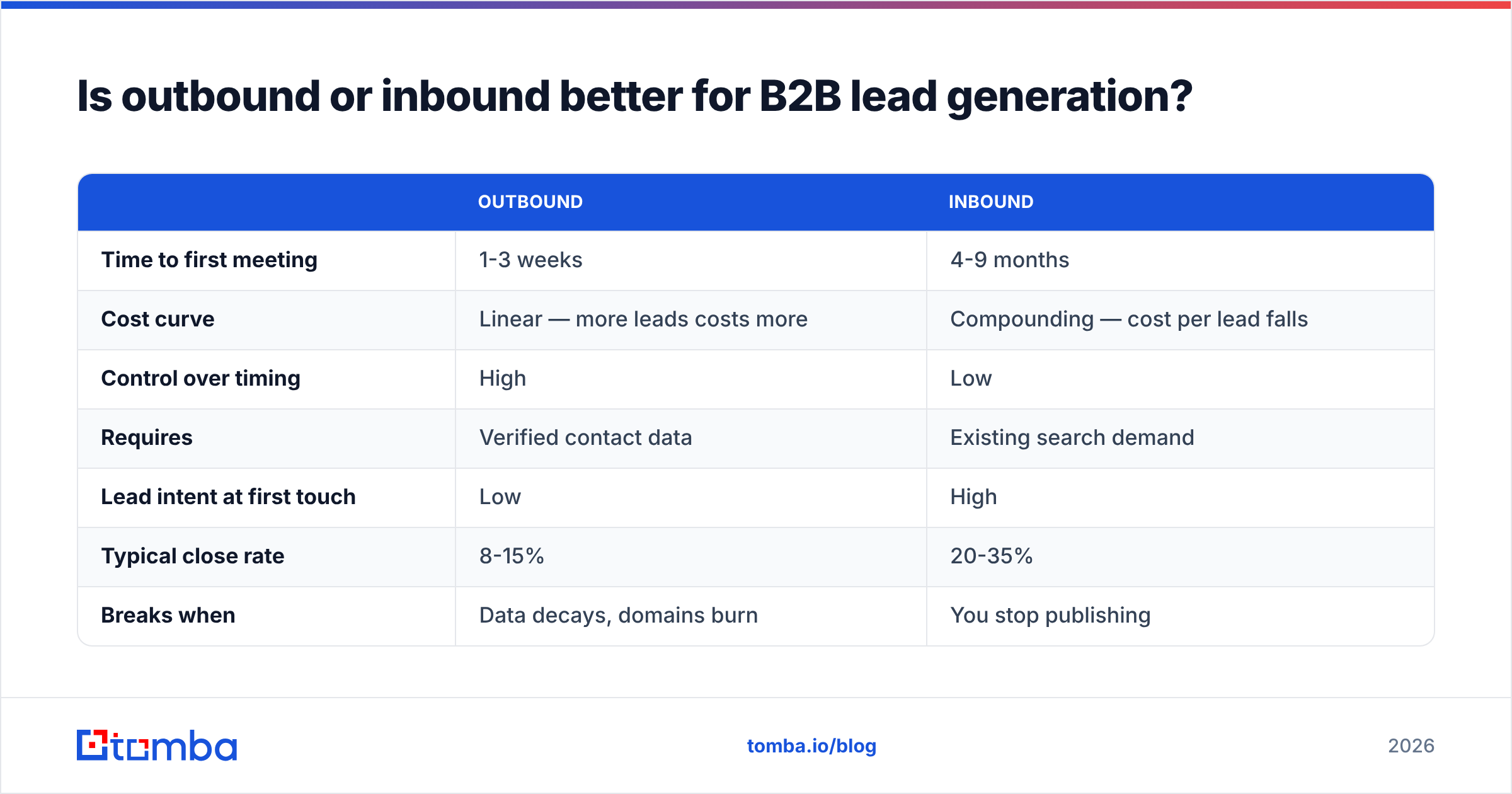
Is outbound or inbound better for B2B lead generation?#
Neither. They solve different problems and the honest answer is that you need both, started at different times.
Outbound creates demand. You reach people who weren't looking. It works when you can define who has the problem, and it fails when you can't. Outbound gives you control over timing and volume, which is why it's the right first motion for a new product — you can test 200 messages against a segment next week and know something by Friday.
Inbound captures demand. People searching for a solution find you. It works when meaningful search volume already exists for your category, and it compounds: a post that ranks brings leads for years at near-zero marginal cost. It fails when you're creating a category nobody is searching for yet, or when you quit at month four because nothing happened yet.
| Outbound | Inbound | |
|---|---|---|
| Time to first meeting | 1-3 weeks | 4-9 months |
| Cost curve | Linear — more leads costs more | Compounding — cost per lead falls |
| Control over timing | High | Low |
| Requires | Verified contact data | Existing search demand |
| Lead intent at first touch | Low | High |
| Typical close rate | 8-15% | 20-35% |
| Breaks when | Data decays, domains burn | You stop publishing |
The practical answer for most teams under $10M ARR: run outbound as the primary motion for pipeline this quarter, and publish consistently so that inbound is carrying meaningful load 12 months from now. The teams that only run outbound hit a ceiling when their addressable list is exhausted. The teams that only run inbound spend a year with no pipeline.
One thing that makes both stronger: visitor identification on your site. Anonymous traffic from a target account reading your pricing page three times is the highest-intent outbound trigger you will ever get, and it sits at the seam between the two motions.
How do you make cold outreach actually get replies?#
Assume the recipient reads the first line, decides in two seconds, and archives. Write for that.
Relevance beats personalization. "I saw you went to Michigan" is personalization. "You're hiring three SDRs and running HubSpot — most teams at that stage lose two weeks a month to manual list building" is relevance. The second one earns the reply because it demonstrates you understand their situation, not that you can read a profile.
One ask, and make it small. "Worth a 15-minute call Thursday?" converts worse than "Is this a priority for you this quarter, or is it a next-year problem?" The second is a question a busy person can answer in four words, and any answer opens a conversation.
Keep it under 90 words. Longer emails don't get read on phones, and most of your prospects are reading on phones.
Follow up three to four times, then stop. Most replies arrive on touches two through four. Past touch five you're annoying people and generating spam complaints, which cost more than the marginal reply is worth.
Warm your domains and pace your sends. Use a separate sending domain from your primary. Ramp new mailboxes over two to three weeks rather than blasting on day one. If you want a concrete ramp schedule, work through an email warmup calculator before you launch — and check your SPF record, DKIM, and DMARC are all passing first. Google's bulk sender requirements are the baseline; treat them as mandatory, not advisory.
Test one variable at a time. Subject line or first line or CTA — not all three. Otherwise you learn nothing from the result.
If your reply rate is under 2% with clean data and correct authentication, the problem is the offer, not the copy. No amount of subject-line testing fixes a message aimed at people who don't have the problem.
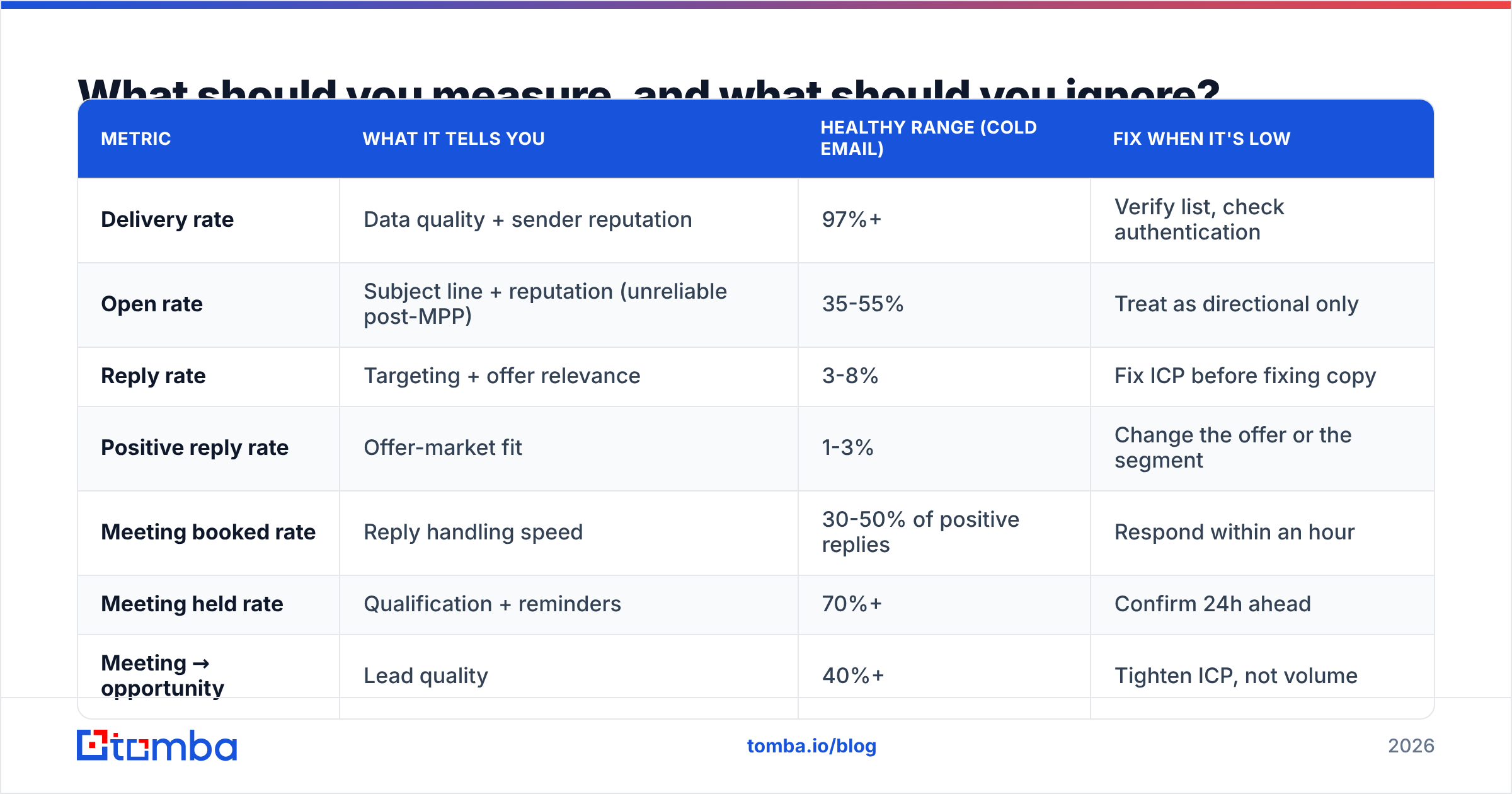
What should you measure, and what should you ignore?#
Measure cost per sales-accepted meeting. Weekly. That's the number that tells you whether a channel deserves next month's budget.
Everything upstream is diagnostic, not a goal:
| Metric | What it tells you | Healthy range (cold email) | Fix when it's low |
|---|---|---|---|
| Delivery rate | Data quality + sender reputation | 97%+ | Verify list, check authentication |
| Open rate | Subject line + reputation (unreliable post-MPP) | 35-55% | Treat as directional only |
| Reply rate | Targeting + offer relevance | 3-8% | Fix ICP before fixing copy |
| Positive reply rate | Offer-market fit | 1-3% | Change the offer or the segment |
| Meeting booked rate | Reply handling speed | 30-50% of positive replies | Respond within an hour |
| Meeting held rate | Qualification + reminders | 70%+ | Confirm 24h ahead |
| Meeting → opportunity | Lead quality | 40%+ | Tighten ICP, not volume |
Ignore vanity metrics: total emails sent, impressions, follower counts, and open rate as a primary KPI (Apple Mail Privacy Protection inflates it beyond usefulness). Ignore MQL counts that nobody in sales has agreed to accept — an MQL definition that marketing wrote alone is a scoreboard, not a metric.
Give each channel one full sales cycle before you judge it. If your average deal takes 60 days, a channel you launched three weeks ago has told you almost nothing about revenue — only about the top of the funnel. Kill on cost per meeting, not on cost per lead, because cost per lead rewards exactly the low-quality volume you're trying to avoid.
What does a realistic 90-day plan look like?#
Days 1-15: Foundation. Define the ICP from closed-won data. Build the first 500-account list. Set up sending domains, authentication, and warmup. Choose your two channels.
Days 16-30: Data and infrastructure. Find and verify contacts for the full list. Enrich for segmentation. Build suppression lists. Write three sequences for three segments. Publish your first two SEO pieces if inbound is one of your two channels.
Days 31-60: Run and instrument. Launch at low volume — 30-50 emails per mailbox per day, ramping. Track the full funnel weekly. Iterate on the segment with the highest positive reply rate and cut the worst performer at day 45.
Days 61-90: Scale what works. Double down on the winning segment. Add mailboxes rather than raising per-mailbox volume. Expand the account list using the profile of accounts that actually replied. By day 90 you should have a defensible cost per meeting for at least one channel.
That's the whole thing. It isn't complicated, it's just sequential — and the sequence is where teams go wrong, usually by launching sends before the data step is done.
Where should you start this week?#
Start with the data, because it's the constraint on everything else. Pull your closed-won list, define the pattern, and build 500 accounts with verified contacts before you write a single sequence.
Tomba's Email Finder handles the find-and-verify step in one pass — domain search to map an organization's addresses, name-based lookup for specific buyers, and built-in verification so bad addresses never reach your sequencer. The free tier gives you 25 searches a month to test accuracy against contacts you already know are correct, and paid plans start at $49/month; full Tomba pricing is public if you want to model the cost per verified contact before committing. Run your first 100 prospects through it, check the bounce rate on the first send, and build from there.
Related guides#
Ready to find emails that actually work?
Join 150,000+ professionals who stopped guessing and started sending. Free credits on signup — no credit card required.
Get the Tomba newsletter
Practical outbound tactics and product updates — once every two weeks.
About the author