How To Generate Leads For Business Development in 2026
A working playbook for business development leads: how to build a target list, pick channels that still convert in 2026, and measure pipeline instead of vanity metrics.
TL;DR
- Business development lead gen is not sales prospecting with a different job title. BD leads are partnerships, channel deals, and strategic accounts — longer cycles, fewer targets, higher value per win.
- Start with a written ICP and a target account list of 50–300 named companies. Volume tactics fail in BD because the addressable universe is small.
- The four channels that still produce BD meetings in 2026: warm intros from your existing network, targeted outbound to a researched list, partner/ecosystem co-selling, and content that gets you cited by the people your targets already read.
- Contact data quality is the hidden bottleneck. A 30% bounce rate on a 200-account BD list means you burned 60 of your best targets and torched domain reputation doing it.
- Measure meetings-to-account and partnership-sourced pipeline, not emails sent. BD dashboards that track activity volume reward the wrong behaviour.
What counts as a business development lead?#
A business development lead is an organization — not a person — that could plausibly become a partner, reseller, integration, channel, or strategic account. The person you contact is a route into that organization, not the unit of measurement.
That distinction changes everything downstream. In transactional sales, you can run a 10,000-contact list and let statistics do the work. In business development you may have 120 realistic targets on the entire planet. Every one you burn with a bad email, a lazy pitch, or a bounced address is gone for a quarter or more.
Three practical consequences:
- Research time per lead goes up, not down. Budget 15–30 minutes per target account before first touch. That is not inefficiency — it is the job.
- Multi-threading is mandatory. Partnership decisions in 2026 typically involve a BD owner, a product stakeholder, and a legal or finance gate. One contact is not enough.
- Rejection is not a dead end. A "not now" from a strategic partner is a 6-month follow-up, not a closed-lost.
- Deliverability is a strategic asset. With a 200-account universe, your sending domain's reputation is finite capital.
How is BD lead generation different from sales prospecting?#
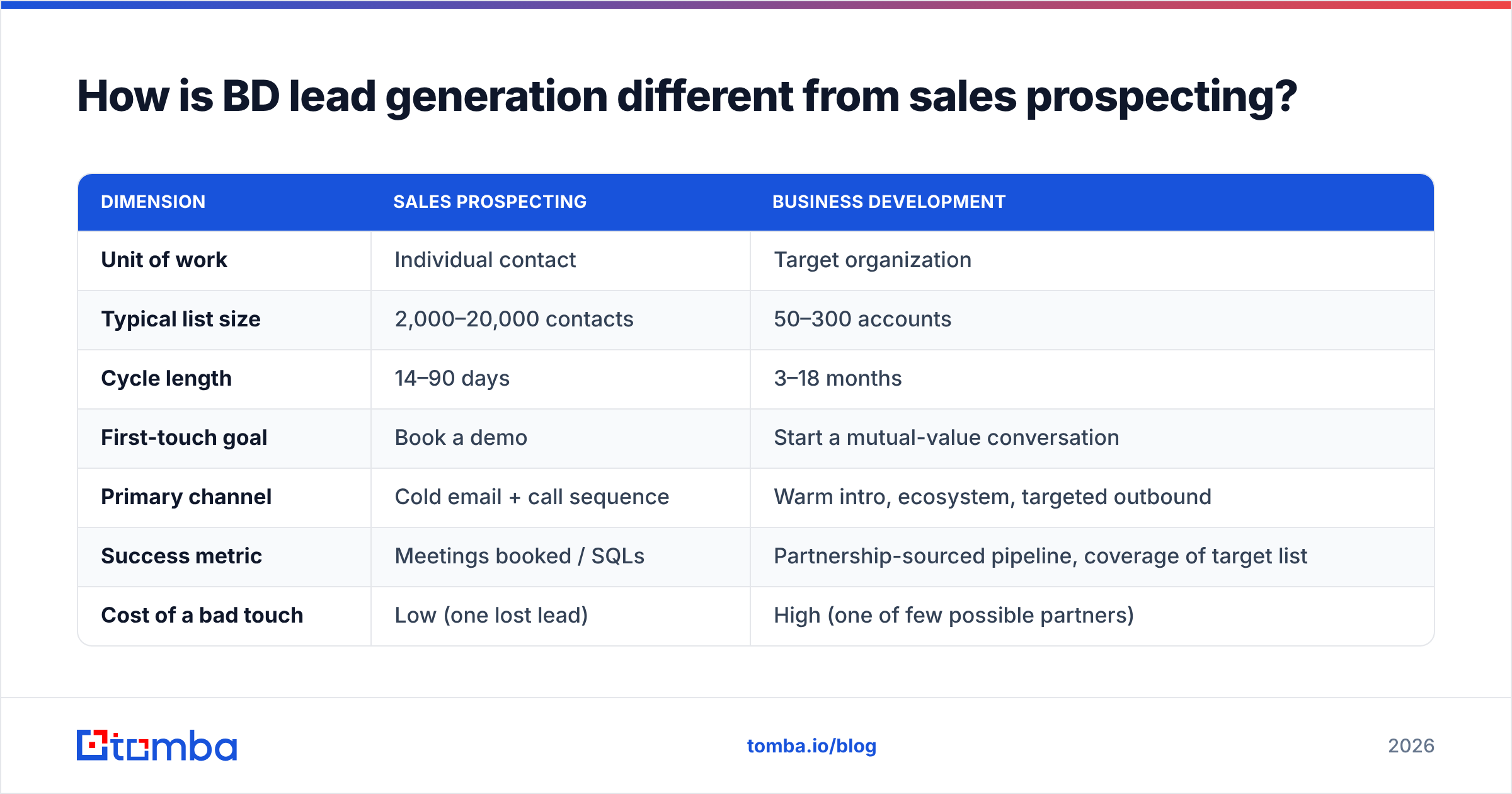
The two get conflated constantly, and the confusion produces bad playbooks: BD teams inherit SDR sequences built for 5,000-lead volumes and wonder why partnership conversations never start.
| Dimension | Sales prospecting | Business development |
|---|---|---|
| Unit of work | Individual contact | Target organization |
| Typical list size | 2,000–20,000 contacts | 50–300 accounts |
| Cycle length | 14–90 days | 3–18 months |
| First-touch goal | Book a demo | Start a mutual-value conversation |
| Primary channel | Cold email + call sequence | Warm intro, ecosystem, targeted outbound |
| Success metric | Meetings booked / SQLs | Partnership-sourced pipeline, coverage of target list |
| Cost of a bad touch | Low (one lost lead) | High (one of few possible partners) |
| Data requirement | Volume with acceptable error | Precision on a small named list |
If your BD function is being measured on emails sent per rep, you have a sales-prospecting metric bolted onto a business-development job. Fix the metric before you fix the tactics.

How do you build a target account list that is actually workable?#
Conclusion first: write the ICP, then name the companies, then find the people. In that order. Teams that reverse it end up with a contact list looking for a strategy.
Step 1 — Define the partnership thesis. Not "companies in fintech." Something falsifiable: "Payment platforms with 50–500 employees that already integrate with at least two data-enrichment vendors and serve SMB merchants in North America." A thesis you can check a company against in 60 seconds.
Step 2 — Source the account names. Combine three sources so you do not inherit one vendor's blind spots:
- Public ecosystem pages — your target category's integration directories and app marketplaces list exactly who partners with whom.
- Review-site category pages on G2 or Capterra, filtered by segment and region.
- Your own product's referrer and firmographic data — companies already touching your ecosystem convert far better than cold names.
Step 3 — Identify the right roles. For partnerships that usually means Head of Partnerships, VP BD, or a product lead who owns the integration surface. For strategic accounts it is the economic buyer plus a technical champion.
Step 4 — Get verified contact data. This is where most BD lists quietly rot. Guessed patterns like first.last@company.com are right often enough to feel productive and wrong often enough to wreck a domain. Run names through a proper email finder, then push everything through an email verifier before the first send. For account-level sweeps where you know the company but not the person, domain search returns the published addresses and the company's dominant email pattern in one call.
Step 5 — Enrich to make personalization possible. Job title alone does not let you write a relevant first line. Layer in headcount, tech stack, funding stage, and recent announcements via data enrichment so your researcher's 20 minutes go into thinking, not tab-switching.
Step 6 — Tier the list. Tier 1 (top 25) gets bespoke research and a warm-intro attempt. Tier 2 (next 75) gets a personalized sequence. Tier 3 gets a light-touch nurture. Do not treat 300 accounts as one undifferentiated blob.
Which channels actually generate business development leads in 2026?#
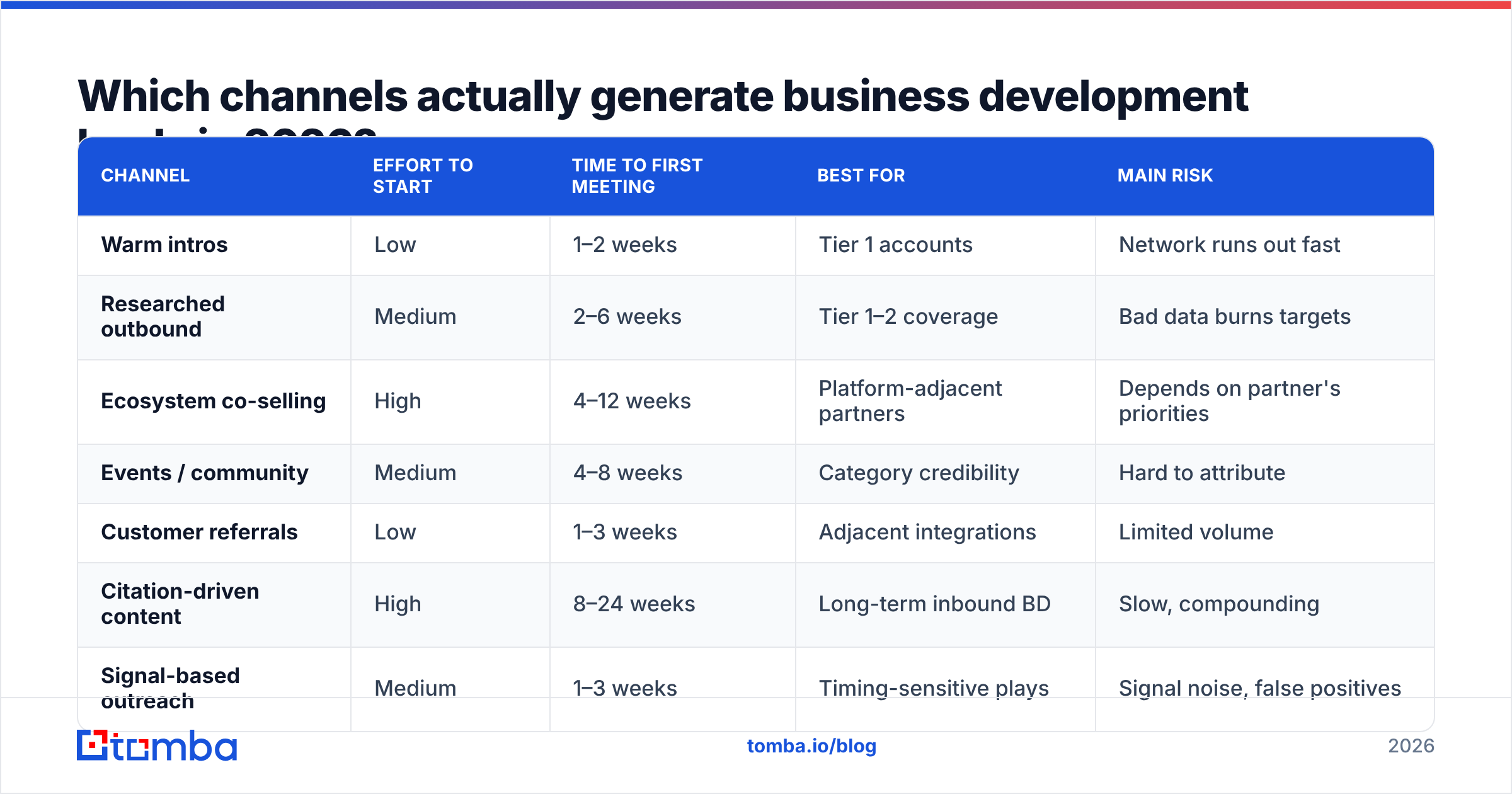
Seven methods, ranked by the pipeline they realistically produce for a two-person BD team.
1. Warm introductions. Still the highest-converting channel by a wide margin. Map second-degree connections across your investors, advisors, customers, and existing partners before you send a single cold email. A referred first meeting converts to a real evaluation at multiples of a cold one.
2. Researched outbound. Cold email works in BD when it reads like a memo, not a sequence. Reference a specific integration gap, a shared customer, or a public roadmap statement. Two hundred good emails beat twenty thousand generic ones.
3. Ecosystem and marketplace co-selling. If your target already sells alongside a platform you integrate with, the platform's partner team is a warmer path than the target's front door. Platform partner managers are professionally motivated to make introductions.
4. Event and community presence. Not booth-buying. Speaking slots, roundtables, and category Slack/Discord communities where the 300 people who matter actually talk. One well-placed panel produces more BD conversations than a quarter of banner ads.
5. Customer-led referrals. Your existing customers already work with your target partners. A quarterly "who else should we be integrated with?" question in QBRs is the cheapest BD source that exists.
6. Inbound content built for citation. Write the benchmark, teardown, or category map that people in your niche link to. You are not chasing traffic — you are chasing the moment a partner's BD lead reads your analysis and emails you first.
7. Signal-based outreach. Job postings, funding announcements, and new-executive hires are timing signals. A company that just hired its first Head of Partnerships is in market for partnerships this quarter, by definition.
| Channel | Effort to start | Time to first meeting | Best for | Main risk |
|---|---|---|---|---|
| Warm intros | Low | 1–2 weeks | Tier 1 accounts | Network runs out fast |
| Researched outbound | Medium | 2–6 weeks | Tier 1–2 coverage | Bad data burns targets |
| Ecosystem co-selling | High | 4–12 weeks | Platform-adjacent partners | Depends on partner's priorities |
| Events / community | Medium | 4–8 weeks | Category credibility | Hard to attribute |
| Customer referrals | Low | 1–3 weeks | Adjacent integrations | Limited volume |
| Citation-driven content | High | 8–24 weeks | Long-term inbound BD | Slow, compounding |
| Signal-based outreach | Medium | 1–3 weeks | Timing-sensitive plays | Signal noise, false positives |
What does a BD outreach sequence look like when the list is small?#
Short answer: fewer touches, more substance, longer gaps.
A workable Tier 1 cadence over six weeks:
- Day 0 — Warm-intro attempt. Ask a mutual connection before you cold-email. If it lands, everything below is unnecessary.
- Day 3 — Email one. Four sentences. What you noticed about their business, the specific overlap, one concrete proposal, one low-friction ask. No calendar link in the first email.
- Day 6 — LinkedIn. Comment substantively on something they published. Do not pitch in the comment.
- Day 10 — Email two. New angle, not a bump. Attach or link something genuinely useful — a shared-customer count, a teardown of the integration surface.
- Day 17 — Phone. For BD, the phone still works because the volume is low enough to make each call worth preparing for. Pull direct dials with a phone finder rather than routing through a switchboard.
- Day 30 — Multi-thread. Contact a second stakeholder with a different framing.
- Day 45 — Close the loop. "Should I check back next quarter?" gets an honest answer more often than a seventh follow-up.
Two things kill this cadence before it starts. The first is a bounced email on day 3, which puts your domain closer to a spam folder for every other target on the list. The second is a generic first line, which tells a Head of Partnerships that you did not do the 20 minutes of work.

How do you keep deliverability from wrecking a small BD list?#
Because BD lists are small, a single deliverability problem is disproportionately expensive. You cannot outrun it with volume.
The non-negotiables:
- Verify before every send, not once a year. B2B contact data decays roughly 2–3% per month as people change jobs. A list you verified in January is materially wrong by June.
- Separate your BD sending domain from your corporate domain. If a warmed subdomain gets flagged, your invoices and contracts still arrive.
- Authenticate properly. SPF, DKIM, and DMARC are table stakes with Google and Microsoft's current bulk-sender enforcement. Check your SPF record and confirm alignment before your first campaign, and read Google's own sender guidelines rather than a summary of them.
- Handle catch-all domains explicitly. Large enterprises frequently accept everything at the MX layer, so a standard verifier returns "unknown." A catch-all verifier resolves a meaningful share of those instead of leaving you guessing on your most valuable accounts.
- Cap daily volume per mailbox. BD does not need 500 sends a day. Thirty well-researched emails from a single warmed mailbox is a realistic and safe ceiling.
- Watch reply rate as a health metric. A collapsing reply rate usually signals a deliverability problem weeks before your open rate makes it obvious.
Keeping email deliverability healthy is not a growth hack in business development — it is the difference between reaching your 300 accounts and quietly reaching 180 of them while your dashboard says 300.
How should you measure business development lead generation?#
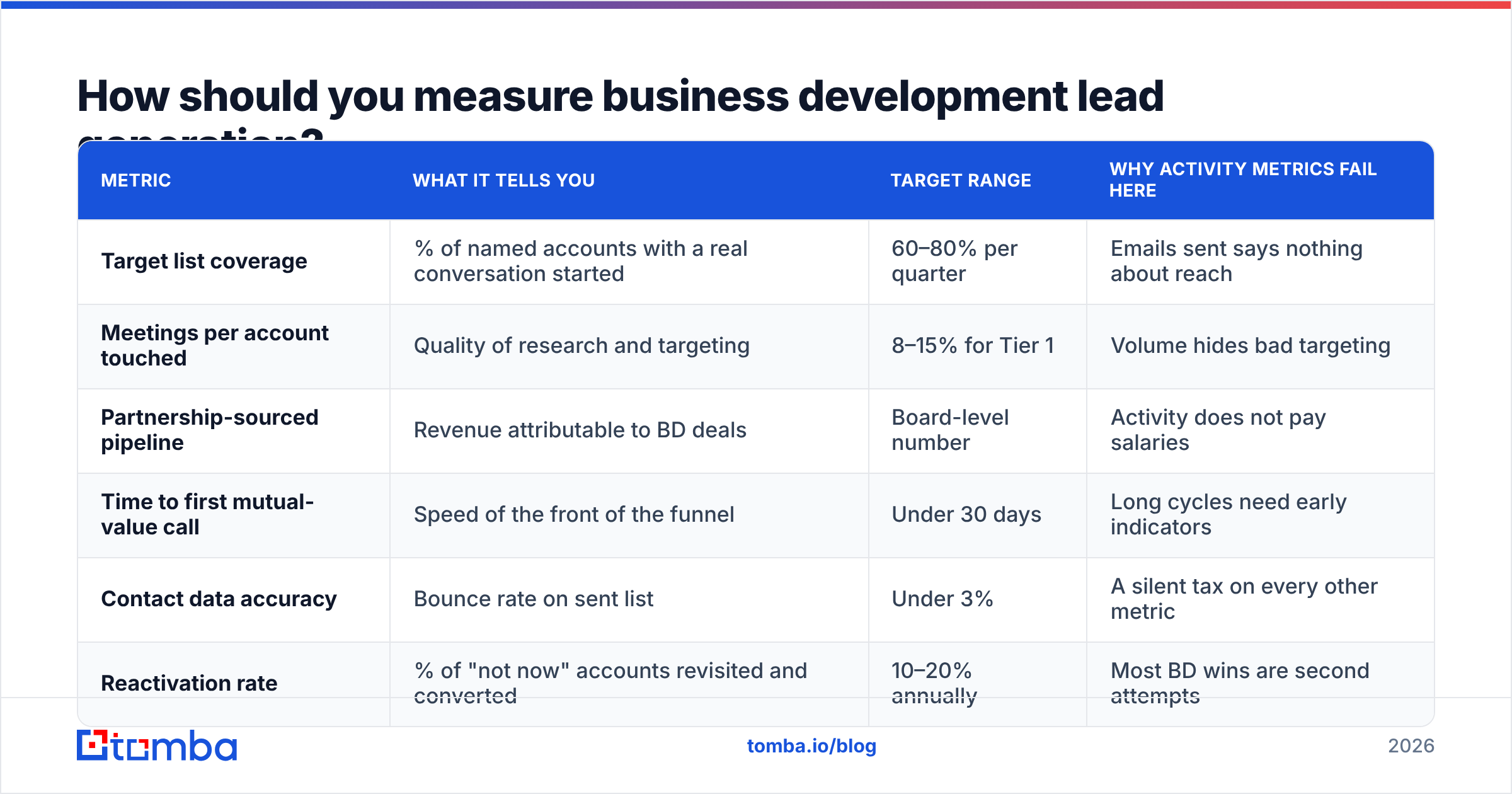
Stop counting activity. Count coverage and conversion.
| Metric | What it tells you | Target range | Why activity metrics fail here |
|---|---|---|---|
| Target list coverage | % of named accounts with a real conversation started | 60–80% per quarter | Emails sent says nothing about reach |
| Meetings per account touched | Quality of research and targeting | 8–15% for Tier 1 | Volume hides bad targeting |
| Partnership-sourced pipeline | Revenue attributable to BD deals | Board-level number | Activity does not pay salaries |
| Time to first mutual-value call | Speed of the front of the funnel | Under 30 days | Long cycles need early indicators |
| Contact data accuracy | Bounce rate on sent list | Under 3% | A silent tax on every other metric |
| Reactivation rate | % of "not now" accounts revisited and converted | 10–20% annually | Most BD wins are second attempts |
The most under-used metric on that list is reactivation. Business development wins are frequently accounts that said no eighteen months ago and now have a new head of partnerships, a new roadmap, or a new competitor. Build a structured revisit queue and work it every quarter.
For benchmarking your funnel against broader B2B norms, HubSpot's annual sales research is a reasonable public reference point — just remember it blends transactional sales with BD and will make your cycle length look alarming by comparison.
What tooling stack does a small BD team actually need?#
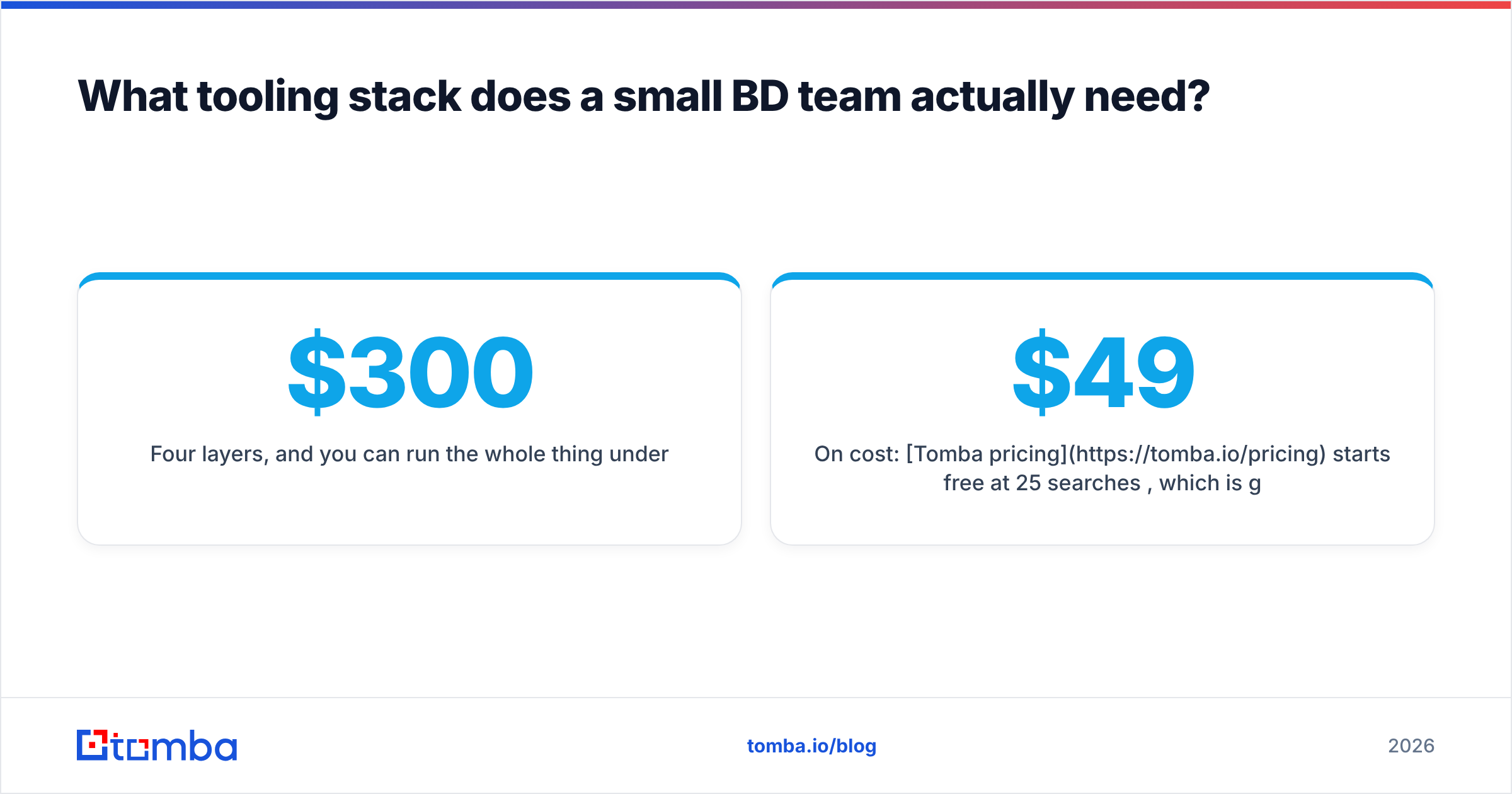
Four layers, and you can run the whole thing under $300/month.
- Account list source — a review-site export, ecosystem scrape, or B2B database query to name the companies.
- Contact discovery and verification — find the right people and confirm the addresses resolve. This is the layer where teams most often over-buy a giant seat-based platform when a credit-based tool covers a 300-account list for a fraction of the cost.
- Sequencing and CRM — whatever your revenue team already uses. BD does not need a separate system; it needs separate fields for partnership stage.
- Enrichment and signals — headcount, funding, tech stack, and job-posting triggers to time the outreach.
On cost: Tomba pricing starts free at 25 searches per month, which is genuinely enough to test a Tier 1 list of 25 accounts before spending anything. Starter is $49/mo, Growth is $99/mo, and Pro is $249/mo for teams running multiple BD motions at once. If your target list is a few hundred accounts rather than tens of thousands, credit-based pricing beats per-seat platform pricing by a wide margin — and if you need bulk lists of pre-verified contacts by industry, a data provider like BookYourData is a solid complement for filling in segments your own sourcing missed.
Whichever stack you land on, wire it together rather than exporting CSVs by hand. The Tomba API and the HubSpot integration let you enrich and verify inside the CRM where your BD stages already live, which removes the single most common failure point in BD ops: a target list that exists in someone's spreadsheet and nowhere else.
What should you do in your first 30 days?#
- Week 1: Write the partnership thesis. Name 100 accounts against it. Kill any account you cannot justify in one sentence.
- Week 2: Find and verify contacts for the top 50. Map warm-intro paths across your investors, customers, and advisors.
- Week 3: Send 10 warm-intro requests and 25 researched cold emails. Nothing generic.
- Week 4: Review reply rate, bounce rate, and meetings booked. Rewrite the thesis based on who actually replied — the replies are your real ICP signal, not your assumptions.
Then repeat with the next 100 accounts. Business development compounds through iteration on a small, well-researched list, not through scaling a bad one.
Start with data you can trust#
The tactics above only work if the contact layer underneath them is accurate. On a 300-account BD list, a 25% bounce rate does not just waste sends — it removes 75 of your best possible partners from reach and damages the domain you need for the rest of the year.
Run your target accounts through the Tomba Email Finder before your next BD campaign. The free tier covers 25 searches a month, which is enough to validate your Tier 1 list end to end before you commit budget. Find the right people, confirm the addresses resolve, and spend your research time on the pitch instead of on guessing email patterns.
Related guides#
// get started
Find, verify and enrich your first contacts today
Start on the free plan with 25 searches a month, then scale when your team is ready.
Free plan · No credit card required · GDPR & CCPA
// about the author