How to Generate MQLs in 2026: A Practical B2B Playbook
Most teams call every form fill an MQL, then wonder why sales ignores them. Here is a concrete scoring, sourcing, and enrichment playbook that produces MQLs your reps actually work.
TL;DR
- An MQL is not "anyone who filled a form." It's a contact whose fit and behavior both clear a threshold you agreed on with sales — and if sales rejects more than 25% of them, your definition is broken, not your reps.
- The fastest lever most teams ignore: enrichment. Half of MQL rejection is missing or wrong data (no title, no company size, personal Gmail), not bad intent.
- Score fit and behavior on separate axes. A VP at a 500-person ICP account who read one pricing page beats an intern who downloaded four ebooks.
- Outbound-sourced MQLs convert at roughly 2-3x inbound content MQLs in most B2B funnels because you control the fit filter before the first touch.
- Build the loop: define → source → enrich → score → route with an SLA → measure MQL-to-SQL acceptance monthly. Anything else is lead-volume theater.
What is an MQL, and why does yours keep getting rejected?#
A marketing qualified lead is a contact who has shown enough fit and enough interest that marketing is willing to stake its reputation on sales working it. That last clause is the part most teams skip.
Here's the analogy: an MQL is a restaurant reservation, not a walk-in. A walk-in is anyone who wandered past the door. A reservation means someone gave you a name, a party size, and a time — enough information that you can actually set the table. When marketing forwards walk-ins labeled as reservations, the kitchen stops trusting the host stand.
The typical failure looks like this. Marketing runs a webinar, gets 340 registrants, marks all 340 as MQLs, and celebrates. Sales works maybe 60, finds that 200 are students, competitors, or people at 4-person companies, and quietly starts ignoring the MQL queue entirely. Six months later the two teams are arguing about lead quality in a QBR and nobody has changed the definition.
Three structural causes, in order of how often they show up:
- No fit gate. Behavior alone (downloaded, attended, clicked) became the entire qualification. Fit — company size, industry, geography, title — was never scored.
- Missing data. The form asked for email and nothing else, so the record has no title or headcount to score against. The lead might be perfect; you can't tell.
- No agreed rejection loop. Sales can't send an MQL back with a reason code, so nobody ever learns which signals were noise.
Fix data first. It's the cheapest of the three and it unblocks the other two.

What are the components of a working MQL definition?#
A usable definition has four parts, and you should be able to write all four on one index card:
- Fit criteria (hard gate). Company must be in one of N industries, employee count in a defined band, headquarters in a serviceable region, and the contact must hold a role that touches the buying decision. Fail any of these and the lead is not an MQL regardless of behavior.
- Behavioral threshold (points). A score built from actions with different weights — pricing page visit, demo request, repeat visits within 14 days, high-value content download, reply to a nurture email.
- Recency window. Points decay. A pricing page visit from March is not a buying signal in September. Most teams use a 30- or 60-day rolling window.
- Negative signals (subtractive). Free-email domain, competitor domain, careers page as the only visit, unsubscribed, known student email pattern. These subtract points or hard-disqualify.
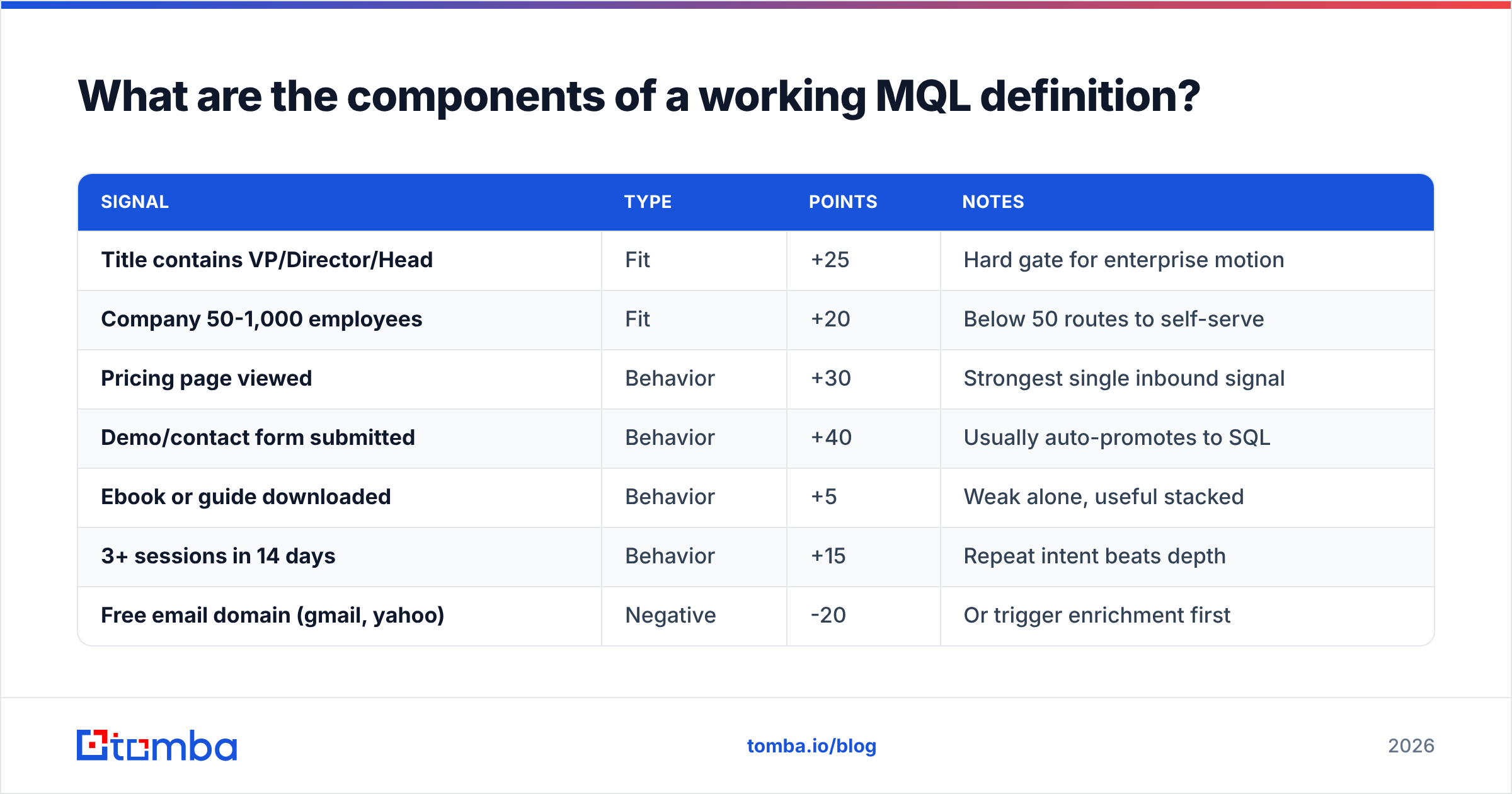
Here's a concrete scoring frame you can adapt:
| Signal | Type | Points | Notes |
|---|---|---|---|
| Title contains VP/Director/Head | Fit | +25 | Hard gate for enterprise motion |
| Company 50-1,000 employees | Fit | +20 | Below 50 routes to self-serve |
| Pricing page viewed | Behavior | +30 | Strongest single inbound signal |
| Demo/contact form submitted | Behavior | +40 | Usually auto-promotes to SQL |
| Ebook or guide downloaded | Behavior | +5 | Weak alone, useful stacked |
| 3+ sessions in 14 days | Behavior | +15 | Repeat intent beats depth |
| Free email domain (gmail, yahoo) | Negative | -20 | Or trigger enrichment first |
| Competitor domain | Negative | Disqualify | Maintain an explicit blocklist |
Set the MQL threshold at a number that produces a volume sales can actually work. If your team of four AEs can handle 120 leads a month, tune the threshold until you get roughly 120 — not 800. Scarcity forces the definition to be honest.
How do you source enough raw leads to qualify in the first place?#
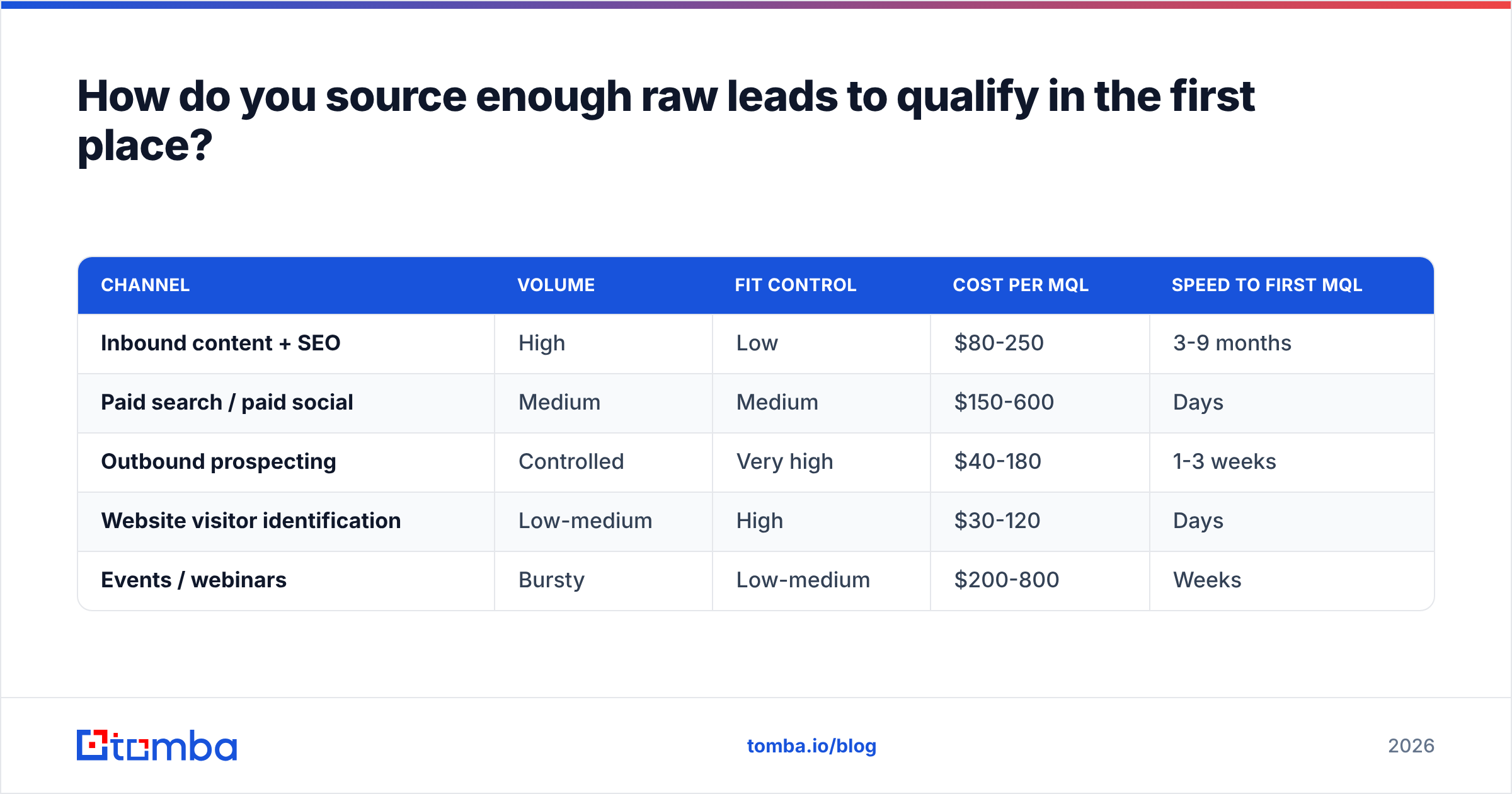
You can't score what you don't have. MQL generation is a supply problem before it's a filtering problem, and the four supply channels behave very differently.
| Channel | Volume | Fit control | Cost per MQL | Speed to first MQL |
|---|---|---|---|---|
| Inbound content + SEO | High | Low | $80-250 | 3-9 months |
| Paid search / paid social | Medium | Medium | $150-600 | Days |
| Outbound prospecting | Controlled | Very high | $40-180 | 1-3 weeks |
| Website visitor identification | Low-medium | High | $30-120 | Days |
| Events / webinars | Bursty | Low-medium | $200-800 | Weeks |
Inbound is the slowest to start and the hardest to control for fit, but it compounds. Outbound is the opposite: you pick the accounts, so fit is 100% by construction, and the only question is whether you can reach the right person. That's why outbound-sourced MQLs typically show higher acceptance rates — the fit gate ran before the first email, not after.
The practical move for most teams under $20M ARR is to run outbound as the fit-controlled base load and let inbound accumulate underneath it. Build your target account list from your ICP definition, then find the humans:
- Account list first. Pull companies matching your fit criteria — industry, headcount, tech stack, funding stage. Tools like Vainu or a straightforward B2B database query both work here.
- Then the contacts. Use domain search to pull every discoverable address at a target company, filtered by department, so you can pick the right two or three rather than blasting everyone.
- Then verify. Run the list through an email verifier before it enters your CRM. A bounced MQL is worse than no MQL — it damages sender reputation and pollutes your acceptance metrics.
- Then enrich. Append title, seniority, headcount, and LinkedIn URL so the scoring model has something to score.
For the inbound side, website visitor identification deserves more attention than it gets. Roughly 95-98% of B2B site visitors never fill out a form. Visitor identification turns a slice of that anonymous traffic into named companies you can then prospect into — effectively converting inbound intent into outbound-quality fit data.
Why is enrichment the highest-leverage step in MQL generation?#
Because scoring is arithmetic on fields, and empty fields score zero.
Run this audit on your own database: pull 200 recent inbound leads and count how many have a populated job title, employee count, and industry. In most CRMs the answer is somewhere between 30% and 60%. Every blank row is a lead your scoring model silently rejects — not because the person is a bad fit, but because you never asked and never appended.
Three enrichment plays that move MQL volume without changing a single form:
- Backfill firmographics from the email domain. The domain tells you the company; the company tells you industry, headcount, and revenue band. This alone re-qualifies a meaningful chunk of your "unscored" pile.
- Resolve personal emails to work identities. Someone signed up with a Gmail address. A reverse email lookup can often map that to a real professional identity and employer, converting a -20 negative signal into a scoreable record.
- Append missing contact channels. If a lead scores as an MQL but you only have an email, adding a phone number roughly doubles your realistic contact rate on the follow-up.
Shorten your forms while you're at it. Every additional required field costs conversion — HubSpot's research on form length has shown meaningful drop-off as fields increase. Ask for the work email, then append the rest server-side. You get better data and better conversion, which is a rare pairing.
How should you score fit and behavior separately?#
Use a two-axis grid instead of a single number. A single score collapses two different questions — "should we sell to this company?" and "are they ready now?" — into one figure that hides which one failed.
Plot fit (A/B/C/D) against behavior (1/2/3/4) and route accordingly:
- A1, A2 (great fit, high intent): Immediate MQL. Route to an AE within 15 minutes if it's a demo request.
- A3, A4 (great fit, low intent): Do not send to sales as an MQL. Send to outbound sequencing or nurture. These are your best future pipeline and the fastest way to burn rep trust if mislabeled.
- B1, C1 (poor fit, high intent): Review manually. Sometimes this is a real expansion signal (a small team inside a large enterprise). Often it's a student or a competitor.
- D anything: Disqualify and stop spending on them.
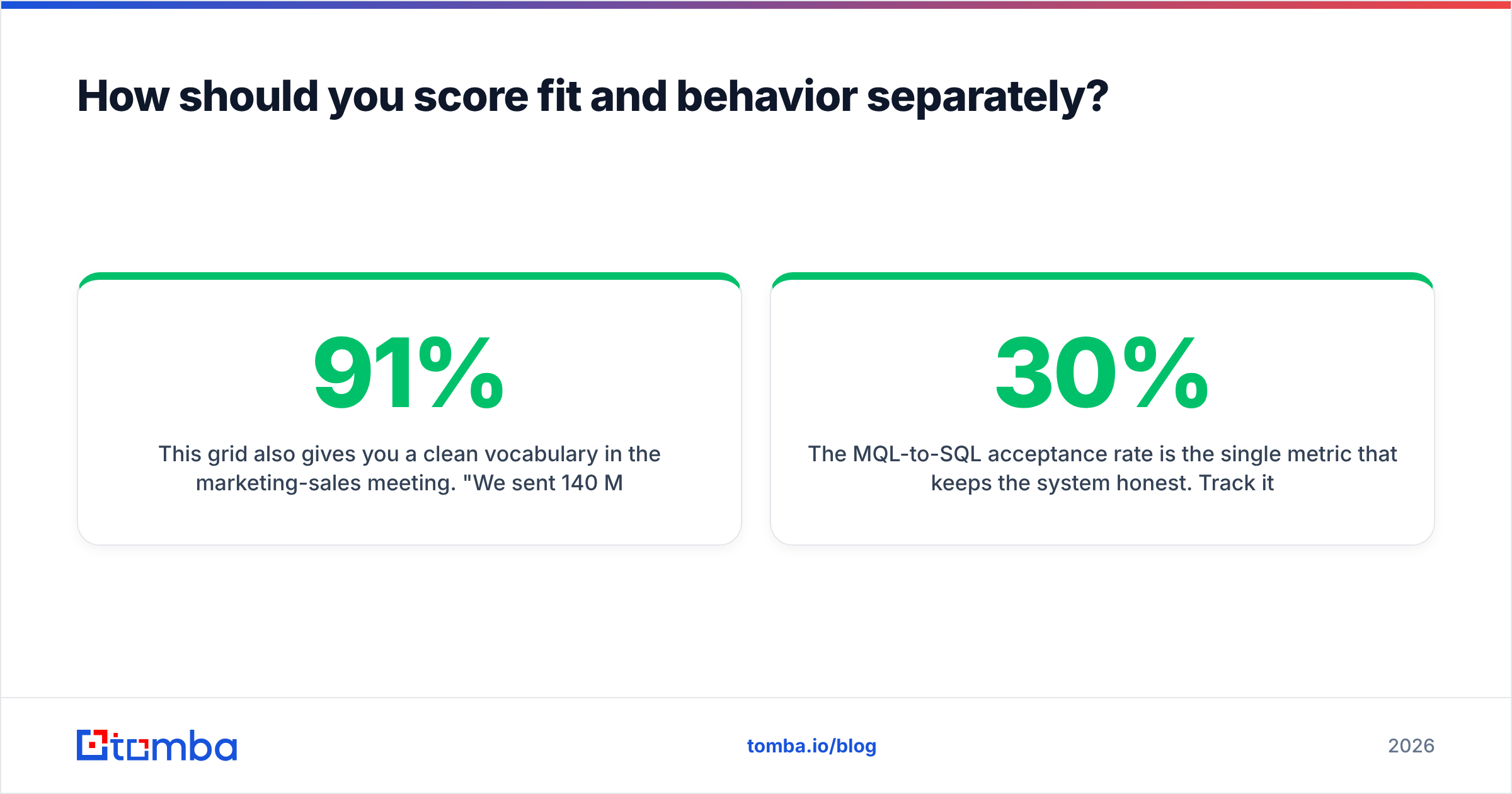
This grid also gives you a clean vocabulary in the marketing-sales meeting. "We sent 140 MQLs, 118 were A1/A2, acceptance was 91%" is a conversation. "We sent 900 leads" is not.
The MQL-to-SQL acceptance rate is the single metric that keeps the system honest. Track it monthly. Healthy B2B teams land somewhere between 30% and 50% acceptance depending on how tightly they gate. If you're above 80%, your threshold is too high and you're starving the funnel. Below 25% and you're sending noise. Gartner's research on B2B buying is a useful reality check on how nonlinear the journey actually is — buyers loop back through stages, so a lead scoring low today may score high in six weeks without any change in their fit.
What does the handoff SLA look like?#
Generation without routing is wasted work. Codify four things in writing:
- Response time. Sales contacts every MQL within X hours (15 minutes for demo requests, 24 hours for score-threshold MQLs). Speed-to-lead is the highest-correlation variable in most inbound funnels.
- Attempt cadence. Minimum touches before the lead can be closed out — typically 5-8 attempts across email, phone, and LinkedIn over 12-14 days.
- Rejection reason codes. Sales must pick from a fixed list: wrong title, company too small, no budget, competitor, bad data, not now. Free-text rejections teach you nothing.
- Recycle path. Rejected-for-timing leads go back into nurture with a re-scoring date, not into a graveyard.
Wire the rejection codes into your reporting. After 90 days, the distribution tells you exactly what to fix. Mostly "bad data"? That's an enrichment problem. Mostly "company too small"? Your fit gate needs a headcount floor. Mostly "not now"? Your behavioral threshold is firing too early — raise it and push those leads to nurture instead.
Sync the whole loop into your CRM so scores, enrichment fields, and reason codes live where reps already work. Native connections to HubSpot or Salesforce mean the enriched data lands on the record automatically instead of in a spreadsheet somebody forgets to import.
What's the 30-day plan to start generating MQLs?#
Week 1 — Define. Get marketing and sales in one room. Write the fit gate, the behavioral threshold, the negative signals, and the rejection reason codes. One page, both sides sign it.
Week 2 — Audit and enrich. Export your existing database. Measure field completeness. Enrich everything with a title, headcount, and industry. Re-score the entire base against the new definition. Most teams find 15-30% of their "unqualified" pile actually clears the bar once the data is complete.
Week 3 — Build supply. Stand up one controlled channel. If you have traffic, turn on visitor identification. If you don't, build a 500-account target list and find verified contacts at each. Verify before import, always.
Week 4 — Route and measure. Turn on the SLA. Set up the acceptance-rate dashboard. Hold a 30-minute weekly review where sales reads back the rejection codes. Adjust the threshold once a month, not once a week — you need enough volume to see signal.
Do not skip week 1 to get to week 3 faster. Every team that does ends up back in the QBR argument.
Which tools do you actually need?#
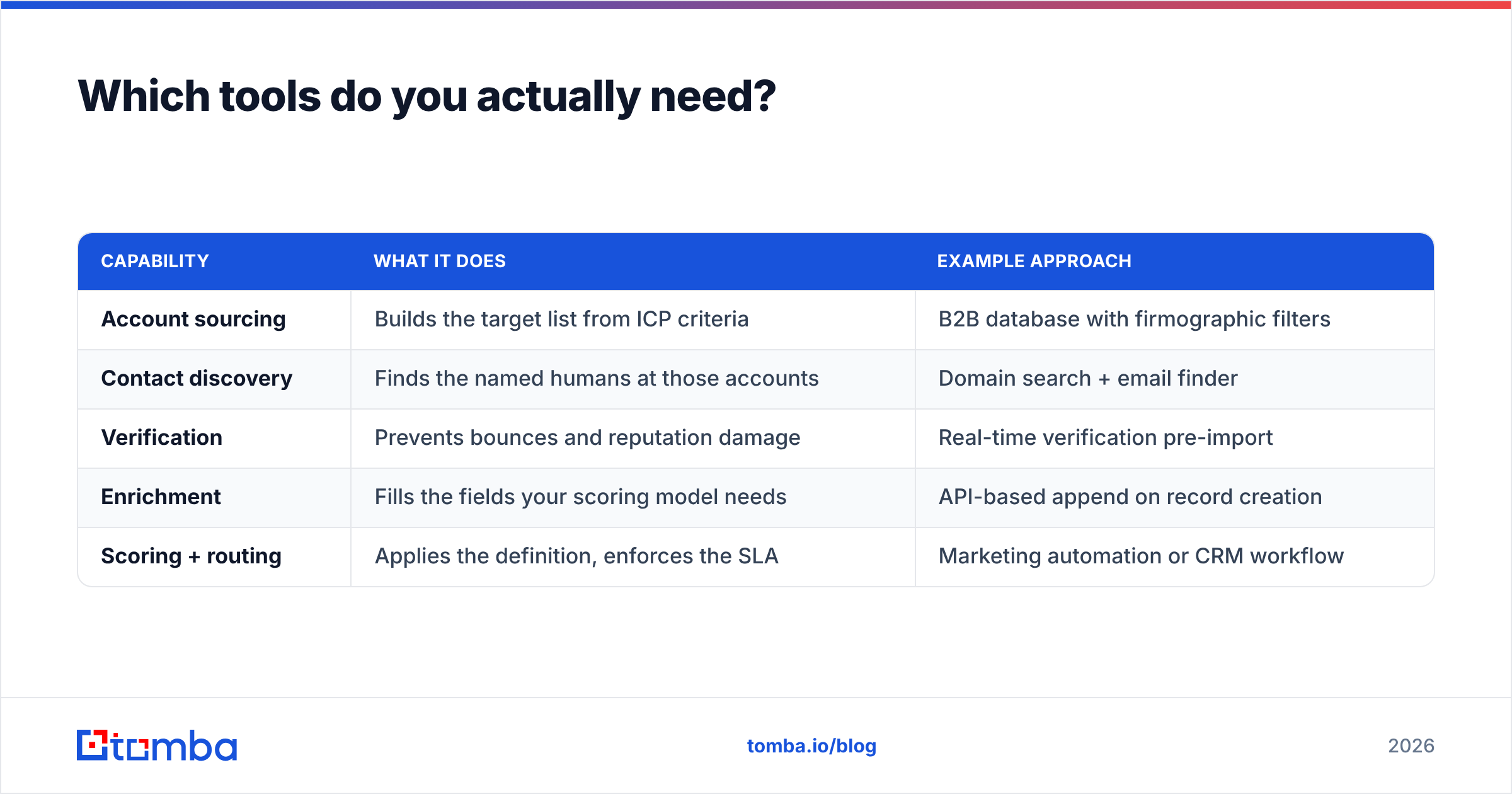
You need four capabilities, and they don't have to come from four vendors:
| Capability | What it does | Example approach |
|---|---|---|
| Account sourcing | Builds the target list from ICP criteria | B2B database with firmographic filters |
| Contact discovery | Finds the named humans at those accounts | Domain search + email finder |
| Verification | Prevents bounces and reputation damage | Real-time verification pre-import |
| Enrichment | Fills the fields your scoring model needs | API-based append on record creation |
| Scoring + routing | Applies the definition, enforces the SLA | Marketing automation or CRM workflow |
Cost matters here because MQL economics are unforgiving. If you're paying $600 per MQL on paid social and $80 on outbound, your channel mix should reflect that. Data tooling that charges per-record enrichment on top of a seat license adds up fast — check Tomba pricing against whatever you're using now: the free tier covers 25 searches a month for testing, Starter is $49/mo, Growth $99/mo, and Pro $249/mo with volume credits that make bulk enrichment predictable rather than a surprise line item.
Peer tools are worth evaluating on your own data. BookYourData is strong if you want pre-built, pay-as-you-go lists rather than an API-first workflow, and comparing two providers on the same 100 test accounts tells you more than any G2 category page will.
Start with the data layer#
The teams that generate MQLs consistently aren't running cleverer campaigns. They have a written definition, complete records, and a routing SLA that both sides respect — in that order.
If your bottleneck is supply and fit control, start by building the account list and finding verified contacts inside it. The Tomba Email Finder gives you name-and-domain lookups with source attribution, feeds directly into bulk enrichment for whole lists, and connects through the Tomba API so enrichment fires the moment a record is created rather than in a monthly cleanup batch. Run 25 free searches against your current target list, compare the completeness against what's in your CRM today, and you'll know within an hour whether data is the thing holding your MQL numbers down.
Related guides#
// get started
Find, verify and enrich your first contacts today
Start on the free plan with 25 searches a month, then scale when your team is ready.
Free plan · No credit card required · GDPR & CCPA
// about the author