How to Get a Client to Respond: 9 Tactics That Work
Silence is rarely rejection — it's usually a routing problem. Here are nine tested tactics for getting a client to respond, plus the follow-up cadence and channel mix that actually move deals forward.
TL;DR
- Most client silence is a logistics failure, not a rejection — wrong inbox, wrong person, wrong ask, or a message that lands in spam.
- Fix deliverability and contact data first. A perfect follow-up sent to a bounced or catch-all address responds at exactly 0%.
- Follow-up cadence beats follow-up cleverness: 4–6 touches over 18–21 days, each adding new information, outperforms three "just checking in" bumps.
- Make replying cheaper than ignoring — binary questions, pre-filled options, and one clear next step lift reply rates more than longer emails.
- The break-up or "permission to close your file" email is the single highest-converting message in most sequences. Use it deliberately, not as a threat.
Why do clients stop responding in the first place?#
Because the cost of replying to you is higher than the cost of ignoring you. That's the whole mechanism.
Think of a client's inbox like a triage desk in an emergency room. Everything arriving is sorted by "will this hurt me if I ignore it?" Your proposal follow-up sits in the same queue as their board deck, their team's escalations, and a vendor invoice that's actually overdue. Nothing about your message signals urgency to them, so it gets deferred. Deferred twice becomes forgotten.
When you dig into silent threads, the causes cluster into five buckets:
- The message never arrived. Authentication failures, a spam-triggering subject, or a stale address. This is far more common than sellers assume — Google's bulk sender requirements tightened enforcement, and unauthenticated mail is quietly filtered rather than bounced.
- You're emailing the wrong person. Your champion left, changed roles, or never had budget authority in the first place. Around a third of B2B contact data decays annually as people change jobs.
- Your ask is too expensive. "Let me know your thoughts on the attached 14-page proposal" requires 40 minutes of cognitive work. Nobody has 40 minutes.
- Internal priorities shifted. The project got deprioritized, and telling you is awkward, so they say nothing.
- They already decided no. Roughly a fifth of silence is a genuine soft no that the buyer won't voice because they want to avoid the conversation.
Only bucket five is actually unwinnable. The other four are process problems you control.

How do you diagnose why a specific client went quiet?#
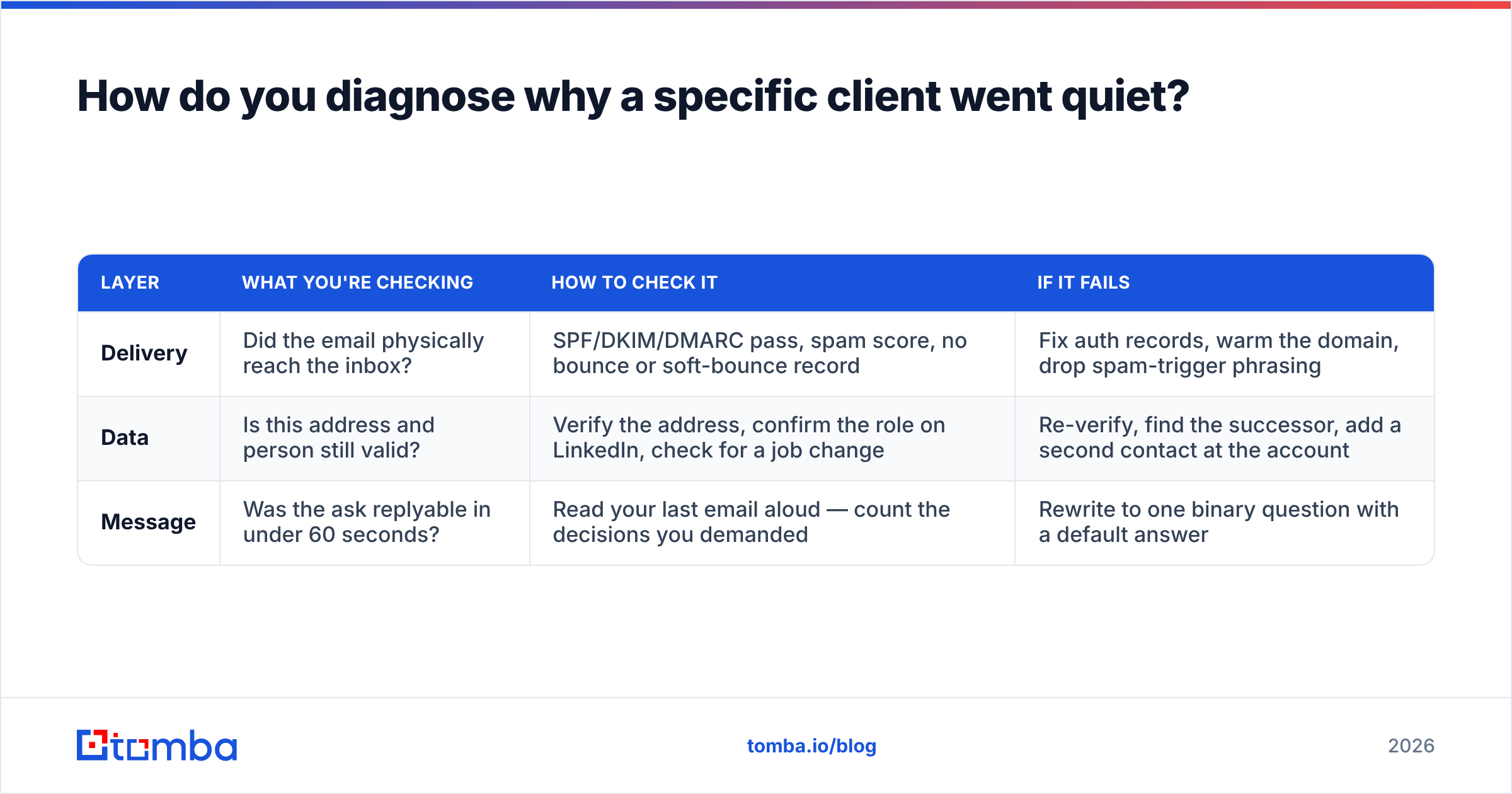
Run a three-layer check before you write another word. Each layer is cheap and rules out a whole class of failure.
| Layer | What you're checking | How to check it | If it fails |
|---|---|---|---|
| Delivery | Did the email physically reach the inbox? | SPF/DKIM/DMARC pass, spam score, no bounce or soft-bounce record | Fix auth records, warm the domain, drop spam-trigger phrasing |
| Data | Is this address and person still valid? | Verify the address, confirm the role on LinkedIn, check for a job change | Re-verify, find the successor, add a second contact at the account |
| Message | Was the ask replyable in under 60 seconds? | Read your last email aloud — count the decisions you demanded | Rewrite to one binary question with a default answer |
Start with delivery because it's the most invisible failure mode. If you're sending from a domain with a broken SPF record or a reputation dented by a bad list, your reply rate is capped no matter how good the copy is. Run the domain through an SPF checker and a spam checker before you blame the message.
Then check the data. If the contact bounced or sits on a catch-all domain, you have no signal at all — a catch-all accepts everything and delivers selectively. Running the address through an email verifier tells you whether you're talking to a real mailbox or shouting into a void. For accounts where the champion has clearly moved on, a domain search surfaces who else at that company holds the same function.
Only after both pass should you rewrite the email. Sequence matters: rewriting copy that never gets delivered is theater.
What follow-up cadence actually gets a client to respond?#
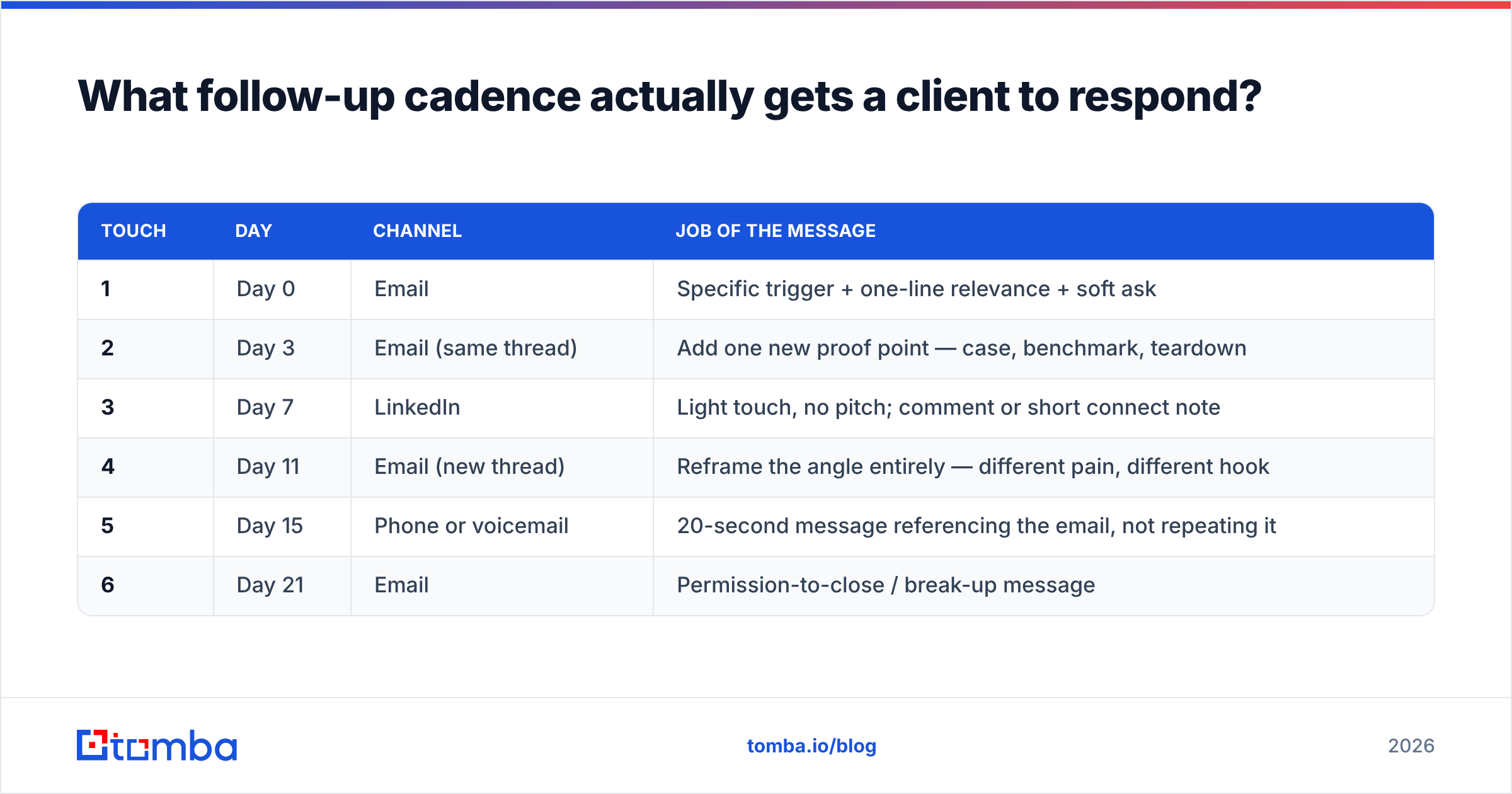
Four to six touches spread over roughly three weeks, each carrying new information, with channel variation from touch three onward.
Two numbers matter more than the rest. First, the majority of replies to a well-built sequence arrive after the first message — sending once and stopping forfeits most of your pipeline. Second, response rates degrade sharply past six touches, and the deliverability cost of grinding a cold contact through touch nine outweighs any incremental reply.
Here's a cadence that holds up across most B2B contexts:
| Touch | Day | Channel | Job of the message |
|---|---|---|---|
| 1 | Day 0 | Specific trigger + one-line relevance + soft ask | |
| 2 | Day 3 | Email (same thread) | Add one new proof point — case, benchmark, teardown |
| 3 | Day 7 | Light touch, no pitch; comment or short connect note | |
| 4 | Day 11 | Email (new thread) | Reframe the angle entirely — different pain, different hook |
| 5 | Day 15 | Phone or voicemail | 20-second message referencing the email, not repeating it |
| 6 | Day 21 | Permission-to-close / break-up message |
Three rules make this cadence work rather than annoy:
- Every touch must earn its place. "Just bumping this to the top of your inbox" adds nothing and trains the recipient to ignore your name. If you have nothing new, wait until you do.
- Vary the channel, not just the day. A LinkedIn outreach touch between emails changes the context and signals persistence without inbox fatigue. Layering a phone touch in makes the sequence feel like a person rather than a tool.
- Change threads at least once. Long reply-chains get collapsed and buried. A fresh subject line at touch four gives the message a second chance at visual attention.
Which email structures get the highest reply rates?#
Short ones with a single, low-cost decision. The pattern that consistently wins looks like this:
- Subject line: 3–5 words, lowercase, no pitch. "quick question re: onboarding" outperforms "Transform Your Onboarding Efficiency in 2026." Test variants with a subject line tester before committing a sequence to it.
- Opening line: about them, verifiably. Reference a hiring post, a product launch, a comment they left. Generic personalization ("loved your website") reads worse than no personalization.
- Body: two sentences, maximum. One sentence of relevance, one sentence of value. Anything longer gets scanned, not read.
- Ask: binary with a default. "Is this still a priority for Q2 — yes or no?" beats "Would you be open to a 30-minute call to explore synergies?" The first takes three seconds to answer.
- Signature: plain. Images, banners, and tracking-heavy footers hurt deliverability and add nothing to the reply decision.
A concrete rewrite makes the difference obvious.
Before (0 replies):
Hi Sarah, I wanted to follow up on the proposal I sent over last week regarding our partnership opportunity. I'd love to hop on a quick call to walk you through the details and answer any questions you might have. Let me know what times work best for you this week or next!
After (replied in 4 hours):
Sarah — is the Q2 onboarding project still moving, or did it slip? Happy to park this until it's live. No hard feelings either way.
The second version gives the recipient an easy escape hatch, which is precisely why it gets answered. You removed the social cost of saying no, and "no" is information you can act on today.
If you're building these at volume, cold email templates give you a tested starting structure — just don't ship them unedited.
Does the break-up email really work?#
Yes, and it's usually the highest-reply message in the sequence — but only when it's genuine.
The mechanism is loss aversion plus relief. You're simultaneously signaling that the offer is going away and releasing the recipient from the obligation to engage. Both are motivating. What kills it is passive aggression: "I guess you're not interested" or "this will be my last attempt" reads as a threat, and threats get deleted.
A break-up email that works:
Hi Marcus — I've reached out a few times about the data migration and haven't heard back, which usually means it's not a priority right now. I'm going to close the file on my end so I stop cluttering your inbox. If it comes back up in Q3, just reply here and I'll pick it straight back up.
Three things it does right: it names the reason for silence charitably, it takes the action itself rather than demanding one, and it leaves a zero-friction door open. Note that it does not include a calendar link, a PDF, or a final "one last thing."
Send it, then actually close the file. Re-open the thread in 60–90 days with a genuine trigger — funding round, new hire in the relevant function, product launch. That re-entry converts better than a seventh follow-up ever will.
Should you switch channels when email fails?#
Yes — after touch two, and with intent rather than desperation.
Buyers show up on multiple surfaces, and multithreading an account raises your odds more than any single-channel intensity. The practical hierarchy:
- LinkedIn works well for the soft touch. A thoughtful comment on their post outperforms a connection request with a pitch attached. Their own guidance on social selling holds up: engagement before ask.
- Phone cuts through in ways email can't, especially for senior contacts whose inboxes are triaged by someone else. A twenty-second voicemail that references your email — "sent you a note Tuesday about the migration timeline, wanted to make sure it landed" — often produces an email reply rather than a call back. Sourcing accurate mobile numbers is the bottleneck here; a phone finder closes that gap without hand-scraping.
- A second contact at the same account is underrated. If your champion has gone dark, their peer or their manager often surfaces the real reason. This isn't going over someone's head — it's confirming the project still exists.
- Physical mail or a video message is a low-volume, high-effort play. Reserve it for accounts where the deal value justifies twenty minutes of manual work.
The failure mode is running all channels simultaneously on day one. Five touches across five channels in 48 hours reads as automated pressure, not persistence.
How do data quality and deliverability change reply rates?#
They set the ceiling. Copy determines where you land under that ceiling.
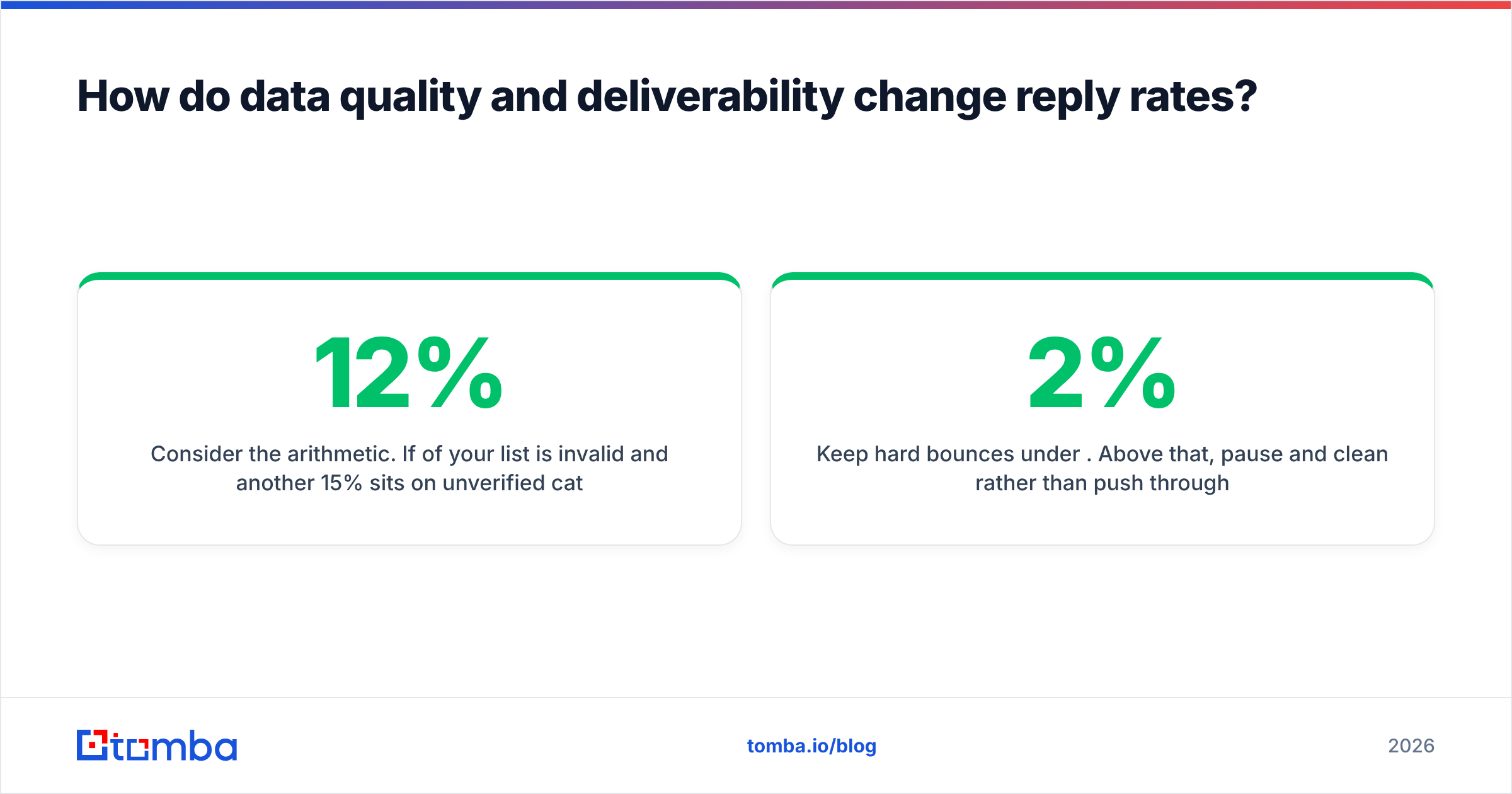
Consider the arithmetic. If 12% of your list is invalid and another 15% sits on unverified catch-all domains, you've already lost roughly a quarter of your addressable replies before writing a word. Worse, bouncing at that rate signals to mailbox providers that you're sending to a purchased list, which suppresses inbox placement for the valid addresses too. Poor email deliverability compounds — one bad send degrades the next three.
The hygiene checklist that protects your sender reputation:
- Verify every address before the first send, and re-verify anything older than 90 days.
- Keep hard bounces under 2%. Above that, pause and clean rather than push through.
- Authenticate fully — SPF, DKIM, and DMARC, all aligned.
- Cap volume per mailbox. Multiple sending domains beat one domain at high volume.
- Remove duplicates so the same human doesn't get the same sequence twice from two reps.
If you're rebuilding a list from scratch, an email finder that returns a confidence score per result is more useful than one returning a raw string, because it lets you route low-confidence contacts to a verification step instead of burning them on a send.
What does a realistic response benchmark look like?#
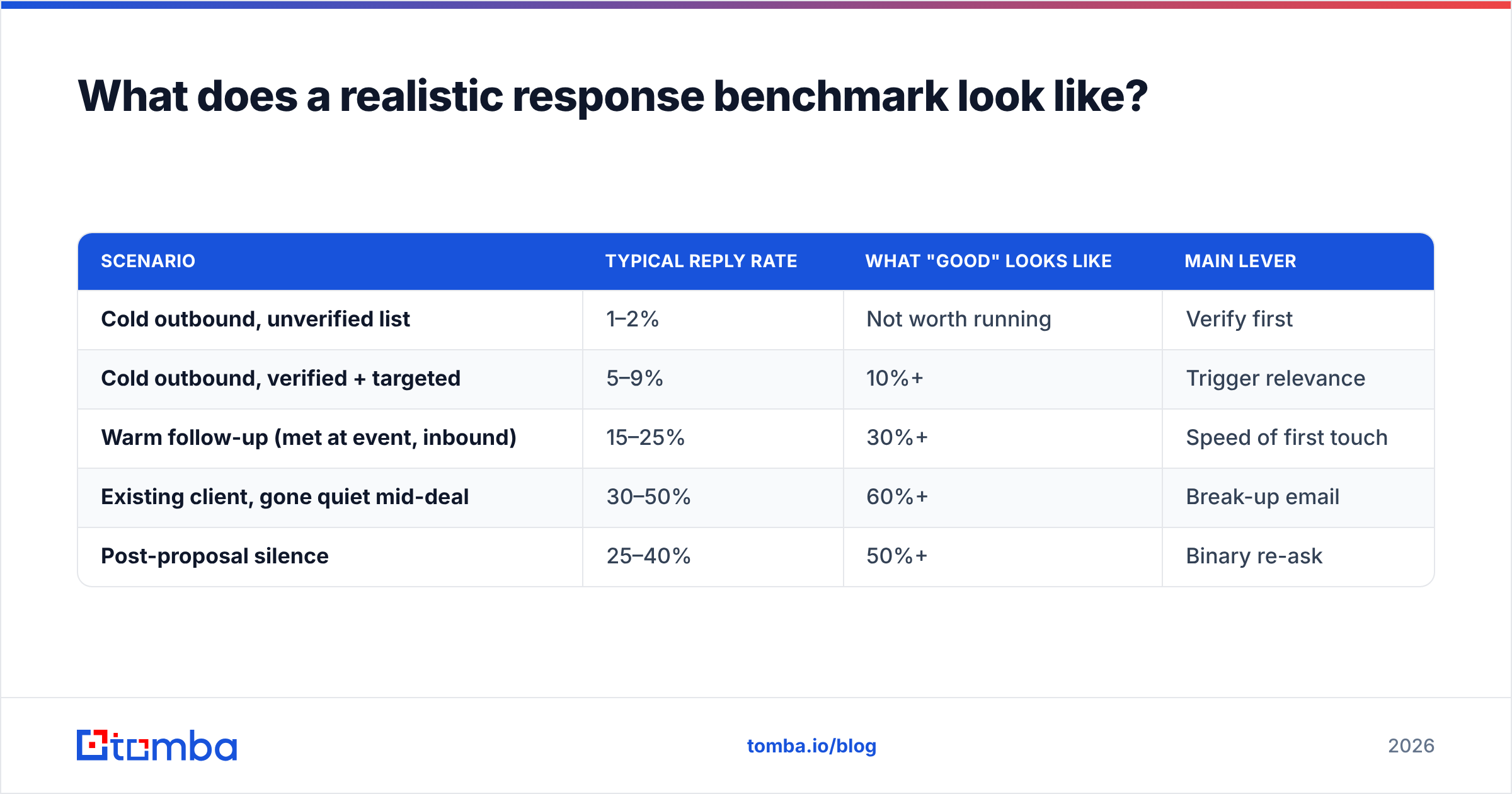
Set expectations against actual numbers rather than the outliers people post on LinkedIn.
| Scenario | Typical reply rate | What "good" looks like | Main lever |
|---|---|---|---|
| Cold outbound, unverified list | 1–2% | Not worth running | Verify first |
| Cold outbound, verified + targeted | 5–9% | 10%+ | Trigger relevance |
| Warm follow-up (met at event, inbound) | 15–25% | 30%+ | Speed of first touch |
| Existing client, gone quiet mid-deal | 30–50% | 60%+ | Break-up email |
| Post-proposal silence | 25–40% | 50%+ | Binary re-ask |
Two takeaways. First, mid-deal silence is far more recoverable than cold silence — if a client has already engaged and stopped, your odds of a reply are several times higher, so those threads deserve disproportionate effort. Second, if your cold numbers sit at 1–2%, no rewrite will fix it. That's a targeting and data problem, and it's solved upstream. Reviewing where the data comes from is a more productive use of an afternoon than another round of subject line testing.
Track your own baselines in your CRM rather than importing someone else's benchmark. Reply rate by segment, by touch number, and by channel will tell you within a month where your sequence actually leaks. Vendor-published aggregates from HubSpot and peer reviews on G2 are useful directional context, but your own funnel is the only number that governs decisions.
What should you stop doing immediately?#
A short list of habits that reliably suppress replies:
- "Just checking in" with no new information. It signals you have nothing to offer and asks them to do the thinking.
- Guilt framing. "I've reached out three times now" makes replying feel like an apology.
- Multiple asks in one email. Every additional question reduces the odds of any of them being answered.
- Attachments in a cold or reviving email. They trigger filters and require a download decision.
- Sending Monday 9am. Everyone's automation fires then. Mid-morning Tuesday through Thursday consistently clears more inbox competition.
- Never asking why. "Was it price, timing, or fit?" turns a dead thread into usable intelligence even when it doesn't revive the deal.
Where should you start this week?#
Pick your ten quietest open threads and run the three-layer diagnosis: delivery, data, message. You'll typically find that three or four were never delivered or went to a stale address — which means they were never rejections at all, just plumbing failures wearing the costume of disinterest.
Fix the plumbing first. Verify the addresses, confirm the contacts still hold the role, then send one short binary re-ask to each. Send a genuine break-up email to anything still silent after two more touches, and re-enter those accounts in a quarter with a real trigger.
If contact accuracy is your bottleneck — and for most teams chasing silence, it is — start with the Tomba Email Finder. It returns verified professional addresses with a confidence score per result, so you know before you send whether a thread went quiet because the client wasn't interested or because your message never landed. The free tier covers 25 searches a month to test it against your own dead threads; paid plans start at $49/mo, with full Tomba pricing available if you need bulk or API volume. Fix the delivery problem, and a surprising share of your "unresponsive" clients turn out to have been responsive all along.
Related guides#
Ready to find emails that actually work?
Join 150,000+ professionals who stopped guessing and started sending. Free credits on signup — no credit card required.
Get the Tomba newsletter
Practical outbound tactics and product updates — once every two weeks.
About the author