How to Get Clients for Digital Marketing: 9 Proven Ways
Referrals dried up? Here are nine tested channels for landing digital marketing clients in 2026, with real cost-per-client math, outreach scripts, and a channel comparison table.
TL;DR
- Most agencies and freelancers get stuck at the same place: referrals covered months 1–12, then the pipeline went quiet and nobody had built a repeatable acquisition channel.
- The nine channels below are ranked by realistic cost per client and time to first deal — outbound email and audit-led outreach win on speed; SEO and partnerships win on long-term margin.
- Outbound only works when your list is accurate. A 30% bounce rate does not just waste sends, it burns the sending domain you need for every future campaign.
- Niche down before you scale anything. "Digital marketing for anyone" costs 3–5x more per client than "paid social for DTC supplement brands."
- Pick two channels, not nine. Run each for 90 days with tracked numbers before you judge it.
Why is getting clients for digital marketing harder in 2026?#
Because the supply side exploded and the buyer got skeptical. Anyone with a laptop can call themselves a growth consultant, AI tools made deliverables look identical from the outside, and in-house teams now handle a chunk of the work that used to be outsourced by default.
That changes what actually works. Generic pitches ("we do SEO, PPC, social, email") get ignored because the prospect has received forty of them this quarter. What still converts is specificity: a named problem, evidence you understand their market, and proof you have fixed it before for someone who looks like them.
The mechanics of client acquisition have not changed. The tolerance for vagueness has.

Which channels actually bring in digital marketing clients?#
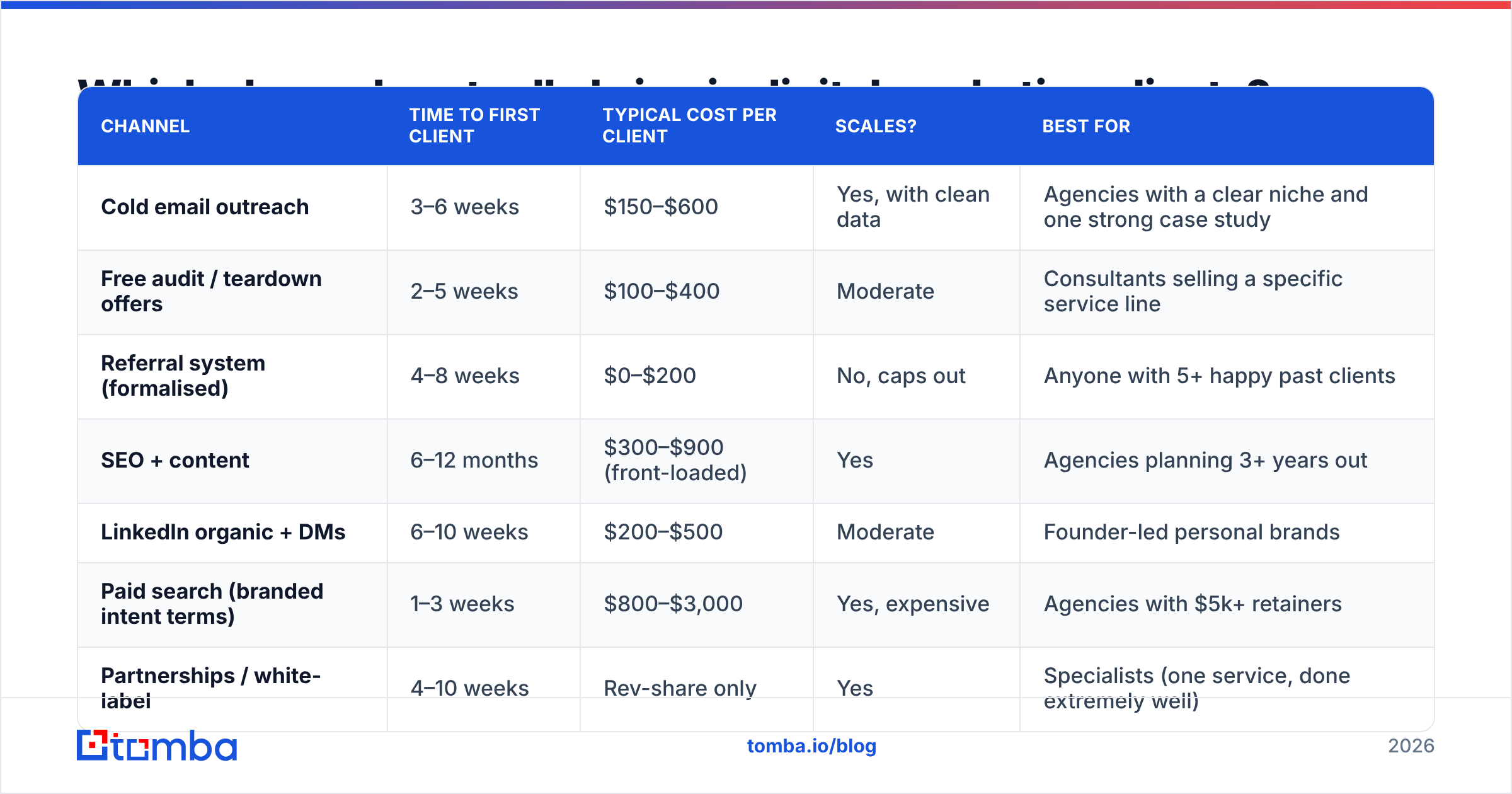
Here is the honest comparison. The numbers below reflect what small agencies and solo consultants typically report — treat them as planning ranges, not guarantees.
| Channel | Time to first client | Typical cost per client | Scales? | Best for |
|---|---|---|---|---|
| Cold email outreach | 3–6 weeks | $150–$600 | Yes, with clean data | Agencies with a clear niche and one strong case study |
| Free audit / teardown offers | 2–5 weeks | $100–$400 | Moderate | Consultants selling a specific service line |
| Referral system (formalised) | 4–8 weeks | $0–$200 | No, caps out | Anyone with 5+ happy past clients |
| SEO + content | 6–12 months | $300–$900 (front-loaded) | Yes | Agencies planning 3+ years out |
| LinkedIn organic + DMs | 6–10 weeks | $200–$500 | Moderate | Founder-led personal brands |
| Paid search (branded intent terms) | 1–3 weeks | $800–$3,000 | Yes, expensive | Agencies with $5k+ retainers |
| Partnerships / white-label | 4–10 weeks | Rev-share only | Yes | Specialists (one service, done extremely well) |
| Marketplaces (Upwork, Clutch) | 1–4 weeks | 10–20% fee | Limited | Early-stage, building case studies |
| Local events / meetups | 4–12 weeks | $200–$800 | No | Location-bound service businesses |
Two patterns jump out. First, nothing except paid search delivers clients in under two weeks, so plan cash flow accordingly. Second, the cheapest channels per client (referrals, partnerships) are the ones that cap out fastest — which is exactly why agencies that live on referrals hit a ceiling around $30k–$50k MRR and stall.
How do you build an outbound list that does not bounce?#
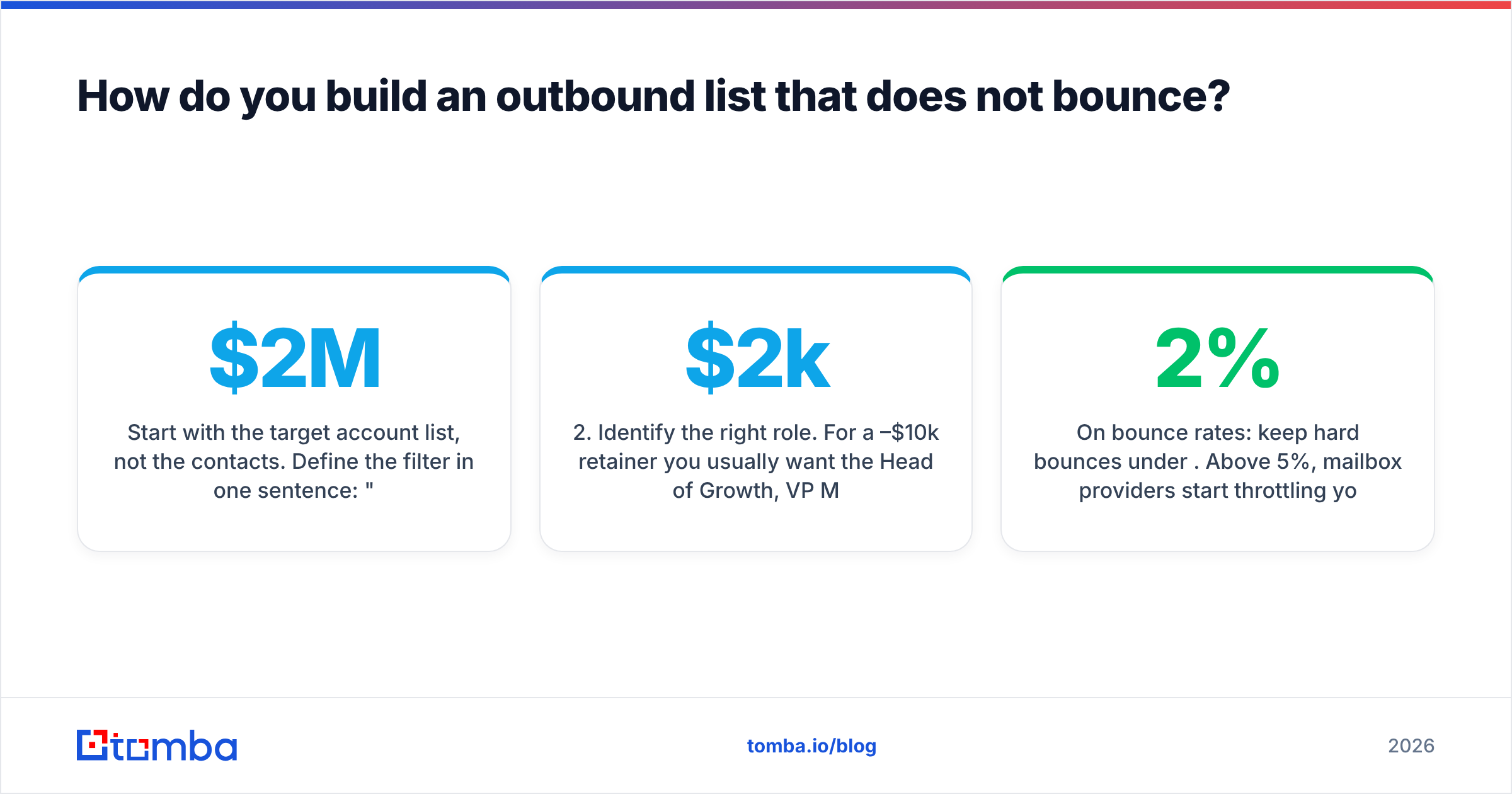
Start with the target account list, not the contacts. Define the filter in one sentence: "Shopify stores doing $2M–$20M in the supplement category who are running Meta ads but have no email flows." That sentence is your entire prospecting brief.
From there the workflow is four steps:
- Build the company list. Pull from an ads library, a tech-stack lookup, a directory, or LinkedIn Sales Navigator. Aim for 200–500 companies per campaign — enough for statistical signal, small enough to personalise.
- Identify the right role. For a $2k–$10k retainer you usually want the Head of Growth, VP Marketing, or the founder at companies under 30 people. Skip the marketing coordinator; they cannot sign.
- Find and verify the email. Use a domain search to pull the pattern and known contacts for each company, then run every address through an email verifier before it enters your sequence. This is the step most people skip, and it is the one that determines whether the campaign lands.
- Enrich for personalisation hooks. Recent funding, a new hire in the role you sell to, a site change, a job posting for the exact skill you provide. One specific hook beats ten generic merge tags.
On bounce rates: keep hard bounces under 2%. Above 5%, mailbox providers start throttling you, and above 10% you are actively damaging sender reputation that takes months to rebuild. Verification is not optional hygiene, it is the difference between a channel that compounds and one that dies in month three.

What does a cold email that books meetings actually look like?#
Short, specific, and about them. The structure that works consistently:
- Line 1 — the observation. Something true about their business that took you thirty seconds to find. "You're running 14 Meta creatives on the Sleep SKU but the landing page is the generic collection page."
- Line 2 — the implication. Why that matters in money terms. "That's usually a 20–35% haircut on ROAS for supplement brands at your spend level."
- Line 3 — the proof. One sentence, one number, one comparable client. "We fixed the same gap for [comparable brand] and their blended ROAS went from 1.8 to 2.6 in six weeks."
- Line 4 — the ask. Low commitment. "Want me to send the three-slide teardown? No call needed."
Under 90 words total. No attachments in email one. No calendar link in email one either — offering the teardown as a deliverable converts better than asking for thirty minutes, because you are giving before you take.
Follow up three times over twelve days, then stop. HubSpot's sales research has consistently found that the majority of replies land after the first message, but the returns past four touches are close to zero and the annoyance cost is real.
If you want a starting point rather than a blank page, the cold email templates library covers the audit-offer and case-study angles specifically.
Is a free audit offer still worth doing?#
Yes — but only if the audit is genuinely useful when the prospect ignores you afterward.
The failure mode is the "audit" that is really a sales deck with three screenshots and a pricing page at the end. Prospects have seen it. It converts at low single digits and it burns the brand.
What works is a teardown that costs you 20–40 minutes and gives the prospect something they could act on without you: three specific problems, the estimated revenue impact of each, and a note on which one you would fix first. Send it as a Loom or a PDF. Then the ask is simply "want me to walk through the second one?"
The economics: at 40 minutes per teardown and a 15–25% meeting rate on warm-ish lists, you are spending roughly 3 hours of work per booked meeting. That is expensive at scale and excellent at the 20-prospect level, which is why this channel pairs well with outbound rather than replacing it — you cold email 300 people, and you teardown the 25 who opened three times.
How do you turn referrals into a system instead of luck?#
Referrals are the cheapest clients you will ever get and most agencies leave them entirely to chance. Three changes fix that.
- Ask at the moment of visible result, not at the end of the engagement. When you send the report showing the win, that is the highest-goodwill point in the relationship. That is the ask.
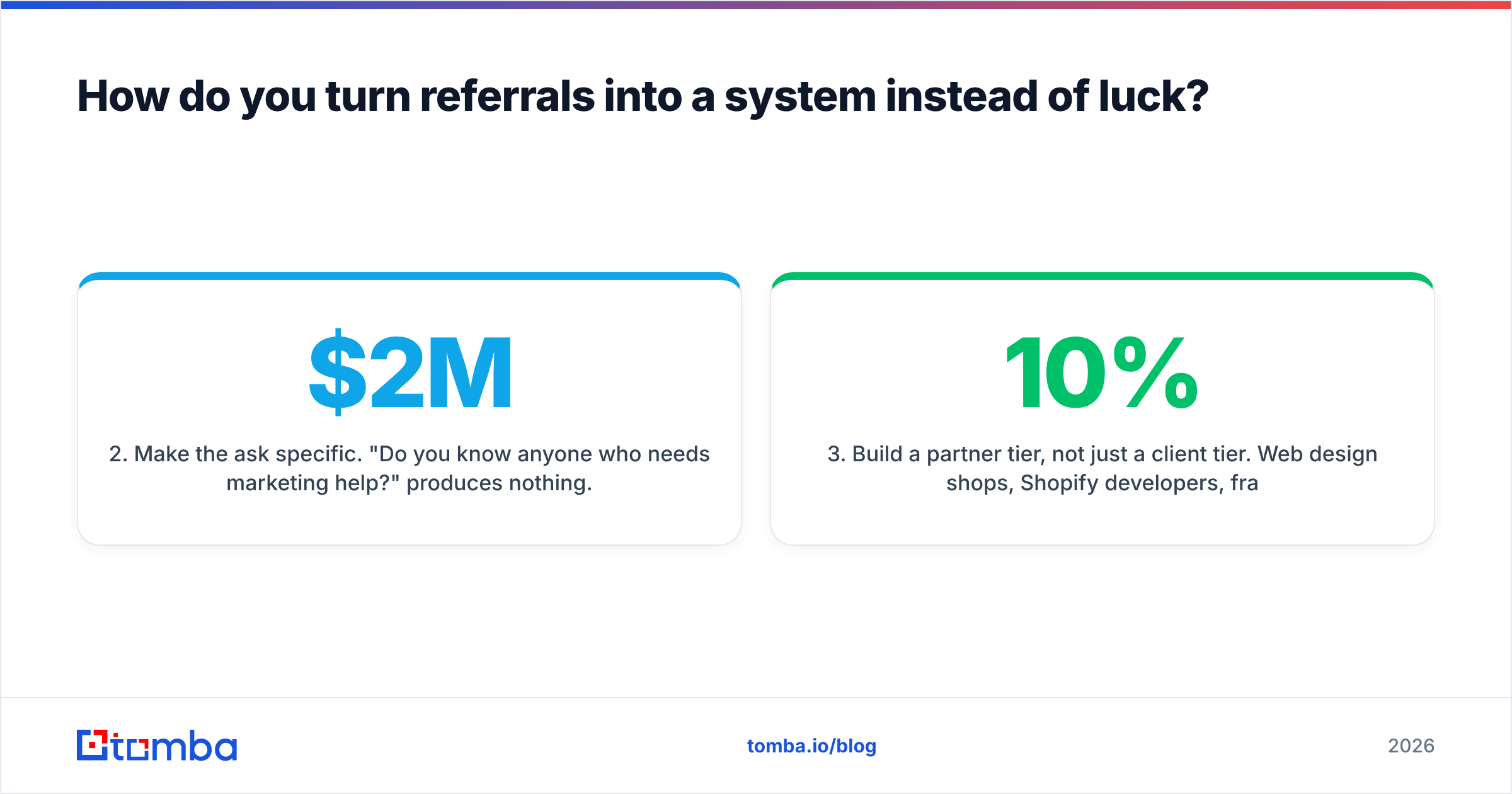
- Make the ask specific. "Do you know anyone who needs marketing help?" produces nothing. "Do you know another DTC founder in the $2M–$10M range who is struggling with paid social attribution?" produces names.
- Build a partner tier, not just a client tier. Web design shops, Shopify developers, fractional CFOs, and PR firms all talk to your buyer before you do and none of them compete with you. A 10% first-year rev-share turns them into a channel. Formalise it in writing.
Track referral source on every deal in your CRM. Most agencies cannot answer "which past client has sent us the most revenue" — and that person deserves a very nice dinner and a proactive quarterly check-in.
How should you price and package to make client acquisition easier?#
Packaging is an acquisition lever, not a finance detail. Three principles.
- Lead with a paid diagnostic, not a retainer. A $1,500–$3,500 strategy sprint converts far better than a $5k/mo commitment because the buyer's risk is bounded. Roughly 50–70% of well-run diagnostics convert to retainers.
- Name the outcome, not the activity. "Meta ads management" is a commodity with a price everyone can google. "Paid social profitability audit and rebuild for supplement DTC" is not.
- Publish a starting price. Agencies that hide pricing entirely get more calls and worse calls. A "from $4,000/mo" line filters out the tyre-kickers before they eat an hour of your week.
What tools do you need for a client acquisition stack?#
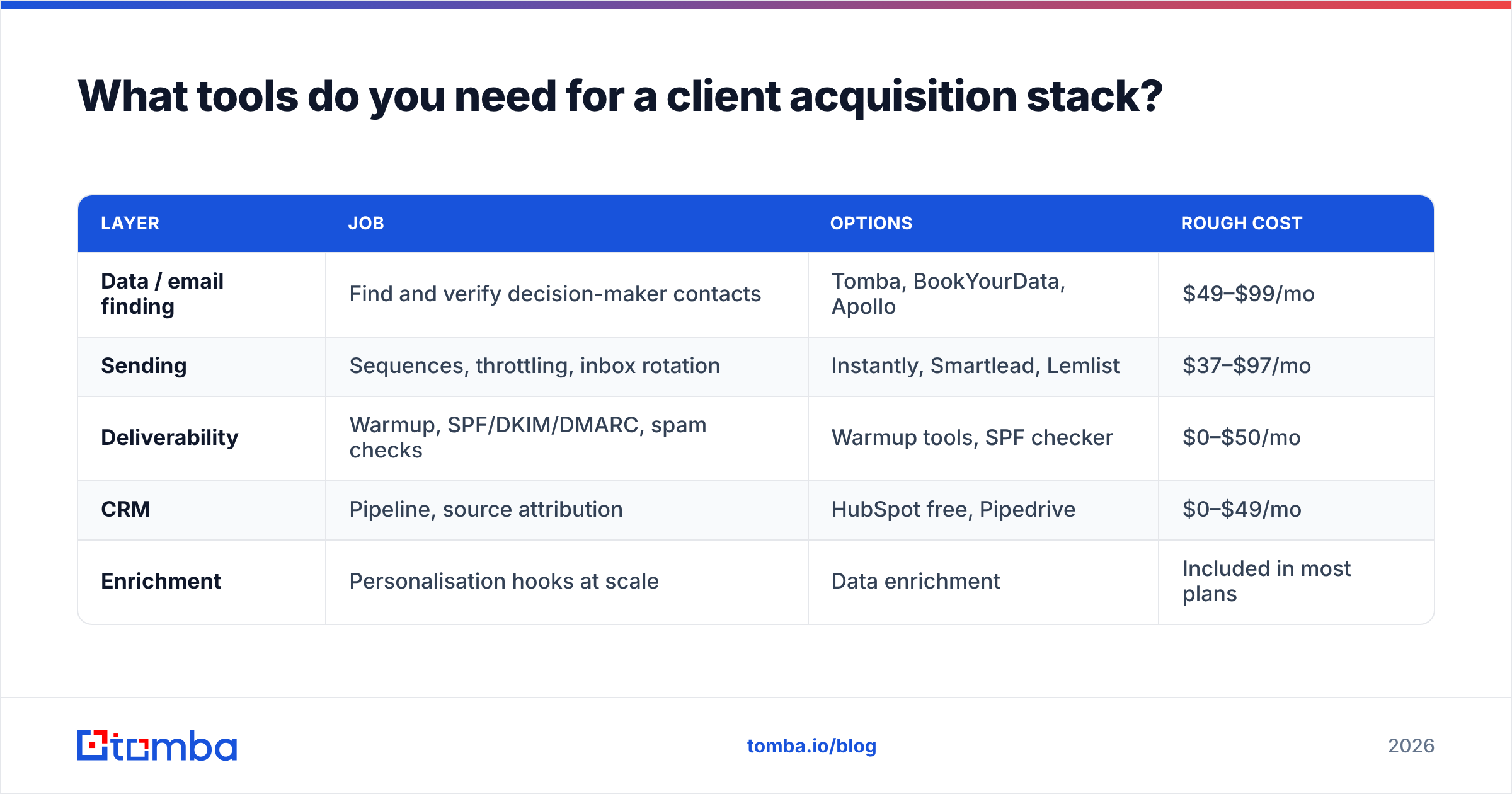
You need less than the software vendors suggest. The core stack for outbound-led client acquisition:
| Layer | Job | Options | Rough cost |
|---|---|---|---|
| Data / email finding | Find and verify decision-maker contacts | Tomba, BookYourData, Apollo | $49–$99/mo |
| Sending | Sequences, throttling, inbox rotation | Instantly, Smartlead, Lemlist | $37–$97/mo |
| Deliverability | Warmup, SPF/DKIM/DMARC, spam checks | Warmup tools, SPF checker | $0–$50/mo |
| CRM | Pipeline, source attribution | HubSpot free, Pipedrive | $0–$49/mo |
| Enrichment | Personalisation hooks at scale | Data enrichment | Included in most plans |
A note on data providers, since this is where money gets wasted: BookYourData is a solid pick if you want to buy pre-built lists by industry and title, and it is genuinely good at coverage in North American mid-market. Tomba is the better fit when you already know which companies you want and need to find and verify the specific people at them — the pattern-based approach means you can go from a list of 300 domains to verified decision-maker addresses without buying a database you will use once. Apollo bundles data and sending, which is convenient until you hit its data-quality variance on smaller companies.
The Tomba pricing tiers run Free (25 searches/mo) for testing, Starter at $49/mo, Growth at $99/mo, and Pro at $249/mo — most solo consultants and small agencies live comfortably on Starter or Growth. If you want to check coverage against your actual target list before paying anything, the free tier is enough to test 25 domains.
For vendor-neutral comparison, G2's marketing agency software category is a reasonable place to sanity-check what peers in your size band are actually using.
What about SEO, content, and inbound for an agency?#
Inbound is the highest-margin channel and the slowest. Budget 6–12 months before it produces a client, and only start it if you can fund acquisition from another channel in the meantime.
What works for agencies specifically:
- Bottom-of-funnel comparison content. "[Competitor] vs [Competitor] for Shopify brands" and "how much does X cost" pages convert at 5–10x the rate of top-of-funnel guides.
- Location + service pages if you serve a geography. Low volume, extremely high intent.
- Free tools. A calculator or checker that solves one narrow problem generates links and email captures indefinitely. It is the highest-leverage inbound asset an agency can build.
- Case studies with real numbers. Not "increased traffic significantly." Actual before/after figures with the timeframe. These are what prospects read right before they email you.
One caution: do not write generic "what is digital marketing" content. It ranks against publishers with 10,000 backlinks and it attracts readers who will never hire you.
How do you know a channel is working before you give up on it?#
Set the measurement before you start, because otherwise you will kill a working channel in week four out of anxiety.
For outbound, the leading indicators in order: deliverability (are emails landing?), open rate (is the subject line and sender reputation OK?), reply rate (is the message relevant?), positive reply rate (is the offer right?), meeting rate, close rate. A break anywhere upstream makes everything downstream look broken.
Benchmarks worth holding yourself to on a well-targeted B2B list: 40%+ open rate, 3–8% total reply rate, 1–3% positive reply rate. If opens are under 20%, stop optimising copy — you have a deliverability or data problem, and the fix is verification plus domain warmup, not another subject line. Check your email deliverability fundamentals before you touch the message.
Give each channel 90 days and a real budget. Two channels run properly beat six run badly, every time.
Where should you start this week?#
If you have zero pipeline right now: run the referral asks today (free, fastest), and start building one outbound list of 200 well-qualified companies in parallel. Referrals cover the next 30 days; outbound covers days 30–90.
If you already have inconsistent outbound: stop adding volume and fix the data. Pull 100 addresses from your current list, verify them, and see what percentage comes back risky. That number usually explains everything about your results.
If you are at capacity but want better clients: kill the marketplace work, raise the floor price, and put the reclaimed hours into partnerships and bottom-of-funnel content.
The agencies that stop scrambling for clients are not the ones with the best creative — they are the ones who built two acquisition channels that run whether or not anyone is feeling motivated that week.
Ready to build the list? Tomba's Email Finder turns a list of target company domains into verified decision-maker email addresses, with verification built in so your outbound lands in inboxes instead of spam folders. Start on the free tier with 25 searches, test it against your own target accounts, and only pay once you have seen the coverage on companies you actually want as clients.
Related guides#
// get started
Find, verify and enrich your first contacts today
Start on the free plan with 25 searches a month, then scale when your team is ready.
Free plan · No credit card required · GDPR & CCPA
// about the author