How to Get Clients for Staffing Agency Growth (9 Plays)
Staffing agencies do not fail on recruiting. They fail on client acquisition. Here are nine channels ranked by cost per signed client, plus the outreach data stack that makes them work.
Every play on how to get clients for staffing agency growth comes down to one number: fully loaded cost per signed client. Here is the ranking.
TL;DR
- Staffing agencies rarely fail because they cannot find candidates. They fail because they cannot find hiring managers who will pay a fee.
- The highest-ROI channel in 2026 is still job-posting mining: a company posting a role it has not filled in 30 days is a pre-qualified buyer with a budget already approved.
- Cold email beats cold calling on cost per signed client, but only if your list is verified. Bounce rates above 3% will kill the domain you spent months warming.
- Referrals and redeployment produce the cheapest clients but cannot be scaled on demand. Treat them as margin, not as pipeline.
- The practical stack is: signal source (job boards, funding news, layoffs) → decision-maker identification → verified contact data → multichannel sequence → CRM.
Why is client acquisition harder than candidate acquisition?#
Because candidates want to talk to you and hiring managers do not.
Think of it like running a restaurant. Sourcing candidates is buying ingredients — there is a market, prices are known, and suppliers call you. Getting clients is filling tables on a Tuesday night. Nobody wakes up wanting to pay a 20% placement fee.
The economics make this worse. A typical contingency placement earns 15-25% of first-year salary. On a $90,000 role that is about $18,000 in revenue, minus recruiter time. If winning that client costs you more than $3,000-4,000, you are working for the privilege of working. So every channel below is judged on one number: fully loaded cost per signed client, not cost per lead.
There is a second problem. Staffing is a trust purchase in a low-trust category. Most hiring managers have been burned — a resume flood, a candidate who ghosted on day three, an invoice dispute. Your outreach competes against that memory, not against other agencies.

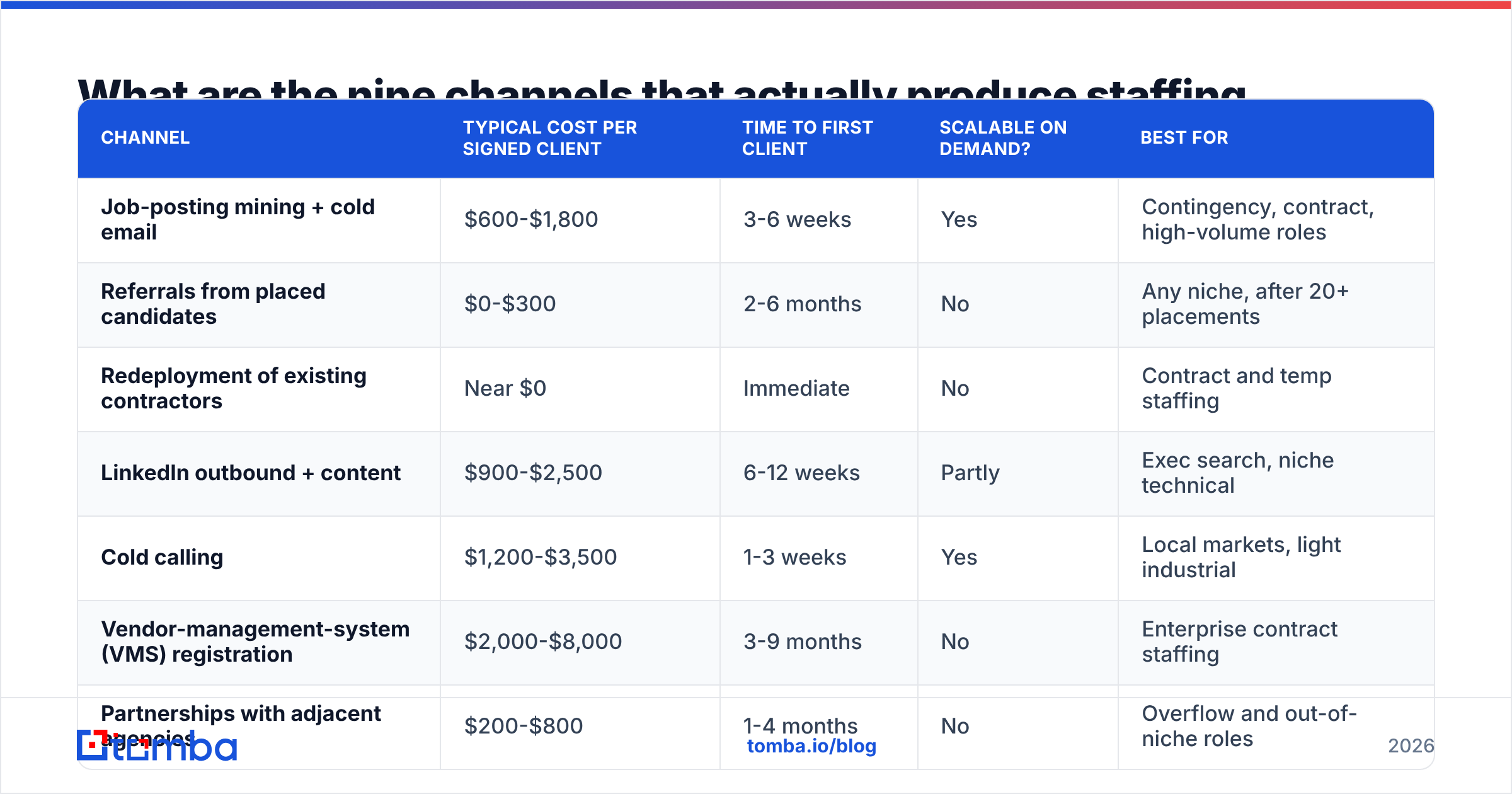
How to get clients for staffing agency growth: nine channels ranked#
Here is the honest ranking. Cost ranges assume a small agency (2-10 people) in a US or EU market, and they include tooling plus loaded labor time.
| Channel | Typical cost per signed client | Time to first client | Scalable on demand? | Best for |
|---|---|---|---|---|
| Job-posting mining + cold email | $600-$1,800 | 3-6 weeks | Yes | Contingency, contract, high-volume roles |
| Referrals from placed candidates | $0-$300 | 2-6 months | No | Any niche, after 20+ placements |
| Redeployment of existing contractors | Near $0 | Immediate | No | Contract and temp staffing |
| LinkedIn outbound + content | $900-$2,500 | 6-12 weeks | Partly | Exec search, niche technical |
| Cold calling | $1,200-$3,500 | 1-3 weeks | Yes | Local markets, light industrial |
| Vendor-management-system (VMS) registration | $2,000-$8,000 | 3-9 months | No | Enterprise contract staffing |
| Partnerships with adjacent agencies | $200-$800 | 1-4 months | No | Overflow and out-of-niche roles |
| Paid search (Google Ads) | $2,500-$9,000 | 2-8 weeks | Yes | "staffing agency near me" intent |
| Trade shows and local associations | $3,000-$12,000 | 3-12 months | No | Manufacturing, healthcare, gov |
Two takeaways. First, the cheapest channels — referral and redeployment — are outputs of delivery quality, not marketing activity. You cannot buy more of them this quarter.
Second, only two channels can be turned up on Monday morning: outbound email and cold calling. That is why almost every agency that grows past $1M in gross profit runs a structured outbound motion, whatever else it does.
How do you build a client list from job postings?#
This is the single highest-signal play in staffing, and most agencies run it badly.
The logic is simple. A live job posting is a public admission that a company has an approved requisition, a budget, and an unsolved problem. A posting that has been live for 30+ days says internal recruiting is failing. That is your opening line.
The five-step process:
- Define the signal narrowly. Not "companies hiring." Instead: "Series B-D SaaS companies, 50-500 employees, US, with a senior backend or data engineering role live for 21+ days." Narrow signals produce specific first lines, and specific first lines get replies.
- Scrape or subscribe to the source. Indeed, LinkedIn Jobs, Greenhouse and Lever boards, and company career pages. Greenhouse and Lever board URLs are the most useful, because one page exposes the full req list for a company.
- Identify the right human. For roles under $120K, the hiring manager beats the recruiter. For volume contract work, talent acquisition leadership beats the hiring manager. In companies under 200 people, the founder or COO often owns the decision outright.
The last two steps are where most campaigns are won or lost.
- Get verified contact data. This is where most lists die. Guessing
firstname.lastname@company.comproduces bounce rates north of 20% on modern domains. Use a proper email finder against the company domain and person name. Then run every address through an email verifier before it touches your sequencer. - Sequence with the signal, not with your credentials. Your first email should reference the specific req and the specific problem, never your "25 years of combined recruiting experience."
For steps 3 and 4 at volume, domain search is the workhorse. Give it company.com and it returns the addresses on that domain with roles and confidence scores. Now you can see whether a target company's TA team is one person or fifteen. That single data point changes your pitch: a one-person TA team is drowning, a fifteen-person team wants a vendor agreement.
A practical volume benchmark: 40 well-researched job-signal emails per day, per SDR, with a 4-touch sequence. In a healthy niche that tends to produce 6-12 conversations per week and 1-3 signed clients per month. If you are sending 400 generic emails a day and getting nothing, the problem is the list and the first line, not the volume.
What does a cold email to a hiring manager actually look like?#
Short, specific, and about their req. Here is the structural skeleton, not a template to copy verbatim:
- Line 1 — the signal. "You've had the Senior Data Engineer role open on your Greenhouse board since July 14."
- Line 2 — the inference. "Usually when a role sits that long in this market it's the Airflow-plus-dbt combination — the overlap pool in Austin is about 400 people and half are already at [competitor]."
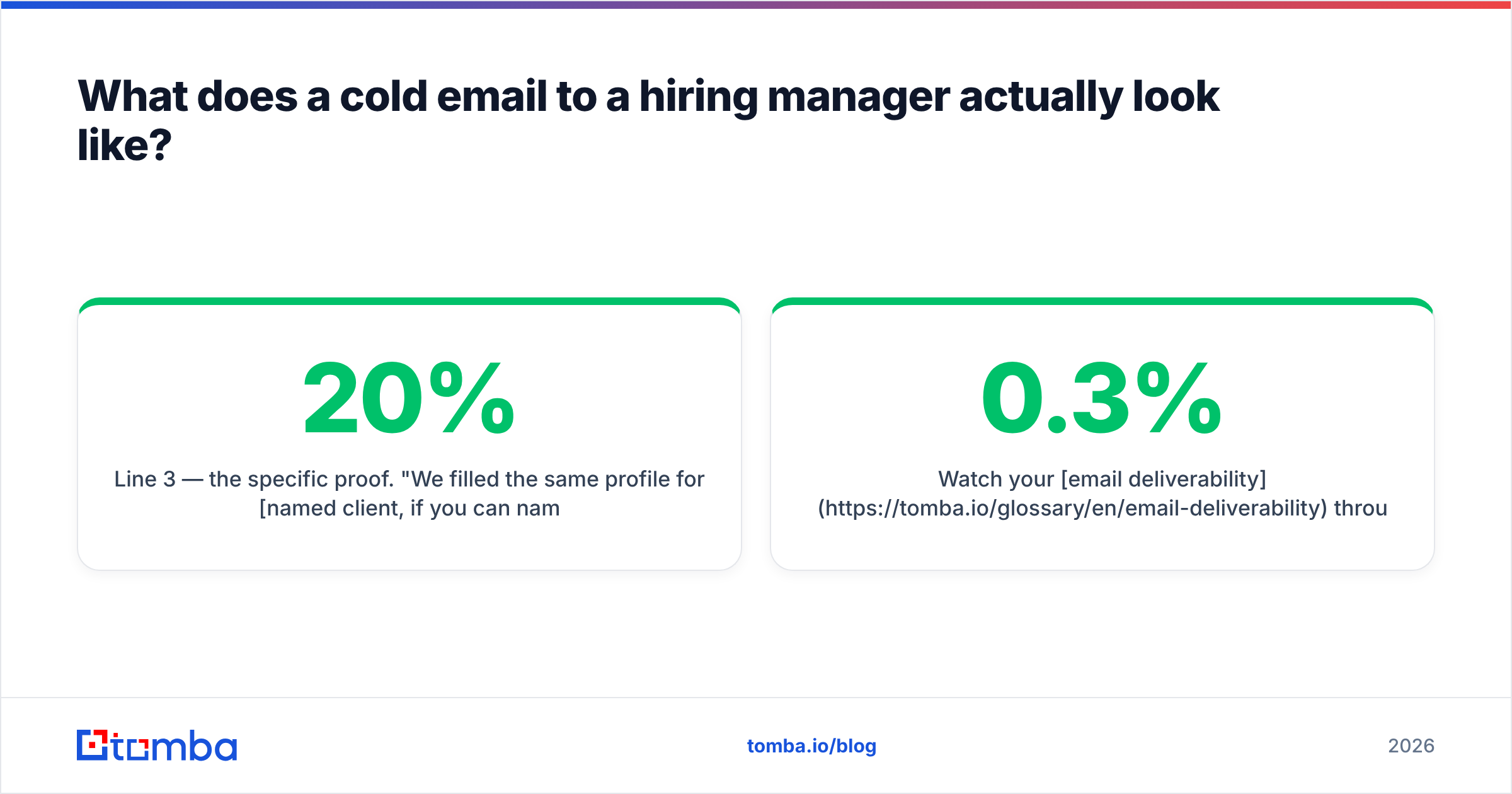
- Line 3 — the specific proof. "We filled the same profile for [named client, if you can name them] in 19 days at a 20% fee."
- Line 4 — the small ask. "Worth 12 minutes on Thursday to compare notes on the pool, even if you don't use an agency?"
Four sentences. No attachment, no calendar link in the first email, no "I hope this email finds you well." The "even if you don't use an agency" clause matters more than it looks. It lowers the perceived cost of replying.
Follow-ups should add new information, not nag. Touch two: a salary benchmark for that role in that metro. Touch three: two anonymized candidate profiles ("a senior data engineer currently at a Series C fintech, 8 years, available in 3 weeks"). Touch four: a genuine close-out. Anonymized profiles — sometimes called MPC or "most placeable candidate" outreach — remain the highest-converting follow-up in the industry. They invert the pitch: you are offering supply, not asking for demand.
Watch your email deliverability throughout. Google and Yahoo's bulk-sender requirements have made list hygiene non-negotiable. Authenticate with SPF, DKIM and DMARC, keep spam complaints under 0.3%, and keep bounces under 3%. Google's own sender guidelines spell out the thresholds. An unverified purchased list will trip all three limits in a week.

Is cold calling still worth it for staffing agencies in 2026?#
Yes, in specific niches — and it is now best used as a second touch rather than a first.
Cold calling still wins in local light-industrial, healthcare, skilled trades, and any market where the decision maker does not live in an inbox. A branch manager at a distribution center will pick up. A VP of Engineering at a remote-first SaaS company will not.
The modern pattern is call-after-email. Send the signal email Monday, call Wednesday, and open with "I sent you a note about the Senior Data Engineer role Monday — did that land?" Connect rates roughly double when the name is already familiar. That workflow needs mobile numbers alongside emails, so a phone finder belongs in the same enrichment step as your email lookup.
Honest math: at 60 dials a day with an 8% connect rate and a 15% conversation-to-meeting rate, you get roughly 0.7 meetings per day per caller. That is workable in a $50-80K/year SDR market and painful in a $120K one. Run the numbers for your own cost base before committing headcount.
How do referrals, redeployment, and partnerships fit in?#
They are the margin layer. They cost almost nothing and convert at 3-10x outbound rates, but you cannot dial them up.
Referrals from placed candidates. A candidate you placed six months ago now works alongside hiring managers in other departments. Ask at the 90-day check-in, not at placement. The line that works: "Who else on your team is hiring that I should not bother?" — the negative framing gets a straighter answer.
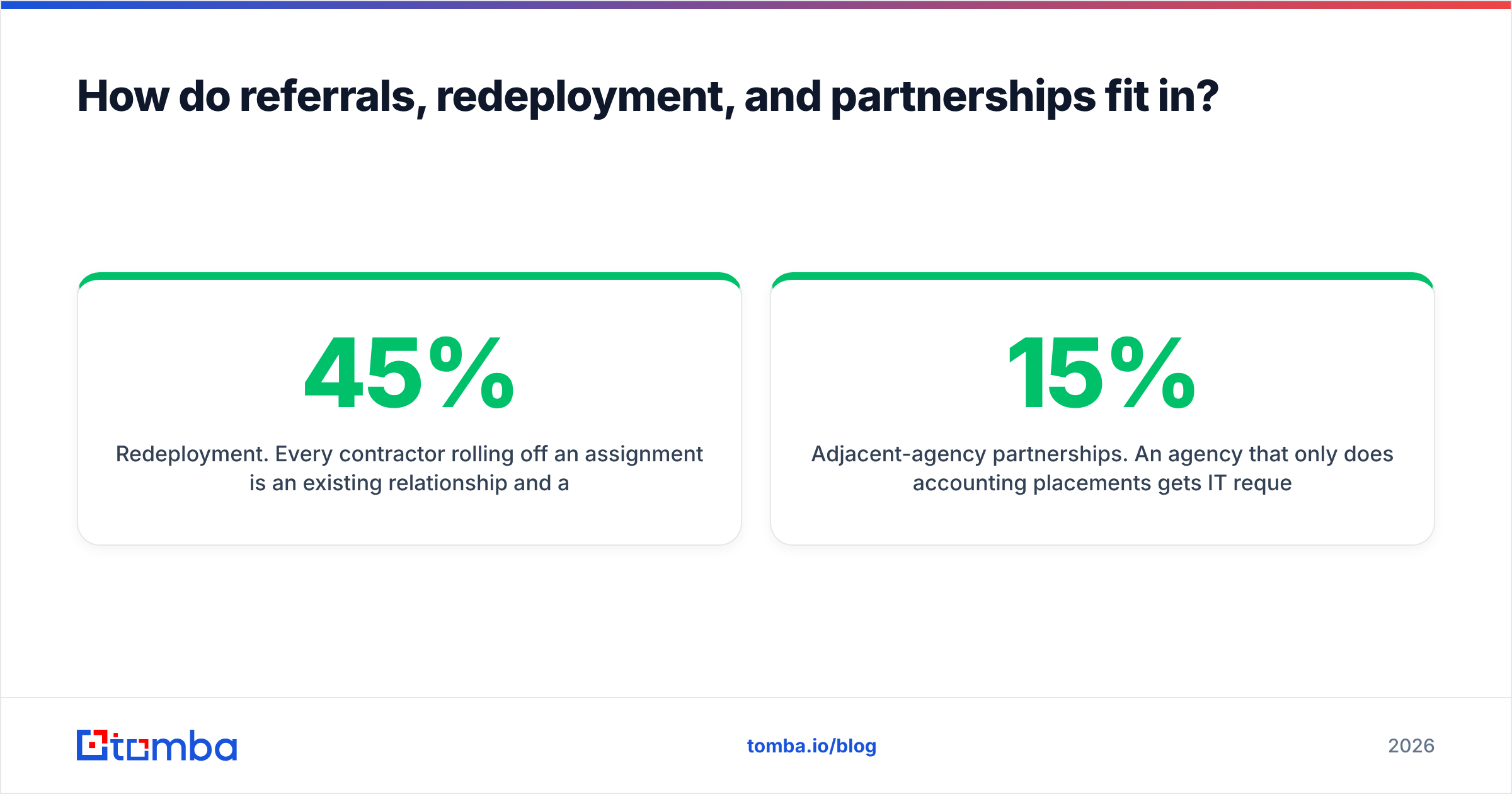
Redeployment. Every contractor rolling off an assignment is an existing relationship and a proven skillset. Agencies with disciplined redeployment programs run 30-45% redeployment rates; agencies without them run under 10%. This is a calendar-hygiene problem, not a sales problem — set an alert 45 days before every contract end date.
Adjacent-agency partnerships. An agency that only does accounting placements gets IT requests every month and throws them away. Find five agencies in adjacent niches, agree on a 10-15% split fee, and formalize it in writing. This is the cheapest pipeline in the industry and almost nobody works it systematically.
Client alumni tracking. When a hiring manager who used you changes companies, they are the warmest lead you will ever have. Track job changes across your past client contacts. A reverse email lookup or periodic data enrichment run over your closed-won contact list will surface who moved and where. A "congrats on the new role — are you building out a team?" email to a former buyer converts at rates outbound cannot approach.
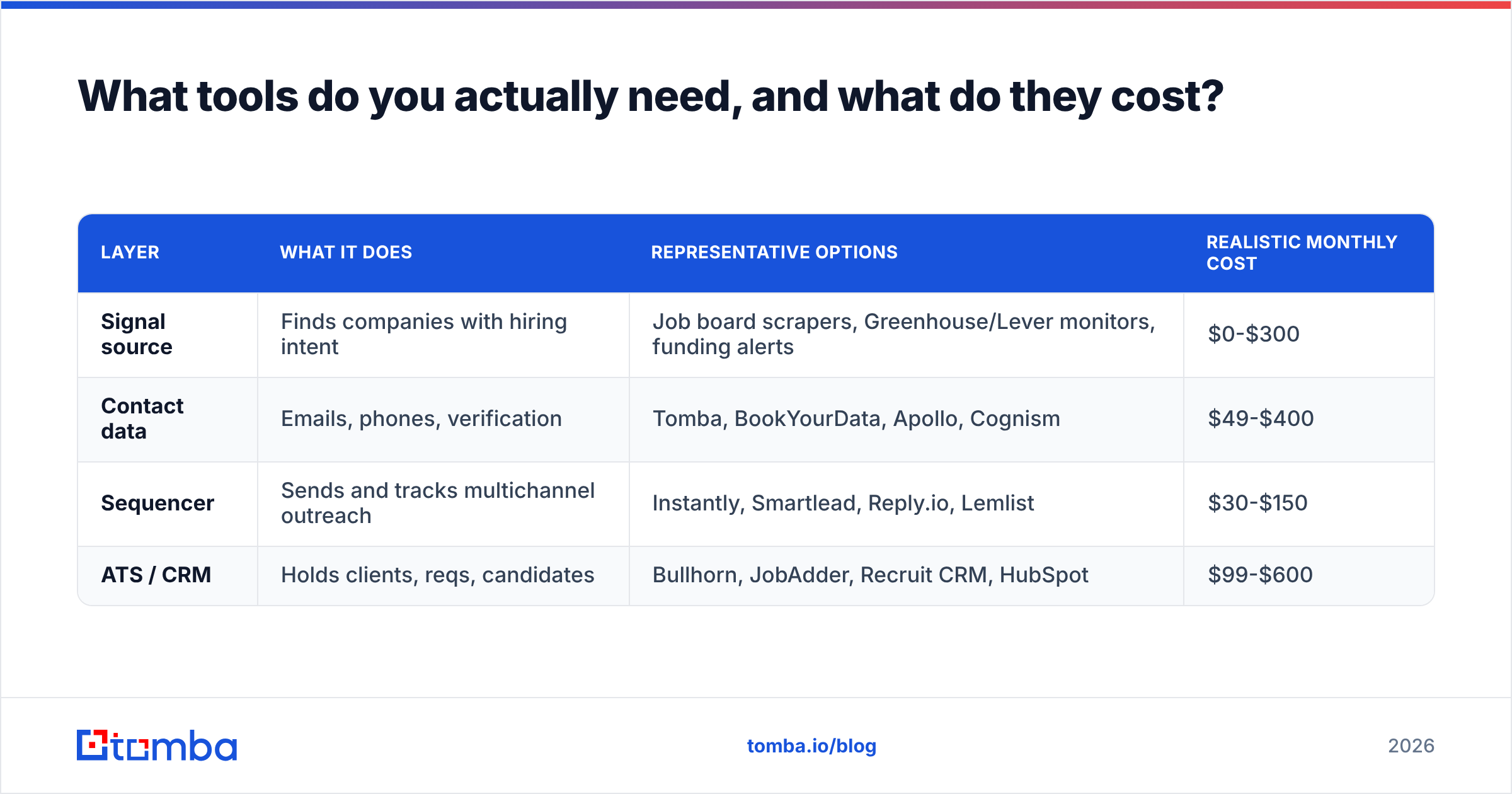
What tools do you actually need, and what do they cost?#
You need four layers. Do not buy an all-in-one platform before you know your motion works.
| Layer | What it does | Representative options | Realistic monthly cost |
|---|---|---|---|
| Signal source | Finds companies with hiring intent | Job board scrapers, Greenhouse/Lever monitors, funding alerts | $0-$300 |
| Contact data | Emails, phones, verification | Tomba, BookYourData, Apollo, Cognism | $49-$400 |
| Sequencer | Sends and tracks multichannel outreach | Instantly, Smartlead, Reply.io, Lemlist | $30-$150 |
| ATS / CRM | Holds clients, reqs, candidates | Bullhorn, JobAdder, Recruit CRM, HubSpot | $99-$600 |
On the data layer, the choice is between broad databases and precision finders. Broad databases are strong when you want volume in a known ICP; BookYourData is a solid option if you want to buy a filtered list outright rather than build it. Precision finders are stronger when your signal is company-specific — you already know the target account from a job posting, and you need the right person's verified address right now.
Tomba pricing starts with a free tier at 25 searches per month, then Starter at $49/mo, Growth at $99/mo, and Pro at $249/mo, with Enterprise custom. For a two-person agency running the job-signal play, the $99 tier typically covers a month of prospecting comfortably. Check current G2 reviews for how the category is shifting before you sign an annual contract with anyone.
One integration note that saves hours. If your prospecting list lives in a spreadsheet, use the Google Sheets add-on or bulk email finder rather than copying rows into a web UI one at a time. And if you are pushing accepted leads into a CRM, wire it up through the HubSpot integration or Zapier integration so enrichment happens on record creation instead of as a weekly chore.
What mistakes kill staffing agencies' client acquisition?#
Five patterns show up over and over in agencies that stall between $300K and $1M in gross profit.
- Selling "quality candidates" instead of a specific problem. Every agency says it has quality candidates. Nobody has ever bought because of that sentence. Sell the shortlist for the one req that is bleeding.
- Going wide instead of deep. An agency covering "IT, finance, marketing, and operations" cannot write a credible first line for any of them. Niche agencies close faster and charge more.
- Skipping verification. A 22% bounce rate on a cold campaign does not just waste sends. It burns the sending domain, and recovering a burned domain takes 6-10 weeks. Verify before you send, always.
The last two are the quiet ones. They cost you deals you never see.
- No follow-up discipline. Most staffing deals close on touch 4-7. Agencies that send one email and move on are paying full list-building cost for a fraction of the yield.
- Treating the client relationship as transactional. The second placement with an existing client costs roughly a tenth of the first. Quarterly check-ins with past clients beat net-new prospecting on almost any spreadsheet you build.
There is also a timing point worth naming. Hiring signals decay fast. A job posting that goes live Monday is contested by Thursday. If your list build takes two weeks, you are pitching roles that are already filled or already covered by three competitors. Speed from signal to first touch is a moat that costs nothing but process discipline.
How should you sequence your first 90 days?#
If you are starting from zero clients, run this order:
- Days 1-14: Pick one niche and one geography. Build the signal source. Write the four-touch sequence. Warm two sending domains — use a warmup calculator to set a ramp schedule rather than guessing.
- Days 15-45: Build and verify 400-600 contacts. Send 40/day. Call the opens. Target 10 discovery calls.
- Days 46-75: Convert 2-3 discovery calls into signed terms. Deliver hard on the first req — your first placement is your entire referral engine.
- Days 76-90: Run the alumni and partnership plays with whatever relationships you now have. Review cost per signed client per channel and cut what did not work.
The agencies that succeed here are not the ones with the best pitch. They are the ones whose list is accurate, whose signal is fresh, and whose follow-up does not stop at touch two.
Where to start#
How to get clients for staffing agency growth is a data problem wearing a sales-problem costume. The signal is public: job boards, funding rounds, org changes. The bottleneck is getting from "this company is hiring" to "this specific person's verified email is in my sequencer" without burning a week or a sending domain.
Start with one company that has had a role open for a month. Run its domain through the Tomba Email Finder, verify the address, and send the four-sentence email above. Then do it thirty-nine more times tomorrow. The free tier gives you 25 searches to test the motion before you spend anything; Starter at $49/mo covers a serious first campaign.
Related guides#
// get started
Find, verify and enrich your first contacts today
Start on the free plan with 25 searches a month, then scale when your team is ready.
Free plan · No credit card required · GDPR & CCPA
// about the author