How To Get Clients For Your Business: A 2026 Playbook
Nine client-acquisition channels ranked by cost, speed, and effort — with the exact outreach math, a channel comparison table, and the tools that make cold outbound work in 2026.
TL;DR
- Most businesses fail at client acquisition because they run one channel badly, not because they picked the wrong channel.
- Cold outbound is the only channel that produces clients in under 30 days without ad spend — but it collapses if your contact data is bad.
- Referrals have the highest close rate (roughly 3-5x cold) and the lowest volume. Treat them as a system, not luck.
- Content and SEO cost the least per client at scale and the most in months-to-first-deal. Start them early, don't depend on them early.
- Run the math before the tactics: target clients ÷ close rate ÷ reply rate = how many contacts you actually need.
Why do most businesses struggle to get clients?#
Because they confuse activity with a pipeline.
A founder sends 40 LinkedIn connection requests, publishes two blog posts, boosts a post on Facebook, and then concludes "marketing doesn't work for us." What actually happened is that no single channel got enough volume, enough time, or enough iteration to produce a signal.
Client acquisition is a numbers problem wrapped in a positioning problem. If you know your close rate and your reply rate, you can reverse-engineer exactly how much input you need. If you don't know those numbers, every channel feels equally broken.
Here is the arithmetic that governs everything below:
Clients needed ÷ close rate ÷ meeting-booked rate ÷ reply rate = contacts required.
Say you want 4 new clients this quarter. You close 25% of qualified calls. 40% of replies turn into a call. 5% of well-targeted cold emails get a reply. That's 4 ÷ 0.25 ÷ 0.40 ÷ 0.05 = 800 contacts. Not 80. Not "a few outreach emails a week."
That single calculation kills more bad strategies than any framework. Most people running outbound are working with 60 contacts and expecting the results of 800.
What are the fastest ways to get clients for your business?#
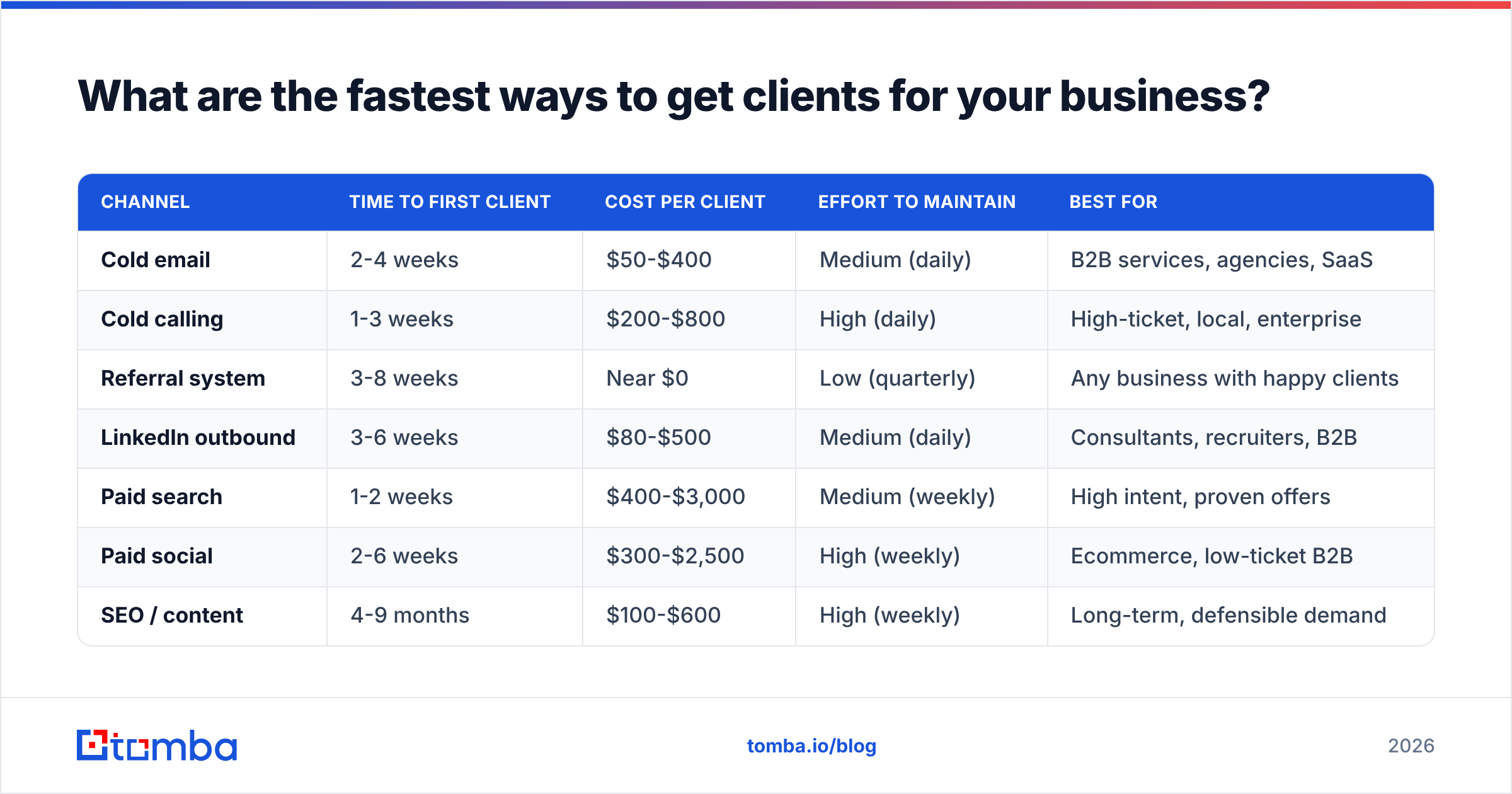
Rank channels on three axes: cost per client, time to first client, and effort to maintain. Almost every disappointment comes from picking a slow channel when you needed a fast one, or an expensive one when you had no budget.
| Channel | Time to first client | Cost per client | Effort to maintain | Best for |
|---|---|---|---|---|
| Cold email | 2-4 weeks | $50-$400 | Medium (daily) | B2B services, agencies, SaaS |
| Cold calling | 1-3 weeks | $200-$800 | High (daily) | High-ticket, local, enterprise |
| Referral system | 3-8 weeks | Near $0 | Low (quarterly) | Any business with happy clients |
| LinkedIn outbound | 3-6 weeks | $80-$500 | Medium (daily) | Consultants, recruiters, B2B |
| Paid search | 1-2 weeks | $400-$3,000 | Medium (weekly) | High intent, proven offers |
| Paid social | 2-6 weeks | $300-$2,500 | High (weekly) | Ecommerce, low-ticket B2B |
| SEO / content | 4-9 months | $100-$600 | High (weekly) | Long-term, defensible demand |
| Partnerships | 2-4 months | Low variable | Low (monthly) | Complementary service providers |
| Marketplaces / directories | 1-4 weeks | 10-20% of revenue | Low | Freelancers, early agencies |
Read that table as a portfolio, not a menu. The working pattern for most businesses in 2026 is: one fast channel to pay the bills, one slow channel to compound. Cold outbound plus content. Paid search plus referrals. Pick one from each column and ignore the rest until the first pair works.
The five-step sequence that actually holds up#
- Define one buyer, not a category. "Marketing agencies" is a category. "12-40 person performance marketing agencies in the US who run paid social for DTC brands" is a buyer. The second one lets you write an email that can't have been sent to anyone else.
- Build the list before you build the pitch. You cannot personalize what you cannot see. Pull 300-800 verified contacts at your target companies first — the list will teach you what the pitch should say.
- Pick one fast channel and run it for 6 weeks minimum. Six weeks is roughly the shortest window that produces statistically meaningful reply-rate data at 100-150 sends per week.
- Instrument every step. Track sends, deliveries, replies, positive replies, calls booked, and closes. Without step-level numbers you'll optimize the wrong thing — usually the copy, when the real problem is the list.
- Only add a second channel once the first is repeatable. Repeatable means you can predict, within 30%, how many calls next month's activity will produce.
How do you find the right people to contact?#
Bad targeting is the single most expensive mistake in outbound, and it hides itself well — it looks like a copywriting problem.
Start with a company list, not a contact list. Sources that work in 2026:
- Job boards. Companies hiring for a role adjacent to your service have a budget and an admitted gap. A company posting for a "Demand Gen Manager" is telling you they have a demand-gen problem right now.
- Tech-stack signals. If your service only works alongside HubSpot, filter for companies running HubSpot. A website tech stack check turns a generic list into a qualified one.
- Funding and expansion news. New capital means new initiatives and new budget owners.
- Competitor client logos. Public case studies on a competitor's site are a pre-validated list of companies that buy what you sell.
- Your own site traffic. Companies already visiting your pricing page are the warmest cold contacts you will ever get — visitor identification turns anonymous sessions into named accounts.
Once you have 200-500 target companies, you need contacts. Two approaches, and the difference matters more than people think:
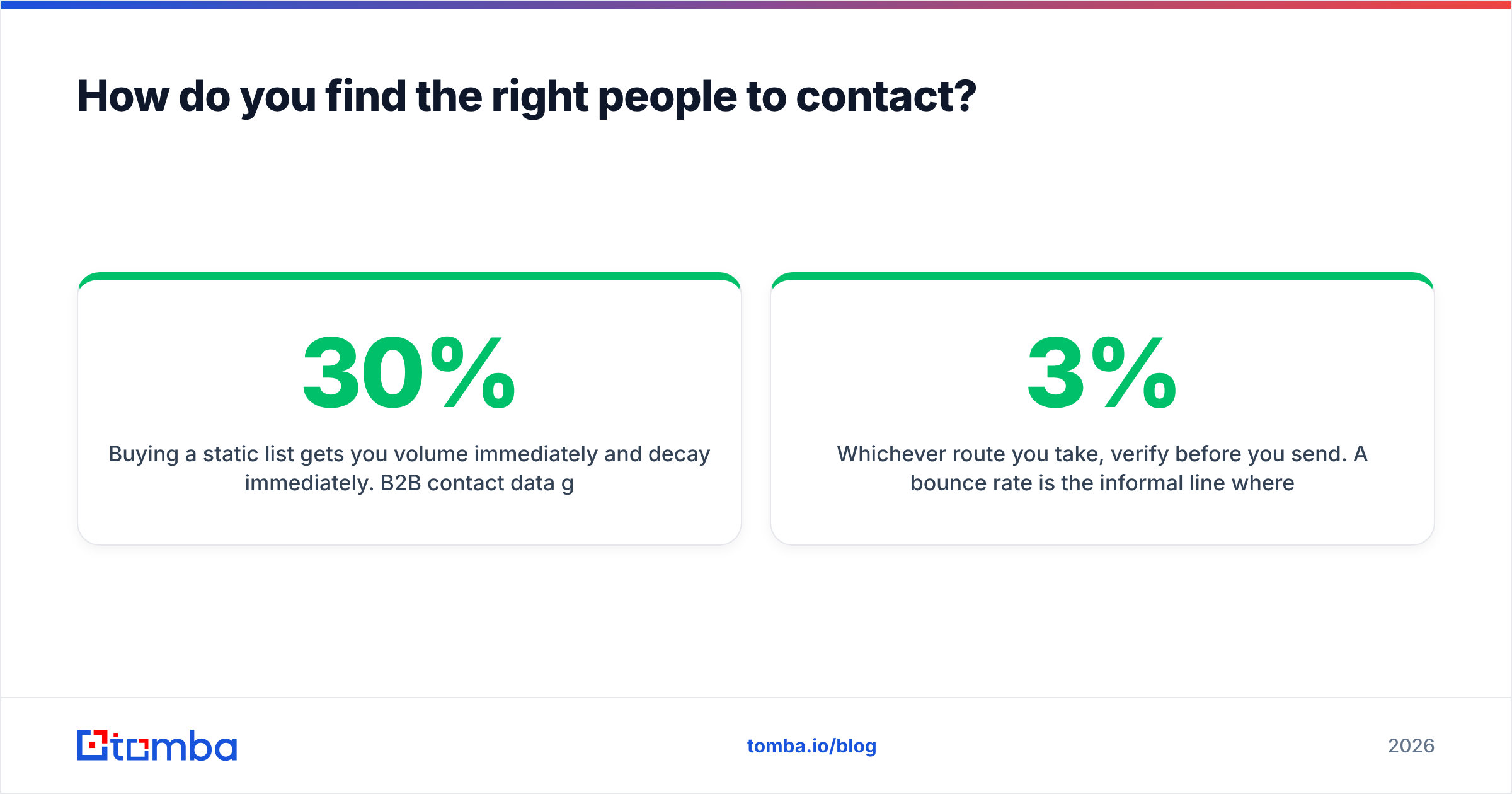
Buying a static list gets you volume immediately and decay immediately. B2B contact data goes stale at roughly 22-30% per year — people change jobs, companies get acquired, domains migrate. A list bought in January is meaningfully wrong by August. Vendors like BookYourData do this well and offer pay-as-you-go pricing with verification built in, which makes them a reasonable fit when you need a large, clean list once rather than continuously.
Finding contacts on demand costs more per query but stays fresh, because each lookup is resolved and verified when you run it. If you're building lists weekly, this is the cheaper model in practice. A domain search returns every publicly discoverable address at a target company with its confidence score and sources, so you can pull contacts for the 300 companies you actually care about instead of renting 50,000 you don't.

Whichever route you take, verify before you send. A 3% bounce rate is the informal line where inbox providers start throttling you; above 5%, your domain reputation degrades fast enough that even your good emails stop landing. Running the list through an email verifier before the first send is the cheapest insurance in the entire process — it costs cents per contact and protects the domain your whole business emails from.
Is cold email still worth it in 2026?#
Yes, with two caveats that didn't apply five years ago.
Caveat one: volume without permission-adjacent targeting is dead. Google and Yahoo's bulk sender requirements (enforced since 2024) mean spam complaint rates above 0.3% get you filtered, not warned. You cannot brute-force your way to clients anymore. 150 sharply targeted emails per day beats 2,000 sprayed ones, and it's not close.
Caveat two: infrastructure is now table stakes. Authenticated sending domain, warmed-up mailboxes, a secondary domain so you're not risking your primary, and honest one-click unsubscribe. Google's own sender guidelines are the actual spec — read them once rather than trusting a Twitter thread. Check your SPF record before you send anything.
What performs, based on how buyers actually behave:
- 50-125 words. Anything longer gets scanned, not read.
- One specific observation about their business in the first line — not "I loved your website."
- One ask, and make it small. "Worth a look?" outperforms "do you have 30 minutes Thursday?" because it costs the reader nothing to say yes.
- 3-4 follow-ups over 18 days. Roughly half of positive replies arrive after the first message; abandoning after one send throws away most of your yield.
- Subject lines of 2-5 words, lowercase, no brackets, no numbers. It should look like an email a colleague sent.
If you want a starting structure, the cold email templates library is a faster starting point than a blank page — just rewrite the specifics so it stops sounding like a template.
How do referrals and partnerships compare to outbound?#
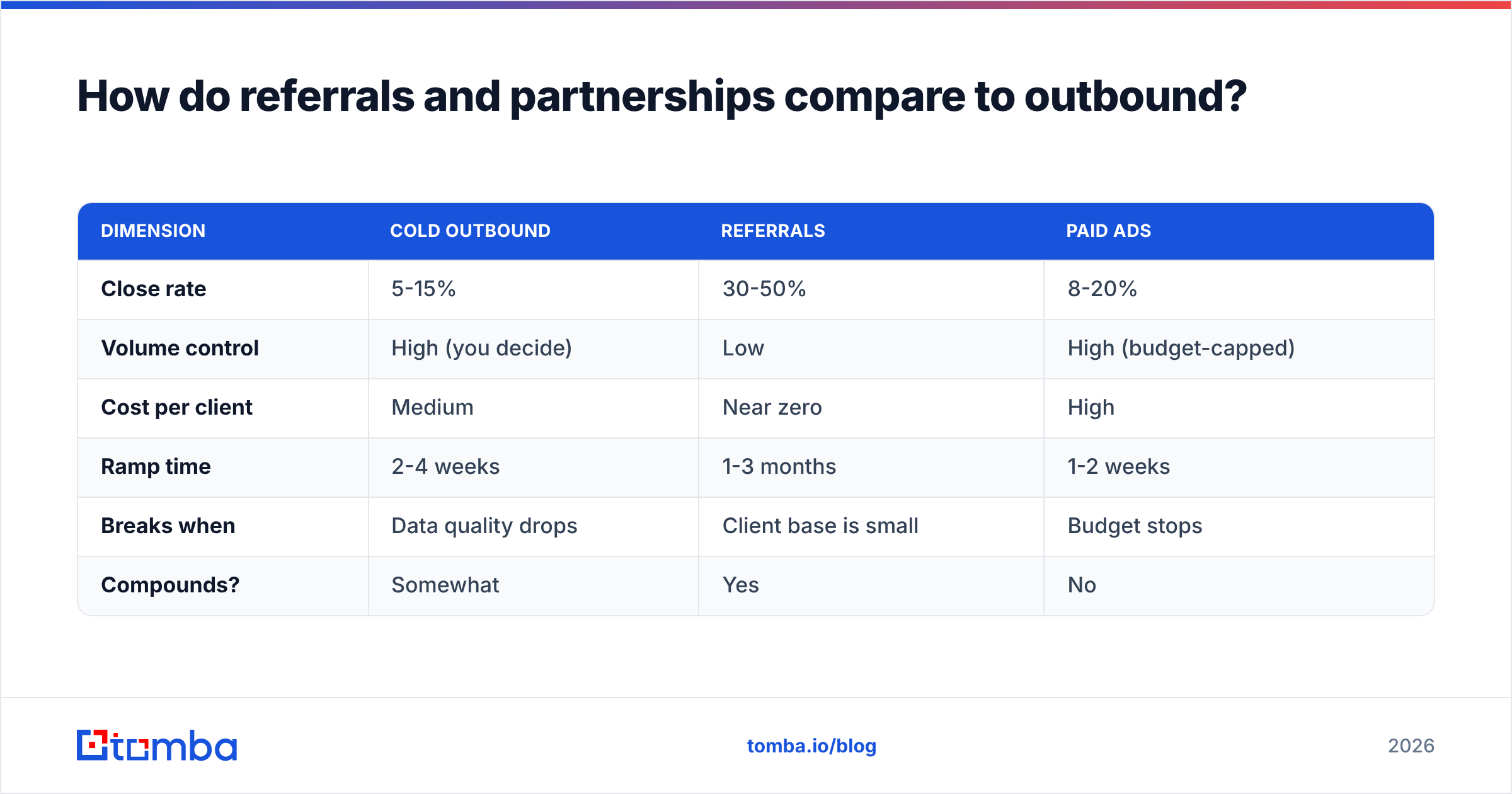
Referrals close at 3-5x the rate of cold outreach and cost effectively nothing. They also don't scale on command. That combination means referrals should be a system running in the background, not the plan.
A referral system that produces something predictable has four parts:
- A trigger. Ask at a defined moment — after a delivered win, at the 90-day mark, at renewal. Not "whenever it feels right," because it never feels right.
- A specific ask. "Do you know anyone who'd benefit?" gets nothing. "Which two agencies in your network are dealing with the same reporting problem you had in Q1?" gets names.
- A warm handoff. An intro email you draft for them, so their effort is one forward and one sentence.
- A reason to bother. Revenue share, a service credit, or a genuinely useful favor returned.
Partnerships are referrals at the company level. Find businesses selling to your exact buyer without competing — a web design studio and an SEO consultancy, a bookkeeper and a fractional CFO. The mechanics are the same: one clear trigger, one specific ask, one warm handoff.
| Dimension | Cold outbound | Referrals | Paid ads |
|---|---|---|---|
| Close rate | 5-15% | 30-50% | 8-20% |
| Volume control | High (you decide) | Low | High (budget-capped) |
| Cost per client | Medium | Near zero | High |
| Ramp time | 2-4 weeks | 1-3 months | 1-2 weeks |
| Breaks when | Data quality drops | Client base is small | Budget stops |
| Compounds? | Somewhat | Yes | No |
The honest read: outbound buys you time, referrals buy you margin, ads buy you speed. Early on you need time, which is why outbound is where most businesses under $2M should start.
What tools do you actually need to get clients?#
Fewer than the LinkedIn advice-industrial complex suggests. The functional minimum:
Contact data. You need names, verified emails, and often direct phone numbers at your target accounts. This is the layer everything else sits on — if it's wrong, the best sequencer and the best copy produce nothing. Compare vendors on accuracy and verification transparency, not on database size claims, which are unauditable marketing numbers. Independent user reviews on G2 are more useful than any vendor's own accuracy page.

A sending tool. Anything that handles sequences, rotation across mailboxes, and reply detection. This category is commoditized; pick on price.
A CRM. Even a spreadsheet works below 50 open deals, but a real CRM pays for itself the moment you have two people touching the same pipeline. HubSpot's free tier is genuinely sufficient for most small businesses.
Verification. Non-negotiable, and separate from your finder if your finder doesn't do it natively.
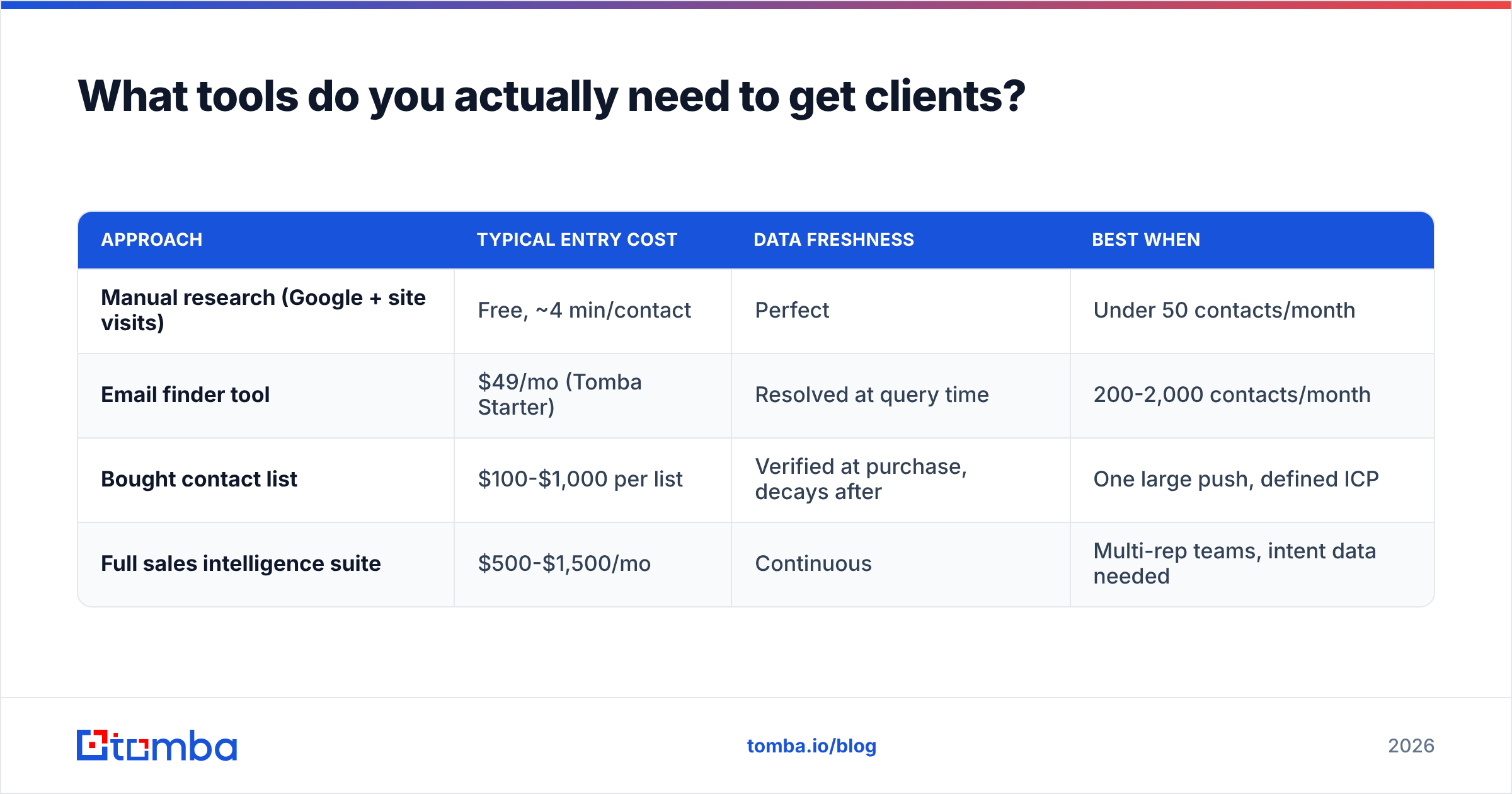
For the data layer specifically, here's how the common approaches stack up:
| Approach | Typical entry cost | Data freshness | Best when |
|---|---|---|---|
| Manual research (Google + site visits) | Free, ~4 min/contact | Perfect | Under 50 contacts/month |
| Email finder tool | $49/mo (Tomba Starter) | Resolved at query time | 200-2,000 contacts/month |
| Bought contact list | $100-$1,000 per list | Verified at purchase, decays after | One large push, defined ICP |
| Full sales intelligence suite | $500-$1,500/mo | Continuous | Multi-rep teams, intent data needed |
Tomba's pricing runs a free tier at 25 searches/month, Starter at $49/mo, Growth at $99/mo, and Pro at $249/mo — which puts a working outbound data stack under $100/month for most small teams. That's the right order of magnitude for this layer. If contact data is costing you more than your sending tool and your CRM combined, you're overbuying.
How do you keep clients coming in month after month?#
Consistency beats intensity, and it's mostly a calendar problem.
The businesses with predictable pipelines aren't doing anything clever. They've made prospecting a fixed, non-negotiable block — typically 60-90 minutes daily — that happens whether or not they're busy with delivery. The feast-famine cycle nearly every service business complains about is caused by one thing: stopping prospecting when you get busy, then restarting from zero when the work ends. The 6-8 week lag between outreach and revenue means you feel that gap a full quarter later, long after you've forgotten what caused it.
Three habits that hold pipelines steady:
- Refresh your list monthly, not quarterly. Contact data decays continuously. Re-run verification on anyone you haven't emailed in 90 days.
- Track leading indicators, not lagging ones. Contacts added and emails sent are controllable today. Revenue is a report on what you did two months ago.
- Kill channels honestly. If a channel has had 6 weeks and 600 quality touches with no meetings, the channel is wrong for you — or your offer is. Both are worth knowing.
And measure the thing that actually predicts everything downstream: your response rate. It's the earliest signal that your targeting, your list quality, or your message has drifted, and it moves weeks before revenue does.
Where should you start this week?#
Pick one buyer. Build a list of 300 verified contacts at companies matching that buyer. Write one email you'd actually reply to. Send 30 a day for six weeks. Track every step. That's it — the whole plan fits in five sentences, and executing it beats reading another forty articles about growth strategy.
The part most people get wrong is the list, because it's the least fun step and the easiest to fake with a scraped export. Start with the Tomba Email Finder — search by domain, name, or company, get verified addresses with confidence scores and source citations, and confirm them before your first send. The free tier gives you 25 searches to test whether your targeting is even right, which is a cheaper way to find out than burning a domain on 500 bad addresses.
Build the list. Send the emails. The rest is follow-up.
Related guides#
// get started
Find, verify and enrich your first contacts today
Start on the free plan with 25 searches a month, then scale when your team is ready.
Free plan · No credit card required · GDPR & CCPA
// about the author