How to Get Customers for Website Design: 9 Proven Channels
Most web designers wait for referrals and call it a pipeline. Here are nine channels that actually book discovery calls in 2026 — ranked by cost, speed, and how fast they stop working.
TL;DR
- Referrals and marketplaces are the two channels every designer starts with, and both cap out fast — referrals depend on volume you don't have yet, and marketplaces compete you down to $500 sites.
- The highest-margin channel for most solo designers and small studios in 2026 is targeted outbound to businesses with visibly broken sites — you can see the problem before you pitch it.
- Outbound only works when you reach a decision-maker, which means the bottleneck is contact data, not copy. Use a domain search to get the owner or marketing lead, not
info@. - Local SEO and partner referrals (agencies, marketers, developers) are slower to start but produce the highest close rates once running.
- Build two channels, not nine. Pick one fast channel for cash now and one slow channel that compounds.
Web design is one of the few services where you can diagnose the prospect's problem from the outside, for free, in about eight seconds. That's a structural advantage almost no other service business has — and most designers waste it by posting on Instagram and hoping.
This post ranks nine channels for getting website design clients, tells you what each one actually costs in time and money, and shows where each one breaks.
Why do most website designers struggle to get customers?#
Three reasons, in order of how much damage they do.
You're selling a commodity by default. "I build websites" competes with Wix, Squarespace, Framer templates, and a Fiverr seller in another timezone charging $150. Nothing in that sentence explains why you cost more. Designers who niche — "Shopify sites for supplement brands," "booking sites for med spas" — stop competing on price because the buyer can't compare you to a template.
Your pipeline is entirely passive. Referrals, past clients, and the occasional inbound form. All three are demand you catch, not demand you create. When they dry up in Q1, you have zero levers to pull.
You pitch to the wrong person. Most designers email hello@ or info@ and wonder why nothing lands. Those inboxes are triaged by whoever has time, and a redesign proposal is never urgent to a junior. You need the owner, the marketing director, or the person whose bonus depends on the site converting.
Fixing the third one is the fastest win, and it's mostly a data problem.
What are the 9 best channels for getting web design clients?#
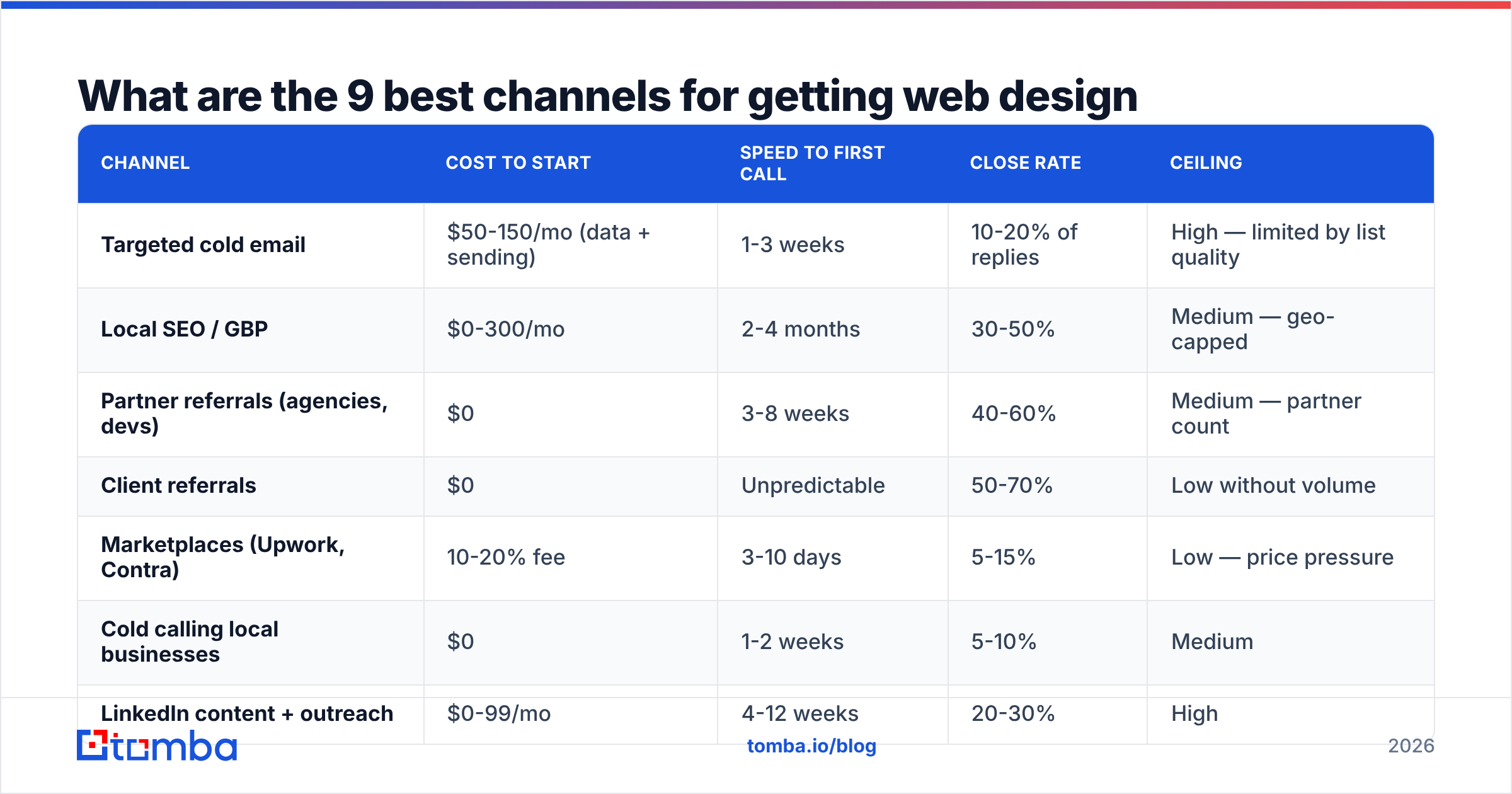
Here's the full ranking. "Speed" means time from starting the channel to first booked call. "Ceiling" means roughly how far the channel scales before it stalls.
| Channel | Cost to start | Speed to first call | Close rate | Ceiling |
|---|---|---|---|---|
| Targeted cold email | $50-150/mo (data + sending) | 1-3 weeks | 10-20% of replies | High — limited by list quality |
| Local SEO / GBP | $0-300/mo | 2-4 months | 30-50% | Medium — geo-capped |
| Partner referrals (agencies, devs) | $0 | 3-8 weeks | 40-60% | Medium — partner count |
| Client referrals | $0 | Unpredictable | 50-70% | Low without volume |
| Marketplaces (Upwork, Contra) | 10-20% fee | 3-10 days | 5-15% | Low — price pressure |
| Cold calling local businesses | $0 | 1-2 weeks | 5-10% | Medium |
| LinkedIn content + outreach | $0-99/mo | 4-12 weeks | 20-30% | High |
| Paid search (Google Ads) | $800+/mo | 1-2 weeks | 10-20% | High — CAC dependent |
| Communities / Slack / Reddit | $0 | 2-6 weeks | 25-40% | Low |
Read that table as a portfolio, not a menu. The working combination for most independents is one fast channel + one compounding channel: cold email now, local SEO or LinkedIn content in the background.
How do you find web design clients with cold outreach?#
Cold outreach for web design works better than for almost any other service because your pitch can be specific and provable. You aren't guessing at a pain point — you can see the 6-second load time, the 2014 layout, the mobile menu that doesn't open.
The process, in five steps:
- Define a trigger, not an industry. "Dentists" is not a list. "Dentists whose site fails Core Web Vitals and has no online booking" is. Triggers you can detect at scale: no SSL, no mobile viewport tag, WordPress 5.x, a "Copyright 2019" footer, recent funding, a new marketing hire, a rebrand announcement.
- Build the company list. Google Maps scrapes, local chamber directories, Clutch/G2 category pages, funding databases, or a filtered B2B database query by industry and headcount. Aim for 200-400 companies you'd genuinely be proud to work with.
- Get the decision-maker's email — not the generic one. This is where most campaigns die. Run each domain through a domain search to pull named contacts and the company's email pattern, then use the email finder to resolve the specific owner or marketing lead. For a 300-company list this is a 20-minute job with the bulk email finder, not a two-day one.
- Verify before you send. Bounce rate above 3% will get your domain flagged by Gmail and Microsoft, and a flagged domain kills every channel that depends on email. Run the list through an email verifier and drop anything that isn't deliverable. Google's bulk sender requirements spell out the thresholds you're being measured against.
- Send a specific, short, no-attachment email. Three to five sentences. Name the exact problem on their site, name the business consequence, offer a low-friction next step.
A template that consistently works:
Subject: your booking page on mobile
Hi Marta — pulled up northsidedental.com on my phone and the "Request Appointment" button falls below the fold and doesn't tap through on iOS Safari. If your traffic splits like most dental sites, that's roughly 60% of visitors hitting a dead end.
I rebuild booking flows for dental practices — usually a 2-week job. Want me to send a 90-second screen recording showing what I'd change? No cost, no pitch deck.
— Sam
Note what's missing: no "I hope this email finds you well," no portfolio link, no 400-word agency intro, no PDF. You're selling a 90-second video, not a website.
What actually makes cold email work versus get ignored?#
The gap between a 1% reply rate and a 12% reply rate is rarely the copy. It's these five things, roughly in order of impact:
- List relevance — every contact should have a visible, nameable problem you solve. If you can't write a sentence specific to their site, remove them from the list.
- Deliverability hygiene — separate sending domain, SPF/DKIM/DMARC configured, warmed for 2-3 weeks, 20-40 sends per mailbox per day. Check your records with an SPF checker before you start.
- Data accuracy — a verified, named contact beats a guessed
firstname@every time. Guessed addresses bounce, and bounces compound into spam-folder placement. - Follow-up discipline — 60-70% of replies come from emails two through four. One-and-done outreach is the single most common failure.
- Offer friction — "book a 30-min discovery call" converts far worse than "want the 90-second video?" Sell the smallest possible next step.
The response rate you should expect for a well-built web design list is 5-12% on a four-email sequence. Below 3%, your list is wrong, not your writing.

Is local SEO better than outbound for web designers?#
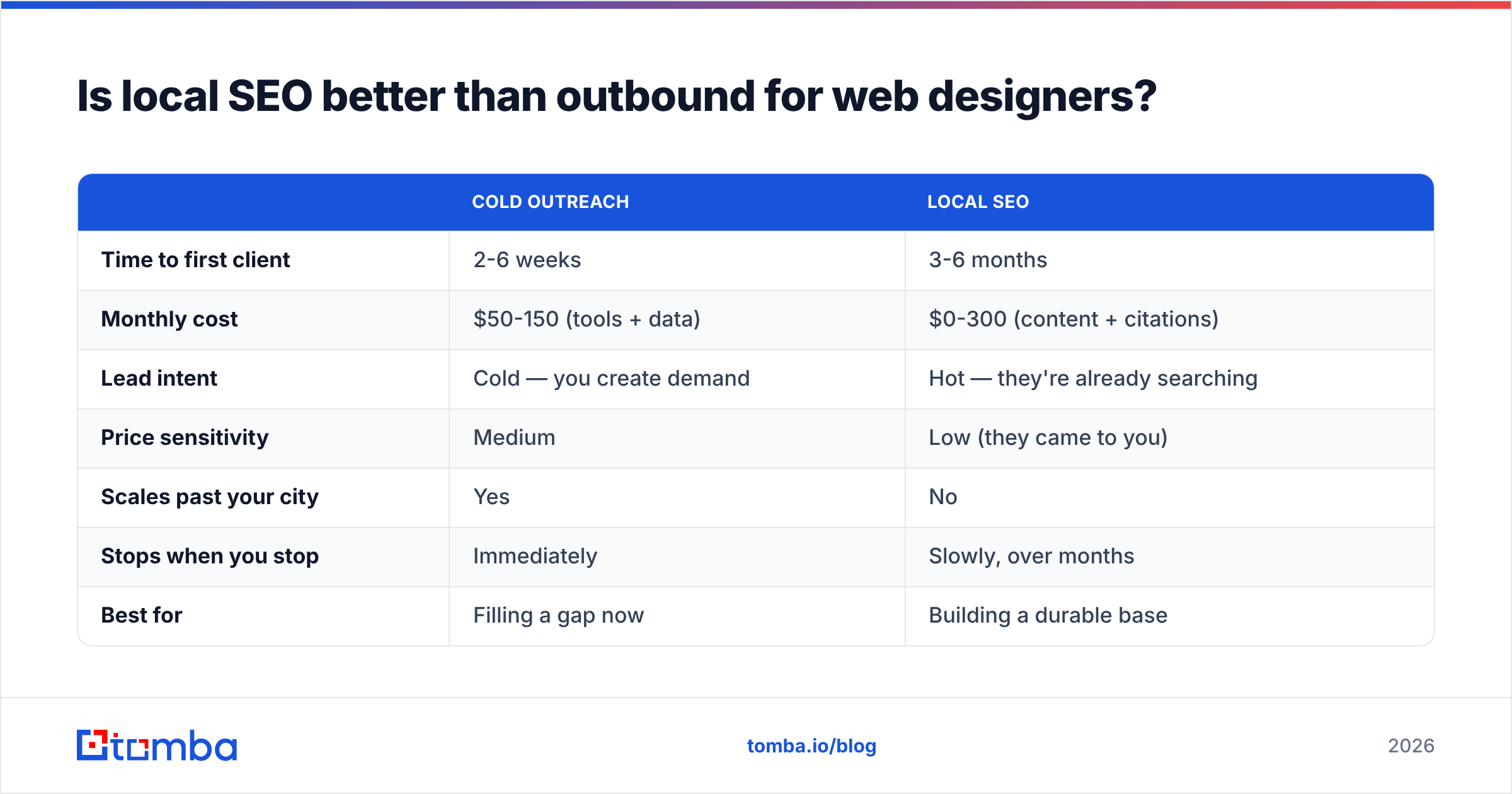
They solve different problems. Outbound gets you clients this month; local SEO gets you clients every month starting in month four.
| Cold outreach | Local SEO | |
|---|---|---|
| Time to first client | 2-6 weeks | 3-6 months |
| Monthly cost | $50-150 (tools + data) | $0-300 (content + citations) |
| Lead intent | Cold — you create demand | Hot — they're already searching |
| Price sensitivity | Medium | Low (they came to you) |
| Scales past your city | Yes | No |
| Stops when you stop | Immediately | Slowly, over months |
| Best for | Filling a gap now | Building a durable base |
For local SEO specifically, the work is narrower than people think: a fully-completed Google Business Profile with real photos, 15+ reviews, a page per service and per city you serve ("website design in Boulder," "Shopify developer Denver"), and citations in the obvious directories. Google's own local ranking documentation is the only source worth reading on relevance, distance, and prominence — most third-party "local SEO secrets" content is recycled from it.
The compounding effect is real. A Boulder web designer ranking in the map pack for three service terms gets inbound leads that close at 40-50% because the prospect already decided they need a designer and just picked one.
How do partner referrals work for website designers?#
This is the most underused channel in the list, and it has the highest close rate of anything you can start for free.
The insight: dozens of businesses sell to your exact customer without competing with you. They need a designer regularly and don't have one.
Who to partner with:
- Marketing agencies without a design arm — they win a retainer, need a site rebuilt, and currently subcontract to whoever's cheap.
- Freelance developers — they build, they don't design, and clients keep asking them to.
- SEO consultants — half their recommendations require site changes the client can't implement.
- Copywriters and brand strategists — the deliverable is words or a brand book; someone has to put it on a page.
- Fractional CMOs — they walk into companies with a mandate and a budget, and the site is almost always on the list.
How to actually start one: find 30-50 of these businesses in your region or niche, get the founder's email (an email finder makes this a same-day job), and pitch a specific reciprocal arrangement — a 10-15% referral fee, or a white-label rate they can mark up. Be explicit about the money. Vague "let's collaborate" emails go nowhere; "I pay 15% on any project you send, here's my white-label pricing" gets replies.
Two or three good partners can produce more revenue than any other channel on this list, because the referral arrives pre-sold.
What about marketplaces, communities, and paid ads?#
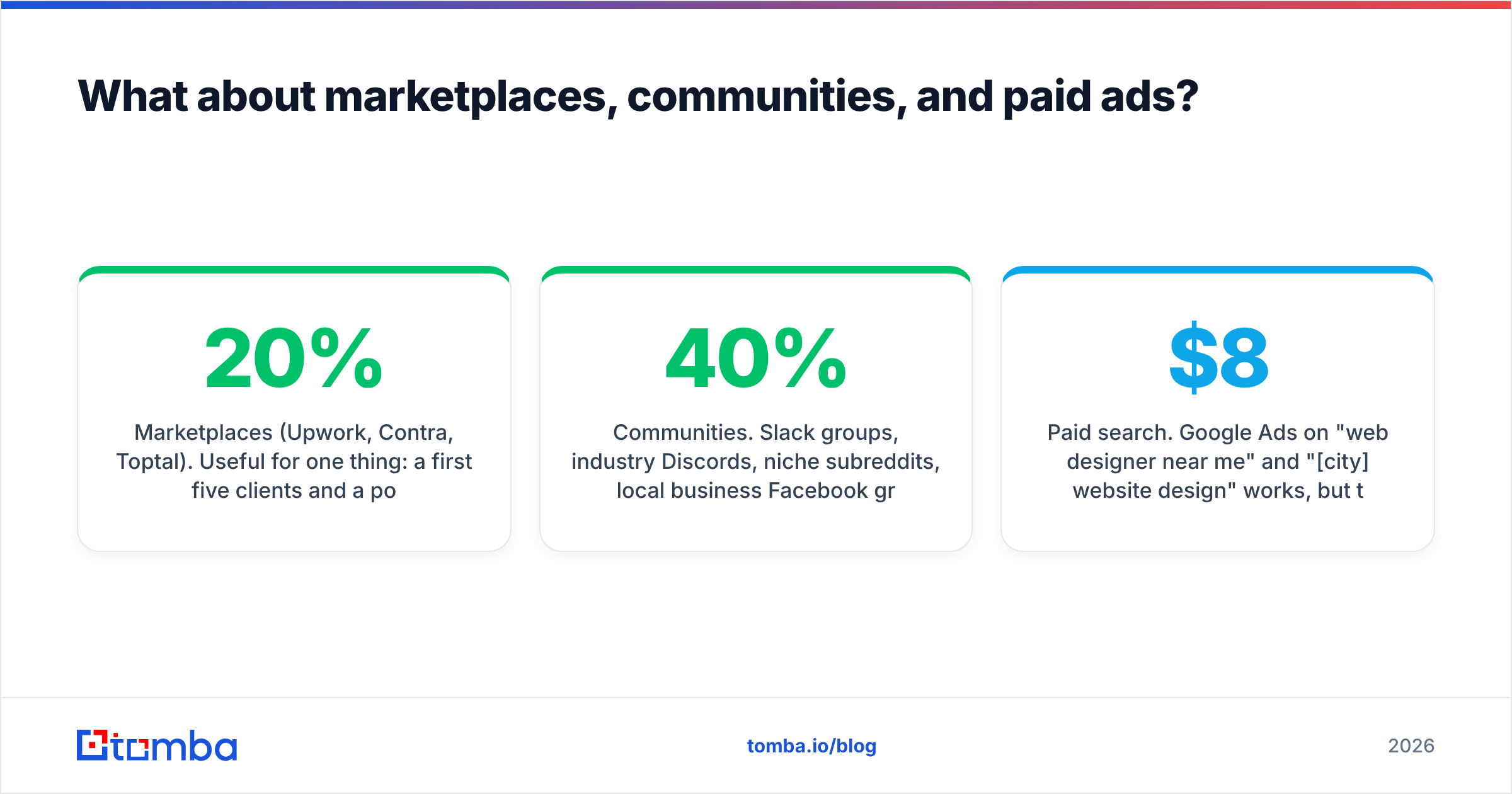
Marketplaces (Upwork, Contra, Toptal). Useful for one thing: a first five clients and a portfolio when you have neither. The economics are bad long-term — 10-20% fees, buyers comparing you against $300 bids, and no ownership of the client relationship. Treat it as a bootstrapping phase with an exit date, not a business model. If you do use it, filter hard for clients with verified payment and a $2,000+ budget, and move the relationship off-platform legally once the first project completes.
Communities. Slack groups, industry Discords, niche subreddits, local business Facebook groups. Close rates are high (25-40%) because trust is pre-built, but volume is low and the channel punishes selling. The functional pattern is answering questions for 6-8 weeks before mentioning what you do, once. If you don't enjoy the community anyway, this channel will fail.
Paid search. Google Ads on "web designer near me" and "[city] website design" works, but the CPCs run $8-25 and you need a landing page that converts at 5%+ to make the math survive. Don't start here. Start here once you know your close rate and average project value, because otherwise you're bidding blind. If you want the industry benchmark data before committing budget, WordStream's search advertising benchmarks are the most-cited free reference.
LinkedIn. Underrated for designers targeting B2B and SaaS clients. The pattern that works: post site teardowns — before/after screenshots of real (anonymized) sites with the specific problems annotated. It demonstrates competence instead of claiming it, and it's endlessly repeatable content. Pair it with light outreach: 10-15 connection requests a day to marketing leads at companies whose sites you've critiqued.
How do you price and pitch so clients say yes?#
Getting the meeting is half the job. The other half is not losing it on price.
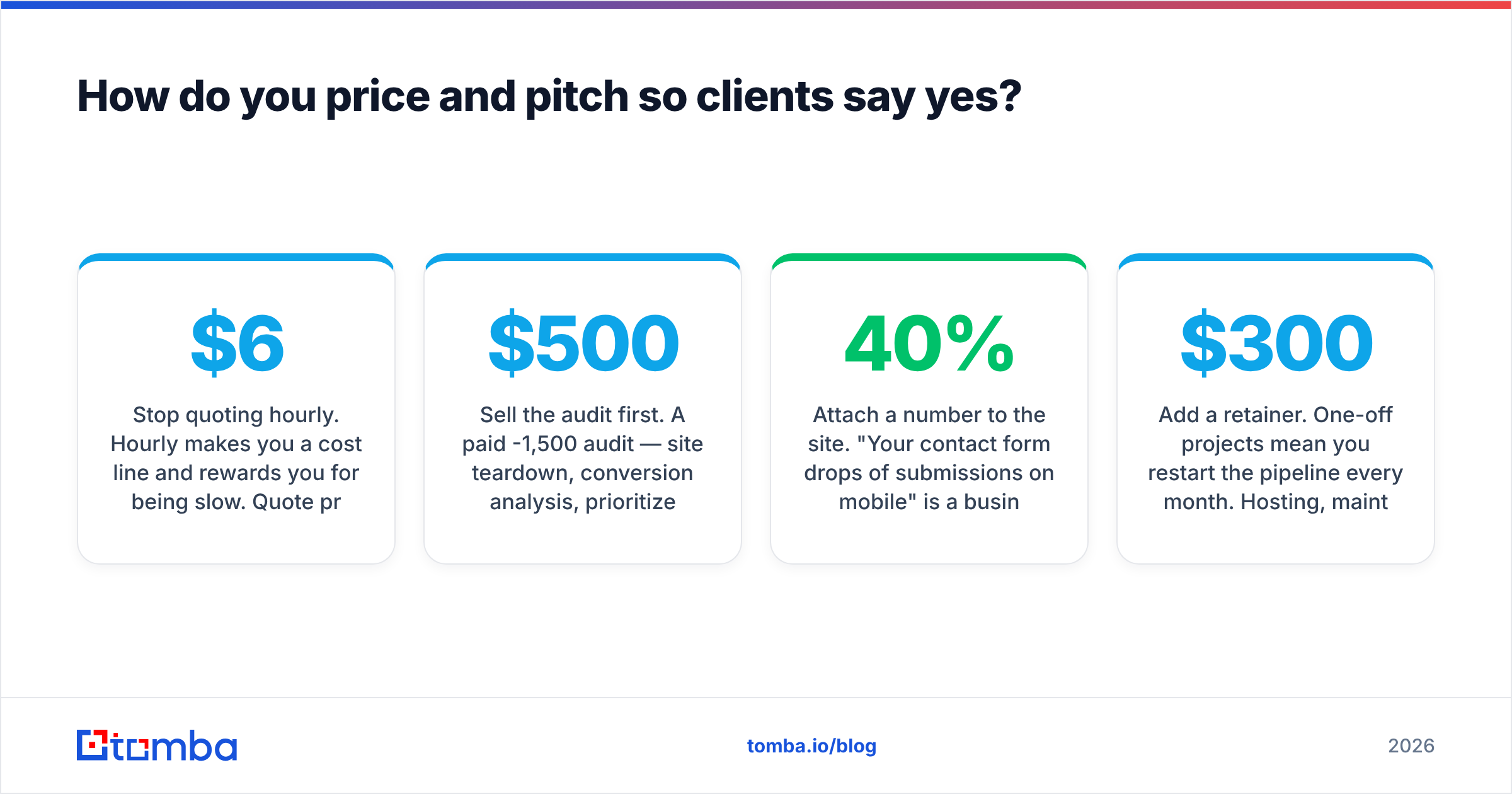
Stop quoting hourly. Hourly makes you a cost line and rewards you for being slow. Quote project fees tied to an outcome: "a booking flow that converts mobile visitors" costs $6,500, not "80 hours at $85."
Offer three tiers, always. A stripped-down option, the one you want them to buy, and a premium tier with ongoing maintenance. Most buyers pick the middle, and the top tier makes the middle look reasonable.
Sell the audit first. A paid $500-1,500 audit — site teardown, conversion analysis, prioritized fix list — converts to a full project at 50-70% and filters out tire-kickers before you write a proposal. It also gets you paid for the diagnostic work you were doing for free in your outreach emails.
Attach a number to the site. "Your contact form drops 40% of submissions on mobile" is a business problem. "Your site looks dated" is an opinion, and opinions get haggled.
Add a retainer. One-off projects mean you restart the pipeline every month. Hosting, maintenance, monthly CRO changes, or a content update package at $300-1,500/mo turns a lumpy freelance income into something predictable. HubSpot's research on agency retainer models covers the structures that hold up.
What's a realistic 30-day plan to book your first clients?#
Week 1 — Set up. Buy a separate sending domain, configure SPF/DKIM/DMARC, start warmup. Define your niche and trigger. Write your one-sentence positioning.
Week 2 — Build the list. 200-300 companies matching your trigger. Pull named decision-makers with a domain search, resolve emails, verify the whole list, remove anything risky. Simultaneously: claim and complete your Google Business Profile and ask three past clients for reviews.
Week 3 — Send. 20-30 emails per day per mailbox. Four-email sequence over 12 days. Track replies, not opens — open tracking is unreliable in 2026 and hurts deliverability. In parallel, email 30 potential referral partners with an explicit fee offer.
Week 4 — Iterate and follow up. Analyze reply patterns. If replies are under 3%, your list is wrong — rebuild it before touching the copy. Deliver free teardown videos to everyone who asked. Book calls. Send tiered proposals.
Expect 200-300 contacts to produce 15-30 replies, 5-10 calls, and 1-3 projects. That's a normal first cycle, and it improves substantially on the second run when your targeting is sharper.
Start with the contact data#
Every channel here except local SEO depends on reaching a specific human at a specific company. That's the actual bottleneck for most designers — not the pitch, not the portfolio, not the pricing.
Tomba's Email Finder resolves named decision-makers from a company domain, with verification built in so your sending domain stays clean. The free tier gives you 25 searches a month to test the workflow on your first shortlist; the Starter plan at $49/mo covers a normal outbound cycle, and Growth at $99/mo handles a full studio pipeline. Check Tomba pricing for the full breakdown.
Build the list this week. Send next week. The designers who stay busy in 2026 aren't the best designers — they're the ones with a pipeline that doesn't depend on luck.
Related guides#
// get started
Find, verify and enrich your first contacts today
Start on the free plan with 25 searches a month, then scale when your team is ready.
Free plan · No credit card required · GDPR & CCPA
Get the Tomba newsletter
Product and data updates
// about the author