How to Get Leads for Cold Calling: A 2026 Playbook
Cold calling still works — but only if the list does. Here are seven repeatable ways to source, verify, and prioritize phone-ready leads without burning your day on dead numbers.
TL;DR
- Cold calling does not fail because calling is dead — it fails because the list is dead. Connect rate is a data problem before it is a talent problem.
- The seven reliable sources are your own website traffic, CRM closed-lost, job boards, intent signals, association and event directories, purchased B2B databases, and enriched LinkedIn exports.
- Every phone number needs three checks before a rep touches it: line type, DNC status, and whether the human still works there.
- Pair every phone number with a verified email. Multi-channel sequences beat phone-only by a wide margin, and the email gives you a fallback when voicemail eats the call.
- Budget roughly 25-40% of list cost for enrichment and validation. It is cheaper than paying a rep to dial disconnected numbers.
Why do most cold calling lists fail before the first dial?#
Because the list was built for email and handed to a phone team.
A list built for email needs one accurate field: a deliverable address. A list built for calling needs four: a direct dial (not a switchboard), a line type (mobile converts far better than desk), a DNC-clean status, and a current employment check. Miss any one and you get the classic outcome — a rep dials 100 numbers, reaches 4 humans, and concludes cold calling is dead.
Industry connect rates hover in the low single digits for switchboard-heavy lists and climb into the 8-15% range when direct mobiles dominate. That gap is entirely a sourcing decision. Nothing about the script changed.
The second failure mode is staleness. B2B contact data decays at roughly 2-3% per month as people change jobs, which means a list you bought in January is meaningfully wrong by July. If you are not re-verifying on a rolling basis, you are dialing a snapshot of a company that no longer exists.

What are the seven best sources for cold calling leads?#
Here is the shortlist, ordered by connect quality rather than volume.
- Website visitor identification — People already on your pricing page are the warmest cold call you will ever make. Tools that do visitor identification resolve anonymous company traffic into named accounts you can then find contacts inside. Small volume, outsized connect rate.
- CRM closed-lost and dormant accounts — Deals that died on budget or timing 9-18 months ago are the cheapest pipeline in your building. The champion may have moved, but the pain usually did not. Re-verify the contact, then call.
- Job postings as a buying signal — A company hiring three SDRs needs sales tooling. A company hiring a Head of Compliance needs compliance software. Job boards publish intent for free, in plain language, with a timestamp.
- Association, chamber, and event directories — Trade association member lists and conference attendee rosters give you a pre-qualified vertical slice. They rarely include phone numbers, which is where enrichment comes in.
- Purchased B2B databases — Fastest path to volume. Quality varies enormously by vendor and by region; test a small sample before committing to a seat.
- LinkedIn Sales Navigator exports — Excellent for targeting precision (title, headcount, tech stack, recent job change), useless on its own for phone numbers. You export the person, then enrich for the dial.
- Referral and network mining — Ask every closed-won customer for two names. Highest conversion, lowest volume, and the one most teams skip because it does not scale in a spreadsheet.
Most teams should run three of these, not seven. Pick the two highest-intent sources for your motion plus one volume source, and go deep.
How do the main lead sources compare on cost and connect rate?#
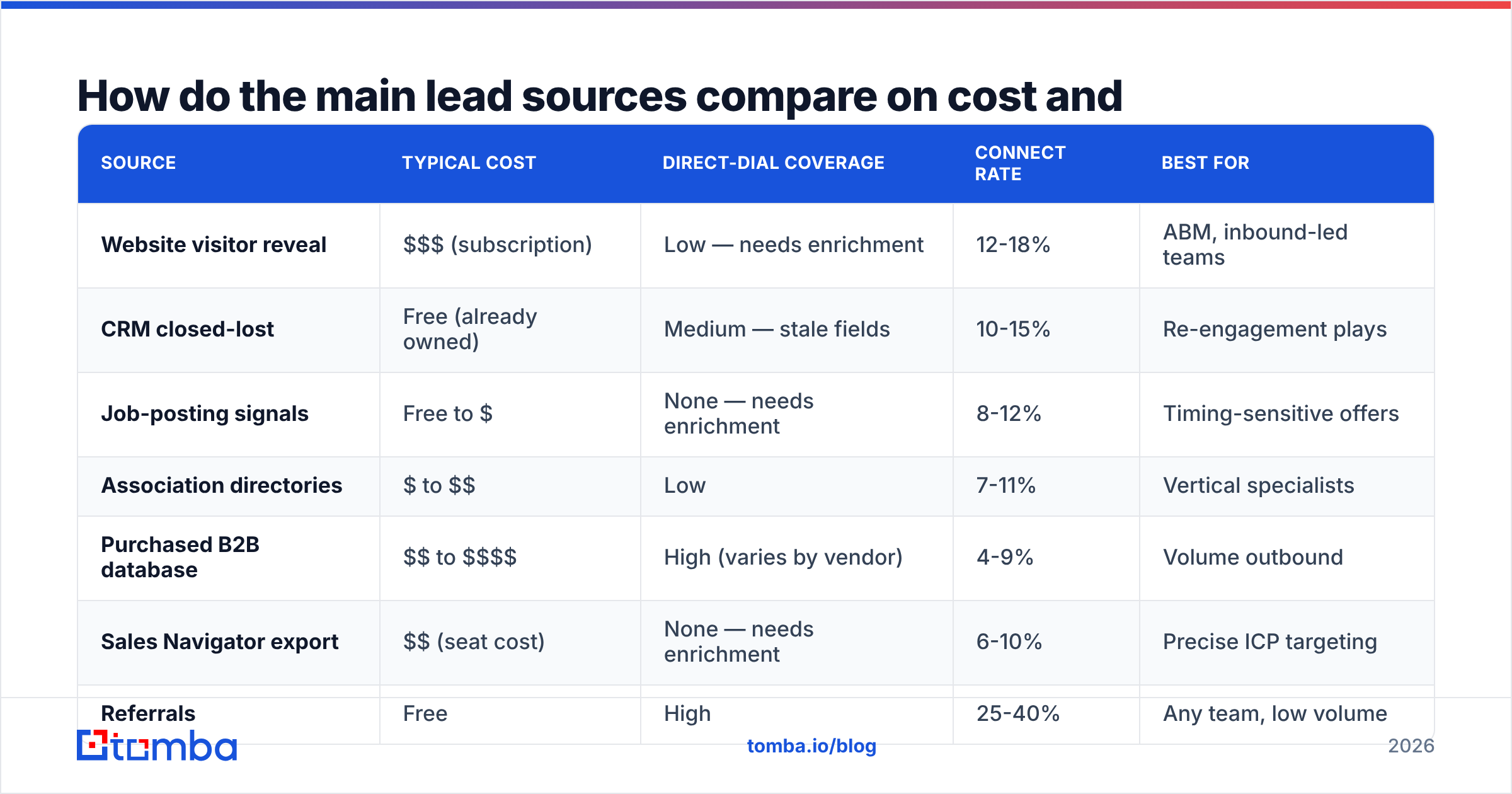
| Source | Typical cost | Direct-dial coverage | Connect rate | Best for |
|---|---|---|---|---|
| Website visitor reveal | $$$ (subscription) | Low — needs enrichment | 12-18% | ABM, inbound-led teams |
| CRM closed-lost | Free (already owned) | Medium — stale fields | 10-15% | Re-engagement plays |
| Job-posting signals | Free to $ | None — needs enrichment | 8-12% | Timing-sensitive offers |
| Association directories | $ to $$ | Low | 7-11% | Vertical specialists |
| Purchased B2B database | $$ to $$$$ | High (varies by vendor) | 4-9% | Volume outbound |
| Sales Navigator export | $$ (seat cost) | None — needs enrichment | 6-10% | Precise ICP targeting |
| Referrals | Free | High | 25-40% | Any team, low volume |
Read that table as a portfolio, not a ranking. Referrals win on rate and lose on volume; databases do the opposite. A functioning outbound team runs both.
How do you turn a name into a callable phone number?#
The enrichment step is where most lists get made or ruined. The sequence that works:
Step 1 — Resolve the company. Start from a domain, not a company name. "Acme" matches 400 companies; acme.io matches one. If you only have a name, run it through a company website finder first.
Step 2 — Find the people. Use a domain search to pull every known contact at that domain, then filter by title and department. This is faster than guessing individual names and it surfaces the adjacent roles you did not know to ask for.
Step 3 — Get the direct dial. Run the resolved contacts through a phone finder to attach mobile and direct-line numbers. Expect coverage in the 40-70% range depending on geography — North America is well covered, EMEA is thinner, and DACH is thinnest due to stricter data rules.
Step 4 — Validate the line. A phone validator tells you whether the number is live, what carrier owns it, and whether it is mobile or landline. Mobile numbers connect roughly twice as often. Sort your queue by line type and you have improved connect rate before saying a word.
Step 5 — Attach the email. Always. Run each contact through an email verifier so the rep has a same-day follow-up path after every voicemail. Call-then-email within 15 minutes is the single highest-leverage sequencing tweak available to a phone team.
Step 6 — Scrub against DNC. In the US, the FTC's national registry applies primarily to consumer numbers, but many mobile B2B numbers are personally registered. Check your obligations — the FTC's guidance for businesses is the authoritative starting point, and EU/UK teams have separate GDPR and PECR duties.
Is buying a list better than building one?#
It depends on how much time you have and how narrow your ICP is.
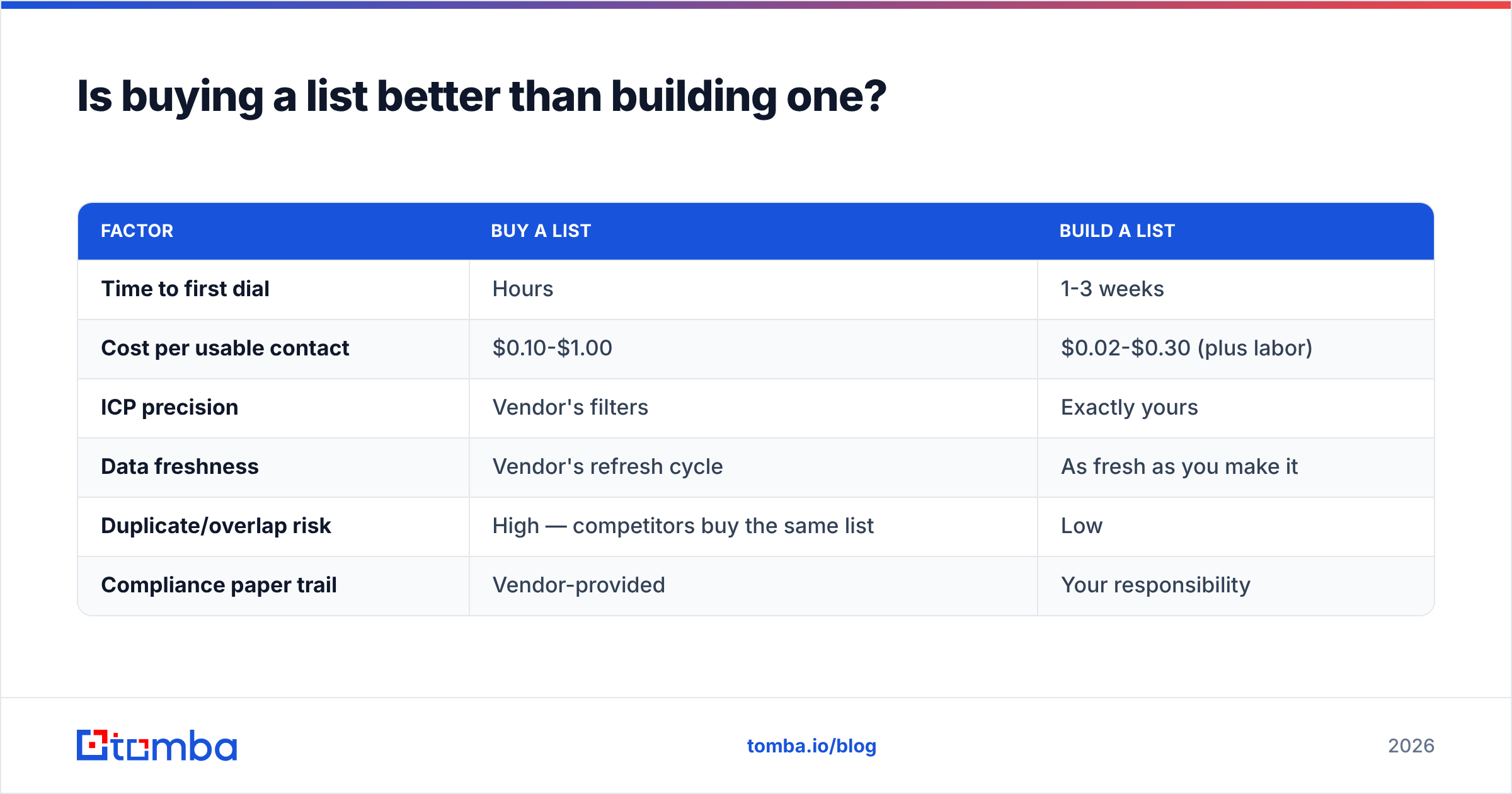
| Factor | Buy a list | Build a list |
|---|---|---|
| Time to first dial | Hours | 1-3 weeks |
| Cost per usable contact | $0.10-$1.00 | $0.02-$0.30 (plus labor) |
| ICP precision | Vendor's filters | Exactly yours |
| Data freshness | Vendor's refresh cycle | As fresh as you make it |
| Duplicate/overlap risk | High — competitors buy the same list | Low |
| Compliance paper trail | Vendor-provided | Your responsibility |
Buying wins when you need volume this quarter and your ICP maps cleanly onto standard firmographic filters (industry, headcount, geography, tech stack). BookYourData is a solid option here — pay-as-you-go credits, no forced annual seat, and a documented accuracy guarantee, which makes it easy to test a small batch before scaling.
Building wins when your ICP is defined by something no filter captures — "companies that just lost a compliance officer," "agencies running a specific ad platform," "manufacturers with an ISO audit due." Those signals live in job boards, press releases, and public filings, not in a dropdown.
The honest answer for most teams: buy the base, build the signal layer on top. Purchase 2,000 accounts that fit firmographically, then use free signals to decide which 200 get called first this week.

What list hygiene actually moves connect rate?#
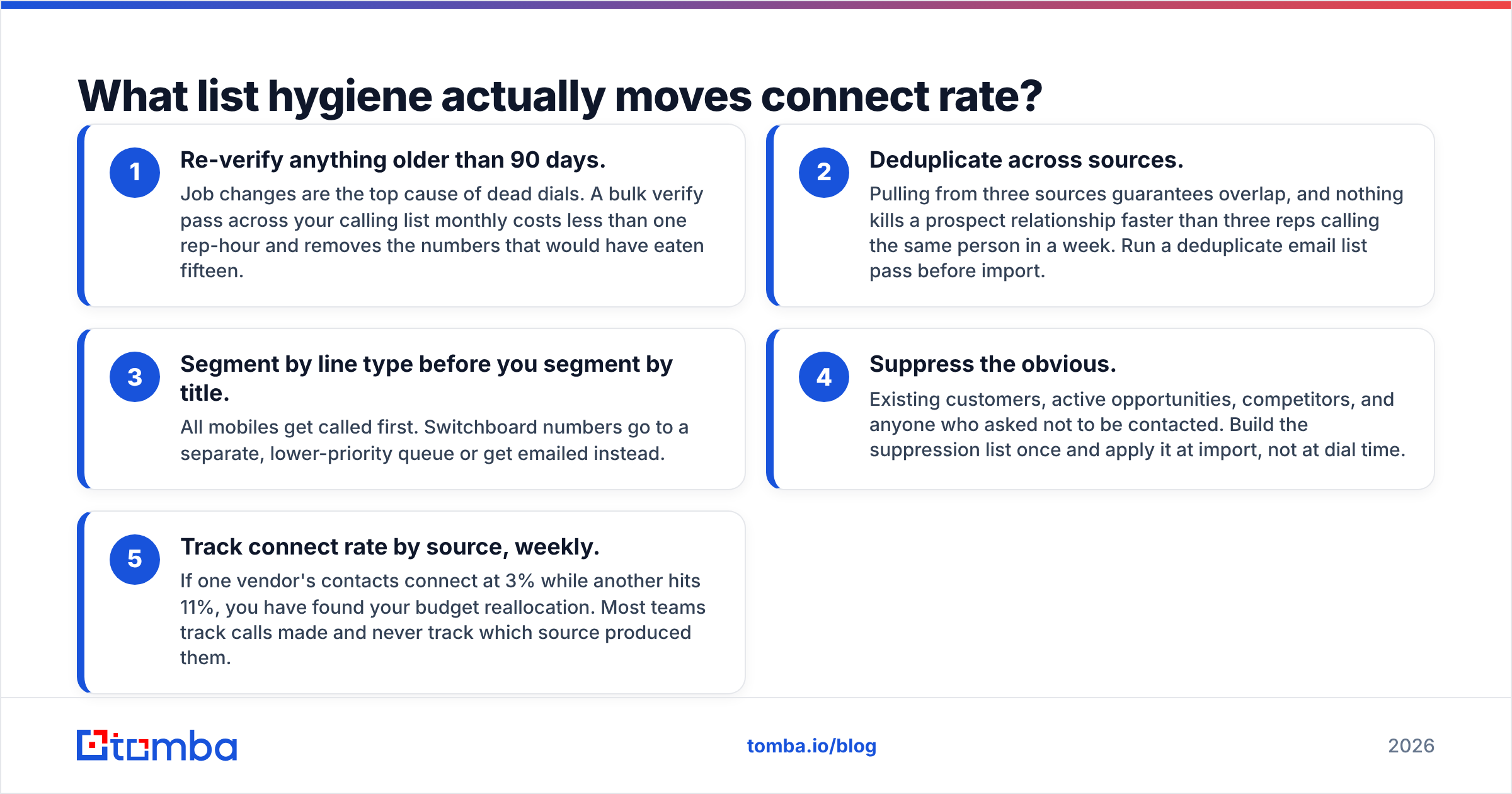
Five rules, in order of impact.
- Re-verify anything older than 90 days. Job changes are the top cause of dead dials. A bulk verify pass across your calling list monthly costs less than one rep-hour and removes the numbers that would have eaten fifteen.
- Deduplicate across sources. Pulling from three sources guarantees overlap, and nothing kills a prospect relationship faster than three reps calling the same person in a week. Run a deduplicate email list pass before import.
- Segment by line type before you segment by title. All mobiles get called first. Switchboard numbers go to a separate, lower-priority queue or get emailed instead.
- Suppress the obvious. Existing customers, active opportunities, competitors, and anyone who asked not to be contacted. Build the suppression list once and apply it at import, not at dial time.
- Track connect rate by source, weekly. If one vendor's contacts connect at 3% while another hits 11%, you have found your budget reallocation. Most teams track calls made and never track which source produced them.
Note the theme: none of these are calling skills. They are data operations. The best phone team in the world dialing a stale list will lose to an average team dialing a clean one.
How should you prioritize the list once it is clean?#
Rank by a simple composite rather than by alphabetical account name, which is what happens by default in most CRMs.
- Signal recency — Did something happen in the last 14 days? New funding, a relevant job posting, a website visit, a job change into a buying role. Recency beats fit.
- Line type — Mobile before desk before switchboard.
- Seniority band — Call one level above your usual buyer. If they delegate down, you get a warm internal referral, which is a materially different conversation.
- Account familiarity — Prior touch of any kind (webinar, content download, old deal) belongs at the top.
Feed these four into a scoring column and sort. It takes an afternoon to set up and it is the highest-ROI hour a sales ops person can spend. If you want a framework for the scoring model itself, G2's sales intelligence category is a reasonable place to compare how vendors implement it.
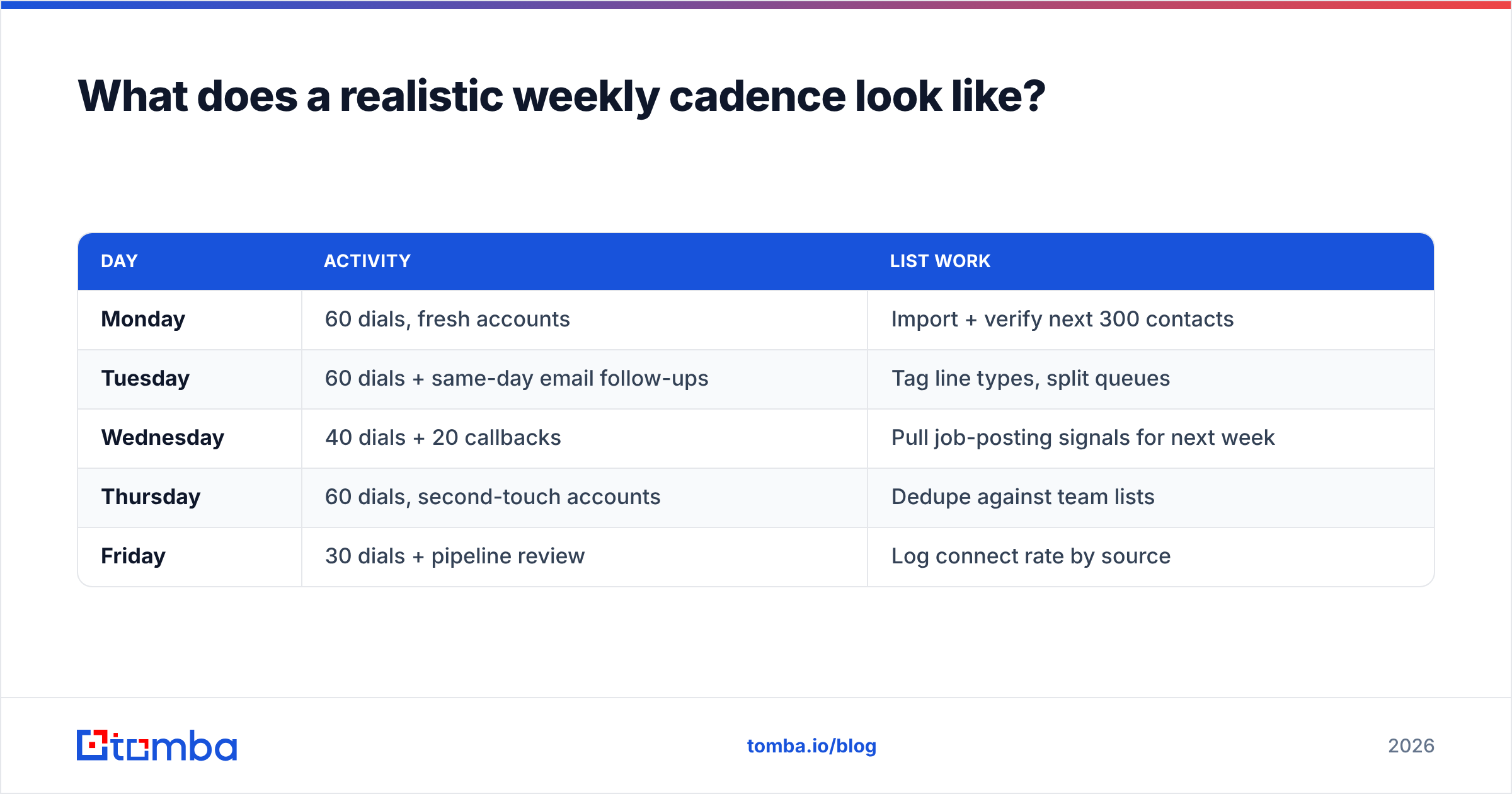
What does a realistic weekly cadence look like?#
Assume one full-time rep, 5 days, targeting 60 dials a day.
| Day | Activity | List work |
|---|---|---|
| Monday | 60 dials, fresh accounts | Import + verify next 300 contacts |
| Tuesday | 60 dials + same-day email follow-ups | Tag line types, split queues |
| Wednesday | 40 dials + 20 callbacks | Pull job-posting signals for next week |
| Thursday | 60 dials, second-touch accounts | Dedupe against team lists |
| Friday | 30 dials + pipeline review | Log connect rate by source |
That is 250 dials a week against a rolling 300-contact refresh. At a 10% connect rate you get 25 conversations, and at typical B2B conversion you get 3-5 meetings. Those numbers are unremarkable individually and compound significantly across a quarter — but only if the 300 new contacts each week are actually reachable.
The failure pattern is obvious in hindsight: teams optimize the 250 dials and neglect the 300 imports. The import is the lever.
How do you stay compliant while cold calling?#
Short version: know which regime applies, keep records, and honor opt-outs immediately.
- United States — The TCPA governs automated dialing and prerecorded messages; manual B2B dialing to business lines has more latitude, but personal mobiles registered on the DNC do not. Consult counsel on your specific dialer setup.
- EU/UK — GDPR requires a lawful basis (legitimate interest is commonly used for B2B, and it requires documentation, not just an assertion). PECR adds rules for UK marketing calls. Corporate subscriber screening against the TPS/CTPS is mandatory.
- Canada — CASL is primarily anti-spam but sits alongside the National DNCL for voice.
- Everywhere — Log the source of every record. If a prospect asks where you got their number, "a list" is not an answer that survives a regulator's follow-up question. Knowing your data sources is a compliance asset, not a nice-to-have.
Compliance is also a quality filter in disguise. A vendor that cannot tell you where a record came from probably cannot tell you how old it is either.
Where should you start this week?#
Pick the smallest version that produces evidence.
Take 100 accounts that fit your ICP. Run domain search to pull contacts, phone finder to attach dials, phone validator to sort by line type, and email verifier to attach the follow-up channel. Call the mobile segment first. Track connect rate against whatever your baseline was.
If the number moves, you have proven the process on 100 records and can scale to 1,000 with confidence. If it does not move, you have learned something for the cost of an afternoon rather than a quarter.
Start with the contact layer, because everything downstream depends on it. The Tomba Email Finder resolves names and domains into verified contacts, with phone finder, catch-all verification, and enrichment sitting alongside it in the same workspace — so one lookup gives your reps both the dial and the follow-up. The free tier includes 25 searches a month to test the accuracy on your own accounts, and paid plans start at $49/mo on Starter with Growth at $99/mo; full Tomba pricing is public. Build the clean 100 first, then decide what to scale.
Related guides#
// get started
Find, verify and enrich your first contacts today
Start on the free plan with 25 searches a month, then scale when your team is ready.
Free plan · No credit card required · GDPR & CCPA
// about the author