How To Get Phone Numbers For Cold Calling: 9 Methods
Direct dials beat switchboard numbers by a wide margin, but most lists are 40% stale. Here are nine ways to source cold calling phone numbers in 2026, what each costs, and which ones survive a connect-rate audit.
TL;DR
- Direct dials convert roughly 3-5x better than switchboard numbers, so "get a phone number" really means "get a mobile or desk line that bypasses the gatekeeper."
- The nine practical sources fall into three buckets: enrichment tools (fastest, ~$0.02-$0.30 per number), manual research (free, ~4-8 minutes per contact), and community/event data (free, low volume, high intent).
- Every purchased list decays 25-35% per year. Validate before dialing or you burn dialer minutes and rep morale on disconnected lines.
- Compliance is not optional: check DNC registries, honor state calling windows, and record consent for anything resembling an automated dialer.
- The realistic workflow: find the email first, enrich to a phone, validate the line, then dial. Email-first sourcing is cheaper and gives you a fallback channel when the phone fails.
Why do most cold calling lists fail before the first dial?#
Because the number is wrong, not because the pitch is wrong.
Think of a B2B contact list like milk in a fridge with no date label. It looked fine when you bought it. Nobody checked. Three months later half the carton is unusable, and you only find out when you're already mid-pour.
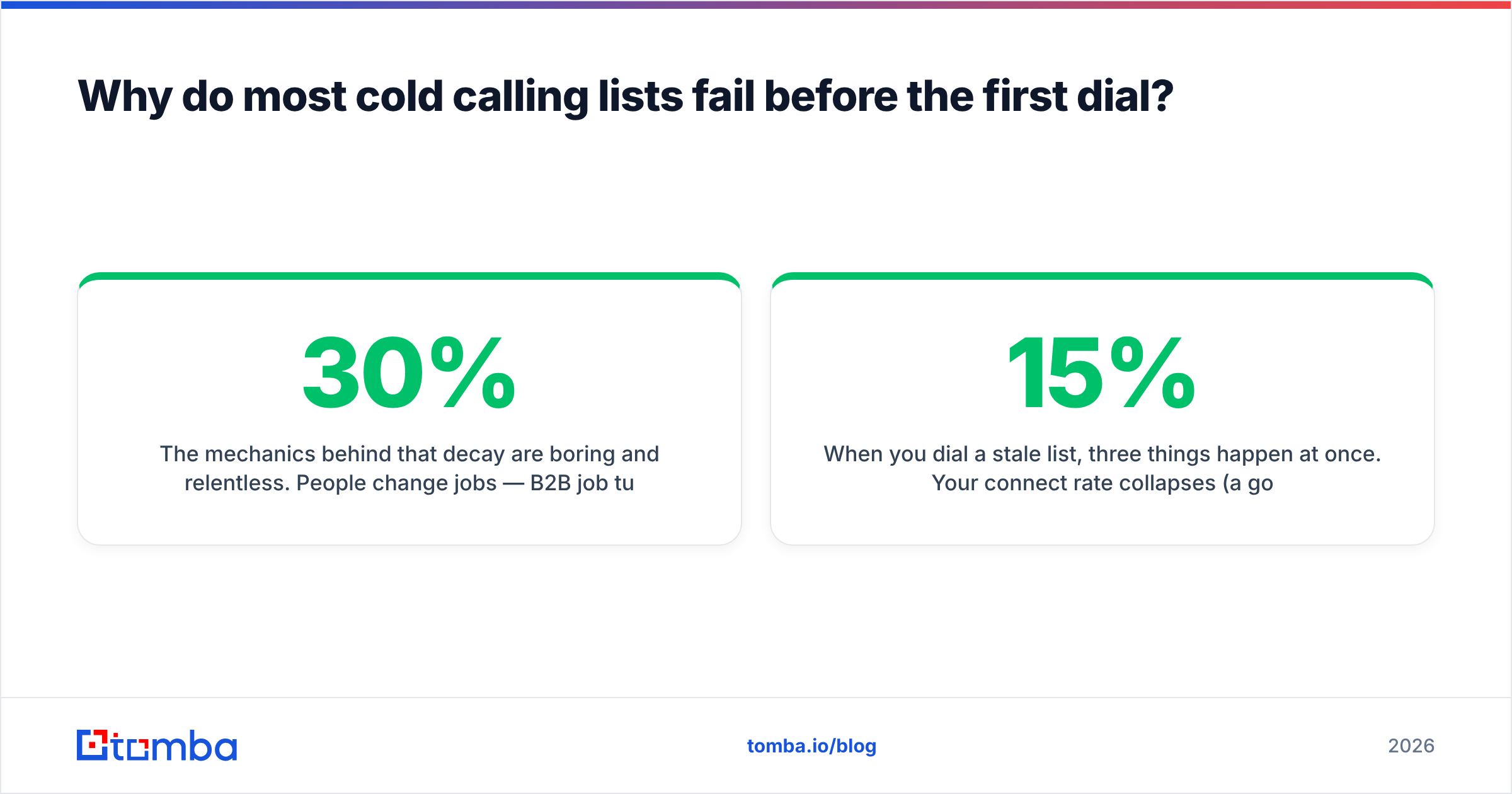
The mechanics behind that decay are boring and relentless. People change jobs — B2B job turnover runs roughly 20-30% annually in sales and marketing roles. Companies get acquired and renumber their entire block. Employees drop desk phones for softphones. Mobile numbers get ported. Every one of those events silently invalidates a row in your CSV.
When you dial a stale list, three things happen at once. Your connect rate collapses (a good list hits 8-15% connect on direct dials; a stale list drops under 3%). Your reps stop trusting the data and start freelancing their own research, which destroys pipeline consistency. And if you're using a power dialer, your carrier flags the abnormal disconnect ratio and starts labeling your outbound number as spam.
So the real question isn't just how to get phone numbers for cold calling. It's how to get numbers that are still true on the day you dial them.

What is the difference between a direct dial, a mobile, and a switchboard number?#
This distinction determines your entire connect rate, so get it right before you spend a dollar.
- Switchboard / main line — The number on the company's contact page. Routes to reception or an IVR. You will spend 60-90 seconds getting past a gatekeeper, and success rates for reaching a named VP this way sit in the low single digits. Cheap to find, nearly worthless at scale.
- Extension-based direct dial — The main line plus a four-digit extension that rings the target's desk. Better, but hybrid work has gutted desk-phone answer rates. Useful for on-site industries: manufacturing, logistics, healthcare admin, field services.
- True direct dial (DID) — A dedicated ten-digit number that rings one person's desk or softphone. This is the gold standard for enterprise prospecting and the number most data vendors charge a premium for.
- Verified mobile — The prospect's cell. Highest answer rate by a wide margin (people answer phones in their pocket), highest compliance risk, and the hardest to source legitimately. Treat these as a scarce resource for your top-tier accounts.
- Personal VoIP / Google Voice — Increasingly common with founders and consultants. Answers like a mobile, forwards unpredictably. Worth capturing when you find it in an email signature.
A practical rule: if your ICP is enterprise and office-based, chase DIDs. If your ICP is SMB owners, founders, and field managers, chase mobiles — the switchboard often doesn't exist at all.
What are the 9 ways to get phone numbers for cold calling?#
Here's the full menu, ordered roughly by cost-per-usable-number.
1. B2B data platforms with phone coverage. Tools like Tomba's phone finder, Cognism, ZoomInfo, and Lusha maintain licensed phone datasets. You supply a name plus company (or an email) and get back a number with a confidence score. Fastest path from zero to a dialable list.
2. Email-first enrichment. Find the work email, then enrich the record to a phone. This is usually cheaper because email data is denser and more verifiable than phone data. Start with a domain search to map the company's contacts, then push those records through enrichment.
3. Email signatures. Founders, consultants, agency owners, and anyone in a client-facing role frequently include a mobile in their signature. If you've already run a cold email sequence, mine your reply inbox before you buy anything. This is free, accurate, and criminally underused.
4. Company websites and press pages. Press contacts, investor-relations pages, and "meet the team" sections leak direct lines. Regional office pages are especially good — a corporate HQ hides numbers, but the Cleveland branch office publishes theirs.
5. LinkedIn contact info panel. A surprising percentage of profiles have a phone number in the "Contact info" modal, visible to first-degree connections and sometimes to anyone. Low yield per profile, but zero cost and unambiguous accuracy.
6. Regulatory and public filings. SEC filings, state business registrations, trade licenses, and procurement databases list officer contact details. Slow, but the numbers are legally required to be current — which makes them unusually reliable for SMB owners and licensed professionals.
7. Event attendee lists and speaker bios. Conference agendas, webinar registrations, and podcast show notes routinely publish direct contact info for speakers. High intent, since these people are actively promoting themselves.
8. Industry directories and associations. Chamber of commerce listings, professional association member directories, franchise registries, and vertical directories (construction, medical, legal). Underrated for local and mid-market ICPs.
9. Referrals and warm intros. The highest-quality number is the one a mutual contact hands you. Not scalable, but your close rate on these will embarrass every other source on this list.
Which method actually delivers the best cost-per-connect?#
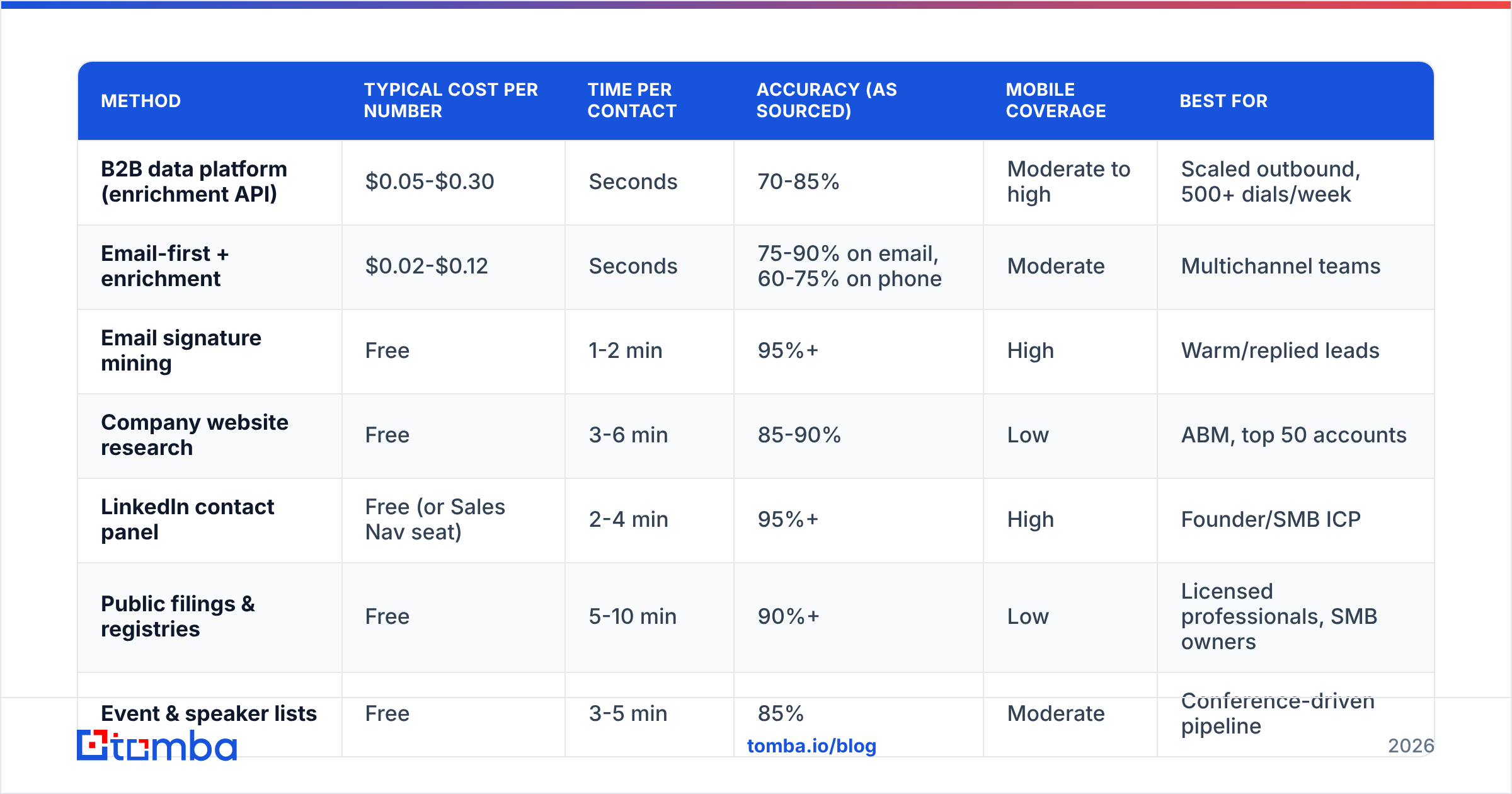
Volume matters less than what survives validation. Here's how the main approaches compare on the metrics that actually affect your pipeline.
| Method | Typical cost per number | Time per contact | Accuracy (as sourced) | Mobile coverage | Best for |
|---|---|---|---|---|---|
| B2B data platform (enrichment API) | $0.05-$0.30 | Seconds | 70-85% | Moderate to high | Scaled outbound, 500+ dials/week |
| Email-first + enrichment | $0.02-$0.12 | Seconds | 75-90% on email, 60-75% on phone | Moderate | Multichannel teams |
| Email signature mining | Free | 1-2 min | 95%+ | High | Warm/replied leads |
| Company website research | Free | 3-6 min | 85-90% | Low | ABM, top 50 accounts |
| LinkedIn contact panel | Free (or Sales Nav seat) | 2-4 min | 95%+ | High | Founder/SMB ICP |
| Public filings & registries | Free | 5-10 min | 90%+ | Low | Licensed professionals, SMB owners |
| Event & speaker lists | Free | 3-5 min | 85% | Moderate | Conference-driven pipeline |
| Purchased static list (CSV) | $0.01-$0.05 | Instant | 45-65% | Low | Almost nothing — see below |
Two things jump out. First, manual methods are more accurate than automated ones — you're trading rep hours for data quality. At roughly $40/hour fully loaded, five minutes of research costs about $3.30 per contact, which is 10-60x the price of an enrichment credit. That math only works for named accounts.
Second, static purchased CSV lists are the worst option on nearly every axis. They're cheap because they're already old on the day of purchase, with no refresh mechanism and no confidence scoring.
How do you compare the main phone data providers?#
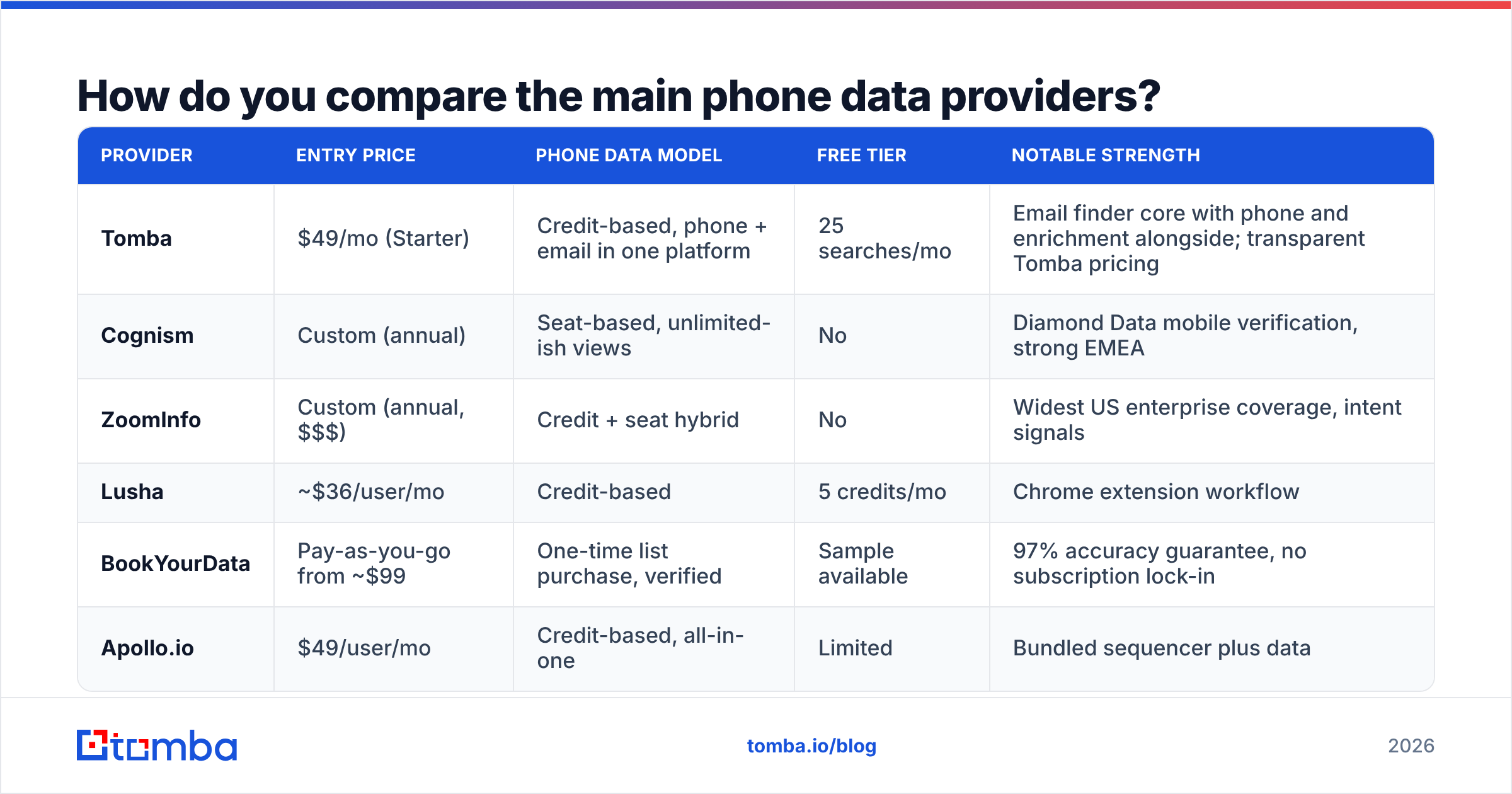
Coverage claims from vendors are marketing numbers measured on their own sample. Test against your own ICP before committing to an annual contract.
| Provider | Entry price | Phone data model | Free tier | Notable strength |
|---|---|---|---|---|
| Tomba | $49/mo (Starter) | Credit-based, phone + email in one platform | 25 searches/mo | Email finder core with phone and enrichment alongside; transparent Tomba pricing |
| Cognism | Custom (annual) | Seat-based, unlimited-ish views | No | Diamond Data mobile verification, strong EMEA |
| ZoomInfo | Custom (annual, $$$) | Credit + seat hybrid | No | Widest US enterprise coverage, intent signals |
| Lusha | ~$36/user/mo | Credit-based | 5 credits/mo | Chrome extension workflow |
| BookYourData | Pay-as-you-go from ~$99 | One-time list purchase, verified | Sample available | 97% accuracy guarantee, no subscription lock-in |
| Apollo.io | $49/user/mo | Credit-based, all-in-one | Limited | Bundled sequencer plus data |
A note on structure: pay-as-you-go models like BookYourData suit teams running a defined campaign with a fixed target count — you buy exactly what you need and there's no seat commitment. Credit subscriptions suit continuous prospecting where you're enriching new records weekly. Seat-based enterprise contracts only make sense above roughly 10 reps, where per-record pricing stops being efficient.
If you're currently on a heavy annual contract and questioning the value, the Apollo alternative and RocketReach alternative breakdowns cover the trade-offs in more depth. Also check independent user reviews on G2 rather than trusting vendor-published accuracy claims — the coverage gap between "US enterprise tech" and "European manufacturing SMB" is enormous and no vendor advertises where they're weak.
How do you validate phone numbers before you dial?#
Run a four-step gate. Skipping it is why teams burn 30% of their dialer minutes on dead air.
- Format and line-type check. Normalize everything to E.164 (+1XXXXXXXXXX), then run a HLR or carrier lookup to confirm the number is active and identify whether it's mobile, landline, or VoIP. A phone validator does this in bulk before the number ever reaches your dialer.
- Cross-reference against a second source. If your enrichment tool returns a number, confirm it against the email signature, LinkedIn panel, or company site. Two independent sources agreeing is the strongest signal you'll get short of dialing.
- Freshness stamp. Ask your vendor when the record was last verified. Anything older than 90 days should be re-validated. If a vendor can't tell you the verification date, that's the answer.
- Suppression scrub. Remove existing customers, active opportunities, competitors, and anyone who has previously asked not to be called. Then apply DNC screening (details below).
For lists over a few hundred rows, do this in batch rather than one at a time — bulk verify processing turns a two-day manual chore into a coffee break.
Is cold calling legal, and what compliance rules apply in 2026?#
Business-to-business cold calling is legal in the US, but it is not unregulated, and the penalties are per-call.
TCPA (US). The Telephone Consumer Protection Act governs automated dialing and prerecorded messages. B2B calls to business landlines have historically enjoyed broad exemptions, but calls to mobile numbers using an autodialer or prerecorded voice require prior express consent — and since most direct dials are now cell phones, that exemption is far narrower than reps assume. Statutory damages run $500-$1,500 per violation. Read the FCC's own guidance rather than relying on secondhand summaries.
DNC registries. The National Do Not Call Registry applies to consumers, not businesses, but many of your "business mobiles" are personally registered numbers. Scrub against the federal list plus applicable state lists, and maintain your own internal DNC list — that one is mandatory regardless of B2B status.
Calling windows. Federal rules restrict telemarketing to 8am-9pm in the recipient's time zone. Several states impose tighter windows. Your dialer should enforce this automatically based on area code — though area code no longer reliably indicates location after two decades of number portability, so use the company's registered address where possible.
GDPR (EU/UK). Calling an EU-based prospect requires a lawful basis, typically legitimate interest, plus a documented balancing test and clear opt-out on first contact. Several member states additionally require checking national opt-out registries (Germany's rules are notably strict on B2B cold calls). Do not assume your US playbook transfers.
State-level laws. Florida, Oklahoma, and Maryland have passed mini-TCPA statutes with consent requirements stricter than federal law. If you dial nationally, your compliance floor is set by the strictest state you touch.
None of this makes cold calling impractical. It makes sloppy cold calling expensive. Document your data source per record, log consent and opt-outs, and keep a suppression list that actually gets applied.
What does a realistic sourcing workflow look like?#
Here's the sequence that produces the lowest cost per connected conversation for a typical mid-market team.
Step 1 — Define the account list first, not the contact list. Pick 200-400 companies matching your ICP. Sourcing contacts without an account thesis produces high volume and low relevance.
Step 2 — Map contacts by domain. Run each company domain through a domain search to pull every discoverable person, title, and email. This gives you the org chart shape before you spend phone credits.
Step 3 — Filter to 2-4 people per account. Champion, economic buyer, and one adjacent stakeholder. Enriching everyone is how you waste a credit budget.
Step 4 — Verify emails, then enrich to phone. Emails are cheaper to validate and give you a second channel. Run them through an email verifier first — a bounce tells you the person left, which saves you a phone credit and a wasted dial.
Step 5 — Validate and scrub phones. Line-type check, DNC screen, suppression list, calling-window assignment.
Step 6 — Sequence, don't blast. Email touch, then call, then LinkedIn, then call again. Prospects who've seen your name answer at meaningfully higher rates than pure cold dials.
Step 7 — Feed outcomes back. Log every disconnected number and wrong-person result back into your CRM so the same bad row doesn't get dialed next quarter. Most teams skip this and re-dial the same dead numbers three campaigns in a row.
If you run this in a spreadsheet, the Google Sheets add-on removes most of the copy-paste. If you're building it into a workflow, the Tomba API handles the same steps programmatically.
How many phone numbers do you actually need?#
Work backwards from your quota rather than guessing at list size.
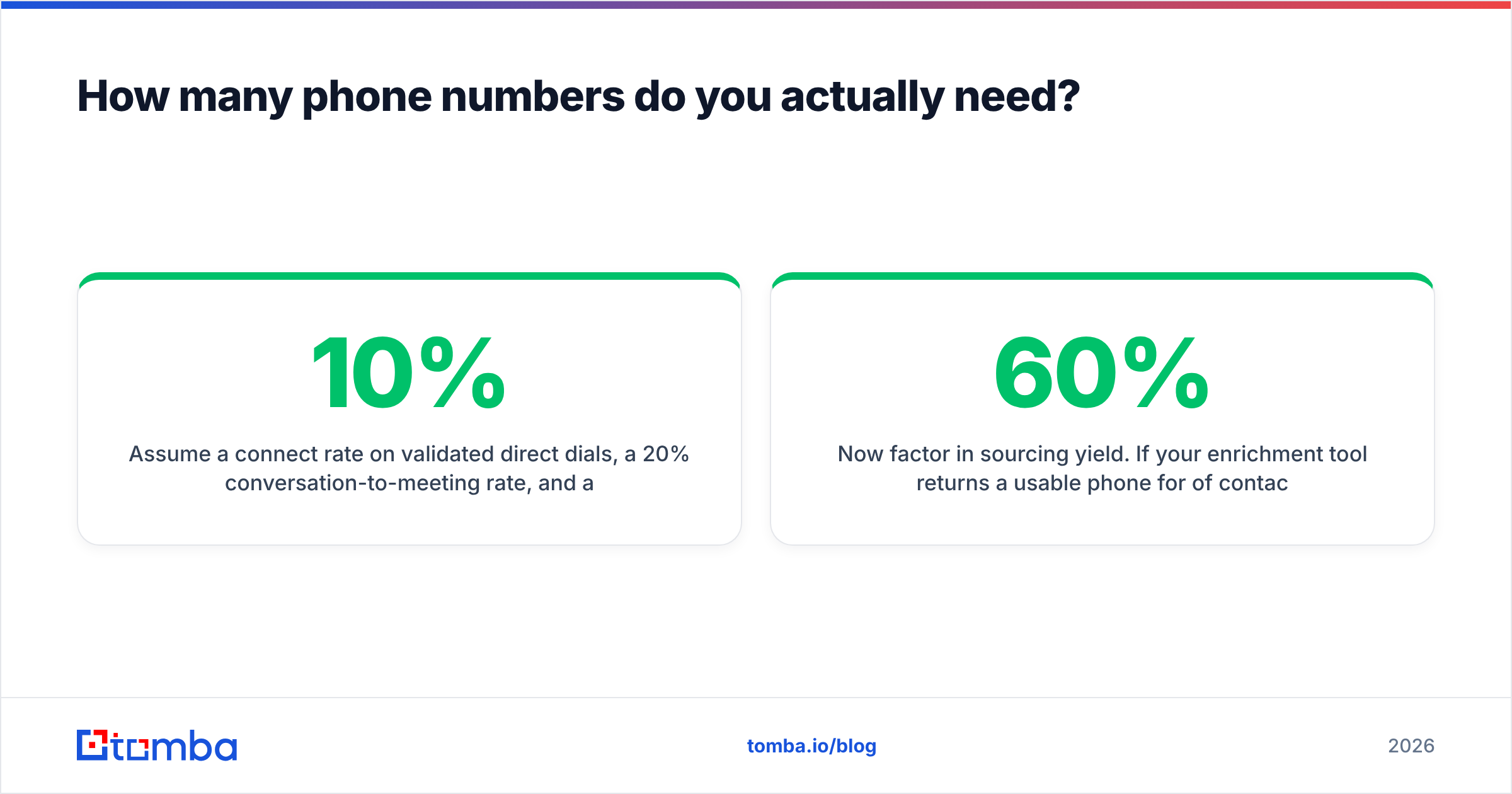
Assume a 10% connect rate on validated direct dials, a 20% conversation-to-meeting rate, and a 25% meeting-to-opportunity rate. To generate 10 opportunities, you need 40 meetings, 200 conversations, and roughly 2,000 dials. At 2.5 dial attempts per contact before you give up, that's about 800 unique validated numbers.
Now factor in sourcing yield. If your enrichment tool returns a usable phone for 60% of contacts, you need roughly 1,350 input records. At $0.10 per credit, that's $135 in data cost for 10 opportunities — trivially cheap compared to the rep hours spent dialing.
That ratio is the actual argument for buying data instead of researching manually: the data is never the expensive part. Rep time is. Any method that improves connect rate by even two points pays for itself many times over, which is why validation matters more than sourcing volume.
Get the contact data behind every dial#
Phone numbers are downstream of knowing who to call and how to reach them. The Tomba Email Finder gets you the verified work email first — the cheapest, most verifiable identifier in B2B — and the surrounding tools handle the rest: domain search to map an account, verification to strip dead records, and enrichment to attach phone data to the contacts worth calling.
Start on the free tier with 25 searches a month to test coverage against your own ICP before committing. If the yield holds up on your accounts, Starter runs $49/mo and Growth $99/mo. Test it on twenty companies you already know well — that's the only accuracy benchmark that means anything.
Related guides#
// get started
Find, verify and enrich your first contacts today
Start on the free plan with 25 searches a month, then scale when your team is ready.
Free plan · No credit card required · GDPR & CCPA
// about the author