How To Hire Salespeople in 2026: A 7-Step Hiring Playbook
Most sales hires fail for reasons you can predict before the offer letter. Here is a 7-step process for scorecards, sourcing, role-plays, and ramp that filters out the people who interview well but never close.
TL;DR
- A bad sales hire costs roughly 6-12 months of salary once you count ramp, lost pipeline, and territory damage — so the screening bar matters more than the sourcing volume.
- Write a scorecard before you write the job ad. If you cannot define what "good" looks like in numbers, every interview becomes a vibe check.
- The single highest-signal interview stage is a live role-play against a real objection from your market. Resumes and "tell me about a time" answers are easy to rehearse; a cold discovery call is not.
- Hire for the motion you actually run. An enterprise AE who closed six-figure deals with an SDR feeding them will drown in a self-sourced SMB role.
- Ramp is part of hiring. A rep with no territory, no lead list, and no verified contact data will miss quota for reasons that have nothing to do with their skill.
Why do so many sales hires fail?#
Because most hiring processes measure charisma, and the job requires discipline.
Sales is one of the few functions where the interview format rewards the exact skill that is easiest to fake. A candidate who is warm, quick, and good at narrative will beat a candidate who is methodical and quietly relentless — even though the second profile often outperforms in a repeatable motion. Recruiters call this the "interview-to-quota gap," and it is why turnover in B2B sales sits far above other departments. G2's software buyer research and multiple sales-org surveys put annual sales rep turnover in the 25-35% range depending on segment, with SDR roles at the painful end.
The three failure modes that show up again and again:
- Motion mismatch. The rep was excellent inside a machine — inbound leads, an SDR, a marketing engine, a known brand — and you hired them into a role where they have to build pipeline from zero.
- No definition of good. Nobody wrote down what a successful first 90 days looks like, so the manager and the rep discover they disagreed about it in month four.
- Starved from day one. The rep joins, gets a CRM login and a territory spreadsheet with 40% bounced emails in it, and burns their first quarter on data cleanup instead of conversations.
Only the first is a hiring problem in the traditional sense. The other two are process problems you can fix before you post the role.

What should a sales hiring scorecard include?#
Write the scorecard first. It converts "I liked them" into a decision you can defend and repeat.
A usable scorecard has four blocks:
- Outcome targets — the specific, measurable results this person must produce. Not "grow the territory." Instead: "$450K new ARR in year one, 12 net-new logos, 60% of pipeline self-sourced by month 9."
- Competencies — 5-7 behaviors that predict those outcomes in your motion. Examples: multithreading into 3+ stakeholders, running a structured discovery call, writing a follow-up email that advances a deal, holding a price under pressure.
- Disqualifiers — the things that end the process regardless of how good the rest looks. No CRM hygiene. Blames territory for every miss. Cannot name a single deal they lost and why.
- Evidence source — for each competency, which interview stage tests it. If a competency has no test attached, delete it or design the test.
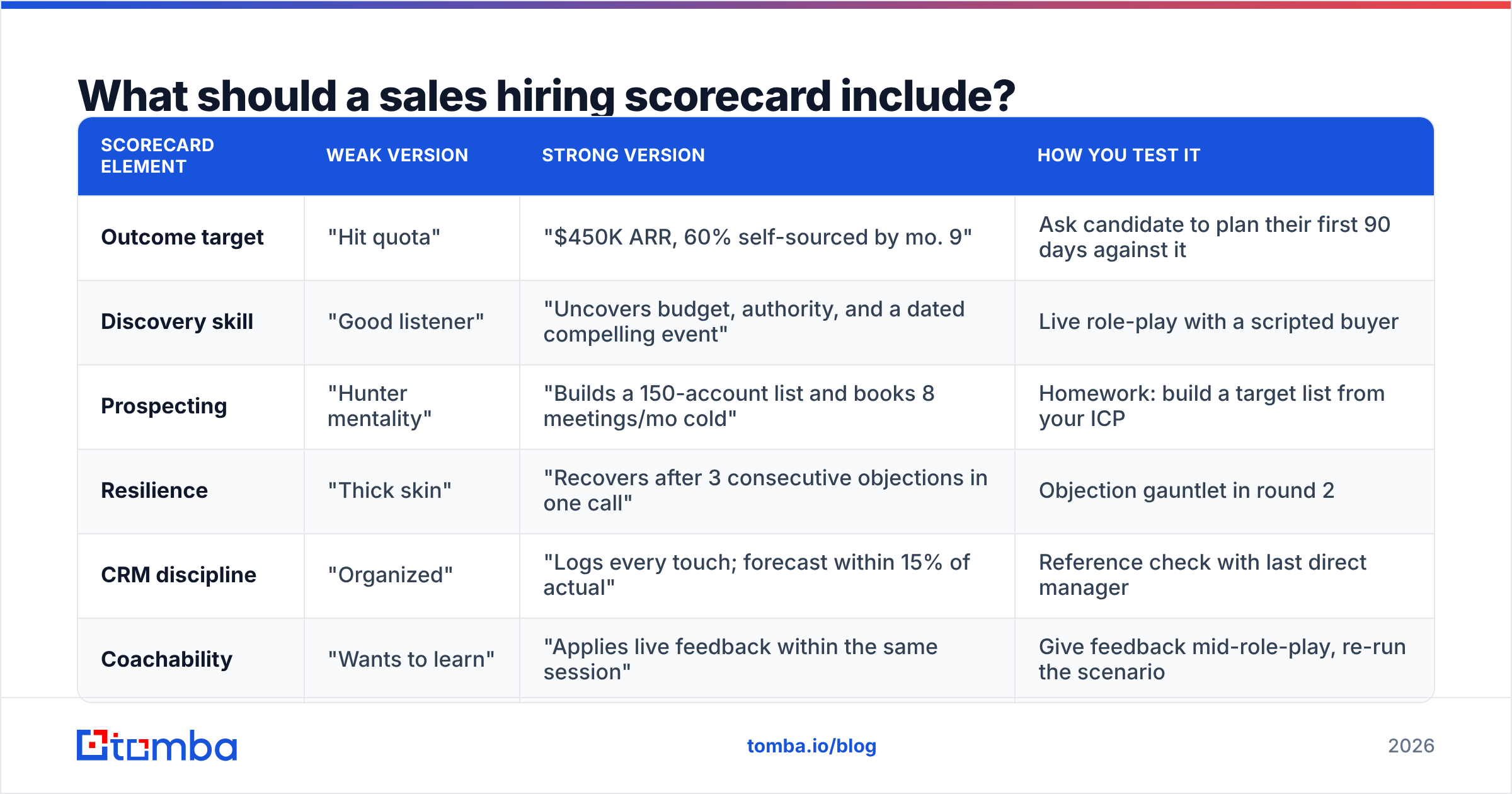
The evidence column is what separates a scorecard from a wish list. Anyone can list "coachability." Testing it means giving feedback mid-role-play and watching whether the candidate applies it in the next five minutes.
| Scorecard element | Weak version | Strong version | How you test it |
|---|---|---|---|
| Outcome target | "Hit quota" | "$450K ARR, 60% self-sourced by mo. 9" | Ask candidate to plan their first 90 days against it |
| Discovery skill | "Good listener" | "Uncovers budget, authority, and a dated compelling event" | Live role-play with a scripted buyer |
| Prospecting | "Hunter mentality" | "Builds a 150-account list and books 8 meetings/mo cold" | Homework: build a target list from your ICP |
| Resilience | "Thick skin" | "Recovers after 3 consecutive objections in one call" | Objection gauntlet in round 2 |
| CRM discipline | "Organized" | "Logs every touch; forecast within 15% of actual" | Reference check with last direct manager |
| Coachability | "Wants to learn" | "Applies live feedback within the same session" | Give feedback mid-role-play, re-run the scenario |
How do you write a job post that filters instead of attracts?#
Optimize the job post for the right candidate saying yes, not for the most applications.
Volume is not your friend here. A vague post gets 400 applicants and a 2% relevance rate; a specific one gets 60 applicants where a third are worth a call. Four things to include that most posts leave out:
- The actual motion. "You will self-source 70% of your pipeline. We do not have an SDR team." That sentence alone removes half the wrong applicants.
- Real comp numbers. Base, OTE, and the split. Pay-transparency laws increasingly require it anyway, and a range you are embarrassed to publish is a range that will waste everyone's time in round three.
- Deal profile. Average contract value, sales cycle length, who you sell to by title. A rep who has only sold $8K annual deals to marketing managers will struggle with a 9-month cycle into IT security.
- What is broken. "Our onboarding docs are thin and the CRM needs cleanup" attracts builders and repels people who need a finished machine. That is the correct filter for an early-stage team.
Skip the adjective pile. "Rockstar," "ninja," and "hungry closer" tell a candidate nothing and signal that you have not thought about the role. HubSpot's sales hiring research consistently finds that role clarity is one of the strongest retention predictors — the misalignment usually starts in the job description.
What interview process actually predicts sales performance?#
Four stages, each testing something the previous stage could not.
Stage 1 — Screen (25 min, recruiter or hiring manager). Confirm motion fit and comp fit. Three questions do most of the work: What percentage of your pipeline did you source yourself? Walk me through your last deal from first touch to signature. What was your quota and what did you actually attain, by year?
That third question is where most exaggeration surfaces. Ask for the number, then ask what the team average was. A rep at 92% of quota on a team averaging 60% is a stronger hire than a rep at 105% on a team averaging 140%.
Stage 2 — Role-play (45 min, hiring manager + one rep). Send the scenario 24 hours ahead: your product, a specific persona, a specific trigger event. Run a discovery call. Then run an objection gauntlet — price, timing, incumbent vendor — back to back. Score against the scorecard immediately, before you discuss with the other interviewer.
Stage 3 — Homework (candidate's own time, 2 hours max). Give them your ICP definition and ask for a 25-account target list with a rationale for each tier, plus three cold emails they would actually send. This tests research ability, writing, and whether they understand your buyer. Respect their time — two hours, not a full territory plan, and never work you would otherwise pay for.
Stage 4 — References (2 calls, both direct managers). Skip the candidate-supplied cheerleaders where you can. Ask managers one calibrating question: "Where did they rank among reps you managed at that level, and who was above them?" A manager who has to think about the ranking is giving you real data.
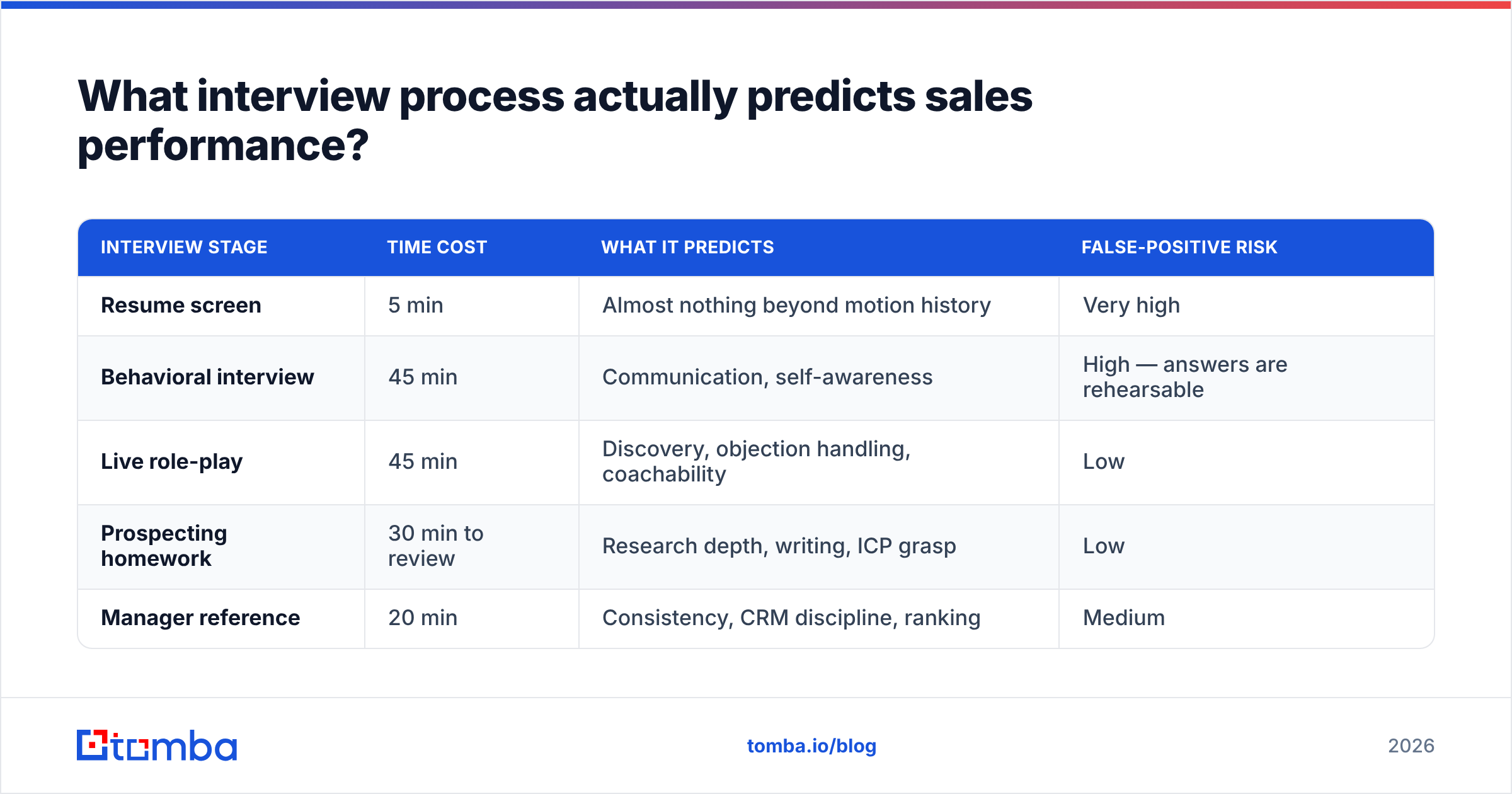
| Interview stage | Time cost | What it predicts | False-positive risk |
|---|---|---|---|
| Resume screen | 5 min | Almost nothing beyond motion history | Very high |
| Behavioral interview | 45 min | Communication, self-awareness | High — answers are rehearsable |
| Live role-play | 45 min | Discovery, objection handling, coachability | Low |
| Prospecting homework | 30 min to review | Research depth, writing, ICP grasp | Low |
| Manager reference | 20 min | Consistency, CRM discipline, ranking | Medium |
Where do you find good salespeople in 2026?#
The best reps are rarely on job boards, because their managers are actively working to keep them.
The channels that produce actual hires, roughly in order of yield:
- Referrals from your own reps. Pay for them. A $3-5K referral bonus is a fraction of a recruiter fee and the source quality is materially better because your rep's reputation is attached.
- Reps who sell to your ICP but not your product. Someone selling payroll software to 200-person manufacturers already knows your buyers, their budget cycle, and their objections. Build a list of adjacent vendors and go direct.
- LinkedIn Sales Navigator with tight filters. Title, tenure (18+ months — anyone with three sub-year stints in a row is a pattern), company headcount at time of hire, and industry.
- Inbound from your own content. Reps who read your blog and follow your founders convert at a higher rate and ramp faster because they already believe the story.
- Recruiters, last. Useful for senior and niche roles. Expensive and slow for everything else.
For outbound sourcing you need contact data that actually delivers. Sourcing 200 passive candidates and having 35% of your emails bounce does two things: it wastes your week, and it quietly damages your domain reputation right before you need it for a hiring campaign. Run your sourcing list through an email verifier before the first send, and use domain search to pull the verified format for a target company when you only have a name and an employer.
If you are sourcing from LinkedIn profiles specifically, a LinkedIn finder will resolve profile URLs to work emails, which matters because most passive candidates ignore InMail and read their inbox.

How much does a bad sales hire actually cost?#
Between 6 and 12 months of on-target earnings, and that is the conservative estimate.
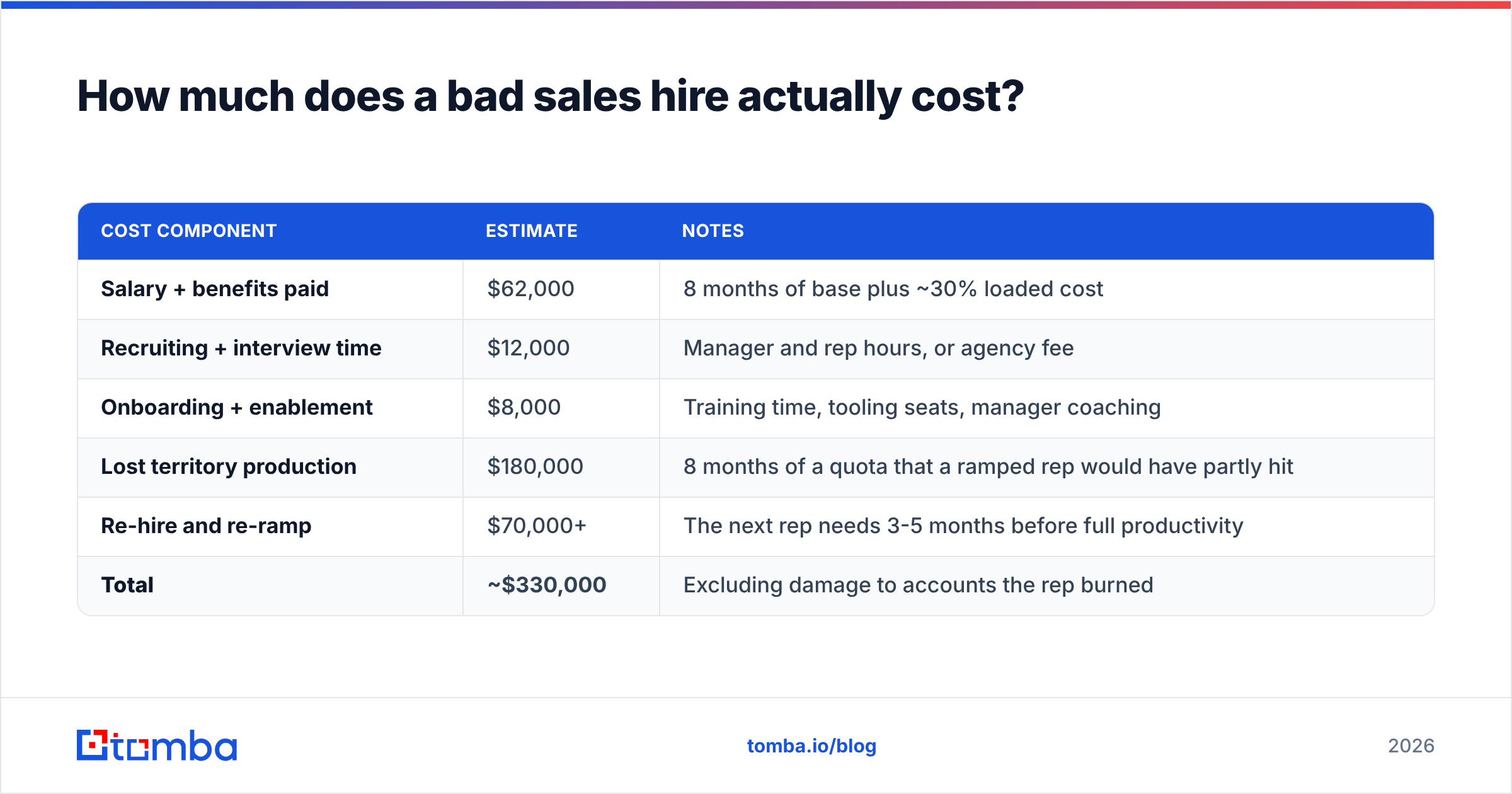
Break it down for a $70K base / $140K OTE mid-market AE who washes out at month eight:
| Cost component | Estimate | Notes |
|---|---|---|
| Salary + benefits paid | $62,000 | 8 months of base plus ~30% loaded cost |
| Recruiting + interview time | $12,000 | Manager and rep hours, or agency fee |
| Onboarding + enablement | $8,000 | Training time, tooling seats, manager coaching |
| Lost territory production | $180,000 | 8 months of a quota that a ramped rep would have partly hit |
| Re-hire and re-ramp | $70,000+ | The next rep needs 3-5 months before full productivity |
| Total | ~$330,000 | Excluding damage to accounts the rep burned |
The lost-territory line is the one teams underestimate. While a wrong-fit rep occupies a patch, nobody else is working it, and the accounts they contacted badly are harder for the next rep to reopen. That is why a slower process with a real role-play stage is almost always cheaper than a fast one — one avoided mis-hire pays for a year of extra interview hours.
What should the first 90 days look like?#
Ramp is the second half of hiring. Treat it as part of the same project.
A 30/60/90 that works in B2B SaaS:
- Days 1-15 — Absorb. Product certification, five recorded customer calls, three shadowed live calls, ICP and competitor briefing. Deliverable: the rep pitches the product back to you and handles three objections.
- Days 16-30 — Build. The rep builds their own target account list against the ICP, with a tiering rationale. This is where a clean B2B database and a working bulk email finder save weeks — a rep manually hunting for contacts is a rep not talking to buyers.
- Days 31-60 — Activity. Full outbound cadence live. Measure leading indicators only: accounts touched, multithreaded contacts per account, meetings booked, call recordings reviewed with the manager weekly. Do not judge closed revenue yet.
- Days 61-90 — Pipeline. The rep should have built pipeline coverage of at least 2x their quarterly quota, run discovery on their own opportunities, and have one deal past a technical or procurement stage.
Set the checkpoint honestly. If at day 60 the leading indicators are flat and coaching has not moved them, you have learned something and you should act on it. The expensive version of this decision is the one you defer to month seven.
Two ramp mistakes to avoid: giving a new rep an untouched greenfield territory with no data (they will spend their ramp doing research, not selling), and giving them the recycled closed-lost accounts nobody wants (they will conclude the product does not sell). A mix of both, with verified contact data attached, is what a fair ramp looks like.
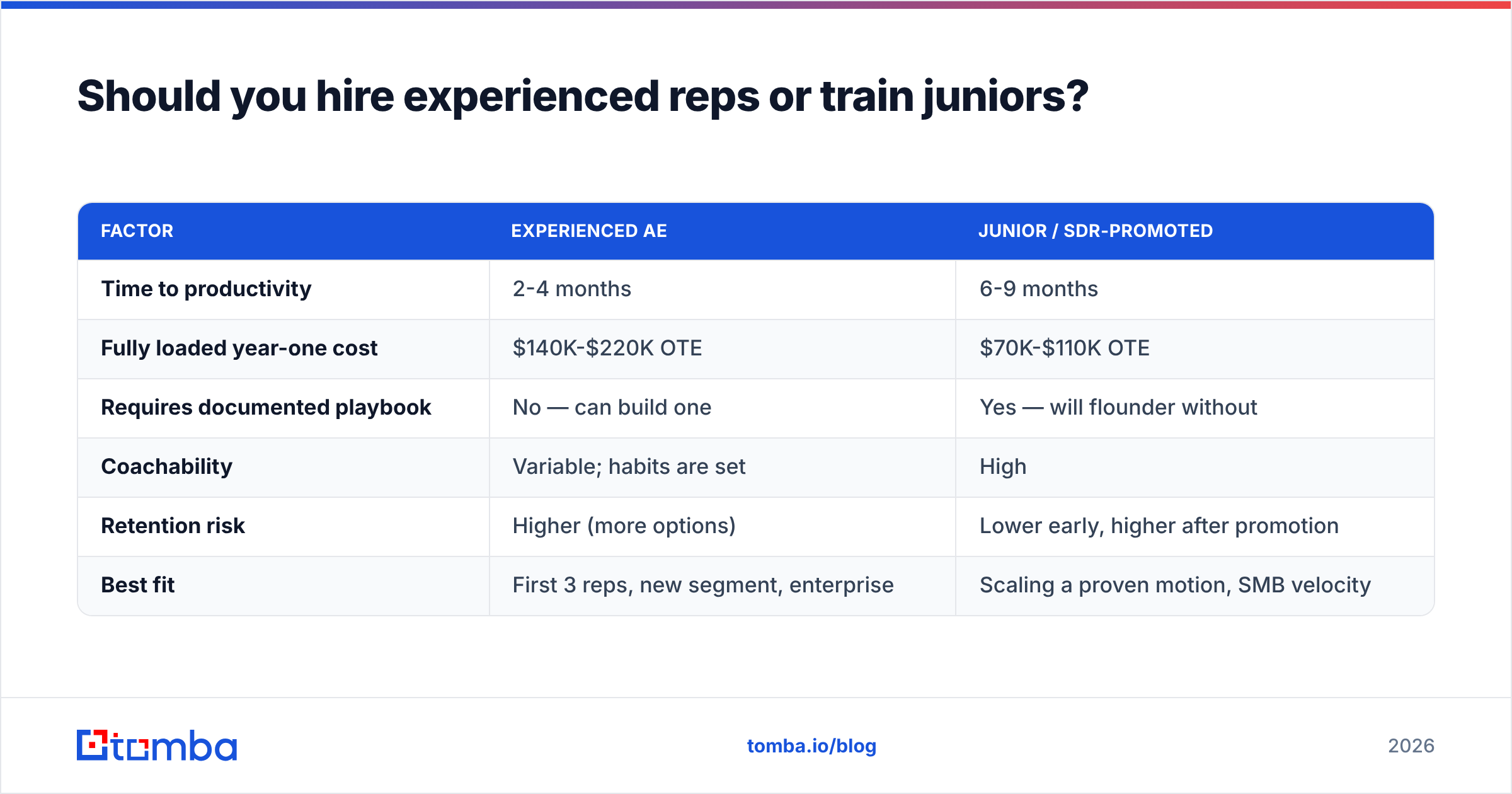
Should you hire experienced reps or train juniors?#
Depends on whether your sales motion is documented. That is the whole answer.
| Factor | Experienced AE | Junior / SDR-promoted |
|---|---|---|
| Time to productivity | 2-4 months | 6-9 months |
| Fully loaded year-one cost | $140K-$220K OTE | $70K-$110K OTE |
| Requires documented playbook | No — can build one | Yes — will flounder without |
| Coachability | Variable; habits are set | High |
| Retention risk | Higher (more options) | Lower early, higher after promotion |
| Best fit | First 3 reps, new segment, enterprise | Scaling a proven motion, SMB velocity |
If you have no playbook, no call library, and no documented discovery framework, hire experienced. You are paying for someone who can operate without scaffolding and help build it. Once the motion is written down and repeatable, junior hires are dramatically better economics — you get more coachable people, cheaper, with longer tenure and an internal promotion path.
The failure pattern is doing it backwards: hiring three juniors into an undocumented motion because they were affordable, then concluding six months later that "outbound doesn't work for us."
How do you keep good reps once you have hired them?#
Comp is table stakes. The differentiators are territory fairness, manager quality, and whether the rep believes they can hit the number.
Practical levers, in rough order of impact:
- Realistic quotas. If fewer than 50% of your reps hit quota, your quota is a retention problem, not a performance problem.
- Territory transparency. Publish how patches are assigned and rebalanced. Perceived favoritism in territory assignment drives more resignations than base pay does.
- Weekly coaching on recorded calls. Not pipeline review — actual skill coaching on a specific call. Reps leave managers who only inspect and never develop.
- Working data and tools. A rep whose lead lists bounce or whose CRM double-counts accounts feels the friction every single day. Keeping enrichment current with data enrichment is unglamorous and it directly protects rep productivity.
- A visible path. AE to senior AE to team lead, with published criteria. Ambiguity about advancement is a top-three reason strong reps take recruiter calls.
Peer benchmarking helps too. Vendor-neutral sources like Gartner's sales research publish quota-attainment and turnover benchmarks you can hold your own numbers against, which is more useful than comparing to whatever your last company did.
Where should you start this week?#
Pick the cheapest high-leverage fix first: write the scorecard for your next open role, and add a live role-play stage to your process. Those two changes cost you a morning and eliminate most of the mis-hires that a resume-and-vibes process lets through.
Then fix the data your new rep will inherit. A hiring process is only as good as the territory you hand the winner — and a territory built on stale contacts sets a strong rep up to look weak.
Give your next hire a territory that actually works. Tomba's Email Finder lets you build and verify target-account contact lists before day one, so a new rep spends their ramp in conversations instead of in spreadsheets. Start on the free tier with 25 searches a month, or move to Starter at $49/mo when you are sourcing at volume — see Tomba pricing for the full breakdown.
Related guides#
// get started
Find, verify and enrich your first contacts today
Start on the free plan with 25 searches a month, then scale when your team is ready.
Free plan · No credit card required · GDPR & CCPA
// about the author