How to Identify Warm Leads: A 2026 Signal-Based Playbook
Most reps guess which leads are warm. Here is a concrete scoring system built on real buying signals, plus the thresholds and tooling that separate warm from wishful thinking.
TL;DR
- A warm lead is not a lead who downloaded something. It is a lead showing recent, repeated, role-relevant behavior — all three, or it is still cold.
- The highest-value signals in 2026 are pricing-page visits, job changes at existing accounts, hiring posts for adjacent roles, and second-visit anonymous traffic. Content downloads rank near the bottom.
- Score signals on two axes: intent weight and decay speed. A pricing-page hit is worth 25 points today and 4 points in three weeks.
- Warm leads still need contact data. A signal you can't act on within 48 hours is worth roughly zero, which is why enrichment sits inside the workflow, not after it.
- Build a three-tier queue — Hot (call today), Warm (sequence this week), Nurture — and force a weekly review so nothing rots at the bottom.
What actually makes a lead "warm"?#
A warm lead is someone whose recent behavior implies they are actively solving the problem you sell into — not someone who once touched your brand.
Think of it like a restaurant reservation. Someone who walked past your window last March is not a customer. Someone who looked up your menu twice this week, checked your hours, and clicked "directions" is about to walk in. The behavior isn't just positive; it's recent, repeated, and tied to the act of buying.
Most teams get this wrong because CRM fields reward the easy definition. Someone hits a form, the record flips to "MQL," and a rep gets a task. But the majority of form fills come from people doing research with no budget, no timeline, and no authority. Meanwhile the VP who visited your pricing page three times from a corporate IP never filled out anything and never enters the queue at all.
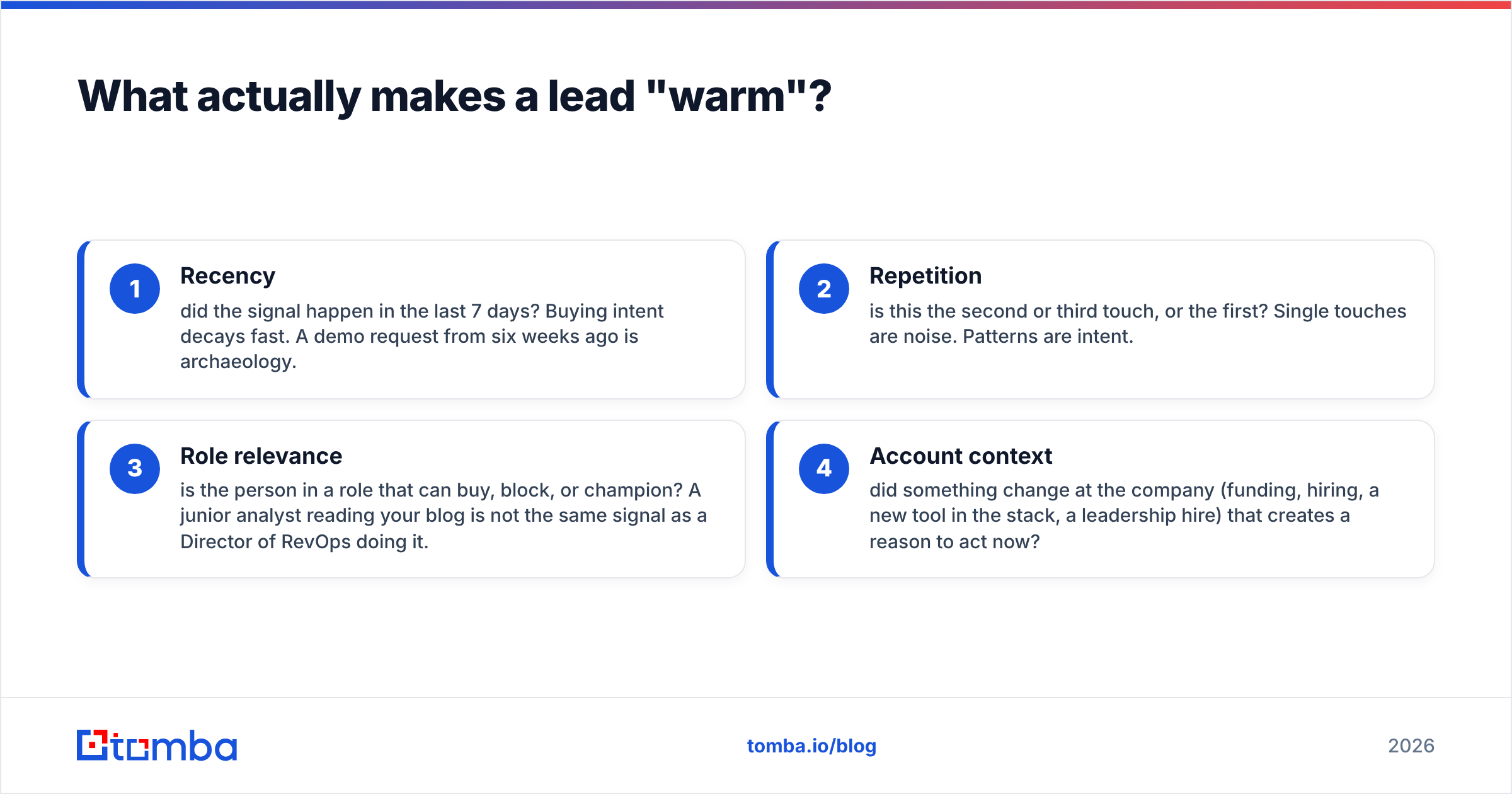
The fix is to define warmth as a function of three variables:
- Recency — did the signal happen in the last 7 days? Buying intent decays fast. A demo request from six weeks ago is archaeology.
- Repetition — is this the second or third touch, or the first? Single touches are noise. Patterns are intent.
- Role relevance — is the person in a role that can buy, block, or champion? A junior analyst reading your blog is not the same signal as a Director of RevOps doing it.
- Account context — did something change at the company (funding, hiring, a new tool in the stack, a leadership hire) that creates a reason to act now?
A lead needs at least three of those four to earn a rep's calendar time. Two out of four goes into a sequence. One goes into nurture and stays there.

Which buying signals are worth the most in 2026?#
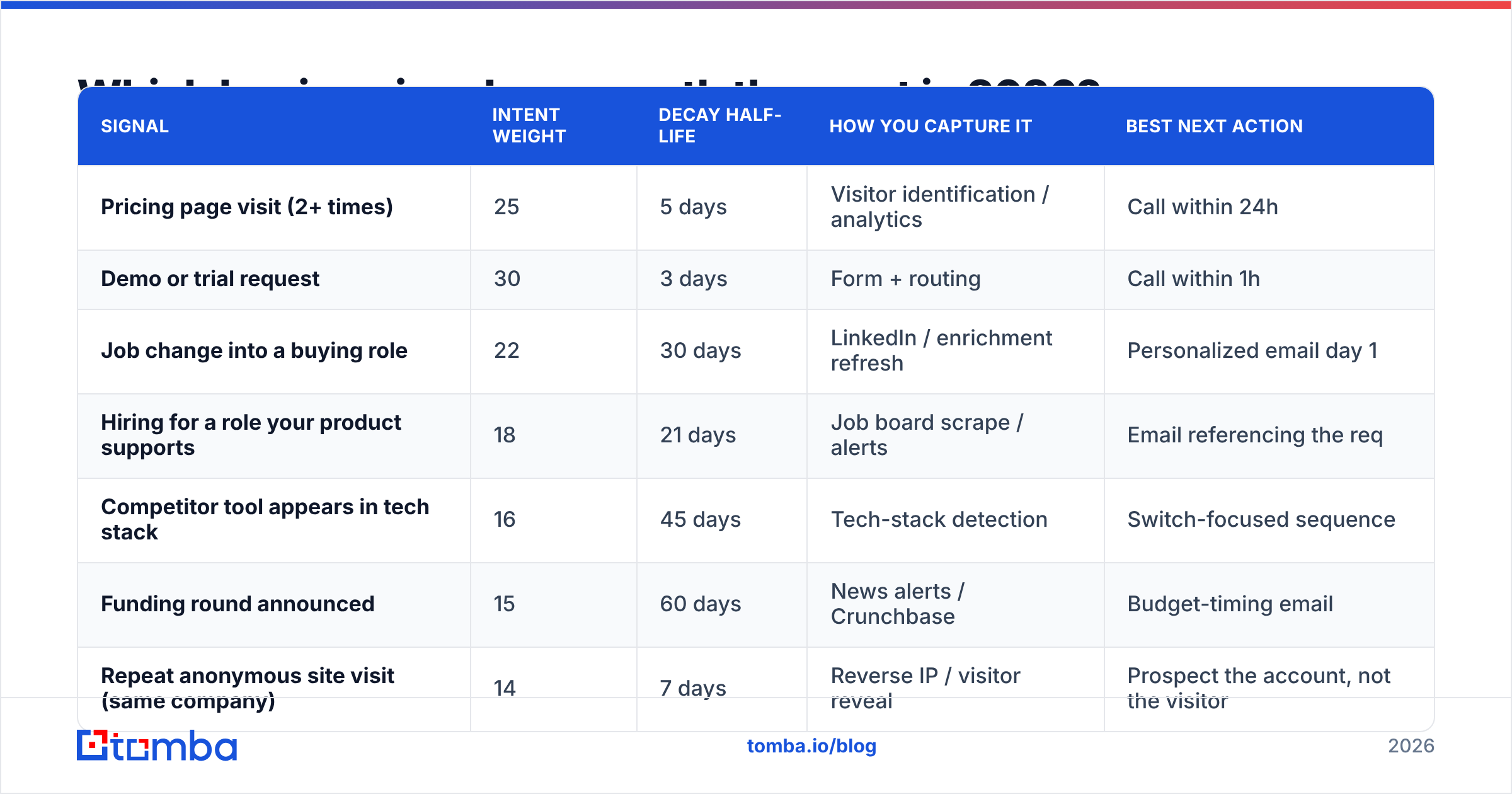
Not all signals are equal, and most scoring models weight them as if they were. Here's a working weight table you can drop into your CRM or lead scoring model and adjust from there.
| Signal | Intent weight | Decay half-life | How you capture it | Best next action |
|---|---|---|---|---|
| Pricing page visit (2+ times) | 25 | 5 days | Visitor identification / analytics | Call within 24h |
| Demo or trial request | 30 | 3 days | Form + routing | Call within 1h |
| Job change into a buying role | 22 | 30 days | LinkedIn / enrichment refresh | Personalized email day 1 |
| Hiring for a role your product supports | 18 | 21 days | Job board scrape / alerts | Email referencing the req |
| Competitor tool appears in tech stack | 16 | 45 days | Tech-stack detection | Switch-focused sequence |
| Funding round announced | 15 | 60 days | News alerts / Crunchbase | Budget-timing email |
| Repeat anonymous site visit (same company) | 14 | 7 days | Reverse IP / visitor reveal | Prospect the account, not the visitor |
| Replied to a cold email with a question | 20 | 2 days | Inbox | Reply same day |
| Opened an email 4+ times | 6 | 4 days | Sequencer | Bump, do not call |
| Downloaded a top-of-funnel PDF | 4 | 14 days | Form | Nurture only |
Two things stand out when teams actually build this table.
First, email opens are nearly worthless now. Apple Mail Privacy Protection and similar proxy prefetching inflate open counts badly enough that a "hot" open-based score is often just a mail client. Weight opens at 5–6 points maximum and never route a call off them.
Second, job changes are the most underused warm signal in B2B. When a champion who used your product at Company A moves to Company B, that's a warm lead at a cold account. Most CRMs never notice because the contact record still shows the old email. Refreshing contact records with data enrichment on a quarterly cadence surfaces these automatically instead of by accident.
How do you build a warm-lead scoring model that isn't fiction?#
Start with a 100-point scale and split it into two halves: 60 points for behavior, 40 points for fit. A high-fit lead with no behavior is a prospecting target, not a warm lead. A high-behavior lead with no fit is a student writing a term paper.
The behavior half (0–60):
- Base signal score — sum the intent weights from the table above, capped at 45.
- Recency multiplier — apply the decay. A 25-point signal at 1.5 half-lives is worth about 9 points. Do the math in your CRM, not in your head.
- Velocity bonus — add 15 if three or more signals land within a 7-day window. Clustering is the single strongest predictor of a real buying cycle.
The fit half (0–40):
- Title match — 15 for economic buyer, 10 for champion, 4 for user, 0 for unrelated.
- Company size band — 10 if inside your ICP range, 5 adjacent, 0 outside.
- Tech-stack match — 10 if they run a tool you integrate with or replace.
- Geography and language — 5 if inside a territory you can actually serve.
Then set your thresholds honestly:
- 75+ = Hot. Rep calls today. If you have more than ~15 of these per rep per week, your thresholds are too loose.
- 50–74 = Warm. Multi-touch sequence this week, with a real personalization line pulled from the triggering signal.
- 30–49 = Nurture. Automated content, no rep time.
- Under 30 = leave it alone. Touching these burns your sender reputation for no return.
The discipline that makes this work is the decay job. Run it nightly. A model where scores only go up produces a queue full of leads that were warm in April and are now embarrassing to call.
What tools do you need to catch these signals?#
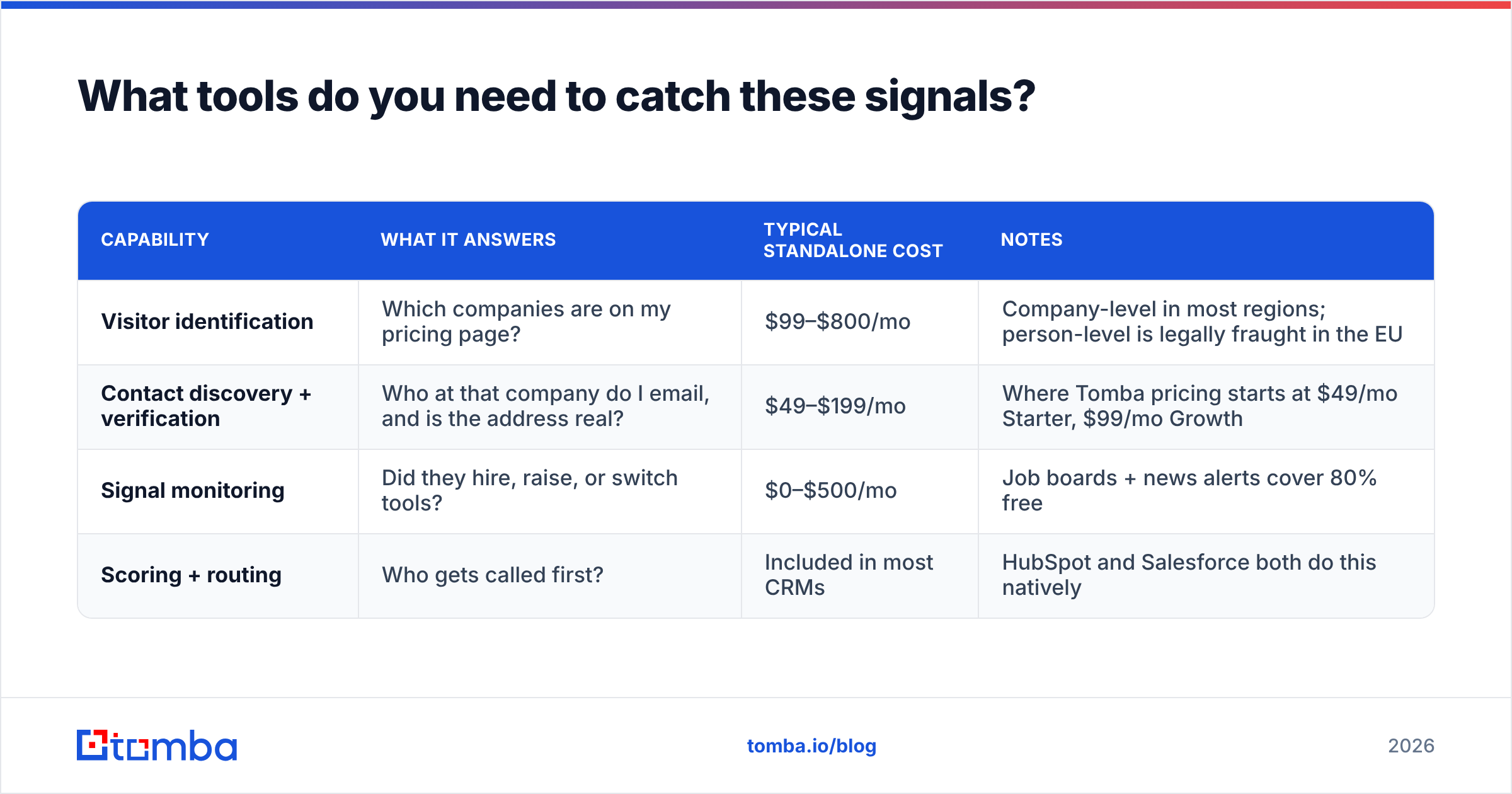
You need four capabilities. Whether they come from one platform or four is a budget question, not an architecture question.
| Capability | What it answers | Typical standalone cost | Notes |
|---|---|---|---|
| Visitor identification | Which companies are on my pricing page? | $99–$800/mo | Company-level in most regions; person-level is legally fraught in the EU |
| Contact discovery + verification | Who at that company do I email, and is the address real? | $49–$199/mo | Where Tomba pricing starts at $49/mo Starter, $99/mo Growth |
| Signal monitoring | Did they hire, raise, or switch tools? | $0–$500/mo | Job boards + news alerts cover 80% free |
| Scoring + routing | Who gets called first? | Included in most CRMs | HubSpot and Salesforce both do this natively |
The gap that kills most warm-lead programs is the second row. Teams buy an intent tool, get a list of companies that visited, and then have no way to reach a human at those companies. The signal expires while someone manually hunts on LinkedIn.
That's the part worth automating. A domain search turns "Acme Corp visited pricing twice" into a filtered list of Acme's RevOps and Sales Ops contacts with verified addresses, in the same hour the signal fired. Pair it with website visitor reveal and the loop closes without a human doing lookup work.
How do you tell a warm lead from a curious one?#
Four tests, in order of how quickly they disqualify.
1. The budget-adjacent test. Did they touch anything that costs money — pricing, plans, "request a quote," an ROI calculator? Someone reading your comparison blog post is learning. Someone reading your pricing page is shopping. This is the single cleanest split in B2B behavioral data.
2. The multi-person test. Are two or more people from the same domain active in the same week? B2B purchases involve 6–10 stakeholders on average, per Gartner's B2B buying research. One person poking around is research. Three people from the same company in seven days is an evaluation committee.
3. The specificity test. Did they ask a specific question, or a general one? "Do you support SOC 2 reporting for our Q1 audit?" is warm. "What does your product do?" is not. Specificity implies a real internal requirement.
4. The timeline test. Any mention of a date, a renewal, a quarter, or a contract end. Even a vague "we're looking at this for next quarter" beats a strong compliment with no time attached.
If a lead fails tests 1 and 4, downgrade it regardless of how much activity it shows. Enthusiastic browsing is not a purchase intent.
How do you act on a warm lead before it cools?#
Speed matters more than polish. The classic Harvard Business Review lead-response study found firms responding within an hour were roughly seven times more likely to qualify the lead than those responding an hour later — and sixty times more likely than firms waiting 24 hours. Nothing since has contradicted that.
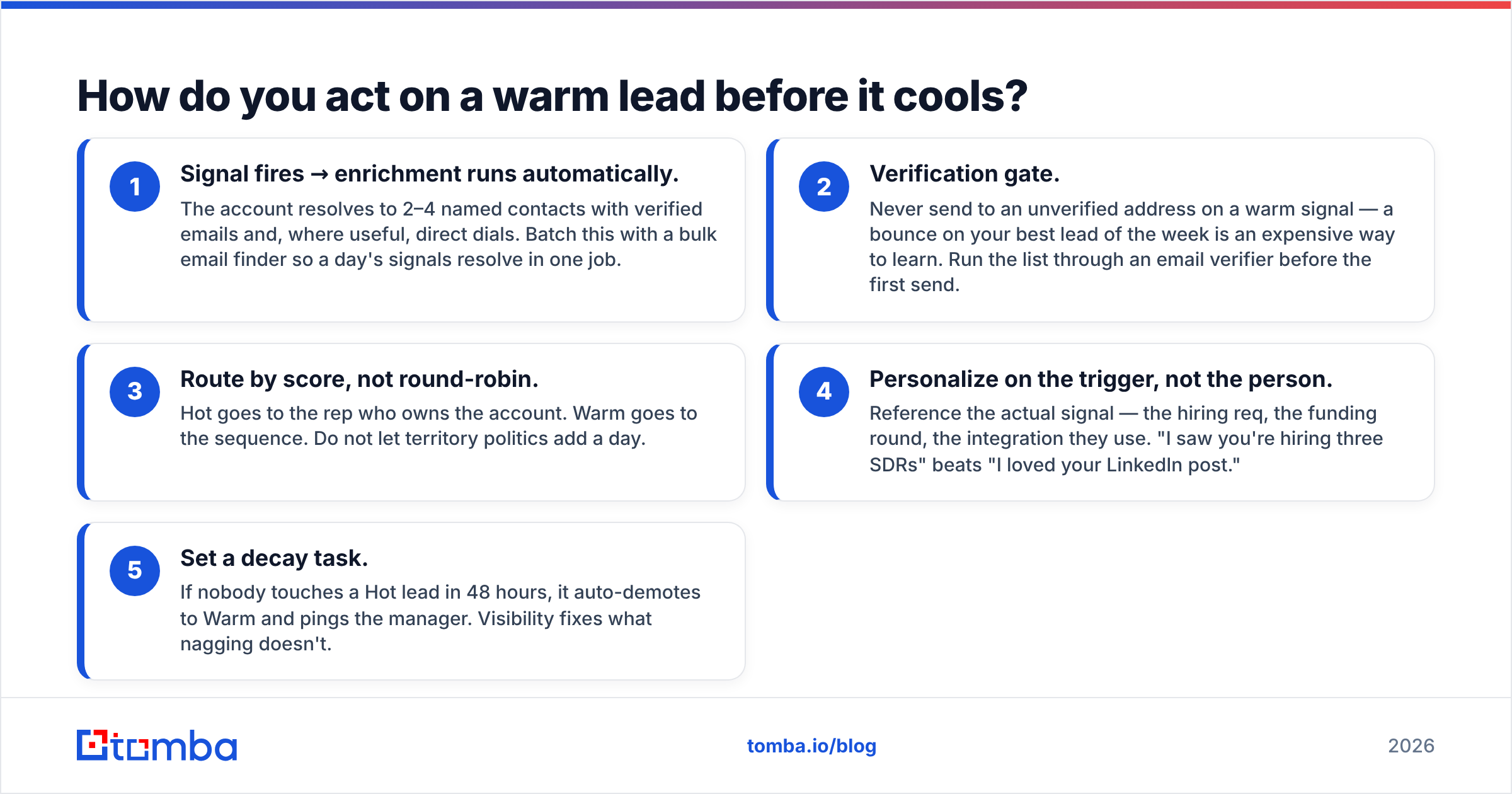
A workable operating rhythm:
- Signal fires → enrichment runs automatically. The account resolves to 2–4 named contacts with verified emails and, where useful, direct dials. Batch this with a bulk email finder so a day's signals resolve in one job.
- Verification gate. Never send to an unverified address on a warm signal — a bounce on your best lead of the week is an expensive way to learn. Run the list through an email verifier before the first send.
- Route by score, not round-robin. Hot goes to the rep who owns the account. Warm goes to the sequence. Do not let territory politics add a day.
- Personalize on the trigger, not the person. Reference the actual signal — the hiring req, the funding round, the integration they use. "I saw you're hiring three SDRs" beats "I loved your LinkedIn post."
- Set a decay task. If nobody touches a Hot lead in 48 hours, it auto-demotes to Warm and pings the manager. Visibility fixes what nagging doesn't.
The most common failure here isn't bad targeting. It's a two-week lag between signal and outreach, which turns a warm lead into a cold email with weirdly specific stalking energy.
How should you handle warm leads that go quiet?#
Assume silence means bad timing, not rejection. Most warm leads that don't convert had a real problem and a wrong quarter.
Build a re-warm trigger instead of a nurture drip nobody reads. Set alerts on the account so that when a new signal fires — a job change, a funding event, a fresh pricing visit — the lead re-enters the Hot queue with full context attached. The second conversation is dramatically easier than the first because the discovery work is already done.
Practically, that means keeping the contact record alive. B2B contact data decays at roughly 25–30% per year as people change jobs, so a warm lead you parked in January is often unreachable by August. Quarterly re-verification of your parked-warm segment costs very little and keeps the re-warm trigger from firing into a dead mailbox. If you're rebuilding contact points after a job change, a LinkedIn finder is usually the fastest path back to a working address.
What are the most common warm-lead mistakes?#
- Treating MQL as a synonym for warm. MQL is a marketing accounting unit. Warm is a sales priority. Keep them separate, and let sales publicly reject MQLs without a fight.
- Scoring without decay. Guaranteed to produce a queue of stale leads within two months.
- Weighting opens heavily. Privacy proxies made this metric close to random. Clicks still mean something; opens mostly don't.
- Ignoring anonymous traffic. In most B2B funnels, 95%+ of pricing-page traffic never identifies itself. If you only score identified leads, you're scoring the small tail.
- No contact data plan. The signal is only half the job. If you can't reach a named human within a day, the score is decoration.
- Never recalibrating. Pull last quarter's closed-won deals, look at what signals actually preceded them, and re-weight. Do it quarterly. Your model will be wrong in ways you can only learn from your own data.
Where should you start if you have none of this?#
Do this in the order below. Each step works on its own, so you get value before the whole system exists.
- Week 1 — Add pricing-page and demo-page visits as tracked events. Weight them heavily. That alone beats most scoring models.
- Week 2 — Set up alerts on your top 100 target accounts for hiring, funding, and leadership changes. Free tools cover this.
- Week 3 — Wire enrichment into the trigger so every fired signal produces named, verified contacts automatically instead of a research task.
- Week 4 — Build the three-tier queue with a decay job and a weekly review. Ten minutes a week keeps it honest.
- Month 2 — Backtest against closed-won and re-weight. Cut any signal that shows no correlation with revenue, however satisfying it feels.
If you want a broader tool comparison before committing budget, review options like BookYourData for prebuilt list acquisition and G2's lead intelligence category for peer-verified reviews. Different teams reasonably land in different places depending on whether they're buying lists or resolving inbound signals.
Ready to turn signals into conversations?#
Identifying warm leads is only worth the effort if you can reach them before the signal decays. That's the step most teams underbuild. Tomba's email finder resolves a company and a name into a verified professional email address in seconds — through the app, the API, or a bulk job that clears a whole day of signals at once. The free tier gives you 25 searches a month to test it against your own warm list, and Starter runs $49/mo when you're ready to run it as part of the workflow.
Score the signal. Find the human. Send the email the same day. That sequence is the entire program.
Related guides#
// get started
Find, verify and enrich your first contacts today
Start on the free plan with 25 searches a month, then scale when your team is ready.
Free plan · No credit card required · GDPR & CCPA
// about the author