How to Improve Lead Quality: A 2026 Playbook for B2B Teams
Most teams chase more leads when the real problem is bad ones. Here is a concrete, seven-step system for improving lead quality — scoring, data hygiene, ICP tightening, and the metrics that prove it worked.
TL;DR
- Lead quality is a data problem before it is a marketing problem. Roughly 30% of B2B contact data decays every year, so a "good" lead from Q1 is often a bounce by Q3.
- The fastest wins are unglamorous: tighten your ICP definition, verify every email before it enters the CRM, and kill the scoring rules nobody can defend.
- Score on fit and intent separately. A single blended score hides why a lead is good and makes it impossible to debug.
- Measure MQL-to-SQL acceptance rate, not MQL volume. If acceptance is under 40%, your quality problem is real and quantifiable.
- Enrichment beats form length. Ask for three fields, append the other fifteen from a data provider.
Most teams respond to a weak pipeline by asking for more leads. That is usually the wrong lever. If your sales team accepts 25% of what marketing sends over, doubling volume just doubles the rejection pile and burns rep trust. The better move is to raise the hit rate on the leads you already generate.
This post walks through how to improve lead quality with concrete steps: defining fit, fixing your data layer, rebuilding scoring, and instrumenting the whole thing so you can prove it worked.
What does "lead quality" actually mean?#
Lead quality is the probability that a given lead converts to a closed-won deal at an acceptable cost. That is it. It is not form completeness, not job title prestige, not how excited the lead sounded on a chat widget.
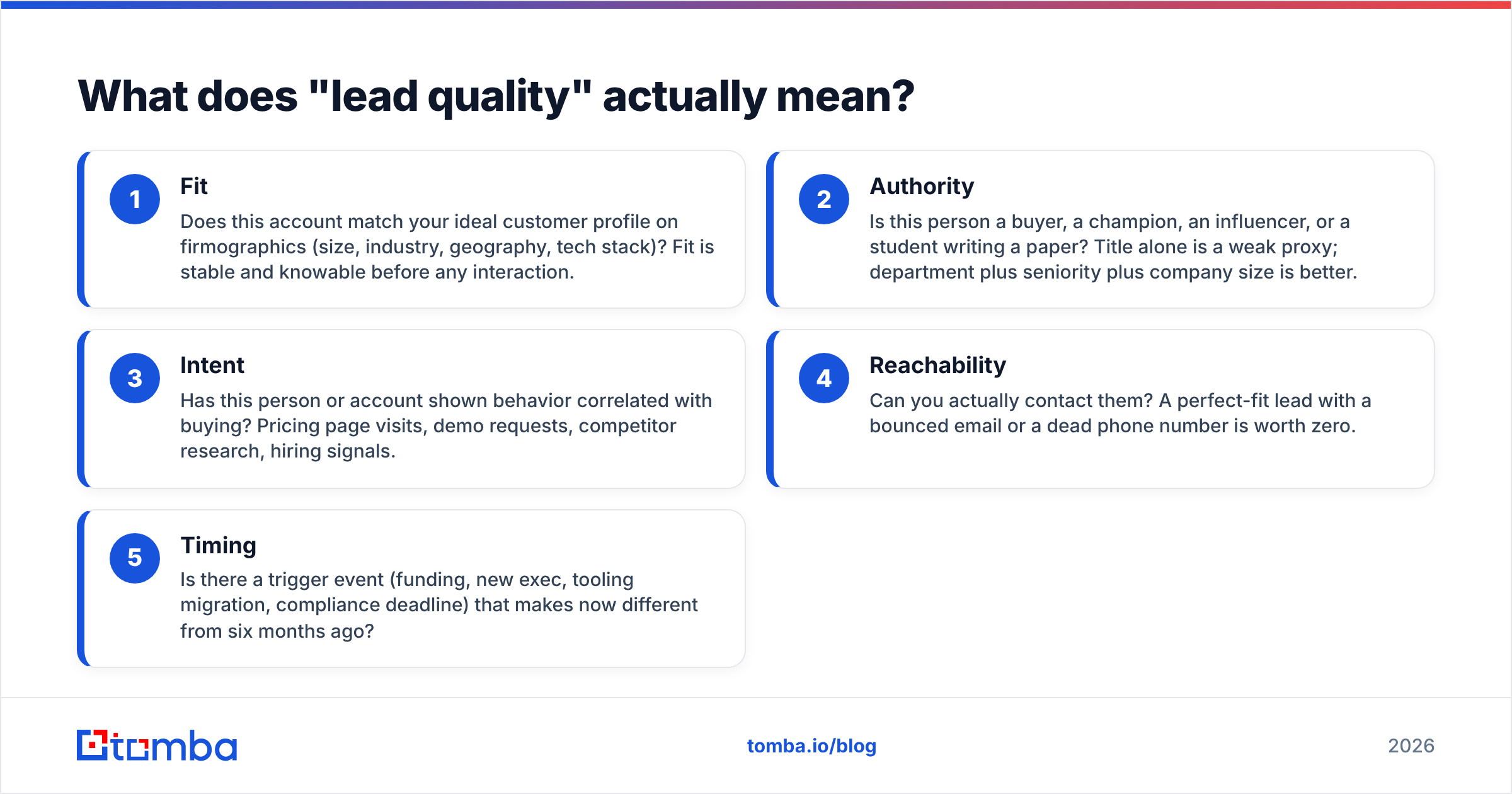
Breaking it into components makes it operational:
- Fit — Does this account match your ideal customer profile on firmographics (size, industry, geography, tech stack)? Fit is stable and knowable before any interaction.
- Authority — Is this person a buyer, a champion, an influencer, or a student writing a paper? Title alone is a weak proxy; department plus seniority plus company size is better.
- Intent — Has this person or account shown behavior correlated with buying? Pricing page visits, demo requests, competitor research, hiring signals.
- Reachability — Can you actually contact them? A perfect-fit lead with a bounced email or a dead phone number is worth zero.
- Timing — Is there a trigger event (funding, new exec, tooling migration, compliance deadline) that makes now different from six months ago?
Most scoring models over-weight intent and almost completely ignore reachability. That is backwards. Reachability is binary and cheap to check; intent is fuzzy and expensive to infer.
Why is your lead quality bad in the first place?#
Four causes account for most of the damage, and they compound.
Cause 1: the ICP is a slide, not a filter. Plenty of companies have a beautiful ICP deck that nothing in the tech stack enforces. If your form does not block free-email domains and your scoring model does not penalize 5-person companies when your ACV requires 200 seats, the ICP is decoration.
Cause 2: data decay. HubSpot's research on database health puts B2B contact decay at roughly 22–30% annually as people change jobs, companies rebrand, and domains get retired. A CRM that has not been re-verified in eighteen months is closer to half-rotten than clean.
Cause 3: incentives that reward volume. If demand gen is compensated on MQL count, you will get MQL count. You will get gated ebooks that attract students, webinars that attract competitors, and a paid-social channel optimized for the cheapest click rather than the best-fit click.
Cause 4: no feedback loop. Sales rejects leads in a Slack DM instead of a disposition field. Marketing never learns which sources produce revenue versus noise, so budget keeps flowing to the channel with the best cost-per-lead and the worst cost-per-customer.
How do you tighten your ICP so it filters, not just describes?#
Start from closed-won data, not aspiration. Pull your last 40–60 won deals and your last 40–60 losses, then look for the attributes that actually separate them.
Run this in a spreadsheet before you run it in software:
- Segment by revenue band. Which company-size bracket produced the highest win rate and the shortest sales cycle? That is your core, not the logo you wish you had.
- Check industry concentration. If three verticals produced 70% of revenue, everything else is an experiment, and experiments get a smaller budget.
- Map the buying committee. Which title actually signed? Which title first raised their hand? Those are often different, and your scoring should reward both.
- Identify disqualifiers. List the attributes that appeared in losses but almost never in wins — wrong region, no in-house dev team, regulated industry you cannot serve.
- Encode it. Turn each finding into a rule that lives in the CRM or the enrichment layer, with a numeric weight, not a vibe.
Once encoded, your ICP becomes a scoring input rather than a poster. This is also where contact enrichment pays for itself: you cannot filter on employee count, industry, or tech stack if those fields are empty on 60% of records.
Which lead scoring model should you use?#
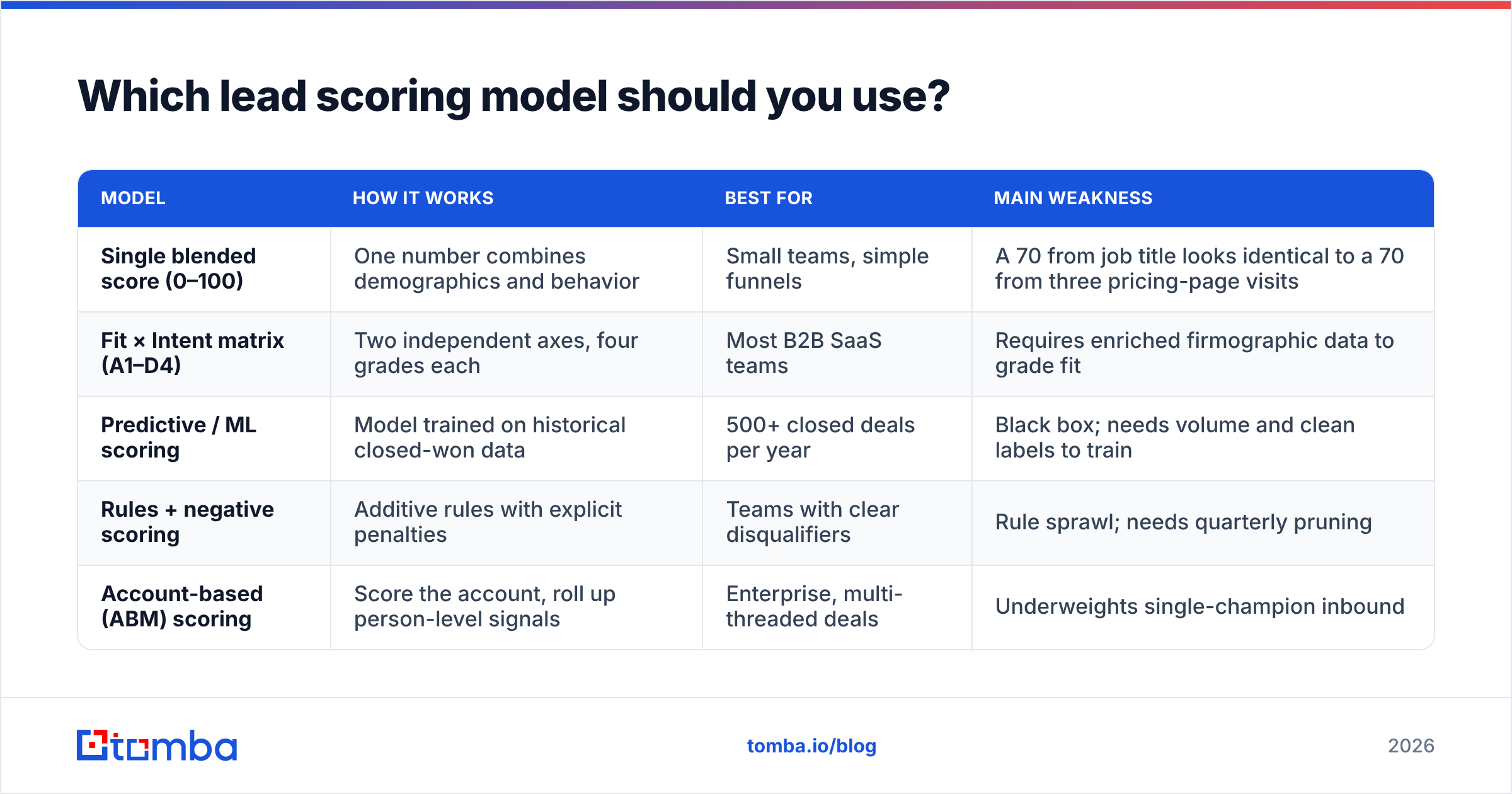
Blended single-score models are the most common and the least useful. Splitting fit and intent into two axes gives you a matrix that sales and marketing can actually argue about productively.
| Model | How it works | Best for | Main weakness |
|---|---|---|---|
| Single blended score (0–100) | One number combines demographics and behavior | Small teams, simple funnels | A 70 from job title looks identical to a 70 from three pricing-page visits |
| Fit × Intent matrix (A1–D4) | Two independent axes, four grades each | Most B2B SaaS teams | Requires enriched firmographic data to grade fit |
| Predictive / ML scoring | Model trained on historical closed-won data | 500+ closed deals per year | Black box; needs volume and clean labels to train |
| Rules + negative scoring | Additive rules with explicit penalties | Teams with clear disqualifiers | Rule sprawl; needs quarterly pruning |
| Account-based (ABM) scoring | Score the account, roll up person-level signals | Enterprise, multi-threaded deals | Underweights single-champion inbound |
The Fit × Intent matrix is the right default for most teams. An A4 lead (perfect fit, high intent) goes to a rep in under five minutes. A D4 lead (terrible fit, high intent) goes to self-serve or nowhere. An A1 lead (perfect fit, no intent) goes to outbound, not to a rep's "call now" queue.
Whatever model you choose, build in negative scoring. Free email domains, student job titles, competitor domains, and unsubscribed contacts should subtract points, not simply fail to add them. Most teams add fifteen positive rules and zero negative ones, then wonder why every lead scores 60.
How do you fix the data layer under your leads?#
This is where the largest, fastest gains live, because it is mechanical rather than political.
Verify before the record is created, not after. A bounced email costs you twice: once in sender reputation, once in wasted rep time. Run every inbound address through an email verifier at form submission. Syntax check, MX record check, and SMTP validation take under a second and stop the garbage at the door.
Handle catch-all domains explicitly. A large share of enterprise domains accept every address, so a naive verifier returns "valid" for asdf@company.com. Treat catch-all results as a separate bucket and route them through a catch-all verifier before your reps waste a sequence on them.
Shorten forms and enrich the rest. Every field you add cuts conversion. Ask for work email and name, then append company size, industry, LinkedIn, and technology stack automatically. Marketo's long-running form-length research and most CRO literature agree here: three-field forms materially outperform seven-field forms, and enrichment closes the gap without the friction.
Re-verify on a schedule. Quarterly re-verification of your active database is not optional at 30% annual decay. Run a bulk verify pass on anything older than 90 days before it enters a sequence.
Standardize before you dedupe. "Acme Corp", "Acme Corporation", and "ACME" are three accounts in most CRMs. Normalize domain as the primary key, not company name.
What sources actually produce high-quality leads?#
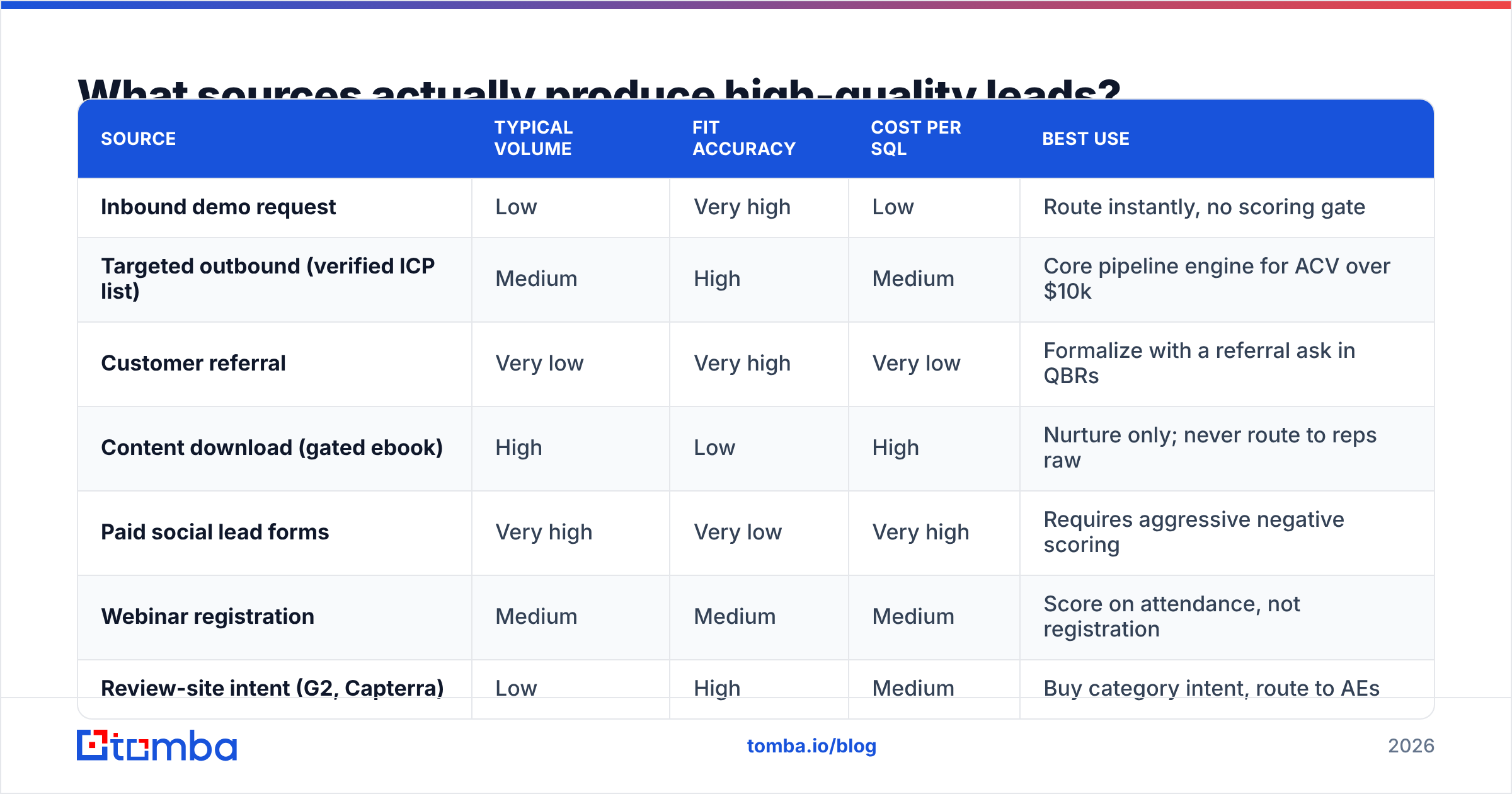
Channel quality varies far more than channel cost, and cost-per-lead hides it completely. Here is how the common sources typically rank once you measure them on close rate rather than volume:
| Source | Typical volume | Fit accuracy | Cost per SQL | Best use |
|---|---|---|---|---|
| Inbound demo request | Low | Very high | Low | Route instantly, no scoring gate |
| Targeted outbound (verified ICP list) | Medium | High | Medium | Core pipeline engine for ACV over $10k |
| Customer referral | Very low | Very high | Very low | Formalize with a referral ask in QBRs |
| Content download (gated ebook) | High | Low | High | Nurture only; never route to reps raw |
| Paid social lead forms | Very high | Very low | Very high | Requires aggressive negative scoring |
| Webinar registration | Medium | Medium | Medium | Score on attendance, not registration |
| Review-site intent (G2, Capterra) | Low | High | Medium | Buy category intent, route to AEs |
Two things stand out. First, gated content and paid social lead forms produce the most leads and the worst leads — they are the top of most dashboards and the bottom of most revenue reports. Second, targeted outbound built on a verified list competes with inbound on quality, because you control the fit criteria completely. That only holds if the list is genuinely ICP-matched and the contact data is accurate; a scraped list with 40% bounces is worse than no list.
For outbound specifically, building from a domain search across your ICP account list gives you a fit-first starting point rather than a title-first one. You pick the accounts that match your closed-won pattern, then find the people inside them — instead of buying a title-filtered list and hoping the accounts happen to fit.
Independent review data is worth checking here too. G2's grid reports are a reasonable sanity check on which data vendors actually deliver the coverage they advertise in your specific region and segment, since coverage varies enormously between North America and, say, DACH or LATAM.
How do you build the sales-marketing feedback loop?#
Quality dies without a disposition loop. The mechanics are simple and most teams still skip them.
- Mandatory disposition field. Every routed lead gets accepted or rejected with a reason code: wrong company size, wrong region, no budget, bad contact data, competitor, student. Six options, dropdown only, required to close the record.
- Weekly 20-minute review. Marketing and sales look at last week's rejections by reason code. Not a strategy meeting — a triage meeting.
- Monthly scoring adjustment. Reason codes that repeat become negative scoring rules or routing changes. If "wrong region" is 18% of rejections, the problem is your ad targeting, not your scoring.
- Quarterly source audit. Rank every source by cost per SQL and cost per closed-won, then cut the bottom two. This is the only meeting where cost-per-lead is allowed to be mentioned, and only to be dismissed.
A shared definition of an MQL, written down and signed by both teams, is the precondition for all of this. If you cannot point to the document, you do not have one. Our B2B glossary entry on the term is a reasonable starting template if you are writing yours from scratch.
Which metrics prove lead quality improved?#
Track these five. Volume metrics are deliberately absent.
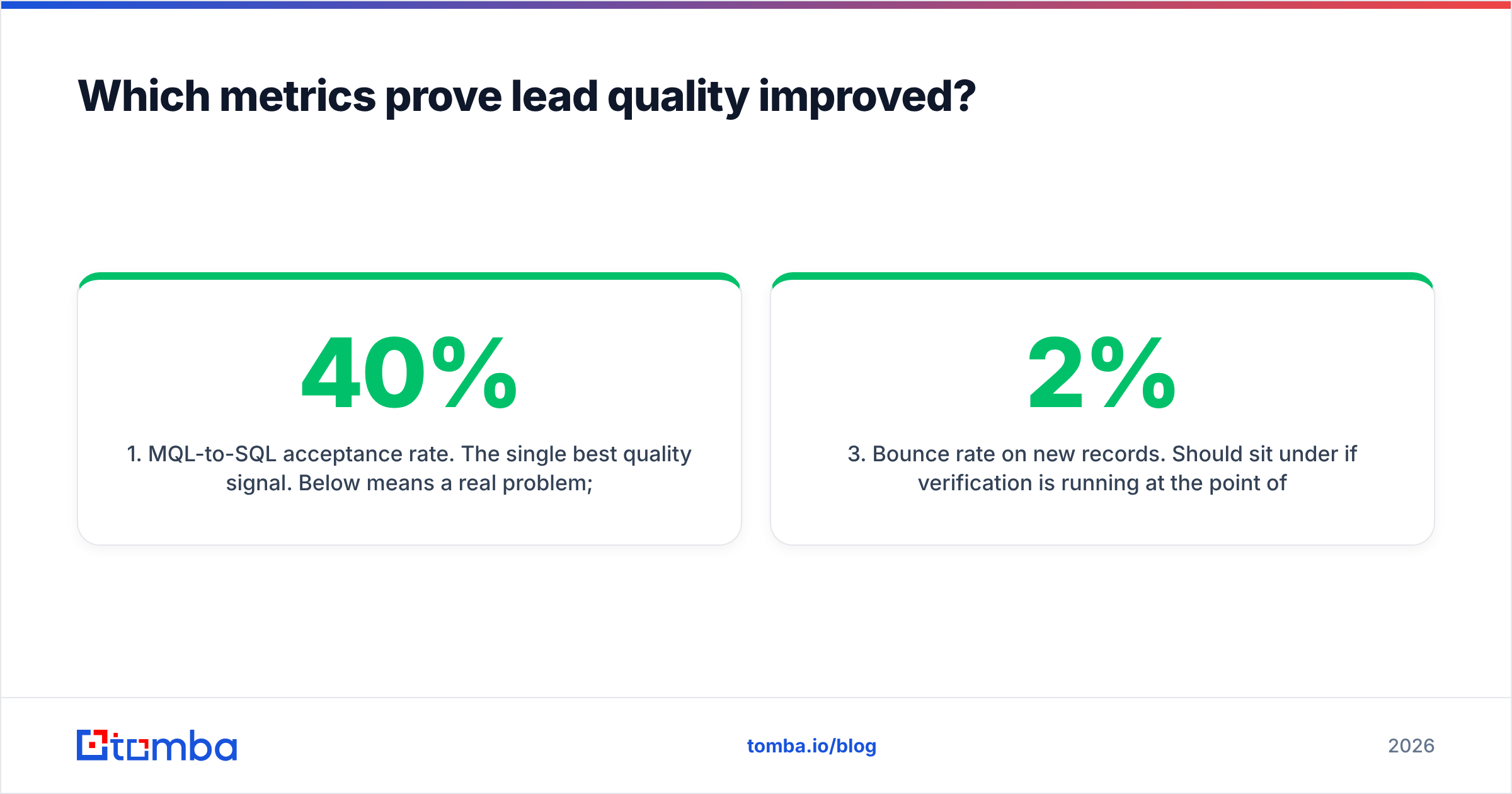
- MQL-to-SQL acceptance rate. The single best quality signal. Below 40% means a real problem; 60–75% is healthy for most B2B SaaS.
- Lead-to-closed-won rate by source. Ties quality directly to revenue and exposes the cheap-lead trap.
- Bounce rate on new records. Should sit under 2% if verification is running at the point of capture. Anything above 5% means your data layer is leaking.
- Time-to-first-touch on A-grade leads. High-fit, high-intent leads decay in hours. If your median is over 30 minutes on those, routing is the bottleneck, not quality.
- Average deal size by lead source. Frequently reveals that your "cheapest" channel produces deals worth a third of the ones from your most expensive channel.
Give any change at least one full sales cycle before judging it. If your cycle is 60 days, a scoring change made in March is not evaluable until May, and reading the March numbers will only tempt you into reverting something that was working.
What does a 90-day lead quality fix look like?#
- Days 1–15. Pull closed-won and closed-lost data, rebuild the ICP from evidence, write the shared MQL definition, and get both VPs to sign it.
- Days 16–30. Turn on email verification at the point of capture. Run a bulk re-verify on the existing database. Add the disposition field with six reason codes and make it required.
- Days 31–60. Rebuild scoring as a Fit × Intent matrix. Add negative scoring rules. Shorten forms to three fields and switch on enrichment to backfill the rest.
- Days 61–90. Run the weekly rejection triage. Audit sources on cost per closed-won. Cut the two worst performers and move that budget to the best one.
Ninety days is enough to move acceptance rate by 15–25 points at most companies, because the starting point is usually so poor. The hard part is not the tooling — it is holding the line on the ICP when a quarter looks light and volume starts to feel tempting again.
Where should you start today?#
Start with reachability, because it is the one dimension you can fix this week without a single meeting. Export your active lead list, verify it, and see what percentage is undeliverable. That number is usually the fastest argument you will ever make for a data-quality budget.
If your outbound motion needs accurate, ICP-matched contacts rather than a bigger list, Tomba Email Finder is built for exactly that: find verified professional email addresses by domain, name, or company, with verification built into the same workflow so bad records never reach your CRM. The free tier covers 25 searches a month if you want to test coverage on your own ICP accounts first, and paid plans start at $49/mo — full Tomba pricing is public. Run 50 of your target accounts through it, compare the results to whatever list you are working from now, and let the bounce rate settle the argument.
Related guides#
// get started
Find, verify and enrich your first contacts today
Start on the free plan with 25 searches a month, then scale when your team is ready.
Free plan · No credit card required · GDPR & CCPA
// about the author