How to Improve Sales Skills in 2026: A Practical Rep Playbook
Most sales training fails because it teaches theory instead of reps. Here is a concrete, drill-based system for improving discovery, objection handling, and pipeline quality in 90 days.
TL;DR
- Sales skill is not a personality trait. It breaks down into roughly seven measurable sub-skills — research, opener, discovery, framing, objection handling, multithreading, and follow-up — and each one improves with deliberate reps, not motivation.
- The fastest gains come from the two ends of the funnel most reps ignore: pre-call research quality and post-demo follow-up discipline. Both are process problems, not talent problems.
- Record and review one call per day. Thirty reviewed calls beats thirty hours of sales books, every time.
- Bad data silently caps skill growth. If 30% of your contacts bounce or route to the wrong person, your "conversion problem" is a list problem, and no amount of coaching fixes it.
- Use a 90-day cycle: 30 days diagnosing with call recordings and pipeline math, 30 days drilling one weak sub-skill at a time, 30 days measuring against a baseline you wrote down on day one.
Why does most sales training fail to improve sales skills?#
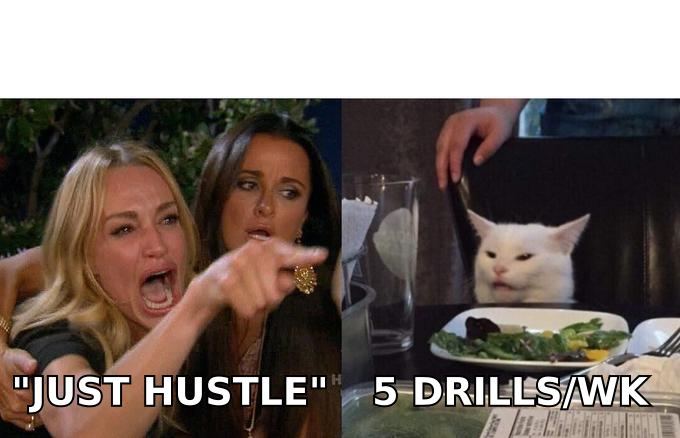
Because it optimizes for feeling motivated instead of changing behavior on the next call.
The standard pattern: a rep reads three sales books, attends a two-day workshop, gets fired up, and then reverts to their old script by Thursday. Nothing was measured, so nothing changed. It's like watching swimming tutorials on YouTube — you learn vocabulary, not stroke mechanics.
Deliberate practice works differently. You isolate one narrow behavior, do it repeatedly under real conditions, get fast feedback, and correct. Musicians and surgeons train this way. Salespeople almost never do, which is exactly why the gap between a median rep and a top rep is so large and so persistent.
There's a second failure mode that nobody talks about: skill improvements are invisible when your inputs are broken. If you're emailing addresses that bounce, calling numbers that ring to a switchboard, or pitching a company that churned its buying committee six months ago, your close rate barely moves even if your discovery got 40% better. You'll conclude the training didn't work. It did — the measurement was contaminated.
So the honest answer to "how to improve sales skills" starts with separating skill problems from data problems, then attacking the skill problems one at a time.
What are the seven sub-skills that actually move deals?#
Stop thinking of "selling" as one thing. It's a stack. Here's the breakdown, roughly in the order a deal touches them:
- Pre-call research — Can you name the prospect's likely priority, their reporting line, and one recent company event in under six minutes? This is the highest-leverage and most-skipped skill in the stack.
- The opener — The first 15 seconds of a cold call or the first two lines of a cold email. Measured by connect-to-conversation rate and reply rate, not by how clever it sounds.
- Discovery — Question quality, silence tolerance, and your ability to get a prospect to say something they haven't said out loud before. Measured by how many of your notes contain the prospect's own words versus your assumptions.
- Framing and demo — Showing only what's relevant to what you heard. Measured by demo-to-next-step conversion.
- Objection handling — Not rebuttals. Clarification, then reframing. Measured by how often "we need to think about it" turns into a scheduled next step.
- Multithreading — Getting a second and third contact inside the account. Deals with three or more engaged contacts close dramatically more often than single-threaded ones.
- Follow-up discipline — The unglamorous one. Most lost deals die from silence on your side, not rejection on theirs.
Rate yourself 1–5 on each right now. Whatever the lowest number is, that's your next 30 days. Do not train the skill you're already good at because it's more fun.
How do you diagnose which sales skill is actually weak?#
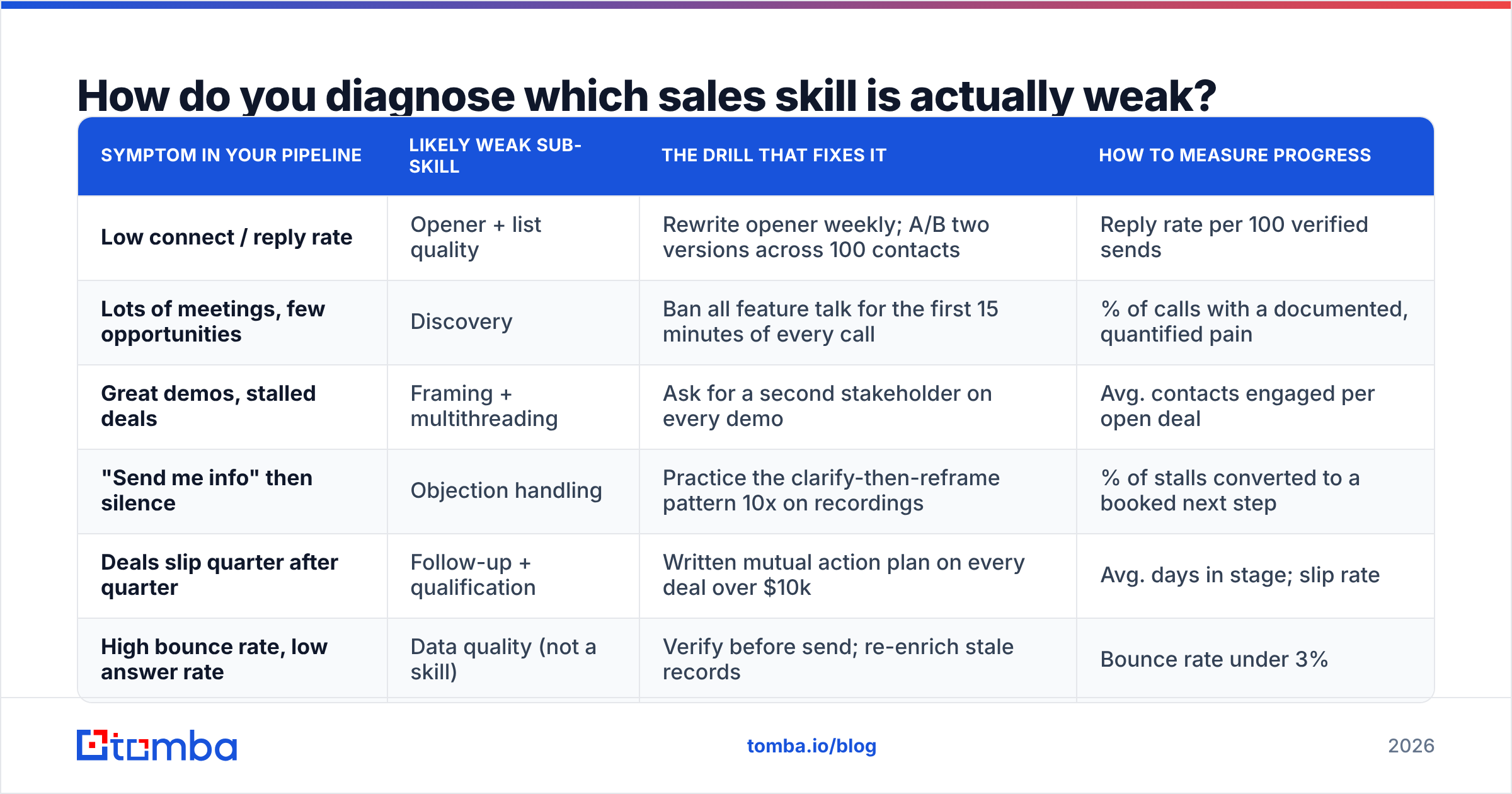
Use pipeline math, not vibes. Your conversion rates between stages tell you where the leak is, and each leak maps to a specific sub-skill.
| Symptom in your pipeline | Likely weak sub-skill | The drill that fixes it | How to measure progress |
|---|---|---|---|
| Low connect / reply rate | Opener + list quality | Rewrite opener weekly; A/B two versions across 100 contacts | Reply rate per 100 verified sends |
| Lots of meetings, few opportunities | Discovery | Ban all feature talk for the first 15 minutes of every call | % of calls with a documented, quantified pain |
| Great demos, stalled deals | Framing + multithreading | Ask for a second stakeholder on every demo | Avg. contacts engaged per open deal |
| "Send me info" then silence | Objection handling | Practice the clarify-then-reframe pattern 10x on recordings | % of stalls converted to a booked next step |
| Deals slip quarter after quarter | Follow-up + qualification | Written mutual action plan on every deal over $10k | Avg. days in stage; slip rate |
| High bounce rate, low answer rate | Data quality (not a skill) | Verify before send; re-enrich stale records | Bounce rate under 3% |
Note the last row. It looks like a skill problem from the outside — the rep is "bad at outbound" — but it's an input problem. Before you spend a quarter coaching, run your list through an email verifier and see what your real deliverable base is. If a rep is sending 400 emails a week and 90 of them never arrive, they're not underperforming by 22%; they're being measured wrong by 22%.
What daily drills improve sales skills fastest?#
These are the reps that produce measurable change inside four weeks. Pick two. Not seven.
Drill 1: The one-call review. Record every call (with consent, per your jurisdiction). Each day, review exactly one — not the best, not the worst, a random one. Write down three things: the question you should have asked, the moment you talked over the prospect, and the one sentence that landed. Fifteen minutes. This single habit outperforms every other item on this list.
Drill 2: Six-minute research sprints. Set a timer. In six minutes, find the prospect's role scope, one company signal (funding, hiring, product launch, leadership change), and one specific reason to reach out today. If you can't find all three, the account isn't ready — move on. This trains speed and ruthless prioritization simultaneously.
Drill 3: Silence counting. On your next ten discovery calls, count how many times you let three full seconds pass after the prospect finishes a sentence. Most reps score zero. Target three per call. The information you get in second four is consistently better than anything you'd have said.
Drill 4: Objection cold reps. List your ten most common objections. Each morning, pick one and say your response out loud, on camera, in under 30 seconds. Watch it back. The goal is not a memorized script — it's removing the two-second panic gap where you start defending instead of asking.
Drill 5: The reply-rate lab. Write two versions of one cold email. Same list, same day, split evenly, minimum 100 contacts per arm to get anything close to signal. Change exactly one variable. Most reps change five things and learn nothing. If subject lines are your bottleneck, a subject line generator is a fine starting point for candidates — just make sure you're testing one variable at a time.
Drill 6: The second-contact rule. For every open deal, name a second stakeholder by end of week. If you can't name one, find one. A domain search across the account surfaces the org's email pattern and adjacent roles in seconds, which turns "I don't know who else to talk to" into a list.
Drill 7: The Friday slip audit. Every Friday, list the deals that moved their close date. For each, write the actual reason in one sentence — no euphemisms. "Champion never had budget authority" is useful. "Timing" is not. Four weeks of this teaches better qualification than any methodology deck.
How does data quality change what "good selling" even means?#
It changes the denominator on every metric you're using to judge yourself.
Think of your list as the soil and your skills as the seed. Excellent technique on a decayed list produces a mediocre harvest and a completely wrong conclusion about the seed. According to G2's category data and most vendor benchmarks, B2B contact data decays somewhere in the range of 20–30% per year through job changes alone — and that's before company-level churn. A list you built 14 months ago is not the list you think it is.
Practically, this means three things for skill development:
- Verify before you measure. Reply rate on delivered emails is a skill metric. Reply rate on attempted sends is a mixed metric that hides your actual progress.
- Re-enrich before you re-engage. A closed-lost deal from last year is often a new opportunity with a new buyer. Contact enrichment on your dormant CRM records surfaces those without any new prospecting work.
- Separate the channels. If email is contaminated and phone is clean, your "outbound skills" score is really two different scores averaged into noise.
This is also why comparing yourself to a teammate's numbers is usually unproductive. If their territory has cleaner data, you're comparing soil, not skill.
Which sales methodology should you learn?#
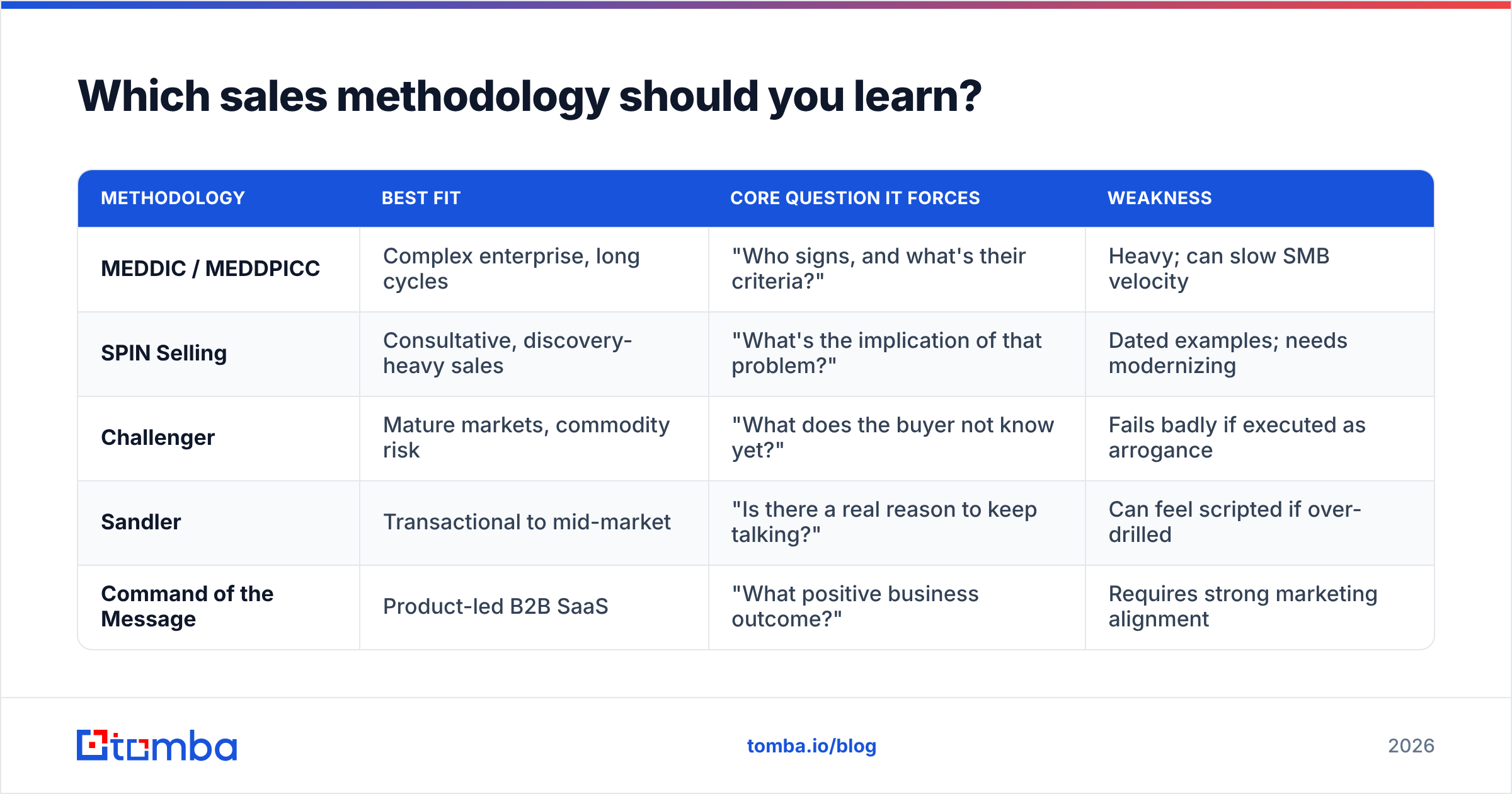
Whichever one your team already runs — the specific framework matters far less than consistency across your pipeline reviews.
| Methodology | Best fit | Core question it forces | Weakness |
|---|---|---|---|
| MEDDIC / MEDDPICC | Complex enterprise, long cycles | "Who signs, and what's their criteria?" | Heavy; can slow SMB velocity |
| SPIN Selling | Consultative, discovery-heavy sales | "What's the implication of that problem?" | Dated examples; needs modernizing |
| Challenger | Mature markets, commodity risk | "What does the buyer not know yet?" | Fails badly if executed as arrogance |
| Sandler | Transactional to mid-market | "Is there a real reason to keep talking?" | Can feel scripted if over-drilled |
| Command of the Message | Product-led B2B SaaS | "What positive business outcome?" | Requires strong marketing alignment |
The trap is methodology tourism — switching every quarter, so nothing gets deep enough to be automatic. HubSpot's sales resources and Salesforce's guides both cover these frameworks in depth for free, so cost is not a reason to skip the reading. But pick one, run it for two quarters, and judge it on your slip rate and forecast accuracy rather than on how modern it feels.

How long does it take to see real improvement?#
Ninety days, structured in three phases. Anything faster is usually noise; anything slower usually means no measurement was ever set up.
Days 1–30: Baseline and diagnose. Write down five numbers before you change anything — reply rate, meeting-to-opportunity rate, average deal cycle, average contacts per deal, and slip rate. Record calls daily. Do not try to improve anything yet. Reps skip this phase constantly, then have no way to prove any of it worked.
Days 31–60: Drill one thing. Pick the single lowest-scoring sub-skill and run two drills against it every working day. Resist the urge to fix everything. A rep who improves discovery by 30% and nothing else will out-earn a rep who improved five things by 5%.
Days 61–90: Measure and re-baseline. Compare the same five numbers against day one. Expect one to move meaningfully and the others to be flat — that's a success, not a failure. Then pick the next weakest sub-skill and repeat.
A few practical guardrails:
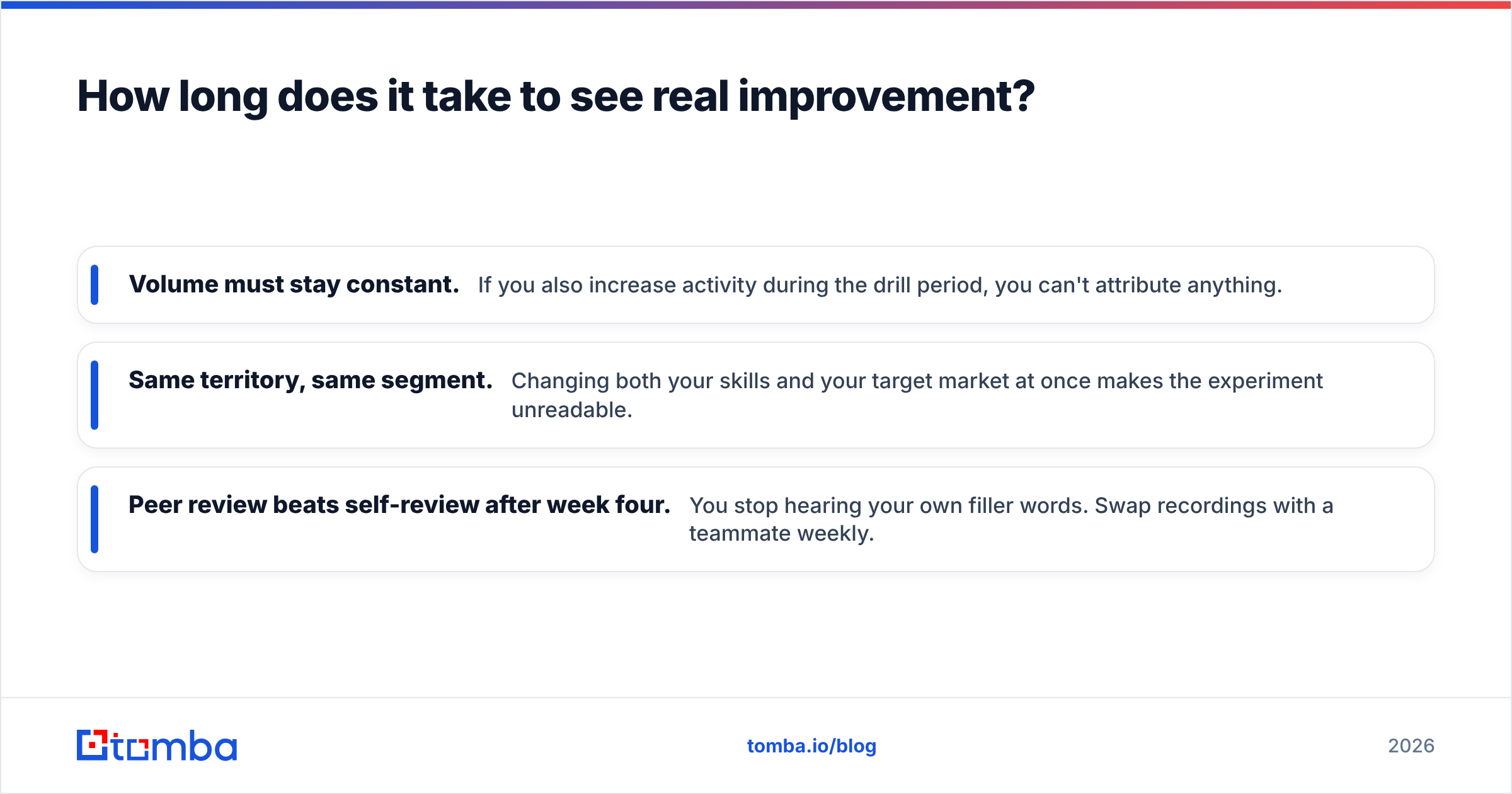
- Volume must stay constant. If you also increase activity during the drill period, you can't attribute anything.
- Same territory, same segment. Changing both your skills and your target market at once makes the experiment unreadable.
- Peer review beats self-review after week four. You stop hearing your own filler words. Swap recordings with a teammate weekly.
What tools support skill development without replacing it?#
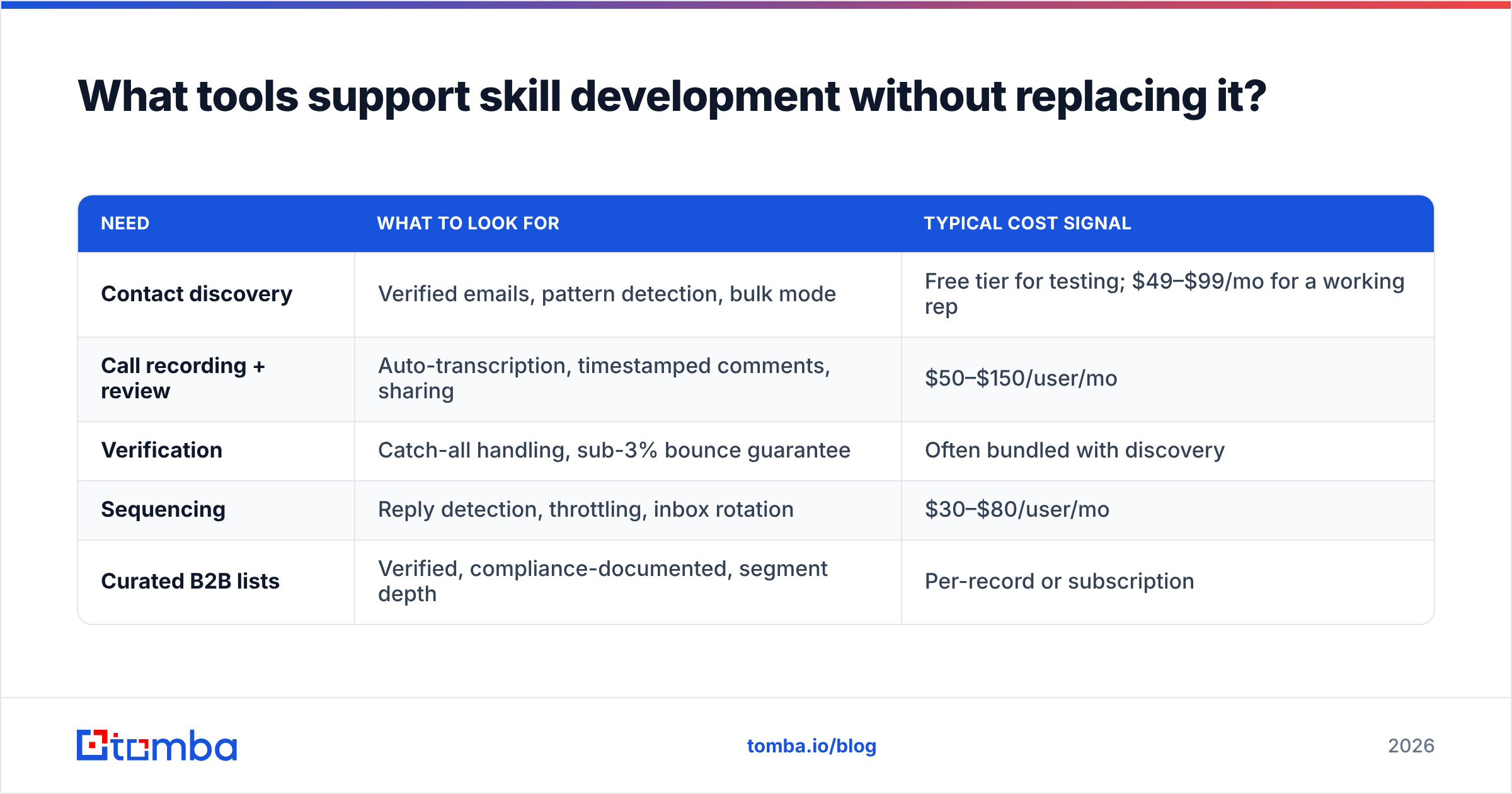
Tools compress the mechanical parts so you spend your reps on the human parts. That's the whole value proposition — none of them will teach you to ask a better second question.
| Need | What to look for | Typical cost signal |
|---|---|---|
| Contact discovery | Verified emails, pattern detection, bulk mode | Free tier for testing; $49–$99/mo for a working rep |
| Call recording + review | Auto-transcription, timestamped comments, sharing | $50–$150/user/mo |
| Verification | Catch-all handling, sub-3% bounce guarantee | Often bundled with discovery |
| Sequencing | Reply detection, throttling, inbox rotation | $30–$80/user/mo |
| Curated B2B lists | Verified, compliance-documented, segment depth | Per-record or subscription |
On the discovery side, Tomba pricing starts with a free tier at 25 searches/month, then Starter at $49/mo, Growth at $99/mo, and Pro at $249/mo — enough to test whether your bounce problem is real before committing budget. For teams that prefer buying pre-built lists rather than sourcing contact by contact, BookYourData is a solid option with strong verification standards; the two approaches complement each other well — build targeted lists for your named accounts, buy for broad segment coverage.
Whatever you pick, apply one filter: does this tool give me more reps at the skill I'm trying to build, or does it just give me more activity? A sequencer that triples your send volume while your discovery is weak makes you worse at a larger scale.
What should you do this week?#
Three things, in this order.
First, record tomorrow's calls and review one. Not five — one. The habit matters more than the coverage.
Second, run your current prospecting list through verification and find out what your real delivery rate is. If it's under 90%, fix that before you touch your messaging, because your messaging tests are currently meaningless.
Third, write your five baseline numbers somewhere you'll see them in 90 days. Improvement you can't measure is a story you're telling yourself.
If step two is where you're stuck — you're guessing at addresses, guessing at formats, and watching bounces eat your reply rate — start with the Tomba Email Finder. Find verified professional emails by domain, name, or company, confirm them before they hit send, and get your skill metrics measuring skill again instead of measuring your list's age. The free tier gives you 25 searches a month, which is plenty to check whether your data is the real bottleneck.
Related guides#
Ready to find emails that actually work?
Join 150,000+ professionals who stopped guessing and started sending. Free credits on signup — no credit card required.
Get the Tomba newsletter
Practical outbound tactics and product updates — once every two weeks.
About the author