How to Increase Software Sales: 9 Tactics That Work in 2026
Most software sales problems are not closing problems. Here are nine tactics — pipeline math, data hygiene, pricing, and outbound sequencing — that actually move software revenue in 2026.
TL;DR
- Most software sales slumps are pipeline-volume or data-quality problems, not closing-skill problems. Fix the top of the funnel before you buy sales training.
- Four levers move software revenue: more qualified accounts, higher contact reach rate, better win rate, and higher average contract value. Only one of them is about talking to prospects.
- Bad contact data quietly destroys 20-35% of outbound capacity. Verified email plus a working phone number is the cheapest performance upgrade available.
- Product-led motions and sales-led motions need different playbooks. Running one playbook on both is why "our reps just aren't closing" gets said in QBRs.
- Expansion revenue is usually cheaper than new logos. If your net revenue retention is under 100%, growth spend is going into a leaky bucket.
Why do software sales stall in the first place?#
Because the math stops working long before the pitch does.
Software revenue is an arithmetic identity, not a mystery. Revenue equals accounts contacted × reach rate × meeting rate × win rate × average contract value. When bookings drop, one of those five numbers moved. Sales leaders almost always assume it was win rate — the part that involves human performance — and respond with coaching, new decks, or a discovery framework.
In practice, the number that moved is usually reach rate or accounts contacted. Your list decayed. Two SDRs left. The domain that carried your outbound got throttled. A data vendor's refresh cycle slipped and 30% of your emails now bounce.
Here is a useful analogy: a sales team is a kitchen. If dishes are going out cold, you can retrain the chefs, or you can check whether the walk-in freezer has been broken for three weeks. The freezer is cheaper to fix and more often the cause.
So before you spend on enablement, instrument the five numbers. Then work them in order of cost-to-fix.
What are the four levers that actually increase software sales?#
There are only four places incremental software revenue comes from. Everything tactical rolls up into one of them.
- More qualified accounts in play — expand the addressable list, tighten ICP fit, and add sourcing channels. Highest ceiling, slowest to compound.
- Higher contact reach rate — get your message in front of a human. This is a data and deliverability problem, not a persuasion problem. Fastest payback of the four.
- Higher win rate — better qualification, multithreading, security-review readiness, and competitive positioning. Medium speed, requires process discipline.
- Higher average contract value — packaging, tiering, seat expansion, and annual-vs-monthly incentives. Often the single most profitable lever because it costs almost nothing to pull.
Rank your own quarter against these. If you cannot say which of the four you are working on this month, you are not running a plan — you are running activity.
How do you fix the reach-rate problem first?#
Start with data, because it is the cheapest and most measurable fix.
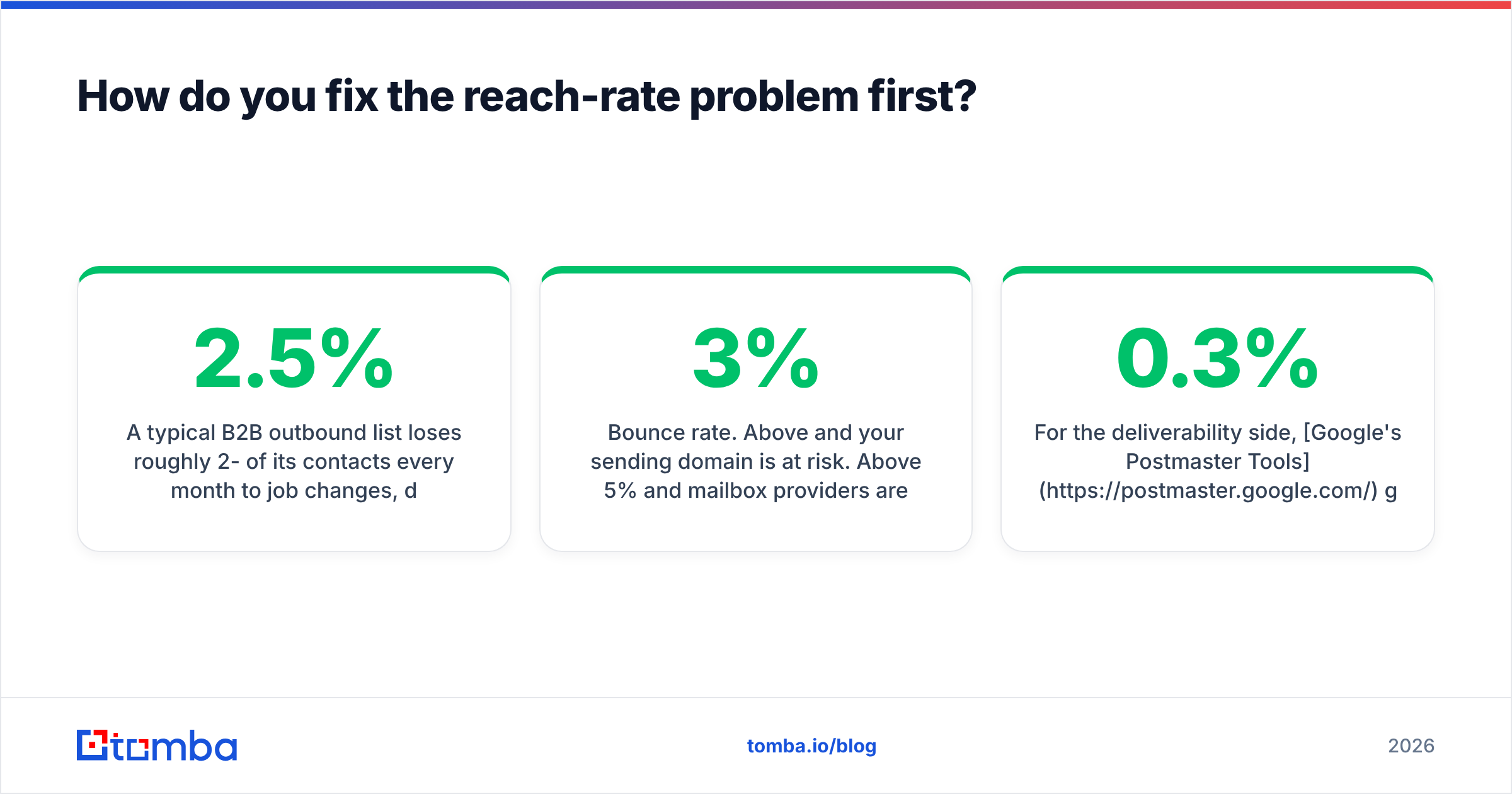
A typical B2B outbound list loses roughly 2-2.5% of its contacts every month to job changes, domain migrations, and role shifts — which compounds to about 25-30% annual decay. A list you bought in January is materially wrong by August. That decay does not show up as an error message; it shows up as "our reps aren't hitting quota."
Three checks to run this week:
- Bounce rate. Above 3% and your sending domain is at risk. Above 5% and mailbox providers are already filtering you. Run your existing list through an email verifier before the next send, not after.
- Catch-all share. Many enterprise domains accept all mail, which makes standard verification useless. A catch-all verifier tells you whether a mailbox behind a catch-all domain is genuinely deliverable instead of forcing you to guess.
- Coverage gap. Count how many target accounts have zero verified contacts. That number is your real TAM ceiling, and it is usually worse than the CRM suggests. A domain search across your account list closes the gap faster than manual LinkedIn hunting.
Only after those three are clean should you touch messaging. Rewriting copy that lands in a dead mailbox is theater.
For the deliverability side, Google's Postmaster Tools gives you spam-rate and reputation data straight from the largest inbox provider — treat anything above a 0.3% spam complaint rate as a live incident.
What does a sourcing stack for software sales look like in 2026?#
Software sales teams typically stitch together four categories: an intent or account-list source, a contact-data source, a sequencing tool, and a CRM. The contact-data layer is where accuracy and cost diverge most sharply between vendors.
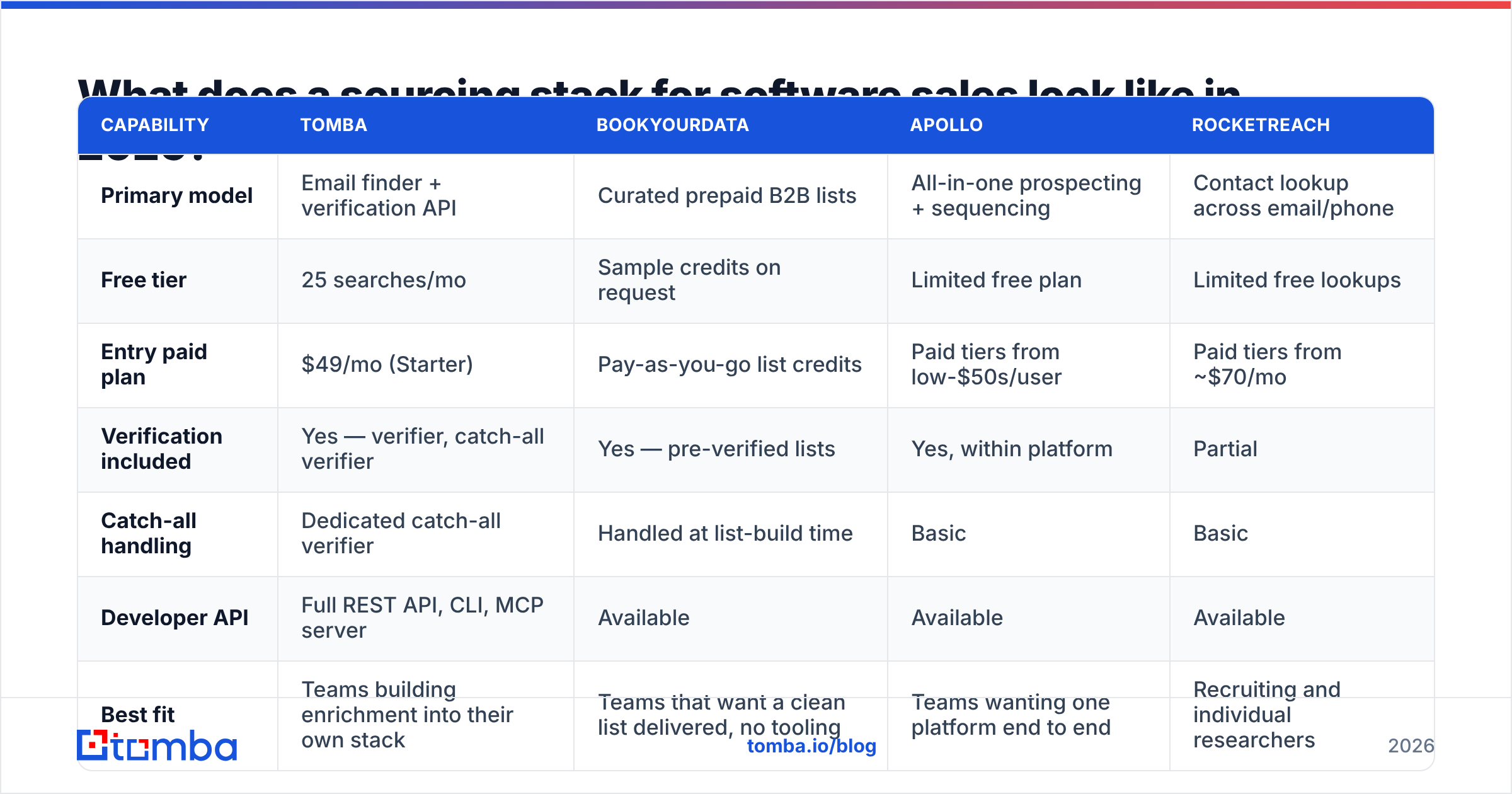
| Capability | Tomba | BookYourData | Apollo | RocketReach |
|---|---|---|---|---|
| Primary model | Email finder + verification API | Curated prepaid B2B lists | All-in-one prospecting + sequencing | Contact lookup across email/phone |
| Free tier | 25 searches/mo | Sample credits on request | Limited free plan | Limited free lookups |
| Entry paid plan | $49/mo (Starter) | Pay-as-you-go list credits | Paid tiers from low-$50s/user | Paid tiers from ~$70/mo |
| Verification included | Yes — verifier, catch-all verifier | Yes — pre-verified lists | Yes, within platform | Partial |
| Catch-all handling | Dedicated catch-all verifier | Handled at list-build time | Basic | Basic |
| Developer API | Full REST API, CLI, MCP server | Available | Available | Available |
| Best fit | Teams building enrichment into their own stack | Teams that want a clean list delivered, no tooling | Teams wanting one platform end to end | Recruiting and individual researchers |
The honest read: these are not interchangeable. BookYourData is strong when you want a pre-built, pre-verified list handed to you and do not want to operate a data pipeline. Apollo makes sense when you want sequencing and data under one login and can accept the coupling. Tomba pricing sits at $49/mo Starter, $99/mo Growth, and $249/mo Pro, and it is aimed at teams that want the finder and verifier as composable pieces — via the Tomba API, a spreadsheet add-on, or a CRM sync — rather than another all-in-one seat license.
Pick based on whether you want a list or a pipeline. Buying the wrong one is how tools end up shelfware by Q3.
How do product-led and sales-led motions differ?#
They differ in who qualifies whom, and mixing them is a common cause of flat software revenue.
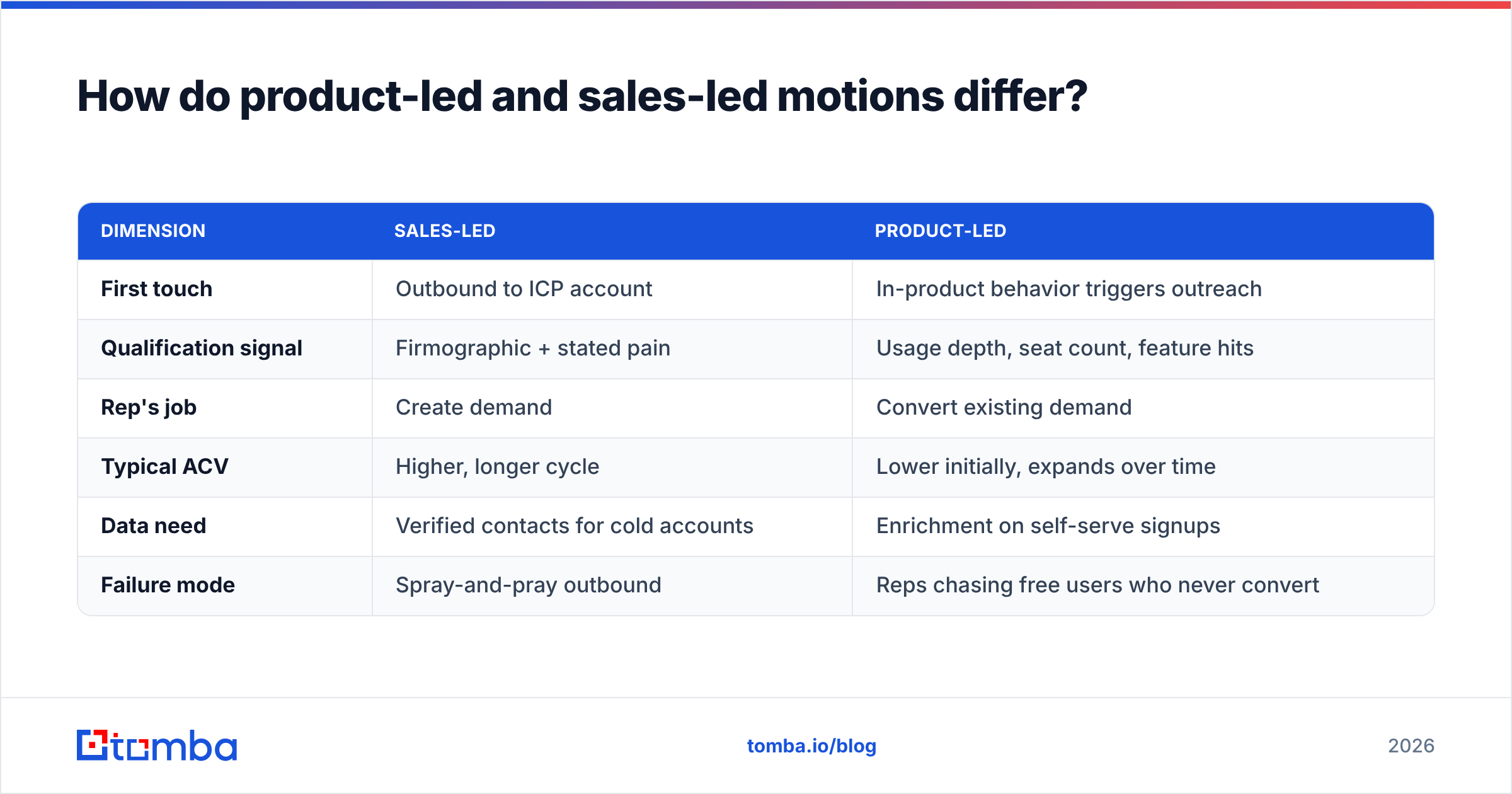
In a sales-led motion, your rep qualifies the account before value is delivered. In a product-led motion, the user delivers value to themselves and then qualifies into a sales conversation. The signals, timing, and even the ideal first message are different.
| Dimension | Sales-led | Product-led |
|---|---|---|
| First touch | Outbound to ICP account | In-product behavior triggers outreach |
| Qualification signal | Firmographic + stated pain | Usage depth, seat count, feature hits |
| Rep's job | Create demand | Convert existing demand |
| Typical ACV | Higher, longer cycle | Lower initially, expands over time |
| Data need | Verified contacts for cold accounts | Enrichment on self-serve signups |
| Failure mode | Spray-and-pray outbound | Reps chasing free users who never convert |
If you run product-led, your data problem is not finding people — it is enriching people who already signed up with a personal email or a bare work address. Data enrichment and reverse email lookup turn a signup row into a routable, scorable account record. That single step often moves self-serve-to-sales conversion more than any change to your trial length.
If you run sales-led, your data problem is coverage and freshness on accounts that have never heard of you.
Running the product-led playbook on cold accounts, or the sales-led playbook on trial users, wastes both.
How do you raise win rate without new headcount?#
Win rate responds to three things, in descending order of impact.
- Multithreading. Deals with a single contact lose disproportionately when that contact leaves or gets overruled. Gartner's research on B2B buying groups has consistently found that a typical enterprise software purchase involves six to ten decision-makers — see Gartner's B2B buying insights. If your average opportunity has 1.4 contacts, that is your win-rate problem in one number. Use bulk email finder runs on open opportunities to fill in the buying group before the deal reaches procurement.
- Disqualification speed. Every week a dead deal sits in stage 3 is a week of rep capacity spent on a zero. Set hard exit criteria — no economic buyer identified by day 21, no next meeting on the calendar, no written pain — and enforce them in pipeline review, not in a spreadsheet nobody opens.
- Security and procurement readiness. In software, an alarming share of "we lost on price" deals actually died in a security questionnaire or a legal redline. Pre-build the SOC 2 packet, the DPA, and the standard MSA redlines. This is unglamorous and it converts.
Notice that none of these require hiring. They require deciding.

What about pricing and packaging?#
Raising average contract value is the least-worked lever in most software companies, which makes it the most available one.
Concrete moves, roughly in order of ease:
- Add an annual incentive. Two months free on annual prepay improves cash position and cuts churn exposure. Most teams already have this; fewer actually train reps to lead with it.
- Introduce a third tier above your current top tier. Anchoring works. A high tier that 5% of accounts buy still lifts the perceived value of the middle tier that 60% buy.
- Move a popular feature up a tier. Look at feature usage by plan. If a Starter-tier feature is the top-three reason people pick you, it is underpriced.
- Charge for what scales with customer value. Seats, records, API calls, sending volume — pick the meter that grows when the customer wins. Flat pricing leaves expansion revenue on the table.
- Kill discounting-by-default. Track discount rate by rep. The spread is usually enormous, and the high-discount reps rarely have the better win rate.
HubSpot's research on SaaS pricing models is a reasonable starting reference if you are rebuilding tiers from scratch.
How do you build an outbound sequence that survives 2026 filtering?#
Deliverability is now a gating factor, not a footnote. Both Google and Yahoo enforce authentication and complaint-rate thresholds for bulk senders, and the tolerance is thin.
A sequence that holds up:
- Authenticate everything. SPF, DKIM, and DMARC on every sending domain. Check yours with an SPF checker before you scale volume, not after a deliverability incident.
- Use subdomains for outbound. Keep your primary corporate domain out of the blast radius.
- Warm up honestly. Ramp volume over weeks. An email warmup calculator gives you a realistic ramp schedule instead of a guess.
- Verify immediately before send, not at list-build time. A list verified 60 days ago is not a verified list.
- Cap daily volume per mailbox. Somewhere in the 30-50 range per mailbox is defensible. More mailboxes beat more volume per mailbox.
- Write for reply, not for open. Open rates became unreliable when Apple Mail Privacy Protection shipped. Measure replies and meetings booked.
The sequence structure itself matters less than most people think. Three to five touches across email and phone, with a genuine reason for each, outperforms an eight-step drip of increasingly desperate bumps. Pair email with a real number from a phone finder — connect rates on verified direct dials remain far better than on switchboard numbers.
Which metrics should you actually review weekly?#
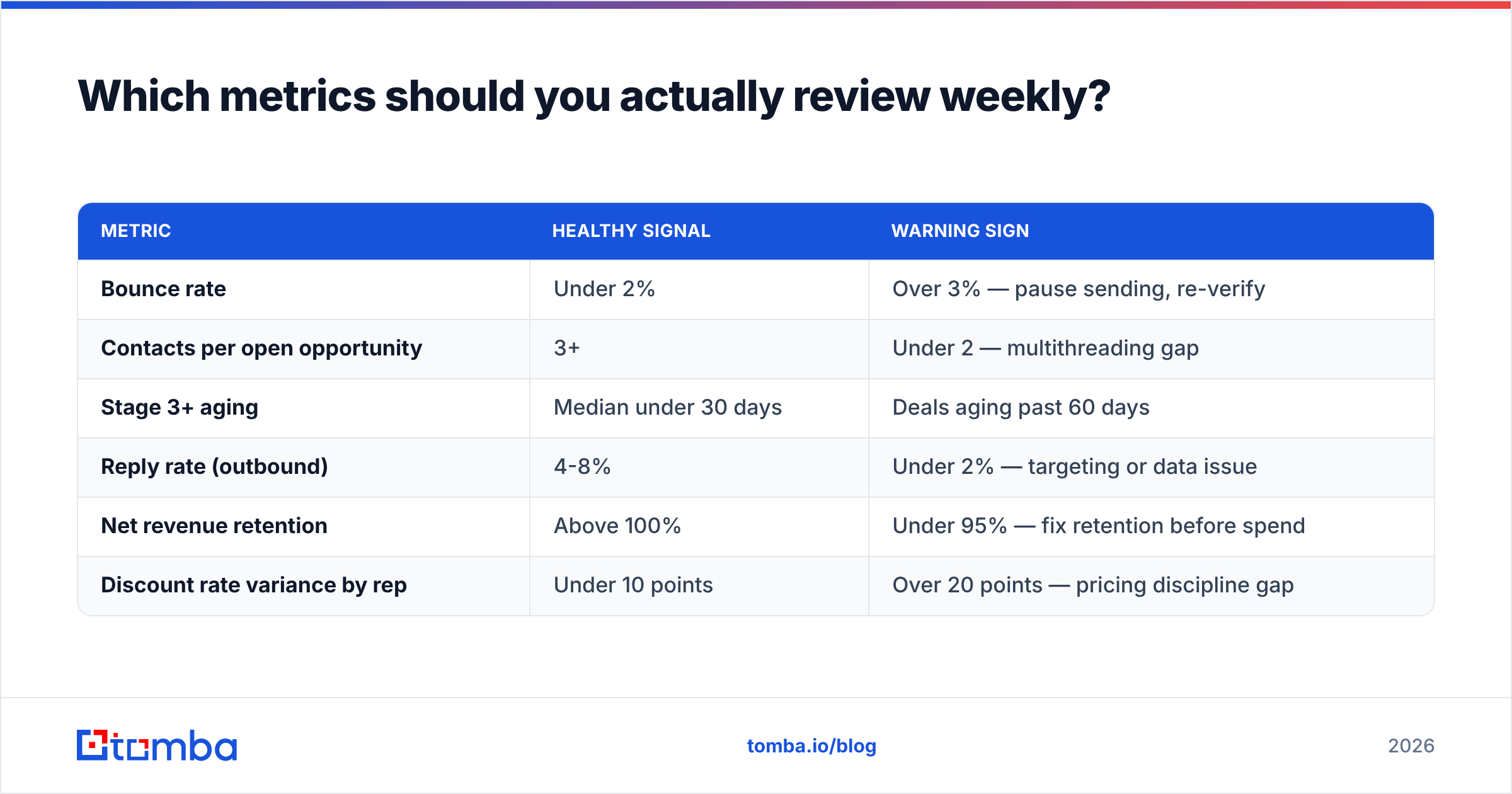
Keep the list short enough that people remember it.
| Metric | Healthy signal | Warning sign |
|---|---|---|
| Bounce rate | Under 2% | Over 3% — pause sending, re-verify |
| Contacts per open opportunity | 3+ | Under 2 — multithreading gap |
| Stage 3+ aging | Median under 30 days | Deals aging past 60 days |
| Reply rate (outbound) | 4-8% | Under 2% — targeting or data issue |
| Net revenue retention | Above 100% | Under 95% — fix retention before spend |
| Discount rate variance by rep | Under 10 points | Over 20 points — pricing discipline gap |
Six numbers. If a weekly review cannot cover these in twenty minutes, the review is about something other than revenue.
What should you do in the next 30 days?#
A realistic sequence for a team of any size:
- Week 1: Verify your entire active outbound list. Record the bounce rate before and after. This alone often recovers double-digit percentages of wasted send capacity.
- Week 2: Audit contacts-per-opportunity across open pipeline. Fill every deal under three contacts using domain search on the account.
- Week 3: Set and enforce disqualification criteria. Expect pipeline to shrink — that is the point.
- Week 4: Ship one pricing change. Annual incentive, a new top tier, or a feature moved up a tier. Measure ACV over the following quarter.
None of this is novel. It is unglamorous operational hygiene, and it is what separates software teams that grow from teams that keep buying enablement.
Ready to fix the data layer first?#
The fastest lever on this list is also the least discussed: reaching more of the right people, at addresses that actually work. Start with the Tomba Email Finder — find verified professional emails by domain, name, or company, run them through the verifier before your next send, and see what your reply rate does when your list stops decaying underneath you. The free tier gives you 25 searches a month to test it against your own account list; Starter is $49/mo when you are ready to run it across the whole pipeline.
Related guides#
// get started
Find, verify and enrich your first contacts today
Start on the free plan with 25 searches a month, then scale when your team is ready.
Free plan · No credit card required · GDPR & CCPA
// about the author