How to Lead a Sales Team in 2026: A Practical Playbook
Most new sales managers inherit a quota, a CRM, and no playbook. Here's the operating system that actually works: hiring, coaching cadence, pipeline reviews, comp, and the metrics worth defending.
TL;DR
- Leading a sales team is an operating system, not a personality. The four moving parts are hiring, cadence, coaching, and data hygiene — in that order of leverage.
- Your weekly rhythm should be fixed and boring: one team pipeline review, one 1:1 per rep, one deal clinic. Everything else is noise.
- Coach behaviours you can observe (discovery questions asked, multithreading, next-step booked), not outcomes you can only report on (closed revenue).
- Bad data kills good management. If your reps spend 9 hours a week hunting contact details, no amount of motivational Slack messages fixes the number.
- Ramp new reps against a written 30/60/90 with pass/fail gates. "Figure it out" is how you lose a $120K hire in month five.
What does it actually mean to lead a sales team?#
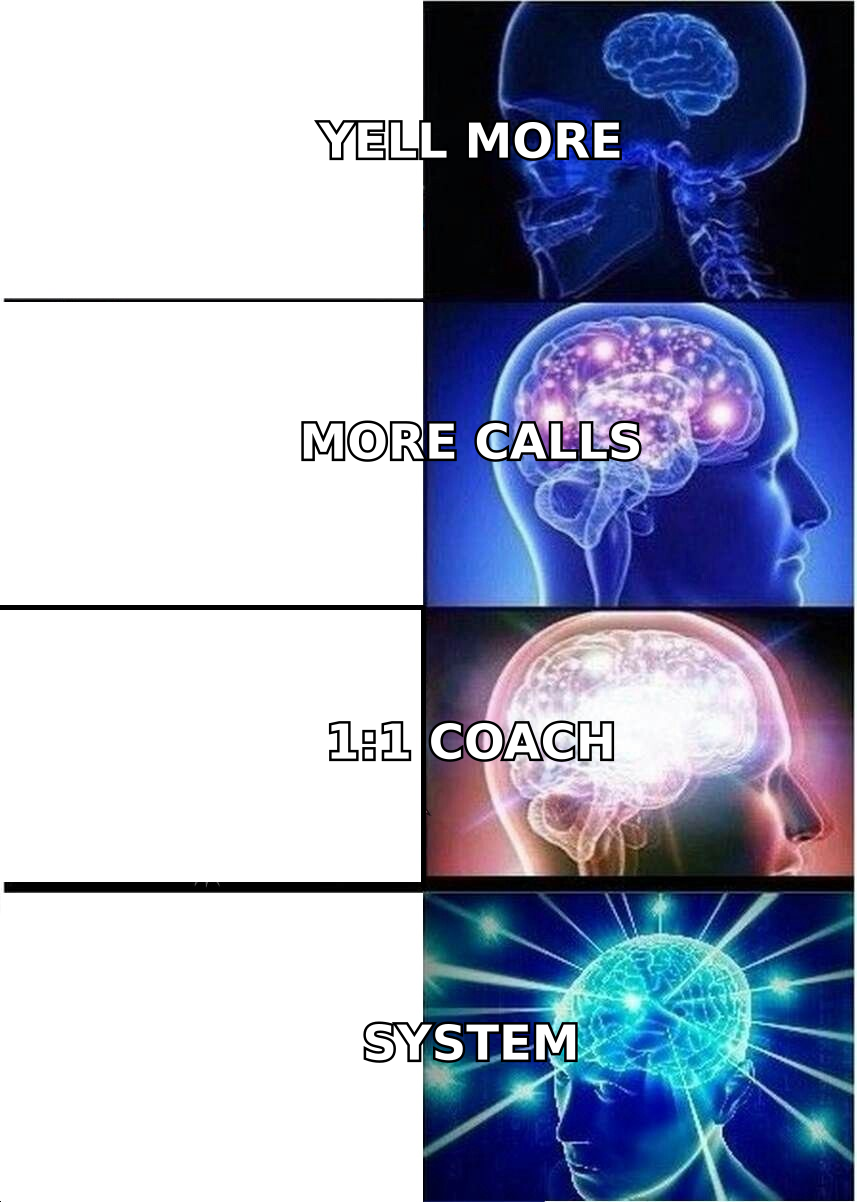
Leading a sales team means owning the system that produces revenue, not the revenue itself. That distinction is where most first-time managers get stuck. They were promoted for being the best closer, so they keep closing — jumping on their reps' calls, rewriting their emails, taking over the hard deals. Six months later they've hit their number and their team hasn't grown an inch.
Think of it like a restaurant kitchen. A great line cook can plate 80 covers on a Friday. A great head chef never touches a pan on a busy night — they design the menu, prep the stations, and fix the bottleneck at the pass. Your job as a sales leader is the pass, not the pan.
Concretely, that means you own five things:
- Talent — who you hire, who you ramp, who you exit, and how fast you do each.
- Cadence — the fixed weekly and monthly rhythm that makes the team predictable.
- Coaching — the repeatable improvement loop on skills, not the pep talk.
- Process and data — pipeline stages that mean something, and a CRM people actually trust.
- Capacity — making sure reps have enough qualified accounts and accurate contact data to hit the plan you handed them.
Everything else — comp plans, territory design, tooling — supports those five. If you're spending your week on anything outside them, you're doing someone else's job.
How is managing different from leading?#
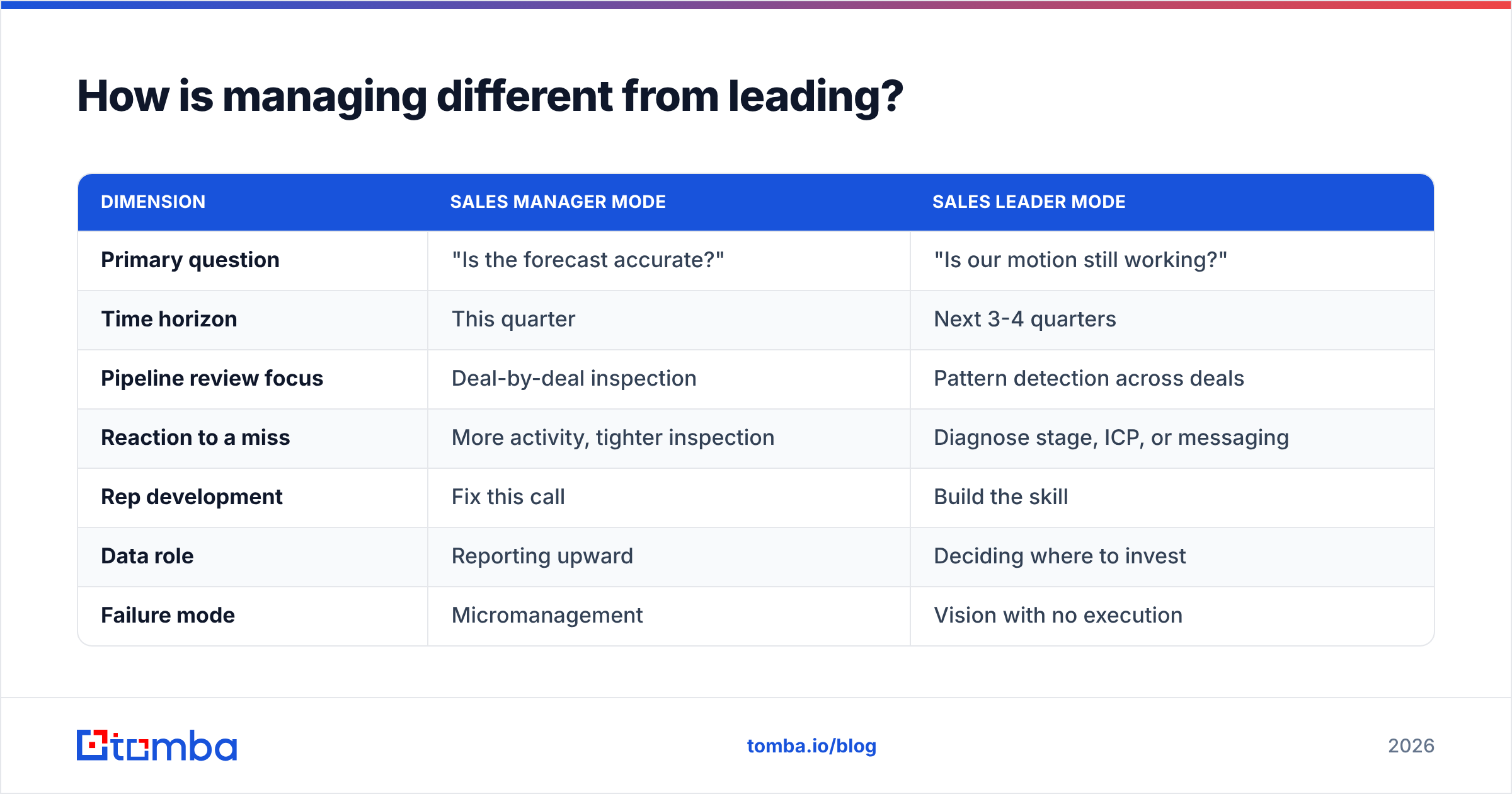
Managing is enforcing the plan. Leading is deciding whether the plan is right and getting people to believe it. You need both, and the mix shifts with team maturity.
| Dimension | Sales manager mode | Sales leader mode |
|---|---|---|
| Primary question | "Is the forecast accurate?" | "Is our motion still working?" |
| Time horizon | This quarter | Next 3-4 quarters |
| Pipeline review focus | Deal-by-deal inspection | Pattern detection across deals |
| Reaction to a miss | More activity, tighter inspection | Diagnose stage, ICP, or messaging |
| Rep development | Fix this call | Build the skill |
| Data role | Reporting upward | Deciding where to invest |
| Failure mode | Micromanagement | Vision with no execution |
New managers over-index on the left column because it feels productive and it's easy to measure. Tenured leaders over-index on the right and lose touch with what's actually happening on calls. The healthy split for a front-line manager of 6-8 reps is roughly 60% manager mode, 40% leader mode — and you should be able to name which activities fall where on your calendar.
What weekly cadence should a sales team run?#
Fix the rhythm and defend it. Reps hate surprise meetings far more than they hate recurring ones, because surprise meetings mean you're anxious and they're about to get inspected.
A cadence that works for most B2B teams of 5-10 reps:
- Monday, 30 min — Team pipeline stand-up. Not deal review. Each rep states: number committed, biggest risk, one ask from the team. No commentary from you beyond unblocking.
- Tuesday/Wednesday, 45 min each — 1:1s. Half development, half deal strategy. The development half comes first, because if you start with deals you'll never get to development.
- Thursday, 60 min — Deal clinic. One or two deals, dissected by the whole team. Rotate who brings the deal. This is the highest-leverage hour on the calendar; it teaches 8 people at once.
- Friday, 30 min — Forecast lock and pipeline hygiene. Stale opportunities get closed or re-dated. No exceptions, no "let me check with them one more time."
- Monthly, 90 min — Motion review. Win/loss patterns, message testing, ICP drift, territory coverage. This is the only meeting where you're allowed to change the plan.
The trap is letting deal strategy eat every slot. If you have a $400K deal wobbling in week 11 of the quarter, you will be tempted to convert all five meetings into war rooms for it. Do that twice and your team stops developing entirely. Protect the deal clinic and the development half of 1:1s the way you'd protect a board meeting.
How do you coach reps without micromanaging?#
Coach inputs you can observe. Report on outputs you can't control.
The difference matters because "close more deals" is not coachable feedback — it's a restatement of the problem. "In your last three discovery calls you asked an average of four questions before pitching; top performers ask eleven" is coachable, because the rep knows exactly what to do differently on Monday.
Build your coaching around a small, fixed skill map. Six is plenty:
- Pre-call research quality — did the rep know the account's funding, tech stack, org structure, and recent triggers before dialling?
- Discovery depth — questions asked, pain quantified in the buyer's own numbers, decision process mapped.
- Multithreading — number of contacts engaged per open opportunity. Single-threaded deals slip; this is the most predictive leading indicator on most teams.
- Next-step discipline — percentage of calls that end with a specific date and calendar invite, not "I'll follow up next week."
- Objection handling — does the rep isolate, or argue?
- Written follow-up — is the recap email a mirror of the buyer's language or a product brochure?
Score each rep red/amber/green monthly. Pick one amber to work on per rep per month — one, not three. Then find the evidence: listen to two calls, read four follow-ups, look at the contact count on their five biggest deals. Coaching without evidence is just opinion, and reps can smell it.
If your team is heavy on outbound, spend disproportionate coaching time on research quality and follow-up. Both compound, and both are usually terrible. Gong's public research on sales conversations has made the same point for years: the behaviours that separate top quartile reps show up early in the call, not in the close.
Which metrics should a sales leader actually track?#
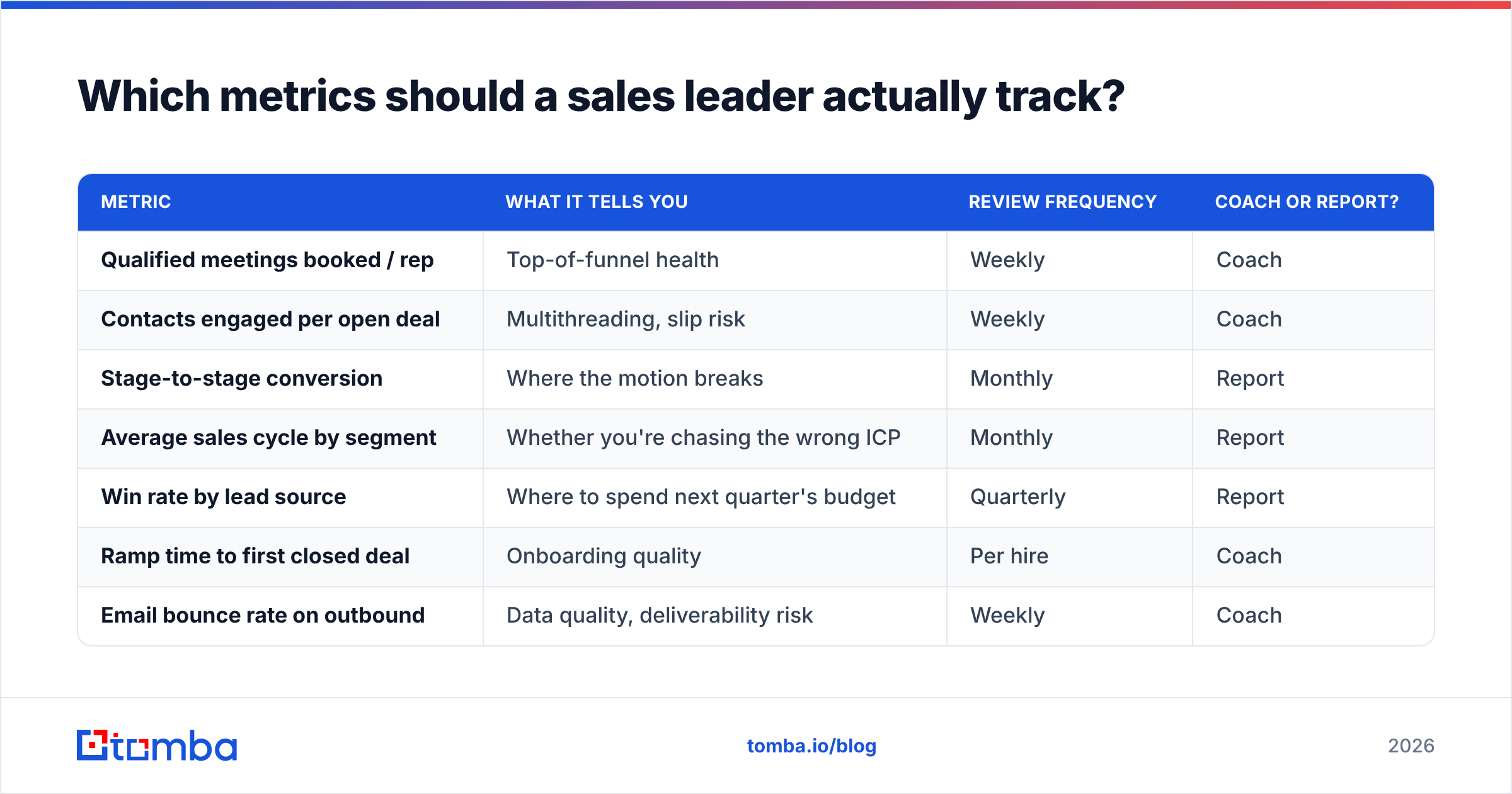
Fewer than you think. Most dashboards are built to reassure executives, not to change rep behaviour. Here's a working set for a front-line leader.
| Metric | What it tells you | Review frequency | Coach or report? |
|---|---|---|---|
| Qualified meetings booked / rep | Top-of-funnel health | Weekly | Coach |
| Contacts engaged per open deal | Multithreading, slip risk | Weekly | Coach |
| Stage-to-stage conversion | Where the motion breaks | Monthly | Report |
| Average sales cycle by segment | Whether you're chasing the wrong ICP | Monthly | Report |
| Win rate by lead source | Where to spend next quarter's budget | Quarterly | Report |
| Ramp time to first closed deal | Onboarding quality | Per hire | Coach |
| Email bounce rate on outbound | Data quality, deliverability risk | Weekly | Coach |
| Forecast accuracy per rep | Whether you can trust the commit | Monthly | Coach |
That last one is underrated. Track each rep's commit versus actual for three quarters and you'll learn more about who to trust with a big account than any personality assessment. Rep A who calls $180K and lands $175K is more valuable to your planning than Rep B who calls $300K and lands $210K, even though Rep B booked more.
Two metrics deserve a warning label. Activity counts (dials, emails sent) are fine as a diagnostic when a rep is underperforming and useless as a permanent target — the moment you make them a goal, you get 200 garbage emails a day and a burnt domain. And pipeline coverage ratio only means something if your stage definitions are honest. A 4x coverage on a pipeline stuffed with dead deals is 1x coverage with extra steps.
How do you fix the data problem underneath the numbers?#
Most "coaching problems" are actually data problems wearing a coaching costume.
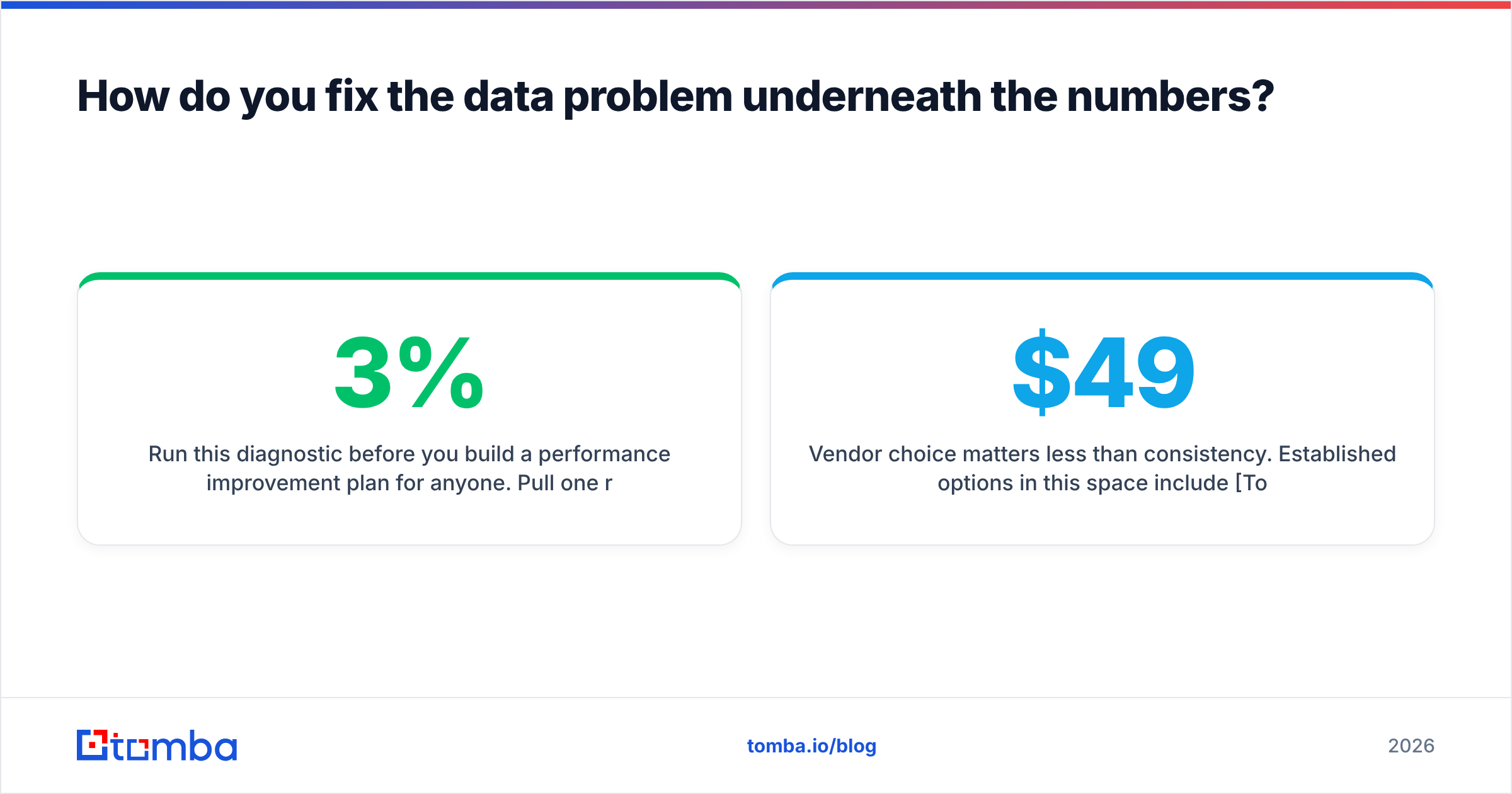
Run this diagnostic before you build a performance improvement plan for anyone. Pull one rep's last 200 outbound sends and check: what percentage bounced, what percentage went to a generic info@ address, and how many hours that week they logged inside LinkedIn manually copying contact details into a spreadsheet. If bounce rate is above 3% or manual research is above 6 hours a week, the rep isn't the bottleneck — the input is.
Three fixes, in order of payback:
- Standardise sourcing. Reps should not each have a personal, undocumented method for finding contacts. Pick a stack, document it, and enforce it. Whether you use an email finder tied to your CRM or a shared enrichment workflow, the point is that two reps working the same account arrive at the same data.
- Verify before send. Bounces damage sender reputation for the whole domain, which means one careless rep can tank everyone's deliverability. Running lists through an email verifier before a campaign is a five-minute step that protects a shared asset.
- Enrich at the account level, not the contact level. When a rep needs six stakeholders at one company, individual lookups are the slow path. A domain search that returns the whole org's addresses and formats at once turns a 40-minute task into a two-minute one, and it makes multithreading realistic instead of aspirational.
Vendor choice matters less than consistency. Established options in this space include Tomba pricing at $49/mo for Starter and $99/mo for Growth, alongside peers like BookYourData for pre-built list buying and Clearbit-style enrichment layers for firmographics. Pick based on whether your motion is account-based (you need depth per company) or volume-based (you need breadth across many companies). Both approaches work; mixing them per-rep does not.

How do you hire and ramp new reps?#
Hire for the motion you actually run, not the one on your website. A rep who crushed $15K transactional deals with inbound leads will struggle with a nine-month enterprise cycle requiring cold multithreading, and the reverse is equally true. This is the single most common expensive mistake in sales hiring.
Your interview loop should include, at minimum: a structured behavioural interview against your skill map, a live mock discovery call with a real ICP scenario, and a written follow-up exercise scored blind. The written exercise is the cheapest signal in the entire process and almost nobody runs it. Ask candidates to research a named account and send you the outreach email they'd actually send. You'll learn more in ten minutes of reading than in an hour of talking.
Then ramp against written gates:
- Day 30 — can articulate the product, ICP, and top three competitors without notes. Has completed 15 shadowed calls. Gate: passes an internal pitch certification.
- Day 60 — running discovery unassisted. Has self-sourced 10 qualified meetings. Gate: two recorded discovery calls scored green on your skill map.
- Day 90 — owns a full territory. First closed-won or a clearly progressing pipeline at 2x segment average cycle length. Gate: forecast submitted and defended in the team review.
If a rep misses two consecutive gates, that's a signal to intervene hard, not to wait for month six and act surprised. Most under-ramped reps know they're struggling long before their manager admits it.
What about comp, territories, and motivation?#
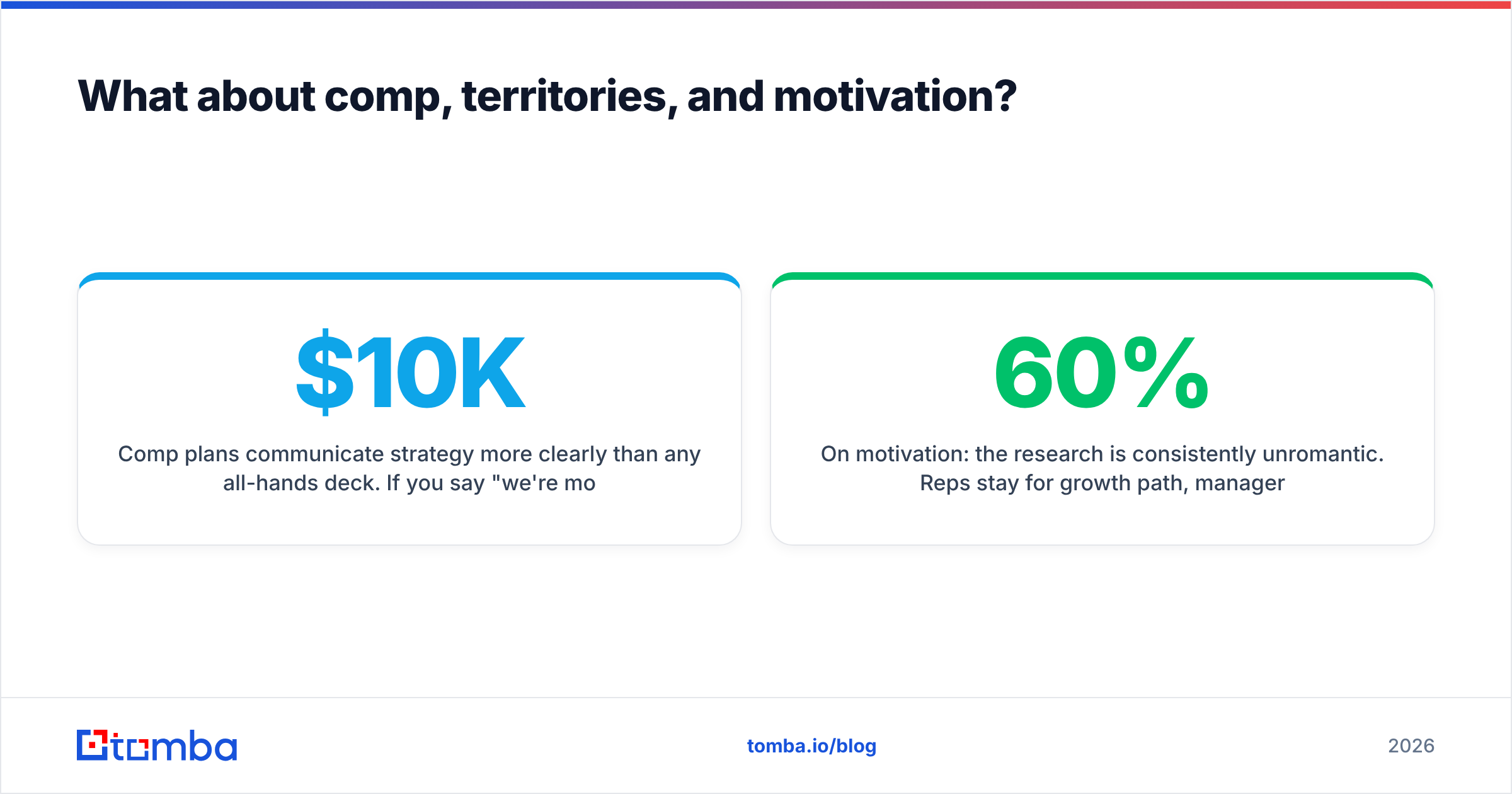
Comp plans communicate strategy more clearly than any all-hands deck. If you say "we're moving upmarket" but pay the same rate on a $10K logo as a $100K one, your reps will keep selling $10K logos, and they'll be right to.
Keep the plan simple enough that a rep can calculate their commission on a napkin. Two accelerators maximum. One quarterly component if you must, but avoid stacking monthly, quarterly, and annual kickers — complexity in comp reads as a trick, and reps assume any plan they can't model is designed to underpay them.
Territories should be balanced on addressable pipeline, not account count. Sixty accounts in a mature vertical where you have five reference customers is worth more than 200 in a market you've never sold into. Rebalance annually, communicate the logic, and never quietly take an account from a rep mid-cycle — that's how you lose trust permanently.
On motivation: the research is consistently unromantic. Reps stay for growth path, manager quality, and a plan they believe is achievable. Gartner's sales research and HubSpot's annual sales reports both land in the same place — attainment rate correlates far more strongly with retention than contest prizes or culture spend do. If fewer than 60% of your team is hitting quota, you don't have a motivation problem. You have a planning problem, and everyone on the floor already knows it.
What does a strong sales leader's first 90 days look like?#
If you've just taken over a team, resist the urge to change anything in the first three weeks.
Weeks 1-3: Listen. Ride along on 15+ calls. Do a 60-minute deep 1:1 with every rep asking three questions: what's working, what's broken, and what would you fix if you had my job. Read the last two quarters of closed-lost notes. Do not announce a new process.
Weeks 4-6: Diagnose. Rebuild the funnel math yourself from raw CRM data — don't trust the dashboard you inherited. Identify the single worst stage conversion. Audit data quality with the bounce-rate test above. Now you have evidence.
Weeks 7-9: Fix one thing. Pick the highest-leverage broken thing and fix it visibly and completely. One thing. A team that sees you close a loop will follow you into the second change. A team that sees five half-finished initiatives will wait you out.
Weeks 10-13: Install the cadence. Now put the weekly rhythm in place, publish the skill map, and set the ramp gates. You've earned the right to add structure because you've demonstrated you understand the work.
Where should you start this week?#
Pick one: audit your data quality, or fix your coaching cadence. Those two produce more measurable lift in the next 60 days than anything else on this page, and they're both free to start.
If the audit is where you land, the fastest version is to take your team's next outbound list and check what percentage of it is actually deliverable before it sends. Tomba's Email Finder gives you verified, source-cited business addresses by domain or by name — with a free tier at 25 searches a month to test against your own list before you commit, and Starter at $49/mo when you're ready to roll it out to the team. Clean inputs make coaching conversations about skill instead of excuses, which is exactly where you want them.
Related guides#
// get started
Find, verify and enrich your first contacts today
Start on the free plan with 25 searches a month, then scale when your team is ready.
Free plan · No credit card required · GDPR & CCPA
// about the author